COMPARISON OF SELECTED IMAGE PROCESSING TECHNIQUES
*1
Adewole A. Philip and
+2Mustapha Mutairu Omotosho
Department of Computer Sciences, University of Lagos, Lagos. Nigeria.
Emails: [email protected],[email protected]
ABSTRACT
Image as an important artifact faced with several constraints that may inhibit its usefulness. These constraints includes noise, Identification of objects in the image and extraction of features. In this paper, the denoising methods of Two Stages Image Denoising By Principal Component Analysis With Local Pixel Grouping(PCA - LPG) and Non Linear Filtering Algorithm For Underwater Images, the object identification methods of SCALE-INVARIANT FEATURE TRANSFORM (SIFT) and SPEEDED UP ROBUST FEATURES (SURF), the feature extraction methods of thresholding and subtraction and template matching are compared experimentally. The experimental evaluation of these algorithms made it possible to draw some conclusions. These conclusions are supported from the results of the implementations of each technique, hence the recommended technique for denoising is Local Pixel Grouping (PCA - LPG), the recommended technique for object identification is SPEEDED UP ROBUST FEATURES (SURF) and the recommended technique for feature extraction is tresholding and subtraction. The recommended techniques for each of the concept were implemented in C# programming language with the help of an open source computer vision library EmguCV.
Keywords: Principal Component Analysis and Local Pixel Grouping, Denoising, Feature Extration, Non Linear Filtering, Object Identification, scale-invariant feature transform, speeded up robust features, Image Processing Algorithms.
INTRODUCTION Background to the Study
Image can be described as an artifact that represent a visual perception, it can be a two dimensional representation that has the same appearance as a real world object in consideration. In today’s technology driven world, the usefulness of this important artifact (i.e. image) cannot be over emphasized. The uses of images range from: satellite television, magnetic resonance imaging (MRI), computer tomography as well as in areas of research and technology such as geographical information systems and astronomy (Motwani, et al. 2004), Security Imaging System (SIS), Facial Recognition System etc.
Despite the enormous usefulness of images, there are certain constraints that have made the realization of this artifact difficult. Three of these constraints and the techniques of solving them are discussed in the course of this article (Review). These constraints are highlighted below:
• Image Containment of Noise
• Problem of Objects Identification and • Image Features Extraction
Image noise is an undesirable effect in an image that is caused by the variation of brightness in a digital camera or scanner. It is much like the grainy image that may become present in an analogue camera. There are
different types of image noise, some of which are: Salt and Pepper Noise (noise that places dark pixels in light regions and light pixels in dark regions), Fixed Pattern Noise (this form of noise normally appears in very long exposure and may become even more prevalent in higher temperatures), Banding Noise (this is noise that is introduced by the digital camera as it is reading data from the digital sensor).
Object Identification as related to image processing can be referred to as the process of finding a given object in an image sequence.
Feature Extraction is a form of dimensionality reduction which tends to reduce a very large or/and redundant input (say of an algorithm) to a manageable size that can still be used as the representation of the large input and still have the same output as if the original input was used.
On the above listed constraints, several techniques in tackling them had been proposed and adopted, but each of these techniques has its own advantages as well as its own disadvantages (Motwani, et al. 2004), it is these techniques that will be examined in the course of this article.
Statement of the Problem
2
Problem poised by availability of noise in an image, thereby reducing the effective analysis and utilization of such image.
The difficulties associated with objects identification in an image.
Uneasy task of extracting features in an image.
Aims and Objectives
The following are the aims and objective of this article.
To examine different techniques of denoising (i.e. removing noise) images.
To examine different techniques of object identification in an image.
To examine different techniques of image’s features extraction.
To harmonize and suggest better techniques based on the reasons that will be discussed.
To simplify the approach of each of the examined technique.
Scope and Limitation of the Study
This study will only cover the review of some specific image denoising, object identification and feature extraction techniques, hence not been able to justify other approaches.
Significant of the Study
The result of this research will not only enhance the understanding of the image processing techniques that are adopted in denoising, object identification and feature extraction but also provides reasons why some techniques may be preferred to others.
Review of Denoising, Object Identification and Feature Extraction Techniques
Review of Denoising Techniques
Denoising remain one of the most challenging research area in image processing, because image denoising techniques not only poised some technical difficulties, but also may result into the destruction of the image(i.e making it blur) if not effectivelly and adequately applied to image.
These two denoising techniques are new compare to wavelets transform based algorithms.
Two Stages Image Denoising By Principal Component Analysis With Local Pixel Grouping(Pca-Lpg)
PCA – LPG was developed by two scientists in persons of Pearson and Hotelling (Jolliffe, 2002). PCA – LPG invloves the recognition of patterns in a data (say image) and attempt to express data recognized in a manner that depicts their similarities and differences. PCA – LPG is capable of identifying patterns even in a very large data (e.g. High Dimensional Image) by reducing the data without significantly loosing an important parts of the data, hence make the data available for analysis (Murali, et al. 2012). By reducing a dataset into a small fraction without loosing the important parts of its form and also recognising the data
pattern, noise and other trivial information can be easily removed.
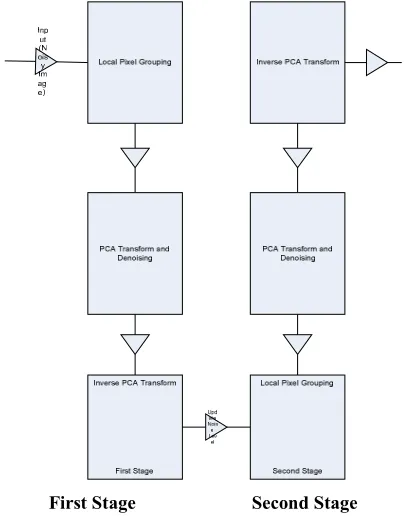
As (Murali, et al. 2012) stated, the PCA-LPG is based on two stages; the first stage involves the initial estimation of the image by removing much of the noise and the second stage involves the further refinement of the first stage (Lei Zhang, et al. 2010). The first and second stage procedures are the same except for the noise level in the input data, where the noise level for second stage input data has been greatly reduced. PCA-based scheme was proposed for image denoising by using a moving window to calculate the local statistics, from which the local PCA transformation matrix was estimated. However, this scheme applies PCA directly to the noisy image without data selection and many noise residual and visual artifacts will appear in the denoised outputs. PCA-LPG models a pixel and its neighbours as a vector variable, The training samples of thisvariable are selected by grouping the pixels with similar local spatial structures to the underlying one in the local window. With such an LPG procedure, the local statistics of the variables can be accurately computed so that the image edge structures can be well preserved after shrinkage in the PCA domain for noise removal.
First Stage Second Stage
Fig 1: Denoising By Principal Component Analysis With Local Pixel Grouping (PCA-LPG)
Non Linear Filtering Algorithm for Underwater Images (Nlfa)
3
noise, Speckle noise, impulse noise and Gaussian noise (Padmavathi, et al. 2009). Some of the several reasons responsible for quality degradation are transmission of limited range of light, low contrast and blurred image due to quality of light and diminishing color.
Padmavathi et al. (2009) identified 5 NLFAs for underwater images vis: Median filter Algorithm, Component Median Filter (CMF), The Vector Median Filter (VMF), Spatial Median Filter (SMF), Modified Spatial Median Filter (MSMF). Padmavathi et al.(2009) assert that Modified Spatial Median Filter (MSMF) is the most suitable filter for denoising the images for different type of noise. It worth discussing Spatial Median Filter (SMF) in order to have proper understanding of Modified-SMF. The SMF is a new denoising algorithm with the purpose of removing noise and fine points of image data while maintaining edges around larger shapes (“around larger shape” is one of the advantages of SMF over previously mentioned algorithms.). it has a similar procedure as Vector Median Filter VMF. The Spatial Median Filter is based on the spatial median quantile function developed by P. Chaudhuri in 1996, which is a L1 norm metric that measures the difference between two vectors (Probal, 1996, Robert Serfling, 2002) assert that a spatial depth could be derived by taking an invariant of the spatial median (Robert Serfling, 2002). This gave the notion that any two vectors of a set could be compared based on their “centrality” using the Spatial Median. The Spatial Median Filter is an uncompromisable denoising algorithm in which every point that is not the maximum spatial depth among its set of mask neighbors will replaced. The Modified Spatial Median Filter attempts to solve this problem. In MSMF, after the spatial depths between each point within the mask are computed, an attempt is made to use this information to first decide if the mask’s center point is an uncorrupted point. If the determination is made that a point is not corrupted, then the point will not be changed. We first calculate the spatial depth of every point within the mask and then sort these spatial depths in descending order. The point with the largest spatial depth represents the Spatial Median of the set. In cases where noise is determined to exist, this representative point then replaces the point currently located under the center of the mask.
Review of Object Identification Techniques
Formally the problem of object identification can be defined as given an Image (G) that has one or more object of interest in it including background and a set of labels corresponding to a set of models known to the system, the system should assign correct labels to regions, or a set of regions, in the image.
Scale-Invariant Feature Transform (Sift)
On the formal definition of this approach, it is an algorithm in computer vision to detect and describe local features in images. The algorithm was developed by (Lowe, 1999).
This approach transforms an image into a large collection of local feature vectors, each of which is invariant to image translation, scaling, and rotation, and partially invariant to illumination changes and affine or 3D projection (Lowe, 1999).
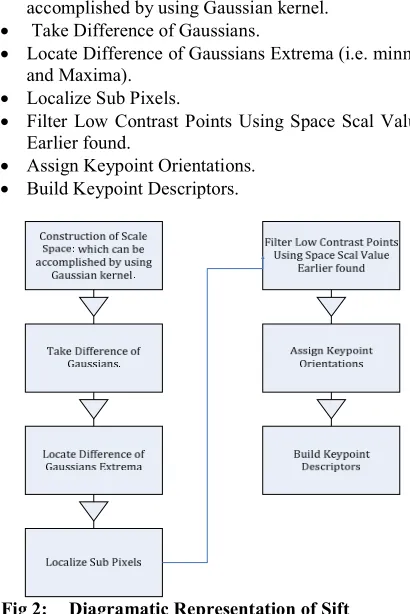
The basic steps involved in SIFT are summerised below:
Construction of Scale Space: which can be accomplished by using Gaussian kernel.
Take Difference of Gaussians.
Locate Difference of Gaussians Extrema (i.e. minma and Maxima).
Localize Sub Pixels.
Filter Low Contrast Points Using Space Scal Value Earlier found.
Assign Keypoint Orientations.
Build Keypoint Descriptors.
Fig 2: Diagramatic Representation of Sift Implementation
Speeded Up Robust Features (Surf)
Is a robust local feature detector, first presented by (Herbert Bay et al. 2008).
4
detection displacements and geometric and photometric deformations. Finally, the descriptor vectors are matched between different images. The matching is based on a distance between the vectors, e.g. the Euclidean distance. The dimension of the descriptor has a direct impact on the time this takes, and less dimensions are desirable for fast interest point matching. However, lower dimensional feature vectors are in general less distinctive than their high dimensional counterparts (Herbert Bay et al. 2008).
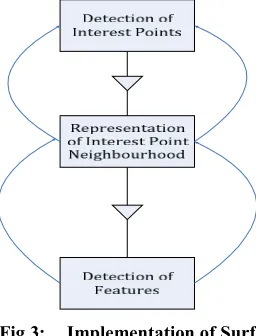
Herbert Bay et al approach to Interest Point Detection uses a very basic Hessian-matrix approximation (because of its good performance and accuracy) (Herbert Bay et al. 2008). This lends itself to the use of integral images (Whicih allows fast computation of box type convolution filters) as made popular by (Viola and Jones, 2001) which reduces the computation time drastically. Integral images fit in the more general framework of boxlets, as proposed by (Simard et al. 1998). The representation of the neighbourhood of selected interest points or scale space representation are often implemented thus: The images are repeatedly smoothed with a Gaussian and then sub-sampled in order to achieve a higher level of the pyramid. Lowe (2004) subtracts these pyramid layers in order to get the DoG (Diference of Gaussians) images where edges and blobs can be found. Lastly the interest point desription according to (Herbert Bay et al. 2008) consists of fixing a reproducible orientation based on information from a circular region around the interest point, then a square region align to the selected orientation will be constructed and and SURF describtor will be extracted from it and finally, features are matched between two images.
Fig 3: Implementation of Surf
Review of Feature Extraction Techniques
Feature extraction is a special form of dimensionality reduction. When the input data (image) to an algorithm is too large to be processed and it is suspected to be notoriously redundant (e.g. the same measurement in both feet and meters) then the input data will be transformed into a reduced representation set of features (also named features vector). Transforming the input
data into the set of features is called feature extraction. If the features extracted are carefully chosen it is expected that the features set will extract the relevant information from the input data in order to perform the desired task using this reduced representation instead of the full size input. Feature extraction can be used in image processing to detect and isolate various desired portions or shapes (features) of a digitized image.
Thresholding and Subtraction
5
and subtraction are attractive (because of simplicity and hence their speed), the performance of both techniques is sensitive to partial shape data, noise, variation in illumination and occlusion of the target shape by other objects. Accordingly, many approaches to image interpretation use higher level information in shape extraction, namely how the pixels are connected within the shape (Mark and Alberto, 2006).
Template Matching
Template matching is an approach in image processing for finding small parts of an image which match a template image (James Church et al., 2008). Template matching is conceptually a simple process in which we need to match a template to an image, where the template is a subimage that contains the shape we are trying to find. Accordingly, we centre the template on an image point and count up how many points in the template matched those in the image. The procedure is repeated for the entire image, and the point that led to the best match, the maximum count, is deemed to be the point where the shape (given by the template) lies within the image. In template matching, the template is first positioned at the origin and then matched with the image to give a count which reflects how well the template matched that part of the image at that position. The count of matching pixels is increased by one for each point where the brightness of the template matches the brightness of the image. This is similar to the process of template convolution. The difference here is that points in the image are matched with those in he template, and the sum is of the number of matching points as opposed to the weighted sum of image data. The best match is when the template is placed at the position where the rectangle is matched to itself. This process can be generalized to find, for example, templates of different size or orientation. In these cases, we have to try all the templates (at expected rotation and size) to determine the best match (Mark and Alberto, 2006).
Methodology, Implementation and Deduction
In line with the main objective of this course (Current Topics In Computing) which is to review the work done previously on pressing computer sciences issues and also highlights the importance/application of the reviewed work. This has made the earlier part of this work to focus much on the Review of the Literature on different techniques used for Image Denoising, Object Identification and Feature Extraction. This part of the article will focus on the selection (With Justification) of the best techniques that will be adopted at different stages of Image Processing as well as their application in solving real life problems.
The following are the standards we will base our recomemdation on :
The technique must be effective enough in terms of accurate output delivery.
The technique must be simple enough for implementation.
The technique should be applicable generally to problems at least to a reasonable extent.
The technique should be fast, effective and uses less computer resources.
Although a single technique of all the considered techniques may not posess all these aforementioned criteria, hence a trade off may exists in the recommendation of a particular technique.
Recomendation of Denoising Technique With Justifications And Application
The first denoising technique considered in this article was the “TWO STAGES IMAGE DENOISING BY PRINCIPAL COMPONENT ANALYSIS WITH LOCAL
PIXEL GROUPING(PCA-LPG)”, this technique is simple
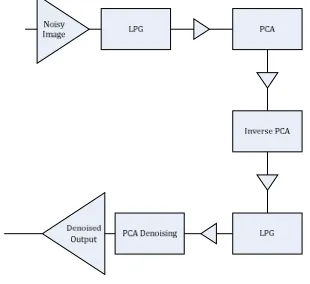
because it uses two stages in its implementation. These stages are summarized as follow: In First stage, the noisy image is taken as an input and subjected to local pixel grouping and then to principal component transform where, they convert set of observed correlated values to linearly uncorrelated variables, these variables will then be ppassed to PCA Transform and produced an output of denoised image. The diagram below surmarizes and simplifies the steps involves in this algorithm.
Fig 4: Simplified Pca – Lpg Processes
The outputed denoised image will be technically more accurate than other technique due to the process this technique adopted in denising images. Even the output of the first stage of this algorithm is enough for the output of some other techniques, and runs very fast as well as required less computer resources compare to other denoisisng techniques (Preethi and Narmadha, 2012).
6
condition such as under water, NON LINEAR FILTERING ALGORITHM (NLFA) is required.
One of the merits of PCA-LGP is that it preserves local image structure during denoising, although it may have a low PSNR (peak signal to noise ratio) which may affect the quality of the output image (Preethi and Narmadha, 2012), this can be handled by using a good quality noisy image as input.
Implementation of Pca – Lpg Denoisisng Technique
The implementation of this technique was carried out using C#.net Language, due to the simplicity of the considered denoising techniques, the two implementation are provided in one application. The user just have to select the technique to use as shown in the picture below.
Fig 5: Selection of noisy image.
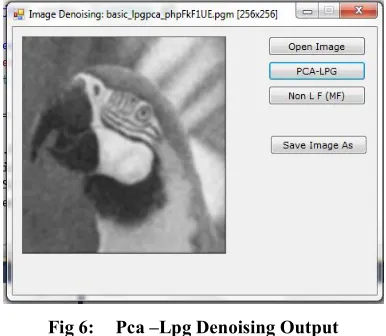
As we can see from the above image, the user can choose from the two techniques to use in denoising the image. Selecting the PCA – LPG will produce the image below.
Fig 6: Pca –Lpg Denoising Output
While selecting Non Linear Filtering (Median Filtering) (Non L F (M F)) button will produce the image below on the same noisy image.
Fig 7: Non Linear Filtering Denoising Output
Its is pertinent to mention that the image format the application uses in its processes is .pgm (Portable Grey Map Image). An image other than this can be converted to .pgm using any converter or at
http://www.sciweavers.org/free-online-image-converter.
Application of Denoising
The areas of application of denoising techniques are very vast and of very great importance some of this include :
Security: for denoising image in order to identify a crime suspect whose picture was taken by either a poor camera or in a poor condition.
Medicine : to clean image in order to have a clear understanding of the part of the body that was snapped (e.g. X-rays).
Astronomical Aplication, e.g. Image taken from space by satelites.
Application denoising can also be found in entertainment.
Recommendation of Object Identification Technique With Justifications and Application
Losely speaking, an Object identification may contain 4 Components vis:
The modelbase : Which is a form of database that holds the previously known pattern/knowledge about the object to be identified in a given image.
Feature detector: This component looks for some properties in the image being examine.
Hypothesizer : this forms an hypothesis that may be work with in order to uniquely and successfully identify an object.
7
Fig 8: General representation of object identification technique.
The two Object Identification techniques which were reviewed in this article follow this general concept with little differences which makes one preferable to other.
The second object identification technique that was reviewd ealier in this article (SPEEDED UP ROBUST FEATURES (SURF)) is a novel technique by (Herbert Bay et al. 2008). This technique took into consideration the weaknesses of the previous object identification technique and also build on their strengths. Notably of those previous algorithm that SURF inherits good features from is SCALE-INVARIANT FEATURE TRANSFORM (SIFT).
According to Herbert Bay et a.l (2008), this technique (SURF) is faster and even more more robust against any form of image than SIFT. This technique can also be seen to be simpler than SIFT due to the fact it can be broken down into three major steps vis: Determination of the interest point, representation of every neighbourhood of the selected interest points and matching of descriptor vector between different images.
From the immediate paragraph above, we can deduce based on the criteria specified at the begining of this section that Speeded Up Robust Features technique of Object Identification is preferable to use to other forms of Object Identification technique.
Implementation of Recommended Surf Object Identification Technique
The implementation of this technique was carried out using C#.net Language, with the help of EMGUCV, which is is a cross platform .Net wrapper to the OpenCV (Open Source Computer Vision) image processing library. The interfaces of this application are shown below.
Fig 9: First Run Page of Surf Implementation Application
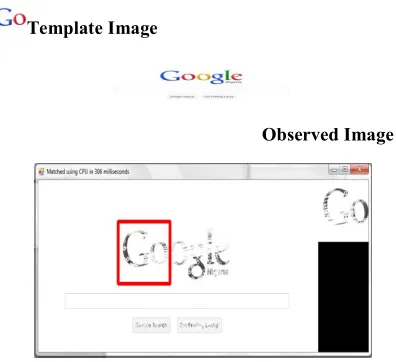
The image above shows where we can select both the template picture (i.e. the picture of the object we want to identify) and the Observed Picture (i.e. the picture from which we want to identify object from.)
After selecting these two important picture a dialogue box will show showing a red border traces of the identified object on the observed Picture as shown below.
The Input Images are :
Template Image
Observed Image
Fig 10: Output of Surf Implementation Application
From the above, the template image was identified from the observed image.
Object Identification Technique
Object Identification is an important concept in which its application cut across several human’s endeavours. Some of its applications are as folow:
8
exchange an image, it would be very difficult to code it. Note that they cannot just encrypt their conversations or images since encrypted data is a red flag in monitoring scenarios. Thus , object identification can be used to determine the objects that made up of the said image.
The second application follows an important trend in mobility; this is the increasing prevalence of cameras on mobile phones. According to NCC as published on her website, Nigeria has over 100Million active mobile phone users as at 2013, research also concluded 2/3 of these mobile phones have camera. A significant number of pictures taken on such cameras are likely to be ”‘throwaway”’ images, i.e., pictures taken to serve a function and which has no value once that function is served. Examples include taking a picture of a dress to get an opinion from a friend, or as an illustration to a message. But the scenario which we are interested in, is taking a picture to find out more information. So a tourist takes a picture of an unknown landmark, sends it to a server, and gets back useful information. Or a health-conscious consumer takes a picture of his dinner, sends it to a server and gets back nutritional information. All these are made possible with the help of object identification concept in image processing.
Recommendation of Feature Extraction Technique With Justifications and Application
Basically the two approaches discussed in the previous section of this article were: approach based on the use of difference in light intensity and an approach based on template matching. According to Mark Nixon et al, the first approach is known as Tresholding and Subtraction while the second one is known as template matching. The recomended approach will be Tresholding and Subtraction. One of the notable advantage is the ability to extract feature with a single image as oppose the template matching technique that requires at least two images i.e. the image to extract feature from and the template which holds the feature to be extracted. Aside this, Nixon et al also asserted that Tresholding and Subtraction is a simple process compare to the template matching.
Implementation of Recommended Tresholding and Subtraction Feature Extraction Technique
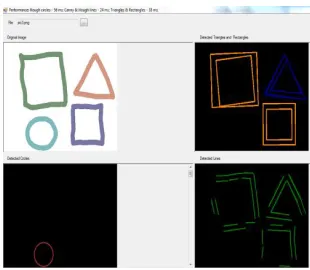
The implementation of this technique is also based on C# and the framework discussed earlier. This application will accept an image and tends to extract out some basic features(shapes). Below is the picture of the application showing the original image to be extracted and the extracted features.
Fig 11: Pictorial representation of feature extraction process using tresholding and subtraction.
Application of Feature Extraction Technique
Feature Extraction does not only has its application in image processing but in order aspect of computing. The following are the general application of feature extraction as they are related to image processing.
In preparation of very large noisy image for denoising process.
In face recognition system.
Finger print recognition system.
CONCLUSION
Image processing has become an important aspect in computing, hence, several techniques that can be used to process image will also be of great importance. On this note, the review image process techniques for denoising, object identification and feature extraction is round peg in a round hole. Two different important techniques for each of denoising, object identification and feature extraction had been discussed so far in this article, their advantages had also been mentioned likewise appropriate recomendation had been made for each of this technique.
REFERENCES
Herbert Bay, Andreas Ess, Tinne Tuytelaars, Luc Van Gool, "SURF: Speeded Up Robust Features", Computer Vision and Image Understanding (CVIU), Vol. 110, No. 3, pp. 346--359, 2008 James Church, Dr. Yixin Chen, and Dr. Stephen Rice,
A Spatial Median Filter for Noise Removal in
Digital Images,
http://cs.olemiss.edu/~ychen/publications/confer ence/church_secon08.pdf
Jolliffe, “Principal Component Analysis” Second ed. Springer Series in Statistics. New York: Springer-Verlag New York.” 2002.
Lei Zhang , Weisheng Dong , David Zhang , Guangming Shi, “Two-stage image denoising by principal component analysis with local pixel grouping” Elsevier-Pattern Recognition,vol-43, 2010, 1531-1549.
9
Proceedings of the Seventh IEEE International Conference on. Vol. 2. Ieee, 1999.
Lowe, D. Distinctive image features from scale-invariant keypoints, cascade ltering approach. IJCV, 60(2):91-110,January 2004.
Mark Nixon, Alberto Aguado, Feature Extraction and Image Processing, 2nd Edition, Academic Press Publishing Company. ISBN 978-0-12372-538-7 Motwani M.C., Gadiya M., Motwani R., Harris F.C..,
"A Survey of Image Denoising Techniques", Proceedings of GSPx 2004, Santa Clara, CA,
http://www.cse.unr.edu/~fredh/papers/conf/034-asoidt/paper.pdf
Murali Mohan Babu .Y, Subramanyam .M.V, Giri Prasad M.N. PCA based image denoising, Signal & Image Processing : An International Journal (SIPIJ) Vol.3, No.2, April 2012.
Padmavathi .G, Subashini.P, Muthu Kumar .M and Suresh Kumar Thakur, Performance analysis of Non Linear Filtering Algorithms for underwater images, International Journal of Computer Science and Information Security (IJCSIS), Vol.6, No.2, 2009
Preethi S. and Narmadha D. Article: A Survey on Image Denoising Techniques. International Journal of Computer Applications 58(6):27-30, November 2012. Published by Foundation of Computer Science, New York, USA. http://www.ijcaonline.org/archives/volume58/
number6/9288-3488
Probal Chaudhuri, (1996). On a Geometirc Notion of Quantiles for Multivariate Data. Journal of the American Statistical Assocation, Vol. 91, No. 434, pp. 862-872
Robert Serfling, (2002). A Depth Function and a Scale Curve Based on Spatial Quantiles. Statistical Data Analysis Based on the L1-Norm and Related Methods
Simard P., Bottou L., Haner P., and LeCun Y. Boxlets: A fast convolution algorithm for signal processing and neural networks. In NIPS, 1998. Viola P.A.and Jones M.J. Rapid object detection using