Applied and Computational Mathematics
2014; 3(5): 262-267
Published online November 10, 2014 (http://www.sciencepublishinggroup.com/j/acm) doi: 10.11648/j.acm.20140305.21
ISSN: 2328-5605 (Print); ISSN:2328-5613 (Online)
Exact, polynomial, determination solution method of the
subset sum problem
Mahammad Maharram Aliyev
National Academy of Sciences of Azerbaijan, Institute of Control Systems, Baku, Azerbaijan
Email address:
To cite this article:
Mahammad Maharram Aliyev. Exact, Polynomial, Determination Solution Method of the Subset Sum Problem. Applied and Computational Mathematics. Vol. 3, No. 5, 2014, pp. 262-267. doi: 10.11648/j.acm.20140305.21
Abstract:
In this paper we give original geometrical interpretation to the domain of definition of integer and combinatorial problems. The solution of the problems concerning NP class has been carried out on the hyperarches. The existence criterion of the solution on the hyperarches has been defined. The method for establishing the sequence of approximation to the solution on the hyperarches was constructed. Calculation experiments were conducted, and the obtained polynomial algorithm, practically and theoretically solved exactly the (SSP) problem.Keywords:
Knapsack Problem (KP), Subset Sum Problem (SSP), NP Class, Integer Programming, N-Dimensional Cube, Hyper Plane, Hyper Circle, Hyper Arch1. Introduction
The problems in computing mathematics are divided into two classes according to their difficulty: 1) the first class contains the problems in which the number of simple operations for its solution (addition, subtraction, division, comparison, and square root) is polynomial expressed by the parameters (by the number of
n
-variables, the number ofm
-restriction) of the problem.This class in said to be a polynomial class and in short is called a P class. 2) The problems in which the number of simple operations for its solution is proportional to n
2 enter to NP class. This class is called NP hard class. The knapsack problem is one of the classic problems in the linear integer programming problems. Up to present time, it was not possible to solve this problem exactly by a polynomial algorithm.
The knapsack problem can be formulated as a solution of the following linear integer programming formulation:
( )
KP
maximize j j nj
x
p
∑
=1(1.1)
subject to
w
x
jc
nj
j
≤
∑
=1
(1.2)
{ }
j
n
x
j∈
0
;
1
=
1
,
2
,...,
(1.3)We will denote the optimal solution vector by
(
* *)
2 * 1 * , ,...,
n
x x x
X = and the optimal solution value by *
Z
. The set *X
denotes the optimal solution set, corresponding to the optimal solution vector.Problem ( )KP is the simplest non-linear integer programming model with binary variables, only one single constraint and only positive coefficients. Nevertheless, adding the integrality condition (1.3) to the simple linear program (1.1)-(1.2) already puts
( )
KP into the class of “difficult” problems [1].The knapsack problem has been studied for centuries as it is the simplest prototype of a maximization problem. Already in 1897 Mathews showed how several constraints may be aggregated into one single knapsack constrain. This is somehow a prototype of a reduction of a general integer program to( )KP , thus proving that ( )KP is at least as hard to solve as an integer program. It is however unclear how the name “Knapsack Problem” was invented. Dantzig is using the expression in his early work and thus the name could be a kind of folklore [1].
When pj =wj in
( )
KP , the resulting optimizationproblem is known as the subset sum problem
( )
SSP becausewe are looking for a subset of the values
w
i with the sumApplied and Computational Mathematics 2014; 3(5): 262-267 263
( )
SSPmaximize j j nj
x w
∑
=1
;
subject to
w
jx
jc
nj
≤
∑
=1
{ }
j
n
x
j∈
0
,
1
,
=
1
,...,
Although (SSP) is a special case of ( )KP it is still NP-hard and is
NP
- complete [1].The class of NP-complete problems NPC is the set of decision problems Q satisfying the following two properties:
NP
Q
∈
Q
R
NP
R
∈
≤
p∀
:
To see the latter, one may simply assume that anNP-complete problem Q could be solved in polynomial time, then by transforming
R
to Q we would also get apolynomial algorithm for
R
contradicting the assumption. The theory of NP- completeness gives us a framework for showing that it is very doubtful that a polynomial algorithm for solving e.g. the subset sum problem, then we would also be able to solve numerous famous optimization problems like the travelling salesman problem, general integer programming, and we would even be able to efficiently find mathematical profs of theorems, as stated in Cook [1].In this paper, a new solution method of knapsack problem is given by an original approach; some problems are solved exactly by a polynomial algorithm. One is subset sum problem.
2. Problem Statement
At first the engineers and economists has been engaged integer problems. These problems appeared as a result of economic and engineering demands. Therefore, these problems have got engineering and economic interpretation. But these interpretations are not enough for the solution of the problem.
In order to solve any mathematical problem, it is necessary to give its geometrical interpretation. It is the work of professional mathematicians. To this end, this matter requires special attentive in this paper.
We consider that, reader no need to use any references by reading the paper.
When constructing the new method we’ll take three principles:
1.Definition of existence criterion of the solution integer point in the considered domain;
2.Construction of the sequence approximating to the solution using the found point;
3.Definition of necessary and sufficient conditions for the found solution to be optimal.
3. Investigation of
n
-Dimensional Cube
S is the set of vertex points of
n
-dimensional cube whose rib equals a unit, one of the vertexes is on the origin of coordinate, the ribs originate from the origin of coordinates and are arranged on the coordinate axes. The set is equal to the set ∈ 0; 1 ,j
=
1
,
2
,...,
n
[2].Let’s investigate the structure of n-dimensional cube and mathematical relations between its elements. When a rib of
n
-dimensional cube equals a unit, the coordinates of its vertex points consists of a unit and zero. The number of thesevertices is
∑
= == n
k
n k n
C S
0
2 . For the indicated
k
theC
nk number points are such that their k number coordinates consist of a unit,n
−
k
number coordinates consist of zero. The equation of planes holding these points is as follows:1
,
1
;
2
1
+
x
+
+
x
=
k
k
=
n
−
x
⋯
n (3.1)It is seen from equation (3.1) that the planes holding the k n C
number integer points are parallel to each other and these plane equations change only depending on the free term
k
in the right hand side. Denote these hyper planes byMnk .k
Rk= is the distance of these points from the origin.
n k
dk= is the distance of hyper planes Mnk from the origin,
n
j
n
k
o
nkj=
;
=
1
,
is the center of a hyper circle located onhyper planes Mnk and holding the vertices of
n
-dimensional cube, contained in Mnk.n k nk rnk
2 − = Is a
radius of this hyper circle? Denote by
K
nk a hyper circle of aradius
r
nk and center at the pointO
nk located on the hyperplaneMnk. On each
n
-dimensional space we can group theset
S
being the vertices ofn
-dimensional cube with a rib equal a unit on parallel hyper planes Mnk, we solve problem( )
KP on eachK
nk and find general optimal solution. It is a general geometric principle. By solving the optimization problem considered in any domain we solve the problem in the parts whose unions equal to the domain and intersections are empty sets, find optimal solution at each part, compare them and then find general optimal solution.4. Correlation of Constraint Hyper Plane
and Hyper Circles
Let’s study correlations of the constraint plane
=
∑
=
n
j j jx c
w M
1
: and hyper circleKnk. Let’s normalize the
vector
W
(
w
1,
w
2,
…
w
n)
and denote it byn
W
. Wn =1 Find the projection of the vectorW
on the hyper plane Mnk264 Mahammad Maharram Aliyev: Exact, Polynomial, Determination Solution Method of the S
n n n n
p
W
W
N
N
W
=
−
(
,
)
⋅
n n n Nn 1 , , 1 , 1
⋯ are the normal of the hyper plane
nk
M . One of the three relations between the hyper plane
and hyper circles
K
nk is possible:1) c>(W,D1)(Figure 1:Illustration of the correlation of constraint hyper plane and hyper circles). Here
point obtained from the intersection of the straight line passing through the point Onk in the direction
hyper circle Knk and giving the maximum value to the inner
product (W,X)on Knk. In this case, any point lying on
satisfies the constraint:
∑
=
≤
n
j j j
c
x
w
1.
2)c<(W,D2). Here the points D2 is the point obtained from the intersection of the straight line passing through the point
O
nk in the direction Wp and giving the minimal value to the inner product (W,X) on the hyper circlecase none of the points located on the
constraint:
∑
= ≤
n
j j j
c x w 1
.
3)(W,D2)≤c≤(W,D1). In this case either the hyper plane
M
intersects the hyper circle Knk or touches it at thepoints
D
1,D
2. In order to solve problemon each hyper circle Knk⊂Mnk and denote these solutions byXnk* .
Figure 1. Illustration of the correlation of constraint hyper plane and hyper circles =
∑
∑
= = n j nkj j k n j j jS 1p x max 1p x max
(
)
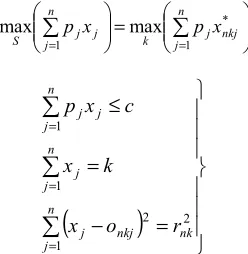
= − = ≤∑
∑
∑
= = = n j nk nkj j n j j nj j j
r o x k x c x p 1 2 2 1 1
In the first case the solution of the problem
Knk is found as follows. We give unit values to
Exact, Polynomial, Determination Solution Method of the S
n.
are the normal of the hyper plane
. One of the three relations between the hyper plane
M
:Illustration of the correlation of ). Here D1 is the point obtained from the intersection of the straight line in the direction Wp and the
and giving the maximum value to the inner . In this case, any point lying on Knk
is the point obtained from the intersection of the straight line passing through the and giving the minimal value on the hyper circle Knk. In this
nk
K satisfies the
. In this case either the hyper plane or touches it at the . In order to solve problem
( )
KP we solve it and denote these solutionsn of the correlation of constraint hyper plane and hyper
nkj *
In the first case the solution of the problem ( )KP on the
Knk is found as follows. We give unit values to
x
jcorresponding to
k
numberTo other
n
−
k
numberx
j we give zero value.In the second case the problem has no solution this case we don’t look for the solution on respectively.
In the third case the solution of problem
special importance. The general solution of the problem reduces to its solution in the third case [3]. In the considered case, the domain for the solutions of the problem is a hyper arch being a part of a hyper circle. We express the hyper arch analytically in the following way
5. Criterion on the Existence of Solution
Points on a Hyper Arch
In order to solve the problem we have to define the criterion on the existence of integer points on a hyper arch. By we denote a set of integer points contained in the hyper circle
nk
K
whosek
number coordinates equal a unit, number coordinates equal a zero. The hyper plane
=
∑
= n j jj
x
c
w
M
1
:
intersects the hyper circle lying onnk
M
and divides it into two parts (figure 2criterion on the existence of solution points on a hyper arch
Figure.2. Illustration of the criterion on the existence of solution points on a hyper arch
The hyper arch H1HH
∑
= ≤
n
j j jx c
w 1
.
Let’s give the criterion on the existence of even if one or none
of these points on this hyper arch. For this we find the
k
−
th
elements of the vector
W
and denote it by unit value to thex
1j corresponding to thesatisfying the condition
w
kmother
n
−
k
numberx
1j. Let’s verify if the pointExact, Polynomial, Determination Solution Method of the Subset Sum Problem
j
p
taking the greatest value.we give zero value.
In the second case the problem has no solution onKnk. In this case we don’t look for the solution on KnkandMnk ,
In the third case the solution of problem
( )
KP on Knk is of neral solution of the problem reduces to its solution in the third case [3]. In the considered case, the domain for the solutions of the problem is a hyper arch being a part of a hyper circle. We express the hyper arch analytically in the following wayCriterion on the Existence of Solution
Points on a Hyper Arch
In order to solve the problem we have to define the criterion on the existence of integer points on a hyper arch. By X(n,k)
we denote a set of integer points contained in the hyper circle umber coordinates equal a unit, n−k number coordinates equal a zero. The hyper plane
intersects the hyper circle lying on
and divides it into two parts (figure 2: Illustration of the criterion on the existence of solution points on a hyper arch).
Illustration of the criterion on the existence of solution points on a
2 satisfies the constraint
Let’s give the criterion on the existence of even if one or
of these points on this hyper arch.
minimum element among the and denote it by
w
km. We givecorresponding to the
k
-numberw
j,
0
≥
−
w
j the zero value toApplied and Computational Mathematics 2014;
obtained in such a way satisfies the constraint
the point X1(n,k) doesn’t satisfy the constraint the problem
( )
KP has no solution in Knk and Mnk respectively. If X1(n,k) satisfies the constraint of problem solution in KnkandMnk, respectively. X1one of the points contained in X(n,k) minimum value to the inner product (W,X
So, we defined the criterion on the existence of solution point on a hyper arch [3].
6. The Local Property Any Point Lying
on the Hyper Circle
Figure. 3. Illustration of the local property any point lying on the
Now let's consider the vector HOnk (fig. 3 local property any point lying on the hyper circle relation between coordinates of the vector HO point of this vector H. H( h1, h2,…, hn ); Onk
1, . By hoj we denote the coordinates of the vector HO hoj= – hj , j= 1, .
Here the maximum values of hj correspond to the minimal of hoj. As hoj consist of the difference of the constant quantity
and hj values
If we consider the vector HOnk as a normal of a plane and take the minimal k number hoj and give to corresponding x unit and the others n-k number x1j zero values we can determine the point X1(n,k) X(n,k) or one of these points
close to H in the vicinity of the point H. This is a local property of any point lying on the hyper circle K
In future we'll use this property in constructing the sequence of approximating to solution of integer points on a hyper arch.
7. The Construction of a Sequence
Converging to the Solution on a Hyper
Arch
Let’s give analytic expression of the problem on a hyper
Applied and Computational Mathematics 2014; 3(5): 262-267
constraint
∑
=
≤
n
j j j
c
x
w
1. If
doesn’t satisfy the constraint the problem respectively.
satisfies the constraint of problem ( )KP has a
) , (
1 nk is a point or
) and giving the
).
So, we defined the criterion on the existence of solution
6. The Local Property Any Point Lying
Illustration of the local property any point lying on the hyper circle
(fig. 3: Illustration of the local property any point lying on the hyper circle). Let's define relation between coordinates of the vector HOnk and initial ); Onk , , … , , . By hoj we denote the coordinates of the vector HOnk. Here the maximum values of hj correspond to the minimal of hoj. As hoj consist of the difference of the constant quantity
as a normal of a plane and take the minimal k number hoj and give to corresponding x1j a zero values we can X(n,k) or one of these points
o H in the vicinity of the point H. This is a local property of any point lying on the hyper circle Knk.
In future we'll use this property in constructing the sequence of approximating to solution of integer points on a
Sequence
Converging to the Solution on a Hyper
Let’s give analytic expression of the problem on a hyper
arch: ∈ − = ≤ →
∑
∑
∑
∑
= = = = } 1 ; 0 { ( 1 1 1 1 j n j nkj j n j j n j j j n j j j x o x k x c x w x pAssume that the point X1
existence criterion and is located on the hyper
use this point and construct a sequence converging to the solution of problem (7.1). The terms of the sequence should satisfy the constraint and give strong monotonically increasing values to the functional.
1) Monotony condition: take the first of the coordinates equal zero of the point X1(n
corresponding coordinates of the point
values
p
i andp
j. pi−pj >2) Constraint satisfaction condition. Let’s give constraint satisfaction condition for the indices
monotony condition pi−pj >0
∑
= − = n j j jx w c d 11 ; d+wj−wi≥ condition.
+
−
j j iw
d
p
p
If condition (7.2) is satisfied, we accept
point X2(n,k) found in such a way increases the functional and satisfies the constraint and is located on
We continue this process until the relation ( satisfied between the indices
i
We conduct the process k=1
find the points , compare the values that they give to the functional and find the solution of problem
(
P X n k)
kZ q
k , ( , ); 1
max *
*= =
vector.
8. Necessary and Sufficient Condition of
the Integer Point Lying on the Hyper
Arch to be Local Optimal Solution on a
Hyper Arch
Denote by A the negation of condition (
Theorem: The necessary and sufficient condition for the integer point on the edge hyper arch to be local optimal
265 = ) max 2 2 nk nkj r c (7.1) ) , (
1 n k is determined by the existence criterion and is located on the hyper circleKnk. We int and construct a sequence converging to the .1). The terms of the sequence should satisfy the constraint and give strong monotonically increasing values to the functional.
1) Monotony condition: take the first of the coordinates
) ,k
n and compare it with the corresponding coordinates of the point X1(n,k) taking unit
0 .
2) Constraint satisfaction condition. Let’s give constraint satisfaction condition for the indices
i
and j satisfying the0 . We calculate the quantity
0
≥ are constraint satisfaction
≥
−
>
0
0
i jw
(7.2).2) is satisfied, we accept x1j=0;x1i=1. The found in such a way increases the functional and satisfies the constraint and is located on Knk.
continue this process until the relation (7.2) is not and
j
.1 ,
1n− for all Knk to k=1,n−1
compare the values that they give to
the functional and find the solution of problem
( )
KP
n ,
1 ; P
(
p1,p2,...,pn)
is object8. Necessary and Sufficient Condition of
the Integer Point Lying on the Hyper
Arch to be Local Optimal Solution on a
by A the negation of condition (7.2).
266 Mahammad Maharram Aliyev: Exact, Polynomial, Determination Solution Method of the Subset Sum Problem
solution, is condition A between coefficients pj and wj according to xj = 1 coordinates and coefficients pi and wi according to xi = 0 coordinates.
Necessities: Suppose that the point X*(n, k) is a local solution point on the edge hyper arch, on the hyper circle K n k.
max(P,X(n,k))=(P,X*(n,k))
Assume contrary. If the point X*(n,k) does not satisfy condition A, when there exist the coordinates xj=1 and xi =0 such that pi-pj>0. If we accept xj=0 and xi=1 then we can find the point (n,k) such that
(P, X*(n, k)) < (P, (n,k)) Z(X*(n, k)) <Z( (n,k))
This contradicts the local optimal solution of the point X*(n, k). The obtained contradiction prove the necessities.
Suffices: Assume that the point X*(n, k) satisfies the condition A. Prove that this point is a local optimal solution on a hyper arch. Prove that is a maximum value of the functional on the edge of the hyper arch Z*= (P, X*(n, k)). Assume contrary. Z* is not a maximum value of the functional on the edge of the hyper arch. Here is a point (n, k) such that ̅= (P, (n,k)) is maximum value of the functional. Show that in this case the point X*(n, k) do not satisfy the condition A.
k number non zero coordinates of the point X*(n, k) denote by xl1 ,xl2 ,…,xlk. By xq1, xq2 , …, xqk denote non zero coordinates at the point (n,k). Then
Z*=pl1*+pl2*+…+plk* plj>0; j=1,
̅
= ̅q1+ ̅q2+…+ ̅qk ̅qj> 0; j=1, If ̅> Z* hens
̅q1+ ̅q2+…+ ̅qk> pl1*+pl2*+…+plk*
There is ̅qj> p*lj; lj qjsuch that ̅qj –p*lj> 0. This fact
contradicts fulfillment of the condition A at the point X*(n,k). As the obtained contradiction, contradicts the theorems condition. Suffices is proved.
9. Estimation of the Number of Iterations
and its Decrease
Now estimate the number of iterations. If any point X1(n,k) is an initial point, then the number of iterations is
Nit ≤ c-(W,X1(n,k))
pi- pj 1 at each iteration, the value of the functional
increases at last by a unit. Find a closer initial point to hyper plane (W, X)=c, we can provide the condition Nit n. In order
to solve these problem, we must chose the integer c1 that satisfies condition (W,X1(n,k)) < c1< c close to c. c-c1<n. Find the intersection point of the hyper plane (W,X) = c1 and the straight line WminWmax and denote it by T (Fig.4: Illustration of the decrease number of iterations). Then we must find the vector L parallel to the intersection of hyper planes (W,X) = c
and x1 + x2+…+xn = k. Transfer in parallel way the point T to on the hyper circle Knk, in the direction of L and –L and find the points H1 and H2on the hyper circle Knk. Show these operations concretely.
Figure 4. Illustration of the decrease number of iterations
Normalize the vector W and denote it by Wn . Find the projections of this vector on the hyper plane Mnk..
Wp= Wn – (Wn,En)En;En = (√ , √ , … ,√ )
Normalize the vector Wpand denote it by Wpn. Transfer in a parallel way the point Onk by rnk in the direction of Wpnand –Wpn. Denote the obtained points by Wmax and Wmin.Wmax = Onk
+ rnkWpn;Wmin = Onk - rnkWpn.
Find the intersection points of the straight line passing through the point Wmin in the direction Wpn and the hyper plane
(W,X) = c1 and denote it by T.
T = Wmin + [(c1 – (W,Wmin ))/(W,Wpn)] Wpn
Find the vector L parallel to the intersection of the hyper plane w1x1 +w2x2 + … + wnxn = c1 and hyper plane x1 + x2 + …
+ xn =k.
, ! 0
", ! 0#
Here E = ( 1, 1, …,1 ). When the dimension of the space is n > 3 the problem has infinitely number solutions.
$ % + $'%'+ ⋯ + $ % 0
% + %'+ ⋯ + % 0 # (9.1) In order to solve the system (9.1) we use the following principle. Chose wk w1 and give the values lj = pj to the elements of the vector in the direction L different from the elements j≠ 1; ≠ .The determinant of the obtained system of equation is
D = *$ $
Applied and Computational Mathematics 2014; 3(5): 262-267 267
$ % + $ % = , % + % = ,' #
, = − . $ + $ + $
/
,'= − . + +
/
% =01+2304
21+23 ; %'=
2104+01
21+23
Thus we determined the L II (M ∩ 6 )direction vector. Normalize the vector L and denote it by Ln.
d = WminF(figure)
d = 71+ 8,88,8 9:; <;
= > ? @A − =@
=' ?B ?B'
=' CA' − A' + 2A = − ='=C2A = − ='
H1= Wmin + dWpn + d2Ln H2= Wmin + dWpn- d2Ln
Find the points X1(n,k) and X2(n,k) close to the points H1 and H2 and from these points construct a sequence approximating to the solution of the both of ends of the hyper arch. Compare the points according to the value given to the functional and find the local solution on the hyper circleX*(n,k).
Apply these processes for all the hyper circle for the k= 1, . (n,k) satisfying condition
Z = max(W,X*(n,k)); k =1, .
will be an optimal solution of the problem.
It showed be noted that while pasting to other end, the following principle may be as well.
If any point X1(n,k) on the hyper arch is known, we find intersection hyper plane (W,X) =(W,X1(n,k)) and the line
WminWmax and denote it by T. Then transfer in a parallel way the point T on the hyper circle in the direction of the vector L =
, E
FFFFFFFFFFFFFFFFFFFG. ' , = T + L.
Calculation experiments given in [4].
10. Investigation of Difficulty Order of
the Problem
To understand difficulty order we must consider the cycles contained in each other in the alqorithm:
1
,
1
−
=
n
k
;n
j
=
1
,
;i
=
1
,
n
;kk
=
1
,
n
;The maximal number of embedded cycles is four.
Hence we proved polynomial property of the method and that its difficulty order is
( )
4n O .
11. Conclusion
In this work we obtained the following new results. 1)Geometric interpretation of domain of definition of the
solution of combinatorial and discrete problems is given. 2)A method for reducing the solution of any linear integer programming problem to its solution on a hyper arch is given.
3)Existence criterion of this problem on a hyper arch is defined.
4)Using the initial point found on a hyper arch a method for constructing the sequence approximating to the solution is given.
5)The difficulty order of the algorithm is a polynomial. 6)Necessary and sufficient conditions for the found point
to be an optimal solution on the edge of hyper arch is given. This condition is analytic.
7)Obtained method is exact, polynomial and determination of the subset sum problem (SSP).
References
[1] Hans Kellerer, Ulrich Pferschy, David Pisinger Knapsack Problems. Spinger-Verlag Berlin. Hidelberg, 2004, 525 p.
[2] Мину М. Математические программирование. Москва, Наука 1990, 485 c.
[3] Aliyev M.M. One approach to the solution of the knapsack problem//Reports NAS of Azerb., 2005, №3, p.32-39.