Effect of Climatic Parameters on the Performance of Different
Designs of Stepped Type Solar Still
Name: J.S. Gawande
Designation: Associate Professor, Organization: Rajarshi Shahu College of Engineering, Buldhana, Email ID : [email protected]
Name: L.B. Bhuyar
Designation: Professor, Organization: PRM Institute of Technology & Research, Badnera-Amravati, Email ID : [email protected]
Abstract — The thermal performance of the stepped type solar still is affected by design, climatic and operational parameters. The design parameters affecting the performance of a stepped type solar still are depth of water, thickness of glass cover, insulation thickness, condensing cover material, shape of the absorber surface, absorbing material provided over the basin surface, angle of inclination of the still, enhancement of heat transfer etc. The climatic parameters include solar intensity, ambient temperature and wind velocity. The effect of various climatic parameters listed above on the distillate yield of different designs of stepped type solar stills is presented in this paper.
In this work, four number of stepped type solar stills with different designs have been selected for studying the effect of climatic parameters like solar intensity, ambient temperature and wind velocity. The absorber area of each stepped type solar still is 0.5093 m2. After conducting experiments for the different designs of stepped type solar still, it has been observed that the intensity of solar radiation goes on increasing from the morning hours with maximum occurring at noon and then it goes on decreasing in the afternoon hours. The hourly variation in ambient temperature follows the same trend as that of solar intensity. It has been observed that the distillate yield increases with increase in solar intensity and ambient air temperature. Also it has been observed that as the wind velocity over the solar still increases, the distillate yield of the solar still increases continuously.
Keyword — Stepped type solar still, wind velocity, distillate yield
1. I
NTRODUCTIONWater is one of the prime elements responsible for life on earth. It covers three-fourths of the surface of the earth. However, most of the earth’s water is found in oceans as salt water, contains too much of salt, cannot be used for drinking, growing crops or most industrial uses. The remaining earth’s water supply is fresh water. Most of this is locked up in glaciers and ice caps, mainly at the north and south poles. If the polar ice caps were to melt,
the sea level would rise and would flood much of the present land surfaces in the world. The rest of the world’s supply of fresh water is found in water bodies such as rivers, streams, lakes, ponds and in the underground. Our drinking water today, far from being pure, contains some two hundred deadly commercial chemicals, toxins and impurities. So there is an important need for clean and pure drinking water. In many coastal areas where sea water is abundant but potable water is not available, solar water distillation is one of the many processes that can be used for purification as well as desalination. Solar still is the widely used solar desalination device. But the productivity of the solar still is very low. To augment the productivity of the single basin type solar still, several research works has been carried out. But its effect on a stepped type solar still is unidentified till date. The works carried on a single basin type solar still are summarized as follows.
The effect of climatic parameters wind on the performance of a single basin type solar still has been studied by different researchers. S.H.Soliman [1] has studied the effect of water and ambient temperatures, wind velocity and angle of inclination of the cover on the performance of the still is shown by means of tables and graphs. This leads to the explanation that at low water temperatures, the rate of evaporation is low. Whereas at high water temperatures, increasing wind speed will increase the ratio of rate of evaporation to the total heat transfer through the cover.
A.S. Nafey, M. Abdelkader, A. Abdelmotalip and A.A. Mabrouk [2] has studied the various parameters affecting the solar still productivity. In this work, investigation of the main parameters affecting solar still performance under the conditions of Suez gulf was considered. A general equation relating the dependent and independent variables which control the daily productivity of a single slope solar still is developed. This equation could be used to predict the daily productivity with a reasonable confidence level (max. error ±5%).
Copyright © 2012 CTTS.IN, All right reserved thickness and asphalt coating of the solar still were found
to be the optimum design parameters that produced an average annual solar still yield of 4.15 kg/m2 day. Investigators’ ideas about the effect of wind on solar stills vary: telkes [4], Lof et al.[5] and Hollands [6] state that increasing wind velocity causes a decrease in the output; Cooper [7] points out that increasing wind velocity causes an increase in output and it is also reported [8,9] that the influence of wind on output is unimportant.
All these investigators have treated the cover of the still as a whole without considering the angle of inclination of the cover or specifying the direction of wind with respect to the cover. Reference [9] indicates that the angle of inclination has no effect on the output. However, Soliman and Kobayashi [10] have shown that output increases with the decrease of the angle of inclination.
Therefore, this work was carried out to find the effect of wind on the performance of stepped type solar stills with different configurations considering simultaneous effect of other climatic parameters like ambient air temperature and solar intensity.
2. E
XPERIMENTALS
ETUPFig.1: Schematic diagram of the experimental setup
Fig.2: Schematic diagram of the stepped type solar still
steps begins to heat up and the moisture content of the air trapped between the water surface and the glass cover increases. When the water absorbs maximum solar radiations equal to the specific heat capacity of its mass, it is saturated and evaporation of water takes place. The basin also radiates energy in the infrared region, which was reflected back into the solar still by the galas cover, trapping the solar energy inside the solar still. The water vapors formed due to the evaporation of water are condensed at the inside of glass cover, as its temperature is less. To ensure that vapors are not lost to the atmosphere, the glass cover is sealed with a rubber gasket using an adhesive of Araldite and Bond-Tite. The condensed water trickles down to the distillate collection trough provided at the bottom and is collected into a glass beaker by using a hose pipe which is mounted at the side of the solar still.
As evaporation of water in the steps takes place, the saline water level in the solar still decreases. To compensate the loss of water, for every half an hour, the makeup water is added to the solar still from the storage tank. A separate hole is also drilled in the sidewall of the still to fix thermocouples to sense the temperatures of water in the basin, absorber plate temperature and inner glass cover temperature. The whole unit is placed on an angle iron stand inclined at an angle of 200equal to the latitude of Buldana to the horizontal. The solar still is oriented due south as the location lies in the northern hemisphere to receive maximum solar radiation throughout the year. This stepped type solar still system has been fabricated in the workshop of Rajarshi Shahu College of Engineering, Buldana. The experimental work was carried out on the roof of the Non-conventional Energy Systems Laboratory of Mechanical Engineering Department. The experiments were performed during the months of January 2012 to April 2012 when the sky was clear i.e. on sunny days. The average sunshine in Buldana was 5.83 kWh/m2/day during the above said period. Five different thermocouples were installed on the soar still system at different locations. These locations were (i) bottom of the basin to measure the temperature of absorber plate, Tb (ii) inner surface of the glass cover, Ti (iii) outer surface of the glass cover, To (iv) water temperature in the basin, Tw and (v) ambient temperature, Ta. A multi channel digital temperature indicator was provided to measure these temperatures. The collecting vessel is used for measuring distillate yield and a vane type digital anemometer is used for measuring wind velocity. The alloy combination, polarity and measurement range for the thermocouples is as given in the table 1.
Table 1: Thermocouples
Sr.No. Item Specification
1 Type of thermocouple
J – Type Iron constantan
thermocouple
2 Alloy of positive wire Iron (100% Fe)
3 Alloy of negative wire
Constantan (55% Cu – 45%
Ni)
4 Temperature range 0 – 7500C
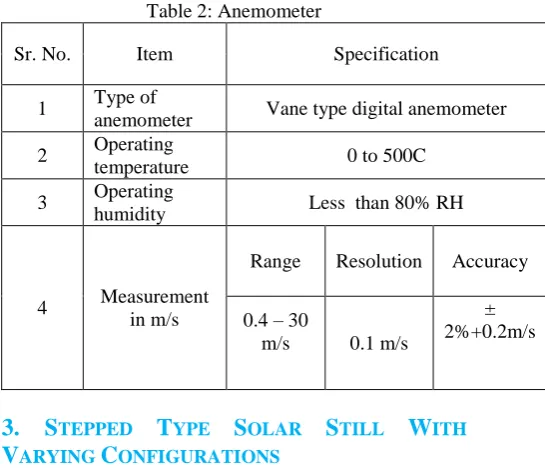
The operating parameters and electrical specifications of anemometer are as given in table 2.
Table 2: Anemometer
Sr. No. Item Specification
1 Type of
anemometer Vane type digital anemometer 2 Operating
temperature 0 to 500C 3 Operating
humidity Less than 80% RH
4 Measurement in m/s
Range Resolution Accuracy
0.4 – 30
m/s 0.1 m/s
± 2%+0.2m/s
3. S
TEPPEDT
YPES
OLARS
TILLW
ITHV
ARYINGC
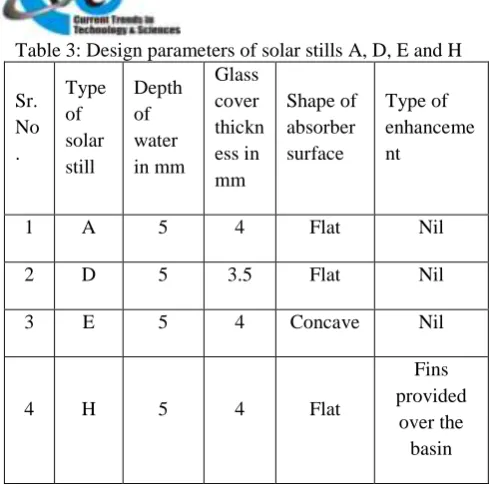
ONFIGURATIONSCopyright © 2012 CTTS.IN, All right reserved Table 3: Design parameters of solar stills A, D, E and H
Sr. No .
Type of solar still
Depth of water in mm
Glass cover thickn ess in mm
Shape of absorber surface
Type of enhanceme nt
1 A 5 4 Flat Nil
2 D 5 3.5 Flat Nil
3 E 5 4 Concave Nil
4 H 5 4 Flat
Fins provided
over the basin
4.
R
ESULTSA
NDD
ISCUSSIONFig.3 represents the variation of hourly temperatures for the experiments conducted on 5th, 6th,10th,15th ,16th and 17th January, 2012 for solar stills A, D, E and H. Similar trends were noticed on all other days. Different variables were measured hourly such as inner glass temperature (Tgi), outer glass temperature (Tgo), ambient temperature (Ta), water temperature (Tw), basin temperature (Tb), wind speed (V) and distillate yield (Y). It can be seen that the temperature of the basin plate is the maximum followed by the temperature of water contained in the basin; which is heated due to incident rays. Then the temperature of the inner glass; where the condensation of vapours takes place and then the outer glass that transmit the incident rays and it is in contact with the surrounding. The ambient temperature is the least one out of all these temperatures. The maximum basin plate temperature occurs between the hours of 12.30 pm to 1.30 pm. It ranged between 600C and 700C. Ambient temperatures for all experiments were in the range of 22 to 330C.
Fig. 3: Variation between the temperatures at different locations of the solar stills A, D, E and H
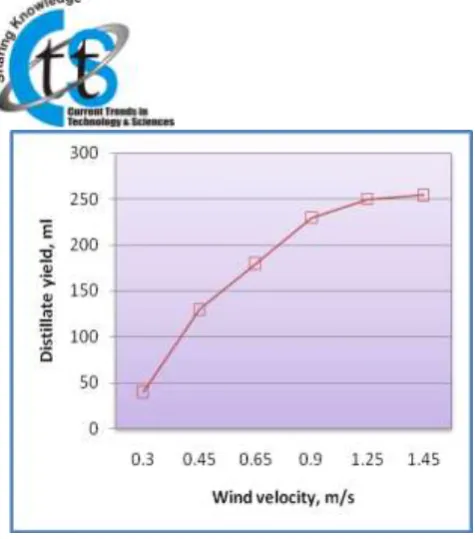
The effect of wind velocity on the distillate yield of the stepped type solar still A, D, E and H on 5th, 6th, 10th, 15th, 16th and 17th January, 2012 is shown in Figs.4-7 respectively. It can be seen from the figures that increasing the wind speed tends to increase the distillate yield of the solar stills. This may be explained by the fact that increasing the wind speed results in a higher heat transfer coefficient which results in a lower cover temperature and higher condensation rate inside the still giving rise to a higher yield of the still.
Fig. 4: Variation of distillate yield with wind velocity for solar still A with 5 mm depth of water
Fig. 6: Variation of distillate yield with wind velocity for solar still E with concave basin surface
Fig. 7: Variation of distillate yield with wind velocity for solar still H with fins provided over the basin The wind velocity is related to climatic conditions of the stepped type solar still. The effect of wind on the distillate yield of the solar still is shown in fig.4-7 for different configurations of the stepped type solar stills. It clearly indicates that wind blowing over the glass cover causes faster evaporation. As the wind velocity increases, the convective heat transfer coefficient from the glass cover to ambient air increases and simultaneously the glass cover temperature decreases. Due to this, the temperature difference between water surface and the glass cover increases and ultimately the yield of the solar still increases as compared to stagnant ambient air conditions. As the wind velocity over the solar still increases, the distillate yield of the solar still increases continuously.
5.
C
ONCLUSIONThe variation of the distillate yield with respect to solar intensity, ambient temperature and wind velocity for various configurations of the stepped type solar still have been studied. For the given set of climatic parameters i.e. solar intensity and ambient temperature, it has been observed that as the wind velocity increases; the distillate yield of the solar still increases.
R
EFERENCE[1] S. H. Soliman, “Effect of wind on solar distillation”, Solar Energy, Vol.13, pp.403-415, 1972
[2] A.S. Nafey, M. Abdelkader, A. Abdelmotalip and A.A. Mabrouk, “Parameters affecting solar still productivity”, Energy Conversion and Management, Vol.41, pp.1997-1809, 2000
[3] H.Al- Hinai, M.S. Al-Nassri and B.A. Jubran, “Effect of climatic, design and operational parameters on the yield of a simple solar still”, Energy Conversion and Management, Vol.43, pp.1639-1650, 2002
[4] M. Telkes, Res. Dev. Prog. Report No. 13, Dec. 1956.
[5] G.O.G. Lof, J. A. Eibling and J. W. Bloemer, “Energy balances in solar distillers”, A.I.Ch.E.J. 7, No. 4,1961
[6] K.G.T. Hollands, “The regeneration of lithium chloride brine in a solar still for use in solar air conditioning” Solar Energy, Vol.7, Issue 39,1963 [7] P. I. Cooper, “Digital simulation of transient solar
still processes”, Solar Energy, Vol.12, pp. 313,1969
[8] P. N. Morse and W.R.W. Read, “ A rational basis for the engineering development of a solar still”, Solar Energy, Vol.12, Issue 1, pp 5-17,1968 [9] “Final three years progress on study and field
evaluation of solar sea water stills”, O.S.W. Research and Development Progress Report No. 190, 1966