ISSN :2394-2231 http://www.ijctjournal.org Page 131
A Study on Data Mining Optimizing Visual Search
Re-Ranking Via Pair Wise Learning Image Datas
1L.Dhivyajayadharshini
1 Research Scholar, Dept.of.Computer science, Annai Vailankanni Arts&Science College Thanjavur-7
---
************************
---Abstract:
Conventional approaches to visual search re-ranking empirically take the “classification performance” as the optimization objective, in which each visual document is determined whether relevant or not, followed by a process of increasing the order of relevant documents. In this project, we first reestablish the fact that: the classification performance fails to produce a globally optimal ranked list. Hence, we formulate re-ranking as an optimization problem, in which a ranked list is globally optimal only if any arbitrary two documents in the list are correctly ranked in terms of relevance. This is different from existing Approaches which simply classify a document as “relevant” or not. To find the optimal ranked list, we convert the individual documents to “document pairs”, Each pair is represented as an “ordinal relation.” Then, we find the optimal document pairs which can maximally preserve the initial rank order while simultaneously keeping the consistency with the auxiliary knowledge mined from query examples and web resources as much as possible. We develop two pair wise re-ranking methods, difference pair wise ranking (DP-ranking) and exclusion pair wise re-ranking (EP-re-re-ranking), to obtain the relevant relation of each document pair. Finally, a round robin criterion is explored to recover the final ranked list.
Keywords— Re-rank, icons, mining
---
************************
---I. INTRODUCTION
Visual search is a type of perceptual task requiring attention that typically involves an active scan of the visual environment for a particular object or feature (the target) among other objects or features (the distracters ). Visual search can take place either with or without eye movements.
The proliferation of digital capture devices and the explosive growth of community-contributed media contents have led to a surge of research activity in visual search. Due to the great success of text document retrieval, most
existing visual search systems rely entirely on the text associated with the visual documents (images or video clips), such as document title, description, automatic speech recognition (ASR) results from videos, and so on.
However, visual relevance cannot be merely judged by the text-based approaches, as textual information may fail to precisely describe the visual content. For an example, when users search for images with a warm color, the images cannot be easily measured by any textual description.
ISSN :2394-2231 http://www.ijctjournal.org Page 132
To address this issue, visual search re-ranking has received increasing attention in recent years .It can be defined as reordering visual documents based on the initial search results or some auxiliary knowledge, aiming to improve search precision.
The research on visual search re-ranking has proceeded along three dimensions from the perspective of how external knowledge is exploited:
Self re-ranking, which mainly focuses on detecting relevant patterns (recurrent or dominant patterns) from
the initial search results without any external knowledge;
Example re-ranking, in which the query examples are provided by users
so that the relevant patterns can be discovered from these examples; Crowd re-ranking, which mines relevant patterns from the crowd sourcing knowledge available on the web. The first dimension, i.e., self-re-ranking, although relies little on the external knowledge, cannot deal with the “ambiguity problem” which is derived from the text queries.
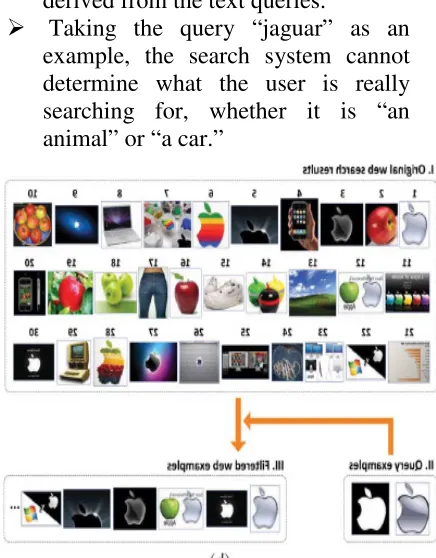
Taking the query “jaguar” as an example, the search system cannot determine what the user is really searching for, whether it is “an animal” or “a car.”
As illustrated in Fig. 1(a), results with different meanings but all related to
“jaguar” can be found in the top-ranked results of “jaguar.”
A similar observation can be found in Fig. 1(b), in which diverse images with the surrounding text of “apple” are mixed in the search results of “apple.” To address this problem, the second and the third dimensions leverage some auxiliary knowledge to better understand the query. Specifically, the second dimension, i.e., example re-ranking, leverages a few query examples to train
ISSN :2394-2231 http://www.ijctjournal.org Page 133
It is reported that much higher improvements can be obtained since different engines can inform and complement the relevant visual information for the given query. However, it still cannot avoid the ambiguity problem as current visual search engines mainly support the text query.
To tackle the “ambiguity problem,” the second and third dimensions explore some auxiliary knowledge to better understand the query. Specifically, the second dimension, i.e., example re-ranking, also called supervised-re-ranking, leverages a few query examples to train the re-ranking models or gives some suggestions to improve the search precision. For example, Yan et al. and view the query examples as pseudo-positives and the bottom-ranked initial results as pseudo-negatives. A re-ranking model is then built based on these samples by support vector machine (SVM). Liu et al. use the query examples to learn the relevant and irrelevant concepts for a given query, and then identify an optimal set of document pairs via an information theory. The final re-ranking list is directly recovered from this optimal pair set.
To leverage more examples, the third dimension, i.e., crowd re-ranking, uses online crowd sourcing knowledge obtained from public social networks. For example, our recent work first constructs a set of visual words based on local image patches collected from multiple image search engines, explicitly detects the so-called salient and concurrent patterns among the visual words, and then theoretically formalizes the re-ranking as an optimization problem on the basis of the mined visual patterns
To address the above issues in example-re-ranking and crowd re-ranking, in this project, we will leverage query examples and crowd sourcing knowledge simultaneously in an efficient way. Through analyzing the keywords and the concept confidence scores, we can mine the concept relatedness to the given query. In the re-ranking process, the initial ranked list is converted to image pairs and represented by the mined concept relatedness. Then, the re-ranking is formulized as an optimization problem to find an optimal pair set. Finally, the re-ranked list is recovered from such pair sets based on a “round robin criterion.
II .Paper performance
1. On-line Live Image Search Module
Our system works directly on top of Live Image Search (Google), with almost the same Web interface. After typing a query keyword, the original result of Live Image Search based on text is presented to user. The user can then drag an image to the Key Image pad, and initiate a content-based query. In this module, we first feed the text query to a visual web search engine and collect the visual documents along with the associated text.
2. Query Example Modules
In this module we are developing the code for query example algorithm. To avoid the ambiguity problem, we then use the query examples to filter the web results and get more clean “web examples.”
3. Distance Definitions
ISSN :2394-2231 http://www.ijctjournal.org Page 134
the “document pairs” after converting the ranking list to a pair set.
The following two strategies of ranking distances are applied over the result from the above module:
• Ranking distance I: difference square
• Ranking distance II: accumulated exclusion
4. Pair Optimization
Based on the distance defined in module three, we the use optimization problem as difference pair-wise re-ranking (DP-re-re-ranking) and exclusion pair wise re-ranking (EP-re-ranking).
5. Recovery of the Re-ranked List
In this module, we define Round Robin Algorithm. To obtain the final re- ranked list, a “round robin ranking” method is explored based on the ordinal scores of visual document pairs. The round robin ranking first assigns real-value ordinal scores to the first document of each pair, while the second document of each pair is assigned 0. All the scores assigned to the same document are then added together. According to the sum of the scores assigned, the documents are finally ranked in descending order and the re-ranked list is obtained.
III . CONCLUSIONS
In this project, we have presented a novel optimization-based approach to visual search re-ranking by directly optimizing the entire ranked list rather than each individual visual documents. We rest analyze the ambiguity problem in visual search re-ranking, and propose that re-ranking should leverage external knowledge to get a robust re-ranked list. Then, we presented the difference between the classification and the ranking problem, and defined the re-ranking problem as guaranteeing the
highest probability that each arbitrary document pair is correctly ranked in terms of relevance. Based on this definition, we theoretically formulate visual re-ranking as an optimization problem which tries to an optimal pair set. Finally, we recover the re-ranking list from such a pair set via round robin criterion. The experiments conducted over three benchmark datasets demonstrated that the proposed re-ranking approach outperforms the text baselines, as well as existing re-ranking approaches.
IV FUTURE ENHANCEMENT
There are several open problems for further studies. First, the text associated with the initial search results has not been explored. It would be a promising topic to leverage both the text and visual cues to represent the visual document pairs. Second, the semantic relationship between concepts, such as co-occurrence and correlation, widely exists. We can explore this relationship to represent the document pairs more precisely. Third, the document pairs are represented by means of a set of concept detectors. However, the size of the concept lexicon is still limited in this work. It will also be interesting to investigate how the re-ranking performance will change with the increase of visual concepts and how many concepts are enough for re-ranking.
V REFERENCES
[1] C. Burges, T. Shaked, E. Renshaw, A. Lazier, M. Deeds, N. Hamilton, and G. Hulldender, “Learning to rank using gradient descent,” in Proc. Int. Conf. Machine Learning, 2005.
ISSN :2394-2231 http://www.ijctjournal.org Page 135
in Proc. Int. Conf. Machine Learning, 2007.
[3] R. Cilibrasi and P. Vitanyi, “The Google similarity distance,” IEEE Trans. Knowl. Data Eng., vol. 19, no. 3, pp. 370–383, Mar. 2007.
[4] D. Cossock and T. Zhang, “Statistical analysis of Bayes optimal subset ranking,” IEEE Trans. Inf. Theory, vol. 54, no. 11, pp. 5140–5154, 2008.
[5] L. B. Cremeant and R. M. Murra, “Stability analysis of interconnected nonlinear systems under matrix feedback,” in Proc. IEEE Conf. Decision and Control, 2003.
[6] D. Duong, B. Goertzel, J. Venuto, R. Richardson, S. Bohner, and E. Fox, “Support vector machines to weight voters in a voting system of entity extractors,” in Proc. IEEE Int. Joint Conf. Neural Networks,
2006.
[7] R. Fergus, L. Fei-Fei, P. Perona, and A. Zisserman, “Learning object categories from Google’s image search,” in Proc. IEEE Int. Conf. Computer Vision, 2005, pp. 1816–1823.
[8] S. Gao, X. Cheng, H. Wang, and L.-T. Chia, “Concept model-based unsupervised web image re-ranking,” in
Proc. IEEE Int. Conf. Image Processing, 2009.
[9] B. Geng, L. Yang, C. Xu, and X.-S. Hua, “Content-aware ranking for visual search,” in Proc. IEEE Conf. Computer Vision and Pattern Recognition, 2010. [10] Google Image. [Online]. Available: http://image.google.com/.
[11] R. Herbrich, T. Graepel, and K. Obermayer, “Large margin rank boundaries for ordinal regression,” in