Integracija podatkovnih baz v ra~unalni{ko
podprtem sistemu upravljanja orodij
Integration of Data Bases in a Computer-Supported Tool Management System
Bogomir Mur{ec - Franci ^u{ UDK 621.9.02:681.3.02:519.61/.64
Strokovni ~lanek (1.04)
UDC 621.9.02:681.3.02:519.61/.64 Speciality paper (1.04)
V prispevku je predlagana celostna zamisel raèunalniko podprtega sistema upravljanja orodij, ki predstavlja povezovanje posameznih baz podatkov v sistemu upravljanja orodij. Celostna zamisel vkljuèuje baze podatkov pri procesu odrezovanja in preraèun rezalnega orodja po metodi konènih elementov.
Bistvena toèka celostne zamisli raèunalniko podprtega sistema upravljanja orodij je model optimalne izbire rezalnih razmer za struenje, iz baz tehnolokih podatkov razliènih izdelovalcev. Model izbere optimalne rezalne razmere glede na podatke o obdelovancu (dimenzije in zahtevana stopnja povrinske hrapavosti), podatke o orodju in podatke o obdelovalnem stroju. Z izbranimi optimalnimi rezalnimi razmerami doseemo ugodno razmerje med nizkimi stroki izdelave in veliko produktivnostjo pri danih omejitvah procesa rezanja. © 1999 Strojniki vestnik. Vse pravice pridrane.
(Kljuène besede: upravljanje orodij, paketi programski, baze podatkov, modeli optimiranja)
The present paper proposes the integral concept of a computer-supported tool management system representing the integration of the individual data bases in the tool management system. The integral concept includes the data bases for the cutting-off process and calculations of the cutting tool by the finite element method.
The most important component of the integral concept of the computer - supported tool management system is the model of optimum selection of cutting conditions for turning from technological data bases of different tool makers. The model selects optimum cutting conditions by taking into account the workpiece data (dimensions and required degree of surface roughness), the tool data and the metal- working machine data. By selection of optimum cutting conditions it is possible to reach a favourable ratio between the low manufactur-ing costs and high productivity takmanufactur-ing into account the given limitation of the cuttmanufactur-ing process.
© 1999 Journal of Mechanical Engineering. All rights reserved.
(Keywords: tool management system, programme packages, data bases, optimization models)
0 UVOD
V sodobni proizvodnji se uporabljajo sistemi za upravljanje orodij, ki omogoèajo dostavo pravih orodij in podatkov za obdelavo na pravo delovno mesto oziroma stroj ob pravem èasu. Najbolj primerna je uporaba raèunalniko podprtih sistemov za upravljanje z orodji.
Èe elijo podjetja obdrati konkurenèno prednost in s tem trièe zvestih kupcev, morajo izpolnjevati osnovni pogoj, tj. strokovno ugodno proizvodnjo vrhunsko kakovostnih izdelkov [7]. Nizko ceno lahko dosegamo samo s poveèano produktivnostjo in ekonomiènostjo, vrhunsko kakovost pa z uvajanjem avtomatizacije na vseh podroèjih.
V prispevku so obravnavani predlogi izboljanja produktivnosti in ekonomiènosti v posamièni in maloserijski proizvodnji z odrezo-vanjem [8]. Temeljna usmeritev sloni na organizaciji orodne slube, tj. na delovanju posameznih enot znotraj te slube, njihovih nalogah ter na njihovih medsebojnih povezavah.
0 INTRODUCTION
In modern manufacturing the used tool man-agement systems ensure timely feeding of correct tools and data to a suitable work station. The use of computer-supported tool management systems is the most appropriate solution.
In order to retain the competitive advantage and the market of faithful buyers the companies must satisfy the basic condition, i.e., cost-effective manu-facture of high-quality products [7]. Low price can be reached only by increased productivity and cost effectiveness, and high quality can be reached by in-troducing automation in all areas.
1 PREDSTAVITEV PROBLEMA
Na trgu je danes veliko komercialnih programov za upravljanje orodij, npr.: MULTI-BRAIN ZOLLER, DLoG, TDM, TOMS, CORO-PLAN, COROTAS, ISCAR itn, nekateri pa so razviti tudi v naih laboratorijih, kot npr. INCERP [8]. Navadno so ti programi na zgoèenkah.
Vsi ti programski paketi vsebujejo baze podatkov za izbiro rezalnih razmer, kakor so rezalna hitrost vc, podajanje f in globina rezanja a. Nekateri
od teh vsebujejo tudi grafiko orodij.
Uporabnik, ki se odloèa za nakup orodnega sistema, stoji pred pomembno odloèitvijo, kateri sistem kupiti. Vsi sistemi so si med seboj podobni, vendar obstajajo med njimi bistvene razlike. Za uporabnika se pojavlja vpraanje, kako iz vseh teh baz podatkov izbrati optimalne rezalne razmere, ob upotevanju vseh omejitev procesa odrezovanja.
V ta namen je bil izdelana celostna zamisel raèunalniko podprtega sistema upravljanja orodij.
1.1 Dosedanje raziskave in spoznanja
Dosedanje raziskave na tem podroèju so temeljile na izbiri orodij in pripadajoèih rezalnih razmer iz baz podatkov posameznih izdelovalcev orodij [6]. To pomeni, da so bile obravnavane samo baze podatkov raznih izdelovalcev orodij (npr. Sandvik, Iscar, Hertel, itn.), kot samostojne enote, ki so e dokaj dobro raziskane. Povezovanje tehnolokih baz podatkov pa do sedaj e ni bilo uporabljeno.
1.2 Predpostavke in omejitve
Pri izdelavi celostne zamisli raèunalniko
podprtega sistema upravljanja orodij
predpostavljamo, da e imamo baze podatkov, iz katerih lahko na podlagi doloèenih omejitev izberemo optimalne rezalne razmere.
1.3 Izhodièa za izvedbo naloge
Osnovna celica celostne zamisli raèunal-niko podprtega sistema upravljanja orodij je podat-kovna baza.
Optimalne rezalne razmere so edini naèin, da z razpololjivimi delavci, stroji in orodjem doseemo najbolji tehnièno ekonomski uèinek proizvodnje [2]. Optimalne rezalne razmere dobimo z optimiranjem glede na omejitve, ki omejujejo uporabno obmoèje rezalnih hitrosti, podajanja in globine rezanja.
1 PRESENTATION OF THE PROBLEM
Today many commercial programmes of tool management are available, such as MULTI-BRAIN ZOLLER, DLoG, TDM, TOMS, CORO-PLAN, COROTAS, ISCAR etc.; some of them have also been developed in our laboratories such as INCERP [8]. Usually, these programmes are on com-pact disks.
All these programme packages contain the data bases for selection of cutting conditions, such as the cutting speed vc, feeding f and cutting depth a.
Some of them contain also the graphs of tools. The user, deciding on purchase of the tool system, faces the important question of which sys-tem to buy. All syssys-tems are mutually similar, but there are important differences between them. The user faces the question of how to select the optimal cut-ting condition out of all these data bases by taking into account all limitations of the cutting process.
To this end, the integral concept of a com-puter-supported tool management system has been worked out.
1.1 Research and findings hitherto
The researches in this area so far have been based on the selection of tools and relevant cutting conditions from the data bases of individual tool manufacturers [6]. That means that only the data bases of various tool makers (e.g. Sandvik, Iscar, Hertel etc.) have been dealt with as individual units, which have already been quite rather thoroughly examined. The integration of technological data bases, however, has not yet been used so far.
1.2 Assumptions and limitations
For working-out of the integral concept of the computer-supported tool management system it is assumed that data bases are already available from which the optimal cutting conditions are selected on the basis of certain limitations.
1.3 Starting points for execution of the task
The basic cell of the integral concept of the computer-supported tool management system is the data base.
Najpomembneja toèka tega prispevka je izdelava in programiranje modela za izbiro optimalnih rezalnih razmer (vc, f , a), iz razliènih baz podatkov. Izdelani model upoteva pri optimiranju naslednje omejitve:
−omejitev na obdelovalnem stroju,
−omejitev na orodju,
−omejitev na obdelovancu,
−omejitev zaradi obdelovalnih razmer,
−omejitev glede na najnije stroke obdelave.
2 CELOSTNA ZAMISEL RAÈUNALNIKO PODPRTEGA SISTEMA UPRAVLJANJA ORODIJ
Celostna zamisel raèunalniko podprtega sistema upravljanja orodij (INKO) pomeni povezavo posameznih baz podatkov v sistemu upravljanja orodij, kakor je prikazano na sliki 1. Celostna zamisel vkljuèuje baze podatkov pri procesu odrezovanja in preraèun strunih noev po metodi konènih elementov. Bistvena toèka celostne zamisli pa je model optimalne izbire rezalnih razmer.
V celostni zamisli se èrpajo podatki iz sedanjih baz podatkov. Nato se na podlagi doloèenih omejitev, npr. najveèja izraba stroja, najmanji stroki, optimalna kakovost obdelane povrine itn. doloèijo optimalne rezalne razmere.
2.1 Baze podatkov pri procesu odrezovanja
Zelo pomemben segment pri naèrtovanju tehnologije odrezovanja sestavljajo podatkovne baze, v katere shranjujemo in vnaamo podatke, ki jih potrebujemo pri naèrtovanju in vodenju proizvodnje [3]. Osnovna baza podatkov za naèrtovanje procesa odrezovanja tako vsebuje naslednje datoteke: 1. datoteka obdelovalnih strojev,
2. datoteka materialov obdelovancev, 3. datoteka rezalnih ploèic,
4. datoteka rezalnega orodja,
5. datoteka dral orodij (dral rezalnih ploèic in osnovnih dral),
6. datoteka rezalnih razmer, 7. datoteka priporoèil.
Iz navedenih datotek lahko dobimo vse potrebne podatke pri naèrtovanju tehnolokega procesa.
2.2 Baza podatkov za oznaèevanje rezalnih ploèic po standardu ISO
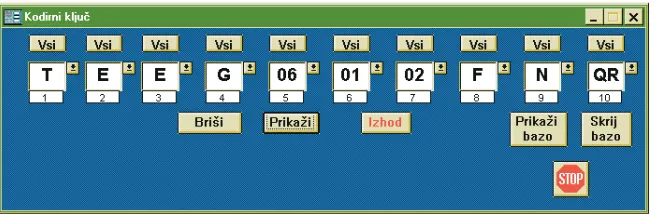
V okviru celostne zamisli je bila izdelana baza podatkov za oznaèevanje rezalnih ploèic za struenje po standardu ISO, s programskim paketom ACCESS 2.0. Za oznaèevanje rezalnih ploèic se po priporoèilih ISO uporablja poseben kodirni kljuè, ki
The most important point of this contribution is the working out and programming of the model for the selection of optimal cutting conditions (vc, f, a), from different data bases. The model made into account the following limitations for optimization:
−limitations on the machine tool, −limitations on the tool,
−limitations on the workpiece, −limitations due to cutting conditions,
−limitations with respect to minimizing the machining costs.
2 AN INTEGRAL CONCEPT OF COMPUTER-SUPPORTED TOOL MANAGEMENT SYSTEM
The integral concept of a computer-sup-ported tool management system (INCO) represents the integration of the individual data bases in the tool management system as shown in Figure 1. The inte-gral concept includes the data bases for the cutting-off process and calculation of cutting blades by the finite element method. The essential feature of the integral concept is the model of optimal selection of cutting conditions.
The integral concept - the data - are taken from existing data bases. Then the optimal cutting conditions are determined on the basis of certain limi-tations, such as the maximal utilization of the ma-chine, minimum costs, optimal quality of machined surface etc.
2.1 Data bases for the cutting process
The data bases, into which the data needed for production planning and managing are stored and entered, are a very important segment for the plan-ning of cutting technology [3]. The basic data base for planning the cutting process contains the follow-ing data files:
1. data file of machine tool, 2. data file of workpiece materials, 3. data file of cutting inserts, 4. data file of cutting tools,
5. data file of tool holders (cutting insert holders and basic holders),
6. data file of cutting conditions, 7. data file of recommendations.
From these data files all the necessary data on planning of the technological process can be ob-tained.
2.2 Data base for marking of the cutting inserts according to the ISO standard
Sl. 1. Celostna zamisel raèunalniko podprtega sistema upravljanja orodij SISTEM OPTIMIRANJA (2. korak)
• najveèja produktivnost
optimalno izbrani rezalni pogoji vc, f, a • najmanjši
stroški MULTI-BRAIN
ZOLLER
DLoG TDM TOMS COROPLAN
in COROTAS
ISCAR INCERP
SISTEMI UPRAVLJANJA ORODIJ-BAZE PODATKOV
izbira stroja: P, η
maksimalna izraba stroja
P
c=
F v
c cP
EM⋅
≤
η
nizki stroški
natanèen obdelovanec
(poves v dopustnih mejah)
udej≤ udop
površina izdelana po kriterijih TQM (tolerance v dopustnih mejah)
doloèitev napetosti in deformacij po MKE (σ≤σdop)
DA
DA
DA
DA
DA
NE NE NE NE
NE
...
OBDELOVANEC: -najmanjši stroški izdelave
Cilj: -optimalna kakovost
C
E
L
O
S
T
N
A
Z
A
M
I
S
E
L
• izbira materiala orodja
• izbira rezalnih pogojev (1. korak) razlièni proizvajalci
STROJ:
3. korak
4. korak
5. korak
6. korak
Fig. 1. Integral concept of a computer-supported tool management system- INCO
• highest
productivity
optimally selected cutting conditions vc, f, a • lowest
costs MULTI-BRAIN
ZOLLER
DLoG TDM TOMS COROPLAN
and COROTAS
ISCAR INCERP
TOOL MANAGEMENT SYSTEMS-DATA BASES PODATKOV
selection of machine: P, η
maximum utilization of machine
P
cF v
c cP
EM=
⋅
≤
η
low costs
accurate workpiece (deflection within permissible
limits) ureal≤ uperm
surface made according to criteria TQM (tolerances within permissible limits)
checking of stresses and deformations according to FEM method (σ≤σperm)
YES
YES
YES
YES
YES
NO NO NO NO
NO
...
SYSTEM OF OPTIMIZATION (2 nd step)
WORKPIECE: -lowest manufacturing costs
Target: -optimum quality
I
N
T
E
G
R
A
L
C
O
N
C
E
P
T
I
N
C
O
• selection of tool material
• selection of cutting conditions (1 st step) different manufacturers
MACHINE:
3 rd step
4 th step
5 th step
6 th step
je sestavljen iz desetih mest, kakor to prikazuje slika 2. Oznaèbe na posameznih mestih so tevilène in èrkovne [8].
3 MODEL OPTIMALNE IZBIRE REZALNIH RAZMER
Prispevek prikazuje model za izbiro optimalnih rezalnih razmer, dobljenih iz razliènih baz podatkov, na osnovi doloèenih omejitev.
3.1 Izbira optimalnih rezalnih razmer
Pri izdelavi modela za najboljo izbiro rezalnih razmer predpostavljamo, da elimo najveèjo kakovost izdelkov, najmanje stroke, pri najkrajem èasu izdelave. Ker vsem tem zahtevam ni mogoèe hkrati zadostiti, je treba izbrati najboljo reitev glede kakovosti, strokov in èasa [5].
Kakovost, stroki in èas so v veliki meri odvisni od rezalnih razmer, ki so v razponu od najmanjih do najveèjih, pri èemer je treba izbrati najbolje rezalne razmere, kakor je prikazano na sliki 3.
3.2 Algoritem za izbiro najboljih rezalnih razmer
Na sliki 4 je prikazan potek izbire najboljih rezalnih razmer ter izraèun tevila potrebnih rezov in èasa obdelave pri optimalno izbranih rezalnih razmerah [8].
ten units as shown in the example in Figure 2, is used for marking of cutting inserts. Markings on the indi-vidual places are made by numbers or letters [8].
3 MODEL FOR OPTIMAL SELECTION OF CUTTING CONDITIONS
In the paper a model is presented for opti-mal selection of cutting conditions obtained from different data bases according to some limitations.
3.1 Selection of optimal cutting conditions
When making the model for optimum se-lection of cutting conditions we assume that we want the maximum quality of products, minimum costs and minimum manufacturing time. As all these re-quirements cannot be met simultaneously, it is nec-essary to select an optimal solution concerning qual-ity, costs and time [5].
Quality, costs and time depend to a large extent on the cutting conditions which, in turn, range from the minimal to the maximal ones - but optimal cutting conditions must be selected as shown in Figure 3.
3.2 Algorithm for selection of optimal cutting conditions
Figure 4 shows the process of selection of optimal cutting conditions and the calculation of the number of required cuts and duration of machining in the case of the optimal cutting conditions selected [8].
Sl. 2. Primer izpolnjene osnovne maske, za izbiro rezalnih ploèic za struenje po standardu ISO 1832-1985
3.3 Raèunalniki program za izbiro najboljih rezalnih razmer
Po zasnovi algoritma je bil izdelan raèunalniki program za izbiro najboljih rezalnih razmer. Program je izdelan s programskim paketom Delphi 2.0 in deluje v okolju Windows [8]. Celotni program je ena datoteka, ki je sestavljena iz veè modulov, kakor je prikazano na sliki 5:
−glavni modul (v njem potekajo izraèuni, nanj pa
so vezani preostali moduli),
−modul za vnos rezalnih razmer (v njem so moduli,
ki so sestavljeni iz razliènih tehnolokih baz rezalnih razmer),
3.3 Computer programme for selection of opti-mal cutting conditions
After conceiving the algorithm, the com-puter programme for selection of optimal cutting con-ditions was made. It was made by computer package Delphi 2.0 and works in the Windows environment [8]. The entire programme consists of one data file comprising several modules as shown in Figure 5:
−main module (in which the calculations are effected, and to which the other modules are connected),
−module for entering cutting conditions (it contains the modules consisting of different technological data bases of cutting conditions),
Fig. 3. Representation of optimal cutting conditions
depth of cutting feeding
optimal cutting conditions
maximum
minimum minimum
cutting speed
minimum
maximum maximum
Sl. 3. Prikaz optimalnih rezalnih razmer
DLoG, Iscar, INCERP, Strojniški priroènik, CoroGuide,
preostale baze tehnoloških podatkov
vnos rezalnih razmer iz razliènihtehnolokih baz podatkov
vc1, f1, a1; vc2, f2, a2; vc3, f3, a3 ...
vnospodatkov zastroj, orodje, obdelovanecinmaterial
omejitev gledenaobdelovalnistroj: - gledenamoè strojainizkoristek, - gledenamaksimalno tevilo vrtljajev stroja.
omejitev gledenaorodje
omejitev gledenaobdelovanec
omejitev gledenaobdelovalne razmere
omejitev gledenanajnijestroke
doloèitev potrebnega tevila rezov
doloèitev èasa zaobdelavo
izpis optimalnih rezalnih razmer izpis potrebnega števila rezov in èasa obdelave
NE
NE
NE
NE
NE DA
DA
DA
DA
DA
Sl. 4. Definicija programskih korakov Fig. 4. Definition of programme steps
DLoG , Iscar, INCERP,M echanical engineering handbook, CoroG uide, other technological data bases
entering cutting conditions from different technological data bases vc1, f1, a1; vc2, f2, a2; vc3, f3, a3 ...
entering data on machine, tool, workpiece and material
limitation with respect to machine tool:
− with respect to machine capacity and efficiency
− with respect to number of revolutions of machine limitation with respect to tool
limitation with respect to workpiece
limitation with respect to cutting conditions
limitation with respect to lowest costs
determination of required number of cuts
determination of time of machining
display of optim al cutting conditions display of required num ber of cuts and tim e of m achining
NO
NO
NO
NO
NO YES
YES
YES
YES
YES
globina rezanja podajanje
optimalne rezalne razmere
najveèja
najmanjše najmanjša
rezalna hitrost
najmanjša
najveèja
−modul za vnos drugih tehnolokih podatkov. Vsebuje naslednje enote:
−modul obdelovalnih strojev,
−modul obdelovalnih orodij,
−modul hrapavosti povrine obdelovanca in
−modul materiala obdelovanca.
−module for entering the other technological data. This contains the following units:
−module of machine tools, −module of cutting tools,
−module of workpiece surface roughness and −module of workpiece material.
Sl. 5. Sestava programa
Fig. 5. Structure of programme
table
Cutting-offtechnique engineetable Mringechanicahandbool k SPK Ftaeblldme ühle
module for entering cutting conditions
MAIN MODULE (calculations)
connection with other technological data bases
(DLoG, ISCAR, INCERP,
COROGUIDE,...)
module for entering other technological data
moduleof
machinetools modultooeoflscutting modusurfaceleof
roughness
moduleof
workpiece material
moduleof turningcell GF
NDM-16
moduleof universal lathe Prvomajska 420
moduleof tool setting
angle
moduleof radius ofcutting
inserts
moduleoftool resistanceto
wear
... modules of technological data on cutting conditions:
preglednica
Tehnikaodrezovanja Strojnikipreglednicapriroènik SPKpreglednicaFeldmühle
modul za vnos rezalnih razmer
GLAVNI MODUL (izraèuni)
povezava z zunanjimi bazami tehnoloških
podatkov
(DLoG,ISCAR,INCERP,
COROGUIDE,...) modul za vnos preostalih
tehnološkihpodatkov
modul obdelovalnih
strojev
modul obdelovalnih
orodij
modul hrapavosti
povrine
modul materiala obdelovanca
modul struilnecelice
GFNDM-16
modul
univerzalne strunice
Prvomajska420
modul nastavnega
kotaorodij
modul radijarezalnih
ploèic
modul obstojnosti
orodij ...
4 ALGORITEM ZA IZRAÈUN REZALNIH RAZMER NA TEMELJU DOPUSTNEGA
POVESA OBDELOVANCA
V okviru magistrskega dela Integralni koncept raèunalniko podprtega sistema upravljanja orodij [8] so razvite formule za globino rezanja in podajanje pri struenju, na temelju dopustnega povesa obdelovanca, za tri osnovne naèine vpenjanja obdelovanca:
−obdelavo obdelovanca med konicama,
−obdelavo obdelovanca, na eni strani vpetega v vpenjalno glavo in na drugi strani podprtega s konico in
−obdelavo obdelovanca, vpetega samo v vpenjalno
glavo.
Natanènost geometrijske oblike izdelka je odvisna od povesa obdelovanca. Manji je poves obdelovanca, bolj natanèna je geometrijska oblika izdelka. Èe bomo pri izbiri podajanja in globine rezanja upotevali tudi te formule, bo obdelovanec izdelan veliko bolj natanèno [8].
5 UPORABA METODE KONÈNIH ELEMENTOV PRI ODREZOVANJU
Metoda konènih elementov (MKE) se veliko uporablja tudi na podroèju odrezovanja, predvsem za preraèune strunih noev, frezal, rezalnih ploèic, dral orodij, strojev, obdelovancev itn.
Glavni del raziskave v okviru celostne zamisli raèunalniko podprtega sistema upravljanja orodij, tj. analiza strunega noa po metodi konènih elementov, je bil izveden s programskima paketoma I-DEAS in BERSAFE [8].
5.1 Analiza rezultatov, dobljenih z MKE s tehnolokega vidika
Preraèun je pokazal, da nastanejo najveèje primerjalne napetosti na konici strunega noa, ki ree. Najvija temperatura se pojavi na cepilni ploskvi, v toèki, ki je nekoliko odmaknjena od rezalnega roba. Zato prav na tem mestu prihaja tudi do najmoèneje obrabe orodja.
V primeru, ko se pojavijo prevelike napetosti, deformacije ali previsoke temperature, je treba spremeniti rezalne razmere na takno vrednost, da so le-te v dopustnih mejah. Kadar pa so napetosti, deformacije in temperature zelo nizke, lahko zaostrimo rezalne pogoje, da dvignemo produktiv-nost in ekonomièproduktiv-nost odrezovanja.
Naloga tehnologa je, da optimalno izbira rezalne razmere, tudi z vidika MKE in s tem vpliva na èimveèjo produktivnost in èimmanje stroke pri odrezovanju [8].
4 ALGORITHM FOR CALCULATION OF CUT-TING CONDITIONS BASED ON PERMISSIBLE WORKPIECE DEFLECTION
In the frame of the masters thesis Integral concept of computer-supported tool management system [8] the formulas are developed for the depth of cutting and feeding during turning, on the basis of permissible workpiece deflection, for three basic manners of workpiece clamping:
−machining of workpiece between tips,
−machining of workpiece clamped on one side into
clamping head and supported on the other side on the tip, and
−machining of workpiece clamped into clamping
head only.
The accuracy of geometrical shape of prod-uct depends on the workpiece deflection. The smaller the workpiece deflection, the more accurate will be the geometrical shape of the product. If these formu-las are also taken into account when selecting the feeding and depth of cutting, the manufactured workpiece will be much more accurate [8].
5 USE OF FINITE ELEMENT METHOD FOR CUTTING-OFF
The FEM method is largely used also in the area of cutting, particularly for calculations of turn-ing blades, millturn-ing cutters, cuttturn-ing inserts, tool hold-ers, machines, workpieces etc.
The main part of the research in the frame of the integral concept of computer- supported tool management system, i.e., analysis of the turning blade according to the FEM method was carried out by means of programme packages I-DEAS and BERSAFE [8].
5.1 Analysis of results obtained by FEM method from the technological view point
The calculations showed that the greatest equivalent stresses occur on the tip of the turning blade which cuts. The highest temperature occurs on the cleaving surface, at the point slightly distant from the cutting edge. Therefore, at this point the greatest tool wear appears.
When excessive stresses, deformations or temperatures occur it is necessary to reduce the cut-ting conditions to such a value that they are within the permissible limits. If the stresses, deformations and temperatures are very low, the cutting conditions may be intensified to increase productivity and the cost-effectiveness of cutting off.
6 PREGLED STANJA IN RAZVOJNIH USMERITEV
Elektronski katalog orodij CIMSource FormBase [1] izhaja e od leta 1995 in vsebuje tehnoloke podatke o 90.000 orodjih 13 izdelovalcev. V prispevku predstavljena celostna zamisel raèunalniko podprtega sistema upravljanja orodij, pomeni povezovanje razliènih sistemov za upravljanje orodij in baz podatkov razliènih izdelovalcev. Zanimivo je, da smo se lotili povezovanja razliènih podatkovnih baz, ne da bi sploh vedeli za ta katalog. To pomeni, da smo na pravi poti, kajti tudi v svetu razmiljajo o povezovanju. Integracija vseh teh baz podatkov in sistemov za upravljanje je nujno potrebna. Na svetu je zelo veliko razliènih izdelovalcev orodij, in èlovek se teko znajde, ko mora izbrati sebi primerna orodja. Povezovanje na tem podroèju ustvarja red.
V izdelanem modelu za izbiro optimalnih rezalnih razmer lahko uporabljamo tudi podatke iz tega kataloga.
7 SKLEPI
Sedanja industrija mora izdelovati izdelke z vrhunsko kakovostjo za kar najnijo mogoèo ceno [4]. Bistvena toèka celostne zamisli raèunal-niko podprtega sistema upravljanja orodij je model optimalne izbire rezalnih razmer iz razliènih baz podatkov, ki jih ponujajo izdelovalci orodij. Model izbere optimalne rezalne razmere glede na obdelovanec, orodje in stroj. Dobljene (optimalne) rezalne razmere zadoèajo omejitvam, ki jih postavimo pred zaèetkom optimiranja.
Izkazalo se je, da je najbolje, èe uporabljamo za orodja doloèenega podjetja tudi bazo podatkov tega podjetja.
Vrednosti rezalnih razmer v katalogih izdelovalcev orodij oziroma v njihovih bazah podatkov so precej veèje od priporoèenih vrednosti v razliènih priroènikih. To pomeni, da terjajo orodja doloèenega izdelovalca sebi primerne delovne razmere, stroje in ustrezno pripravo tehnologije. Celostna zamisle raèunalniko podprtega sistema upravljanja orodij je bila razvita za pomoè uporabniku pri optimalni izbiri rezalnih razmer.
6 SURVEY OF SITUATION AND DEVELOP-MENT ORIENTATIONS
The electronic catalog of tools CIMSource FormBase [1] has been published since 1995 and con-tains technological data on 90,000 tools of 13 makers. The integral concept of a computer-sup-ported tool management system presented in the pa-per represents an integration of various tool manage-ment systems and data bases of different makers. We should like to point out that we undertook to inte-grate the different data bases without knowing any-thing about that catalog. This means that we are on the correct way, since also elsewhere in the world the experts are thinking about integration. The inte-gration of all these data bases and management sys-tems is urgent. There is a very great number of tool makers world-wide, and it is hard to select the ap-propriate tools. Integration in this area brings the or-der into the professional practice
In the worked out model for selection of optimum cutting conditions it is possible also to use the data from the catalog.
7 CONCLUSIONS
Todays industry has to manufacture products of high quality and at the lowest possible price [4].
The essential point of the integral concept of computer supported tool management system is the model of optimal selection of cutting conditions from the different data bases offered by tool makers. The model selects the optimal cutting conditions with respect to workpiece, tool and machine. The obtained (optimal) cutting conditions comply with the limita-tions defined before the beginning of optimization.
It has proved that, when using the tools of a particular maker, it is best also to use the data base of that tool maker.
Authors address:
Mag. Bogomir Murec, Dipl. Ing.
Prof. Dr. Franci Èu, Dipl. Ing., Dipl. Econ. Faculty of Mechanical Engineering University of Maribor
Smetanova 17
2000 Maribor, Slovenia Naslov avtorjev:
mag. Bogomir Murec, dipl. in. prof. dr. Franci Èu, dipl. in., dipl. oec. Fakulteta za strojnitvo
Univerze v Mariboru Smetanova 17 2000 Maribor
8 LITERATURA 8 REFERENCES
[1] CIM GmbH, CIMSOURCE FormBase, Guidelines / Instructions for Use, Aachen, Germany.
[2] Èu, F., Sokoviæ, M., Kopaè J., J. Baliè (1997) Model of complex optimization of cutting conditions. Journal of Materials Processing Technology, 64, 41-52, ELSEVIER.
[3] Èu, F., Automatisches Daten-Erfassungssystem für Zerspanungen. Werkstatt und Betrieb, 120, 923
-926, Carl Hanser Verlag, München.
[4] Èu, F. (1996) Tehnika odrezavanja. Univerza v Mariboru, Fakulteta za strojnitvo, Maribor.
[5] Èu, F. (1998) Vrednostna analiza. Univerza v Mariboru, Fakulteta za strojnitvo, Maribor.
[6] Kastelic, S., Kopaè, J., J. Peklenik (1993) Conceptual design of a relational data base for manufacturing
processes. CIRP ANNALS 1993, Manufacturing Technology, Vol. 42, 493-496.
[7] Kataliniè, B. (1995) Megatrends in der Automatisierung der Produktion, Elektrotechnik und
Informationstechnik.Zeitschrift des Österreichischen Verbandes für Elektrotechnik, Heft 4, 169-171,
Springer Verlag, Wien / New York.
[8] Murec, B. (1998) Integralni koncept raèunalniko podprtega sistema upravljanja orodij. Magistrsko delo,
Univerza v Mariboru, Fakulteta za strojnitvo, Maribor.
Prejeto: Sprejeto: