Stefan Härer1, Matthias Bernhardt1, Matthias Siebers2, and Karsten Schulz1
1Institute of Water Management, Hydrology and Hydraulic Engineering (IWHW), University of Natural Resources and Life
Sciences (BOKU), 1190 Vienna, Austria
2Commission for Glaciology, Bavarian Academy of Sciences and Humanities, 80539 Munich, Germany
Correspondence:Matthias Bernhardt ([email protected]) Received: 17 August 2017 – Discussion started: 15 September 2017
Revised: 4 March 2018 – Accepted: 30 March 2018 – Published: 4 May 2018
Abstract. Knowledge of current snow cover extent is es-sential for characterizing energy and moisture fluxes at the Earth’s surface. The snow-covered area (SCA) is often es-timated by using optical satellite information in combina-tion with the normalized-difference snow index (NDSI). The NDSI thereby uses a threshold for the definition if a satel-lite pixel is assumed to be snow covered or snow free. The spatiotemporal representativeness of the standard threshold of 0.4 is however questionable at the local scale. Here, we use local snow cover maps derived from ground-based pho-tography to continuously calibrate the NDSI threshold val-ues (NDSIthr) of Landsat satellite images at two European
mountain sites of the period from 2010 to 2015. The Re-search Catchment Zugspitzplatt (RCZ, Germany) and Ver-nagtferner area (VF, Austria) are both located within a single Landsat scene. Nevertheless, the long-term analysis of the NDSIthrdemonstrated that the NDSIthrat these sites are not
correlated (r=0.17) and different than the standard thresh-old of 0.4. For further comparison, a dynamic and locally optimized NDSI threshold was used as well as another lo-cally optimized literature threshold value (0.7). It was shown that large uncertainties in the prediction of the SCA of up to 24.1 % exist in satellite snow cover maps in cases where the standard threshold of 0.4 is used, but a newly developed cal-ibrated quadratic polynomial model which accounts for sea-sonal threshold dynamics can reduce this error. The model minimizes the SCA uncertainties at the calibration site VF by 50 % in the evaluation period and was also able to im-prove the results at RCZ in a significant way. Additionally, a scaling experiment shows that the positive effect of a locally
adapted threshold diminishes using a pixel size of 500 m or larger, underlining the general applicability of the standard threshold at larger scales.
1 Introduction
mind, information on the current snow distribution is elemen-tary for water resources management (Thirel et al., 2013) and weather forecasting model systems (Dee et al., 2011).
Snow cover distribution is often derived from satellite data and then either used as input for operational models (Butt and Bilal, 2011; Dee et al., 2011; Homan et al., 2011; Tekeli et al., 2005) or for the offline evaluation of mod-elled snow cover (Bernhardt and Schulz, 2010; Warscher et al., 2013) and snow fall patterns (Maussion et al., 2011). The used snow-cover mapping approaches can be grouped into four categories: manual interpretation, spectral mixture analysis and classification-based and index-based methods. Manual interpretation and classification-based approaches are often used in local snow cover mapping studies. Both are out of the scope of this study as the need for expert knowledge and high time demands limit their applicabil-ity for large time series data. Spectral mixture analysis is also not in the focus of this study as it needs an exten-sive spectral database for the different land surface com-ponents (Sirguey et al., 2009; Painter et al., 2009). These databases are usually not commonly available and only the final snow cover product can be downloaded (TMSCAG for Landsat and MODSCAG for MODIS). We focus on the au-tomatic normalized-difference snow index (NDSI) approach here. It was developed by Dozier (1989) and is a simple and established method to identify snow cover in optical satellite images. NOAA/NESDIS, which is assimilated into ERA/Interim (Dee et al., 2011; Drusch et al., 2004), and the widely used MODIS snow cover products (Hall and Riggs, 2007; Hall et al., 2002) make use of the NDSI.
The NDSI can be traced back to band rationing tech-niques (Kyle et al., 1978; Dozier, 1984) related to the NDVI (Rouse Jr. et al., 1974; Tucker, 1979) and is based on the physical principle that snow reflection is significantly higher in the visible range of the spectrum than in mid-infrared. The index ranges between −1 and 1 and a differentiation between snow and no snow is based on an NDSI thresh-old value (NDSIthr) which is commonly assumed to be 0.4
(Dozier, 1989; Hall and Riggs, 2007; Sankey et al., 2015). According to Hall et al. (2001) the accuracy for monthly snow detection using the atmospherically corrected MODIS product (MOD10/MYD10) with its standard threshold is re-spectively about 95 % and about 85 % in non-forested and forested areas. These accuracies make NDSI-based snow cover products well suited for global-scale applications, but uncertainties have to be expected at the local scale (Härer et al., 2016). Moreover, the snow detection algorithm for the MODIS snow cover product changed in the latest Collec-tion 6. The algorithm now uses an NDSI threshold of zero to-gether with a flag system to detect snow cover, and users are encouraged to use their own NDSI threshold in the MODIS Snow Products Collection 6 User Guide if a binary snow cover map is desired.
In line with this, numerous recent studies have questioned the general applicability of a standard NDSIthrin local snow
and glacier monitoring. When calibrating the NDSIthr
man-ually or with automated methods against field data for sin-gle scenes, large deviations from the standard value of 0.4 have been observed. The published values range from 0.18 to 0.7 (Burns and Nolin, 2014; Härer et al., 2016; Maher et al., 2012; Racoviteanu et al., 2009; Silverio and Jaquet, 2009; Yin et al., 2013). The wide range of values show the spa-tiotemporal variability of the NDSIthrand raise the demand
for a valid non-subjective method to define this value. Maher et al. (2012), for example, assumed a spatially cal-ibrated NDSIthr of 0.7 to be constant over time. The
com-prehensive work of Yin et al. (2013) compared various auto-matic entropy-based, clustering-based and spatial threshold methods to adjust the NDSIthr for specific satellite images.
The findings of Yin et al. (2013) are based on single-date comparisons at five sites around the world and were under-taken on a regional scale. The clustering-based image seg-mentation method developed by Otsu (1979) compared best to the evaluation data sets, which is why the Otsu method is used as comparative data here.
Härer et al. (2016) presented a calibration strategy for satellite-derived snow cover maps on the basis of local cam-era systems. The results achieved show that NDSIthrcan be
distinctly different during the snow cover period and that there is a need for temporal adaption of NDSIthrto achieve
valid results in view of the local snow-covered area (SCA). The aim of this study is to evaluate the variability of NDSIthrin space and time and to test if this variability leads
to significant uncertainties in the existing snow cover maps. A scaling exercise which has investigated up to which scale a locally adapted threshold can improve the classification re-sults shows the limits of the fixed threshold approach at the local scale.
Figure 1.The figure shows the two test sites used in this study and their location within a Landsat scene, with the camera location in yellow, the catchment area outlined in black and the digital elevation model (DEM) superimposed on a LandsatLook image.(a)Research Catchment Zugspitzplatt (Germany),(b)Vernagtferner catchment (Austria),(c)Landsat scene (LandsatLook image, WRS2 path 193, row 27) which contains both sites.
2 Study site and data
This study focuses on two mountain sites in the European Alps, the Research Catchment Zugspitzplatt (RCZ) located in Germany (47◦400N, 11◦000E; Bernhardt et al., 2015; We-ber et al., 2016) and the Vernagtferner (VF) catchment in Austria (46◦520N, 10◦490E; Fig. 1a–c; Abermann et al., 2011). RCZ is a partly glacierized headwater catchment with a spatial extent of about 13.1 km2. It stretches from 1371 to 2962 m a.s.l. The substrate is mainly limestone. VF is also an alpine headwater basin with a size of 11.5 km2 and a glaciated part of about 7.9 km2(Mayr et al., 2013). It ranges from 2642 to 3619 m a.s.l. and the underlying rock is gneiss. The sites are equipped with similar single-lens reflex cam-era systems for monitoring wide parts of the catchments starting from May 2011 at RCZ and from August 2010 at VF. The photographs are recorded as 8-bit data with three colour channels (red, green and blue; RGB) on an hourly basis for RCZ and 3 times a day for VF. The camera locations at the study sites are depicted in Fig. 1a and b and the camera ori-entations are south-west at RCZ and west–north-west at VF. Both investigation areas are located within a single Landsat scene (Fig. 1c), which guarantees comparable illumination conditions and allows for a direct comparison of the NDSIthr
between the sites.
Overall, 156 Landsat scenes from Landsat 5 TM, 7 ETM+ and 8 OLI were available for the observation period between 18 August 2010 and 31 December 2015. Suitable satellite image–photograph pairs were available for 15 dates for RCZ and VF, for 1 date for RCZ and for 32 dates for VF only. The differences stem from the local weather conditions, from the different lengths of the local photograph time series and from the restriction that an NDSIthrcalibration with PRACTISE or
the clustering-based image segmentation from Otsu (1979) can only be applied if the area is not fully snow covered. For
the photo rectification part of our study, we use digital ele-vation models (DEM), with a horizontal resolution of 1 m of RCZ and VF, and orthophotos, with sub-metre spatial reso-lution and topographic maps as additional material to ensure optimal geometric accuracy.
3 Methods
Our study investigates the differences of automatically de-rived NDSIthrfrom (a) Landsat satellite imagery and (b)
ter-restrial photography with literature values and displays their effects on the resulting snow cover maps. Radiometrically and geometrically corrected Landsat Level 1 data were used in combination with the cloud and shadow masking software Fmask of Zhu et al. (2015). Any pixel with a cloud probabil-ity exceeding 95 % in this analysis was excluded with a sur-rounding buffer of three pixels (Härer et al., 2016). The top-of-atmosphere reflectance values were calculated according to the Landsat user handbook but no atmospheric correction was applied to the Landsat data to facilitate a direct compari-son to many studies that apply the NDSI for snow cover map-ping, especially in high-elevation areas where atmospheric influence is known to be low (Bernhardt and Schulz, 2010; Maher et al., 2012; Warscher et al., 2013).
The normalized-difference snow index (NDSI) was calcu-lated according to Dozier (1989) by using green (∼0.55 µm) and mid-infrared (MIR,∼1.6 µm) reflectance values: NDSI=ρgreen−ρMIR
ρgreen+ρMIR
. (1)
NDSI values can range between−1 and 1 and the NDSIthr
Figure 2.Input and output data and the workflow of PRACTISE (version 2.1) used to generate the calibrated NDSI snow cover maps from Landsat data (from Härer et al., 2016).
of the fixed values, the standard of 0.4 and another litera-ture value of 0.7 (Maher et al., 2012) were used. For the dy-namic approaches, the clustering-based image segmentation approach from Otsu (1979) and a terrestrial camera-based calibration approach of Härer et al. (2016) were applied.
By using Otsu (1979), the NDSIthrwas calibrated by
max-imizing the between-class variance of the two classes snow and no snow:
max −1≤NDSIthr≤1
n
σO2o= max −1≤NDSIthr≤1
{Ps(NDSIthr)
Pns(NDSIthr)[µs(NDSIthr)
−µns(NDSIthr)]}, (2)
wherePs andPns are the probabilities of the classes snow
and no snow with respect to the NDSIthr, andµsandµnsare
the mean values of these two classes. The probability ofPsis
thereby calculated as the number of pixels with NDSI values above the NDSIthrdivided through the total number of pixels
in the image.Pnscalculates the absolute difference ofPsto 1.
We further restricted the satellite image area used for de-riving NDSIthr according to Otsu (1979) to the catchment
area of RCZ and VF to allow for a spatiotemporally vari-able NDSI threshold value within the satellite scenes investi-gated. Moreover, this definition facilitated direct comparison between the locally derived thresholds using the Otsu method and our own method presented in the next paragraph.
The second dynamic method to calibrate the NDSIthrof
the Landsat data for RCZ and VF used ground-based pho-tographs as baseline. The Matlab software PRACTISE (ver-sion 2.1; Härer et al., 2013, 2016) was utilized first to geo-rectify the available terrestrial photographs and secondly to calibrate the NDSIthr. To do so, overlapping areas in the
photograph–satellite image pairs were used. For further un-derstanding, Fig. 2 gives a general overview of the needed input, the internal processing steps and the generated out-put data of PRACTISE 2.1. The first program part georecti-fied the photographs and computed differences between ar-eas with and without snow. This results in a high-resolution photography-based snow cover map (Fig. 2, left column).
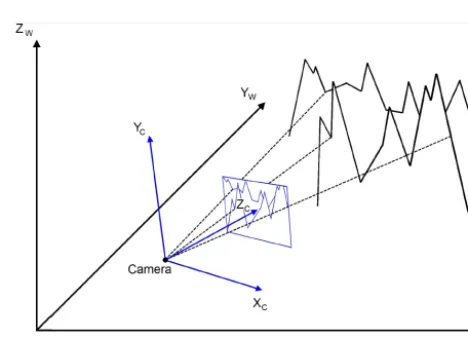
Figure 3.Schematic relationship between the camera location and orientation, and the two-dimensional photograph (blue) and three-dimensional real world coordinate system (black). The dashed line connects the locations of three exemplary ground control points of the photograph with the real world for clarification.
The second part calibrated the NDSIthrfor the satellite scene
of interest and used the achieved value to calculate an NDSI-based satellite snow cover map (Fig. 2, right column).
The photo georectification is based on the assumption that the recorded two-dimensional photograph (Fig. 3, blue colour) is geometrically connected to the three-dimensional real world (Fig. 3, black colour). Georectification is possible if the camera type, lens and sensor system, location and ori-entation are known and if a high-resolution digital elevation model (DEM) is available.
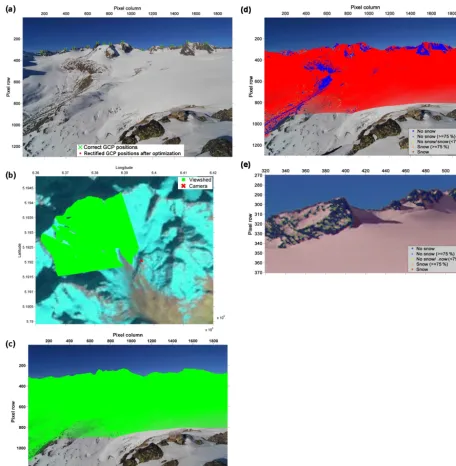
Figure 4.Internal processing steps within a single PRACTISE evaluation are shown for a photograph of VF on 17 November 2011. The figures chronologically show the routines for the photograph processing in PRACTISE which are(a)the optimization of the camera location and orientation using ground control points,(b)the viewshed analysis performed using the resulting camera location and orientation,(c)the projection and(d)the classification of visible DEM pixels. More details of the PCA-based classification results in(d)can be seen in an enlarged view in(e).
sourceforge.net/, last access: 2 May 2018). Once all data were available and ready, the PRACTISE program evalua-tion could start.
In the first step, information about the camera location and orientation was needed for georectification of the photogra-phy. This information was automatically optimized by using ground control points (GCPs, Fig. 4a; Sect. 3.3 in Härer et al., 2013). The calculated viewpoint and viewing direction
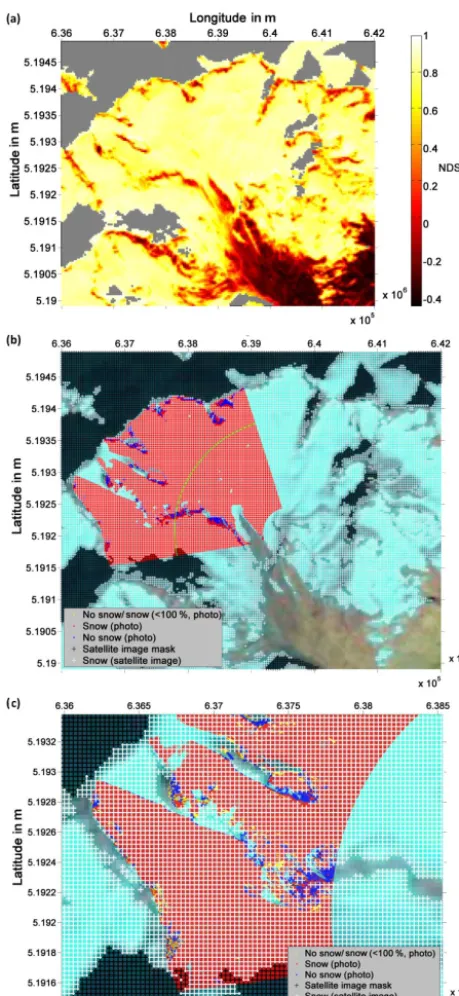
Figure 5.We outline here the internal processing steps within the remote sensing routines of PRACTISE. The Landsat NDSI map from 17 November 2011 is shown in(a). Clouds and shadows (grey areas) are excluded using Fmask. The photograph and satellite snow cover map derived from the PRACTISE evaluation are superim-posed on the LandsatLook image of 17 November 2011 in (b). Snow is depicted in red in the photograph snow map and white in the satellite snow map. The lower areas at VF (south-east of the green line in(b)were excluded from the complete analysis. The close-up in(c)clarifies which photographed areas are part of the analysis and additionally underlines the high agreement between photograph and satellite snow cover map. The maps are projected in the Universal Transverse Mercator (UTM) system based on the World Geodetic System 1984 (WGS84).
Then, the snow classification module was activated to dif-ferentiate between snow-covered and snow-free DEM pixels (Fig. 4d). Two major procedures were available for classi-fication: statistical analysis which used the blue RGB band (Salvatori et al., 2011; Sect. 3.4 in Härer et al., 2013) and an approach based on principal component analysis (PCA; Sect. 3.1 in Härer et al., 2016). The first was used for shadow-free scenes, the second for scenes with shaded areas. Sec-tion 3.4 in Härer et al. (2013) gives more insights into a third manual option if none of the two classification routines could be applied successfully. Moreover, it was shown in Sect. 4 in Härer et al. (2013) that even if a wrong classification al-gorithm was applied, no more than 5 % of the pixels in the error-prone parts of the photograph snow cover map were misclassified. It was also shown in an earlier publication that the classification of shadow-affected photographs are of the same quality as photographs without shadows (Sect. 4 in Härer et al., 2016). As for this study, every classified image was visually inspected and no major snow classification er-rors comparable to our worst case example in the previous publication were found; we expect a relative misclassifica-tion error of 1 %. For the example photograph of VF on 17 November 2011, the snow classification algorithm utilizing PCA was selected to account for the shadow-affected areas in the upper left part of the photograph (Fig. 4d, enlarged view in Fig. 4e).
After the photograph rectification and classification, the remote sensing routine of PRACTISE began with the identi-fication of satellite pixels that spatially overlap with the pho-tograph snow cover map (Sect. 3.2 in Härer et al., 2016). The photograph and satellite image used were thereby recorded within 1 (RCZ) to 3 h (VF). Moreover, a cloud- and shadow-free satellite image is generated by using Fmask (Zhu et al., 2015). The NDSI map required was calculated according to Eq. (1) of PRACTISE (Fig. 5a).
If both the NDSI satellite map and the corresponding high-resolution photograph snow cover map were processed, the iterative calibration of the NDSI threshold value was begun. The Landsat image was thereby resampled to the finer reso-lution of the photograph snow cover map in the calibration to avoid losing any information through aggregation. The best agreement between the local-scale (photograph) and the large-scale (Landsat) snow cover maps was detected by max-imizing accuracy, which is the ratio of identically classified pixels to the overall number of photograph–satellite image pixel pairsn(Aronica et al., 2002):
F =(a+d)
n . (3)
shown for more detail in Fig. 5c.
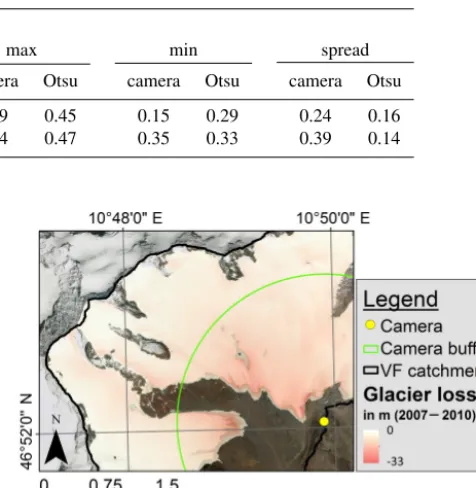
The glacier retreat between DEM production years (2007, 2010) and over the analysis period 2010–2015 resulted in a discrepancy between real world elevations and the avail-able DEMs, especially in the last years of the observation period. Figure 6 exemplarily depicts the glacier retreat be-tween 2007 and 2010 by superimposing the ice mass loss on an orthophoto of VF from 2010. This loss in elevation leads to inaccuracies in the georectification results of the photographs. Additionally, testing the 28 August 2010 pho-tograph by applying the DEM of 2007 and 2010 showed that these georectification issues in turn affect the NDSIthr
calibration results. For the DEM from 2007, the calibrated NDSIthr is 0.47, while the correct threshold for the
up-to-date DEM from 2010 is 0.52. As a consequence, we limited the analysis to higher elevated and thus colder areas of the catchment where glacier retreat is marginal (areas north-west of the green line in Figs. 5b and 6).
To ensure that reducing the spatial overlap between photo-graph snow cover map and NDSI satellite map does not have any negative effect on the calibrated NDSIthr, we firstly
cal-ibrated the NDSIthrfor the three investigated Landsat scenes
in 2010 for the complete and the upper area only. Moreover, we calibrated the NDSIthr for the 44 remaining scenes
be-tween 2011 and 2015 using the upper area DEM from 2007 and 2010 to test for NDSIthr sensitivity in the longer time
series. For both approaches, the differences between the cal-ibrated NDSIthr never become larger than 0.01. Hence, we
assume that our calibration approach of using the higher el-evated areas at VF which is incorporated in PRACTISE by excluding a radius of 1800 m around the camera from the analysis (green line in Figs. 5b and 6) is valid for the com-plete analysed time series between 2010 and 2015. As we did not find a similar effect on the NDSIthrcalibration in our
tests at RCZ, there was no need to remove the glacier areas at RCZ from the analysis.
Figure 6.Glacier retreat from 2007 to 2010 causes a loss in eleva-tion of up to−33 m at VF. The green line depicts the buffer distance around the camera which was excluded from the analysis due to sig-nificant glacier loss which in turn led to geometric inaccuracies in the photograph rectification and incorrect NDSI threshold calibra-tion results.
4 Results and discussion
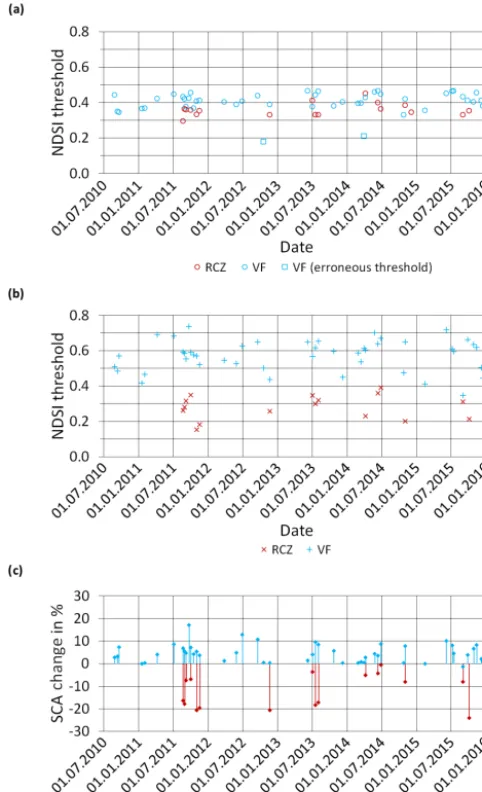
The NDSI thresholds derived by the two dynamic meth-ods are now discussed and related to static thresholds. The NDSIthrpredicted by the Otsu method are densely grouped
around 0.4. This is underlined by a mean of 0.36 and a stan-dard deviation of 0.04 at RCZ and a mean of 0.41 with a corresponding standard derivation of 0.04 at VF (Table 1). The statistics do not include two dates at VF as no separat-ing NDSIthr could be found by using the Otsu method here
(squares in Fig. 7a). This contradicts the real situation as the photographs show that there was no full snow coverage at the respective dates which would generally allow for predic-tion of NDSIthr. This shows that the application of the Otsu
method is potentially uncertain in nearly fully snow-covered situations. Furthermore, the small and thus almost negligible differences with the standard of 0.4 do not justify the addi-tional effort of using a location-dependent threshold predic-tion like the Otsu method. Addipredic-tionally, the weak seasonal dynamics which can be found at VF also do not require time-dependent calculation of the threshold.
Figure 7.The figure displays in(a)the complete time series of ad-justed NDSI thresholds using the Otsu segmentation method (cir-cles, erroneous thresholds as squares) at RCZ (red) and VF (blue) and depicts in(b)the camera-calibrated NDSI thresholds at these two sites utilizing ground-based photographs as in situ measure-ments (blue pluses for VF and red crosses for RCZ). Relative SCA changes at RCZ and VF resulting from the application of the stan-dard instead of the camera-calibrated reference NDSI threshold are shown in(c).
of NDSIthrbetween the two sites. The archived 16 NDSIthrat
RCZ and 47 NDSIthrat VF are compared in a first step. The
presumption of a comparable NDSIthr for both sites could
not be confirmed in this case. Significant differences were detected despite the fact that both sites are high alpine and are located within a single Landsat scene. Moreover, the cali-brated NDSIthrwere in large parts significantly different than
the standard value of 0.4. Figure 7b and Table 1 illustrate the variability and the range of NDSIthr at both sites. The
minimum value at RCZ is 0.15 while the maximum value is 0.39. The values at VF are generally higher and range
be-Figure 8.Estimates of NDSI threshold values at VF are predicted by a quadratic polynomial model (NDSIvf, blue line) which was fitted for each day of the year to the calibrated NDSI thresholds be-tween 2010 and 2013 (NDSIthr, blue pluses). The black asterisks
represent the NDSIthrfrom 2014 to 2015 at VF used for
evalua-tion of NDSIvf. Additionally, an NDSIthrprediction model for RCZ
(NDSIrcz, red line) is defined by a quadratic polynomial model
fit-ted to the complete time series of calibrafit-ted NDSIthrat VF (blue
pluses and black asterisks,r2=0.36, RMSE=0.07) and an addi-tional term of−0.34. NDSIrczis evaluated against the calibrated
NDSIthrof RCZ (red crosses).
tween 0.35 and 0.74. Values at both sites thus strongly scatter around their catchment-specific mean value (0.28 at RCZ, 0.57 at VF) but show characteristic development over the year (Fig. 8), which is also detected in a weaker form for the Otsu method at VF. Independent of the fact that this sea-sonal dynamic is comparable for both sites using the camera-based method, Fig. 7b highlights that the correlation coeffi-cient between NDSIthrat RCZ and VF is very low when they
are compared on a date-by-date basis (r=0.17). By contrast, a correlation between the Otsu method and the terrestrial camera-based method at VF of−0.56 is found, which how-ever cannot be observed at RCZ between the two methods (r=0.10, Fig. 7a and b).
The results of the camera-based methods require deeper investigation to analyse if such different NDSIthrvalues are
justifiable. Despite the strong scatter and the resulting low correlation, the differences in the catchment-specific mean NDSIthrlevels seem to be systematic (Table 1). Topographic
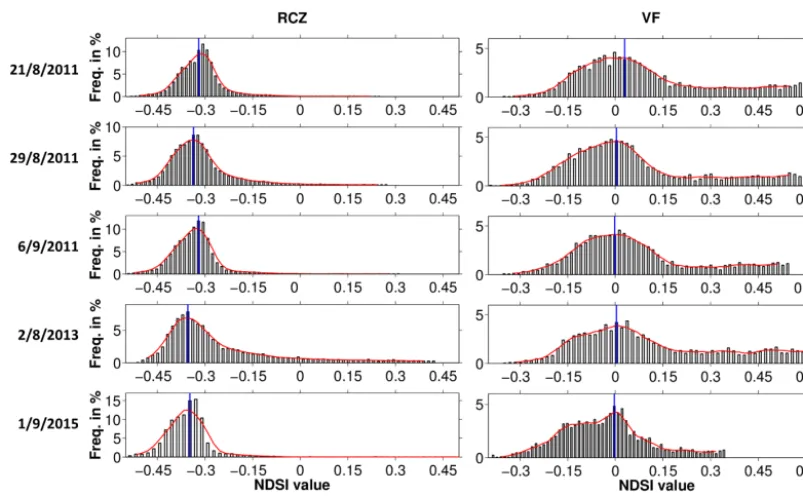
Figure 9.Representative NDSI values for the rock surfaces in RCZ and VF catchment are determined using frequency histograms of the snow-free bare rock NDSI values for five summer dates. A smoothed moving average of five histogram classes is shown with red. The maxima of the smoothed histograms are depicted in blue for each catchment and the dates investigated.
VF. This corresponds to the spectral behaviour of limestone and gneiss. Limestone is typically lighter than gneiss in the visible range but the reflectance further increases for wave-lengths up to 2 µm while it stays similar for a typical gneiss. As the NDSI calculates the difference between the green (0.55 µm) and the mid-infrared wavelength (1.55 µm) in the numerator and uses the sum of these two bands in the denom-inator, limestone has therefore a negative value and gneiss is around zero. The mean NDSI difference of the rocks at RCZ and VF amounts to about 0.34. This difference is compara-ble to the mean systematic difference of 0.26 found for the mean calibrated NDSIthrat both sites. It is therefore
proba-ble that the different rock types and therefore the background radiation trigger the catchment-specific mean NDSIthrlevels
which in turn supports the idea of adapting NDSIthrlocally.
Next, the effect of the calibrated NDSIthron the SCA
pre-dicted at RCZ and VF is analysed. The differences between the SCA predicted with the standard threshold of 0.4 and those predicted with the Otsu method are small in our study. This can be related to the minor differences between standard NDSIthrand the threshold predicted over Otsu. The absolute
differences are 0.05 km2on average for VF and 0.15 km2for RCZ. The effects achieved with the photographic method in-stead are on a level which questions the applicability of the standard threshold for local investigations. The differences in SCA between the products using the calibrated NDSIthrand
the standard threshold of 0.4 are calculated using the camera-calibrated SCA as baseline which has shown the highest
ac-curacy of the derived snow cover products when compared to the available photo classifications of PRACTISE (Härer et al., 2016):
SCAdiff %=
100(SCA0.4−SCAcam)
SCAcam
. (4)
The values are between−24.1 % at RCZ and+17.2 % at VF (Fig. 7c) and reveal how different standard and calibrated NDSI-based snow cover maps are on the small scale. The deviations are in general larger at RCZ, where the calibrated NDSI threshold values are mainly below 0.4. This means that the SCA is systematically underestimated when using the standard of 0.4. The lower error at VF compared to the error percentages at RCZ could be related to the generally higher snow-covered area in the VF catchment. These relative dif-ferences result in turn in significantly different absolute SCA (standard threshold versus calibrated threshold). Here, the highest differences are 1.09 km2at RCZ and 1.67 km2at VF. This is a relevant error margin especially if the small catch-ment sizes of only 13.1 km2 (RCZ) and 11.5 km2 (VF) are taken into account.
Given this finding and the large variability observed in cal-ibrated NDSIthr, it is obvious that methods which locally
cal-ibrate the NDSIthrfor a single date and then apply this
of the observed NDSI thresholds at VF (0.35 to 0.74). How-ever, when applied to the complete time series, this approach results in a mean absolute error in SCA of 1.26 km2 com-pared to an average deviation of 0.41 km2 for the standard threshold method. This approach thus might help in some studies where, by chance, an NDSI threshold is found for the calibration date that also describes the other analysis dates well. However, our example shows that the chances are also high that it deteriorates the accuracy compared to the stan-dard threshold method when applied to other dates.
An alternative to the temporally constant threshold meth-ods is a statistical modelling approach fitted to the cali-brated NDSIthr. This however requires a solid set of
calibra-tion data to adjust the model to the observacalibra-tions at multi-ple dates. VF hence serves as an exammulti-ple for this approach because of its higher data availability. As stated before a seasonal dynamic in the calibrated NDSIthr could be
ob-served at both sites. A quadratic polynomial model was fit-ted against the day of year for the calibrafit-ted NDSIthrof the
years 2010 to 2013 at VF (NDSIvf, Fig. 8). NDSIvfmight not
exactly reproduce the calibrated thresholds at any time step (r2=0.45; RMSE=0.06), but the evaluation of this simple model for 2014 and 2015 at VF shows a remarkable reduc-tion in the average SCA error from 0.35 km2 when apply-ing the standard threshold of 0.4 down to 0.17 km2. These results are promising. We investigated whether the seasonal behaviour of the calibrated NDSI thresholds can be attributed to the elevation and azimuth angles of the sun. The corre-lation r between azimuth angle and NDSI is 0.75 for RCZ and 0.42 for VF. For sun elevation, r is 0.77 for RCZ and 0.54 for VF. The found correlation values are significant at the 0.001 level except for the azimuth angle at VF which is significant at the 0.01 level. The sun angles thus explain the seasonal development while the observed variability within the seasons is still unclear. Snow age, grain size, albedo de-velopment or other effects might be potential drivers of this behaviour. A detailed investigation of this variability is how-ever beyond this study but will be the subject of future stud-ies.
As not every site is equipped with camera infrastructure, it was also tested if the achieved regression model can be transferred to RCZ while including information about the geology-dependent offset among the average NDSIthr
val-ues. Hence, the model is fitted to the complete calibrated NDSIthr time series at VF (r2=0.36; RMSE=0.07) and
a term (−0.34) for the systematic mean NDSI difference of the rocks at RCZ and VF is added (NDSIrcz, Fig. 9).
The evaluation of NDSIrcz seems to slightly underestimate
the calibrated NDSIthr at RCZ. Nevertheless, the quadratic
polynomial model accounting for the reflectance differences at different sites results in a significant reduction of snow cover mapping uncertainties of 40 % as the mean SCA error amounts to 0.18 km2 while the application of the standard threshold method causes an average deviation in snow cover of 0.31 km2in RCZ. Given the assumption that the seasonal
dynamic and the correction factor are generally applicable, the presented seasonal model derived from the multi-year use of PRACTISE at a single site is hence not only temporally transferrable: by using information about the spectral proper-ties of the pending rock types without the need for other cam-era systems, it is also spatially transferrable. This assump-tion and the transferability of the model is probably only true for high-elevation areas where the atmospheric absorbance is low. Even though the NDSI is an index which reduces the de-pendence on atmospheric conditions, atmospheric correction might be necessary, in addition to more dynamic approaches that reflect the vegetation growth and senescence over the year for lowland areas. Hence, the approach needs to be fur-ther evaluated and developed in future studies with more test sites.
Figure 10.At VF, we exemplarily show in(a)the effect of scaling to NDSI-based snow cover products for a Landsat 7 scene on 16 Septem-ber 2012. The columns from left to right are the camera-calibrated SCA, the standard threshold SCA, and their differences at VF. The different rows show different scaling factors, being 1 (30 m) 3 (90 m), 7 (210 m), 17 (510 m) and 33 (990 m) from the top to the bottom. The concurrent photograph in(b)depicts the snow situation at VF in our example. The analysis of all investigation dates in(c)shows at which pixel size how many of the camera-calibrated and standard threshold snow cover maps become identical. The spatial resolutions of the Sentinel-2, Landsat, MODIS and NOAA AVHRR satellites are outlined for clarity.
5 Conclusions
The study has revealed that using the standard threshold of 0.4 is adequate for satellite products with a pixel size of 500 m and more. For higher-resolution snow cover map-ping, significant improvements in the quality of the snow cover maps can be achieved if a threshold is used which is variable in space and time. The clustering-based segmen-tation technique of Otsu produces results which are only slightly different from those of the standard threshold of 0.4 and does not indicate a need for a further adaption. How-ever when compared to local images, the resulting differ-ences become obvious and could only be reduced by the presented camera-based technique. The long-term analysis of calibrated NDSIthrat two comparable high-elevation sites
has shown that large deviations from the 0.4 standard thresh-old exist. The calibrated optimal threshthresh-old values span a range from 0.15 to 0.74 over the complete time series and can reach a difference of 0.45 between the observation sites
at a single date. It was also shown that these differences in NDSIthrlead to significantly different SCA when compared
to the standard of 0.4.
The NDSIthrat both sites have similar seasonal dynamics
while scattering around different site-specific average values (0.28 at RCZ, 0.57 at VF). The difference between the aver-age threshold values at the two sites could be related to the different reflection properties of the rock types in the investi-gation areas (limestone at RCZ and gneiss at VF). The overall correlation coefficient between NDSIthrof both sites is low
(r=0.17). This prohibits the general use of one catchment’s calibrated threshold values in another catchment of the same satellite scene.
a fixed NDSI threshold can lead to large uncertainties in the resulting snow cover products at least at the local scale. Con-sequently, local studies must account for the NDSIthr
vari-ability in space and time in order to guarantee high-accuracy snow cover products. However, when studies are carried out with sensors with a pixel size of 500 m or greater, the advan-tage of a location-dependent NDSIthrvanishes.
It was shown that site-specific single-date adaptations of the NDSIthr also do not lead to resilient results. The
uncer-tainty introduced by a single measurement is not quantifi-able and can lead to results worse than that achieved by using the standard value of 0.4. A quantitative calibration or visual derivation of the NDSIthrfor a single date and its application
to other dates is therefore inappropriate.
The approximation of the NDSIthrover a simple seasonal
model fitted to the calibrated NDSIthr at the respective site
has shown improvements instead. The achieved model was able to reduce the error in the SCA prediction by 50 % when compared to the standard threshold method. Nevertheless, a fundamental data pool of in situ information covering the dy-namic over the year and the range of possible NDSIthrwithin
a season is needed for calculating this relation. Finally, it was shown that the fitted model parameters are also spa-tially transferable if an additional term accounts for the back-ground radiation of the different rock types. This is possible without in situ measurements by utilizing the constant NDSI differences of the rock surface in the respective catchments. However, this needs to be further tested at more sites. Future studies will hence use the existent webcam infrastructure in the European Alps as well as camera systems installed world-wide at the INARCH network sites (Pomeroy et al., 2015) for the generation of numerous calibrated NDSIthr. The observed
threshold values will serve as an operational source for ap-plicable NDSIthrand will allow for the evaluation of the
pre-sented temporally and spatially variable prediction approach of NDSIthr. In the case of a successful evaluation, the
pre-sented scheme allows for objective and reproducible deriva-tion of the NDSIthrvalue for any given satellite scene. This is
a large advantage as, until now, the threshold is often set in-tuitively or assumed to be constant, which neither conforms to the complexity of the models evaluated on basis of NDSI-based snow cover maps nor to the needs of the models which assimilate these maps.
Data availability. Relevant data can be made available upon
re-quest to the authors.
Competing interests. The authors declare that they have no conflict
of interest.
Acknowledgements. This work was funded by the Austrian
Science Fund (I 2142-N29), the doctoral scholarship program
of the German Federal Environmental Foundation (DBU) and the Helmholtz Research School Mechanisms and Interactions of Climate Change in Mountain Regions (MICMoR), and has additionally received a fundamental support of the Environmental Research Station Schneefernerhaus (UFS) as part of the Virtual Alpine Observatory (VAO). The Commission for Glaciology of the Bavarian Academy of Sciences and Humanities kindly provided Vernagtferner data. We want to thank the crew of the UFS (Markus Neumann, Till Rehm and Hannes Hiergeist) for supporting this piece of research by hosting the authors and maintaining the camera system. Thomas Werz and Michael Weber also supported the research by periodically maintaining the camera system. Finally, we want to thank the editor Guillaume Chambon, and the reviewers Simon Cascoin and Nick Rutter for their useful comments and suggestions on the manuscript.
Edited by: Guillaume Chambon
Reviewed by: Nick Rutter and Simon Gascoin
References
Abermann, J., Kuhn, M., and Fischer, A.: A reconstruc-tion of annual mass balances of Austria’s glaciers from 1969 to 1998, Ann. Glaciol., 52, 127–134, https://doi.org/10.3189/172756411799096259, 2011.
Agosta, C., Fettweis, X., and Datta, R.: Evaluation of the CMIP5 models in the aim of regional modelling of the Antarc-tic surface mass balance, The Cryosphere, 9, 2311–2321, https://doi.org/10.5194/tc-9-2311-2015, 2015.
Aronica, G., Bates, P. D., and Horritt, M. S.: Assessing the uncer-tainty in distributed model predictions using observed binary pat-tern information within GLUE, Hydrol. Process., 16, 2001–2016, https://doi.org/10.1002/hyp.398, 2002.
Bernhardt, M. and Schulz, K.: SnowSlide: A simple routine for cal-culating gravitational snow transport, Geophys. Res. Lett., 37, L11502, https://doi.org/10.1029/2010GL043086, 2010. Bernhardt, M., Schulz, K., Liston, G. E., and Zängl, G.: The
in-fluence of lateral snow redistribution processes on snow melt and sublimation in alpine regions, J. Hydrol., 424–425, 196–206, https://doi.org/10.1016/j.jhydrol.2012.01.001, 2012.
Bernhardt, M., Härer, S., Jacobeit, J., Wetzel, K. F., and Schulz, K.: The Virtual Alpine Observatory – research focus Alpine hydrol-ogy, Hydrol. Wasserbewirts., 58, 241–243, 2014.
Bernhardt, M., Schulz, K., and Pomeroy, J.: The International Network for Alpine Research Catchment Hydrology. A new GEWEX crosscutting Project, Hydrol. Wasserbewirts., 59, 190– 191, 2015.
Burns, P. and Nolin, A.: Using atmospherically-corrected Landsat imagery to measure glacier area change in the Cordillera Blanca, Peru from 1987 to 2010, Remote Sens. Environ., 140, 165–178, https://doi.org/10.1016/j.rse.2013.08.026, 2014.
Butt, M. J.,and Bilal, M.: Application of snowmelt runoff model for water resource management, Hydrol. Process., 25, 3735–3747, https://doi.org/10.1002/hyp.8099, 2011.
ar-data assimilation system, Q. J. Roy. Meteorol. Soc., 137, 553– 597, https://doi.org/10.1002/qj.828, 2011.
Dozier, J.: Snow reflectance from LANDSAT-4 Thematic Mapper, IEEE T. Geosci. Remote, GE-22, 323–328, https://doi.org/10.1109/TGRS.1984.350628, 1984.
Dozier, J.: Spectral Signature of Alpine Snow Cover from the Landsat Thematic Mapper, Remote Sens. Environ., 28, 9–22, https://doi.org/10.1016/0034-4257(89)90101-6, 1989.
Drusch, M., Vasiljevic, D., and Viterbo, P.: ECMWF’s global snow analysis: Assessment and revision based on satellite observations, J. Appl. Meteo-rol., 43, 1282–1294, https://doi.org/10.1175/1520-0450(2004)043<1282:EGSAAA>2.0.CO;2, 2004.
Dutra, E., Viterbo, P., Miranda, P. M. A., and Balsamo, G.: Com-plexity of Snow Schemes in a Climate Model and Its Impact on Surface Energy and Hydrology, J. Hydrometeorol., 13, 521–538, https://doi.org/10.1175/JHM-D-11-072.1, 2012.
Dyurgerov, M.: Mountain and subpolar glaciers show an increase in sensitivity to climate warming and intensification of the water cycle, J. Hydrol., 282, 164–176, https://doi.org/10.1016/S0022-1694(03)00254-3, 2003.
Hall, D. K. and Riggs, G. A.: Accuracy assessment of the MODIS snow products, Hydrol. Process., 21, 1534–1547, https://doi.org/10.1002/hyp.6715, 2007.
Hall, D. K., Foster, J. L., Salomonson, V. V., Klein, A. G., and Chien, J. Y. L.: Development of a technique to assess snow-cover mapping errors from space, IEEE T. Geosci. Remote, 39, 432– 438, https://doi.org/10.1109/36.905251, 2001.
Hall, D. K., Riggs, G. A., Salomonson, V. V., DiGirolamo, N. E., and Bayr, K. J.: MODIS snow-cover products, Remote Sens. Environ., 83, 181–194, https://doi.org/10.1016/S0034-4257(02)00095-0, 2002.
Härer, S., Bernhardt, M., Corripio, J. G., and Schulz, K.: PRAC-TISE – Photo Rectification And ClassificaTIon SoftwarE (V.1.0), Geosci. Model Dev., 6, 837–848, https://doi.org/10.5194/gmd-6-837-2013, 2013.
Härer, S., Bernhardt, M., and Schulz, K.: PRACTISE – Photo Rectification And ClassificaTIon SoftwarE (V.2.1), Geosci. Model Dev., 9, 307–321, https://doi.org/10.5194/gmd-9-307-2016, 2016.
Homan, J. W., Luce, C. H., McNamara, J. P., and Glenn, N. F.: Improvement of distributed snowmelt energy bal-ance modeling with MODIS-based NDSI-derived fractional
and precipitation variability on near-term snow trends, Clim. Dy-nam., 45, 1099-1116, https://doi.org/10.1007/s00382-014-2357-4, 2015.
Maussion, F., Scherer, D., Finkelnburg, R., Richters, J., Yang, W., and Yao, T.: WRF simulation of a precipitation event over the Tibetan Plateau, China – an assessment using remote sensing and ground observations, Hydrol. Earth Syst. Sci., 15, 1795–1817, https://doi.org/10.5194/hess-15-1795-2011, 2011.
Mayr, E., Hagg, W., Mayer, C., and Braun, L.: Calibrating a spa-tially distributed conceptual hydrological model using runoff, an-nual mass balance and winter mass balance, J. Hydrol., 478, 40– 49, https://doi.org/10.1016/j.jhydrol.2012.11.035, 2013. Otsu, N.: Threshold Selection Method from Gray-Level
Histograms, IEEE T. Syst. Man. Cyb., 9, 62–66, https://doi.org/10.1109/Tsmc.1979.4310076, 1979.
Painter, T. H., Rittger, K., McKenzie, C., Slaughter, P., Davis R. E., and Dozier, J.: Retrieval of subpixel snow covered area, grain size, and albedo from MODIS, Remote Sens. Environ., 113, 868– 879, https://doi.org/10.1016/j.rse.2009.01.001, 2009.
Pomeroy, J., Bernhardt, M., and Marks, D.: Research network to track alpine water, Nature, 521, 32–32 https://doi.org/10.1038/521032c, 2015.
Racoviteanu, A. E., Paul, F., Raup, B., Khalsa, S. J. S., and Armstrong, R.: Challenges and recommendations in mapping of glacier parameters from space: results of the 2008 Global Land Ice Measurements from Space (GLIMS) workshop, Boulder, Colorado, USA, Ann. Glaciol., 50, 53–69, https://doi.org/10.3189/172756410790595804, 2009.
Rangwala, I., Miller, J. R., Russell, G. L., and Xu, M.: Using a global climate model to evaluate the influences of water vapor, snow cover and atmospheric aerosol on warming in the Tibetan Plateau during the twenty-first century, Clim. Dynam., 34, 859– 872, https://doi.org/10.1007/s00382-009-0564-1, 2010. Rouse Jr., J., Haas, R. H., Schell, J. A., and Deering, D. W.:
Mon-itoring vegetation systems in the Great Plains with ERTS, in: 3rd Earth Resources Technology Satellite-1 Symposium – Vol. I: Technical Presentations, NASA SP-351, NASA, Washington, USA, 309–317, 1974.
Sankey, T., Donald, J., Mcvay, J., Ashley, M., O’Donnell, F., Lopez, S. M., and Springer, A.: Multi-scale analysis of snow dynam-ics at the southern margin of the North American continen-tal snow distribution, Remote Sens. Environ., 169, 307–319, https://doi.org/10.1016/j.rse.2015.08.028, 2015.
Santini, M. and di Paola, A.: Changes in the world rivers’ dis-charge projected from an updated high resolution dataset of current and future climate zones, J. Hydrol., 531, 768–780, https://doi.org/10.1016/j.jhydrol.2015.10.050, 2015.
Silverio, W. and Jaquet, J. M.: Prototype land-cover mapping of the Huascaran Biosphere Reserve (Peru) using a digital elevation model, and the NDSI and NDVI indices, J. Appl. Remote Sens., 3, 033516, https://doi.org/10.1117/1.3106599, 2009.
Sirguey, P., Mathieu, R., and Arnaud, Y.: Subpixel monitoring of the seasonal snow cover with MODIS at 250 m spatial resolu-tion in the Southern Alps of New Zealand: Methodology and accuracy assessment, Remote Sens. Environ., 113, 160–181, https://doi.org/10.1016/j.rse.2008.09.008, 2009.
Takata, K., Emori, S., and Watanabe, T.: Development of the minimal advanced treatments of surface interac-tion and runoff, Global Planet. Change, 38, 209–222, https://doi.org/10.1016/S0921-8181(03)00030-4, 2003. Tekeli, A. E., Akyurek, Z., Sorman, A. A., Sensoy, A., and Sorman,
A. U.: Using MODIS snow cover maps in modeling snowmelt runoff process in the eastern part of Turkey, Remote Sens. En-viron., 97, 216–230, https://doi.org/10.1016/j.rse.2005.03.013, 2005.
Tennant, C. J., Crosby, B. T., and Godsey, S. E.: Elevation-dependent responses of streamflow to climate warming, Hy-drol. Process., 29, 991–1001, https://doi.org/10.1002/hyp.10203, 2015.
Thirel, G., Salamon, P., Burek, P., and Kalas, M.: Assimilation of MODIS Snow Cover Area Data in a Distributed Hydrological Model Using the Particle Filter, Remote Sens., 5, 5825–5850, https://doi.org/10.3390/rs5115825, 2013.
Tucker, C. J.: Red and photographic infrared linear combinations for monitoring vegetation, Remote Sens. Environ., 8, 127–150, https://doi.org/10.1016/0034-4257(79)90013-0, 1979.
Vavrus, S., Philippon-Berthier, G., Kutzbach, J. E., and Ruddiman, W. F.: The role of GCM resolution in simulating glacial inception, Holocene, 21, 819–830, https://doi.org/10.1177/0959683610394882, 2011.
Viviroli, D., Archer, D. R., Buytaert, W., Fowler, H. J., Greenwood, G. B., Hamlet, A. F., Huang, Y., Koboltschnig, G., Litaor, M. I., Lopez-Moreno, J. I., Lorentz, S., Schaedler, B., Schreier, H., Schwaiger, K., Vuille, M., and Woods, R.: Climate change and mountain water resources: overview and recommendations for research, management and policy, Hydrol. Earth Syst. Sci., 15, 471–504, https://doi.org/10.5194/hess-15-471-2011, 2011. Warscher, M., Strasser, U., Kraller, G., Marke, T., Franz, H., and
Kunstmann, H.: Performance of complex snow cover descrip-tions in a distributed hydrological model system: A case study for the high Alpine terrain of the Berchtesgaden Alps, Water Resour. Res., 49, 2619–2637, https://doi.org/10.1002/wrcr.20219, 2013. Weber, M., Bernhardt, M., Pomeroy, J. W., Fang, X., Härer, S., and
Schulz, K.: Description of current and future snow processes in a small basin in the Bavarian Alps, Environ. Earth Sci., 75, 1223, https://doi.org/10.1007/s12665-016-6027-1, 2016.
Yin, D., Gao, X., Chen, X., Shao, Y., and Chen, J.: Comparison of automatic thresholding methods for snow-cover mapping us-ing Landsat TM imagery, Int. J. Remote Sens., 34, 6529–6538, https://doi.org/10.1080/01431161.2013.803631, 2013.