e-ISSN: 2278-7461, p-ISSN: 2319-6491
Volume 8, Issue 3 [March 2019] PP: 52-57
Transversality and Appropriation of English in an Academic
Environmental Engineering Area an experience in the classroom
Maria Alexandra Rincon, Luz Angela Cuellar
Universidad Santo Tomas, seccionalTunja, Colombia Universidad Tecnológica y pedagogica de Colombia
Corresponding Author: Maria Alexandra Rincon
ABSTRACT:
This study began in an academic space in which Environmental Engineering students at Santo Tomás University in Tunja researched Biotechnology. The students had level A2 of English as a foreign language, but they have not learned English Specific Purposes (ESP) which are used to learn specific contents in their academic program. This research responds to the students' needs who read texts within their specific area of knowledge. This research analyzes the position of the transversality of the EFL (English as a foreign language) in the integral training to be developed in the undergraduate students of the Environmental Engineering program. This research presents a descriptive, non-experimental, field approach, developed as a classroom experience. This study was done with 15 students of the eighth semester of Environmental Engineering who, during the second semester of 2018, were studying the subject of Emphasis option III called Environmental Biotechnology. The data collection was done through a structured survey by the students and a matrix of analysis for the study program. The reliability coefficient was calculated with Cronbach's Alpha method, resulting in a value of 0.85. Data analysis was performed with descriptive statistics using measures of central tendency, position, dispersion, and analysis of variance. Additionally, a teachers’ daily journal was written (Biotechnology subject and English as a foreign language) which enriched the analysis of teachers’ observations about students’ perceptions during the research process. The results show that the positioning of the EFL mainstreaming in the integrated curriculum of the Environmental Engineer is favorable because this classroom experience has permitted the design of a curriculum proposal in order to integrate English language in subjects as Option Modules of the Academic program in Environmental Engineering.Keywords: Transversality, English for Specific Purposes, curriculum, integral training, biotechnology.
--- --- Date of Submission: 25-10-2019 Date of acceptance: 06-11-2019 ---
---I.
INTRODUCTION
The transversality of the English language in Engineering subjects has become one of the main objectives that academic programs must fulfill with the minimum quality standards proposed by the (Ministry of National Education, 2004), through its National program of bilingualism 2004-2019, including the communicative competence standards in English. The program mentions as strategic projects the use of new technologies and the generation of labor competencies that facilitate the appropriation of a second language. Similarly, it is worth highlighting the competitive advantage that the command of English as a foreign language represents for students in terms of job opportunities in addition to being accompanied by a process of globalization of the country as well as free trade agreements. (Ministry of National Education, 2004).
The definition of a foreign language is considered as one that allows and is essential in the development of commercial, social and educational activities (Ministry of National Education, 2006). The management of a foreign language by Environmental Engineers allows them to develop communicative competence, strengthening processes where language facilitates the exchange of meanings of concepts and complex words. (Pilar, 2006).
For that reason, the need to provide tools to students to directly integrate the English language within the subjects given arises thanks to facing the new millennium. The current processes of development of globalization are evident where there are marked tendencies between those who know and those who do not know how to access the world of work, which influences university failure in the use of the foreign language.(Fandiño, 2012)
differences lie in the fact that the objectives of an ESP course are designed to reflect the development of specific skills in a particular area, there is an emphasis on teaching specific vocabulary and verbs that are used in the daily work of the profession to which the ESP course is focused. In addition, communicative goals depend on the students’ needs to face or will face in their area of work. On this point, Huchinson (1987)mentions that tailoring an English course to the needs of students contributes to motivation and that in turn facilitates language learning. Hyland (2007) emphasizes that the starting point of the design of an ESP course is a research base because it is necessary to know the needs of students, the discourse and the sociopolitical context. The ESP courses covered in this work belong to the Universidad Tecnológica de Gutiérrez Zamora in its academic unit of Poza Rica
Consequently, this article shows the development of experience in the classroom that contributes to the appropriation of a second language in the environmental engineering program of the Saint Thomas University Tunja, which has been developing and implementing the policy in a second language, promoting language competence in foreign languages in order to promote highly competitive graduates and implement international mobility agreements for their students and teachers in the same way the University needs to renew policies to strengthen this learning; in such a way as to enhance the academic mobility of students before the completion of subjects and of teachers for their links with international networks.
Methods
This research was developed under the parameters established by the approach of action research. This approach is defined by Elliott described by J. McKernan as " the study of a social situation with a view to improving the quality of the action inside it" (Mckernan, 2001). The approach aids in the solution of problematic situations that surround the participants. Hence, it is characterized by being cyclical since it takes a systematic process of development and by being qualitative because it does not look for exact numerical results, but it allows to carry out interpretations of the problematic situation from the self-reflection of the researcher (Mckernan, 2005).
Consequently, the Engineering Academic Program in collaboration with the Fray Bernardo de Lugo Languages Institute of Santo Tomás University has developed a strategy for the subject of Biotechnology that includes activities within academic spaces such as:
1. Management of bibliography and writing of articles of interest in a foreign language (English). 2. Oral presentation in English of exhibitions on disciplinary presented topics by students. 3. Explanation in English by the teacher, in some moments of the Masterclass.
4. Forum in English in the virtual classroom giving opinions about students’ experience.
5. The opening of ova (technical learning objectives) for courses in English in a Platform Moodle. 6. Course projects involving foreign language.
Finally, the students answered a qualitative evaluation during each one of the academic terms in the semester (academic weeks 4,8,12 y 16). Also, they answered a survey type Likert which is defined as an attitude scale of seemingly equal intervals. It belongs to what has been called the ordinal scale. It uses some series of statements or items about which a response is obtained by the subject. The presentation of this method of summary ratings for the measurement of attitudes was first published by R. Likert in 1932, starting from a survey on international relations, race relations, economic conflict, political conflict, and religion, carried out between 1929 and 1931, in many universities in the United States. The scale of Likert is one of the most used in the measurement of attitudes, probably inspired by the factor theory of skills of Charles Spearmang, who built a simple method by the simplicity of its elaboration and application (Spearmang C, 1904). These advantages include a wide range of responses; the recourse of judges, used at other scales, is also avoided, this does not affect the high correlation that is maintained with respect to other methods of measuring attitudes. According to the perspective of considering attitudes as a continuum from the unfavorable to the favorable, this technique, besides placing each individual at a certain point (which is a common feature at other scales), takes into account the breadth and consistency of attitudinal responses. The identification of the most outstanding styles of learning, and their main interests and difficulties as much in the learning of the foreign language as in that of the subject as well. The knowledge of the above-mentioned needs and interests allowed the definition of a curricular proposal that facilitates the process of biotechnology education and learning in English.
II.
RESULTS AND DISCUSSION.
Description of the experience
The experience was done in an Environmental Biotechnology class which is studied by the students of the eighth semester. Moreover, the objective of this academic space refers to the technological innovation in molecular technologies for Environmental improvement. In this academic space, they propose real topics of environmental engineering in order to go deep and apply knowledge to the solution of practical problems; using molecular specialized tools. These topics, related to the curriculum, projects and lines of research of the program, at the same time that the student could join to these projects without matter if these students have not confirmed yet any group of student’s research teams or if they would like to be part of an investigation
Consequently, this practical experimentation with elements of biotechnology and Environmental Microbiology is used to test the theory, as an essential part of the didactics of their learning. This allows to abstract, model and validate the developed designs, and even modify them quickly to be adjusted to the reality. Information systems design processes at present make it necessary for an Engineer to know about design and how structures can be modified to design in an efficient and timely way the different systems of bio or phytoremediation as modern techniques to solve problems. Considering many variables that do not make it easy to predict their behavior according to their performance to obtain the best results. This means that, within the framework of environmental issues, it is vitally important to equip future engineers with concepts and elements that enable them to carry out the use of biotechnological tools, thus becoming key for the development of new and clean technologies; within the framework of modern engineering. On the other hand, in the academic space, a strategy was applied during the second semester of 2018 to appropriate the second language in the classroom.
Quantitative assessment of the Learning Teaching Process
Assessment processes aim at both learners' learning and teaching processes themselves. The information provided by the evaluation helps the team of teachers to have relevant information in order to critically analyze and make decisions about their own educational intervention. For that reason, it was necessary to compare the information provided by the continuous assessment of students with the intended educational goals and with the action plan to implement them. Therefore, the programming of the teaching process and the teacher's involvement as a facilitator of this process, the resources used, the spaces, the planned times, the grouping of students were evaluated, as well as the evaluation criteria and tools. In other words, we evaluate everything that is limited to the field of classroom experience in the teaching-learning process. The evaluation of the process identified human and material resources, training and infrastructure needs, etc. and to rationalize both the internal use of these resources and the demands directed to the Administration to facilitate them according to the needs.
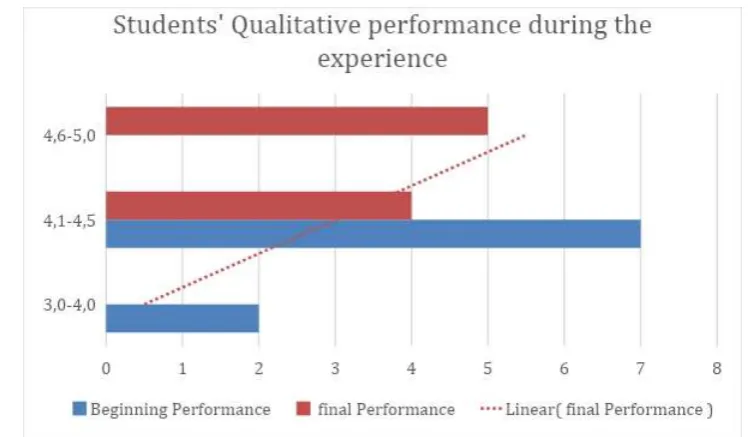
Figure 1 shows the performance of the students involved in the classroom experience of teaching English for specific purposes. It can be inferred that the students involved presented a final grade represented in the superior range with values between 4.6 and 5.0 and a tendency to improve the performance in relation to the motivation presented can be observed students throughout the classroom experience with English for specific purposes (USP).
Surveys
The surveys applied to the biotechnology students showed: first, they have knowledge about the process of bilingualism that the university develops; second, that experiments and visual resources favor and facilitate their learning, which corresponds to the stage of concrete thinking that is characterized by deductive thinking, In addition to reflecting on their actions, the results of the surveys show that listening and speaking skills must be strengthened, because this is the most difficult for students which was demonstrated during their performance. It should be noted that students place great value on learning a foreign language (see Figure 2), in this case, English. They also welcome the different methodologies that were implemented to teach subjects of last semesters as in this case the subject of biotechnology in English (see Figure 3).
The role of the student is one of the main changes achieved in language teaching. The students played a more active role as they will be responsible for the level of development of language skills and it is them that must give the greatest effort within the classroom (Ordorica, 2010). This is related to the application of the language in an area that is to your liking and which belongs to the applied areas of your program.
Regarding the role of this emotional filter in the process of acquiring a second language, Pizarro and Josephy (2010) believe that: The emotional state of the students and their attitudes act as a filter that allows the information necessary for the understanding to enter, prevent, or block the information necessary for the acquisition of the language. Thus, the higher the effective filter reflected in a higher level of anxiety, low self-esteem, and low participation – the more likely the student will fail in their learning process. On the contrary, a low affective filter will allow better levels of acquisition and learning of a second language (p.211).
Figure 2.. Answers of the questions. Excerpt from the survey.
It is important to emphasize that the interest on the part of the student body has been very notable (with 99% participation) and the level of satisfaction reached increased since it was reflected in the surveys that anonymous students have answered, where, conscious of the importance of English in formation (to which they qualify with a punctuation of 5/5), they reveal that this activity has helped them to improve their capacity of draft in the above-mentioned language 4,5/5) and reading comprehension in English, provided that they feel capable of consulting bibliography in English (4.5/5). Nevertheless, though they have qualified the activity with (4.5), the aspect that they coincide in emphasizing in a major measure is the fact that the activity helps them to establish relations among the different subjects of the study plan.
Finally, from the point of view of the teacher, it has been observed that the students who took part in the activity know the English name of the concepts of Environmental biotechnology and can access interesting bibliographies related to the subject written in English with ease. In this respect it is important to highlight that the students who took part in the above-mentioned activity write with great ease at the moment of analyze the reports own scientist of the area of work. Regarding the previous research, it is possible to affirm that subjects in their final semesters of Engineering have achieved the goal of supporting the process of bilingualism, by means of the creation of didactics for the integration of the English in the area of biotechnology.
III.
CONCLUSION
It is possible to conclude that this classroom experience will design a curriculum proposal for the integration of English into the elective subjects of the Environmental Engineering program. What contributes from this field of action and from experience in teaching practice, to the consolidation of academic programs in subjects such as Biotechnology and Environmental Microbiology in English that support both the University in its bilingual process, as the action of teachers in the development of their bilingual classes. The present proposal is therefore open to future research that could add or update favorable elements, from institutional management to quality bilingual training in Colombia.
It is important to note that the evaluation of this teaching experience, either individually or from the whole team, shows one of the most powerful training strategies to improve the quality of the teaching-learning process. Similarly, the evaluation of the teaching team as a whole made it possible to identify factors related to the functioning of the experience, personal relations, the working environment, organizational aspects, among others that are very significant elements in the functioning of classroom experiences in the study of the English language with specific Purposes.
REFERENCES
[1]. Botero, C. (2006). Los EjesTransversalescomoInstrumentoPedagógico para la Formaciónen Valores. Revista Politécnica, (3), pp. 49-59. Medellín.
[2]. Caicedo González, Yulied Carolina, et. al. Implementación de unapropuesta de bilingüismopara el colegioguimarc en suproceso de instituciónmonolingüe a bilingüe. Trabajo de grado. Licenciados en educaciónbásica con énfasis en humanidades e idiomas. Bogotá: Universidad Libre de Colombia. Facultad de Ciencias de la educación, 2010. 75 P.
[3]. Bilingüismo Para El ColegioGuimarc En Su Proceso De InstituciónMonolingüe A Bilingüe. Trabajo de grado. Licenciados en educaciónbásica con énfasis en humanidades e idiomas. Bogotá: Universidad Libre de Colombia. Facultad de Ciencias de la educación, 2010. 75 P.
[4]. Elliot, J. (2000). El CambioEducativodesde la InvestigaciónAcción. Madrid: Morata.
[5]. Fandiño-Parra; BERMÚDEZ-Jiménez., LUGO-Vásquez, J. V. E. (2012). Retos del ProgramaNacional de Bilingüismo. Colombia Bilingüe. Educ. Educ. Vol. 15, No. 3, 363-381.
[6]. Gargallo, B., Suárez, J., Morant, F., Marín, J. M., Martínez, M. y Díaz, I. (2004). Un primer diagnóstico del uso de internet en los centrosescolares de la ComunidadValenciana. Procesos de formación y efectossobre la calidad de la educación. Valencia: IVECE (InstitutoValencianodeEvaluaciónyCalidadEducativa).Versiónelctrónica:http://wwwn.mec.es/cide/espanol/publicaciones/investigaci on/estudios/inv2004tic/02.pdf
[7]. Gonzalez, V. (2003). La Educación de Valores en el CurrículoUniversitario, Un Enfoque Psicopedagógico para suEstudio. RevistaPedagogíaUniversitaria, 8(4). La Habana.
[8]. Hopkins, D. (1989). Investigación en el Aula. Guía del Profesor. Barcelona: PPU. Jiménez, M. J. y Laliena, L. (1992). Transversales: EducaciónAmbiental. Madrid: MEC.
[9]. El Ministerio de Educación Nacional (2006). Estrategiasqueorientarán la acción del sector educativoduranteestecuatrienio. MEN Colombia Plan Sectorial 2006-2010.
[10]. Jiménez, M. J. y Laliena, L. (1992). Transversales: EducaciónAmbiental. Madrid: MEC. [11]. McKernan, J. (2001). Investigación-Acción y Currículum. Madrid: EdicionesMorata.
[12]. Mckernan, James. Investigación- acción: Antecedenteshistóricos y filosóficos En: Investigaciónacción y curriculum. 2a Ed. Madrid: EdicionesMorata tr5g S.L, 2001. P. 24.
[13]. Magendzo, A. (2005). Curriculum y Transversalidad: UnaReflexióndesde la Práctica. RevistaMagisterio, agosto-septiembre. Santiago de Chile.
[14]. Práctica. RevistaMagisterio, agosto-septiembre. Santiago de Chile.
[15]. Pinkley, Diane, CLIL: Content and language integrated learning EN: Children learningEnglish as a foreign language [en línea] http://www.pearsonelt.com/professionaldevelopment/articles/Children+Learning
[16]. English+as+a+Foreign+Language+with+CLIL> [citado en 29 de Noviembre 2018]
[18]. LineamientosCurricularesInstitucionales.ColecciónDocumentosInstitucionales,(22),Bogotá:Unisalle.Universidad de La Salle. (2007). LineamientosCurricularesInstitucionales. Colección DocumentosInstitucionales, (22), Bogotá: Unisalle.
[19]. Spearman C. Inteligencia general determinada y medidaobjetivamente. Am J Psich 1904; 5: 201-293. 15. [20]. Spearman C. Prueba y medición de asociación entre dos cosas. Am J Psich 1904; 5: 72-101.
[21]. Truscott De Mejía, Anne-Marie; LÓPEZ M., Alexis y PEÑA, Beatriz. Bilingüismo en el contextocolombiano. Iniciativas y perspectivas en el siglo XXI. EdicionesUniandes. Bogotá, Colombia. 2011.
[22]. Truscott De Mejia, Anne-Marie y TOVAR Lionel Antonio. Perspectivasrecientes del bilingüismo y de la educaciónbilingüe en Colombia. Escuela de Ciencias del Lenguaje. Cali, Colombia.1999.
[23]. Zorro, Imelda, et.al. (2011). La autonomía y el aprendizaje del ingléscomolenguaextranjera. Universidad Libre. 108 p.