Image Processing Based Analysis of the Compressive Strength for the
Stones Used In Historical Masonry Structures
Suat Gokhan Ozkaya1, Mehmet Baygin2, Muhammed Alperen Ozdemir3 and Ilker Kazaz4
1 Civil Engineering, 2 Computer Engineering, Ardahan University, Ardahan, 75000, Turkey.
3
Civil Engineering, Igdir University, Igdir, 76000, Turkey.
4
Civil Engineering, Erzurum Technical University, Erzurum, 25000, Turkey.
{1suatgokhanozkaya, 2mehmetbaygin}@ardahan.edu.tr, [email protected], [email protected]
ABSTRACT
Determining the mechanical properties of materials used in masonry structures, which is one of the most important issues in civil engineering, is a field that requires very laborious and intensive laboratory work. As a result of these studies, basic mechanical properties such as compressive strength and tensile strength of structures can be obtained. These parameters, especially used in the restoration process of these structures, are the basic arguments for determining the real behavior of the structure. With this study, it was provided to examine the stones used in the historical masonry structures with computer vision technology. For this purpose, stones having different qualities taken from stone quarries are primarily taken through a camera. Subsequently, the image of each sample is transferred to the computer environment and the properties of these samples are obtained by image processing. After all these tests, these samples are tested in the laboratory and compressive strength are measured. As a result, the data obtained from the laboratory environment and the results obtained by image processing are compared and the calibration of this proposed image processing based analysis method is provided. With this new approach, which is a recommended image processing base, it is possible to perform experimental applications in the laboratory environment in computer environment. Again due to these studies very difficult and lengthy studies have been shortened to a considerable extent and the specific features of the images taken through a basic camera have been calculated very quickly in the computer environment. During the study, approximately 100 pieces of stone samples were provided and 80% of these samples were divided into two groups: training and 20% test data. Image processing based analysis method was applied to both groups and training data was used for calibration of the system. In the proposed approach, both image processing based analysis approach and laboratory crushing experiment were performed for each sample. As a result of all these tests, the proposed approach has been able to
analyze the pressure strength on the stones with a margin of error of about 2%.
Keywords: Image Processing, Artificial Neural Network, Compressive Strength, Stone.
1. INTRODUCTION
There are many historical buildings in our country, which have reached daily from a wide variety of civilizations. Historical masonry structures are also among those structures that are regarded as cultural heritage. These historical buildings need to be transmitted safely to future generations. For this reason, it is necessary to examine these historic masonry structures in detail, to test the samples taken from these structures and to make the necessary actions according to the information obtained from these tests. At the beginning of these processes restoration process is coming. However, the mechanical properties of the materials used to accomplish this process need to be thoroughly examined [1]. At this point, the most important materials that make up the accumulation of stones are at the beginning of the stones.
217 International Journal of Computer Science and Software Engineering (IJCSSE), Volume 6, Issue 10, October 2017 S. G. Ozkaya et. al
masonry structures. It has been shown that the compressive strength of the structures decreases over time with these proposed methods [5]. In another study carried out on the subject of compressive strength, the compressive strength of concrete was measured. In this study, compressive strength of concrete was determined by image processing and artificial neural network methods. The compressive strength parameters of concrete structures conveyed to artificial neural networks were determined to process the information obtained from the concrete images taken through a camera [6]. In another study on concrete compressive strength, Baygin, et al. [7] performed measurement using image processing and artificial neural network techniques. For this purpose 100 samples have been provided and the images of these samples have been taken through a camera. From these images, standard deviation, arithmetic mean and median values were obtained by image processing. The obtained values were given to the artificial neural network and the system was trained. In the test procedures, the samples were divided into two groups as training and test group and the work was confirmed by laboratory tests. A block diagram of this work is shown in Fig. 1.
Concrete Sample Collection
Separate Samples into Training (80%) and Test (20%) Sets
Receive Images of The Training and Test Sets
Apply Image Processing to a Training and Test Sets
Feature Extraction from Training and Test Sets
Train The Artificial Neural Network with Training Set
Laboratory Tests
Calibrate Artificial Neural Network Results
Comparison with Test Set
Fig. 1. An example study from the literature [7]
Image processing can be used in many different areas actively. In one of the studies performed in this frame, the detection of the rail surfaces was performed and a method for diagnosing the fault in the same operation was developed. In this work where the image processor is used, the failures between the rails have been determined with high success. Experimental results have proved that the proposed method gives accurate and effective results. In another study carried out on the compressive strength of concrete structures, the prediction of the concrete compressive strength using image processing was also carried out. In this frame, samples with different compressive strengths are produced in laboratory environment. Aggregate and cement percentages were obtained in the study and the compressive strength of the concrete was determined according to these values [8]. As mentioned in the beginning of the chapter, various methods have been developed in the literature in order to
measure the compressive strength of constructions. These methods are grouped into destructive and non-destructive methods. Examples of destructive methods include buried sample and core sampling techniques. Examples of non-destructive methods are hardness tests, pull-out tests, penetration tests, mechanical sound wave velocity techniques and ultra sound velocity techniques [9]. In this work, a new method of measuring the compressive strength with image processing and artificial neural network has been developed. In this study carried out as an example of non-destructive methods, 2 different types of stone samples were used. In the experimental works carried out on a total of 100 samples (50 andesite stone, 50 tercan stone), the images of the stones were first taken via a camera and transferred to the computer environment. After this process, stones were crushed in the laboratory and the compressive strength values of the stones were obtained and documented. Image processing steps were applied to the stone images transferred to the computer environment and arithmetic mean, standard deviation and median values were extracted from this image. Finally, these data obtained in the system are given as input to the artificial neural networks and the compressive strength values of the stones are estimated. In the study, samples were divided into two groups, training and test group, and the tests were performed separately in both groups. As a result of this proposed method, it is observed that the compressive strength values of the stones used in the masonry structures can be detected with an error rate of + -2%.
In the second part of this work carried out for this purpose, detailed features of the stone samples used in the system are presented. In the third part of the work, the proposed image processing based compressive strength technique is given in detail. In the fourth section, the results of the implementation are given and in the fifth and last section the results are shared.
2. STONE SAMPLES
In this study, two different types of natural stone extracted from the Eastern Anatolia Region of Turkey were examined. The stones examined in this study are Tercan stone (Erzincan, Turkey) and Andesite (Erzurum, Turkey). These stones, which are provided in the framework of the study, are tested in the laboratory and the compressive strengths of the stones are measured. Details of these stone samples with different compressive strength values are presented in sub-sections.
2.1 Andesite Stone
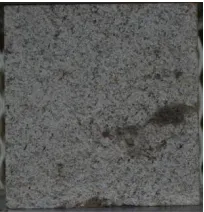
which is very easy to remove and process, is concentrated in the Turkish region. A sample image of this stone used in laboratory experiments is as shown in Fig. 2.
Fig. 2. Andesite stone sample
2.2 Tercan Stone
This stone type, which is generally used as decoration material, has an easily removable and workable structure. Sample images of this stones, which have intensive reserves and are taken from the Erzincan region of Turkey, are as shown in Fig. 3.
Fig. 3. Tercan stone sample
3. PROPOSED APPROACH
In this study, a non-destructive method was applied to estimate the compressive strength using an artificial neural network based on image processing. With this method developed, the stones obtained in the study frame are taken through a camera and the process of breaking these stones is performed in the laboratory environment. A total of 100 specimen samples from different parts of Turkey were obtained and tested. A block diagram illustrating this work, which aims to measure the compressive strength parameter without the need for any laboratory testing, is presented in Figure 4.
PC ANN Image Process
Camera
Fig. 4. Proposed approach
219 International Journal of Computer Science and Software Engineering (IJCSSE), Volume 6, Issue 10, October 2017 S. G. Ozkaya et. al
Stone samples (andesite, tercan)
Divide the samples into training and test sets
Get an image of each sample
Get arithmetic mean, standart deviation and median features from images
Train the artificial neural network with training set
Laboratory tests for samples
Check the test set with artificial neural network.
Compare with the results obtained from the laboratory environment
Fig. 5. A flowchart of the proposed approach
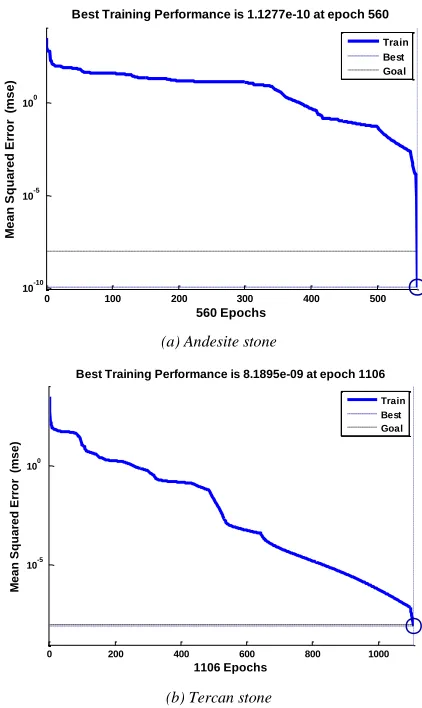
In the scope of the study, an artificial neural network with forward feed is designed. This designed artificial neural network has three inputs and one output. The input parameters of the system are the arithmetic mean, standard deviation and median, and the output parameter is the compressive strength. Details of this artificial neural network used during the study are as given in Table 1. In addition, a graphic showing the progress of the artificial neural network in the study process for all two sample types is presented in Fig. 6-(a) and (b) respectively.
Table 1: Artificial Neural network parameters
Parameters Values
Type Feed Forward Input Layer 3 Output Layer 1 Hidden Layer 20 Learning Rate
Goal
Iteration 1000 Training Set 40 Andesite, 40 Tercan
Test Set 10 Andesite, 10 Tercan
(a) Andesite stone
(b) Tercan stone
Fig. 6.The progress of artificial neural network
4. EXPERIMENTAL RESULTS
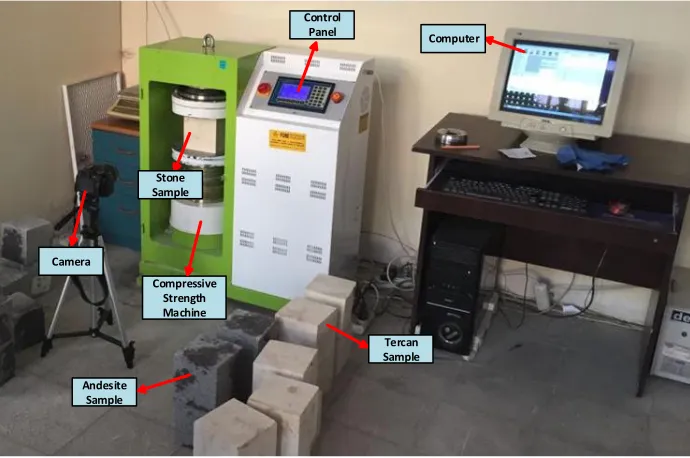
In this study, a new method of using artificial neural network based on image processing for pressure bearing of stones was developed. Two different types of samples are provided for this purpose, and the pressure strengths of these samples are different. Basically one camera is used in the system to take an image of stone samples and subjected to certain pre-processes. In addition, these samples are investigated with the artificial neural network which is included in the system and designed within the scope of the study and the compressive strength values of the samples are determined. An image of the experimental setup used in the studies is as shown in Fig. 7.
0 100 200 300 400 500
10-10 10-5 100
Best Training Performance is 1.1277e-10 at epoch 560
M
e
a
n
S
q
u
a
re
d
E
rr
o
r
(
m
s
e
)
560 Epochs
Train Best Goal
0 200 400 600 800 1000
10-5 100
Best Training Performance is 8.1895e-09 at epoch 1106
M
e
a
n
S
q
u
a
re
d
E
rr
o
r
(
m
s
e
)
1106 Epochs
Computer
Compressive Strength Machine Camera
Control Panel
Stone Sample
Tercan Sample
Andesite Sample
Fig. 7. Experimental setup
The arithmetic mean, standard deviations and median information of stones are extracted in image processing step and input to artificial neural networks. A total of 100 samples were used in the study, 50 for each of the two sample types. The values obtained for some of the samples used for training are as given in Table 2. As given in the beginning of the section, only a certain part of the data used in the study is presented in this study. Sample values of the test samples used for this purpose are presented in Table 3. In addition, the compressive strength values obtained for test specimens are given in Table 4.
Table 2: Sample training data
Parameters
Samples
Andesite Stone Tercan Stone
S1 S2 S1 S2
Input
Standard
Deviation 0.014 0.008 0.011 0.011
Arithmetic
Mean 0.366 0.362 0.554 0.543
Median 0.380 0.376 0.584 0.592
Output
Compressive Strength
(MPa)
53.09 41.24 13.43 15.02
Table 3: Artificial neural network parameters for test set
Samples
Input Parameters
Andesite Stone Tercan Stone
Standard Deviation
Arithmetic
Mean Median
Standard Deviation
Arithmetic
Mean Median
S1 0.0146 0.4796 0.4980 0.0132 0.5718 0.6039
S2 0.0153 0.2874 0.2824 0.0096 0.5350 0.5725
S3 0.0119 0.4139 0.4314 0.0080 0.5219 0.5569
S4 0.0099 0.4065 0.4157 0.0121 0.5372 0.5725
S5 0.0127 0.3955 0.4157 0.0259 0.6925 0.7098
S6 0.0200 0.3822 0.4000 0.0210 0.6131 0.6294
S7 0.0122 0.3802 0.3961 0.0197 0.5437 0.5882
S8 0.0136 0.4424 0.4588 0.0248 0.5900 0.6039
S9 0.0143 0.4598 0.4745 0.0329 0.5957 0.6118
221 International Journal of Computer Science and Software Engineering (IJCSSE), Volume 6, Issue 10, October 2017 S. G. Ozkaya et. al
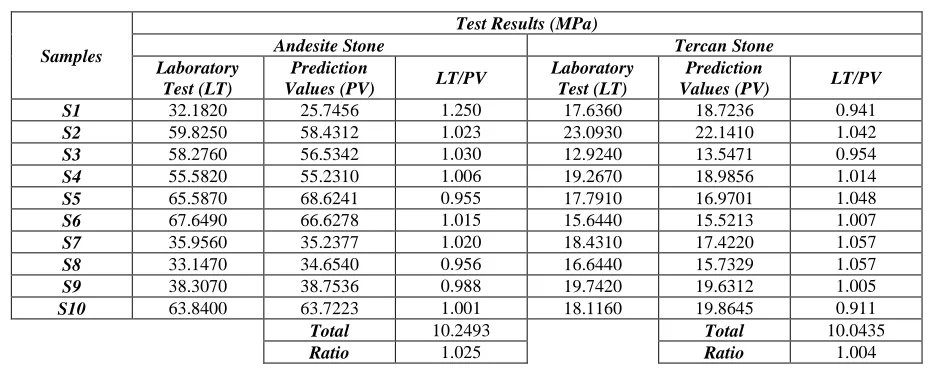
Table 4: Test results obtained from laboratory environment and artificial neural network
Samples
Test Results (MPa)
Andesite Stone Tercan Stone
Laboratory Test (LT)
Prediction
Values (PV) LT/PV
Laboratory Test (LT)
Prediction
Values (PV) LT/PV
S1 32.1820 25.7456 1.250 17.6360 18.7236 0.941
S2 59.8250 58.4312 1.023 23.0930 22.1410 1.042
S3 58.2760 56.5342 1.030 12.9240 13.5471 0.954
S4 55.5820 55.2310 1.006 19.2670 18.9856 1.014
S5 65.5870 68.6241 0.955 17.7910 16.9701 1.048
S6 67.6490 66.6278 1.015 15.6440 15.5213 1.007
S7 35.9560 35.2377 1.020 18.4310 17.4220 1.057
S8 33.1470 34.6540 0.956 16.6440 15.7329 1.057
S9 38.3070 38.7536 0.988 19.7420 19.6312 1.005
S10 63.8400 63.7223 1.001 18.1160 19.8645 0.911
Total 10.2493 Total 10.0435
Ratio 1.025 Ratio 1.004
As can be seen from Table 4, as a result of this study, a comparison of the compressive strength values with the laboratory tests resulted in a margin of error of +-2%. However, the compressive strength values of the stones can be obtained as MPa without any laboratory tests.
5. CONCLUSIONS
In this study, a new method of predicting compressive strength using image processing and artificial neural network is proposed. Tests for two different types of stone specimens were carried out within the framework of the studies. The proposed approach was carried out in two stages. In the first stage, images taken through a camera were subjected to necessary pre-processing and predicted by using artificial neural network. In the second stage, laboratory tests were carried out to obtain the actual compressive strength values of the stone samples and the system was calibrated. Finally, the software and laboratory compressive strength values obtained from the test images were compared and it was determined that the system works with an error margin of +-2%. This approach, which can be shown as an example of non-destructive measurement methods, has created a system which is quite cost effective, advantageous in time and can give a smooth result.
REFERENCES
[1] Şimşek, O. and Erdal, M., "Investigation of some mechanical and physical properties of the Ahlat stone (ignimbrite)", Gazi University Journal of Science, vol. 17, no. 4, 2004, pp.71-78.
[2] Aköz, F. and Yüzer, N., "Tarihi Yapilarda Malzeme Özelliklerinin Belirlenmesinde Uygulanan Yöntemler",
IMO-1. Insaat Muhendisligi Egitimi Sempozyumu, 2009, pp.6-7.
[3] Babacan, A.E., Ersoy, H. and Gelişli, K., "Kayaçların Fiziksel, Mekanik ve Elastik Özelliklerinin Ultrasonik Hız Tekniği ve Zaman-Frekans Analiziyle Belirlenmesi: Bej Kireçtaşları (KD Türkiye) Üzerine Örnek Bir Çalışma", Jeoloji Mühendisliği Dergisi, Teknik Not, vol. 36, no. 1, 2012, pp. 2012.
[4] Vasanelli, E., Calia, A., Colangiuli, D., Micelli, F. and Aiello, M.A., "Assessing the reliability of non-destructive and moderately invasive techniques for the evaluation of uniaxial compressive strength of stone masonry units", Construction and Building Materials, vol. 124, 2016, pp.575-581.
[5] Lourenço, P.B. and Pina-Henriques, J., "Validation of analytical and continuum numerical methods for estimating the compressive strength of masonry", Computers & structures, vol. 84, no. 29, 2006, pp.1977-1989.
[6] Çankaya, G., Arslan, M. H. and Ceylan, M., "Determination of Concrete Compressive Strength by Using Image Processing and Artificial Neural Network Methods", Selcuk University Journal of Engineering, Science and Technology, vol. 1, no. 1, 2013, pp.1-12. [7] Baygin, M., Ozkaya, S.G., Ozdemir, M.A. and Kazaz,
I., "A New Approach Based On Image Processing for Measuring Compressive Strength of Structures", International Journal of Intelligent Systems and Applications in Engineering, 2017, pp.21-25.
[8] Başyiğit, C., Kilinçarslan, Ş. and Çomak, B., "Görüntü işleme tekniği ile beton basınç dayanımının tahmin edilmesi", Süleyman Demirel Üniversitesi Fen Bilimleri Enstitüsü Dergisi, vol. 16, no. 1, 2012. [9] Ergun, A. and Kurklu, G., "Mevcut betonarme
AUTHOR PROFILES:
Suat Gokhan Ozkaya was born in Erzurum, Turkey, in 1983. He received B. S. degree in civil engineering from Karadeniz Technical University (KTU), Trabzon, Turkey and the M. S. degree in civil engineering from Ataturk University, Erzurum, Turkey, in 2013, respectively. He started the Phd program in civil engineering from Erzurum Technical University (ETU), Erzurum, Turkey, in 2013. He works as Research Assistant in the Ardahan University, Ardahan, Turkey.
Mehmet Baygin was born in Elazig, Turkey, in 1988. He received the B. S. degree in computer engineering from Firat University, Elazig, Turkey, in 2010, the M. S. degree in computer engineering from Firat University, Elazig, Turkey, in 2013, respectively and he started the Ph. D. program in computer engineering from Firat University, Elazig, Turkey, in 2013. He is currently a research assistant in the Department of Computer Engineering, Ardahan University, Ardahan, Turkey. His research interests are image processing, computer vision, photovoltaic systems and heuristic methods.
Muhammed Alperen Ozdemir was born in Erzurum, Turkey, in 1982. He received B. S. degree in civil engineering from Ataturk Universty , Erzurum, Turkey, in 2006 and the M. S. degree in civil engineering from Universty of Dayton, Dayton, Ohio, USA, in 2012, respectively. He started the Phd program in civil engineering from Erzurum Technical University (ETU), Erzurum, Turkey, in 2013. He currently works as Research Assistant in the Igdir University, Igdir, Turkey.
![Fig. 1. An example study from the literature [7]](https://thumb-us.123doks.com/thumbv2/123dok_us/1327042.1640871/2.612.57.287.349.475/fig-example-study-literature.webp)