e-ISSN: 2278-7461, p-ISSN: 2319-6491
Volume 5, Issue 11 (Dec 2016) PP: 21-27
A Case Study:Tidal Energy with Distributed Generation for
Bangladesh
Md. Rafiul Abdussami
1*, Tahmid Alam
2, GalibNakib Rahman
3, Sakib Faisal
4 1, 2, 3,4Dept. of Electrical and Electronic Engineering, Islamic University of Technology, Board Bazar,
Gazipur-1704, Bangladesh
Abstract
—
Forthe last few decades, the electricity demand has been increasing with the increased amount of population. To cope up with this, new methodology and sources of electricity generation are introduced. This paper enlightens the power crisis scenario of the southern part of the Bangladesh and the prospect of the tidal energyof that region which is the most reliable, smart and cost effective solution at this situation. This paper also emphasizes on the concept of “Distributed Generation (DG)” which represents a holistic approach to the solution of the power crisis of the southern part of Bangladesh. By collecting, calculating and analysing some realistic data, we have shown that at least 30% power crisis can be solved by using only tidal energy of our selected sites.Index Terms—Tidal Energy, Electricity Demand, Load-Shedding, Distributed Generation
I.
INTRODUCTION
The installed generation capacity of Bangladesh Power Development Board (BPDB) is 12,339 MW (April’ 2016) where the initial installed generation capacity was 200 MW in 1972 [1]. So with the passage of time generation of electricity in Bangladesh is increasing i.e. the sources of electricity generation is flourishing rapidly. Bangladesh has an enormous source of tidal energy, especially at the southern part of the country. It is predicted that 0.1% of ocean energy can provide the required whole world energy demand five times over [2]. Wave is too much predictable than other renewable energy sources. The surface of the earth is continuously getting heated by the sun. Most of the heat energy is absorbed by the earth surface and water. As the earth is moving around the sun, the density of the water will be changed. The wind created due to moving globe and gravity ripples on water. The continuous flow of wind will cause blowing of the ripple which turn the still water into wave. Wave can travel a long distance with a loss of minimum energy and it breaks on distant shore. As wave travels to distant shore and again comes back, this is constantly renewed [3].[4] indicates that the tidal power consistently increases with the height of wave and with the wave period.This papers shows the amount of electricity generation by the tidal energy of the different areas of Chittagong which is sufficient to meet the lack of public electricity demand of Chittagong. This paper also demonstrates how the concept of “Distributed generation (DG)” can be implemented here with an efficient way. The technology of harnessing tidal energy is very simple and the expected life-time is more than 40 years for a tidal power plant [5].This paper is organized as follows. Electricity scenario of the Chittagong district is briefly discussed in section II. In section III, the prospect of the tidal energy is represented in a graphical fashion. In section IV, a real case is studied by collecting practical data and doing some numerical analysis. We conclude our findings and contribution in section V.
II.
ELECTRICITY
SCENARIO
OF
CHITTAGONG
Chittagong is the main coastal seaport city in southern part of Bangladesh. Bangladesh has 724 km of coastal line along Bay of Bengal and most of the regions are disconnected from the supply of electricity. There are 10 million people living in the coastal zone and only 3% of them are getting access of electricity [6].
In the recent time, BangladeshPower Development Board (BPDB) is going to take a mega project for Chittagong, Cox’s Bazar and the three districts of the Chittagong Hill Tract where 500,000 new consumers are going to be connected. The deadline of the project is predicted in 2018. It includes installing 2,500 km long distribution line and constructing and repairing of 23 sub-stations [7]. For establishing this huge project, the sources of renewable energy (like wind, Tidal wave etc.) can play a vital role.
III.
TIDAL
ENERGY
IN
CHITTAGONG
𝐸 =1
2× 𝜌 × 𝑔 × 𝜉 × Ϫ
2 (1)
Where, 𝜌 =Density of sea water; (𝐾𝑔/𝑚3)
𝑔 =Gravitational acceleration due to earth; (𝑚/𝑠2) 𝜉 =Horizontal surface area of basin; (𝑚2)
Ϫ =Tidal range (Difference between high and low tide); (m)
Fig. 1 Detailed power profile of the selected sites
The duration of a tidal regimeis 12.42 hr1[10], consisting of two floods and two ebb tides.The tidal energy is zero at low tide.Again,
1 𝑑𝑎𝑦 = 60 × 60 × 24 = 86,400 𝑠𝑒𝑐𝑜𝑛𝑑𝑠
Therefore, the corresponding average tidal power can be expressed as:
𝑃 = 24
12.42×
𝐸 86,400
= 24
12.42×
1
86,400×
1
2× 𝜌 × 𝑔 × 𝜉 × Ϫ
2
Considering 𝑔 =9.81𝑚/𝑠2, 𝜌 = 1025 𝐾𝑔/𝑚3 and 𝜉 = 4 × 10⁶𝑚2 (Assumption), the average tidal power
(W) can be written as:
𝑃 = 112.445 × 10⁻³× 𝜉 × Ϫ2 (2)
So, the actual output tidal power is:
Γ = 𝑃 × 𝜂 (3)
Where, 𝜂 is the turbine efficiency. The range of turbine efficiency is between 20 to 40% [12]. To calculate the total power profile of the selected sites, we have taken the turbine efficiency as 33% which is the average turbine efficiency [11].
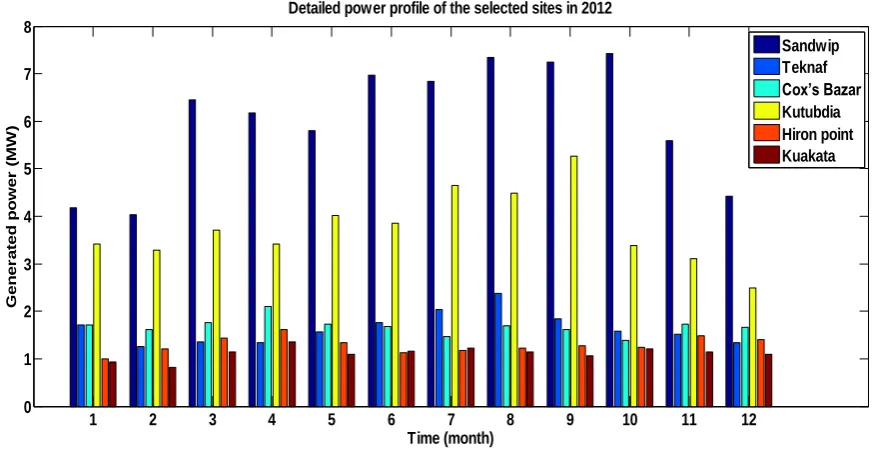
Using eq. (3) and the tidal range data which are collected from [9], we have calculated the total power profile for each particular monthof our selected sites in 2012.The detailed power profile of the selected sites is shown in fig.1.
1 Semi-diurnal period
1 2 3 4 5 6 7 8 9 10 11 12
0 1 2 3 4 5 6 7 8
G
e
n
e
r
a
te
d
p
o
w
e
r
(
M
W
)
Time (month)
Detailed power profile of the selected sites in 2012
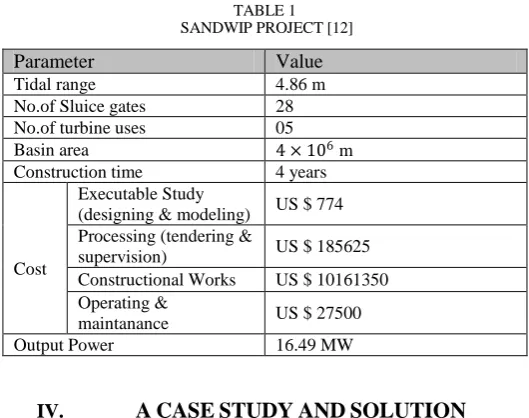
By analysing fig.1,it can be said that Sandwip, Teknaf, Cox’s Bazar, Kutubdia, Hiron point and Kutubdia could be a key factor of power solution in chittagong, specially the Sandwip and kutubdia island.The sandwip project which is already taken is roughly summarized in Table 1:
TABLE 1 SANDWIP PROJECT [12]
Parameter Value
Tidal range 4.86 m
No.of Sluice gates 28
No.of turbine uses 05
Basin area 4 × 10⁶ m
Construction time 4 years
Cost
Executable Study
(designing & modeling) US $ 774 Processing (tendering &
supervision) US $ 185625
Constructional Works US $ 10161350 Operating &
maintanance US $ 27500
Output Power 16.49 MW
IV.
A
CASE
STUDY
AND
SOLUTION
For the case study, we have collected the data of the height of tide and the amount of load-shedding of that particular region of the southern part of Bangladesh. The data of the electricity demand and load-shedding for some selected period in Chittagong are shown in Table 2:
TABLE 2 DEMAND AND LOAD-SHEDDING DATA FOR SELECTED DATES [13]
Date Demand (MW) Load-Shed (MW)
June 1,2016 1008 25
June 2,2016 982 20
June 3,2016 840 17
June 4,2016 980 31
June 6,2016 859 24
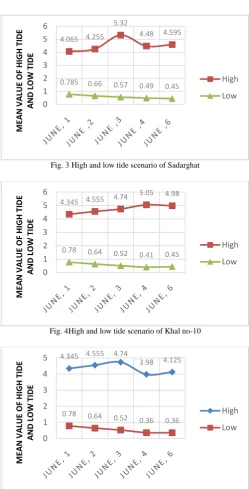
We have also collected the height of the tide for those days from Chittagong port authority. These data are for four particular places in Chittagong; Khal no-18, Sadarghat, Khal no-10, Kalurghat[14].Usually the height of the tide is recorded four times in a day. The recorded data indicates two high tide value and two low tide value. For the convenience of putting the high tide values and low tide values in mathematical formula, we have taken the average value for the both cases.
Fig. 2High and low tide scenario of Khal no-18 4.715 4.96 5.18 4.48 4.595
0.95 0.75
0.56 0.49 0.45
0 1 2 3 4 5 6
M
EA
N
V
A
LUE
O
F H
IGH TI
D
E
A
N
D
L
O
W
TID
E
High
Fig. 3 High and low tide scenario of Sadarghat
Fig. 4High and low tide scenario of Khal no-10
Fig. 5High and low tide scenario of Kalurghat
The term “Tidal range” which is used in eq. (3) defines the difference between high tide and low tide in meters. That’s why we have calculated the “Tidal range” from Fig. 2, Fig. 3, Fig. 4, and Fig. 5 and represented graphically in Fig. 6.
4.065 4.255 5.32
4.48 4.595
0.785 0.66 0.57 0.49 0.45
0 1 2 3 4 5 6 M EA N V A LUE O F H IGH TI D E A N D L O W TID E High Low
4.345 4.555 4.74
5.05 4.98
0.78 0.64 0.52
0.41 0.45 0 1 2 3 4 5 6 M EA N V A LUE O F H IGH TI D E A N D L O W TID E High Low
4.345 4.555 4.74
3.98 4.125
0.78 0.64 0.52
Fig. 6Tidal range profile of the selected sited for case study
Using (1), we have determined the total electric power generation by tidal wave for different regions. Then we have added all the calculated power from different sites for a particular date and compare with values of the load-shedding [13] occurred on that day. The comparison is shown:
TABLE 3
TOTAL GENERATED TIDAL POWER PROFILE OF SELECTED DATE
Date Total Generated Power (MW)
June 1,2016 7.4736
June 2,2016 9.0990
June 3,2016 11.808
June 4,2016 9.8666
June 6,2016 10.4270
Ju n 1
,20 16
Ju n 2
,20 16
Ju n 3
,20 16
Ju n 4
,20 16
Ju n 6
,20 16 0
1 0 2 0 3 0 4 0
P
o
w
e
r
(
M
W
) L o a d - s h e d
G e n e r a te d p o w e r b y tid a l w a v e
Fig. 7 Comparison between Load-shed and Generating Tidal Power of Selected Date
From Table 3 and Fig. 7, we can calculate that almost 30%, 45.5%, 70%, 31% and 43% load-shedding can be mitigated respectively by using only tidal of the Chittagong area. We have considered only the four tidal regions; Khal no- 18, Sadarghat, Khal no-10 and Kalurghat.
To provide this electricity, it must be added with the main grid. For doing this, “Distributed Generation (DG)” technology might be the most reliable and flexible option.
Distributed Generation (DG) is also termed as decentralized generation as small scale electricity is generated and distributed at the closer to its end. There are a lot of areas in Chittagong where grid connectivity is neither
0 1 2 3 4 5
June 1,2016
June 2,2016
June 3,2016
June 4,2016
June 6,2016
Ti
d
al
R
an
ge
reliable nor cost effective. So, for people of these region, DG might be a better option. According to CIGRE2 , DG is defined as the generation units which are often connected to distribution network and this is neither planned centrally nor dispatched, having maximum capacity of 50 MW to 100 MW [15].According to DPCA3, DG is a small scale power generation technology which is closer to the consumer site [16].CIGRE 4 defines DG which is not centrally planned and dispatched and is smaller than 50 or 100 MW.As there is huge variation in the definition of DG, some practical factors e.g. the objective, the location, the size (rating) of DG, the area covered by DG, the technology etc. are considered to define the term “DG” more precisely. As DG produces power locally to the user, it minimizes the transmitting power loss. It provides emergency power supply and reduce the peak power requirements. It improves power quality and reduces vulnerability to terrorism [17]. It also avoids the impact of massive grid failure. DG supported by green technology saves the use of land. One of the most important consideration to choose DG compared to the centralized distribution is the environmental impact.
V.
CONCLUSION
Though the tide height is low and the initial cost is a little bit high, the exercise is showing that it is possible to harness a good amount of electric power. As the tidal energy is much available in Chittagong district, it can be utilized most than the other sources. It is already indicated that at least 30% power crisis can be solved only by means of tidal power of some particular area of Chittagong. This paper also suggests to introduce the “Distribution Generation” concept in this perspective which will add a new way for Bangladesh in the power crisis solution sector. A large number of barrage are already built there to protect the land life. So, only by using simple and cheap technology, it is possible to harness a huge amount of tidal energy. Only the effective effort for harnessing this huge amount of energy can solve the power crisis of the southern part of the Bangladesh.
REFERENCES
[1] Bangladesh Power Development Board”, Available at: http://www.bpdb.gov.bd/bpdb/. (Accessed on: June 24, 2016)
[2] RESEARCH & INNOVATION”, European Commission, Ocean Energy, Available at: http://ec.europa.eu/research/energy/eu/index_en.cfm?pg=research-ocean, (Accessed on: June 20, 2016)
[3] Abduldaem Al-Kaheel, “SECRETS OF QURAN MIRACLES”, Available at:
http://www.kaheel7.com/eng/index.php/earth-science/310-the-energy-of-sea-waves, (Accessed on: June 20, 2016)
[4] Shah Md. Salimullah, Md. MonjurEllahi Rafi, M. R. I. Sheikh, “Prospect of Wave Power in Bangladesh”, American Journal of Engineering Research (AJER), e-ISSN : 2320-0847 p-ISSN : 2320-0936, Volume-03, Issue-05, pp-29-35.
[5] Fraenkel P.L. Tidal current energy technologies. Ibis, 2006; 148: 145-151.
[6] A.N.M Mominul Islam Mukutl, Md. Quamrul Islam, Muhammad MahbubulAlam, “Analysis of wind characteristics in coastal areas of Bangladesh”.(Accessed on: June 18, 2016).
[7] “500,000 new consumer likely to get electricity connections in Chittagong”, Newspaper article: DhakaTribune, May 11, 2016
[8] Amit Kumar Sikder, NishatAnjum Khan Md. Tariqur Rahman, Monirul Islam, AminulHoque. “Tidal Energy: A Solution to Energy Crisis in Coastal Area of Bangladesh”. International Conference on Electrical Engineering and Information & Communication Technology (ICEEICT) 2014.
[9] Lamb H. Hydrodynamics, 6th ed. London: Cambridge University Press; 1994, pp768 [10] Availableat:
https://answers.yahoo.com/question/index;_ylt=AwrXoCCSPmVXvj8AjsxPmolQ;_ylu=X3oDMTByNzd qbzZjBGNvbG8DZ3ExBHBvcwMzBHZ0aWQDBHNlYwNzYw ?qid=20101115202144AACtm3Y&p= what%20is%20semi%20diurnal (Accessed on: June 18, 2016)
[11] Tester JW, Drake EM, Driscoll MJ, Golay MW, Peters WA. Sustainable energy:choosing among options. MIT Press; 2005. 870pp.
[12] Md. Alamgir Hossain, Md. Zakir Hossain, Md. Atiqur Rahman, “Perspective and Challenge of Tidal Power in Bangladesh”, World Academy of science, Engineering and Technology International journal of Electrical, Computer, Energetic and Communication Engineering Vol: 8, No:7, 2014.
2
the international Council on Large Electricity Systems 3 Distributed Power Coalition of America
[13] “Bangladesh Power Development Board”, Available at: http://www.bpdb.gov.bd/bpdb/index.php?option=com_content&view=article&id=152&Itemid=100. (Accessed on: June 24, 2016)
[14] CHITTAGONG PORT AUTHOROTY”, Tide Table, Avilable at: http://cpa.gov.bd/download-tide-tables/ ,(Accessed on: June 19, 2016.
[15] Pepermans G., Driesen J., Haeseldonckx D., D’haeseleer, W., Belmans R. “DISTRIBUTION GENERATION: DEFINITION, BENEFITS AND ISSUES”. WORKING PAPER SERIES n°2003-8.K.U.Leuven - Energy Institute. (Accessed on: June 18, 2016)
[16] F. Gonzalez-Longaat, C. Fortoul, “Review of the Distributed Generation Concept: Attempt of
Unification”, Available at:
https://www.academia.edu/2685370/Review_of_Distributed_Generation_Concept_Attempt_of_Unificati on (Accessed on: June 19, 2016)
[17] “Distributed Generation”, Education Modules , Available at:
http://www.dg.history.vt.edu/ch1/benefits.html, (Accessed on: June 19, 2016)