Generalized Triangular Intuitionistic Fuzzy Geometric
Averaging Operator for Decision Making in Engineering
Daniel O. Aikhuele * and Sarah Odofin
Faculty of Manufacturing Engineering, Universiti Malaysia Pahang, Pekan 26600, Pahang-Malaysia, Malaysia; [email protected]
* Correspondence:[email protected]
Abstract: Intuitionistic fuzzy set, which can be represented using the triangular intuitionistic fuzzy number (TIFN), is a more generalized platform for expressing imprecise, incomplete and inconsistent information when solving multi-criteria decision-making problems, as well as for reflecting the evaluation information exactly in different dimensions. In this paper, the TIFN has been applied for solving some multi-criteria decision-making problems by developing a new triangular intuitionistic fuzzy geometric aggregation operator, that is the generalized triangular intuitionistic fuzzy ordered weighted geometric averaging (GTIFOWGA) operator, and defining some triangular intuitionistic fuzzy geometric aggregation operators including the triangular intuitionistic fuzzy weighted geometric averaging (TIFWGA) operator, the ordered weighted geometric averaging (TIFOWGA) operator and the hybrid geometric averaging (TIFHWGA) operator. Based on these operators, a new approach for solving multicriteria decision-making problems when the weight information is fixed has been proposed. Finally, the proposed method has been compared with some similar existing computational approaches by virtue of a numerical example to verify its feasibility and rationality.
Keywords: generalized triangular intuitionistic fuzzy geometric aggregation operator; triangular intuitionistic fuzzy number; intuitionistic fuzzy set; multi-criteria decision-making; attitudinal character; flexibility
1. Introduction
In solving multi-criteria decision-making (MCDM) problems, it is often required that several criteria are considered simultaneously before selecting or ranking alternatives. Since the information required for solving the MCDM problems is often incomplete, inconsistent and indeterminate, the manner in which it is expressed, therefore, has remained a major task and of great interest among researchers over the past several years. In handling these issues, Zadeh [1], who introduced the concept of fuzzy set theory, has outlined how the fuzzy set (FS) concept could be used for expressing such decision-making problems. However, the FS theory, which is characterized by only one function, “the membership function ( )”, in most cases cannot be used fully to express some kind of complex fuzzy information. “For example, during voting, if there are ten persons voting for an issue, and three of them give the “agree’’, four of them give the “disagree”, and the others abstain. Obviously, FS cannot fully express the polling information” [2]. To solve this kind of problem, Atanassov [3] extended the fuzzy set theory by adding a new function “the non-membership function ( )”, in order to form the intuitionistic fuzzy set (IFS) theory.
The membership and non-membership functions of the IFS theory are represented by an intuitionistic fuzzy number (IFN), are more or less independent and are constrained with the conditions that the sum of the membership and non-membership must not exceed one [4]. These constraints, however, have been challenged recently by Despi [5] who defined a new IFS in which the sum of the membership and non-membership functions are more than one and their differences are either positive or
negative. This new IFS has been justified and supported by Li [6] and Marasini et al. [7]. The computation of membership and non-membership function in this study will be based on the new IFS.
Extensive review of the IFS, which is represented by IFN for solving MCDM problems, has shown an increase over the past few years as revealed in the literature [8–18] with a few extensions of the IFN, such as the trapezoidal IFN (TrIFN) [19,20], the interval-valued TrIFN (IVTrIFN) [21,22], Pythagorean IFN (PIFN) [23] and the triangular IFN (TIFN) [24–26]. This study, however, will be concerned with the triangular intuitionistic fuzzy numbers (TIFNs) only, with the purpose of accounting for the attitudinal character or risk attitude of the DMs, which have not been fully studied in the reviewed literature.
The application of TIFN in MCDM is based on its ability to express decision information in several dimensions and to reflect the assessment information in a more holistic manner [24]. Several research efforts have been made in the advancement of TIFN over the past few years. Among them, we can mention the characterization of membership and non-membership degrees in intuitionistic fuzzy sets (IFS) using the triangular fuzzy numbers by Shu et al. [26]. Chen and Li [27] developed a new distance measurement between two TIFNs for determining attribute weights, as well as weighted arithmetic averaging (TIFN-WAA) operators on TIFNs. Zhang and Nan [28] developed a methodology for ranking TIFNs by considering the concept of a TIFN as a special case of the IFN. Wan et al. [29], using the TIFN, extended the classical VIseKriterijumska Optimizacija I Kompromisno Resenje (VIKOR) method for solving multi-attributes group decision-making (MAGDM) problems, while Li et al. [30] investigated the arithmetic operations and cut sets over TIFNs, and defined the values and ambiguities of the membership degree and non-membership degree for the TIFNs, as well as the value index and ambiguity index.
Other contributions to the study of TIFN are in the area of information fusion operators (aggregation), where Chen and Li [27] introduced the weighted arithmetic averaging operator on TIFNs (TIFN-WAA). Wan et al. [29] presented the triangular intuitionistic fuzzy weighted average (TIF-WA) operator for the selection of personnel. The triangular intuitionistic fuzzy weighted average (TIFWA) operator, the ordered weighted average (TIFOWA) operator, the hybrid weighted average (TIFHWA) operator, the triangular intuitionistic fuzzy generalized ordered weighted average (TIFGOWA) operator, and the generalized hybrid weighted average (TIFGHWA) operator were developed by Wan et al. [31].
Upon investigation of the different aggregation operators of TIFN, it has been revealed that the ranking of TIFNs are a bit complicated and cannot be easily compared with other TIFNs [32] as well as
account for attitudinal character or risk attitude of the DMs. In order to further advance the study of
aggregation operators of TIFN, simplify its comparison and application in MCDMs, and to express the risk attitude of the DMs in the decision-making process, this paper attempts to do the following:(1) Define some triangular intuitionistic fuzzy aggregation operators, that is, the triangular intuitionistic fuzzy weighted geometric averaging (TIFWGA) operator, ordered weighted geometric averaging (TIFOWGA) operator and the hybrid weighted geometric averaging (TIFHWGA) operator;
(2) Develop a new generalized triangular intuitionistic fuzzy aggregation operator, that is, the generalized triangular intuitionistic fuzzy ordered weighted geometric averaging (GTIFOWGA) operator. This is mainly to allow for more attitudinal information to be expressed or used in accordance with the different DMs interests or preference;
(3) Propose a simple and straightforward approach for solving MCDM problems when the performance ratings are expressed in triangular intuitionistic fuzzy numbers (TIFNs).
2. Preliminaries
In this section, the fundamental definitions and concepts of TIFN and IFS as described by Liang et al. [32] and Despic and Simonovic [33] are presented.
2.1. Intuitionistic Fuzzy Set (IFS)
Definition 1. If the IFS A in = { } is defined fully in the form = { , ( ), ( ), ( ) | ∈ }, where : → [0,1], : → [0,1] and : → [0,1], then the different relations and operations for the IFS are given as:
1. . = { , ( ). ( ), ( ) + ( ) − ( ). ( ) | ∈ }; 2. + = { , ( ) + ( ) − ( ). ( ), ( ). ( ) | ∈ }; 3. = { , 1 − (1 − ( )) , ( )) | ∈ , > 0;
4. = { , (
( )
) , 1 −(
1 −( )
)|
∈}
, > 0;5. = if and only if
( )
=( )
and( )
=( )
for all ∈ ; 6. ≤ if and only if( )
≤( )
and( )
≥( )
for all ∈ .2.2. The Triangular Intuitionistic Fuzzy Number (TIFN)
The TIFN is basically the use of the traditional triangular fuzzy number to express the membership ( ) and non-membership degree ( ) such that the intuitionistic fuzzy number is based on the triangular fuzzy number, which is termed the triangular intuitionistic fuzzy number (TIFN). In the following, the basic concepts relating to the TIFN are introduced:
Definition 2. Let be a TIFN, where the membership and non-membership function for are defined as follows [28,31,32]:
Membership function:
( ) =
( − )
( − ) ( ≤ < ), ( = ) ( − )
− ( < ≤ ),
0 otherwise.
(1)
For non-membership function, it is given as:
( ) =
( − + ( − ́ ))
( − ́ ) ( ́ ≤ < ), ( = ) ( − + ( ́ − ))
́ − ( < ≤ ́),
0 otherwise,
(2)
where 0 ≤ ≤ 1; 0 ≤ ≤ 1; 0 ≤ + ≤ 1, , , , ́ , ́ ∈ .
The TIFN is therefore denoted as ́ = 〈([ , , ]; ), ([ , , ]; )〉, when = 1, and = 0, and ́ will change into the traditional triangular fuzzy number (TFN). Generally, the TIFN ́ is defined as ́ = ([ , , ]; , ) for convenience. In the following, the operational rules for any two TIFNs are presented.
1. 1+ 2= 1+ 2, 1+ 2, 1+ 2 ; 1+ 2− 1 2, 1 2 ;
2. 1 2= 1 2, 1 2, 1 2 ; 1 2, 1+ 2− 1 2 ;
3. = [ , , ]; 1 − (1 − ) , ( ) , ≥ 0;
4. =
[
, ,]
; ( ) , 1 − (1 − ) , ≥ 0.The operational results for the rules given in the Definition 4 for the two TIFNs are given in the operations:
1. 1+ 2= 2+ 1; 2. 1⊗ 2 = 2⊗ 1;
3. ( 1+ 2) = 1+ λ 2 ≥ 0; 4. 1α + 2α = ( 1+ 2) 1 2≥ 0; 5. 1⊗ 2 = 1+2
1 2≥ 0; 6. 1 ⊗ 2 =
(
1⊗ 2)
≥ 0.Definition 4. [31] Let = [ , , ]; , and = [ , , ]; , be two TIFNs, and the Hamming distance between and is given as:
( , ) =1 6
1 + − − 1 + − + 1 + − − 1 + −
+ 1 + − − (1 + − ) . (3)
Definition 5. [31,35] Let ́ = ([ , , ]; , ) be a TIFN. If the membership and non-membership functions are represented by the score function ( ́ ) and accuracy function ( ́ ), respectively, then ́ can be defined as follows:
( ́ ) = ( + 2 + )
4 , (4)
( ́ ) = ( + 2 + )(1 −4 ). (5)
Definition 6. [31,35] Let ́ and ́ be two TIFNs. If ( ́ ) = ( ) and ( ́ ) = ( )( ) are the membership and non-membership functions of ́ , then:
1. If ( ́ ) < ( ́ ) then
́
1<́
2;2. If ( ́ ) = ( ́ ) and ( ́ ) = ( ́ ), then
́
1=́
2; 3. If ( ́ ) = ( ́ ) and ( ́ ) < ( ́ ), theń
1<́
2.3. Some Weighted Geometric Operators and the Generalized Ordered Weighted Geometric Operators of TIFNs
In this section, motivated by existing achievements [32,36,37], we develop some triangular intuitionistic fuzzy geometric averaging operators and discuss some of their useful properties and then introduce new generalized geometric operators for TIFNs.
3.1. Some Weighted Geometric Aggregation Operators on TIFNs
TIFWG ( , , , … , ) = ( ) ⊗ ( ) ⊗ ( ) … ⊗ ( ) ,
where = ( , , , … , ) is the weighting vector of
(
= 1, 2, 3, … ,)
with ∈[
0, 1]
and ∑ , = 1. Furthermore,TIFWG ( , , , … , ) = ∏ ( ) =
[∏ ( ) , ∏ ( ) , ∏ ( ) ]; ∏ ( ) , 1 − ∏ (1 − ) . (6)
Definition 8. Let = [ , , ]; , for all ( = 1, 2, 3, … , ) be a collection of TIFNs on X. The TIFOWGA operator of dimension n is a mapping TIFOWGA: Ω → Ω, and
TIFOWG ( , , , … , ) = ( ) ⊗ ( ) ⊗ ( ) … ⊗ ( ) ,
where = ( , , , … , ) is the exponential weighting vector of ( = 1, 2, 3, … , ) with ∈
[
0, 1]
and ∑ = 1, and
(
1, 2, 3, … ,)
is a permutation of X (i. e. , 1, 2, 3, … , ) such that 1≤ 2≤ ⋯ ≤ . Furthermore,TIFOWG ( , , , … , ) = ( )
= ( ) , ( ) , ( ) ; ( ) , 1 − (1 − ) .
(7)
Definition 9. Let = [ , , ]; , for all ( = 1, 2, 3, … , ) be a collection of TIFNs on X. The TIFHWGA operator of dimension n is a mapping TIFHWGA: Ω → Ω, such that
TIFHWG ( , , , … , ) = ( ) ⊗ ( ) ⊗ ( ) … ⊗ ( ) ,
where is the ith largest of the weighted TIFN = , = 1, 2, 3, … , , = ( , , , … , ) is the exponential weighting vector of ( = 1, 2, 3, … , ) with ∈ [0, 1] and ∑ = 1, and ( , , , … , ) is a permutation of X (i. e. , 1, 2, 3, … , ) such that ≤ ≤ ⋯ ≤ . Furthermore,
TIFHWG , ( , , , … , )
= ( ) , ( ) , ( ) ; ( ) , 1 − (1 − ) . (8)
3.2. The Generalized Ordered Geometric Operator of TIFNs
The TIFOWGA operator is extended to develop a new generalized aggregation operator for TIFN. The new GTIFOWGA has been inspired by the work of Tan [37] and Qi et al. [38].
Definition 10. Let ( , , , … , ) be a collection of triangular intuitionistic fuzzy arguments and = [ , , ]; , . The GTIFOWGA operator of dimension n is a mapping GTIFOWGA: Ω → Ω, which has an exponential weighting vector = ( , , , … , ) , ∑ = 1, and ∈ [0, 1], > 0; then,
Theorem 1. Let ( , , , … , ) be a collection of triangular intuitionistic fuzzy arguments and = [ , , ]; , . If the exponential weighting vector = ( , , , … , ) , ∑ = 1, and ∈ [0, 1], > 0, then the GTIFOWGA operator obtained is a TIFN and is given as follows:
( , , , … , ) = ⊗ ⊗ … . .⊗
= ( ( )) , /
, ( ( )) , /
, ( ( )) , /
; 1
− 1 − 1 − 1 − ( ) , /
, 1 − 1 − ( ) /
.
(9)
Proof. Using mathematical induction on Ω:
1. For = 1,
=
( ( )) , ( ( )) , ( ( )) ; 1 − 1 − 1 − 1 − ( )
/
, 1 − 1 − ( ) /
.
Thus, for = 1, Equation (9) holds.
2. For = 2,
⊗
= ( ( )) , ( ( )) , ( ( )) ; 1
− 1 − 1 − 1 − ( ) , 1 − 1 − ( )
⊗ ( ( )) , ( ( )) , ( ( )) ; 1
− 1 − 1 − 1 − ( ) , 1 − 1 − ( ) .
Since, = [ , , ]; , + − then,
⊗
= ( ( )) ( ( )) , ( ( )) ( ( )) , ( ( )) ( ( )) ;
1 − 1 − 1 − 1 − ( ) ∗ 1 − 1 − 1 − 1 − ( )
/
, 1 − 1 − ( ) +
1 − 1 − ( ) /
− 1 − 1 − ( ) ∗ 1 − 1 − ( ) /
1 − 1 − 1 − 1 − ( ) ∗ 1 − 1 − 1 − 1 − ( ) , 1 − 1 − ( )
∗ 1 − ( ) .
Thus, the result is true for = 2.
3. Suppose = , then
⊗ ⊗ … . .⊗ =
∏ ( ( )) , / , ∏ ( ( )) , / , ∏ ( ( )) , / ; 1 − 1 − ∏ 1 − 1 −
( ) ,
/
, 1 − ∏ 1 − ( ) /
.
For = + 1, we then have:
⊗ ⊗ … . .⊗
= ( ( )) , , ( ( )) , , ( ( )) , ; 1
− 1 − 1 − 1 − ( ) , 1 − 1 − ( )
⊗ ( ( )) , ( ( )) , ( ( )) ; 1
− 1 − 1 − 1 − ( ) , 1 − 1 − ( )
= ( ( )) ,
/
, ( ( )) , /
, ( ( )) , /
; 1
− 1 − 1 − 1 − ( ) ,
/
, 1 − 1 − ( ) /
.
It confirms that the result is true for = + 1, and thus it holds for all of . Hence,
( , , , … , ) =1 ⨂ =1 ⊗ ⊗ … . .⊗
= ( ( )) ,
/
, ( ( )) , /
, ( ( )) , /
; 1
− 1 − 1 − 1 − ( ) ,
/
, 1 − 1 − ( )
/
The theorem is true for any number of TIFN, which completes the proof. □
3.3.Some useful properties of the GTIFOWGA operator
Theorem 2. Commutative property. Let = [ , , ]; , and = , , ̃ ; , ( =
1, 2, 3, … , ) be two TIFNs. If the exponential weighting vector = ( , , , … , ) , ∑ = 1, and ∈ [0, 1], > 0, then the GTIFOWGA operator obtained is a TIFN and is given as follows for the commutative property:
= (∀ = 1, 2, 3, … , ).
Proof. If ( , , , … , ) is a permutation of , , , … , , then we have = ( = 1, 2, 3, … , ),
that is
[ , , ]; , = , , ̃ ; , .
Then,
( , , , … , ) = , , , … , .
Theorem 3. Idempotent property. Let = [ , , ]; , and = , , ̃ ; , ( =
1, 2, 3, … , ) be two TIFNs. If the exponential weighting vector = ( , , , … , ) , ∑ = 1, and ∈ [0, 1], > 0, then the GTIFOWGA operator obtained is a TIFN and is given as follows for idempotent property:
= (∀ = 1, 2, 3, … , ).
Proof: Since = , then we have
( , , , … , ) =1 ⨂
=1 ⊗ ⊗ … . .⊗
=1(( ) ⊗ ( ) ⊗ … . .⊗ ( ) ) =1(( ) ⋯ )
=1( ) = .
Theorem 4. Monotonicity property. Let = [ , , ]; , and = , , ̃ ; , ( =
1, 2, 3, … , ) be two TIFNs. If the exponential weighting vector = ( , , , … , ) , ∑ = 1, and ∈ [0, 1], > 0, then the GTIFOWGA operator obtained is a TIFN and is given as follows for the Monotonicity property:
≤ (∀ = 1, 2, 3, … , ).
( , , , … , ) ≤ , , , … , ,
where
[
, ,]
≤[
, ,̃ ]
, ≤ , and ≥ .It follows that,
( ( )) , , ( ( )) , , ( ( )) ,
≤ ( ( )) , , ( ( )) , , ( ̃( )) , ,
1 − 1 − 1 − 1 − ( ) ,
/
≤ 1 − 1 − 1 − 1 − ( ) , ,
1 − 1 − ( ) /
≥ 1 − 1 − ( ) .
According to Definition 2, number 6, we can conclude that ( , , , … , ) ≤ , , , … , .
Therefore,
≤ (∀ = 1, 2, 3, … , ).
In addition, let ( , , , … , ) be a collection of triangular intuitionistic fuzzy arguments and = [ , , ]; , . If the exponential weighting vector = ( , , , … , ) , ∑ = 1, and ∈ [0, 1], > 0, then the GTIFOWGA operator obtained is a TIFN and is given as follows for the Monotonicity property:
If
= [ ( ), ( ), ( )]; ( ), ( ) ,
and
= [ ( ), ( ), ( )]; ( ), ( ) .
Then,
≤ ( , , , … , ) ≤ .
Proof: If
= [ , , ]; ,
for all
( = 1, 2, 3, … , ),
then
= [ ( ), ( ), ( )]; ( ), ( ) ,
= [ ( ), ( ), ( )]; ( ), ( )
are TIFNs. Since
[ , , ] ≤ [ , , ] ≤ [ , , ], ≤ ≤
and
≤ ≤ ,
then we have:
( ( )) , /
, ( ( )) ,
/
, ( ( ))
/
≤ ( ( )) , , ( ( )) , , ( ( ))
≤ max ( ( )) , , max ( ( )) , max ( ( )) ,
1 − 1 − 1 − 1 − min ( )
/
≤ 1 − 1 − 1 − 1 − ( )
≤ 1 − 1 − 1 − 1 − ( ) ,
1 − ∏ 1 − ( )
/
≤ 1 − ∏ 1 − ( ) ≤ 1 − ∏ 1 − ( ) .
That is,
( ( )) , ( ( )) , ( ( ))
≤ ( ( )) , ( ( )) , ( ( ))
≤ ( ( )) , ( ( )) , ( ( ))
1 − 1 − 1 − 1 − min ( )
/
≤ 1 − 1 − 1 − 1 − ( )
1 − 1 − ( ) /
≤ 1 − ∏ 1 − ( ) ≤ 1 − 1 − ( ) .
According to Definition 2, number 6, the above equation can be rewritten as
( ( )) , ( ( )) , ( ( )) ; 1 − 1 − 1 − 1 − min ( ) ,
1 − 1 − ( ) ≤ ( ( )) , ( ( )) , ( ( )) ;
1 − 1 − 1 − 1 − ( ) , 1 − 1 − ( )
≤ ( ( )) , ( ( )) , ( ( )) ;
1 − 1 − 1 − 1 − ( ) , 1 − 1 − ( )
/ .
That is, ≤ ( , , , … , ) ≤ .
4. Multi-Criteria Decision Making (MCDM) with the Generalized Geometric Operators for TIFNs
In this section, the GTIFOWGA operator is utilized for solving MCDM problems in which the performance ratings of the alternatives with respect to a given criteria are expressed in TIFN.
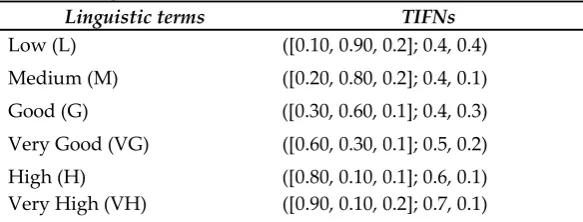
Consider an MCDM problem in which the alternatives = { , , , … , }, are assessed with respect to the criteria = { , , , … , }. The motivation here is to select the best alternative according to the intuitionistic fuzzy decision matrix given by the DM(s) ( ) ( = 1, 2, 3, … , ) when the criteria weights information is fixed. In collecting the DMs preference information for the alternatives with respect to the given criteria, a linguistic scale has been introduced which comprises of some linguistic variables which can be presented to the DMs and the TIFNs which are used for the evaluation proper. The new linguistic and TIFNs scale is given in Table 1
Table 1: Linguistic and TIFNs scale
Linguistic terms TIFNs
Low (L) ([0.10, 0.90, 0.2]; 0.4, 0.4)
Medium (M) ([0.20, 0.80, 0.2]; 0.4, 0.1)
Good (G) ([0.30, 0.60, 0.1]; 0.4, 0.3) Very Good (VG) ([0.60, 0.30, 0.1]; 0.5, 0.2)
High (H) ([0.80, 0.10, 0.1]; 0.6, 0.1) Very High (VH) ([0.90, 0.10, 0.2]; 0.7, 0.1)
4.1. Algorithm of the Proposed Approach for Solving the MCDM Problems
Step 1: Use the decision information given by the DMs aggregate of all the decision matrices ( = 1, 2, 3, … , ) into a collective decision matrix = ( ) using either the TIFOWGA operator, the TIFWGA operator or the TIFHWGA operator, where = ( , , , … , ) is the weighting vector of the DMs (see Definitions 7–9).
= ( ) =
([ , , ]; , ) … … ([ , , ]; , )
([ , , ]; , ) … ⋯ ([ , , ]; , )
⋮
⋮ ⋮⋮ ⋱⋱ ⋮⋮
([ , , ]; , ) … ⋯ ([ , , ]; , )
.
Step 2: Use the decision information given in matrix = ( ) , utilizing the GTIFOWGA operator to derive the overall preference values ( = 1, 2, 3, … , ), which is the collective comprehensive value of alternative :
= [ , , ]; , =
( , , , … , ) = ⊗ ⊗ … . .⊗
= ( ( )) ,
/
, ( ( )) , /
, ( ( )) , /
; 1
− 1 − 1 − 1 − ( ) ,
/
, 1 − 1 − ( )
/
,
where = ( , , , … , ) is the weighting vector of the criteria.
Step 3: Calculate the scores function ( ) ( = 1, 2, … , ) and accuracy function ( ) ( = 1, 2, … , ) for the membership and non-membership functions:
( ́ ) = ( ) , ( ́ ) = ( )( ).
Step 4: Rank the alternatives by virtue of Definition 6.
4.2. Numerical Example
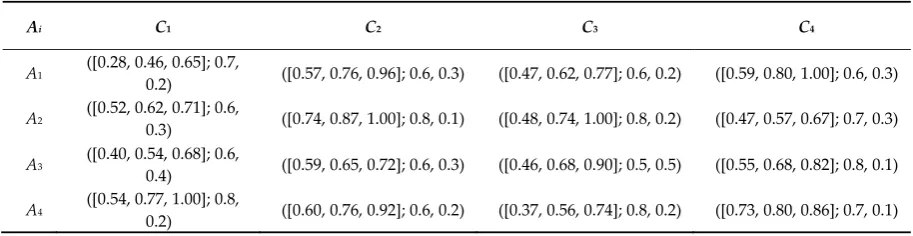
Suppose the product development team of a design company “X” has generated four new design alternatives (A1, A2, A3, and A4) for a new crane machine during the conceptual design phase. A group of experts (E1, E2, E3, and E4), within the company have given their aggregated assessment (see Table 2) of the design alternatives with respect to the criteria: Expected mechanical safety C1, Amount of wear C2, Operating and maintenance cost C3, and Mass and size C4, whose weight vectors are given as = {0.15, 0.25, 0.32, 0.28}. We select the best alternative design using the proposed algorithm.
Table 2. Aggregation of all the experts’ assessments (group intuitionistic fuzzy decision matrix).
Ai C1 C2 C3 C4
A1 ([0.28, 0.46, 0.65]; 0.7,
0.2) ([0.57, 0.76, 0.96]; 0.6, 0.3) ([0.47, 0.62, 0.77]; 0.6, 0.2) ([0.59, 0.80, 1.00]; 0.6, 0.3)
A2 ([0.52, 0.62, 0.71]; 0.6,
0.3) ([0.74, 0.87, 1.00]; 0.8, 0.1) ([0.48, 0.74, 1.00]; 0.8, 0.2) ([0.47, 0.57, 0.67]; 0.7, 0.3)
A3 ([0.40, 0.54, 0.68]; 0.6,
0.4) ([0.59, 0.65, 0.72]; 0.6, 0.3) ([0.46, 0.68, 0.90]; 0.5, 0.5) ([0.55, 0.68, 0.82]; 0.8, 0.1)
A4 ([0.54, 0.77, 1.00]; 0.8,
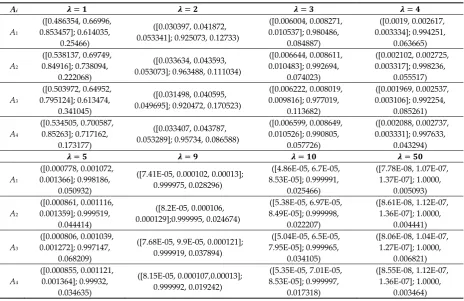
Since the experts’ assessments have already been aggregated, we jump to step 2 in the algorithm to derive the overall preference values. Using the GTIFOWGA operator when the criteria weighting vector are given as = {0.15, 0.25, 0.32, 0.28}, the comprehensive evaluation for the four design alternatives are shown in Table 3.
Table 3. The overall preference values (comprehensive evaluations for four alternatives).
Ai = = = =
A1
([0.486354, 0.66996, 0.853457]; 0.614035,
0.25466)
([0.030397, 0.041872, 0.053341]; 0.925073, 0.12733)
([0.006004, 0.008271, 0.010537]; 0.980486, 0.084887) ([0.0019, 0.002617, 0.003334]; 0.994251, 0.063665) A2 ([0.538137, 0.69749, 0.84916]; 0.738094, 0.222068) ([0.033634, 0.043593, 0.053073]; 0.963488, 0.111034)
([0.006644, 0.008611, 0.010483]; 0.992694, 0.074023) ([0.002102, 0.002725, 0.003317]; 0.998236, 0.055517) A3 ([0.503972, 0.64952, 0.795124]; 0.613474, 0.341045) ([0.031498, 0.040595, 0.049695]; 0.920472, 0.170523)
([0.006222, 0.008019, 0.009816]; 0.977019, 0.113682) ([0.001969, 0.002537, 0.003106]; 0.992254, 0.085261) A4 ([0.534505, 0.700587, 0.85263]; 0.717162, 0.173177) ([0.033407, 0.043787, 0.053289]; 0.95734, 0.086588)
([0.006599, 0.008649, 0.010526]; 0.990805, 0.057726) ([0.002088, 0.002737, 0.003331]; 0.997633, 0.043294) = = = = A1 ([0.000778, 0.001072, 0.001366]; 0.998186, 0.050932)
([7.41E-05, 0.000102, 0.00013]; 0.999975, 0.028296) ([4.86E-05, 6.7E-05, 8.53E-05]; 0.999991, 0.025466) ([7.78E-08, 1.07E-07, 1.37E-07]; 1.0000, 0.005093) A2 ([0.000861, 0.001116, 0.001359]; 0.999519, 0.044414) ([8.2E-05, 0.000106, 0.000129];0.999995, 0.024674) ([5.38E-05, 6.97E-05, 8.49E-05]; 0.999998, 0.022207) ([8.61E-08, 1.12E-07, 1.36E-07]; 1.0000, 0.004441) A3 ([0.000806, 0.001039, 0.001272]; 0.997147, 0.068209)
([7.68E-05, 9.9E-05, 0.000121]; 0.999919, 0.037894) ([5.04E-05, 6.5E-05, 7.95E-05]; 0.999965, 0.034105) ([8.06E-08, 1.04E-07, 1.27E-07]; 1.0000, 0.006821) A4 ([0.000855, 0.001121, 0.001364]; 0.99932, 0.034635) ([8.15E-05, 0.000107,0.00013]; 0.999992, 0.019242) ([5.35E-05, 7.01E-05, 8.53E-05]; 0.999997, 0.017318) ([8.55E-08, 1.12E-07, 1.36E-07]; 1.0000, 0.003464)
By applying Definitions 6, we can obtain the ranking of all the design alternatives as shown in Table 4. In addition, from Tables 3 and 4, we can see that, when the value of λ changes, the rankings of the design alternatives also change. Furthermore, if we decide to use any of the operators (TIFOWGA, TIFWGA or the TIFHWGA) in step 2, the ranking of the design alternatives will, therefore, be in the order
> > > , where the best alternative is .
Table 4. The rankings of all design alternatives.
Ranking Best Design
Alternative
1 2> 4> 1> 3 2
2 2> 4> 1> 3 2
3 4> 2> 1> 3 4
4 4> 2> 1> 3 4
9 4> 2> 1> 3 4
4.3. Comparison Analysis and Discussion
To verify the effectiveness and the feasibility of the proposed MCDM approach based on the GTIFOWGA operator, a comparative study has been conducted between the proposed MCDM approach, the triangular intuitionistic fuzzy aggregation operator proposed by Li [35] and the extended VIKOR method of TIFNs by Wan et al. [29] using the same numerical example above.
4.3.1. The Triangular Intuitionistic Fuzzy Aggregation Operator by Li [35]
Since the TIFN decision matrix has been normalized already, we calculate the weighted comprehensive values Si for the alternative Ai:
= = 〈 , , ; min , max { }〉
= [ , , ]; , .
In applying the weighted comprehensive values Si for the alternatives Ai( = 1, 2, 3, 4), we have: = 〈(0.50,0.68, 0.86); 0.6,0.3〉, = 〈(0.55,0.71, 0.86); 0.6,0.3〉;
= 〈(0.51,0.65, 0.80); 0.5,0.5〉, = 〈(0.55,0.71, 0.86); 0.6,0.2〉.
To rank the alternatives we have, ( , ) = ( , )( , ), where ∈ [0,1] is the weight representing the DM preference information. If ∈ [0, ], then it indicates that the DM prefers uncertainty or negative feelings, while if ∈ [ , 1], it means that the DM prefers certainty or positive feelings. Finally, if = [ ], the DM can be said to be indifferent between positive feelings and negative feelings. In this case, since there are no indications of the feeling of the experts or DMs in the question, we assume = [ ]. In calculating the values of , from the comprehensive values Si, we have:
, = 0.416, , = 0.432, , = 0.311,and , = 0.462.
The ranking of the design alternatives are, therefore, in the order > > > , where is the best design alternative.
4.3.2. The Extended VIKOR Method of TIFNs by Wan et al. [29]
Using the extended VIKOR method of TIFNs to solve the design selection problem above, we have the following for the group utility values and individual regret values:
( ) = 0.413, ( ) = 0.141, ( ) = 0.284, ( ) = 0.126,
( ) = 0.428, ( ) = 0.151, ( ) = 0.307, ( ) = 0.104.
Thus, = 0.428, = 0.284, and = 0.151, = 0.104.
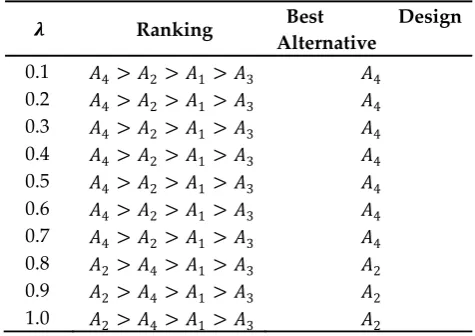
The comprehensive values of each of the alternatives and the ranking orders, which are in increasing order with the different coefficients of decision mechanism are obtained as follows:
( ) = ( ) −
− + (1 − )
( ) −
− .
Table 5. The rankings of all design alternatives.
Ranking Best Design
Alternative 0.1 4 > 2> 1> 3 4 0.2 4 > 2> 1> 3 4 0.3 4 > 2> 1> 3 4 0.4 4 > 2> 1> 3 4 0.5 4 > 2> 1> 3 4 0.6 4 > 2> 1> 3 4 0.7 4 > 2> 1> 3 4 0.8 2 > 4> 1> 3 2 0.9 2 > 4> 1> 3 2 1.0 2 > 4> 1> 3 2
From the comparison analysis, we can conclude that the proposed approach is effective, feasible and rational, as both the results of triangular intuitionistic fuzzy aggregation operator proposed by Li [35] and the extended VIKOR method of TIFNs by Wan et al. [29] are in agreement with our proposed method. The main advantage of the proposed new method is that it is straightforward and with less computational steps and formulae, unlike the other methods. The GTIFOWGA operator allows for more attitudinal information and flexibility of the DMs to be expressed and is used in accordance with the different interests or preferences in solving MCDM problems, since it is a multi-measure of neutralism, pessimism and the optimistic characteristics of DMs rather than one single measure as shown in Table 4.
5. Conclusions
Triangular intuitionistic fuzzy numbers (TIFNs), which are a more generalized platform for expressing imprecise, incomplete and inconsistent information when solving multi-criteria decision-making problems and for reflecting the evaluation information in different dimensions, has been applied in this study by developing a new triangular intuitionistic fuzzy geometric aggregation operator that is the generalized triangular intuitionistic fuzzy ordered weighted geometric averaging (GTIFOWGA) operator and defining some triangular intuitionistic fuzzy geometric aggregation operators, including the triangular intuitionistic fuzzy weighted geometric averaging (TIFWGA) operator, ordered weighted geometric averaging (TIFOWGA) operator and the hybrid geometric averaging (TIFHWGA) operator.
Based on these operators, a new approach has been proposed for effectively solving multicriteria decision-making problems when the weight information are fixed and the performance rating information are expressed in TIFNs. From the perspective of the aggregation operators, the generalized aggregation (GTIFOWGA) operator developed in this study allows the values of coefficients of decision mechanism λ to be variables (parameters) rather than fixed numbers, and allows for more attitudinal information and flexibility of the DMs to be expressed and used in accordance with the different interests or preferences in solving MAGDM problems, since it is a multi-measure of neutralism, pessimism and the optimistic characteristics of DMs rather than one single measure.
Conflicts of Interest: The author declare no conflict of interest.
References
1. Zadeh, L.A. Fuzzy sets. Inf. Control1965, 8, 338–353.
2. Liu, P.; Zhang, L. The Extended VIKOR Method for Multiple Criteria Decision Making Problem Based on Neutrosophic Hesitant Fuzzy Set. Available online: http://fs.gallup.unm.edu/TheExtendedVIKORMethod.pdf (accessed on 03/05/2016).
3. Atanassov, K.T. Intuitionistic fuzzy sets. Fuzzy Sets Syst. 1986, 20, 87–96.
4. Deschrijver, G.; Kerre, E.E. On the position of intuitionistic fuzzy set theory in the framework of theories modelling imprecision. Inf. Sci.2007, 177, 1860–1866.
5. Despi, I.; Opris, D.; Yalcin, E. Generalised Atanassov Intuitionistic Fuzzy Sets. In Proceedings of the eKNOW 2013, The Fifth International Conference on Information, Process, and Knowledge Management, Nice, France, 24 February–1 March 2013; pp. 51–56.
6. Marasini, D.; Quatto, P.; Ripamonti, E. Intuitionistic fuzzy sets in questionnaire analysis. Qual. Quant.2016, 50, 767–790.
7. Li, D.-F. Decision and Game Theory in Management with Intuitionistic Fuzzy Sets; Springer: New York, NY, USA, 2014; Volume 308.
8. Li, D.-F. Multiattribute decision making models and methods using intuitionistic fuzzy sets. J. Comput. Syst. Sci.
2005, 70, 73–85.
9. Lin, L.; Yuan, X.H.; Xia, Z.Q. Multicriteria fuzzy decision-making methods based on intuitionistic fuzzy sets. J. Comput. Syst. Sci.2007, 73, 84–88.
10. Jahromi, M.K. Multiattribute decision making models and methods using intuitionistic fuzzy sets. Int. Math. Forum2012, 7, 2847–2851.
11. Bai, Z. An Interval-Valued Intuitionistic Fuzzy TOPSIS Method Based on an Improved Score Function. Sci. World J.2013, 2013, doi:10.1155/2013/879089.
12. Xu, Z. Intuitionistic Preference Modeling and Interactive Decision Making; Studies in Fuzziness and Soft Computing; Springer: Heidelberg, Germany, 2014; pp. 195–223.
13. Liu, M.; Ren, H. A New Intuitionistic Fuzzy Entropy and Application in Multi-Attribute Decision Making.
Information2014, 5, 587–601.
14. Chen, S.M.; Chiou, C.H. A new method for multiattribute decision making based on interval-valued intuitionistic fuzzy sets, PSO techniques and evidential reasoning methodology. In Proceedings of the International Conference on Machine Learning and Cybernetics, GuangZhou, China, 12–15 July 2015; Volume 1, pp. 403–409.
15. Garg, H. Generalized intuitionistic fuzzy interactive geometric interaction operators using Einstein t-norm and t-conorm and their application to decision making. Comput. Ind. Eng.2016, 101, 53–69.
16. Aikhuele, D.O.; Turan, F.B.M. Intuitionistic fuzzy-based model for failure detection. SpringerPlus 2016, 5, doi:0.1186/s40064-016-3446-0.
17. Aikhuele, D.O.; Turan, F.B.M. An Improved Methodology for Multi-Criteria Evaluations in the Shipping Industry. Brodogradnja2016, 67, 59–72.
18. Garg, H. Some series of intuitionistic fuzzy interactive averaging aggregation operators. SpringerPlus2016, 5, doi:10.1186/s40064-016-2591-9.
19. Dong, J.; Yang, D.Y.; Wan, S.P. Trapezoidal intuitionistic fuzzy prioritized aggregation operators and application to multi-attribute decision making. Iran. J. Fuzzy Syst.2015, 12, 1–32.
20. Das, D. A Study on Ranking of Trapezoidal Intuitionistic Fuzzy Numbers. Int. J. Comput. Inf. Syst. Ind. Manag. Appl.2014, 6, 437–444.
21. Tian, M.; Liu, J. Some Aggregation Operators with Interval-Valued Intuitionistic Trapezoidal Fuzzy Numbers and Their Application in Multiple Attribute Decision Making. Adv. Model. Optim.2013, 15, 301–308.
23. Garg, H. Generalized Pythagorean fuzzy Geometric aggregation operators using Einstein t-norm and t-conorm for multicriteria decision-making process. Int. J. Intell. Syst.2016, doi:10.1002/int.21860.
24. Li, D.F. A note on “using intuitionistic fuzzy sets for fault-tree analysis on printed circuit board assembly.”
Microelectron. Reliab.2008, 48, doi:10.1016/j.microrel.2008.07.059.
25. Robinson, J.P.; Poovarasan, V. A Robust MAGDM Method for Triangular Intuitionistic Fuzzy Sets. Int. J. Pure Appl. Math.2015, 101, 753–762.
26. Shu, M.-H.; Cheng, C.-H.; Chang, J.-R. Using Intuitionistic Fuzzy Sets for Fault-Tree Analysis on Printed Circuit Board Assembly. Microelectron. Reliab.2006, 46, 2139–2148.
27. Chen, Y.; Li, B. Dynamic multi-attribute decision making model based on triangular intuitionistic fuzzy numbers. Sci. Iran. 2011, 18, 268–274.
28. Zhang, M.J.; Nan, J.X. A compromise ratio ranking method of triangular intuitionistic fuzzy numbers and its application to MADM problems. Iran. J. Fuzzy Syst.2013, 10, 21–37.
29. Wan, S.P.; Wang, Q.Y.; Dong, J.Y. The extended VIKOR method for multi-attribute group decision making with triangular intuitionistic fuzzy numbers. Knowl. Based Syst.2013, 52, 65–77.
30. Li, D.F.; Nan, J.X.; Zhang, M.J. A Ranking Method of Triangular Intuitionistic Fuzzy Numbers and Application to Decision Making. Int. J. Comput. Intell. Syst.2010, 3, 522–530.
31. Wan, S.; Lin, L.-L.; Dong, J. MAGDM based on triangular Atanassov’s intuitionistic fuzzy information aggregation. Neural Comput. Appl.2016, doi:10.1007/s00521-016-2196-9.
32. Liang, C.; Zhao, S.; Zhang, J. Aggregation Operators on Triangular Intuitionistic Fuzzy Numbers and Its Application to Multi-Criteria Decision Making Problems. Found. Comput. Decis. Sci. 2014, 3, 321–326.
33. Despic, O.; Simonovic, S.P. Aggregation operators for soft decision making in water resources. Fuzzy Sets Syst.
2000, 115, 11–33.
34. Zhang, X.; Liu, P. Method for aggregating triangular fuzzy intuitionistic fuzzy information and its application to decision making. Technol. Econ. Dev. Econ.2010, 16, 280–290.
35. Li, D.-F. A ratio ranking method of triangular intuitionistic fuzzy numbers and its application to MADM problems. Comput. Math. Appl.2010, 60, 1557–1570.
36. Xu, Z.; Yager, R.R. Some geometric aggregation operators based on intuitionistic fuzzy sets. Int. J. Gen. Syst.
2006, 35, 417–433.
37. Tan, C. Generalized intuitionistic fuzzy geometric aggregation operator and its application to multi-criteria group decision making. Soft Comput.2011, 15, 867–876.
38. Qi, X.W.; Liang, C.Y.; Zhang, J. Some generalized dependent aggregation operators with interval-valued intuitionistic fuzzy information and their application to exploitation investment evaluation. J. Appl. Math.2013,