Article
1
A Practical Approach Deriving Optimal Unit
2
Hydrograph from Noisy Runoff in absence of
3
Rainfall Data
4
Kee-Won Seong 1,*
5
1 Department of Civil Engineering, College of Engineering, Konkuk University, 120 Neungdong-ro,
6
Gwangjin-gu, Seoul 05029, Korea; [email protected]
7
* Correspondence: [email protected]; Tel: +82-2-450-3450
8
Abstract: As a procedure deriving UH (unit hydrograph), the root selection method necessitates
9
only storm runoff data. However, this method must deal with the uncertainty related to the noise
10
fluctuation of runoff ordinates and derive one optimal UH from many storms. This study proposes
11
a procedure that applies the Savitzky-Golay filter to smooth the noise fluctuation of the runoff
12
ordinates and uses the linear combination of UHs from individual storms to derive an optimal UH.
13
The proposed method is applied to the storms of the Nenagh River basin in Ireland. The
14
applicability of the Savitzky-Golay filter for smoothing the noise fluctuation of storm runoffs is
15
examined by means of the Nash-Sutcliffe efficiency index. Furthermore, the root selection method
16
is extended to also estimate IUHs. The results show that the adoption of the Savitzky-Golay filter
17
improves the applicability of the root selection method and that the optimal UH predicts accurately
18
the time-to-peak and peak discharge.
19
Keywords: root selection method; unit hydrograph; Savitzky-Golay filter; Nash-Sutcliffe index
20
21
1. Introduction
22
The unit hydrograph (UH) concept is generally used for the analysis of rainfall-runoff
23
relationship since it is practically convenient to describe linearly the basin response to rainfall input.
24
Numerous methods have been proposed to find an UH from storm hydrographs with known
25
rainfall inputs. However, one still needs an efficient method estimating the UH in absence of rainfall
26
input. For unknown rainfall input in hydrograph analysis, several researches focused on separating
27
a UH from the runoff hydrograph. De Laine [1] suggested the root matching method using the roots
28
of the polynomial representing the Z-transform of a hydrograph of finite length. Turner et al. [2]
29
proposed an alternative approach that is less sensitive to data quality than that of De Laine [1]. This
30
approach called the root selection method used the Argand diagram to decide the shape of a
31
resulting UH. Based on Turner et al. [2], Ojha et al. [3] applied scaling parameters to adjust the
32
values of UH coordinates. To improve UH determination, Parmentier et al. [4] proposed a method
33
that avoids the subjective selection of rainfall roots by identifying and controlling the
34
time-dependent response components. Bruen et al. [5] extended the applicability of the root selection
35
method in separating urbanization effects in runoff data. Based on the theory of response separation
36
provided by the root selection method, Seong [6] suggested a novel method estimating the
37
parameters of the Clark’s IUH.
38
Though the root selection method has shown satisfactory results in determining a UH, the
39
uncertainties in UH ordinates and the derivation of a representative UH based on multiple storm
40
events remain still matters to be considered. De Laine [1] and Turner et al. [7] showed that the root
41
selection method produces remarkably sensitive roots for the polynomial representing a single
42
storm runoff hydrograph. This means that the uncertainties polluting the runoff hydrographs from
43
different storms will affect sensitively each UH polynomial for the corresponding storm. To reduce
44
such uncertainties, this study applies the five-point Savitzky-Golay filter to runoff data [8,9]. By
45
applying the filter, the variation of UH ordinates extracted from different storms can be diminished
46
within a narrow range so that the important UH parameters such as peak value and time-to-peak
47
exhibit more stable values.
48
Even though the smoothing filter is applied, a UH based on individual storm event usually
49
differs from one storm to another. Occasionally, the estimate of UH from a single event will yield
50
unreliable result showing unsatisfactory value of goodness-of-fit index. Thus, this research suggests
51
a method by which an optimum UH is derived from available multiple storm events. To do this, this
52
research combines the UH polynomials from multiple storm events based on the linear combination
53
theory. In addition, this research investigates the applicability of IUHs obtained from UHs resulting
54
from the root selection by comparing them with existing IUHs obtained from a conventional
55
method.
56
The validity of the proposed methodology is verified using the 22 storm records of the Nenagh
57
River at Claianna, Ireland, which are adopted in the referred researches concerning the root selection
58
method and investigating other general rainfall-runoff relationships [2,3,7,10,11].
59
2. Method
60
2.1 Smoothing of Runoff Data by the Savitzky-Golay Filter
61
Though runoff data can be collected by a proper way, there is still an uncertainty associated
62
with natural randomness that might affect the root selection procedure. The uncertainty of runoff
63
data appears frequently in the form of oscillations in the hydrograph. If rainfall data is available for
64
rainfall-runoff analysis, this uncertainty can be eliminated or reduced by minimizing error
65
techniques such as the least squares method or other regression methods. Moreover, the concurrent
66
use of multiple storms in the convolution procedure would lower the uncertainties when deriving
67
UH. However, in absence of rainfall data, the root selection method cannot consider the uncertainty
68
of runoff data and will result in relatively higher variation of the UH ordinates obtained from
69
different storms. In signal processing field, these oscillations from randomness are generally
70
eliminated by data smoothing. Among the various smoothing techniques, the Savitzky-Golay filter
71
is adopted in this research since it tends to preserve the peak heights of a given noisy signal. Such
72
characteristics of the Savitzky-Golay filter makes it particularly adapted for deriving UH, especially
73
when associated with the root selection method.
74
For a runoff data y=
{
q1, , qn}
consisting of n discharge ordinates, the Savitzky-Golay filter75
fits a polynomial of arbitrary order to the2m+1data points surrounding the center for data
76
smoothing. Chau [9] proposed the following expression involving a set of weights wj for this
77
polynomial:
78
* 1
2 1
m
i j i j
j m
q w q
m =− +
=
+
, (1)where q*i denote the smoothed discharge ordinates and qi j+ are the original runoff ordinates, in
79
which i and j are the running indices. It is known that the Savitzky-Golay filter uses the least-squares
80
technique to find the weights wj. For example, the best quadratic polynomial smoothing data to the
81
surrounding five data values (m = 2 for 2m+1 = 5) is expressed in Equation (2):
82
(
)
*
2 1 1 2
1
3 12 17 12 3
35
i i i i i i
q = − q− + q− + q + q+ − q+ . (2)
This study adopts Equation (2) to smooth the runoff because it involves the lesser number of runoff
83
data points in the smoothing process. Equation (2) requires the first and last points to be treated.
84
Here, an artificial extension of data by adding zeros is employed.
85
2.2 The Root Selection Method
The linear discrete convolution relationship between a pulse response function being UH, an
87
input being effective rainfall and an output being runoff is usually expressed as Equation (3) [6]:
88
(
)
(
)
0
( ) n ( )
i
y nT h iT x n i T
=
=
− , (3)where T is the time interval for sampling; the output y nT( ) is the runoff sampled at t nT= ; and,
89
the input x n
(
(
−1)
T)
is the effective rainfall between times t= −(
n 1)
T and nT . The pulse90
response function h iT( ) represents the ordinate value of T-period UH at time t=iT i, =0n. As
91
for Equation (3), De Laine [1] proposed the root matching method to estimate the UH without using
92
rainfall data. The root matching method uses the Z-transformation method for rainfall-runoff
93
modelling in frequency domain. Thus, Equation (3) can be rewritten as:
94
1 1 1
( ) ( ) ( )
Y z− =H z− X z− , (4)
where Y z( −1) is a polynomial resulting from the Z-transform of direct runoff y; X z( −1) is a
95
polynomial representing the Z-transform of rainfall x; and, H z( −1) is a polynomial indicating the
96
Z-transform of UH. The root matching method uses the roots of the runoff polynomial Y z( −1) to
97
give H z( −1). According to De Laine [1], from the results of multiple runoff analysis, the common
98
roots in more than two runoff polynomials can be extracted because the common roots are
99
independent of the rainfall and thus, the UH can be constructed using these common roots.
100
However, Turner et al. [2] showed that the root matching method is sensitive to the errors in runoff
101
data and proposed a new method finding the UH polynomial by considering the roots on the
102
complex plot (or the Argand diagram) of the runoff polynomial. Based on the analysis using
103
synthetic data and real runoff data, they found a specific feature of the roots reflecting UH on the
104
Argand diagram. Furthermore, the authors showed that this feature was practically common to all
105
runoff events in a same basin. Finally, Turner et al. [2] suggested a procedure (the root selection
106
method) that could extract UH roots from the runoff roots on the Argand diagram and showed that
107
the method gave a smaller average error in UH than the root matching method.
108
2.3 Determination of an Optimal UH for Multiple Storm Events
109
The root selection method has been successful in identifying UH roots from a runoff
110
polynomial based on individual single runoff event. However, a practical procedure is still
111
necessary to determine the optimal UH obtained from multiple runoff events. Accordingly, this
112
study constructs an optimal runoff polynomial by selecting the optimal UH roots from a unique and
113
integrated Argand diagram in which all runoff roots appear. The suggested method involves the
114
following processes:
115
1 smoothening of fluctuation in ordinates of runoff hydrographs by the Savitzky-Golay filter
116
based on large number of runoff data;
117
2 selection of the UH roots for each storm runoff data by conventional root selection procedure,
118
and derivation of the individual single-event UH polynomial;
119
3 overlapping of the UH roots selected individually from different storm runoffs on the Argand
120
diagram from one storm to another;
121
4 removal of eventual abnormal roots based on thick circular pattern that might indicate the
122
uncertainty associated with natural randomness of runoff process;
123
5 reconstruction of the UH polynomial for each storm by considering the removed roots in step 4,
124
and normalization of each coefficient of the polynomial by dividing each coefficient by the sum
125
of all coefficients;
126
7 construction of an optimal UH polynomial by linear combination of the UH polynomials for
127
storms considered to be a response to one unit of the effective rainfall for a specified duration
128
The above-mentioned procedure can be formulated mathematically as follows. Consider k storm
130
runoffs y y=
[
1, ,ym, ,yk]
in which ym represents the direct runoff data for the mth storm
131
event. Each ordinate of ym becomes one coefficient of the runoff polynomial when applying the
132
Z-transform to runoff ym. The same notation applies for the UHs h=
[
h1, , hm, , hk]
and for the133
effective rainfall series x x=
[
1, ,xm, ,xk]
using the relationship given in Equation (3). Equation
134
(4) is also generalized by introducing a subscript denoting the event number. The resulting
135
convolution equation replacing Equation (4) is then:
136
1 1 1
( ) ( ) ( ), 1, ,
m m m
Y z− =H z− X z− m= k. (5)
Since this work uses the smoothed runoff obtained by the Savitzky-Golay filter instead of the raw
137
runoff data Y zm( −1), Equation (5) is rewritten with the smoothed runoff Y zm*( −1) as shown in
138
Equation (6):
139
*( 1) ( 1) ( 1), 1, ,
m m m
Y z− =H z− X z− m= k, (6)
where Ym*(z−1)=Z y
( )
*m ; and, y*m represents the smoothed runoff data for the mth storm.140
Considering UH polynomials for k storms H zm( −1) with m=1, , k, the coefficients of H zm( −1)
141
do not indicate the ordinates of UH for storm number k but represent simply the relative values
142
between the coefficients of H zm( −1). Therefore, the coefficients of H zm( −1) must be readjusted
143
with the scale factors cm such that the sum of the coefficients equals one unit of effective rainfall for
144
a specific duration. After this adjustment, a combined UH polynomial can be derived by the linear
145
combination of the H zm( −1), m=1, , k using the scale factors cmfor the corresponding storm m
146
as shown in Equation (7):
147
1 1 1
1 1
( ) ( ) k k( )
H z− =c H z− + +c H z− , (7)
where H z( −1) is tentatively an optimal UH polynomial. The resulting optimal UH polynomial can
148
be obtained by rescaling the coefficients to satisfy the definition of UH.
149
2.4 Parameters of Nash’s IUH with Root Selection Method
150
A vital aspect of using IUH (instantaneous UH) in a hydrologic modeling is that the IUH is free
151
from the difficulties related to the duration time of the effective rainfall. One widespread conceptual
152
IUH model is the Nash’s model [12]. The Nash’s IUH follows a gamma probability density function
153
as shown in Equation (8):
154
( )
1( )
1expn
t t
h t
K n K K
−
= −
Γ , (8)
where h
( )
is the functional form of Nash’s IUH; n and K are the model parameters to be155
estimated; and, Γ
( )
is the gamma function. This work intends to find the IUH parameters from156
the UH obtained by root selection. For this purpose, this research applies the method of moments
157
(MOM) to calculate the parameters of Nash’s model. The use of MOM was proposed by Nash [12] in
158
which the moments of the IUH are the moments of the input (effective rainfall series) and output
159
(direct runoff). In this research, the parameters (n, K) for 21 storms in Nenagh basin are determined
160
by MOM using input (one unit of the effective rainfall for a specified duration) and output functions
161
(UH resulting from the root selection method).
162
3. Application and Result Assessment
163
The site chosen to apply the proposed method estimating a multiple-event UH is Nenagh River
165
basin with an area of 295 km2, at Claianna, Ireland [10]. Twenty-two storm data with peak values
166
varying from 18 to 51.6 m3/s on direct runoff s are considered. The corresponding rainfalls run
167
between 2.91 and 11.61 mm. Both discharge and rainfall data were sampled at interval T = 3 hours.
168
The flow chart of the proposed method is shown in Figure 1.
169
170
Single-Event UHs
Savitky-Golay filter
THIS RESEARCH
Runoff Data
Smoothed Runoff Data
Runoff Polynomials
Z- transformation
Stacked Argand Diagram
Individial Argand Diagram
Finding roots
Root selection
Linear Combination
Optimal UH of Basin
Z- transformation
EXISTING METHOD
Runoff Data
Runoff Polynomials
Individual UHs
Root selection
Nash’s IUHs
Method of Moment
171
Figure 1. Flow chart of method proposed by this study in comparison with the conventional root
172
selection method.
173
This research considers 22 storms as single runoff sample y y=
[
1, ,y22]
, in which the last
174
storm y22 is used to check the validity of the proposed method by showing runoff reproduction.
175
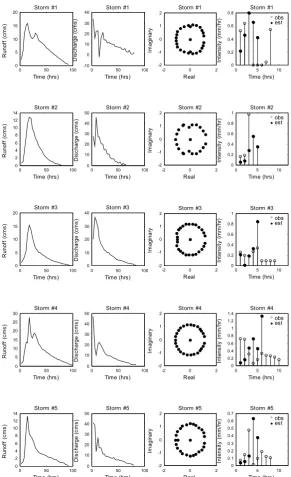
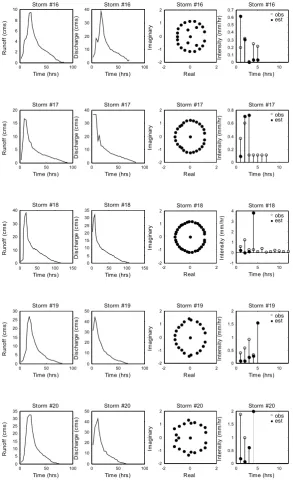
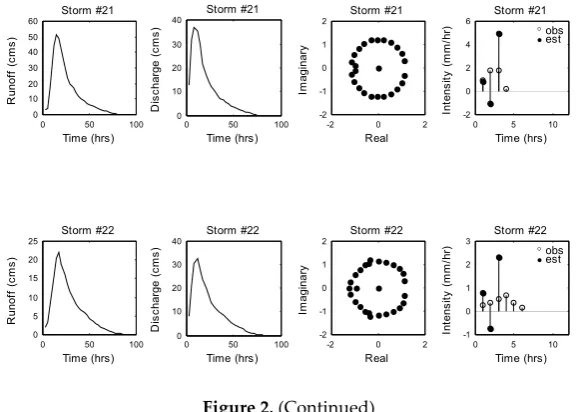
The runoff hydrographs y corresponding to the 22 different storms are shown in the leftmost panel
176
of each row in Figure 2.
177
0 50 100 0 5 10 15 20 Time (hrs) Ru no ff ( cm s) Storm #1
0 50 100
-10 0 10 20 30 40 Time (hrs) D is char ge ( cm s) Storm #1
-2 0 2
-2 -1 0 1 2 Real Im ag in ar y Storm #1
0 5 10
0 0.2 0.4 0.6 0.8 Time (hrs) In te ns ity ( m m /h r) Storm #1 ° obs • est
0 50 100
0 2 4 6 8 10 12 14 Time (hrs) R un off ( cms ) Storm #2
0 50 100
0 10 20 30 40 50 Time (hrs) D is c har ge ( cm s) Storm #2
-2 0 2
-2 -1 0 1 2 Real Ima g in a ry Storm #2
0 5 10
0 0.2 0.4 0.6 0.8 1 Time (hrs) In te n si ty ( mm/h r) Storm #2
° obs • est
0 50 100
0 5 10 15 20 Time (hrs) Ru n off ( cms ) Storm #3
0 50 100
0 10 20 30 40 Time (hrs) D is c har ge ( cm s) Storm #3
-2 0 2
-2 -1 0 1 2 Real Ima g in a ry Storm #3
0 5 10
0 0.2 0.4 0.6 0.8 1 Time (hrs) In te n si ty ( mm/ h r) Storm #3
° obs • est
0 50 100
0 5 10 15 20 25 30 Time (hrs) R uno ff (c m s) Storm #4
0 50 100
0 10 20 30 40 50 Time (hrs) D is ch ar ge ( c m s) Storm #4
-2 0 2
-2 -1 0 1 2 Real Im agi nar y Storm #4
0 5 10
0 0.2 0.4 0.6 0.8 1 1.2 1.4 Time (hrs) In tens it y (m m /hr ) Storm #4 ° obs • est
0 50 100
0 2 4 6 8 10 12 14 Time (hrs) R unof f (c m s) Storm #5
0 50 100
0 10 20 30 40 50 Time (hrs) D is ch ar ge ( c m s) Storm #5
-2 0 2
-2 -1 0 1 2 Real Im agi nar y Storm #5
0 5 10
0 0.1 0.2 0.3 0.4 0.5 0.6 0.7 Time (hrs) In tens it y (m m /hr ) Storm #5 ° obs • est
179
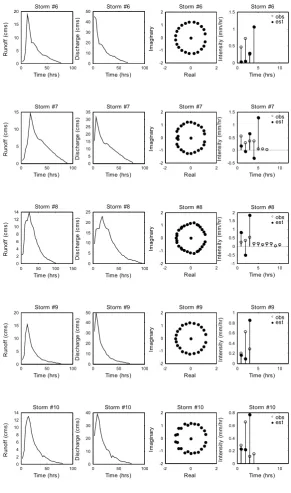
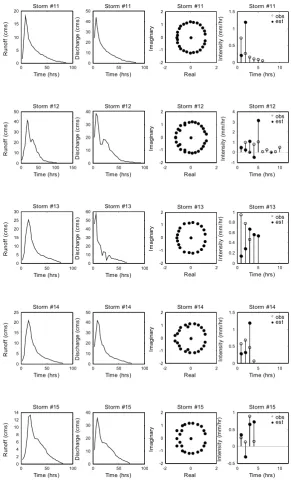
Figure 2. Observed runoff data (22 storms of Nenagh Basin) and the results of the root selection
180
method applying each runoff: the panels from left to right of each row plot successively the runoff
181
hydrograph, estimated unit hydrograph, Argand plot for selected roots, and hyetographs for both
182
measured and estimated rainfalls
183
0 50 100 0 5 10 15 20 Time (hrs) Ru n off ( cms ) Storm #6
0 50 100
0 10 20 30 40 50 Time (hrs) D is c har ge ( cm s) Storm #6
-2 0 2
-2 -1 0 1 2 Real Ima g in a ry Storm #6
0 5 10
0 0.5 1 1.5 Storm #6 Time (hrs) In te n si ty ( mm/h
r) ° obs• est
0 50 100
0 5 10 15 Time (hrs) R uno ff ( cm s) Storm #7
0 50 100
0 5 10 15 20 25 30 35 Time (hrs) D is ch ar ge ( cm s) Storm #7
-2 0 2
-2 -1 0 1 2 Real Im agi nar y Storm #7
0 5 10
-0.5 0 0.5 1
1.5 Storm #7
Time (hrs) In te ns ity ( mm/ h
r) °• est obs
0 50 100 150 0 2 4 6 8 10 12 14 Time (hrs) R unof f (c m s) Storm #8
0 50 100
0 5 10 15 20 25 Time (hrs) D is ch ar ge ( cm s ) Storm #8
-2 0 2
-2 -1 0 1 2 Real Im agi nar y Storm #8
0 5 10
-1 -0.5 0 0.5 1 1.5
2 Storm #8
Time (hrs) In tens it y (m m /hr
) ° obs
• est
0 50 100
0 5 10 15 20 Time (hrs) Ru n off ( cms ) Storm #9
0 50 100
0 10 20 30 40 50 Time (hrs) D is c har ge ( cm s) Storm #9
-2 0 2
-2 -1 0 1 2 Real Im ag inar y Storm #9
0 5 10
0 0.2 0.4 0.6 0.8
1 Storm #9
Time (hrs) In te n si ty ( mm/ h
r) ° obs
• est
0 50 100
0 2 4 6 8 10 12 14 Time (hrs) R uno ff (c m s) Storm #10
0 50 100
0 10 20 30 40 Time (hrs) D is ch ar ge ( cm s) Storm #10
-2 0 2
-2 -1 0 1 2 Real Im agi nar y Storm #10
0 5 10
0 0.2 0.4 0.6 0.8 Storm #10 Time (hrs) In tens ity ( m m /hr
) ° obs
• est
185
Figure 2. (Continued)
0 50 100 0 5 10 15 20 Time (hrs) R u no ff ( cms ) Storm #11
0 50 100
0 10 20 30 40 50 Time (hrs) D is char ge ( cm s ) Storm #11
-2 0 2
-2 -1 0 1 2 Real Im a gi n ar y Storm #11
0 5 10
0 0.5 1
1.5 Storm #11
Time (hrs) In te ns ity ( m m /h
r) ° obs
• est
0 50 100 150 0 10 20 30 40 50 Time (hrs) Ru n off ( cms ) Storm #12
0 50 100
0 10 20 30 40 Time (hrs) D is char ge ( cm s ) Storm #12
-2 0 2
-2 -1 0 1 2 Real Ima gi n ar y Storm #12
0 5 10
-1 0 1 2 3
4 Storm #12
Time (hrs) In te ns ity ( mm/h
r) °• est obs
0 50 100
0 5 10 15 20 25 30 Time (hrs) Ru n off ( cms ) Storm #13
0 50 100
0 10 20 30 40 50 60 Time (hrs) D is c har ge ( cm s) Storm #13
-2 0 2
-2 -1 0 1 2 Real Ima g in a ry Storm #13
0 5 10
0 0.2 0.4 0.6 0.8
1 Storm #13
Time (hrs) In te n si ty ( mm/h
r) ° obs
• est
0 50 100
0 5 10 15 20 25 Time (hrs) R uno ff ( cm s) Storm #14
0 50 100
0 10 20 30 40 50 Time (hrs) D is ch ar ge ( cm s) Storm #14
-2 0 2
-2 -1 0 1 2 Real Im agi nar y Storm #14
0 5 10
0 0.5 1 1.5 Storm #14 Time (hrs) In te ns it y ( mm/ h
r) ° obs• est
0 50 100
0 2 4 6 8 10 12 14 Time (hrs) R unof f (c m s) Storm #15
0 50 100
0 10 20 30 40 Time (hrs) D is ch ar ge ( c m s) Storm #15
-2 0 2
-2 -1 0 1 2 Real Im agi nar y Storm #15
0 5 10
-0.5 0 0.5
1 Storm #15
Time (hrs) In tens it y (m m /hr
) ° obs
• est
187
Figure 2. (Continued)
0 50 100 0 2 4 6 8 10 Time (hrs) Ru n off ( cms ) Storm #16
0 50 100
0 10 20 30 40 Time (hrs) D is c har ge ( cm s) Storm #16
-2 0 2
-2 -1 0 1 2 Real Ima g in a ry Storm #16
0 5 10
0 0.1 0.2 0.3 0.4 0.5 0.6
0.7 Storm #16
Time (hrs) In tens ity ( m m /hr
) ° obs
• est
0 50 100
0 5 10 15 20 Time (hrs) R u nof f (c m s) Storm #17
0 50 100
0 10 20 30 40 Time (hrs) D is char g e (c m s) Storm #17
-2 0 2
-2 -1 0 1 2 Real Ima gi n ar y Storm #17
0 5 10
0 0.2 0.4 0.6
0.8 Storm #17
Time (hrs) In te n si ty ( mm/h
r) ° obs• est
0 50 100 150 0 10 20 30 40 Time (hrs) R unof f ( cm s) Storm #18
0 50 100 150 0 5 10 15 20 25 30 35 Time (hrs) D isch a rg e ( cms) Storm #18
-2 0 2
-2 -1 0 1 2 Real Im agi nar y Storm #18
0 5 10
-1 0 1 2 3
4 Storm #18
Time (hrs) In te ns it y ( m m /h
r) ° obs• est
0 50 100
0 5 10 15 20 25 30 Time (hrs) R uno ff ( cm s) Storm #19
0 50 100
0 10 20 30 40 50 Time (hrs) D is ch ar ge ( cm s ) Storm #19
-2 0 2
-2 -1 0 1 2 Real Im agi nar y Storm #19
0 5 10
0 0.5 1 1.5
2 Storm #19
Time (hrs) In tens it y ( m m /hr
) ° obs
• est
0 50 100
0 5 10 15 20 25 30 35 Time (hrs) Ru n off ( cms ) Storm #20
0 50 100
0 10 20 30 40 50 Time (hrs) D is c har ge ( cm s) Storm #20
-2 0 2
-2 -1 0 1 2 Real Ima g in a ry Storm #20
0 5 10
0 0.5 1 1.5 2 Storm #20 Time (hrs) In tens ity ( m m /hr
) ° obs
• est
189
Figure 2. (Continued)
0 50 100 0
10 20 30 40 50 60
Time (hrs)
R
uno
ff
(
cm
s)
Storm #21
0 50 100
0 10 20 30 40
Time (hrs)
D
is
ch
ar
ge (
cm
s)
Storm #21
-2 0 2
-2 -1 0 1 2
Real
Im
agi
nar
y
Storm #21
0 5 10
-2 0 2 4
6 Storm #21
Time (hrs)
In
te
ns
ity
(
m
m
/h
r) ° obs
• est
0 50 100
0 5 10 15 20 25
Time (hrs)
R
u
no
ff (
cms
)
Storm #22
0 50 100
0 10 20 30 40
Time (hrs)
D
is
char
ge (
cm
s)
Storm #22
-2 0 2
-2 -1 0 1 2
Real
Im
ag
in
ar
y
Storm #22
0 5 10
-1 0 1 2
3 Storm #22
Time (hrs)
In
te
ns
ity
(
m
m
/hr
) ° obs
• est
191
Figure 2. (Continued)
192
The UHs hm (m=1,, 22) were derived individually from the 22 different storm events by the
193
conventional root selection method. The resulting UHs and roots of H zm( −1) for corresponding
194
storm events are indicated in the second and third panels from left of each row in Figure 2. It appears
195
that the root patterns for many different storm events are fairly displaced from the regular pattern,
196
resulting in fluctuations of ordinates in many UHs. Therefore, it could be supposed that the
197
individual UHs are virtually subject to uncertainty related with the randomness. Each rightmost
198
panel in the rows of Figure 2 shows the rainfall difference between the values from measured
199
hyetograph and the roots from X zm( −1), m=1, , 22 . One sees the presence of inevitable and
200
remarkable discrepancy in estimated rainfall in many storms. This indicates clearly that the
201
uncertainty in runoff data affected the estimation of both rainfall and UHs.
202
To clarify the uncertainties in UHs, Figure 3(a) shows a plot in which the 22-individual storm
203
UHs are stacked altogether, and Figure 3(b) plots the Argand diagrams of the corresponding
204
( 1, , 22) m
Y m= . Figure 3(a) reveals the large variation between UHs, the significant oscillations of
205
the ordinates values, and the abnormal ordinate values as well. Thus, if a representative UH is
206
derived based on these UHs, this representative UH might be subjected to high variation related to
207
uncertainties. Even though not all individual Argand diagrams show perfect circular pattern of
208
runoff roots as shown in Figure 1, the stacked Argand diagrams in Figure 3(b) show explicit circular
209
pattern of the runoff roots. Thus, stacking the runoff data permits to identify more easily the
210
abnormal roots from the runoff roots.
211
0 50 100
-10 0 10 20 30 40 50 60
Time (hrs)
R
unof
f (
cm
s)
(a)
-2 -1 0 1 2
-2 -1 0 1 2
Real
Im
aginar
y
(b)
212
Figure 3. Applying root selection method in conventional way to 22 storms of Nenagh Basin: (a)
213
estimated unit hydrographs by root selection method; (b) Argand plot for runoff polynomials.
214
The Savitzky-Golay filtering was applied to the 22 runoffs. To produce single smoothed runoff y*,
216
the filter used adjacent five runoff ordinate values as introduced in Equation 2. Figure 4(a) shows the
217
UH stacking the 22 different storms after the Savitzky-Golay filtering and Figure 4(b) indicates the
218
Argand diagrams for corresponding Ym* (m=1,, 22).
219
220
0 50 100
-10 0 10 20 30 40 50 60
Time (hrs)
R
unof
f (
cm
s)
(a)
-2 -1 0 1 2
-2 -1 0 1 2
Real
Im
aginar
y
(b)
221
Figure 4. Effect of applying Savitzky-Golay filter to 22 storms of Nenagh Basin: (a) estimated unit
222
hydrographs by root selection method; (b) Argand plot for runoff polynomials.
223
In Figure 4(a), one can observe that the variations among the ordinates of each UH are fairly reduced
224
compared to Figure 3(a). Moreover, the overall pattern of UH root circles based on the filtered data
225
shown in Figure 4(b) appears to be improved in the sense that the roots in the circular pattern gets
226
closer together when using the Savitzky-Golay filter. The result shows that the Savitzky-Golay filter
227
stabilizes the UH by reducing the uncertainty brought by the random error from the runoff data.
228
Besides, compelling changes related with abnormal roots can be found. The abnormal points,
229
positioned outside the circle in Figure 3(b), are repositioned inside the circle after smoothing as in
230
Figure 4(b), while the abnormal points inside the circle virtually retain their position. However, this
231
change of root pattern did not contribute in producing a better rainfall estimate.
232
233
3.2 Evaluation Using the Performance Index
234
In order to investigate the effect of the Savitzky-Golay filter more precisely, this study
235
compared the performance of UHs with/without Savitzky-Golay filtering. Among the numerous
236
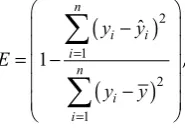
goodness-of-fit criteria, this study selected the Nash-Sutcliffe model efficiency coefficient [13] as
237
comparison index following the recommendation of ASCE [14]. The Nash-Sutcliffe index is defined
238
as:
239
(
)
(
)
2
1
2
1
ˆ 1
n
i i
i n
i i
y y
E
y y
=
=
−
= −
−
, (9)in which yi is the observed runoff; yˆi is the modelled discharge; and, y is the average
240
discharge at time t. The closer the Nash-Sutcliffe index to 1, the better the performance of the model.
241
Specifically, a value of 0.9 for E indicates a very satisfactory model performance, a value between 0.8
242
and 0.9 indicates an acceptable model, and a value between 0.6 and 0.8 indicates unsatisfactory
243
fitting results [15]. The applicability of UHs were compared using the Nash-Sutcliffe index for UH
244
models with and without Savitzky-Golay filtering. Table 1 compares the Nash-Sutcliffe index
245
yielded for the 22 storms of Nenagh basin. The last row in the table represents the average value for
246
both UHs.
247
Table 1. Comparison of Nash-Sutcliffe model efficiency coefficient for UHs with/without
249
Savitzky-Golay filtering.
250
251
252
The table apparently indicates that for most of the events, the UH model with filtering performs
253
better than the UH without filtering. The overall index value clearly proves the applicability of
254
Savitzky-Golay filtering as indicated by the average Nash-Sutcliffe index of 0.83 (> 0.8). This result
255
shows that the UH model using Savitzky-Golay filtering can be recommended for the prediction of
256
rainfall-runoff of the Nenagh basin at least.
257
3.3 Deriving of Optimal UH (Multiple-Event Analysis)
258
The 22 storms presented chronologically in Figure 2 were used for deriving an optimal UH. For
259
this purpose, the first 21 storms were used to give an optimal UH estimate with careful selection of
260
the abnormal roots on the basis of Figure 4. The last 22nd storm was used for validation of the
261
prediction. Using each of the 21 single-event UHs H zm( −1), m=1,, 21, a multiple-event UH
262
1
( )
H z− was derived by the linear combination method as shown in Equation (7). The optimal UH
263
1
( )
H z− is compared to a selection of H zm( −1), m=1, 2, 10, 16 in Figure 5. In the figure, the UHs
264
based on the selected storms vary from one storm event to another.
265
Event Nash-Sutcliffe model efficiency coefficient
Without filter With filter
1 .59 .84
2 .65 .97
3 .89 .88
4 .65 .77
5 .56 .76
6 -.01 .68
7 .58 .73
8 .85 .84
9 .88 .78
10 .96 .97
11 .89 .93
12 .88 .87
13 .09 .95
14 .93 .98
15 .88 .99
16 .73 .69
17 .85 .85
18 .48 .62
19 .27 .73
20 .09 .60
21 .91 .95
22 .93 .90
0 10 20 30 40 50 60 70 80 90
Time (hr)
0 5 10 15 20 25 30 35 40
peak ordinate of optimal UH
optimal UH UH storm 1 UH storm 2 UH storm 10 UH storm 16 UH (Bree, 1978)
266
Figure 5. Comparison of UH ordinates obtained by this research (optimal UH) with those of selected
267
events and Bree [10].
268
These selected storms were also used by Bree [10] to obtain a reliable UH when using the least
269
squares method. According to Bree [10], the estimation of the UH from a single-event analysis did
270
not result in a reliable UH. Besides, the combination of multiple storms produced more reliable UH
271
by reducing the oscillations of UH ordinates. Similar result could be observed in this research. In
272
Figure 5, one can find that the oscillations in the individual UHs H zm( −1) were virtually removed
273
when the multiple-event analysis was applied. Thus, to calculate a design runoff in conjunction with
274
a design rainfall, using multiple-event UH H z( −1) is preferable for better prediction.
275
3.4 Estimating Parameters of Nash’s IUH
276
The parameters (n, K) for available storms in Nenagh basin were determined by MOM which
277
uses the single-event UH for each storm and corresponding unit rainfall provided with 1 cm depth
278
for 3-hours duration. For this calculation, a computer code serviced by Colorado State University
279
[16] was used. Incidentally, Mohan and Vijayalakshmi [11] have carefully determined the Nash’s
280
parameters based on a typical MOM procedure using rainfall data. Thus, the parameter values given
281
by Mohan and Vijayalakshmi [11] could provide proper reference values to be compared with those
282
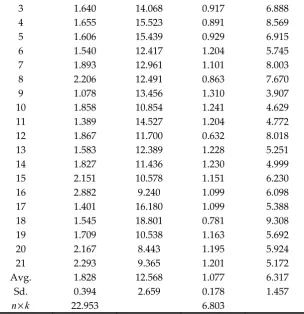
resulting from this research. Table 2 lists the parameters (n, K) for 21 storms obtained from these two
283
different approaches.
284
285
Table 2. Comparison of Nash IUH’s parameters of this research with those of Mohan and
286
Vijayalakshmi [11].
287
Event This research Mohan and
Vijayalakshmi (2008)
n k n k
1 1.955 14.293 0.996 7.926
3 1.640 14.068 0.917 6.888
4 1.655 15.523 0.891 8.569
5 1.606 15.439 0.929 6.915
6 1.540 12.417 1.204 5.745
7 1.893 12.961 1.101 8.003
8 2.206 12.491 0.863 7.670
9 1.078 13.456 1.310 3.907
10 1.858 10.854 1.241 4.629
11 1.389 14.527 1.204 4.772
12 1.867 11.700 0.632 8.018
13 1.583 12.389 1.228 5.251
14 1.827 11.436 1.230 4.999
15 2.151 10.578 1.151 6.230
16 2.882 9.240 1.099 6.098
17 1.401 16.180 1.099 5.388
18 1.545 18.801 0.781 9.308
19 1.709 10.538 1.163 5.692
20 2.167 8.443 1.195 5.924 21 2.293 9.365 1.201 5.172 Avg. 1.828 12.568 1.077 6.317 Sd. 0.394 2.659 0.178 1.457
n k× 22.953 6.803
288
Table 2 also indicates the statistical properties featuring the variation of the determined
289
parameters. It can be seen that the result obtained in this study exhibit fairly higher values in both
290
parameters than those of the reference values. However, the degree of variation of these values can
291
be regarded as being low in view of the small values of the standard variations. The product values
292
of n and K (n K× ) for all storms were considered to be constant with an average of 22.953, which is
293
significantly higher than the reference value of 6.803. Thus, the IUH with the parameter values of
294
this study would produce lower peak discharge and more delayed time-to-peak in comparison to
295
the IUH given by Mohan and Vijayalakshmi [11]. However, it is evident that the IUH obtained from
296
the root selection would be able to predict runoff more accurately by transferring a few number of
297
UH roots into rainfall roots. Therefore, future work should focus on the efficiency of the selection
298
procedure for UH roots.
299
3.5 Predicted Runoff Using the Optimal UH
300
Event 22 was used to verify the optimal UH H zˆ ( )−1 estimated from 21 storms. Figure 6
301
compares the observed and predicted runoffs using the optimal UH. The single-event UH H22(z−1)
302
derived by the root selection method is also plotted in Figure 6.
303
0 10 20 30 40 50 60 70 80 90 100 0
1
2
3
4
5
6
7
8
9
10
P
rec
ipit
at
io
n (
m
m
)
Time (hr)
storm # 22
0 10 20 30 40 50 60 70 80 90 100 0 5 10 15 20 25 30
D
is
char
ge (
cm
s)
rainfall depth predicted reproduced observed
305
Figure 6. Comparison between the runoff predicted for 22nd storm using the optimal unit
306
hydrograph obtained from 21 storms and the runoff reproduced using the single event unit
307
hydrograph for 22nd event, and the observed runoff for 22nd storm event.
308
In Figure 6, there is no remarkable difference in the overall shape between the observed and
309
predicted runoffs. The peak discharge of the predicted runoff agrees well with that of the observed
310
one. However, the optimal UH resulted in a slightly larger value of the time-to-peak in the predicted
311
runoff. This problem might be solved by selecting more abnormal roots from the runoff roots to
312
reform the optimal UH to another optimal UH having smaller number of ordinates. However, this
313
method involves more subjectivity in the root selection procedure.
314
Interestingly, the reproduced hydrograph using the single-event UH H22(z−1)shows larger
315
deviation from the observed runoff compared to the predicted hydrograph using the optimal UH.
316
This is mainly due to higher uncertainty associated with the determination of H22(z−1). This
317
strongly suggests that using multiple-event UH along with runoff filtering would be applicable
318
especially in absence of rainfall data.
319
320
4. Conclusion
321
The root selection method can be used for determining a UH when rainfall data are not
322
available. The root selection method has shown successful results, but the uncertainty related to
323
noise fluctuations in the resulting UH remains unclear yet. The determination of an optimal UH
324
(multiple-event UH) based on available UHs individually obtained from many storm events
325
(single-event UH) is an important problem for practical use. This study proposed an improved root
326
selection method based on the smoothing technique using the Savitzky-Golay filter to reduce
327
significantly the noise fluctuations in runoff data. The proposed method provided single-event UH
328
for each storm with better applicability. This paper also focused on deriving the optimal UH by
329
linear combination of the single-event UHs from different storms. In addition, determination of
330
proposed method was applied to twenty-two storm events for a basin of the Nenagh River at
332
Claianna, Ireland.
333
In most storm events, the values of Nash-Sutcliffe index using the UHs obtained from the
334
existing root selection method reached unacceptable level (less than 0.8). However, the values of
335
Nash-Sutcliffe index using the UHs based on filtered runoff data appeared to be satisfactory with
336
values higher than 0.8. This result proved that the application of the Savitzky-Golay filter in root
337
selection method enables more accurate prediction by reducing the uncertainty associated with
338
fluctuations of ordinates in runoff data.
339
The proposed method yielded a non-biased estimation of the optimal UH in the sense that the
340
storms with larger runoff and the storms with smaller runoff equally contributed to the
341
determination of the optimal UH. The fluctuations found in some single-event UHs were virtually
342
removed in the optimal UH, and a validation result indicated that there was no remarkable
343
difference between the optimal UH and the UH obtained by using rainfall data.
344
Using the root selection method along with the method of moments allowed the estimation of
345
the parameters of Nash’s IUH. However, it was shown that the IUH with these parameters would
346
result in slightly lower peak values. An objective method to reduce the number of ordinates in UH is
347
necessary.
348
To the knowledge of the author, the proposed root selection method in this research provided a
349
fairly enhanced result in estimating UH for practical use even though few important problems
350
remained to be solved. The proposed method can potentially be applied to other hydrological
351
analysis even when using rainfall data.
352
5. Patents
353
Acknowledgment: This research was fully funded by a Konkuk University Research Committee grant.
354
References
355
1. De Laine, R. J. Deriving the unitgraph without using rainfall data. J. Hydrol. 1970, 10, 379–390,
356
doi:10.1016/0022-1694(70)90224-6.
357
2. Turner, J. E.; Dooge, J. C. I.; Bree, T. Deriving the unit hydrograph by root selection. J. Hydrol.1989, 110,
358
137–152, doi:10.1016/0022-1694(89)90240-0.
359
3. Ojha, C. S. P.; Singh, K. K.; Verma, D. V. S. Single-Storm Runoff Analysis Using Z-Transform. J. Hydrol.
360
Eng.1999, 4, 80–82, doi:10.1061/(ASCE)1084-0699(1999)4:1(80).
361
4. Parmentier, B.; Dooge, J. C. I.; Bruen, M. Root selection methods in flood analysis. Hydrol. Earth Syst. Sci.
362
2003, 7, 151–161, doi:10.5194/hess-7-151-2003.
363
5. Bruen, M.; Dooge James; Parmentier, B. Root-selection methods for separating the urban and rural
364
components of flood hydrographs in urbanising catchments. In Water in the Celtic world: managing resources
365
for the 21th century; British Hydrological Society: Aberystwyth, 2000; pp. 173–180.
366
6. Seong, K. W.; Lee, Y. H. A practical estimation of Clark IUH parameters using root selection and linear
367
programming. Hydrol. Process.2011, 25, 3676–3687, doi:10.1002/hyp.8094.
368
7. Turner, J. E.; Dooge, J. C. .; Bree, T. Comment on “Single storm runoff analysis using Z-transform”;
369
J.Hydrol.Eng.2001, 6, 173–174.
370
8. Savitzky, A.; Golay, M. J. E. Smoothing and Differentiation of Data by Simplified Least Squares
371
Procedures. Anal. Chem.1964, 36, 1627–1639, doi:10.1021/ac60214a047.
372
9. Chau, F. Chemometrics : from basics to wavelet transform; Wiley-Interscience, 2004; ISBN 0471454737.
373
10. Bree, T. The stability of parameter estimation in the general linear model. J. Hydrol.1978, 37, 47–66,
374
doi:10.1016/0022-1694(78)90095-1.
11. Mohan, S.; Vijayalakshmi, D. P. Estimation of Nash’s IUH parameters using stochastic search algorithms.
376
Hydrol. Process.2008, 22, 3507–3522, doi:10.1002/hyp.6954.
377
12. Nash, J. E. The form of the instantaneous unit hydrograph. Int. Assoc. Sci. Hydrol.1957, 45, 114–121.
378
13. Nash, J. E.; Sutcliffe, J. V River flow forecasting through conceptual models part I — A discussion of
379
principles. J. Hydrol.1970, 10, 282–290, doi:10.1016/0022-1694(70)90255-6.
380
14. Yen, B. C.; ASCE Task Committee on Definition of Criteria for Evaluation of Watershed Models of the
381
Watershed Management Committee Irrigation and Drainage Division Discussion and Closure: Criteria
382
for Evaluation of Watershed Models. J. Irrig. Drain. Eng.1995, 121, 130–132.
383
15. Jagan Mohan Reddy, A.; Suresh Babu, C.; Mallikarjuna, P.; Reddy, J. M.; Suresh Babu, A.; Mallikarjuna, C.
384
Rainfall – Runoff Modeling: Comparison and Combination of Simple Time-Series, Linear Autoregressive
385
and Artificial Neural Network Models. WSEAS Trans. Fluid Mech.2008, 3, 126–136.
386
16. RAMÍREZ, J. A. Colorado State University Available online:
387
http://www.engr.colostate.edu/~ramirez/ce_old/classes/ (accessed on Oct 10, 2017).


![Figure 5. Comparison of UH ordinates obtained by this research (optimal UH) with those of selected events and Bree [10]](https://thumb-us.123doks.com/thumbv2/123dok_us/1040371.1604304/13.595.171.420.87.357/figure-comparison-ordinates-obtained-research-optimal-selected-events.webp)