The International Journal of the First Year in Higher Education
ISSN: 1838-2959
Volume 1, Number 1, pp. 43-54 July - 2010
The value of an open, early academic development program to students’
transition and first year experience: The UTAS UniStart program
Andrea Adam, Cathy Hartigan and Natalie Brown Centre for the Advancement of Learning and Teaching University of Tasmania
Abstract
The University of Tasmania’s (UTAS) UniStart program is a pre- and early-semester academic transition support program available to all HECs-eligible incoming students. The aim of the program is to nurture critical thinking and independent study skills in commencing students. UniStart has been offered to commencing UTAS students for over 10 years, with a significant increase both in enrolments and in the flexibility of delivery over recent years. Evaluation of the program indicates that students feel more confident and prepared for their academic studies after undertaking the program and that the majority of students affirm, later in the year, that they have utilised and applied the skills developed in UniStart during their core studies. The program represents an important component of the university’s approach to supporting the first-year experience and student transition.
Please cite this article as:
Adam, A., Hartigan, C. & Brown, N. (2010). The value of an open, early academic development program to students‘ transition and first year experience: The UTAS UniStart program. The International Journal of the First Year in Higher Education,1(1), 43-54.
This article has been peer reviewed and accepted for publication in Int J FYHE. Please see the Editorial Policies under the ‗About‘ section of the Journal for further information.
Introduction
The University of Tasmania (UTAS) is experiencing growth in enrolments and the diversity of the student body, trends which are mirrored across Australia and beyond (Kift & Nelson, 2005). The Bradley Review has set the agenda for an increased intake of students into the tertiary sector, particularly students from non-traditional backgrounds, to meet the participation targets for low socio-economic status students (Bradley, Noonan, Nugent & Scales, 2008). At the same time that these changes have presented new challenges for higher education, there has been growing awareness of the significance of the first year experience for student learning and engagement. In this context, the UniStart program represents an important avenue to support the transition of all HECs-eligible students into the academic culture of the university by helping them to develop their tertiary literacy skills
UniStart is a flexible tertiary literacy development program which aims to equip students with the academic skills required for a successful transition to university study. Intensive on-campus and online programs commence pre-semester, and support continues through the year. On-campus face-to-face classes are delivered in Burnie, Hobart and Launceston, and, since 2009, on two new campuses in New South Wales. Each calendar year, ten blocks of face-to-face classes and two periods of intensive distance support are offered, catering for students commencing both in semester 1 and mid-year in semester 2. UniStart is supported by Commonwealth and University of Tasmania (UTAS) funding and is delivered free to all domestically-enrolled students.
The program has grown from a small course focussed particularly on the transition needs of mature-age entrants, facilitated by Support and Equity (formerly Student Services), to its current presence as an academic preparation program for the range of students entering the university, managed by the central teaching and learning unit at UTAS (Centre for the Advancement of Learning and Teaching [CALT]). Management of the program by the teaching and learning unit ensures a strong pedagogical foundation for the program and ongoing development is facilitated by connections and collaborations between CALT staff and other members of the university: faculty-based teaching staff, support staff and students. Over six thousand students have passed through the UniStart program in the past five years, with program enrolments increasing from a few hundred in 1999, to over one-and-a-half thousand in 2009 (see Figure 1).
0 200 400 600 800 1000 1200 1400 1600 1800
99 00 01 02 03 04 05 06 07 08 09
Ye a r
E
n
ro
lm
e
n
ts
Figure 1 Enrolments in UniStart from 1999 to 2009
existing in 2007, to an interactive experience grounded on best practices in online learning (Wilson & Stacey, 2003). The UniStart online presence now includes online activities, opportunities for students to track their progress, online web-conferenced tutorials and encouragement of interaction through a moderated program wiki.
UniStart stands out amongst the range of preparatory and in-semester academic skills development programs offered by many Australian institutions by the focus on transitioning students, from across the disciplines, into the university. Many institutions, including UTAS, offer programs to prepare students for university study during the standard semesters (e.g., Central Queensland University, Wollongong, Murdoch and Monash). Most universities (Melbourne, Sydney, Australian National University, University of Western Australia, etc.) also provide a program of academic skill development workshops during semester, some with an extensive range of options (e.g., University of New South Wales‘s myStart offerings). In contrast, few institutions advertise the availability of a pre-semester academic transition program similar to UniStart (University of Queensland [UQ], Latrobe Bendigo and RMIT are among the few). Of those programs that are offered some are targeted towards particular disciplines (e.g., James Cook University) or cohorts (such as those who have been out of the educational system for some time or marginalised groups; e.g., UQ, University of New England). UTAS has adopted an integrative approach, inviting students from the range of disciplines and educational backgrounds to come together in their preparation. The length and cohesive nature of the program are distinctive: the on-campus delivery comprises a sequence of sessions over four continuous days (the distance mode supports a facilitated online community).
The UniStart program covers a range of topics, including: critical thinking and reading; academic integrity; note-taking; researching, planning and writing academic essays; accessing online materials and using the Library. This paper reports the findings of an evaluation of the program‘s effectiveness, both from the perspective of current best practice regarding support for first year students and, importantly, from the perspective of the students themselves.
Methodology
Conceptual framework
Data collection and analysis
The existing UniStart program has evolved over the years with input from a range of sources: the pedagogical literature, faculty teaching staff, student feedback, and staff from support areas, such as Support and Equity, the Library and CALT. Over the last two years, staff teaching into the UniStart program across the Tasmanian campuses have met after each semester‘s core contact period to evaluate the program and make improvements for its next iteration. As an important part of this process (Brookfield, 1995), feedback is sought from students at least twice during their UniStart experience: an initial feedback questionnaire administered towards the end of the primary contact period for either the on-campus or distance mode and a follow-up questionnaire administered later in the year.
Initial on-campus surveys include a mixture of yes/no and open-ended questions addressing: what students found most/least valuable in UniStart; whether they think UniStart will change what they do in their first year; their contact with staff; whether they would recommend UniStart to other students; and suggestions and comments. The focus of the initial distance questionnaires is on students‘ experience with UniStart as an online course, and what support they valued or needed to engage effectively with the material in this format. The follow-up survey includes similar questions to the initial on-campus survey regarding: the most/least valuable elements; the impact of UniStart on their study; whether they would recommend the program to others; plus questions regarding students‘ use of other academic support services during the year, and the length of time since they were engaged in formal study. Open-ended responses to the initial surveys conducted in Hobart in 2008 were coded for themes (Miles & Huberman, 1994) and descriptive analyses were conducted on this subset of data. In addition, the emergent themes formed the basis for the response options in the follow-up surveys. Representative student comments have been selected from the remaining qualitative data for the discussion, below.
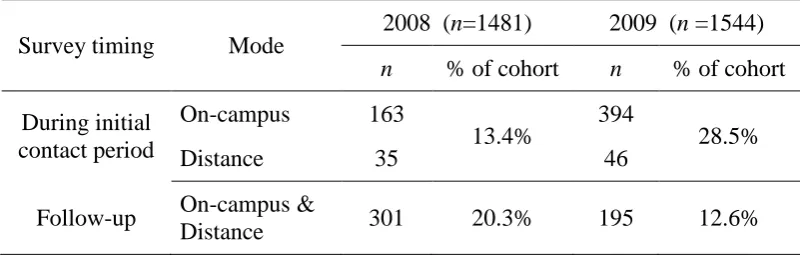
Table 1 Number of students providing data for each survey in 2008 and 2009
Survey timing Mode
2008 (n=1481) 2009 (n =1544)
n % of cohort n % of cohort
During initial contact period
On-campus 163
13.4% 394 28.5%
Distance 35 46
Follow-up On-campus &
Distance 301 20.3% 195 12.6%
Data on end of semester grades and enrolment status were obtained from two new cohorts of students to whom the face-to-face on-campus mode was delivered for the first time in 2009. The sample consisted of 212 students (an additional 16 students withdrew prior to the start of the UniStart program, and were not included in the analysis). Students‘ grades for each individual unit studied in semester 1 were coded numerically based on available grade information: HD=7, DN=6, CR=5, PP=4, NN/Fail=3 (results of ―withdrawn‖ or ―absent, deemed failed‖ were excluded from the calculation), and averaged. Average grades were then further categorised as Pass (average≥4), Fail (average<4) or those who did not complete the unit (withdrew or were graded as absent, deemed failed for all of their units). A simple goodness-of-fit Chi-square analysis was performed for completion figures.
Results and Discussion
P – a sense of purpose
―social capital‖ may be even greater than for traditional entrants, because non-traditional entrants may be less experienced with these required forms of literacy when they enter the higher education system.
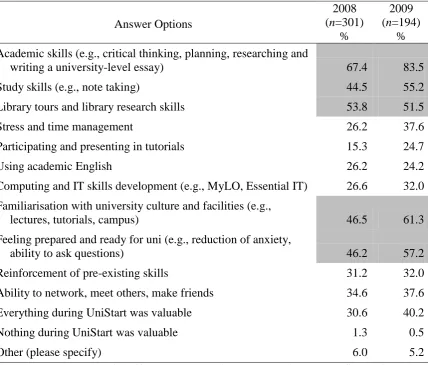
Table 2 shows which elements of the UniStart program students considered to be the most valuable. As can been seen in the table, students‘ familiarisation with the university culture was rated one of the most valuable elements of UniStart, second only to the rating given to Academic skills in 2009 (third in 2008).
Table 2 UniStart sessions considered most valuable by students at follow-up
(Numbers indicate the percentage of students selecting the following options in response to the question: ―Which of the following session/aspects of UniStart do you think was MOST valuable?‖)
Answer Options
2008 (n=301)
%
2009 (n=194)
% Academic skills (e.g., critical thinking, planning, researching and
writing a university-level essay) 67.4 83.5
Study skills (e.g., note taking) 44.5 55.2
Library tours and library research skills 53.8 51.5
Stress and time management 26.2 37.6
Participating and presenting in tutorials 15.3 24.7
Using academic English 26.2 24.2
Computing and IT skills development (e.g., MyLO, Essential IT) 26.6 32.0
Familiarisation with university culture and facilities (e.g.,
lectures, tutorials, campus) 46.5 61.3
Feeling prepared and ready for uni (e.g., reduction of anxiety,
ability to ask questions) 46.2 57.2
Reinforcement of pre-existing skills 31.2 32.0
Ability to network, meet others, make friends 34.6 37.6
Everything during UniStart was valuable 30.6 40.2
Nothing during UniStart was valuable 1.3 0.5
Other (please specify) 6.0 5.2
Note: students were able to identify more than one element as valuable. The top five sessions/aspects are shaded.
Particularly for non-traditional entrants, this increased familiarity and comfort with the university environment can help students feel that they have chosen the correct path, by returning to study—that university ―is for them‖ (Cullity, 2007).
I appreciate the chance to access Unistart, it actually made me feel that I have chosen the right
pathway for myself.(Student 161. 2009 On-Campus Survey)
Staff involved with students in the UniStart program have also commented on the impact of the program on students‘ engagement with their course:
We had high attendance and the students kept coming back, right through the week. I had a couple of sessions with the students, whose levels of energy and enthusiasm remained very high. These students now seem highly engaged with their course, with one another and with the learning environment. (Unsolicited staff feedback, February 20, 2009)
R - a sense of resourcefulness
As Lizzio (2006) explains: ―Successful students not only know how to study but also how to proactively manage the challenges of their whole university experience‖ (p. 2). The UniStart program develops students‘ ability to seek out and utilise the support available at UTAS, and helps improve their ability to manage their study/life balance. UniStart addresses students‘ resourcefulness through a range of avenues: 1) encouraging students to engage positively with the online environment through sessions dealing with the systems used at the university, and workshops developing core IT skills; 2) key collaborations with the Library to assist students with information literacy, and with Support and Equity, utilising their expertise in time management and stress management; and 3) maintaining an emphasis throughout the program on independent study skills. These skills equip students to more successfully manage the challenges of uni life, and to achieve this balance earlier in their studies. For example, feedback from students attending learning support drop-in or appointments later in the year indicates that almost one-third had learned about the availability of the service through their attendance at UniStart.
As shown in Table 2, the five elements of UniStart that students considered most valuable were consistent across both 2008 and 2009: ―Academic skills (critical thinking, essay preparation),‖ ―Study skills,‖ ―Library tours and research skills,‖ ―Familiarisation with university culture‖ and ―Feeling prepared and ready for uni.‖ Student comments regarding the development in their study and information literacy skills reflected these ratings.
I feel more motivated and independent - this will reflect in everything. (Student 2. 2008 On-Campus Survey)
Uni-start [sic] was invaluable, it allowed me to hit the ground running. Unistart should be more
widely advertised and encouraged. (Student 375. 2008 Follow-up Survey)
A - a sense of academic preparedness and development
focus helps students to manage the transition from college, work or other duties into university and to better understand what is expected of them in this new environment.
By far, the coverage of academic skills is rated as one of the most valuable elements of UniStart by the largest percentage of students, whether immediately following the intensive pre-semester contact (e.g., Hobart, 2008, on-campus surveys: 72.9% of n=140) or later in their first year of study (see Table 2). Student comments illustrate how valuable students find the opportunity to practise these skills ―before it counts,‖ and to clarify expectations:
The revision for structuring and planning essays in unistart was especially helpful throughout my courses. Although similar courses are run in workshops throughout the year, unistart provides the info straight up and therefore you feel more prepared. Essay skills learned through unistart are also useful as essay expectations and standard are much higher in university than they are pre-tertiary. This has been repeatedly commented on by several of my tutorial teachers. (Student 175. 2008 Follow-up Survey)
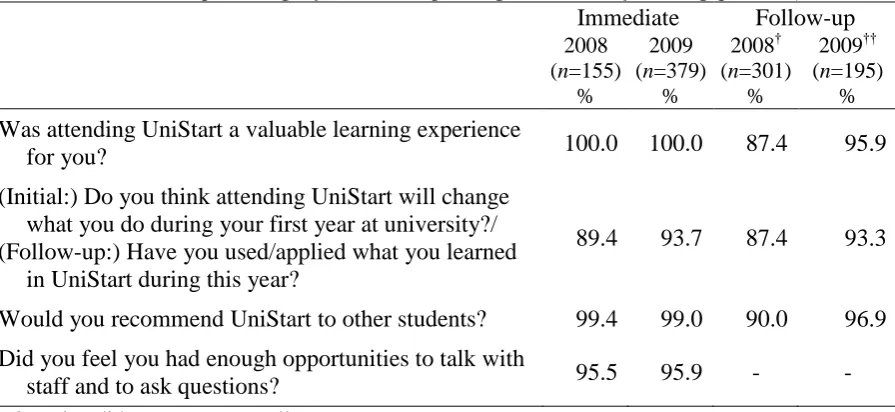
As shown in Table 3, 100 percent of students responding to the survey at the end of the on-campus pre-semester program in 2008 and 2009 indicated that UniStart was ―a valuable learning experience for them.‖ Importantly, when asked about the influence of the UniStart program on their learning during the year, students continued to indicate that the program was valuable, and the majority of students had applied what they learned in UniStart during their study. This percentage was higher in 2009 than 2008, suggesting an improvement in facilitation of students‘ ability to generalise their skills.
Unistart was amazing. I went to the lectures not thinking that I could learn anything more than I already knew, by the end of the first day I was blown away by how much I had learnt in that one
day. It has helped me be much more confident and able this semester. (Student 130, 2009
Follow-up Survey)
Table 3 Student evaluation of the value and impact of UniStart pre-semester and at follow-up
(Numbers indicate the percentage of students responding “Yes” to the following questions)
Immediate Follow-up
2008 (n=155)
%
2009 (n=379)
%
2008† (n=301)
%
2009†† (n=195)
% Was attending UniStart a valuable learning experience
for you? 100.0 100.0 87.4 95.9
(Initial:) Do you think attending UniStart will change what you do during your first year at university?/ (Follow-up:) Have you used/applied what you learned
in UniStart during this year?
89.4 93.7 87.4 93.3
Would you recommend UniStart to other students? 99.4 99.0 90.0 96.9
Did you feel you had enough opportunities to talk with
staff and to ask questions? 95.5 95.9 - -
- Question did not appear on Follow-up survey
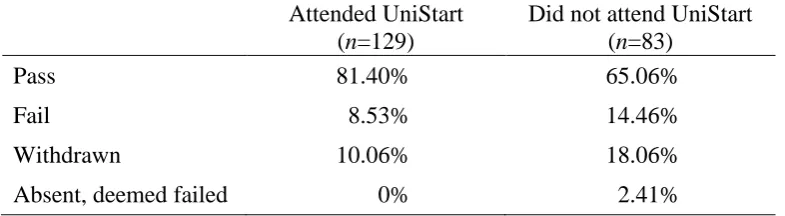
non-attendance following the program, compared to the proportion who did not complete the unit amongst students who did not attend UniStart, χ2(1)=3.86, p<.05, =0.36 (Table 4).
Table 4 Average semester 1 grades of new campus students by UniStart attendance, 2009
Attended UniStart (n=129)
Did not attend UniStart (n=83)
Pass 81.40% 65.06%
Fail 8.53% 14.46%
Withdrawn 10.06% 18.06%
Absent, deemed failed 0% 2.41%
While these results do not indicate a causal link between UniStart and improved retention, they suggest a promising association worthy of continued investigation.
C - a sense of connectedness with students, staff and the institution
The UniStart program enhances students‘ sense of connectedness with the university, staff, and other students. The social support and relationships that students form with each other at university are an important protective factor for success in first year (Wilson & Lizzio, 2009). While interaction between students is encouraged through group activities and participation in class, many students have commented on the value of forming friendships and acquaintances informally through UniStart—even just seeing familiar faces around the campus.
UniStart is an invaluable opportunity for anyone starting or returning to university life. Making new friends in disciplines different to your own and familiarising yourself with the campus layout and facilities goes a long way to easing into the transition. (Student 340. 2008 Follow-up Survey)
A consistent third of students completing the 2008 and 2009 follow-up surveys found ―Ability to network, meet others, make friends‖ to be one of the most valuable elements of UniStart (see Table 2). In response to this feedback, the 2010 program was shaped to include structured opportunities for students to meet and get to know other students in UniStart. One of the potential problems of ―generic‖ or ―add-on‖ academic skills programs is the low emphasis on, or opportunity for, social networking (Henderson, Noble & De George-Walker, 2009). The continuous, cohesive nature of the program in its face-to-face delivery and the community-building embedded into the online delivery appear to have prevented this potential problem arising, in that students report having developed social networks as well as academic skills through their engagement with the program.
Underpinning the entire UniStart program is a commitment to excellence in the delivery of the program, whether in person or online, and to ongoing development in teaching and learning. UniStart staff seek to make the program not only intellectually challenging, but also a welcoming and supportive environment, as reflected by the following student comments.
I thought the quality of the lecture/presentations and the helpfulness of the staff was exemplary and I can now start my degree with a much better idea of what's expected for uni. Thanks for a
great “short” course. (Student 7. 2008 On-Campus Survey)
Caveats
In terms of the assessment of student perspectives on the program, it should be acknowledged that those students voluntarily engaging with the program and providing feedback probably have relatively high levels of intrinsic motivation to prepare for university. Hence, their evaluations of the value of the program may be higher than would be expected from the general population of commencing students.
Moreover, while overwhelmingly the response from students engaging with the program is positive, transition is not a uni-dimensional process, to be ―fixed‖ by a single event. There are at least two key limitations to the program‘s effectiveness as a transition support. First, not all UTAS students enrol in UniStart or attend the program. Although large numbers of students pass through the program, enrolment still represents less than 20% of the commencing on-shore undergraduate cohort. Ongoing questions remain about how to connect with these students and how best to meet their transition support needs (whether through UniStart or alternative measures). Second, the program is pitched towards the fundamental skills required to succeed in the tertiary academic setting. This approach engages many but not all students. It is emphasised to students that they have the right to choose how, and to what extent, they engage in the program. We regard it as a positive for students to exit the program when they decide they are comfortable with the basic skills required and feel prepared to begin their studies. However, more problematic is catching those students at the other end of the spectrum who, despite our best intentions and their hard work, are not adequately prepared via UniStart. These are the students who, ultimately, should be redirected into more extensive preparatory programs and pathways.
Conclusion
References
Bradley, D., Noonan, P., Nugent, H. & Scales, B. (2008). Review of Australian higher education. Final report. Canberra, Australia: Commonwealth of Australia. Available at
http://www.deewr.gov.au/HigherEducation/Review/Pages/ReviewofAustralianHigher EducationFinalReport.aspx
Brookfield, S. (1995). Becoming a critically reflective teacher. San Francisco: Jossey-Bass. Brown, N., & Adam, A. (2009, November). First Year Teaching Forum 2009: Summary
report. Report to the Student Transition and Retention Taskforce, University of Tasmania.
Cullity, M. (2007). Academic culture that enthuses or intimidates mature-age commencers. Retrieved February 2, 2010, from http://www.aare.edu.au/07pap/cul07551.pdf.
Henderson, R., & Hirst, E. (2007). Reframing academic literacy: Re-examining a short course for ―disadvantaged‖ tertiary students. English Teaching Practice and Critique, 6(2), 25-38. Retrieved January 29, 2010, from
http://education.waikato.nz/reearch/files/etpc/2007/v6n2art2.pdf.
Henderson, R., Noble, K. & De George-Walker, L. (2009). Transitioning into university: ―Interrupted‖ first year students problem-solving their way into study. Studies in Learning, Evaluation Innovation and Development, 6(1), 51–64. Retrieved January 29, 2010, from http://sleid.cqu.edu.au.
Kift, S. & Nelson, K. (2005). Beyond curriculum reform: Embedding the transition experience. In Brew, A. & Asmar, C. (Eds.), Proceedings of the 28th HERDSA Annual Conference. Higher Education in a Changing World: Research and Development in Higher Education (pp. 225-235). Milperra, NSW: HERDSA.
Lizzio, A. (2006). Designing an orientation and transition strategy for commencing students: A conceptual summary of research and practice. Griffith University: First Year Experience Project, 2006. Retrieved February 7, 2010, from
http://www.griffith.edu.au/__data/assets/pdf_file/0008/51875/Alfs-5-Senors-Paper-FYE-Project,-2006.pdf
Miles, M. B., & Huberman, A. M. (1994). Qualitative data analysis: An expanded sourcebook (2nd ed.). Thousand Oaks, CA: Sage.
University of Sydney. (2001). First year experience. Retrieved February 6, 2010, from http://www.itl.usyd.edu.au/fye/
Ward, C. A., Bochner, S., & Furnham, A. (2001). The psychology of culture shock. Hove, UK: Routledge.
Wilson, G., & Stacey, E. (2003). Online interaction impacts on learning: Teaching the teachers to teach online. In G. Crisp, D. Thiele, I. Scholten, S. Barker & J. Baron (Eds.), Interact, integrate, impact. Proceedings of the 20th Annual Conference of the Australasian Society for Computers in Learning in Tertiary Education (pp. 541-551). Adelaide, Australia: ASCILITE. Available at
http://www.ascilite.org.au/conferences/adelaide03/docs/pdf/541.pdf Wilson, K. (2009, June). The impact of institutional, programmatic and personal
interventions on an effective and sustainable first-year student experience. Keynote address delivered at the 12th Pacific Rim First Year in Higher Education Conference, ―Preparing for Tomorrow Today: The First Year Experience as Foundation.‖