Vehicular emissions control highlights of the annual Society of Automotive Engineers (SAE)
international congress
http://dx.doi.org/10.1595/147106713X663933 http://www.platinummetalsreview.com/
Reviewed by Timothy V. Johnson
Corning Environmental Technologies, Corning Incorporated, HP-CB-2-4, Corning, NY 14831, USA
Email: [email protected]
The annual SAE Congress is the vehicle industry’s largest conference and covers all aspects of automotive engineering. The 2012 congress took place in Detroit, USA, from 24th–26th April 2012. There were upwards of a dozen sessions focused on vehicle emissions technology, with most of these on diesel emissions. More than 70 papers were presented on this topic. In addition, there were two sessions on gasoline engine emissions control with eight papers presented. Attendance was up relative to the previous year, with most sessions having perhaps 100 attendees, but some had more than 200.
This review focuses on key developments from the conference related to platinum group metals (pgms) for both diesel and gasoline engine emissions control. Papers can be purchased and downloaded from the SAE website (1). As in previous years, the diesel sessions were opened with a review paper of key developments in both diesel and gasoline emissions control from 2011 (2).
Lean NOx Traps
The lean NOx trap (LNT) is currently the leading deNOx concept for smaller lean-burn (diesel and direct injection gasoline) passenger cars and is of interest in applications with limited space or in which urea usage is diffi cult. The deNOx effi ciency is nominally 70–80%, much lower than that of the next generation selective catalytic reduction (SCR) system at >95% and the pgm usage is high (~8–12 g for a 2 l engine). As a result, efforts are focused on improving effi ciency while reducing pgm loadings. Only two papers on LNTs were reported this year, much reduced from previous years.
Katsuo Suga et al. (Nissan Motor Co Ltd, Japan) used a selective pgm deposition process to enhance platinum dispersion (3). The concept is to use a surfactant to preferentially apply the Pt to the ceria rather than to the alumina in the washcoat. Upon ageing, the grain growth of Pt is greatly constrained by the small size of the CeO2 grains, Figure 1. Usage
the NOx desorption rate is considerably slower than either adsorption or catalyst reactions at low temperatures. The NOx desorption rate appears to be increased by enhancing contact with CeO2 and baria,
the NOx trapping material. Work is continuing to verify the effect.
Diesel Particulate Filters
Although diesel particulate fi lters (DPFs) have been in commercial production for original equipment manufacturer (OEM) application for more than 10 years, there is still much optimisation activity in the fi eld. Papers were offered on DPF regeneration and several papers were presented on next generation DPF substrates.
Contrary to light-duty diesel applications, wherein system architecture and operating conditions necessitate burning of the collected soot using mostly thermal means at temperatures of about 600ºC, in heavy-duty applications most (or all) of the soot is burned passively using nitrogen dioxide (NO2)
generated in a pgm-based diesel oxidation catalyst (DOC) and in the catalysed fi lter. Kenneth Lee Shiel
et al. (Michigan Technological University, USA)
quantifi ed this effect for ultra-low sulfur diesel (ULSD) fuel and biodiesel blends (5). They loaded the fi lters to about 2 g l–1 soot in a controlled fashion and then introduced exhaust gas with the desired composition and temperature to measure oxidation of the soot with the NO2. They found that soot generated by
burning biodiesel oxidised slightly more slowly than that from ULSD fuel, contradicting other studies
which have shown enhanced reactivity for biodiesel soot in thermal regeneration. The Arrhenius plot did not take into account the possibility of lowered DOC activity, which can occur with biodiesel usage due to more severe ash poisoning and thermal degradation. Interestingly, the investigators quantifi ed the internal generation of NO2 in the catalysed fi lter, wherein
NO2 fi rst passes through and reacts with the soot;
the resulting nitric oxide (NO) is oxidised back to NO2 in the underlying catalyst and recycled back
for another round of soot oxidation. Recycling rates were quite low at temperatures less than 300ºC, but were very high (each NO molecule recycled three to four times) at 450ºC.
Carl Justin Kamp et al. (Massachusetts Institute of Technology, USA) (6) looked at the recycling of the NO molecule, among other phenomena, in catalysed fi lters in an entirely different way – they used a novel ‘focused beam ion milling’ technique to vaporise away layers of material, ending up with a clean cross-section of the substrate, washcoat, catalyst, ash and soot. Figure 2 shows one such image. There are voids between the soot and the catalyst that are likely formed by the back diffusion of NO2 generated
by the catalyst. Other images show metal oxide ash (from wear and burning lubricant oil) coating the catalyst, but mostly not interfering with this recycling phenomenon. Curiously, images were shown of ash agglomerates measuring 20 μm in diameter that mostly consisted of relatively large voids.
Ageing
Ageing Conventional catalyst:
New concept catalyst: Pt
CeO2
Al2O3
Pt
CeO2 Al2O3
Fig. 1. Platinum is preferentially deposited on small ceria grains to minimise grain growth upon ageing of a new concept NOx trap catalyst (3)
Catalyst
Substrate Soot
1 m
Particulate oxidation catalysts (POCs) are a cross between a DPF and a DOC wherein the soot is trapped by turbulence mechanisms, forcing particles to make contact with the Pt-catalysed fi lter. POCs are a leading approach to particulate emissions control in developing countries because they do not require active regeneration. However, these countries might not have low-sulfur fuel. Piotr Bielaczyc (BOSMAL Automotive R&D Institute Ltd, Poland) et al. (7) looked at the effects of fuel sulfur on the performance of these devices. Although the dry soot coming from the engine was the same in all tests, the total particulate matter (PM) coming from the engine increased with increasing levels of sulfate. Between 20 h and 40 h of operation the fi ltration effi ciency using a high sulfur fuel (365 ppm) dropped by about 10% across the particle size range, while that of a clean (sulfur-free) fuel changed very little. The loss of effi ciency seen in the high-sulfur fuel is likely due to the reduced availability of NO2
for cleaning and maintaining the fi lter effi ciency, since NO2 generation in the DOC is hampered by the
presence of sulfur.
An important emerging trend is to coat DPFs with an SCR catalyst as a way of consolidating parts and getting the SCR closer to the turbocharger for faster heating. Friedemann Schrade et al. (IAV GmbH, Germany) (8) showed that when soot is on the Cu-zeolite coated fi lter, the change in NO2 levels across the
soot layer caused by soot oxidation can impact SCR performance. If the NO2 level going into the fi lter is
higher than ideal for the ‘fast’ SCR reaction, the soot
can improve performance. Conversely, if the NO2 level
is at or below the optimum 50% (of total NOx) level, the soot can impair the SCR performance.
Diesel Oxidation Catalysts
DOCs are generally catalysed with platinum and/ or palladium. They play two primary roles in commercial emissions control systems: (a) to oxidise hydrocarbons (HCs) and carbon monoxide, either to reduce emissions coming from the engine or to create exothermic heat used to regenerate a DPF; and (b) to oxidise NO to NO2, which is required
to continuously oxidise soot on a DPF and/or to enhance the SCR deNOx reactions, particularly at low temperatures.
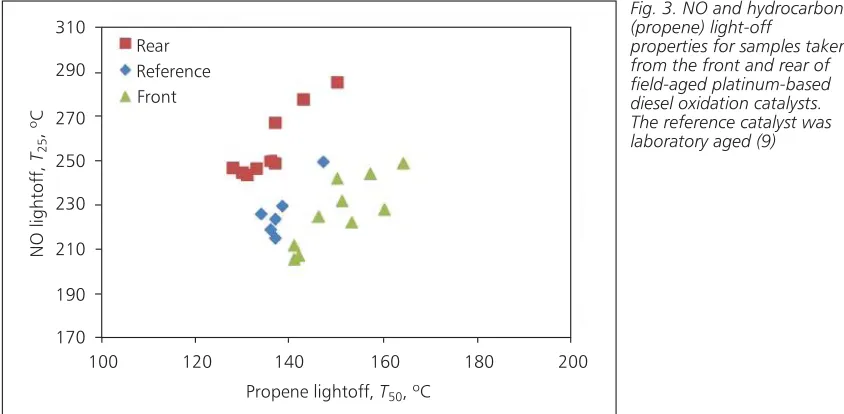
Ageing of DOCs is a critical phenomenon to understand. It can impact HC emissions, DPF regeneration and SCR performance. Junhui Li et al. (Cummins Inc, USA) (9) retrieved several fi eld-aged DOCs from in-use vehicles, sectioned them and studied the ageing characteristics of the segments. As shown in Figure 3, irreversible ageing caused different types of deterioration. Catalyst samples cut from the rear of the DOC had a higher NO light-off temperature than those taken from the front. The opposite was true for HC (propene) oxidation, wherein the rear parts had a lower light-off temperature. The front catalysts were aged primarily by ash contamination, while the back catalysts were generally thermally aged. The overall light-off characteristics of the catalyst deteriorated due to both effects as the mileage increased. The authors also reported reversible deterioration caused by HC
Rear
100 120 140 160 180 200 Reference
Front 310
290
270
250
230
210
190
170
Propene lightoff, T50, ºC
NO lightoff
,
T25
, ºC
Fig. 3. NO and hydrocarbon (propene) light-off
properties for samples taken from the front and rear of
and sulfur poisoning, which could be removed with a thermal treatment.
A new type of DOC was reported by Federico Millo and Davide Fezza (Politecnico de Torino, Italy). They added a low-temperature NOx adsorber material (probably an alkaline earth oxide) to the DOC (10). The material stores NOx (presumably as a nitrate) at low temperatures and then releases the NOx at higher temperatures when the downstream SCR catalyst is operative. The adsorber aged substantially, but could still provide signifi cantly better NOx removal than an SCR-only confi guration. This ‘passive NOx adsorber’ (PNA) concept is being developed by Cary Henry et al. (Cummins Inc, USA) and Howard Hess et al. (Johnson Matthey Inc, USA) with quite impressive results (11).
Gasoline Emissions Control
Catalytic gasoline emissions control has been commercialised for more than 35 years and the three-way catalyst (TWC) for more than 30 years. Yet, it is still evolving and showing signifi cant improvements. Since the mid-1990s, when the TWC was perhaps in its third generation, emissions have dropped by more than 95% and pgm loading is down by upwards of 70% of what it was then. The progress is still continuing.
For example, Yoshiaki Matsuzono et al. (Honda R&D Co, Japan) and Takashi Yamada et al. (Johnson Matthey Japan Inc) described a new layered catalyst for improving the performance of both close-coupled and underbody catalysts (13). The improvements cut pgm usage by 75% while meeting the new California Low Emission Vehicle III, Super Ultralow Emission
Vehicle – 30 mg mile–1 non-methane HC+NOx (LEV III SULEV30) standard. The close-coupled catalyst is layered with higher activity Pd and a lower activity oxygen storage capacity (OSC) on the top, to better withstand phosphorous poisoning and to achieve better HC conversion. The catalyst demonstrates that Pd-only catalysts can have application for the lowest emissions applications. The underbody catalyst utilises a zirconia-based OSC, allowing 50% less Rh to be used
versus the current version of the catalyst.
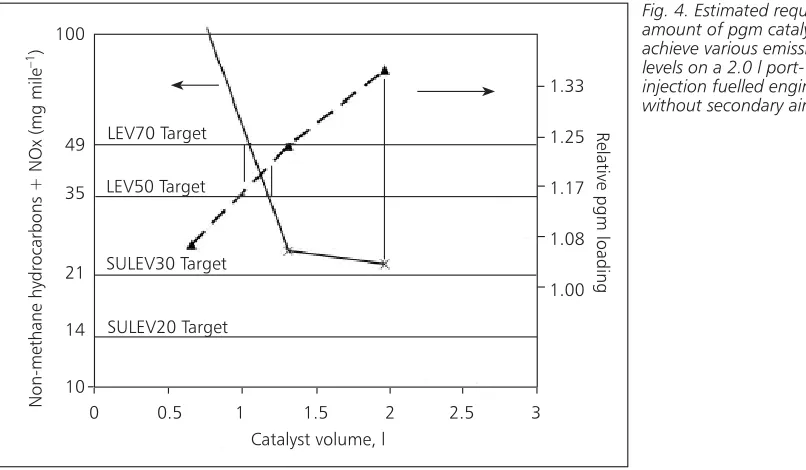
System design and calibration are signifi cant contributors to lowering emissions from gasoline vehicles. Douglas Ball and David Moser (Umicore Autocat Inc, USA) (14) benchmarked fi ve of the cleanest gasoline engine vehicles on the market with a variety of hardware calibration strategies, including port-fueled and direct injection, with and without secondary air, and with different injection timings, engine speeds and air:fuel ratios. The light-off strategies used various combinations of high idle speed, aggressive ignition retard, secondary air and split injections. All designs achieved catalyst light-off during idle before the fi rst hill in the test cycle. Secondary air was not necessarily needed, but helped the catalyst heat to 950ºC in the fi rst idle. Only 500ºC was reached in the same time without secondary air. Turbocharged direct injection engines use split injection, secondary air and late injection to aid cold start. The investigators ran emissions tests to help estimate what volume of catalyst will be needed to meet the new California regulations. Figure 4 shows the case for a highly calibrated, port-fuel injected, naturally aspirated 2.0 l engine without secondary air.
100
49
35
21
14
10
Catalyst volume, l
0 0.5 1 1.5 2 2.5 3 LEV70 Target
LEV50 Target
SULEV30 Target
SULEV20 Target
Non-methane hydrocarbons +
NOx (mg
mile
–1)
Relative pgm loading
1.33
1.25
1.17
1.08
1.00
Approximately 2 l of catalyst will be needed to achieve the SULEV 30 target, compared with about 2.5 l of catalyst to achieve the same result on a 2.4 l engine with secondary air.
In an entirely different approach to evaluating pgm loadings and emissions, Michael Zammit (Chrysler Group LLC, USA) et al. (15) changed the distance from the engine of a close-coupled TWC and measured the emissions. They made estimates of the increased pgm loadings to offset the increased distance while keeping the emissions the same: an additional 37–50 mg Pd per cm of distance from the engine.
To meet the new gasoline particle number regulations of the light-duty Euro 6 regulation in 2017, there is much interest in gasoline particulate fi lters (GPFs). Early testing was done with uncatalysed fi lters, but current evaluations use a TWC coating on the fi lter. Joerg Michael Richter et al. (Umicore Autocat Luxembourg) (16) evaluated two different coated confi gurations with identical total pgm loadings. In one confi guration the pgm was distributed evenly between the close-coupled TWC and the GPF; in another confi guration, the close-coupled catalyst was optimised by zone-coating the Pd so that 80% of it is on the front half. The investigators found that the NOx emissions dropped by 20% in the fi rst coated GPF confi guration compared to the baseline confi guration without a GPF. With an optimised zone coating on the close-coupled catalyst, 6% less pgm was used compared to the baseline, NOx emissions remained at the low level, but CO emissions were reduced by 30% compared to the other GPF confi guration. The researchers reported that the TWC on the GPF aided fi lter regeneration. No fuel penalty was observed when the GPF was applied.
Conclusion
Work is continuing on utilising Pt and other precious metals more effectively to meet tightening tailpipe emission regulations and reduce costs. Examples highlighted in this Congress review include the more effi cient use of Pt in LNTs by distributing it preferentially on the CeO2 portion of the washcoat. In other work, Pt
was applied to a DPF resulting in the enhancement of soot burn by NO2 by three or four times at 450ºC due
to the recycling of the NOx molecule in the vicinity of the soot layer. Soot oxidation by NO2 was found to
be adversely impacted by sulfur in fuel and this could impair the performance of POCs . The functionality
of Pt in fi eld-aged DOCs was impaired by ash in the front portions, adversely impacting HC oxidation, and by thermal ageing in the back, affecting NO oxidation. The pgm loading of TWCs could be cut by 75% by layering the catalyst, placing higher activity Pd and a lower activity oxygen storage catalyst in the top layer. Also, more is being learned on whole system design, such as the effects of catalyst placement, turbocharging, secondary air and fuel injection strategies, and the impacts that these factors have on catalyst loadings. Finally, this Congress featured catalysed GPFs for the fi rst time, showing better system performance if some pgm was moved from the close-coupled catalyst to the GPF.
References
1 SAE International: http://www.sae.org/ (Accessed on 29th January 2013)
2 T. V. Johnson, ‘Vehicular Emissions in Review’, SAE Int. J. Engines, 2012, 5, (2), 216
3 K. Suga, T. Naito, Y. Hanaki, M. Nakamura, K. Shiratori, Y. Hiramoto and Y. Tanaka, ‘High-Effi ciency NOx Trap Catalyst with Highly Dispersed Precious Metal for Low Precious Metal Loading’, SAE Paper 2012-01-1246 4 Y. Tsukamoto, H. Nishioka, D. Imai, Y. Sobue, N. Takagi,
T. Tanaka and T. Hamaguchi, ‘Development of New Concept Catalyst for Low CO2 Emission Diesel Engine
Using NOx Adsorption at Low Temperatures’, SAE Paper 2012-01-0370
5 K. L. Shiel, J. Naber, J. Johnson and C. Hutton, ‘Catalyzed Particulate Filter Passive Oxidation Study with ULSD and Biodiesel Blended Fuel’, SAE Paper 2012-01-0837 6 C. J. Kamp, A. Sappok and V. Wong, ‘Soot and Ash
Deposition Characteristics at the Catalyst-Substrate Interface and Intra-Layer Interactions in Aged Diesel Particulate Filters Illustrated Using Focused Ion Beam (FIB) Milling’, SAE Paper 2012-01-0836
7 P. Bielaczyc, J. Keskinen, J. Dzida, R. Sala, T. Ronkko, T. Kinnunen, P. Matilainen, P. Karjalainen and M. J. Happonen, ‘Performance of Particle Oxidation Catalyst and Particle Formation Studies with Sulphur Containing Fuels’, SAE Paper 2012-01-0366
8 F. Schrade, M. Brammer, J. Schaeffner, K. Langeheinecke and L. Kraemer, ‘Physico-Chemical Modeling of an Integrated SCR on DPF (SCR/DPF) System’, SAE Paper 2012-01-1083
9 J. Li, T. Szailer, A. Watts, N. Currier and A. Yezerets, ‘Investigation of the Impact of Real-World Aging on Diesel Oxidation Catalysts’, SAE Paper 2012-01-1094 10 F. Millo and D. Vezza, ‘Characterization of a New Advanced
11 C. Henry, A. Gupta, N Currier, M. Ruth, H. Hess, M. Naseri, L. Cumaranatunge and H.-Y. Chen, ‘Advanced Technology Light Duty Diesel Aftertreatment System’, US Department of Energy 2012 Directions in Engine-Effi ciency and Emissions Research (DEER) Conference, Dearborn, Michigan, USA, 16th–19th October, 2012 12 K. Ishizaki, N. Mitsuda, N. Ohya, H. Ohno, T. Naka,
A. Abe, H. Takagi and A. Sugimoto, ‘A Study of PGM-Free Oxidation Catalyst YMnO3 for Diesel Exhaust
Aftertreatment’, SAE Paper 2012-01-0365
13 Y. Matsuzono, K. Kuroki, T. Nishi, N. Suzuki, T. Yamada, T. Hirota and G. Zhang, ‘Development of Advanced and Low PGM TWC System for LEV2 PZ EV and LEV3 SULEV30’, SAE Paper 2012-01-1242
14 D. Ball and D. Moser, ‘Cold Start Calibration of Current PZEV Vehicles and the Impact of LEV-III Emission Regulations’, SAE Paper 2012-01-1245
15 M. Zammit, J. Wuttke, P. Ravindran and S. Aaltonen, ‘The Effects of Catalytic Converter Location and Palladium Loading on Tailpipe Emissions’, SAE Paper 2012-01-1247
16 J. M. Richter, R. Klingmann, S. Spiess and K.-F. Wong, ‘Application of Catalyzed Gasoline Particulate Filters to GDI Vehicles’, SAE Paper 2012-01-1244
The Reviewer