R E S E A R C H
Open Access
Using weighted dynamic range for histogram
equalization to improve the image contrast
Thien Huynh-The
1†, Ba-Vui Le
1†, Sungyoung Lee
1*, Thuong Le-Tien
2and Yongik Yoon
3Abstract
In this paper, an effective method, named the brightness preserving weighted dynamic range histogram equalization (BPWDRHE), is proposed for contrast enhancement. Although histogram equalization (HE) is a universal method, it is not suitable for consumer electronic products because this method cannot preserve the overall brightness. Therefore, the output images have an unnatural looking and more visual artifacts. An extension of the approach based on the brightness preserving bi-histogram equalization method, the BPWDRHE used the weighted within-class variance as the novel algorithm in separating an original histogram. Unlike others using the average or the median of gray levels, the proposed method determined gray-scale values as break points based on the within-class variance to minimize the total squared error of each sub-histogram corresponding to the brightness shift when equalizing them independently. As a result, the contrast of both overall image and local details was enhanced adequately. The experimental results are presented and compared to other brightness preserving methods.
Keywords: Contrast enhancement; Weighted dynamic range; Brightness preserving; Within-class variance
Introduction
Enhancing contrast of images by using histogram equal-ization (HE) is the standard technique to improve the visual image by stretching the narrow input image his-togram [1]. However, it is not the appropriate method for consumer electronics, such as TV, because it changes the brightness of the original image strongly and degrades the image quality in visualization. Various methods have been proposed to limit the level of enhancement based on modifying the input histogram with mapping functions. The brightness preserving bi-histogram equal-ization (BBHE) [2], the dualistic sub-image histogram equalization (DSIHE) [3], and the minimum mean bright-ness error bi-histogram equalization (MMBEBHE) [4] divided the input histogram into two sub-histograms by a separating point. In order to enhance the image con-trast, each sub-histogram was equalized independently. The BBHE method used the gray level as the mean value of image brightness to separate an input histogram into two parts: the first one is from the minimum gray level
*Correspondence: [email protected]
†Equal contributors
1Department of Computer Engineering, Kyung Hee University, 1732 Deokyoungdae-ro, Giheng-gu, Youngin-si, Seoul, Gyeonggi-do 446-701, Korea Full list of author information is available at the end of the article
to the mean, and the second one is from the mean to the maximum gray level. The DSIHE method also used a similar approach to enhance the image contrast, except applying the median value instead of the mean value. In practice, the DSIHE is better than the BBHE in both pre-serving the image brightness and conpre-serving the informa-tion content. The simple method to find out the separated point is to test all possible gray-scale values from 0 toL−1 of the histogram by calculating the difference between the mean brightness of input and the mean brightness of output. The separated point is chosen as the value that achieves the minimum difference in overall brightness. Although the above methods are better than HE in keep-ing the brightness of images, the visualization of enhanced images is degraded seriously, sometimes in detail and overall.
Based on the BBHE, the recursive mean separate his-togram equalization (RMSHE) [5] and the recursive sub-image histogram equalization (RSIHE) [6] divided an original histogram into 2n sub-histograms, where nis a positive integer value. The RMSHE splits the histogram into two parts by using the average of input brightness before separating one more time for each sub-histogram to have four segments in total. In practice, there are 2n sub-histograms forn separated times. Having the same
dynamic ranges by the new function for resizing. After the histogram equalization step, the output image would be normalized in brightness with the original to ensure that the mean of output intensity is close to the mean of input intensity. Moreover, the authors in [8] proposed a contrast enhancement method using the dynamic range separate histogram equalization (DRSHE) approach to preserve the naturalness of images and improve the overall contrast. The weighted average of absolute color differ-ence (WAAD) used in the DRSHE produced an output image in which the adjusted histogram looks like the uni-form distribution. The dynamic ranges in this study could be controlled by the adaptive scale factor to preserve the brightness. Detecting the start and stop positions of dynamic ranges is a difficult mission; thus, this algorithm cannot be suitable for various histogram types.
Another technique to improve the contrast, the weighted threshold histogram equalization (WTHE) [9] modified the probability density function of an image his-togram. In detail, each original probability density value could be replaced by a new value based on the probability density function (pdf ) with an initial threshold. Neverthe-less, the disadvantage of this method is determining the threshold value through a scale parameter for the good visualization with no conditions to ensure the sum of the probability density value conserved. In order to solve this trouble, the recursively separated and weighted his-togram equalization (RSWHE) [10] normalized the modi-fied probability density function. With the other solution, each sub-histogram was smoothed by changing the cor-responding original probability density function with the brightness preserving weight clustering histogram equal-ization (BPWCHE) [11]. This approach assigned each non-zero bin of the input histogram for the clusters and computed their weights. By using three criteria to merge pairs of neighbor clusters, the sub-histograms were then equalized independently. The Global Contrast Enhance-ment Histogram Modification Algorithm [12] was repre-sented as the effective method for contrast enhancement by adjusting linear operations of the input histogram and utilizing the black and white (BW) stretching to obtain the visually pleasing, artifact-free, and natural looking images.
[15] in artificial intelligence science was also used for the contrast enhancement application. In this study, the function for mapping the input to the output intensity was established based on the searching and optimization algorithm.
In this paper, the brightness preserving weighted dynamic range histogram equalization (BPWDRHE) is proposed as an efficient contrast enhancement method. The input histogram is separated by applying the Otsu method [1] to determine divided points. The purpose of this approach is to minimize each sub-histogram error corresponding to its mean brightness for histogram equal-ization. In order to be suitable to various input images, the region ranges can be resized by the scale factor that has been set as the initial value. As the post-processes, the HE-based histogram will be smoothed and normalized to get the pleasing visualization with protection in the output brightness.
Brightness preserving weighted dynamic range histogram equalization
The contrast enhancement method proposed in this paper consists of three steps:
• Proposed separation algorithm: Separate the input histogram and adjust sub-histogram ranges by the scale factor.
• Contrast enhancement: Apply histogram equalization for each sub-histogram independently.
• Post-process: Smooth the histogram and normalize the overall brightness.
To be clear about these steps, Figure 1 shows the flow chart of the BPWDRHE method. The framework in Figure 1 can be also applied for color images by improving the contrast of the luminance channel in the YCbCr color model.
Input image Histogram separation Histogram Equalization Post-process Output image
Determine the thresholds using Otsu method.
Segment histogram into 4 partitions.
Adjust the length of partitions
Apply the HE algorithm for each sub-histogram independently.
Correct the scattered histogram after equalization.
Normalize the brightness for preservation.
Figure 1The flow chart of the proposed method BPWDRHE.For the color images, the method is only applied to the luminance channel of the YCbCr color space.
Otsu method [1] that is usually utilized in image segmen-tation applications. Unlike the separation algorithm in the study [16] when the break points were determined by using the local minimum, the proposed approach decides these points based on the minimum of variance. There-fore, this separation scheme reduced the modification of brightness from the histogram equalization of each sub-histogram. In particular, the minimization of the within-class variance is similar to the minimization of the total squared error of each sub-histogram, and it corresponds to the mean brightness. Therefore, the thresholds used in the separation process are determined as the minimum-variance gray level. In this study, these values are seen as the separated points and computed through the weighted sum of variance of the two classesσω2:
σ2
ω(t)=ω1(t)σ12(t)+ω2(t)σ22(t) (1)
where the weightsω1andω2are the probabilities of two
classes separated by a thresholdt.σ12andσ22are the vari-ances of these classes. The individual variance class is defined as
σ2 1(t)=
t i=0
(i−μ1(t))2ωp1((i)t)
σ2 2(t)=
255
i=t+1
(i−μ2(t))2ωp2((i)t)
(2)
wherep(i)is the normalized histogram corresponding to the probability density function of each gray value and
μi(t)are the class means which can be calculated as in the following equations:
μ1(t)=
t i=0
i×p(i)
ω1(t)
μ2(t)= 255
i=t+1
i×p(i)
ω2(t)
. (3)
The weightsω1(t)andω2(t)in Equations 1, 2, and 3 are
defined as
ω1(t)=
t i=0
p(i)
ω2(t)= 255
i=t+1 p(i)
. (4)
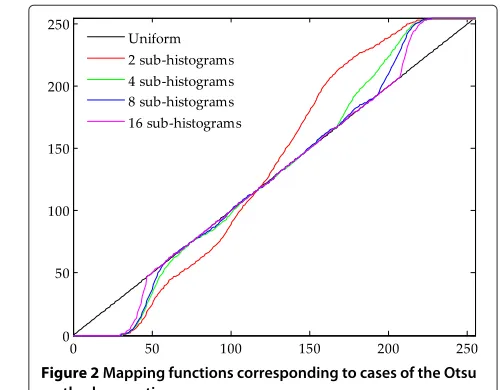
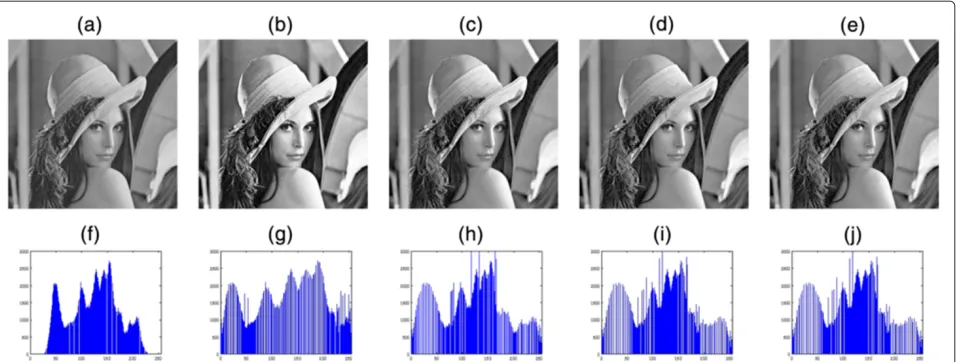
The thresholdtin Equation 1 defined as the value with the minimum of the weighted sum of variance of two classesσω2(t)will separate the overall histogram into two distinguished regions. Therefore, it can be seen that the histogram will be separated into 2nparts withntimes in separation. In this study, four sub-histograms are gener-ated from two times in separation. It can be explained that, actually, whennis too large, the enhancement influence on the output image is too slight, that is, it is difficult to recognize the modification in the overall brightness. Let us consider the effect of the number of sub-histograms on the brightness through the input to output gray-level function with the sample image Lena in Figure 2. In order to get some short results as in Figure 2, we applied the HE algorithm for these sub-histograms indepen-dently. In addition, some intermediate results achieved in the separation process are presented in Figure 3. With the input image shown in Figure 3a, the output images and their histograms are also shown in Figure 3b,c,d,e and Figure 3g,h,i,j, respectively. In the case of two sub-histograms (n=1), the output image lost some details in the dark and light regions, so they are the main reasons of unnatural visualization in the output. The degradation in
Figure 3The intermediate results of histogram equalization using the Otsu method for Lena image.(a)The original image.(b-e)The output withn=1,n=2,n=3, andn=4, respectively.(f-j)The corresponding histograms of the images in(a-e).
Figure 3b can be explained through the mapping intensity line (the red line in the Figure 2), in which the over-enhancement occurs strongly in two ranges [0,100] and [150,255]. These are the darker behavior at dark pixels and the brighter behavior at bright pixels. In practice, the larger the number of sub-histograms, the better the images. However, the mapping functions became similar to the uniform linef(k) = kin Figure 2, and the mean of the output image brightness is close to the mean of the input image brightness if the number of times in the ration is too large. The comparison of the proposed sepa-ration mechanism with the others such as BBHE, DSIHE, MMBEBHE, and RSWHE is also represented in Table 1 as proof.
In this research, four sub-histograms are generated with two times in separation process for avoiding the complex computation and preserving the overall brightness. Let us denotet1, t2, andt3 as the gray levels corresponding
Table 1 Average of the means of 40 testing image brightness (denoted as AMB)
Method AMB
(50 images)
Original 120.98
BBHE [2] 133.27
DSIHE [3] 132.96
MMBEBHE [4] 123.97
RSWHE [12] 123.17
Proposed (2 sub-histograms) 135.05
Proposed (4 sub-histograms) 127.66
Proposed (8 sub-histograms) 123.77
Proposed (16 sub-histograms) 122.39
to the separating points. There are four sub-histogram ranges here as follows: [0,t1], [t1+1,t2], [t2+1,t3], and
[t3+1,L−1]. Figure 4 shows the histogram sample
which is separated into four segments, called DR1, DR2, DR3, and DR4 with lengths of(t1+1),(t2−t1),(t3−t2),
and(L−1−t3), respectively. Although the total length
of these sub-histograms is still Lwith L = 28 gray lev-els, there is a problem after separation when the authors experienced many images: the performance of enhance-ment when the lengths of any sub-histograms are too small.
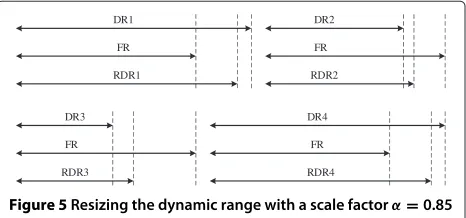
Applying the histogram equalization algorithm for small sub-histograms does not assure an effective enhancement in the output due to a little bit of alteration. So these sub-histograms could be resized by the controllable scale factor and the fixed range to increase their lengths and conserve the total gray level. The length of the fixed range, called FR, depends on the number of sub-histograms that are generated: FR = 2Ln = 64 forn = 2 with a total of
lengthL = 256. The lengths of resized dynamic ranges,
denoted as RDR, of new sub-histograms are defined in the following equation [8]:
RDRi=FR+α (DRi−FR) (5)
where α is the scale factor that has a value between 0 and 1. It is noted that the proposed separation in the previous step is invalid when decreasingα to zero. The examples of an original DR and new RDR after applying a scale factor are shown in Figure 5. Let the range of the new sub-histogram be [0, RDRi−1] for the first one, and [mini, maxi] forith one (withi>1). Calculate the range of theith new sub-histogram through the equations below:
mini= i−1
k=1
RDRi (6)
maxi= i
k=1
RDRi−1. (7)
In Equation 5, the scale factor needs to be chosen care-fully. Whenα = 1, the ranges of these sub-histograms are invariable. The smaller the scale factor, the slighter the effect of the Otsu method in separating the his-togram. Forα = 0, the total histogram was segmented homogeneously, that is, the range of each partition is constant and set at 64 as the fixed range. Figure 6 pre-sented the output images and their histograms in the cases that the scale factor was modified. Through inter-mediate results, it can be seen that the histogram in the case of α = 0.9 looks similar to the one in the case of non-resizing.
Contrast enhancement: histogram equalization for each sub-histogram independently
Applying the HE approach for each sub-histogram inde-pendently is the next step in the BPWDRHE method. With the gray-level k belonging to the ith new sub-histogram (k∈[mini, maxi]), the mapping function for the current gray level as the input is given in the following formula: DR1 FR RDR1 DR3 FR RDR3 DR4 FR RDR4 DR2 FR RDR2
Figure 5Resizing the dynamic range with a scale factorα=0.85 and number of times in separationn=2.
fhe(x)=
⎧ ⎪ ⎪ ⎪ ⎨ ⎪ ⎪ ⎪ ⎩
(RDRi−1) x k=0
nk
N1; (i=1)
(mini−1)+RDRi x k=mini
nk
Ni;(i>1)
(8)
wherenk is the number of pixels of gray-levelk, andNi is the total pixels contained in theith sub-histogram such thatN1denotes the first sub-histogram.
Post-process: smooth the histogram and normalize the brightness
The weakness of HE-based methods is that the HE his-togram distribution is very scattered, that is, the dis-tance between two non-zero pixel bins is large. It can be explained by a few non-zero bins distributed on the huge range. Because of the over-enhancement since this behavior, the output images easily get visual artifacts. In order to deal with this problem, the modified histogram can be altered to be closer to the uniform distributed his-togram, denoted asu. Using the algorithm for histogram smoothing as suggested in [12], the mapping function is defined as
fs(x)=
fhe+λu
(1+λ)I+2γDTD (9) whereλis the uniform parameter andγ is the smooth-ing parameter, and the difference matrixDwith a size of length 255×256 is bi-diagonal:
D=
⎡
⎣−:1 1 0: : 0 0 0
.. .. ..
0 0 0 : : : 0 −1 1
⎤
⎦. (10)
The denominator in Equation 9, (1+λ)I+2γDTD, in fact corresponding to the term operates as the averaged histogram function to make the histogram smoother. The above term can be expressed explicitly and clearly as in the matrix below: ⎡ ⎢ ⎢ ⎢ ⎣
2γ +(1+λ) −2γ 0 0 · · ·
−2γ 4γ +(1+λ) −2γ 0 · · · 0 −2γ 4γ +(1+λ) −2γ · · ·
.. . ... ... ... . .. ⎤ ⎥ ⎥ ⎥ ⎦. (11)
Figure 6The intermediate results of resizing for four sub-histograms.(a)The original image.(b-e)The output without resizing and resizing withα=0.1,α=0.5, andα=0.9, respectively.(f-j)The corresponding histograms of images in(a-e).
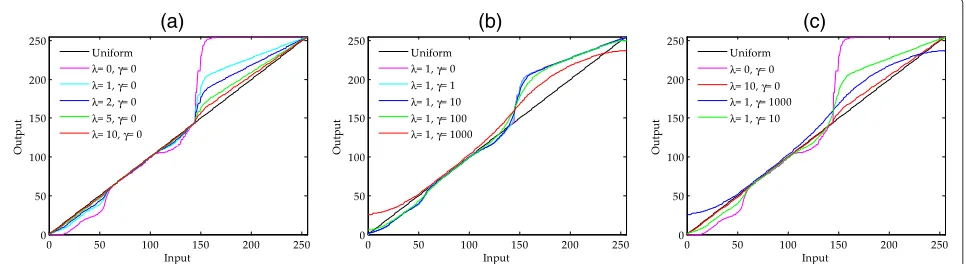
γat zero. It is easy to realize that the mapping function is close to the uniform distribution under increasing λ. Withλ ≥ 10, the line of mapping function is similar to the that of the uniform. The histogram equalization hardly has any influences in improving contrast if the uniform parameter is too large. The effect of smoothing parame-ter in Equation 9 is shown in Figure 7b when the mapping functions withλ≥1 and modified smoothing parameter
γ were considered. In this case, the larger the smoothing parameterγ, the softer the mapping function line. How-ever, it is noted that the drawback of increasingγ is the degrading overall contrast of the output image. Because of the above reasons, choosing the unsuitable value of these parameters can be a cause of degradation of image visual-ization. From the summarization shown in Figure 7c, the case ofλ=1 andγ = 10 seems to be the best choice for the smoothing step.
Finally, in order to minimize the difference between the mean brightness of the output image and the original
image, the modified histogram is normalized by the equation below [7]:
fn(x)=
B Bs
fs(x) (12)
where BandBs are the mean brightness of the original and modified image after using the smoothing algorithm, respectively. The output image not only preserved the overall brightness but also obtained the comfortable visu-alization by applying the mapping function as given in Equation 12.
Results and discussions
For simulation, the authors compared the BPWDRHE with the others which are the Global HE [1], BBHE [2], DSIHE [3], MMBEBHE [4], WTHE [9], BPDHE [7], RSWHE [10], and AGCWD [13] on various images. In practice, 40 gray images [17] and 10 color images [18] of
λ γ λ γ λ γ λ γ λ γ
λ γ λ γ λ γ λ γ λ γ
λ γ λ γ λ γ λ γ
(a) (b) (c)
the Kodak database set are utilized for quantitative mea-surement. Besides that, some random images are chosen for representation and discussion. For more details, the parameters and factors have been set in the proposed sep-aration stage as follows: n = 2 corresponding to four segments generated from the input histogram andα = 0.85 for resizing the lengths of sub-histograms. More-over, with parameters in the post-process, the authors use
λ=1 andγ =10 to achieve efficiency in reducing nega-tive effects from the over-enhancement and visual artifact behavior. These parameters have been chosen through the intermediate simulation, in which the experimental results are represented in Figures 2 and 3 and Table 1 (for explanation ofn), Figure 6 (for description ofα), and Figure 7 (for clarification ofλandγ). It is important to note that determined values for these parameters can-not be optimal for all images because the assessment for image quality depends on various aspects. In this paper, the authors try to estimate their values based on the obser-vation of their specification. The influence of parameter nis measured by the average mean brightness (AMB) as shown in Table 1; meanwhile, the remaining parameters are proposed to overcome unexpected events from the histogram equalization scheme under visualization. How-ever, the influence assessment of these parameters on the overall performance of the output images is necessary to be employed in the next simulation.
Assessment of the performance in contrast enhance-ment is never an easy mission. Although it is desirable to have an objective assessment approach to compare contrast enhancement techniques, unfortunately, there is no accepted objective criterion in the literature to pro-vide meaningful results for every image. However, there are also some common quantitative measurements and subjective assessments for the estimation. In this research, the authors utilized the absolute mean brightness error (AMBE) [5], the discrete entropy (DE) [12], and the sure of enhancement (EME) [19] as the quantitative mea-surements. It is important to notice that the contrast enhancement for color images is quantified by applying these measurements on only its luminance channel. For the input imageXand the output imageY, the AMBE is defined in the following function as
AMBE= |E(X)−E(Y)| (13)
where E(X) and E(Y) are the mean brightness of the imagesXandY, respectively. The lower the value of the AMBE, the better the preservation in brightness. The DE of an image is described in the following function as
DE(X)= − 255
i=0
p(xi)logp(xi) (14)
wherep(xi)is the probability of pixel intensityxi, which is estimated from the normalized histogram. A higher value of DE indicates that the image has richer details. In order to calculate the EME, let us divide the image intok1k2
non-overlapping sub-blocksXi,j of sizew1× w2, in this
paper; its size is chosen as 8 × 8 for assessment. The parameter EME is computed in the following equation as
EME(X)= 1 k1k2
k1
i=1
k2
j=1
20 lnmax
Xi,j
minXi,j
(15)
where maxXi,j
and minXi,j
are the maximum and minimum gray levels, respectively, in block Xi,j. High-contrast sub-blocks give a high EME value, whereas for homogeneous sub-blocks, the EME value should be close to zero. It is worth to note that the EME is highly sensitive to noise. However, for the contrast enhancement applica-tion, this value is expected to be EME(Y) >EME(X).
In the next step, an evaluation of the proposed method includes three simulations. Firstly, the authors assess the influence of some parameters in the separation and post-process stage on the overall performance with the quan-titative and quality results. Then, the proposed method is compared to the others with subjective assessment for both gray-scale and color images. Finally, the com-parison of the objective assessment based on the above quantitative measurements is presented in detail.
Parameter assessment
To evaluate the influence of parameters liken,α,λ, and
Figure 8The influence of parameters on the visual results at the outputs.(a)The original image.(b-j)The outputs corresponding to cases of changing parameters (refer to Table 2 for more information).
value of λ will generate the output which looks similar to the input (the values of DE and EME reach the orig-inal value). Forig-inally, like the case of α, the impact of the smoothing parameterγ is not enough to be detected, at least for the visualization result, while it can be only rec-ognized through the AMBE, DE, and EME with a little bit of changing in value. With the proposed values for these parameters (as in Figures 8c and 9c), the authors want to achieve the balance of performance between the visualization and quantitative results, in which it can be seen that the values of AMBE, DE, and EME are homoge-neously improved to get the stability for all images. That means the overall contrast of the input image is enhanced with the minimization of changes in brightness and loss in detail.
Subjective assessment Gray image
Some contrast enhancement results for gray-scale images are shown in Figures 10, 11, 12, 13, 14 and 15 with three samples named the Toy, the Aircraft, and the Pentagon. For each image, the cropped version of the small area is also represented clearly for analysis in detail. In order to get the evident illustration of enhancement, Figure 16 presented the mapping functions of tested methods for gray-scale images.
For the Toy image shown in Figure 10, due to the over-contrast enhancement occurring abnormally in the Global HE, it is hard to identify the plastic balloons. Some methods including the BBHE, DSIHE, MMBEBHE, and WTHE also provide similar contrast images; however, the
Table 2 Quantitative assessment of parameters on the overall performance
Figures 8 and 9 n α λ γ AMBE DE EME
(a) The original image - 3.7277 7.5317
(c) 2 0.85 1 10 0.0288 3.6578 10.8647
(b) 1 0.85 1 10 0.0334 3.6770 15.3762
(d) 3 0.85 1 10 0.0380 3.7005 9.2426
(e) 2 0.5 1 10 0.0048 3.6734 10.6417
(f) 2 1 1 10 0.0308 3.6470 10.9212
(g) 2 0.85 5 10 0.1201 3.6892 8.6789
(h) 2 0.85 10 10 0.0960 3.7042 8.1405
(i) 2 0.85 1 1 0.0167 3.6409 11.1318
(j) 2 0.85 1 100 0.0479 3.7049 10.1021
background of the output images is degraded seriously with the rough brightness. The photometric differences between some regions in the background are significant and unacceptable. Therefore, the brighter regions can be confused with the balloon shadows. The undesired behav-ior occurs severely in the output of the WTHE method. Therefore, many artifacts and unnatural visualization areas occur unexpectedly. Although getting a better visual quality result, the enhancement of the AGCWD method is not powerful enough to distinguish the details on the balloon to observe as shown obviously in Figure 11. The weakness of this method is not ensuring the over-all brightness. For the BPDHE, RSWHE, and BPWDRHE approaches, the outputs are not distorted in the global contrast; however, the brightness of the RSWHE image is
darker in general. In order to understand the effect of each approach, Figure 16a displays their mapping functions. In the gray-value range [0,40], the behaviors of some meth-ods, such as the Global HE, BBHE, DSIHE, MMBEBHE, WTHE, and BPDHE, are similar and therefore it explained for the dark areas on the balloons. In addition, the decay of illumination on the background is clarified by the shape of mapping lines in the range [190,255].
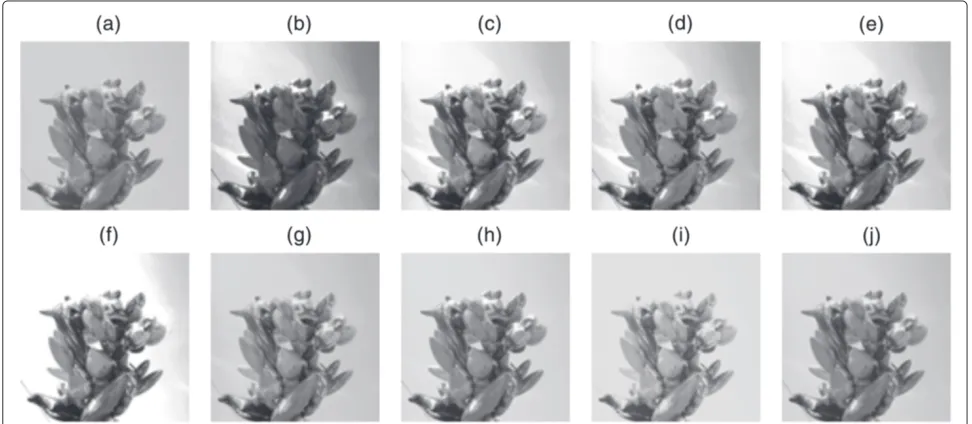
For both the Aircraft image and its cropped area shown in Figures 12 and 13, it can be seen that some approaches, such as the Global HE, BBHE, MMBEBHE, and WTHE, enhanced the overall brightness excessively and therefore the texture on the aircraft body cannot be observed clearly. Although the DSIHE and BPDHE meth-ods perform better than the above methmeth-ods, they also enhanced some unnecessary details on the background. Observation of the contrast enhancement on the RSWHE image is quite difficult due to the slight effect. For the AGCWD method, the enhanced image looks brighter without brightness preservation and so many bright-pixel details have been removed, such as the take-off trail. Meanwhile, the proposed approach enhances the contrast at the moderate level enough to observe each component of the aircraft body and the take-off trail clearly without an alteration in the brightness. The shapes of mapping function lines of some bad visualization schemes, such as the Global HE, BBHE, and WTHE, are alike. The lim-itation of the value range in the WTHE technique can be understood as the main reason for a low contrast in the output. The behavior of the MMBEBHE line in the range [60,150] is the cause of losing details on the air-craft body. Since the RSWHE line is close to the uniform
Figure 11The small region is cropped from Toy.(a)Original. The enhanced image:(b)Global HE.(c)BBHE.(d)DSIHE.(e)MMBEBHE.(f)WTHE. (g)BPDHE.(h)RSWHE.(i)AGCWD.(j)BPWDRHE.
line, the output looks like the input in the contrast. For the BPWDRHE method, the gray-value ranges [0,40] and [200,250] corresponding to the bright and dark pixels are improved fairly.
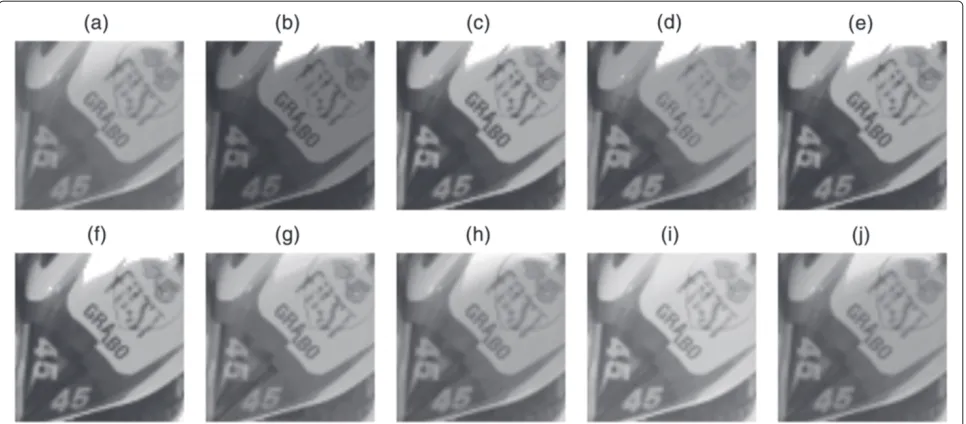
Some methods including the Global HE, BBHE, MMBEBHE, and WTHE methods improved the contrast of image excessively in the two-side extension way in the Pentagon image: the bright pixels to be even brighter and the dark pixels to be even darker. As a result,
some dark and bright details can be damaged seriously. The three methods such as the BPDHE, RSWHE, and BPWDRHE still maintain the general brilliance. How-ever, some regions in the enhanced image of the BPDHE method are dimmed unexpectedly with medium bright-ness pixels, while an enhancement of the RSWHE method is not strong enough to recognize the modification in the contrast. In practice, these observations are displayed in detail in Figure 15. Except for the fan-shaped object
Figure 13The small region is cropped from Aircraft.(a)Original. The enhanced image:(b)Global HE.(c)BBHE.(d)DSIHE.(e)MMBEBHE.(f) WTHE.(g)BPDHE.(h)RSWHE.(i)AGCWD.(j)BPWDRHE.
in the square detected by the very dim thin bound-ary in Figure 15b,c,d,e,f, the BPDHE image also gets the same behavior with medium gray levels. Only with the RSWHE and BPWDRHE methods can the object be iden-tified easily due to its high contrast. The shape of the mapping function line in Figure 16c of the AGCWD approach in the range [125,255] explained for the bright-ened image. Due to getting the same result in the enhance-ment, the lines of the Global HE, BBHE, and MMBEBHE
methods are similar to each other. The gray-level limi-tation in the WTHE and BPDHE produces low-contrast images in the output when the maximum gray value is 200 and 206 instead of 255 as normality. After all, the behavior of the mapping function line of the proposed method at the ranges [0,73] and [190,255] for contrast improvement and [105,170] for brightness preserva-tion produced the pleasing visualizapreserva-tion in the output image.
Figure 15The small region is cropped from Pentagon.(a)Original. The enhanced image:(b)Global HE.(c)BBHE.(d)DSIHE.(e)MMBEBHE. (f)WTHE.(g)BPDHE.(h)RSWHE.(i)AGCWD.(j)BPWDRHE.
Color image
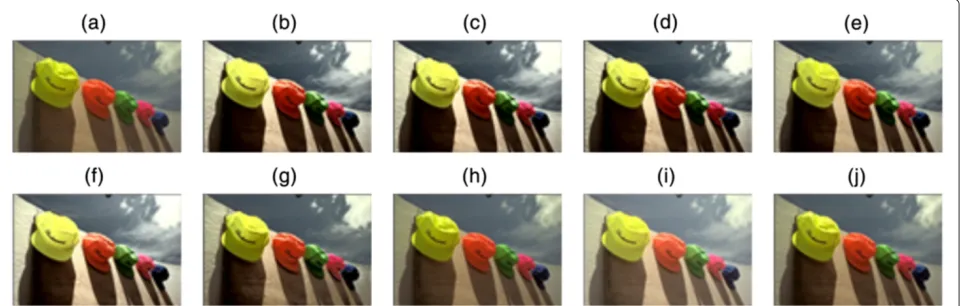
Contrast enhancement can be easily extended to the color images. The most obvious way to extend the color images is to apply these methods to the luminance component. However, some enhancement approaches for color images utilized the HSV (hue, saturation, value) [14] color model to improve the contrast. To consider the performance of the tested method for color images, the simulation was implemented for ten color images from the Kodak standard image library. At first, the sample color image Hats is shown in Figure 17 and the cropped version in Figure 18. In the results of the Global HE, BBHE, DSIHE, and WTHE methods, the hues of the output images are changed seriously. These studies not only darkened some areas of the wood plank and the hat shadows but also
brightened some regions of the cloud and the top of the yellow hat. Therefore, many features in these regions are lost. The degradations of the MMBEBHE, WTHE, and BPDHE approaches are not as severe as the result of the above methods. To be better, the AGCWD method produced the brighter image both in overall and detail; however, recognition of the bright-pixel details on the top of the yellow hat is an impossible task due to its bad con-trast. Only with the proposed method and the RSWHE are the details enhanced expectantly with no hue distortion, for instance, the texture of the wood plank looks clear. Based on the mapping function as shown in Figure 19a, it is not difficult to realize that the Global HE, BBHE, DSIHE, and WTHE methods enhanced over-contrast for the bright pixels corresponding to the pixels in the range
(a) (b) (c)
Figure 17Comparison of enhancement methods with test image Hats.(a)Original. The enhanced image:(b)Global HE.(c)BBHE.(d)DSIHE. (e)MMBEBHE.(f)WTHE.(g)BPDHE.(h)RSWHE.(i)AGCWD.(j)BPWDRHE.
[150,255] and the dark pixels corresponding to the pixels in the range [0,50]. The distortion in the hue component of the cloud and the wood plank can be explained by this behavior. For this sample, only the overall contrast of the AGCWD method is limited. The output images of the RSWHE and BPWDRHE approaches look natural with the enhancement process for both dark-pixel range [0,75] and bright-pixel range [175,255]. Nevertheless, the modification on the output image after improving the contrast in the RSWHE case is not obvious.
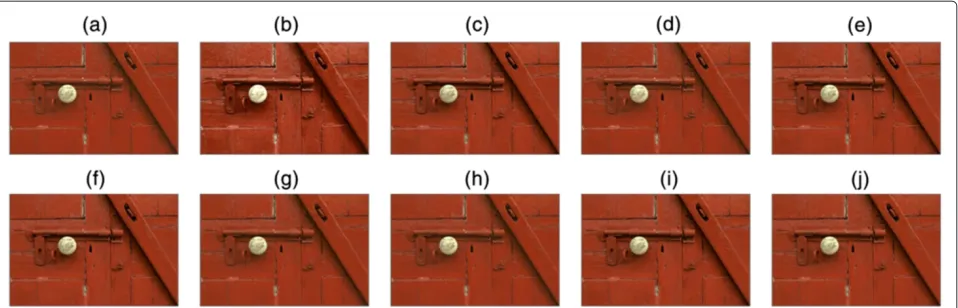
The Wall image, the next color sample, is shown in Figures 20 and 21. The results of the Global HE, BBHE, DSIHE, MMBEBHE, and WTHE have similar contrast enhancement with cold overall hue, while BPDHE has a
better visual result. The characteristic of the AGCWD is that it usually produces the output images which are brighter than the original. Therefore, some bright-pixel details having a low-contrast will be lost or realized with difficulty. In Figure 21, the object behind the glass window in the Global HE, BBHE, DSIHE, and WTHE methods is brightened so much that it is hardly observed. Except for the RSWHE and BPWDRHE, the remaining methods get the same drawback in the slight level. Considering the chroma of the door, it can be seen that the enhance-ment of the RDWHE mechanism is very slight. For the BPWDRHE method, the output image achieves adequate contrast in both the overall and detail. The input to out-put gray-level functions of the tested methods can be
Figure 19Mapping functions of two color images.(a). The Hats(b). The Wall.
carefully considered in Figure 19b. The common short-coming of the Global HE, BBHE, MMBEBHE, DSIHE, and WTHE is the production of the over-contrast images. The output images of these methods lose the bright and dark pixel parts. Based on the mapping function lines in Figure 19b, the pixels belonging to the range [0,50] will be darkened, while the pixels in the range [175,255] become lighter for the above methods. Therefore, details of the object behind the glass window are removed unexpect-edly. Like the previous test images, the AGCWD has a tendency to produce a brighter image for the gray level larger than 50, while the overall contrast has not been pre-served. The BPDHE method is similar to the AGCWD in the range [150,255]; however, it gets the same behavior of the Global HE for the over-contrast enhancement. Only two methods, the RSWHE and BPWDRHE, get the good enhancement when only improving the luminance in the sensible level. Nevertheless, the input to output function of the proposed method is smoother than that of the RSWHE.
Objective assessment
Results of the AMBE, DE, and EME measurement of 50 sample images are listed in Tables 3, 4 and 5, respectively. In Table 3, the average value of AMBEs is shown beside the results of sample images which were presented in the sub-jective assessment. A comparison of AMBE values shows that the proposed method and the BPDHE outperform others used in the simulation when they achieve good brightness preservation with the smallest values by the brightness normalization after equalizing the histogram. Due to focusing on brightness improvement for dimmed images without brightness preservation, the AGCWD method has the greatest value of AMBE when this method made inputs to be brighter in most of the output images. Without any solutions to limit the modification in the overall brightness, the remaining methods produce unex-pected images which are different from the original in the global brightness. Based on the results of the Aircraft sample in Figure 12, it is not difficult to predict the bright-ness error when AMBE values of outputs of the Global
Figure 21Comparison of enhancement methods with test image Wall (cropped from Figure 20).(a)Original. The enhanced image: (b)Global HE.(c)BBHE.(d)DSIHE.(e)MMBEBHE.(f)WTHE.(g)BPDHE.(h)RSWHE.(i)AGCWD.(j)BPWDRHE.
HE, DSIHE, WTHE, and AGCWD are so much higher than others. These methods generate the outputs to be either so much darker or brighter. The BBHE and DSIHE have the same idea in the histogram separation; thus, their AMBE values look similar together, except for some cases of special histograms. Meanwhile, the MMBEBHE gets the better result because its algorithm not only improves the contrast like BBHE but also minimizes the total error of brightness changes.
With the second measurement, the DE of the origi-nal image will be seen as the standard to be compared with the DE of enhanced images. The important thing to note is that the DE values of modified images are always equal or less than the original. This means that it is dif-ficult to retain the detail of the output like the detail of the input. The behavior of losing detail occurs in most
of the enhancement methods because the mapping func-tion is nonlinear, that is, it usually has one output value for many input values. This behavior is absolutely consid-ered through mapping function graphs as in Figures 16 and 19. The other way to explain based on histograms is that many original histogram bins grouped into one bin after enhancement can be the reason of the decrement in the DE values for over-enhanced images. It is not difficult to understand why the DE parameter of output images of these approaches is slightly reduced. Through Table 4, the performance of the proposed method and the RSWHE are quite similar in the average value of DE when both of them with high discrete entropy are better than the other meth-ods. The Global HE gives the worst results in most of the samples with the least value of average as the loss of data of over 15%, while the remaining methods basically keep
Table 3 Absolute mean brightness error (AMBE) and average of AMBEs (AAMBE)
AMBE AAMBE
Method Toy Aircraft Pentagon Hats Wall (50 images)
Global HE [1] 29.38 47.82 11.04 7.81 10.19 30.49
BBHE [2] 5.48 1.46 6.89 23.77 17.19 12.29
DSIHE [3] 1.27 15.42 28.65 0.03 10.19 11.98
MMBEBHE [4] 3.16 6.51 1.37 1.25 1.00 2.99
WTHE [9] 27.13 55.61 12.36 22.25 23.62 29.62
BPDHE [7] 0.15 0.05 0.02 0.02 0.007 0.26
RSWHE [10] 7.70 3.48 0.80 0.76 0.45 2.19
AGCWD [13] 26.14 58.45 35.46 33.52 38.33 36.75
AGCWD [13] 3.61 2.78 4.62 4.74 4.79 4.30
BPWDRHE 4.15 2.77 4.64 4.77 4.81 4.48
image content at the moderate level with the largest losing grade of 6%.
The comparison of EME values in Table 5 shows that the Global HE, BBHE, DSIHE, MMBEBHE, and WTHE methods usually get higher EME values than the remain-ing methods. Since the EME criterion measures a form of contrast, it is no surprise that these methods give the highest values even though they hardly ever produced the most visually pleasing images. Although the enhance-ment grade is identified through this value with the output value greater than the value of the original image, the high results of the above methods can be the main reason for the degradation of quality. As results for the Toy sam-ple, some methods such as the Global HE, BBHE, DSIHE, MMBEBHE, and WTHE achieve the high value of EME corresponding to the high contrast; however, their outputs are seriously damaged unexpectedly in the quality. For the AGCWD method, increasing the brightness overall can be the cause of depressing the local contrast correspond-ing to the EME value, especially with the Aircraft sample. Meanwhile, the EME values achieved from the proposed
method are enough to realize the difference of contrast between inputs and outputs without visual artifacts.
In summary, it is important to note that the quality of an enhanced image depends on many criteria. Besides increasing the contrast in the adequate grade to avoid the occurrence of artifact unexpectedly, the efficient method needs to preserve not only the overall brightness but also the detail in the output. Based on the experimental results, the proposed method satisfied these criteria at least in this evaluation with 50 test images; however, the trade-off here is the computation fee, that is, the algorithm will need more time for enhancing the steps.
Conclusion
In this work, the authors proposed and experimented on the new contrast enhancement method for both gray-scale and color image, called BPWDRHE. The BPWDRHE method enhanced the contrast with preservation of the overall brightness to generate the natural looking images. Unlike some previous techniques, the proposed method reduced the appearance of visual artifacts in the outputs.
Table 5 Measure of enhancement (EME) and average of EMEs (AEME)
EME AEME
Method Toy Aircraft Pentagon Hats Wall (50 images)
Original 4.81 3.14 8.59 5.42 14.65 14.34
Global HE [1] 13.94 25.64 40.57 15.64 39.87 28.86
BBHE [2] 10.99 18.99 36.44 15.85 42.56 26.04
DSIHE [3] 9.40 8.09 21.62 15.91 39.86 23.88
MMBEBHE [4] 11.06 8.72 23.96 14.28 38.07 24.27
WTHE [9] 10.34 15.39 32.5 12.89 34.92 22.44
BPDHE [7] 7.18 5.68 14.71 12.76 19.55 21.09
RSWHE [10] 6.60 3.37 10.16 7.03 16.65 15.12
AGCWD [13] 4.61 1.98 8.56 5.55 14.44 14.19
The novelty of proposed contrast enhancement is that the sum of weighted within-class variance was utilized to determine the break points for histogram separation based on the minimization of the total squared error of each sub-histogram corresponding to the equalization-based brightness shift. After applying the HE technique for these sub-histograms, the output image histogram will be smoothed and normalized to obtain the good visual-ization as the post-processes. Moreover, the BPWDRHE was estimated for gray-scale and color images and then compared to the others in various aspects with some com-mon quantitative assessments, such as the absolute mean brightness error, the discrete entropy, and the measure of enhancement.
Competing interests
The authors declare that they have no competing interests.
Acknowledgements
This research was funded by the MSIP (Ministry of Science, ICT & Future Planning), Korea in the ICT R&D Program 2013.
Author details
1Department of Computer Engineering, Kyung Hee University, 1732
Deokyoungdae-ro, Giheng-gu, Youngin-si, Seoul, Gyeonggi-do 446-701, Korea.
2Department of Electrics and Electronics Engineering, Ho Chi Minh City
University of Technology, 268, Ly Thuong Kiet, District 10, Ho Chi Minh 70000, Vietnam.3Department of Multimedia Science, Sookmyung Women University,
Cheongpa-ro 47-gil 100, Youngsan-gu, Seoul 140-742, Korea.
Received: 27 March 2014 Accepted: 29 August 2014 Published: 13 September 2014
References
1. RC Gonzalez, RE Woods,Digital Image Processing, 3rd Edition. (Prentice Hall, New Jersey, 2007)
2. Y-T Kim, Contrast enhancement using brightness preserving bi-histogram equalization. IEEE Trans. Consum. Electron.43(1), 1–8 (1997)
3. Y Wang, Q Chen, B Zhang, Image enhancement based on equal area dualistic sub-image histogram equalization method. IEEE Trans. Consum. Electron.45(1), 68–75 (1999)
4. S-D Chen, AR Ramli, Minimum mean brightness error bi-histogram equalization in contrast enhancement. IEEE Trans. Consum. Electron.
49(4), 1310–1319 (2003)
5. S-D Chen, AR Ramli, Contrast enhancement using recursive mean-separate histogram equalization for scalable brightness preservation. IEEE Trans. Consum. Electron.49(4), 1301–1309 (2003) 6. KS Sim, CP Tso, YY Tan, Recursive sub-image histogram equalization applied to gray scale images. Pattern Recogn. Lett.28(10), 15 (2007) 7. H Ibrahim, NSP Kong, Brightness preserving dynamic histogram
equalization for image contrast enhancement. IEEE Trans. Consum. Electron.53(4), 1752–1758 (2007)
8. G-H Park, H-H Cho, M-R Choi, A contrast enhancement method using dynamic range separate histogram equalization. IEEE Trans. Consum. Electron.54(4), 1981–1987 (2008)
9. Q Wang, RK Ward, Fast image/video contrast enhancement based on weighted thresholded histogram equalization. IEEE Trans. Consum. Electron.53(2), 757–764 (2007)
10. M Kim, M Chung, Recursively separated and weighted histogram equalization for brightness preservation and contrast enhancement. IEEE Trans. Consum. Electron.54(3), 1389–1397 (2008)
11. N Sengee, H Choi, Brightness preserving weight clustering histogram equalization. IEEE Trans. Consum. Electron.54(3), 1329–1337 (2008) 12. T Arici, S Dikbas, Y Altunbasak, A histogram modification framework and
its application for image contrast enhancement. IEEE Trans. Image Process.18(9), 1921–1935 (2009)
13. S-C Huang, F-C Cheng, Y-S Chiu, Efficient contrast enhancement using adaptive gamma correction with weighting distribution. IEEE Trans. Image Process.22(3), 1032–1041 (2013)
14. Z Zhou, N Sang, X Hu, Global brightness and local contrast adaptive enhancement for low illumination color image. Optik - Int. J. Light Electron Opt.125(6), 1795–1799 (2014)
15. A Draa, A Bouaziz, An artificial bee colony algorithm for image contrast enhancement. Swarm Evol. Comput.16, 69–84 (2014)
16. M Abdullah-Al-Wadud, MH Kabir, MAA Dewan, O Chae, A dynamic histogram equalization for image contrast enhancement. IEEE Trans. Consum. Electron.53(2), 593–600 (2007)
17. The USC-SIPI Image Database. http://sipi.usc.edu/database/. Accessed 20 Jan 2013
18. Kodak Lossless True Color Image Suite. http://r0k.us/graphics/kodak/. Accessed 5 August 2013
19. SS Agaian, B Silver, KA Panetta, Transform coefficient histogram-based image enhancement algorithms using contrast entropy. IEEE Trans. Image Process.16(3), 741–758 (2007)
doi:10.1186/1687-5281-2014-44
Cite this article as:Huynh-Theet al.:Using weighted dynamic range for
histogram equalization to improve the image contrast.EURASIP Journal on
Image and Video Processing20142014:44.
Submit your manuscript to a
journal and benefi t from:
7Convenient online submission 7Rigorous peer review
7Immediate publication on acceptance 7Open access: articles freely available online 7High visibility within the fi eld
7Retaining the copyright to your article