Implementation of E-Service Intelligence in
the Field of Web Mining
PROF. MS. S. P. SHINDE1
Bharati Vidyapeeth University ,Pune
Yashwantrao Mohite institute of Management, Karad [M.S. ] State-Maharashtra,Country-India
PROF. V.P.DESHMUKH2
Bharati Vidyapeeth University ,Pune
Yashwantrao Mohite institute of Management, Karad [M.S. ] State-Maharashtra,Country-India
ABSTRACT:
The World Wide Web is a popular and interactive medium to disseminate information today .The web is huge, diverse, dynamic, widely distributed global information service centre. We are familiar with the terms like e-commerce, e-governance, e-market, e-finance, e-learning, e-banking etc. These terms come under online services called e-service applications. E-services involve various types of delivery systems, advanced information technologies, methodologies and applications of online services. The keyword intelligence will be the next paradigm shift in the e-services, thanks to internet technological advances. Intelligence is closely related with Artificial Intelligence. Web Mining is the technique used to crawl through various web resources to collect required information, which enables an individual to promote business, understanding marketing dynamics, and new promotions floating on the Internet etc. The taxonomy of web mining can be broadly divided into three distinct categories; according to the kinds of data to be mined they are Web Content Mining, Web Structure Mining and Web Usage Mining. There are a lot of techniques of web mining however, artificial intelligence techniques and algorithms are being used by almost all web mining tasks for their efficiency. This paper discusses the two main AI techniques; the Multi-Agent Systems and Swarm Intelligence, with some of their applications in web mining. Web Mining Intelligent techniques can be combined with traditional web mining approaches to improve the quality of mining.
Key Words: Web mining, E-services, Artificial Intelligence, Multi-Agent Systems, Swarm Intelligence
1. INTRODUCTION
2. WEB MINING
Web Mining is the technique used to crawl through various web resources to collect required information, which enables an individual to promote business, understanding marketing dynamics, new promotions floating on the internet etc. It is the use of data mining techniques to automatically discover and extract information from Web documents and services. Web mining should be decomposed into these subtasks:
[1] Resource finding: The task of retrieving intended Web documents.
[2] Information selection and preprocessing: Automatically selecting and preprocessing specific information from retrieved Web resources. This step is transformation process retrieved in Information Retrieval [IR] process from original data. These transformations cover removing stop words, finding phrases in the training corpus, transforming the representation to relational or first order logic form, etc.
[3]Generalization: Automatically discovers general patterns at individual Web sites as well as across multiple sites. Data mining techniques and machine learning are often used for generalization.
[4] Analysis: Validation and/or interpretation of the mined patterns. In information and knowledge discovery process, people play very important role. This is important for validation and/or interpretation in last step.
2.1 INTELLIGENT WEB MINING
The most important tasks addressed in the web mining literature are Classification & Association-rule discovery The two tasks involve mining web data, web customers, web documents, web-based transactions and various web based applications and each has developed a set of approaches. Also, extensive research has been carried out to integrate approaches from both sides of the tasks to conduct high performance web mining. In the meantime, some intelligence techniques including Neural Networks, Fuzzy Logic, Machine Learning, Genetic Algorithms, Bayesian Network, and Case-Based Reasoning have also been applied into web mining .Some successful examples include web user profile clustering, web document classification, web document clustering, online concept retrieval, web key information finding .One of the main aims of web mining is to find out web consumers’ customer behavior patterns. By these patterns, businesses and governments can target marketing, e.g. input patterns to a web server combining with web pages so that when pattern-related customers access the website corresponding ways of marketing can be created .In general, web mining can help establish marketing patterns and customize marketing to bring right products and services to right customers. It can also establish potential customers' list to help make decisions in customer relationship management. Intelligent techniques can be combined with traditional web mining approaches to improve the quality of mining.
2.2 WEB MINING TAXONOMY
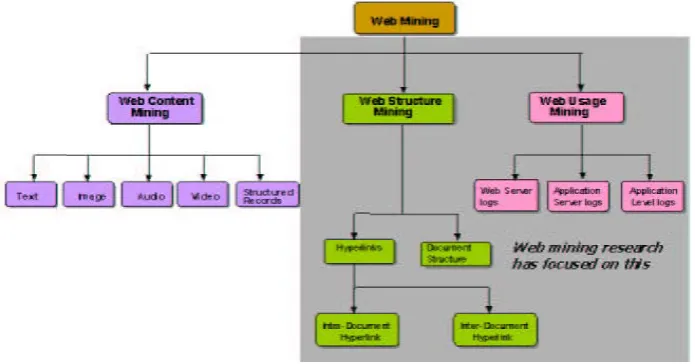
Web Mining can be broadly divided into three distinct categories, according to the kinds of data to be mined. Following figure explains it best.
1. Web Content Mining: Web Content Mining is the process of extracting useful information from the contents of Web documents. Content data corresponds to collection of facts a Web page was designed to convey to the users. It may consist of text, images, audio, video, or structured records such as lists and tables. Text mining and its application to Web content has been the most widely researched. Research activities in this field also involve using techniques from AI such as Information Retrieval [IR] , Natural Language Processing [NLP],Image processing and computer vision.
2. Web Structure Mining: The structure of a typical Web graph consists of Web pages as nodes, and hyperlinks as edges connecting between two related pages. Web Structure Mining can be regarded as the process of discovering structure information from the Web. This type of mining can be further divided into two kinds based on the kind of structural data used.
a] Hyperlinks: A Hyperlink is a structural unit that connects a Web page to different location, either within the same Web page or to a different Web page. A hyperlink that connects to a different part of the same page is called an Intra-Document Hyperlink, and a hyperlink that connects two different pages is called an Inter-Document Hyperlink.
b] Document Structure: The content within a Web page can also be organized in a tree-structured format, based on the various HTML and XML tags within the page. Mining efforts here have focused on automatically extracting document object model [DOM] structures out of documents
3. Web Usage Mining:
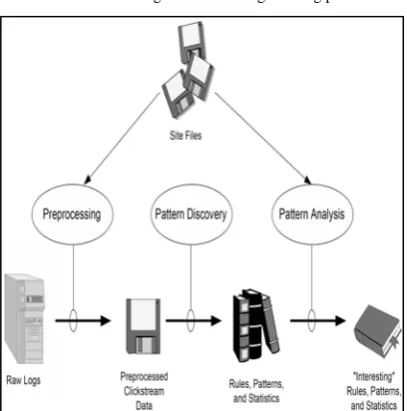
Web Usage Mining is the application of data mining techniques to discover interesting usage patterns from Web data, in order to understand and better serve the needs of Web-based applications. Usage data captures the identity or origin of Web users along with their browsing behavior at a Web site. Capturing, Modeling and analyzing of behavioral patterns of users is the goal of this web mining category. Web usage mining process can be divided into three independent tasks: Preprocessing , Pattern discovery and pattern analysis. The following figure shows this process.
Figure 2: Web usage mining process.
Web usage mining itself can be classified further depending on the kind of usage data considered:
a] Web Server Data: They correspond to the user logs that are collected at Web server. Some of the typical data collected at a Web server include IP addresses, page references, and access time of the users.
b] Application Server Data: Commercial application servers, e.g. Web logic, Broad Vision, Story Server etc. have significant features in the framework to enable E-commerce applications to be built on top of them with little effort. A key feature is the ability to track various kinds of business events and log them in application server logs.
2.3 WEB MINING TECHNIQUES
There are a lot of techniques of web mining; some few to name are as follows: • Cluster and Classification: The cluster techniques identify and distribute similar
Individual’s behaviors in homogeneous groups . Once discoveries the profiles of each group, the characteristics of each one of them can be used to carry out a classification.
• Rules of Association: The association rules can be seen as the identification of actions or facts that, being initially independent, they happen in a combined or associate way. The considered facts can be characteristics or behaviors observed in the individuals.
• Path Analysis: This technique supposes the generation of directed graphs, which represent the relationships among the web pages. The web pages are the nodes of the graphs, and the connections among the pages are the directed arcs among nodes. They can also be defined like graphs with arcs which represent the similarity among pages, or arcs that show the number of users that go from a page to another.
• Sequential patterns: It is a historical of transactions in a web server, where the visit of aclient is stored for a period of time. The problem of discovering sequential patterns of access is based on identifying the group of more frequent accesses in a group of transactions or visits in a giving time.
• Cubes: A cube of data is a type of multidimensional array that allows the users to explore and to analyze a collection of data from different perspectives. From a structural perspective, the cubes of data are composed of two elements: dimensions and measures. The dimensions are categories that describe the studied factors for their analysis, and the measures are the values of the data stored in that structure.
3. ADVANCED AI TECHNIQUES FOR WEB MINING
Almost all web mining tasks are using artificial intelligence techniques and algorithms in order to perform
efficiently. In the following we will briefly describe some of the most valuable AI techniques; some few to name are as follows Multi-Agent Technology and Swarm Intelligence Algorithms.
and they learn from these signals. Each action has an energy cost that can be, for example, the size of the fetched page. Energy is gained from visiting new pages that are relevant to the topic of the query.The wrappers is a programs designed to extract structured data from the web.
Swarm Intelligence
Swarm intelligence [SI] is a term introduced in 1989 in the context of cellular robotic systems and representing the collective behavior of decentralized, self-organized artificial systems, by analogy to the real world where the collective behavior of a swarm can lead to the emergence of an apparent intelligent behavior . Collective intelligence is defined as the ability of a group to solve more problems than its individual members. SI systems are in fact simple agents that are interrelated, being able to communicate one with another and to interact with their environment. The community of agents carries out a distributed problem solving. They follow simple rules and there is no centralized control. Examples from nature of SI include ant colonies, bird flocking, animal herding, bacterial growth, and fish schooling. One of the application of swarm intelligence algorithms to web mining is Ant Colony Optimizer.The algorithm was inspired by the behavior of ants in finding paths from the nest to food, when they create a network of pheromone trails. Two kinds of algorithms are stated . In the first one, the co-occurrence of links in web pages [user selections] was used to compute a matrix of link strengths. The second type of algorithms extracted information from a user sequential path through the web through learning rules in order to change link strengths and create new links.
4. APPLICATIONS OF AI THEORIES IN E-SERVICES: WEB MINING
There is much research in integrating the fields like e-services, Artificial Intelligence and web mining. Intelligent techniques can be combined with traditional web mining approaches to improve the quality of mining. Some of the existing examples are as follows
[1]By applying fuzzy set techniques to set up corresponding marketing patterns, businesses can better predict which kind of customers are loyal for a particular time being, and therefore can help businesses hold best customers and filter potential customers precisely.
[2]Fuzzy Adaptive Resonance [ART] has also been used for clustering customers in groups for targeting [Jain and Krishnapuram, 2001].
[3] A important aspect of web mining is the clustering of customer similar profiles to create customer “segments” [Mobasher et al., 2000].Clustered user profiles are a good option when there exist insufficient data to build individual profiles.Thus, fuzzy set theory can play a major role in customer profile representations and clustering [Jain and Krishnapuram, 2001].
[ 4] Bautista et al. [2000] used a genetic algorithm to build an adaptive consumer profile based on documents retrieved by users.
[5] A fuzzy classification and a genetic term-selection process together provide a better utilization of valuable knowledge to learn the current and future interests of users.
[6] Granular computing techniques have been used in web mining applications to enhance the intelligent functionality of mining systems.
7] For example, Zhang et al. [2003] used both fuzzy computing and interval computing techniques to design a fuzzy-interval data mining system for credit card companies with actual large data sets.
[8] Park [2000] also introduced a neural network-based data mining method to a company's internal customer data for target marketing. A fuzzy ART NN proposed inthis study takes customer's purchasing history as input values and cluster similar customers into groups.
[9] Web document and web pages classification as another important web mining aspect has used NN architectures [Kohonen et al., 2000].
[10] In the meantime, the use of evolution-based genetic algorithms, and the utilization of fuzzy function approximation, have also been presented as possible solutions for the classification problems [Rialle et al., 1997, Petridis and Kaburlasos, 2001, Haruechaiyasak et al., 2002].
[11] Anagnostopoulos et al. [2004] described a probabilistic NN that classifies web pages under the concepts of business media framework. The classification is performed by estimating the likelihood of an input feature vector according to Bayesposterior probabilities.
[12] Web usage mining has become very critical for effective website management, creating adaptive websites, business and support services, personalization, network traffic flow analysis and so on [Abraham and Ramos, 2003].
[14] The study of ant colonies behavior and their self-organizing capabilities is of interest to information/knowledge retrieval, decision support systems sciences and also web mining, because it provides models of distributed adaptive organization, which are useful to solve difficult optimization, classification, and distributed control problems.
[15] Abraham and Ramos [2003] proposed an ant clustering algorithm to discover web usage patterns [data clusters] and a linear genetic programming approach to analyze the visitor trends.
16] Robot Detection and Filtering—Separating Human and Non human Web Behavior : Web robots are software programs that automatically traverse the hyperlink structure of the web to locate and retrieve information. The importance of separating robot behavior from human behavior prior to building user behavior models has been illustrated by Kohavi [2001].
[17] Tan and Kumar [2002] proposed a classification based approach that uses the navigational patterns in click-stream data to determine if it is due to a robot. Experimental results have shown that highly accurate classification models can be built using this approach. Furthermore, these models are able to discover many camouflaged and previously unidentified robots.
[18] Preprocessing—Making Web Data Suitable for Mining.Preprocessing of web structure data, especially link information, has been carried out for some applications, the most notable being Google style web search [Brin and Page 1998]. An up-to-date survey of structure preprocessing is provided by Desikan, Srivastava, Kumar, and Tan [2002].
[19] Flake, Lawrence, and Giles [2000] applied the “maximum-flow minimum cut model” to the web graph for identifying “web communities.”and comparisons were made to detect the strengths and weakness of the two methods.
[20] Reddyand Kitsuregawa [2002] propose a dense bipartite graph method, a relaxati onto the complete bipartite method followed by HITS approach, to find web communities.
CONCLUSION
The World Wide Web is today the major source of data and information for all domains.Web Mining is a new area of pursuit in Computer Science. It integrates concepts and techniques from many existing areas such as Artificial Intelligence and Networking, and applies these to the Web. This paper describes Web mining an important and challenging activity that aims to discover new, relevant and reliable information and knowledge by investigating the web structure, its content and its usage. It is the application of data mining techniques to extract knowledge from the content, structure, and usage of Web data sources. There are many applications of these techniques, for example search engines, Web analysis, Web agents, personalization services etc. This paper focuses on the two main AI techniques: the multi-agent systems and swarm intelligence, with some of their applications in web mining. The mining tasks are so complex that they cannot be efficiently performed without the support of appropriate advanced AI techniques Web Mining Intelligent techniques can be combined with traditional web mining approaches to improve the quality of mining. Fuzzy set theory, User Profile Clustering, Genetic Algorithm, Neural Networking are some of the examples of integration of intelligent and traditional web mining techniques.
REFERENCES
[1] CCPPSS449999//559922:: IInnttrroodduuccttiioonnttooWWeebbMMiinniinngg:: Dr. Jennifer Seitzer
[2] INFORMATION SCIENCE and APPLICATIONS Jose AguilarISSN: 1790-0832 1525 [3] A Web Mining System : JOSE AGUILAR,CEMISID, Departamento de Computación
[4] Han, J., Kamber, M.: Data Mining: Concepts and Techniques, Second edition, p. 628-648.Morgan Kaufmann Publishers, 2006. [5] Liu, B., Chang, K. Ch.: Editorial: Special Issue on Web Content Mining. SIGKDD Explorations, 2004. Paper available on WWW:
http://delivery.acm.org/10.1145/1050000/1046457/p1-liu.pdf[January 2007].
[6] Srivastava, J., Cooley, R., Deshpande, M., Tan, P.: Web Usage Mining: Discovery and Applications of Usage Patterns from Web Data. SIGKDD Explorations, 2000. Paper available on WWW: http://www.acm.org/sigs/sigkdd/explorations/issue1-2/srivastava.pdf
[January 2007].
[7] Vakali, A., Pallis, G.: Web Data Management Practices: Emerging Techniques and Technologies. Idea Group Publishing, 2007.WEB MINING OVERVIEW: Michael Kunc& Jaroslav Zendulka
[8] A Web Mining System:JOSE AGUILAR,VENEZUELA