Design & Implementation of 4 Bit Galois
Encoder and Decoder on FPGA
Dr.Ravi Shankar Mishra1
Head Of Department of Electronics & Communication,
NRI Institute of Technology Bhopal, INDIA,[email protected]
Prof Puran Gour 2
Assistant Professor Department of Electronics & Communication, NRI Institute of Technology Bhopal, INDIA, [email protected]
Mohd Abdullah3
M.Tech Scholar Department of Electronics & Communication,
NRI Institute of Technology Bhopal, INDIA [email protected], Tel +91-9993501968
Abstract:
Galois Field Theory deals with numbers that are binary in nature, have the properties of a mathematical “field,” and are finite in scope. Galois operations match those of regular mathematics. Addition (Ex-Or) and multiplication are common Galois operations, and logarithms, particularly, are handy for checking multiplication results Galois Field multipliers have been used both for coding theory and for cryptography. In this paper we present GF (2m) Galois field encoder & decoder its verification on FPGA Spartan xc3s50-5pq208 using the NIST chosen irreducible polynomial. A complete verification of multiplication is simulated on ModelSim 10.0 a & implemented on FPGA xc3s50-5pq208 will be presented to assure its validity.
Keywords: Galois field, Irreducible polynomial, Galois Encoder,FPGA
1. Introduction
A Galois field multiplication method enables for a arithmetical operations including addition a deduction a multiplication and a multiplier utilizing the multiplication method . The Galois field multiplication method easily
realizes various field multipliers by ANDing respective items of multiplier factor in a stepwise manner rotating left values resulted from the AND operation at the previous step Exclusively ORing the respective values resulted from the rotation with respective corresponding values resulted from AND operation at the current step and operating on the highest polynomial term generated at the previous step in accordance with a generated polynomial. This approach of galois field can be used for designing the encoder and decoder section for the security purposes using the irreducible polynomial based on the NIST standard. .
2. Galois Field Algorithm
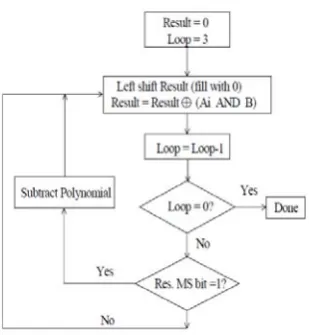
multiplier bit is taken input Ai .The irreducible polynomial and multiplicand remain static. The structure is able to multiply when the operands are all loaded .
Figure.1. Algorithm for GF (2m) Multiplication (Shift and Add Technique)
Operation of the 4-bit multiplier brings as the MSB of the multiplier is under ANDing process with static multiplicand bit and resultant is EX-OR with current result register, which must initialize to 0. As multiplier bits shift, the result accumulates in “R” result. If R (3) is a 1, that means the current partial result is overflowing the 4-bit register and we must subtract a copy of the irreducible polynomial. Note that “subtraction” is also the EX-OR operation. This accomplishes the overall “modulo an irreducible polynomial” correction process.
3. Galois Encoder
The Galois encoder is used at the transmitting end to encrypt the message using GF (2m) algorithm. On receiving the original Message signal the Galois algorithm implemented on the FPGA encodes the message using the private key the irreducible polynomial and multiplier. The 4 bit multiplication results 4 bit encrypted data. The vhdl code is simulated on the model sim 10.a edition and implemented on FPGA XC3S400-4PQG208C yields 225 cryptographic results for GF (2m)multiplier where m =4 of all possible combination inputs.
4. Galois Transmitter & Receiver
Figure. 3. Block diagram for Galois Receiver
The transmitter and receiver section needs a set of protocol for communication.
Tx and Rx sets the following protocols
i) Irreducible Polynomial acts as generator key of the encrypted data table at Transmitter. ii) Table to be discussed between the Tx & Rx.
iii) Multiplier as the private key for decryption process at Rx end.
The Galois encoder generates the encrypted data that can be used for transmitting the Galois encrypted message. At the receiver 4 bit of encrypted data is decoded using the Galois decoder .Multiplier as private key & look up table generated by FPGA at the Rx end is used for decryption of the original message signal.
5. Galois Decoder
The 4 bit of the encrypted data D out is to be hatched for retrieving the original data.Multiplier is taken as the private key to decode the data at the receiver end. Look up table is created on FPGA at Rx end that use the private key for identification of the original bit message data. Look up table consist of 225 iteration generated by the Galois field algorithm. The result & private key retrieves original data. If error in private key original message cannot be retrived.
6. Results
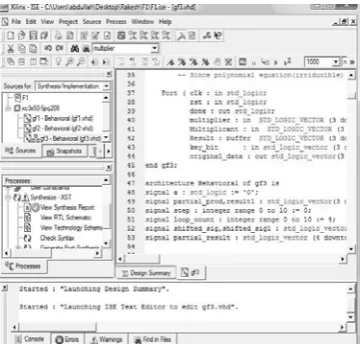
1) Synthesis result
2) Device utilization Summary : Selected Device: SPARTAN 3 xc3s50-5pq208
Table 1: Device utilization Summary
3) Model sim 10.0 a simulated results
Figure.6.Intial state simulation of gf(2m) Figure.7.Simulation 4 bit Galois encoder & decoder on private key being true
4) Verification of Result
Table.2. Analysis of different control signals
The data encryption and decryption using the Galois field is shown in tabular format.When reset is taken as 1 the loop count is loaded with 4.Now again changing the reset pin from 1 to 0 & clk on 1 the results are fetched for encoding & decoding based on the key condition being true or false .
7. Conclusion
We have presented the FPGA implementation of a GF (2m) Encoder & decoder which are based on recommended irreducible polynomial by NIST for applications in cryptosystems. The structure of the used multiplication algorithm, has allowed us to use effectively the resources in the FPGA Spartan3 , as it has already demonstrated in the previous results .The paper simples the circuit and performs high speed operation by decreasing the number of logic gates & increases security during communication dialogue This circuit would be in future designs, such as an 8 bit encoder & decoder . We have used a FPGA Spartan XC3S400-4PQG208C for physical implementation, and for synthesis and simulation process we have used the computational packet ISE8.1i provided by Xilinx.
8. References
[1] Daly y W. Marnane. “Efficient Architectures forimplementing Montgomery Modular Multiplication and RSA Modular Exponentiation on Reconfigurable Logic”. FPGA´02. Monterey, Ca. USA, 2002.
[2] G. Bertoni, J. Guajardo, S. Kumar, G. Orlando, C. Paar y T. Wollinger. “Efficient GF(pm)Arithmetic Architectures for Cryptographic Applications”. In Marc Joyce (Ed.): The Cryptographers´ Track at the RSA Conference,CT-RSA 2003, volume LNCS 2616, pp. 158-175,San Francisco, CA, USA, April 2003.
[3] G.C. Ahlquist, B. Nelson y M. Rice. “Optimal Finite Field Multipliers for FPGA´s”. In P. Lysaght, J. [4] Irvine, R. Hartenstein (Eds.): Field Programmable Logic and Applications. 9th International Workshop, [5] FPL´99, volume LNCS 1673, pp. 51-60, Glasgow, UK, August/September 1999.
[6] Mario Alberto García-Martínez1, Rubén Posada-Gómez1, Guillermo Morales-Luna2 and
[7] Francisco Rodríguez-Henríquez2. FPGA Implementation of an Efficient Multiplier over Finite Fields GF(2m) Proceedings of the 2005 International Conference on Reconfigurable Computing and FPGAs (ReConFig 2005) 0-7695-2456-7/05 © 2005 IEEE
[8] P. Kitsos, G. Theodoridis y O. Koufopavlou. “An efficient reconfigurable multiplier for Galois field [9] GF(2m)”. Microelectronics Journal. Vol. 34, Pags.975-980, 2003.