Page 8 www.ijiras.com | Email: [email protected]
Application Of Conflict Management Methods Among Couples In
Nigeria: Alternative Dispute Resolution Approach
OJO, Funmilayo Yemi (PhD)
Department of Social Justice, Afe Babalola University, Ado-Ekiti, Nigeria
FOLAYAN, Toyeen Abraham
School of Arts and Social Sciences, National Open University of Nigeria, Ibadan, Nigeria
I. INTRODUCTION
Marriage can be a lot of work for both spouses, and sometimes it might end in conflict between couples. Disagreement often arises which cause strain in a relationship and makes marriage even more challenging. The rate of divorce in the world is becoming alarming and geometrical in calculation. It is of a fact most young marriages ends up in divorce between one to six months of celebration. This fact is not only true of United States where the record is rampart but also of Nigeria, an example of other developing countries. Wedding ceremonies and betrothal rites in Nigeria are often marked by open declarations of goodwill, promise and unending love between spouses. No sooner do such events conclude, spouses get embroiled in disagreement, agitations, quarrels, and in some cases, outright struggle, inflicting injuries on one another. Under conditions of improper management, such situations result in litigation, separation and sometimes annulment of the marriage bond (Omorogbe, Obetoh & Odion, 2010).
The word alternative means something that can be used instead of something else (Longman Dictionary of Contemporary English) as earlier noted, there are some shortcomings found for adjudication in resolving marriage disputes and these shortcomings serve as propellers to finding substitutions. Ayinla (2009) stated that the difficulties posed by litigation to the litigants in gaining access to justice, couples with the overburdened courts with little facilities to attend to matters with the deserved alacrity, formalism, legalism and excessive cost, are some other factors that have led to the quest for alternatives to the traditional court system (litigation). Since the court process seems to be cruel, anachronistic and hypocritical, there had to be a better way out (Ogundiji, 2011).
The court through the traditional method of litigation is often bedeviled with countless number of matrimonial causes ranging from marriage dissolution, order for nullity of marriage, nullity of avoidable marriage, judicial separation, restitution of conjugal rights, and jactitation of marriage. But the most astounding thing about all these forms of marriage conflicts is that it is a private family affair which can be Abstract: Couples’ management of dispute using non-violent methods through diplomatic means has been around for long time in Nigeria. However, many individuals are yet to know much about these alternative approaches. This is descriptive survey research design with one hundred and sixty (160) participants. Two hypotheses were generated and tested for at 0.05 alpha levels using t-test statistic. The main instrument for the study was “Alternative Conflict Resolution Scale”.
Significant difference in the level of knowledge about ADR between male and female participants (tobs = 2.96; df =
158; p > 0.05); while no significant difference was found in the level of knowledge about ADR between younger and older participants (tobs = 0.75; df = 158; p< 0.05). The study recommended that Government should establish ADR centers for
would-be couples. Also, while settling dispute at community level, younger couples should be present to observe how elders participate in conflict resolution.
Page 9 www.ijiras.com | Email: [email protected] resolved through Alternative Dispute Resolution Mechanisms.
The fact that conflict is inherent of development of any society, conflict resolution is equally important to the survival of that society (Oputa, 1989, Ladan, 1997). In the traditional setting of pre-colonial era, disputes are resolved in an amicable manner because of the relationship between disputant which must continue so as to keep the society together. It is where such dispute are not settled by traditional negotiation, mediation or conciliation that they are referred to the King to make a binding declaration on such matter which then became a precedent. Even at that, the primary underlining concept behind such resolution is peace and tranquility so that disputes do not go endlessly without resolution. The parties are also enjoined to embrace the King‟s declaration.
Many disputes have been settled recently through the resort to ADR and the fact is not in doubt that Alternative Dispute Resolution Mechanism (ADRM) is fast becoming the best method not only as a complementary or alternative mechanism to litigation but also as the best strategic method of resolving certain private disputes which matrimonial causes is first. The dispensation of justice in Nigeria today is plagued with delay such that the various courts are inundated with cases which last for several years before they can be determined by courts. Long adjournments, cumbersome and rigorous procedure, difficult and ambiguous rules of evidence and other several artificial obstacles are largely responsible for the delay which has so much haunted the dispensation of justice system for so long. The effects of the foregoing scenario are that litigants are often frustrated; suspects are detained for years without formal suspects who ought to be tried and punished for offences committed by them to escape without punishments. Cost of litigation has soared and with the excruciating effect of inflationary trend on the economy, many litigants can no longer pursue ligation cases (Ogundayisi, 1995).
Globally, the role of traditional dispute resolution mechanisms in the dispute resolution continuum has been noted over time with scholars stating that courts only deal with a fraction of all the disputes that take place in society (Galanter 1981). Alternative dispute resolution (ADR) refers to the search for and application of, non-conventional, peaceful methods of settling dispute and resolving conflict situations using the least expensive methods, and in ways that satisfy the parties, as well as ways that preserve relationships after a settlement might have been reached. Asogwu (2009) described ADR as non-adversarial, and processes designed to manage community tension and facilitate community development. ADR is less formal and often more consensual than is done in the courts. The most common forms are mediation and arbitration. Other forms include judicial settlement conferences, fact finding, ombudsman, and others. ADR is sometimes mandated by the courts which require that disputants try mediation before they take their case back to court in the event of failure (Ugwu & Enna, 2015).
It is increasingly recognized that conflict affects men and women differently. It has a wide range of economical, social, and psychological effects which are influenced by gender. Women and men have access to resources, power and decision making before, during and after conflicts (Bamlak, Yeneneh, & Fekadu, 2015). The experience of women and men in
conflict situations is significantly different. While entire communities suffer the consequences of conflict, women and girls are particularly affected because of their status in society and their sex. Women are thus caught in vicious paradox: while they are main civilian victims of conflicts, they are often powerless to defend themselves, they are excluded from the negotiations during the resolution process, and they are confined to a marginal role in the conflict resolution efforts. The general exclusion of women from decision-making positions prior to, during and following conflicts reinforces their victimization. Empowering women in conflict situations would help prevent gender-based violence such as the terrible crimes of rape, forced pregnancy, sexual slavery and others.
In Nigeria, though not statutorily recognized, family/divorce mediation has gained popularity and awareness to some extent. Not being statutorily recognized is the major factor delaying its use in Nigeria. According to Aderibigbe (2011), mediation is beneficial in family matters; mediation is private and its aims at amicable settlement, but this is not yet fully embraced by many in Nigeria. Therefore, divorcing couples should be required to attempt some form of ADR training before proceedings in court, hence it is a good idea to understand this options. This study therefore will look at the application of ADR among selected couples in conflict in Ibadan, Nigeria.
II. RESEARCH LITERATURE
A. ALTERNATIVE METHODS OF CONFLICT
RESOLUTION
Apart from litigation method, there are other methods of non-conventional peaceful and alternative methods of settling disputes and resolving conflict using less expensive methods. Discussing alternative dispute resolution methods in peace making, Olagunje (2002) argued that conflicts has a bad name because of negative conflict management, otherwise conflicts, are not themselves bad. He further reveals that once conflict is open, there are many non-violent methods of resolving them. Hence the alternative dispute resolution method is indentified as one of such methods.
a. ARBITRATION
Page 10 www.ijiras.com | Email: [email protected] of court jurisdiction. Arbitration is either customary or
arbitration by Act (Abia & Ekpoattai, 2014).
b. NEGOTIATION
Negotiation could be defined as “a basic means of getting what one wants from others” (Latz, 2006). It is within the reach and control of parties like communication and collaboration because there are no third parties involved. Thus, negotiation is a direct process of dialogue and discussion taking place between at least two parties who are faced with a conflict situation or dispute. Both parties come to the realization that they have a problem, and both are aware that by talking to each other, they can find a solution to the problem. The benefits of compromised solution, it is believed to outweigh the losses arising from refusal to negotiate. In negotiation, there must be communication between the two parties intended to gain understanding, to produce agreement, to bargain between individual involved in a conflict or dispute. Negotiation typically takes place during the early stages of conflict when communication between parties is cordial and good or at the de-escalation point when communication has been restored (Chikwe, 2011). There are two types of negotiation: positional negotiation and collaborative negotiation. The first type of negotiation is based on the aggressive pursuit of interest by parties, and is typically adversarial and competitive. Parties make demands that are inconsiderate of the interest and needs of others, and this makes it difficult for this interest to be met. Parties may also perceive themselves to be in competition. The desire will be to win, instead of working towards a mutually beneficial outcome. Thus, the demands of one party can be met only to the detriment of the other. Parties tend to stubbornly adhere to their positions and one side seems to dominate the negotiation. It can break down easily.
Collaborative or constructive negotiation, on the other hand, is a process whereby parties try to educate each other about their needs and solve their problems in ways that the interests and fears of both parties are met. The process is collaborative in principle and the emphasis is on mutual understanding and feeling, all aimed at building a sustainable relationship. Negotiation seems to have universal application as a principle of conflict management based on dialogue. It is apparent that the success is functional (Chikwe, 2011).
c. CONCILIATION
It involves a situation where a third party known as reconciliatory is obliged to use his best endeavours to bring parties in a dispute to voluntary settlement of their dispute. The conciliation method of resolving conflict comes into play when an aggrieved party reposts the dispute to elders either in the family or community as the case may be. On listening to the two parties the family head recommends a solution which whether they like it or not, must be accepted by the parties. In conclusion, there might be no prescribed sanction for non-compliance, but the parties are obliged to abide by the decision handed down. Conciliation involves reconciling, appeasing, uniting and winning the other party over. According to Abia and Ekpoattai, (2014), conciliation is also
regarded as a third party non-adversarial intervention process, where the intervener conducts a form of „shuttle diplomacy‟ between disputing parties in a bid to achieve a mutually acceptable terms of conflict resolution for them. The conciliator may suggest „best‟ solution for the disputing parties which, depending on what the consequence might be for them, may or may not be regarded as binding by the parties.
d. MEDIATION
Mediation is anchored on the participation of a third party neutral (called the negotiator) that facilitates or assists parties to arrive at a negotiated agreement. The mediator does not compel in this regard but only elicits facts, agenda and option for settlement by so doing help the parties to negotiate and achieve a win-win solution to their dispute (Brayne & Grimes, 1998). Unlike the conciliator, mediators rarely inquire the facts of the case. But like arbitrators, mediators do not attempt to apportion blame; rather, they provide acceptable compromise. Consequently, in mediation, where the third party intervenes, or called upon to help in settling disputes, the mediator does not give a decision but encourages the parties to find a middle ground where both parties are happy and have a feeling of winning. Consequently, mediation is the intervention in a negotiation or a conflict of an acceptable, impartial neutral third party with no authority in decision making, but can assist the disputing parties to voluntarily reach a mutually acceptable settlement of issues in dispute.
Mediation may also strengthen and establish relationships of trust and respect between the parties, or terminate relationships in a matter that minimizes costs and psychological harm. Mediation is therefore useful in highly polarizes disputes where the parties have been talking and have reached a seemingly insurmountable impasse. A mediator makes primarily, procedural.
III. METHODOLOGY
The total number of participants for the study was one hundred and sixty (160) married couples. The sample consisted of 63 males and 97 females. The participants‟ age range was between 24 and 60 years.
The main instrument used for this study is a questionnaire tagged Alternative Conflict Resolution Questionnaire- ACRQ. The scale consists of two (2) sections, (Sections A & B). Section A consists of demographical information about the participants while section B consists of fifteen (15) items. The respondents are expected to answer either „YES‟ or „NO‟. The instrument was given to two (2) measurement experts to determine the face and content validity of the instrument. The instrument was later corrected in line with the corrections made by the experts. The instrument was a non-compound instrument; this is because it was developed on one variable, which is the knowledge of ADR among married couples.
Page 11 www.ijiras.com | Email: [email protected] which was not part of the study area. The researcher
administered copies of the instrument to this sample with the request that sample should respond to all the items of the instrument as diligent and honest as possible. After an interval of two weeks, the same instrument was administered to the same sample to respond as usual. Their reactions to the instrument indicated that the items of the instrument were clearly understood by the respondents. There was no case of item ambiguity. Time allocation of thirty (30) minutes for responding to the entire scale was found to be adequate. Thus, the initial score as well as the retest score of the sample were correlated using Pearson Product Moment Correlation (r). The correlation Coefficient was found to be 0.87. In behavioural research, an alpha of 0.6 or above is acceptable.
The researcher met the participants in the three local government secretariats. Prior to the day of administration of the questionnaire, there had been notices of boards of various departments for “Marriage Talk on “Secret of successful family”. A marriage expert had been invited to address participants. The researcher thereafter administered the instruments on the participants in their respective locations.
The data that were generated for this study were subjected to t-test statistic to confirm the acceptance or rejection of the null hypotheses.
A. RESEARCH HYPOTHESES
The following null hypotheses were stated and tested for, in this study at alpha level of 0.05.
There is no significant difference in the level of knowledge of ADR between the male and female participants.
There is no significant difference in the level of knowledge of ADR between older and younger participants
The study is designed to cover two local government areas in Ibadan, Oyo state. The study centers on knowledge about ADR as panacea to marital dissolution among couples in Ibadan, Nigeria. The study is mainly limited to couples (wife or husband) in Ibadan. These methods are appraised in connection with their application to marriage disputes only. In terms of jurisdiction, references shall be made to application of the named ADR (conciliation, mediation, negotiation and arbitration) methods generally.
RESULTS
For each of the hypotheses, the statistical test of significance selected and applied to the data are described and a statement confirming the acceptance or rejection of each of the hypothesis.
HYPOTHESIS ONE
There is no significant difference in the level of knowledge about ADR between male and female participants. To test this hypothesis, student‟s t-test statistic was employed to analyze the data generated for this hypothesis. The result is presented in Table 1.
Variable Gender
N Mean SD DF tobserved tcritical p Remarks
Male 63 22.50 2.74
158 2.96 1.96 > 0.05 NS
Female 97 21.82 3.06
Table 1: t-test Summary table Showing Differences between the level of knowledge of ADR for male and female
participants
Table 1 above presents the mean, standard deviation, observed t value as well as well as critical t value of ADR of participants on gender basis. In line with the obtained result, the me 3.an score of the male was 22.50 and standard deviation of 2.74 while the female recorded the mean score of 21.82 with the standard deviation of 3.06. The calculated t-test was 2.96 as against the observed t-value of 1.96 at 0.05 alpha level. Comparing the obtained value of tobserved (1.96) and the t
calculated (2.96), therefore, revealed that the tcalculated is greater
than the tobserved. Hence, the hypothesis, which state that there is
no significant difference in the ADR between the male and female participants is rejected.
HYPOTHESIS TWO
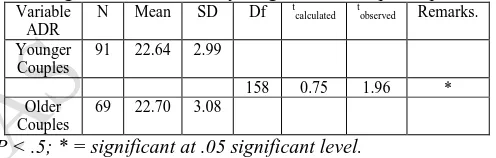
There is no significant difference in the level of knowledge of ADR between younger and older participants.
Variable ADR
N Mean SD Df t
calculated tobserved Remarks.
Younger Couples
91 22.64 2.99
158 0.75 1.96 * Older
Couples
69 22.70 3.08
P < .5; * = significant at .05 significant level.
Table 2: t-test comparison of younger and older participants The result of the analysis displayed in Table 2 above showed the mean, standard deviation, tobserverd as well as t
calculated values of ADR. Information gathered revealed that the
mean score of younger married participants was 22.64 with the standard deviation of 2.99 while the mean score for the married participants was 22.70 with the standard deviation of 3.08. The table further revealed that 0.75 and 1.96 were the calculated and the observed t values respectively at 0.05.
IV. DISCUSSION
The hypothesis states that there is no significant difference in the level of knowledge of ADR between male and female participants in the study. The result of the findings from the study revealed that there was significant difference in the level of knowledge of ADR between the male and the female participants, the hypothesis was therefore rejected. This indicates that there was significant difference between male and female participants. Consequently, the alternative hypothesis was therefore accepted.
Page 12 www.ijiras.com | Email: [email protected] confined to a marginal role in the conflict resolution efforts.
The general exclusion of women from decision-making positions prior to, during and following conflict reinforces their victimization. It however showed that males have knowledge about ADR than females. According to Adedokun (2007) women are known to have very few resources of income due to the fact that she is not expected to compete with men in the world of economy. Even if she loves to, her knowledge base is limited, so she consciously or unconsciously keeps herself in the background; depending on men for almost everything including decision making and sustenance. These women can be uplifted from this subjective position if only they are given education. This type of education according to Aspin and Chapman (2007) will give women awareness of the rights, duties and privileges open to them in their communities including knowledge about ADR when there is conflict.
The hypothesis states that there is no significant difference in the level of knowledge of ADR among couples based on years of experience in marriage. The finding of the study indicated that there was no significant difference in the level of knowledge between older and younger participants. The hypothesis was therefore accepted. This study is at variance with the report of Greef and de Bruyne (2000). With a sample of South African couples, he found that wives who had been married at least 10 years reported the lowest levels of satisfaction when they used conflict avoidant strategies. Studies by Bradbury, Finchma and Beach (2000) also confirm that marital satisfaction is lowest in middle age while conflict and negativity increase in middle-aged couples because they couples are not exposed to alternative dispute resolution.
A. CONCLUSIONS AND RECOMMENDATIONS
From the foregoing, it is obvious that all participants are not on the same level in their knowledge of ADR strategy and there is difference in the knowledge among participants. It is a settled fact that not many women have information about ADR strategy as means of settling dispute in the family.
The findings of the research revealed that there is no difference in the knowledge about ADR between younger and older participants in the two local government areas of the study. This is an indication that where people are in the knowing of ADR, as a means of ensuring that generations in the areas learn the process and value system of ADR in their family or community. The following recommendations are therefore vital:
Government should make funds available to establish pre-marital training centers in very local government in Nigeria.
ADR training should be made compulsory for couples before marriages are conducted either in Registry or Religious places in Nigeria.
Non-governmental organizations should create the awareness campaign to sensitize people to alternatives on the value and advantages of ADR in dispute resolution.
Couples in conflict should first attend ADR sessions before litigation is allowed.
Family counselling centers should be established in every local government areas in Nigeria and would-be-couples
must visit the center before wedding is conducted in the registry or religious places.
REFERENCES
[1] Abia, O.T., & Ekpoattai, I.T. (2014). Arbitration as an alternative method of conflict resolution among Ibibio of South-East Nigeria. American Journal of Social Issues and Humanities, 4, 2276-6928.
[2] Adedokun, M.O.A (2007). Empowering women through education to eradicate injustice. Nigerian Journal of Clinical and Counselling Psychology, 13 (2), 217-236. [3] Aderibigbe, M. (2011). Family Life Line Through Wide
Based Support. >http://www.mediate.com/people/ personprofile.cfm.cfm?avid=1099> Accessed on 20 January, 2011
[4] Asogwa, F.C. (2009). “Emerging trends in conflict management in the modern society: The Alternative Dispute Resolution Approach:, Journal of International Politics and Development Studies, 5 (1&2), 95-96. [5] Aspin, D.N., & Chapman, J.A. (2007). Understanding the
meaning of Life-Long Learning: A Pragmatic Problem Solving Approach. Lagos Organization Review, 3 (6). [6] Ayinla, L.A. (2009). „ADR and the Relevance of
Native/customary Arbitration in Nigeria (Africa): A Critique of Its Nature and Allied Legal Issues‟ Vol.14. The Jurist. Annual Publication of Law Students‟ Society, University of Ilorin, p 253.
[7] Bamlaku., T., Yeneneh T., & Fekadu, B. (2015). Women in conflict and indigenous conflict resolution among Issa and Gurgura clans of Somalia in Eastern Ethiopia. The institute of Pastoral and Agro-Pastoral Studies, Haramaya University, Dire-Dawa, Ethiopia, 2015.
[8] Bradbury, T.N., Fincham, F.D., & Beach,S. H. R. (2000). Research on the nature and determinants of marital satisfaction: A decade in review. Journal of Marriage and the Family, 62, 964-980.
[9] Chikwe, A. (2011). Learn when Negotiating Behaviours is Dynamic Pilot University Lecturers Skill Enhancement Training, 2(2), 11-12.
[10]Galanter, M. (1981). “Justice in Many Rooms: Courts, Private Ordering Indigenous Law”, Journal of Legal Pluralism, 19, 3.
[11]Greef, A. P., & Bruyne, T.de. (2000). Conflict management style and marital satisfaction. Journal of Sex and Marital Therapy, 26, 321-334.
[12]Ladan, M. (1997). “Alternative Dispute Resolution: Processes and Enforcement,” paper delivered at NIALS Government Legal Advisers WOA, pg. 1.
[13]Latz, M.E. (2004). .Grain the Edge: Negotiation to get what you want. First St. Martin Edition. Matrimonial Causes Act 1970, Cap. M7 LFN.
[14]Ogundayisi, A.O. (1995). Legal Practitioner, Arbitrator and Consultant, Abuja, Ogundiji, O.A. (2011) An appraisal of the application of alternative dispute resolution methods to marriage disputes. Retrieved on 13, November, 2015 from www.family
Page 13 www.ijiras.com | Email: [email protected] Couples: The Esan Case. Journal of Social Sciences, 24
(1), 57-63.
[16]Oputa, C.O. (1989) “Human Rights in the Political and Legal Culture of Nigeria,” in Law Publications, P. 75.