99
Int. J. of Engg. Sci. & Mgmt. (IJESM), Vol. 6, Issue 1: Jan-March: 2016, 99-105
INTERNATIONAL JOURNAL OF ENGINEERING SCIENCES
&
MANAGEMENT
A SIMULATION ANALYSIS OF ALGORITHM BASED ON GLOBAL MSE OPTIMIZATION
FOR TARGET TRACKING
Ahtram Uddin
1, Ajay Barapatre
21
M. Tech. (DC) VIT Bhopal,
2AssistantProfessor, EC, VIT Bhopal
1
[email protected],
2[email protected]
ABSTRACT
This paper presents a new approach for reducing the response time in multiple target tracking DAIRKF algorithm .This method is based on to find out global optimality of mean square error (MSE) for multi target tracking. This is of utmost importance for high-performance real-time applications. In this paper we discuss designing of Multi Target Tracking (MTT) algorithm which is based on Kalman filter and to develop an algorithm for multi target tracking such that it will reduce Mean Square Error (MSE) globally. The DAIRKF algorithm is simple in computation while PDA, JPDA algorithms provide exponential terms which increases computational complexity. The idea of this paper is to integrate all targets and measurements . and applied random coefficient matrices Kalman fil-tering to this integrated dynamic with global MSE optimization algorithm . The VHDL simulation results confirm the validity of this concept. The simulated result shows that the proposed algorithm is better and faster than all previous algorithms (PDA, JPDA, and DAIRKF).
Key Words: PDA, JPDA, DAIRKF, Kalman Filtering, Global MSE Optimization ,QP, MTT.
I
NTRODUCTIONn most radar systems used for target detection and tracking, the background information including clutter, noise, and intelligent interference comes into the radar system together with the target signals and obscure target information of interest. Besides that, the internal sensor noise, the uncertainties in the kinematics of the target, and the situations of multitarget tracking (MTT) sys-tems and multisensory syssys-tems further increase complexity of the problem. Therefore, extraction of correct target data from un-wanted information and keeping precise tracking of targets is a very difficult and important topic in radar technology. Target tracking can be described as the process of determining the loca-tion of a target feature in an image sequence over time. It is one of the most important applications of sequential state estimation, which naturally admits Kalman filter. Multiple target tracking radar systems have been applied in both military and civilian areas[13]. The targets in different application areas may include enemy aircrafts, ballistic missiles, surface ships, submarines, ground vehicles and military units, and civil airplanes.
A main function of each radar surveillance system is the target tracking. The basic part of this problem is the process of data association. The problem of correct data association is diffi-cult to be resolved in dense target environment. In these cases
there are clusters with multiple targets and received measure-ments. There often have ambiguities [14]. The proposed approach gives an optimal solution. Recently the increased computational power of the computers allows using this approach in real time implementations.
100
Int. J. of Engg. Sci. & Mgmt. (IJESM), Vol. 6, Issue 1: Jan-March: 2016, 99-105
[18] proposed the probabilistic data association (PDA) algo-rithm. The PDA algorithm, which is based on computing the posterior probability of each candidate measurement found in a validation gate, assumes that only one real target is present and all other measurements are Poisson-distributed clutter. The more complex MHT provides improved performance, but it is difficult to implement and in clutter environments a large number of hy-potheses may have to be maintained, which requires extensive computational resources[14]. . Based on PDA, further proposed the joint probabilistic data association (JPDA) algorithm [1]. JPDA and PDA utilize the same estimation equations. The difference is in the way the association probabili-ties there are still some disadvantages of JPDA. the complexity of this algorithm increases exponentially as the number of targets increases.
Then the DAIRKF algorithm for the multiple target track-ing is proposed . DAIRKF algorithm is more appropriate because it gives better response as compared to JPDA in high dense clus-ter [1]. But it was also complex in computation. The basic idea of this algorithm is to integrate all targets and measurements which need to be associated to a new whole system. Then the random coefficient matrices Kalman filtering is applied to this integrated dynamic system to derive the estimates of these target states DAIRKF is based on Kalman filtering which works on prediction [17-18] integrated random coefficient matrices are formed for prediction and measurement conditions.
For MTT radar system, the computation time for calcu-lating Kalman-filter-based algorithms in software is too long to meet system requirements. Some modification is required to reduce the computation time of Kalman-filter-based algorithms. in this paper global MSE optimization is presented which gives more appropriate results than DAIRKF, MSE is globally opti-mized measurement noise. Global optimization technique is used to optimize the error (measurement noise) [11],due to this globa-lization it reduce the computational time for this linear model is preferred which is linear matrix inequality problem with suffi-cient global optimality conditions.
KALMAN FILTER
The Kalman filter addresses the basic problem of estimation of the state of a discrete-time controlled process that is governed by the linear stochastic difference equation. Kalman filter is com-posed of two essential ingredients, the state or process equation and the measurement or observation equation. The algorithm is carried out in two distinct parts:
Prediction Step or State Equation-
Models the expected variation in the parameter xk that is to be estimated, during the period of time of the measurement process
k+1 k k k
x
= F x + v
Where, xk is the state of the system at time k. It is based on the state of the system at time k-1. vk known as Process noise, Fk is the state transition model which is applied to the previous state xk−1.
Updating state or Observation Equation-
Relates the obtained measurements to its state and is of the form,
k k k k
y = H x + w
Where, Hk is the observation model which maps the true state space into the observed space. wk represents the measurement errors that occur at each observation time and is modeled as Gaussian noise and known as measurement noise.
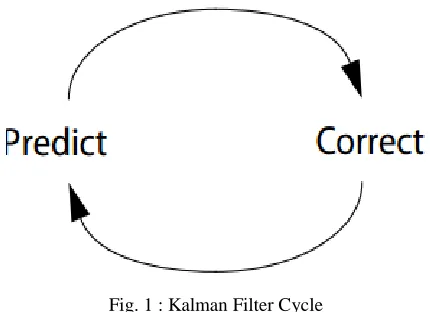
The process and measurement noise assumed to be independent of each other or they are uncorrelated. The noise is assumed to be white Gaussian noise and with normal probability distributions. The process noise covariance matrix or measurement noise cova-riance matrix may change with each time step or measurement. The Kalman filtering problem, namely, the problem of jointly solving the state and observation equations for the unknown state in an optimal manner [19]. This process is shown graphically in Fig 1.1
Fig. 1 : Kalman Filter Cycle
As shown in Fig 1 in Kalman filter cycle, the filter works in a cyclic form where a prediction step is followed by a correction step
PROBLEM FORMULATION
In order to make the notation tractable, we consider a single cluster of targets numbered t=1,….,T at a given time k. There are m measurements associated with this cluster at time k. The dy-namic system is given by
1
x
tk
F
ktx
tk
v
kt(1)
,
x
,t k j k k k j
y
H
w
(2)
where
x
t r k
R
andt r k
v
R
are the system state and process
noise for target t,
y
k j, andw
k j, are the jth measurement and its noise. The subscript k is the time index[1].The process noise t k
v
101
Int. J. of Engg. Sci. & Mgmt. (IJESM), Vol. 6, Issue 1: Jan-March: 2016, 99-105
Fk and Hk are random coefficient matrices their covariance matrices are known as follows:
( )
k
t t k v
Cov v
R
,
(w )
k j, tk w
Cov
R
The result oriented JPDA algorithm described as fallows:
1) First of all for a particular value of k generate N samples from all targets (t=1……T)
,1 ,
,
0 0 0
1
...
Ni i T i T
i
x
x
x
2) For each particle calculation of weights for each and every measurement to track association, normalizedensity is
, i k j
and 0 , k j
denotes the false measurement
3) Generate new set
,1:1 N i T k i
x
by resampling with replace-ment N times.
4) Predict new particle.
5) Increase k and iterate from second step.
The DAIRKF algorithm is something different from the JPDA in computational sense. In JDPA exponential terms are computed but in DAIRKF linear matrix model is computed which is easy to compute when cluster is highly dense.
Consider a discrete time dynamic system
1
x
k
F
kx
k
v
k(3)
x
k k k k
y
H
w
k=0,1,2 (4)
k k k
F F F (5)
k k k
H H H (6)
Where
k k k
F
F
F
k k k
H
H
H
Substituting the value of (5), (6) into (3), (4), the original system is converted to
1
x
k
F x
k k
F
kx
k
v
kx
kx
k k k k k
y
H
H
w
Let,
v
k
F
kx
k
v
k
w
k
H
kx
k
w
k
1
x
k
F x
k k
v
k(7)
x
k k k k
y
H
w
(8) Where,
k k k
w
w
w
,optimal error
k k
w
E w
, mean of noise
k k
H E H
, mean of integrated random coefficient matrices
For single tracking target tracking-
1 2 3
',
,
...
Nk k k k k
X
x x x
x
:for t=1 and N is the no of samples
For multi-targets –
1' 2' 3' '
', X , X ...
t N
k k k k k
X X X
:for t =1…..T
1' 2' 3' '
',
,
...
t N
k k k k k
v
v v
v
v
1' 2' 3' '
',
,
...
t N
k k k k k
y
y
y
y
y
and
1' 2' 3' '
', , ...
t N
k k k k k
w w w w w
1' 2' 3' '
', , ...
t N
k k k k k
H H H H H
: Hk is a diagonal matrix again
t
k k k k
y
H X
w
Measurement
s k
Y
P
andw
k
P
s is the measurementand measurement noise.
The different statistical properties [1] are as –
{ Fk ,Hk,vk,wk,,k = 0,1,2……} sequences of independent ran-dom variables Xk and { Fk ,Hk,vk,wk,k = 0,1,2……} are uncor-related .
The mean of any dynamic function can be calculated by taking first expectation of that function and double expectation gives probability of data. Under the additional conditions on the system dynamics,
the Kalman filter dynamics converges to a steady state filter and steady state gain is derived [1-3].
Filter State Estimate = Predicted State Estimate + gain * error
Or
X
k k/
X
k k/ 1
K
k(
y
k
H X
k k k/ 1)
1 '
/ wk
k k k k
K
p
H R
'
/ 1/ k
(I K
)
/ 1k k k k k k v k k k k
p
F p
F
R
H
p
In case of DAIRKF the error is sub optimal, iterated and filters out but it cannot be so optimal in global sense. The global optimality is achieved by obtaining the mean value which is near about to the error.
GLOBAL MSEOPTIMIZATION
102
Int. J. of Engg. Sci. & Mgmt. (IJESM), Vol. 6, Issue 1: Jan-March: 2016, 99-105
s k
w p
' '
k k k k
min
w Aw + 2a w + α = f w
Now for m measurements-
' 'i k ki i ki i ki i
g w
= w B w + 2b w +β
; i =1…….m
&
'
j k k j k
d w
= w E w - 1
; j=1……..n
Ejcan be calculated by above equation.
As
g w
i
k
= 0
andd w = 0
j
k
m n '
k k
k i i j j k i=1 j=1
w - w
A +
μ B +
γ E
w - w
0
Global MSE optimization is a tool to develop mathematical criteria to identify the global minimizer of the problem (QP). The corres-ponding mathematical criteria are called the global optimality condi-tion for (QP).
The
w
k for which this condition is satisfy known as necessary and sufficient global optimality condition. This is known as KKT point and condition is defined error as global optimality characteriza-tion [11]. The optimal error is defined askk k k
w
w
w
As the,
w
k is nearest tow
kthenw
k
will be minimal or
optimal and measurement will be more accurate. Mean square error variance is calculated as-
' 2
k
k k w
E w w
Let from m measurements n value of
w
k
is satisfy the condition of KKT point. again take the mean of this n values
1 2
...
k k kn
k
w
w
w
w
n
This
w
kis take in to the account and the measurement equation can be modified asx
k k k k
y
H
w
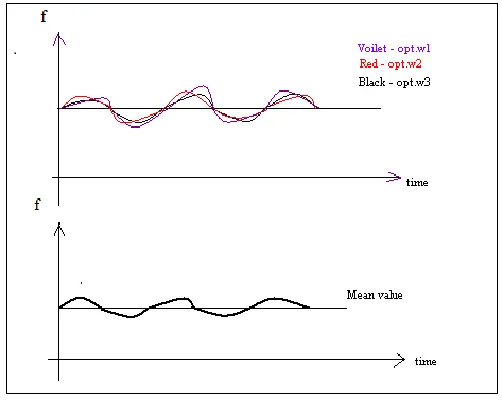
Fig 2:mean of three optimal error value
This
w
k
is used for iteration of calculate more precise
result in the measurement stage. Mean of Optimization of error gives better result even in high dense cluster to identify multi-targets.
The global error optimization in multi target tracking is com-puted by sequential mathematical procedure for optimality of error which is implemented in real time VHDL. Kalman filtering dynamic linear model provides the optimal error and for minimi-zation of error global optimality algorithm is proposed. The flow chart which is given below for complete algorithm is used to track multitarget accurately than the DAIRKF.
SIMULATION RESULTS
103
Int. J. of Engg. Sci. & Mgmt. (IJESM), Vol. 6, Issue 1: Jan-March: 2016, 99-105
Time k
Fig.3: Input for four targets
Time k
Fig.4. Filtered output for global
The simulation results in fig.5 shows the errors for all target tracking results, here it is clear that error of measurement in glob-al optimglob-al glob-algorithm for multi targets is very less than the mea-surement error of DAIRKF algorithm i.e. meamea-surement error is globally optimal.
Time k
Fig.5. DAIRKF and global errors are in parallel for four Targets
5.1 Time response of the different targets :-
Time k
104
Int. J. of Engg. Sci. & Mgmt. (IJESM), Vol. 6, Issue 1: Jan-March: 2016, 99-105
Time k
Fig.7: Time response for DAIRKF and global algorithm for tar-get1
Time k
Fig.8: Time response for DAIRKF and global algorithm for tar-get2
Time k
Fig.9: Time response for DAIRKF and global algorithm for tar-get3
The global optimal response related with time is shown
by the fig.6,7,8 & 9.it is clearly shown that global optimal gives fast response than DAIRKF.This algorithm reduces the response time approximate 20ns .
The first waveform is for target input DAIRKF second waveform is for DAIRKF and third waveform is for global op-timal condition. Fig 5 shows the error comparison of two algo-rithms the global optimal has constant minimal errors. The first waveform is not stable, showing error increasing order.
CONCLUSION AND FUTURE SCOPE
In this paper global optimization algorithm is used for multi target tracking. It is more power full than all other (PDA, JPDA and DAIRKF) algorithms, the simulation results show that the measurement error in DAIRKF algorithm is not optimum as we want for efficient tracking. In integrated random coefficient Kal-man filtering with global MSE optimization algorithm the error is optimized so that any target can be identified very clearly. The error in global optimality algorithm is minimized by selecting the appropriate KKT mean error point. The further improvement in measurement can be possible with finding the new KKT point for mean of global optimal error to fined absolute optimal error. This gives better results in any type of environment and clutter. From fig.6,7,8 & 9. we can say that proposed technique is more appro-priate.
REFERENCES
105
Int. J. of Engg. Sci. & Mgmt. (IJESM), Vol. 6, Issue 1: Jan-March: 2016, 99-105
[2] O. Frank, J. Nieto, J. Guivant, S.Sheding, “Mltiple Target Tracking using Sequential Monte Carlo Methods and Statis-tical Data Association”.
[3] M.I. Ribeiro, “Kalman and Extended Kalman Filters: Con-cept, Derivation and Properties”, feb. 2004
[4] G.Welch, G. Bishop, “An Introduction to the Kalman Filter”,Chapel Hill, NC 27599-3175.
[5] S. Mori, K.C. Chang, C.Y. Chong, “Performance Analysis of Optimal Data Association with Applications to Multiple Tar-get Tracking”, Advance Decision Systems, Mountain View, CA
[6] W.S. Chaer, R.H.Bishop, J.Ghos, “Hirarchical adaptive Kal-man filtering for interplanetary orbit determination”, IEEE Trans. Onaerospace and electronics systems, Vol. 34, No. 3, July 1998.
[7] H.Benoudnine, M.Keche,A.Ouamri, “New Efficient Schemes for Adaptive Selection of the Update Time in the IMMJPDAF”, IEEE Trans. On aerospace and electronics systems, Vol. 48, No.1, January 2012.
[8] V.Jeyakumar, G.Y.Li, “Strong Duality in Robust Semi Defi-nite Linear Programming under Data Uncertainty ”, March 1, 2012
[9] P.D.Hanlon, P.S.maybeck, “Characterization of Kalman Fil-ter Residuals in the Presence of Mismodelling”, IEEE Trans. Onaerospace and electronics systems, Vol. 36, No. 1, Janu-ary 2000.
[10]Y.Gao, W.J. Jia, X.J. Sun, J.L. Deng, “Self Tuning Multisen-sory Weighted Measurement Fusion Kalman Filter”, IEEE Trans. Onaerospace and electronics systems, Vol. 45, No. 1, January 2009.
[11]G.Li, “Global Quardratic Minimization Over Bivalent Constraints: Necessary and Sufficient Global Optimality Condition”.
[12]M.A. Goberna, V. Jayakumar, M.A. Lopez, “Robust Linear Semi Infinite Programming Duality under Uncertainty
[13] Zoran Salcic, Chung-Ruey Lee, “Scalar-Based Direct Algo-rithm Mapping FPLD Implementation of a Kalman Filter” [14]Pavlina Konstantinova, Alexander Udvarev, Tzvetan
Se-merdjiev “A Study of a Target Tracking Algorithm Using Global Nearest Neighbor Approach1”,2003.
[15] Singer, R. A. and Stein, J. J. “An optimal tracking filter for processing sensor data of imprecisely determined origin in surveillance systems”.
[16]Farina, A. and Studer, F. A “ Radar Data Processing I– Introduction and Tracking”. Hertfordshire, UK: Research Studies Press, 1985.
[17]Blackman, S. S. “Multiple-Target Tracking with Radar Ap-plication”. Norwood, MA: Artech House, 1986.
[18] Bar-Shalom, Y. and Tse, E. “Tracking in a cluttered envi-ronment with probabilistic data association”.