GSJ: Volume 7, Issue 10, October 2019, Online: ISSN 2320-9186
www.globalscientificjournal.com
CONTRIBUTION OF EDUCATIONAL RESOURCE CENTRES TO THE PROMOTION OF INCLUSIVE EDUCATION IN RWANDA
. A CASE STUDY OF KOMERA
EDUCATIONAL RESOURCE CENTRE RUTSIRO DISTRICT
Dr. BAIKIRIZE Moses (PhD) [email protected]
Head of Department and lecturer in faculty of Education and Business Studies at East African University Rwanda
ABSTRACT: inclusive education at all institutional level continues to be a major concern of the Ministry of Education in Rwanda. This is because the quality of education depends largely
on inclusive education at all level of education. It is on this basis of the above assumption that
this study was set out to investigate contribution of educational resource centres to the
promotion of inclusive education in Rwanda
.
To accomplish this task survey method was usedin conducting the study. The total of 158 respondents were used for data collection out of which
24 children with disability, 67 were children without disability, 45 respondents were teachers,
15 respondents were parents, 5 head teachers were used, 1 sector education officer was used
and 1 leader of Komera785 Centre was used in the study. Stratified random sampling technique
and purposive sampling were used to identify the study sample. Questionnaires and interview
guides were used for data collection. Documentation, Qualitative and quantitative techniques
were employed to analyze data. The study revealed the following challenges facing educational
resource centres: shortage of qualified staff personnel; inadequate educational materials;
insufficient physical facilities: lack of support from the community; negative attitude from the
community. In conclusion, urgent measures should be put in place so as to minimize the
hindrances.
1. GENERAL INTRODUCTION
The study presents the findings of research study conducted in Mushubati sector Rutsiro district southern province, Rwanda to investigate the contribution of educational resource centres to the promotion of inclusive education in Rwanda
.
In this paper the term inclusion education refers to when all students, regardless of any challenges they may have, are placed in age-appropriate general education classes that are in their own neighbourhood schools to receive high quality instruction, interventions, and supports that enable them to meet success in the core curriculum (Bui, Quirk, Almazan, & Valenti, 2010; Alquraini & Gut, 2012).According to UNESCO - Inclusive education - means that the school can provide a good education to all pupils/students irrespective of their varying abilities. All children will be treated with respect and ensured equal opportunities to learn together. Inclusive education is an on-going process. Teachers must work actively and deliberately to reach its goals”. The finding reveals that the educational centres and schools encountered many challenges in implementing inclusive education in schools.
2. Background to the Study
In the past, people were used seeing special schools here and there specifically for children with disabilities. Most of these centres were run by private people on the basis of charity. Besides, it was somehow a kind of isolation,
(
Ainscow and Dyson, 2006:9).Thus, there is need to change both mindset and practice for educators to go beyond charity and include learners with disabilities in mainstream schools as a right. This is the start of changing educational perspectives enabling them to be inclusive. In this regard, the former special centres are due to be transformed into resource centres in order to support the ordinary schools to become inclusive and accommodate needs of learners with disabilities,(David Mitchell,2010:23).
Itimplies a radical reform of the school in terms of educational policy and curricular development framework, which includes educational content, assessment, pedagogy, systemic grouping of pupils within institutional and curricular structures. It is based on a values system that welcomes and celebrates diversity arising from gender, nationality, race, language, social background, level of educational achievement, disability, etc. Inclusion also implies that all teachers are responsible for the education of all learners, (Eileen and Paul Raw 2010:12).
Through inclusive education, specialized centres are encouraged to send children with disabilities to the nearby mainstream schools, help in assessing their needs and pedagogically intervene with special techniques. In the resource centres, children are supported, looked after and oriented professionally. Special practices are supposed to be carried out to help learners gain functional and study skills, (Florian, L., 2007:87). This is, for instance, the role played by KOMERA, a resource centre in promoting inclusive education in Rutsiro District, particularly in Mushubati sector.
In Rwanda, special schools that have become resource centres for the purpose of inclusive education are mainly Jya Mu Bandi Mwana in Gasabo district, HRD in Muhanga district, KOMERA in Rutsiro district and CEFAPEK in Kamonyi district. These centres have supported a number of schools to promote inclusive education since 2010. Particularly, these schools have been identified in their respective districts,
very low. They visited different orphanages where they encountered a big number of severely traumatized children and youths, due to the 1994 genocide against Tutsi. They worked together and have built trust. This has laid the foundation of their cooperation in several projects namely Widows and Returnees from Congo Thereafter Komera Centre was born. Fr Murenzi has seen the work at the farm in Middenbeemster, initiated and managed by Mrs. Oosterom in Holland in which Children and youths were very much busy in Education and in various activities of that farm in question. After that, the concept of Komera was born in his mind. This dream became true afterward, (www.Komeracentre.com, retrieved on 12th January, 2019).
With the help of Wilde Ganzen construction started in January 2005 (project nr 2004.343). Later that year, children were selected and employees were trained, families were visited at home later that year. Silent work supports with technical advice, with a fixed amount per year for structural costs and with fundraising.
In this research, we assessed to what extent Komera resource centre has influenced success of inclusive education in Rutsiro district, particularly in Mushubati sector. In itself, Komera uses to be a specialized centre for mainly children with hearing impairment and intellectual difficulties. Its educators are mainly using special techniques, sign language and special pedagogy as well. In the last three years, however, they have started to support the nearby inclusive schools following and applying inclusive pedagogical principles. As this process leads to transformation the Rwandan education system, we have chosen this topic to find out how the special centre like KOMERA can serve as a resource centre and contribute to the promotion of inclusive education of children who are discriminated in most of schools.
3. Problem statement to the study
According to Handicap International (2012:5), “in Africa some culture do not accept children who are born with disabilities, they are immediately killed, it is a taboo as they said, if not killed and left alive, these children are not shown to guests, they are hidden, and some parent do not accept those children as their offspring, that is a direct discrimination towards these children who were not want to be born alike”.
A long the history, different people tried to solve this issues and such children were sent attending in special schools but, a small number of children were able to gain these opportunities due to high cost, hence those from poor families were not allowed. However, after studies, the history of disability was not ended, on the job market they are discriminated whatever their education skills. (Goodman., Libby, 1990:34).
To solve this pandemic discrimination, the government of Rwanda since 2007 in compliance with international programs such as MDGs and EFA made policies for emphasis the right of education for all children by the year 2015, irrespective to their capacities and abilities. In this regard, the Seven Year Term Presidential Manifesto (2010: 222) has adopted to promote inclusive education in Rwanda among other priorities.
Even though it was started, people do not understand it yet. People are still ignorant on it and are hesitating to send their children to schools due lacking knowledge, to the long history of education background and due to lacking skills for teachers in applying inclusive pedagogical principals. Promoting inclusive education is a fact that promotes rights for all children including those with disabilities and other special educational needs, (MINEDUC 2013:2).
However, in promoting inclusive education in Rwanda, some gaps were identified. Karangwa, E. (2008: 13) revealed the challenges that were found out in Rwanda. He said:” the system of learning and teaching, the curricula that are somehow rigid, teachers who are not resourced
enough, parents who do not change their mindset and lack of adapted tools and devices to be used
as supportive means for both children and teachers are still hindering factors for inclusive
education’’. The research tried to identify more factors and analyze other successes and gaps that were noted in promoting inclusive education in Rwanda.
4. Objectives of the study
This study was guided by the following objectives:
To analyze the contribution of educational resource centres in promoting inclusive education in Rwanda.
To identify challenges that face educational resource centres in promoting inclusive education in Rwanda.
To investigate how educational resource centres managed to overcome these challenges in promoting inclusive education in Rwanda.
5. Research question of the study
This study was guided by the following research questions:
What is the contribution of educational resource centres in promoting inclusive education in Rwanda?
What are the challenges that educational resource centres face in promoting inclusive education in Rwanda?
How do educational resource centres manage to overcome challenges in promoting inclusive education in Rwanda?
6. LITERATURE REVIEW
In Rwanda, those who need to be included are distinguished into different categories. These include educationally vulnerable children who are under 18 years old, children exposed to conditions that do not enable them to enjoy their fundamental rights like street children, those who head families, children whose mothers are prostitutes or are in prison, those with traumatic conditions, chronic diseases, (Hunbbel Meer, 2012:76).
infrastructure as well as curriculum content, methodology and provision of learning materials, (UNESCO, 2003:98).
Promoting inclusive education has been noted to be essential. Inclusive education gives a chance to learning for all children, irrespective to their needs. Nowadays, inclusive education for Children with Disabilities (CwDs) and other Special Education Needs (SEN) becomes an encouraged practice and a right as well. The United Nations and its agency, UNESCO, have played a significant role in promoting inclusive education worldwide. The most significant event took place in June 1994 when representatives of 92 governments and 25 international organizations met in Salamanca, Spain (UNESCO, 1994:13).
The resulting agreement, known as the Salamanca Statement, demonstrated an international commitment to inclusive education. It included these agreements:
Those with special educational needs must have access to regular schools which should accommodate them within a child-centred pedagogy capable of meeting these needs;
Regular schools with this inclusive orientation are the most effective means of combating discriminatory attitudes, creating welcoming communities, building an inclusive society and achieving an education for all; moreover, they provide an effective education to the majority of children and improve the efficiency and ultimately the cost-effectiveness of the entire education system.
The Statement called upon all governments to „adopt as a matter of law or policy the principle of inclusive education, enrolling all children in regular schools, unless there are compelling reasons for doing otherwise‟, (UNESCO, 1994:43).
Inclusion should, then, be regarded as a long-lasting process which requires time, effort, competence and strong conviction by all those involved in students‟ education, first and foremost, by teachers.
Inclusive Education ; All students, irrespective of their sex, race, color, ethnic or social origin, genetic features, language, religion or belief, political or any other opinion, membership of a national minority, property, birth, disability have the right to have equal opportunity in education (Browder, & Cooper-Duffy, 2003), and to be considered as being an integral part of the learning community. Recognition of this right has recently given rise to the concept of “inclusion”, which has gradually substituted that of “integration”. Throughout the 1980s, the concept of integration was, in fact, based on the distinction between “normal” students and those with special needs (thus requiring specific educational interventions); the idea of integration suggests that the school stays the same but takes steps to accept also those students who present a variety of problems or difficulties (Northway, 1997).
Inclusion is actually a much stronger concept which refers to “the right to belong to the mainstream”; leaving behind the idea that only few learners have “special needs”, the social model of inclusion rather suggests that all students as individual learners present their own peculiar characteristics and have their own specific educational needs.
According to the guide (UNESCO, 2009: 11), the resource centre is fulfilling the following duties: provides support and parents of Children with disabilities and those with other learning
needs to accommodate their learners;
advocates for the provision of inclusive education services to children with disabilities and other Special Educational Needs;
conducts workshops for teachers to acquire knowledge in special and inclusive education; develops and implements educational programs for children with disabilities and other
special educational needs;
supports teachers to make modifications to teaching plans and programs;
Supports inclusive schools to make referrals in case there is need of appropriate interventions and services.
Expense: Funding is a major constraint to the practice of inclusion education. Teaching learners with disabilities in general education classrooms takes specialists and additional staff to support learners‟ needs. Coordinating services and offering individual supports to children requires additional money that many school do not have, particularly in a tight economy. Inadequate funding can hinder ongoing professional development that keeps both specialists and classroom teachers updated on the best practices of inclusion.
Lack of information: Some of the greatest barriers associated with inclusion in education are negative attitudes. As with society in general, these attitudes and stereotypes are often caused by a lack of knowledge and understanding. The attitudes and abilities of general education teachers and para- educators in particular can be major limitations in inclusive education. Training teachers and para- educators to understand and work with children with disabilities is often inadequate, or it may be fragmented and uncoordinated. If educators have negative attitudes toward learners with special needs or have low expectations of them, children will unlikely receive a satisfactory, inclusive education.
Accessibility: Obviously, a student with a disability cannot learn in an inclusive classroom if he cannot enter the room, let alone the school building. Some schools are still inaccessible to learners in wheelchairs or to those other mobility aides and need elevators, ramps, paved pathways and lifts to get in and around buildings. Accessibility can go beyond passageways, stairs, and ramps to recreational areas, paved pathways, and door handles. A student with cerebral palsy, for instance, may not have the ability to grasp and turn a traditional doorknob. Classrooms must be able to accommodate a student‟s assistive technology devices, as well as other furniture to meet individual needs.
Educational modifications: Just as the environment must be accessible to learners with disabilities, the curriculum must facilitate inclusive education, too. General educators must be willing to work with inclusion specialists to make modifications and accommodations in both teaching methods and classroom and homework assignments. Teachers should be flexible in how learners learn and demonstrate knowledge and understanding. Written work, for example, should be limited if a student cannot write and can accomplish the same or similar learning objective through a different method.
communication and coordinated planning between general education teachers and special education staff are essential for inclusion to work. Time is needed for teachers and specialists to meet and create well-constructed plans to identify and implement modifications to the accommodations, and specific goals for individual learners. Collaboration must also exist among teachers, staff, and parents to meet a student‟s needs and facilitate learning at home.
7. RESEARCH METHODOLOGY
The study employed survey design. Mouley (1983) and Kerlinger (1983) observes that survey design is used to collect data from a enormous population at a particular point in time with the intention of describing the nature of current existing situation in order to plan for the future. The survey design, despite being used for both exploratory and preliminary studies allows the researcher to gather information, summarize, and interpret the information for the purpose of clarification (Orodho 2004). Survey design was adopted and used in the study because if enabled the researcher to gather information from the respondents on the contribution of educational resource centres to the promotion of inclusive education in Rwanda.
8. Research design
Yates, D. (2008) define research design as all the methods and procedures that a researcher uses in studying a particular problem. The research design helps the researcher to collect, analyze and interpret the collected data. Prior to obtain information about this paper, through a descriptive design, an investigation was done on field.
Through this study, the researcher examined the relationship that exist between of educational resource centres in Mushubati sector and the promotion of inclusive education, investigated the learning outcomes of the children with disabilities and Special Education Needs in inclusive primary schools, identified strengths and barriers and sought for possible solutions to overcome the identified gaps.
10. Sampling Procedure and Sample Size
were selected from five schools that undergo inclusive education what are; Sure, Mushubati, Kigwa, bumba, and Saint Clement. It was considered adequate in providing results since all categories of schools were included in the study (Kothai, 2003; Kerlinger 1986). Simple random sampling was used to select school from the specific category. Purposive sampling was used to select Mushubati sector Rutsiro district, western province of Rwanda.
As it is not possible to conduct a research on the whole population, the study used Simple random Sampling technique to determine the sample size to be used in the study as follows; 24 learners with disabilities, 67 learners without disability, 45 teachers, 5 head teachers, 15 parents, 1 Sector Education Officer and 1 responsible of Komera Centre, and the total number of respondents was equal to 158 respondents.
11. Data Analysis
Data analysis involved both qualitative and quantitative procedures. In qualitative analysis, information collected was transcribed into written texts by merging the notes taken and then organized into various themes. Quantitative data was grouped according to the research questions and analyzed through percentages and frequencies, and presented in tables.
12. RESULTS AND DISCUSSION
The results of the study were presented as follows:
The contribution of educational resource centre in promoting inclusive education
The following section presents information got during the research period from the Education officer in charge of education in Mushubati sector, the responsible of KOMERA resource centre and head teachers and parents. All of them agreed that, they know what inclusive education is, and head teacher agreed that this form of education is now used in their school under their responsibility since 2010.
Asked about the role that Komera is playing in Mushubati sector, Father Eugene MURENZI, the in charge responsible person of the centre, said : “As a resource centre, we are committed in promoting inclusive education as a way to give chance to all learners, including those with disabilities and other with Special Educational Needs (SNE) and provide the necessary technical support to the nearby inclusive schools. Not only children will benefit from our services but also the entire community as our main partner whom we need to develop through outreach and internal programs so far initiated”. This interview provided information on the important role played by Komera as a resource centre.
The information on the role played by Komera in supporting inclusive schools in Mushubati sector was aknowledged by the educational authorties. This was reinforced by the Head teacher M.J who said : “Komera is supporting us a lot in promoting inclusive education particluarly in providing technical support in relation to pedagogical tips that meet learners‟ diverse needs” . It is as well clear that inclusive schools have received technical suppport from Komera resource centre in the last three years.
The inclusive education has achieved a considerable step in changing mindset of people in this sector regarding children with disability, they confirmed that having disabilities it doesn‟t mean to be unable to do other things. Parents who bear disable children are not ashemed of that, now their children attain schools and they hope that in future their offspring will never on roads for asking means of survival, they are studying how they will take themselves their responsibilty even their disability situation.
In this research, the researcher have assessed whether parents knew what inclusive education was. Out of 15 parents, only 12 had clear understanding of what inclusive education was. 2 of them were defining it as an education system for all and one of them considering it as an education of learners with disabilities or those who cannot succeed as other children can do.
In the present research, 15 out of 15 parents agreed that Komera has played a big role in promoting inclusive education. They all said that Komera came to mobilize them and continued to sensitize them on inclusive education. The parent M.V said: „’Mbere numvaga ko umwana wanjye atakwiga, kubera ukuntu yari ameze, ariko aho Komera imbwiriye ko bishoboka, namujyanyeyo
problem). For parents, Komera has played a big role in sensitization and mobilization of parents who had children with impairments.
After collecting and interpretation data from interviewees, the researcher reached the second step of interpretation of data from teachers, children with disabilities and those without disabilities. The researcher would like to assess the degree of how these respondents knew inclusive education and if it is practical in schools in which they are and if it is important for them.
Table 1: About knowing what inclusive education is
Question Answer Respondents Percentage
Do you know what inclusive education is?
Yes 146 92.4
No 02 7.6
Total 158 100
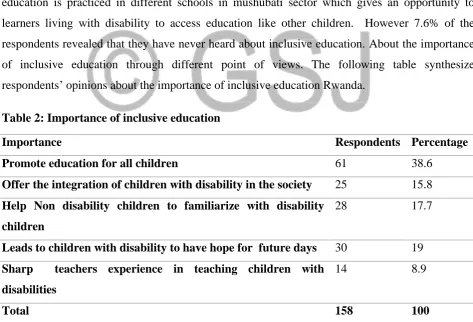
According to the study, 92.4% of agreed that they know what inclusive education is, because this education is practiced in different schools in mushubati sector which gives an opportunity to learners living with disability to access education like other children. However 7.6% of the respondents revealed that they have never heard about inclusive education. About the importance of inclusive education through different point of views. The following table synthesize respondents‟ opinions about the importance of inclusive education Rwanda.
Table 2: Importance of inclusive education
Importance Respondents Percentage
Promote education for all children 61 38.6
Offer the integration of children with disability in the society 25 15.8 Help Non disability children to familiarize with disability
children
28 17.7
Leads to children with disability to have hope for future days 30 19 Sharp teachers experience in teaching children with
disabilities
14 8.9
Total 158 100
19% said that, this education leads to disability children to have hope for the future days, and finally 8.9% agreed that, this education helps teachers to acquire experience in teaching children with disabilities. Basing on these affirmations, the researcher confirmed that, inclusive education is very importance within Mushubati sector and the whole country at large.
Table 3: Contribution of Komera in promoting inclusive education in Mushubati sector
Contribution Respondents Percentage
Provision of support to parents of children with disabilities and those with special education needs in relation to the ways of accommodating learners’ needs.
32 20
Advocacy in the provision of educational services to children with disabilities and other Special Educational Needs and availability of laws by local authorities and international NGOs.
29 18
Conducting workshops for building teachers’ capacities to
acquire knowledge in special and inclusive education.
41 26
Development and implementation of educational programs for
children with disabilities and other special educational needs
24 15
Provision of support to teachers to make modifications in teaching plans and programs.
17 11
Early intervention services 15 10
Total 158 100
The study revealed that 20% provide provision of support to parents of children with disabilities and those with special education needs in relation to the ways of accommodating learners‟ needs, 18% of respondents agreed that, it is an advocacy in the provision of educational services to children with disabilities and other Special Educational Needs and availability of laws by local authorities and international NGOs, 26% of respondents said that it conduct workshops for building teachers‟ capacities to acquire knowledge in special and inclusive education, 15% agreed that, this centre, develop and implement educational programs for children with disabilities and other special educational needs, 26% as the majority confirmed that, it provides support to teachers to make modifications in teaching plans and programs, and last, 8% confirmed that, this centre provides early intervention services to children with disabilities.
In this study, the researcher wanted to know whether this organization has achieved its objectives, according to our respondents confirmation they said that, concretely, Komera resource centre mobilized parents about disability and its creation process. It mobilized parents to prevent disability in case mothers were pregnant, encouraged them to deliver in modern hospitals/ centres and motivated those who had young children with impairment to be early diagnosed and referred to hospitals. In this regard, those who had epilepsy were referred to CARAES NDERA hospital and those with physical deformities referred to GAHINI, HVP GATAGARA and RIRIMA rehabilitation centres.
Table 4.5: Opinions of respondents about the achievement of Komera
Question Answer Respondents Percentages
Does Komera resource centre achieve its objectives?
Yes 158 100
No 00 00
Total 158 100
This indicate the agreement of teachers who are involved in inclusive education of schools who undergone this study, where 100% agreed that, basing on what this organization did, it has achieved its objectives. Basing on this, the researcher confirmed that, this centre still to be excellent in Mushubati sector in promoting inclusive education.
Table 4.11: The role played by KOMERA in promoting inclusive education in Mushubati sector
Opinions Respondents Percentages
Provision of material support to children with disabilities
16 24
Visit us to make sensitization on inclusive education 10 15 Teaching sign language to children with hearing
impairment
14 21
Give advice to children with disabilities 14 21
Training teachers 13 19
Total 158 100
to raise awareness on inclusive education. Of the total number, 21% have seen educators from KOMERA teaching Sign Language children who are hearing impaired living in the centre, 21% affirmed that KOMERA comes in Kigwa PS and Mushubati GS to give them advice and evaluate their problems. 13% have confirmed that they have seen KOMERA educators training indoor training in their schools.
Challenges that faced be educational resource centres in promoting inclusive education According to challenges which inclusive education face, our interviewees said that the major barrier are; infrastructural barriers, lack of information and skills of teachers, economic limitations, lack of synergy among stakeholders and teachings modifications and adjustments. For to solve these challenges, interviewees suggested that, supports from the government should be increased in providing training to teachers, materials, increase infrastructures and finance towards this kind of education.
While conducting this research, we have assessed challenges that parents have faced in promoting inclusive education in Mushubati sector. More particularly, 8 out 15 parents have said that they faced challenges related to poverty in that they failed to afford educational materials and uniforms for their children. Apart from being unable to afford the necessary requirements, 5 parents who had children with hearing impairment expressed to have barriers to communicate with them. They needed to learn how to communicate.
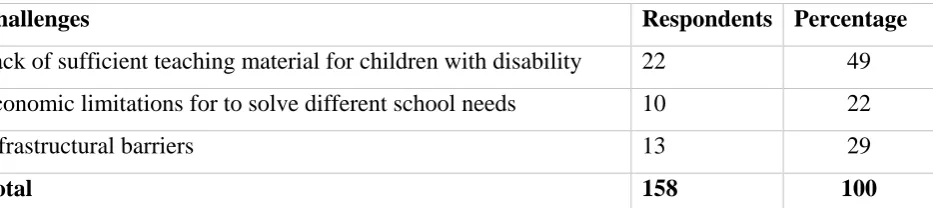
As our interviewees argued, the challenges remain the same, according to the teachers‟ respondent point of view, the following table indicates them in brief.
Table 4.12 Challenges faced in inclusive education in Mushubati sector
Challenges Respondents Percentage
Lack of sufficient teaching material for children with disability 22 49 Economic limitations for to solve different school needs 10 22
Infrastructural barriers 13 29
Total 158 100
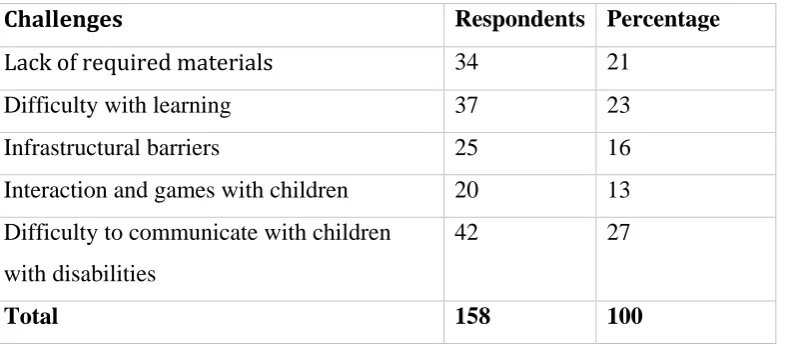
Table 4.13: Challenges faced by children with disabilities in learning
Challenges Respondents Percentage
Lack of required materials 34 21
Difficulty with learning 37 23
Infrastructural barriers 25 16
Interaction and games with children 20 13 Difficulty to communicate with children
with disabilities
42 27
Total 158 100
During this research, we have identified challenges that children with disabilities face in inclusive education. 21% affirmed that they lack educational materials adapted for their needs because the majority come from poor families. 23% face difficulty in learning all subjects, 16% face problems related to inaccessible infrastructures and 13% deny rejection and isolation showing that they manage to interact and play with their peers and 27% revealed that most learners living with disability face difficulties in communication and this this leads to difficulty in learning, interaction barrier and hence learning becomes a challenge since most of children have to first learn sign language to facilitate them in learning. Exceptionally, they suggested that the government should provide adequate educational materials and support.
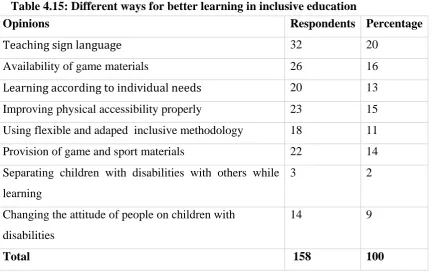
Different ways used by Educational resource centres to overcome challenges in promoting inclusive education in Rwanda.
All the interviewees suggested that children with disabilities learning in inclusive education needed to be provided with assistive devices such, wheel chairs, hearing aids, clutches, and others. All of them encouraged KOMERA resource centre and its different partners organization that provides supports to these children and made a call to the government to continue increasing supports towards these inclusive schools in adapting inclusive curriculum and teachers‟ training. In an actual sense, parents welcome inclusive education but suggest that they could be assisted to help their children learn effectively.
Table 4.15: Different ways for better learning in inclusive education
Opinions Respondents Percentage
Teaching sign language 32 20
Availability of game materials 26 16
Learning according to individual needs 20 13
Improving physical accessibility properly 23 15
Using flexible and adaped inclusive methodology 18 11
Provision of game and sport materials 22 14
Separating children with disabilities with others while learning
3 2
Changing the attitude of people on children with disabilities
14 9
Total 158 100
towards people living with disabilities such that they can take them as other people by giving the love and affection and will help the to know that they are considered like other people and value as human being.
13. Conclusion
This work was presented in five chapters. Chapter one offered a general introduction overview of the research background and presented a whole organizational layout. Chapter two presented the literature review and clarification of the concepts related to the topic of research entitled „‟ The contribution of resource centre “Komera” in promoting inclusive education in Mushubati sector. Chapter three presented the methodology used in conducting the research, Chapter four presented the research findings and chapter five presented the conclusion and recommendations.
In general, the research has provided data and information collected on the ground through administering the questionnaire and interview guide. Basically, the research was on assessing the role played by KOMERA in promoting inclusive education in Mushubati sector, how inclusive education contributed to improving learning outcomes for children with disabilities and other SEN, the challenges that were faced throughout the practice of inclusive education and the strategic ways for better promoting inclusive education. Productively, the research generated data and information that enabled us to interpret the accuracy and relevancy of the topic.
As a result, it was well revealed by the research that inclusive education is actively practiced in Mushubati sector and that KOMERA has played an important role in the last three years. As a matter of facts, KOMERA has helped the nearby schools to mobilize the community, to enroll CwDs and those with Special Needs Education, to actively disseminate the laws and regulations related to the protection of persons with disabilities, to train teachers, to enable inclusive schools adopt inclusive pedagogical practices and promote services of early intervention in MUSHUBATI sector.
For preparing the future of inclusive education in MUSHUBATTI sector, the research also revealed some major challenges which are to be overcome. These included infrastructural barriers, the lack of information and skills for teachers, the economic limitations for parents to afford the learners‟ requirements, the poor teaching modifications and adjustments, the absence of a national curriculum for special education and the lack of synergy among stakeholders.
Throughout this study, we have identified major challenges that KOMERA and partnering inclusive schools have faced in promoting inclusive education in Mushubati sector and, all along sorted out successes and some lessons that we need to strengthen in the further practice of inclusive education. With the successes noted, we need to help KOMERA and the five sampled schools to keep up with promoting inclusive education. This is the reason why we are committed to providing recommendations that could enable the Government of Rwanda, future researchers, KOMERA centre, educationalists, head teachers, teachers, parents, children with and without disabilities to meet principles and guidelines of inclusive education.
The Government of Rwanda should provide training opportunities for teachers in to be able to accommodate all learners‟ needs and promote education for all.
The Government of Rwanda develop a national curriculum for special education to remove disparities that are observed in the privately initiated curricula and, subsequently, review the existing curricula to incorporate principles in adjusting the school environment to make it accessible
Ensure that inclusive pedagogical principles are integrated into the everyday school pedagogical practices particularly in lesson planning, delivery and evaluation.
The Government of Rwanda with the ministry of education should change mindset and accept of education as a right to children with disabilities, not a favor. This is in compliance with the international policies and conventions such as EFA, Salamanca statement and MDGs which stipulate the rights to education for all children irrespective to their limitations; Focus on rights to education, concept of disability and importance of inclusive education;
Educational resource centres should emphasis on the sensitization and mobilization of the local authorities, school leaders, parents and children to make them get awareness on special and inclusive education as it was seen that they are not skilled in the domain.
The Government of Rwanda under the ministry of education Continue to advocate for early intervention services in a bid to prevent the occurrence of disability in the area and assist early those who were in a situation of rehabilitation and in need of life skills.
The Government of Rwanda under the ministry of education should Monitor the application of inclusive pedagogical principles for an effective practice and set strategies of promoting Special Needs Education/Inclusive Education in their respective areas as well as planning for it in their annual, semestrial and termly actions.
Parents Should understand that all learners are equal and have right to education, get involved in their children‟s learning at a regular pace and provide their children the necessary requirements to enable them learning without difficulties; and this will help children to understand the importance of education as a right for all, respect each other, learn to socialize and participate actively to their learning as key players;
Parents Mobilize ignorant peers to send unschooled CwDs and other special needs education (SEN) to school so as to enable them lead an independent life in the future.
Should strengthen their capacities to better apply principles of special and inclusive education and adapt teaching methods to meet individual learning needs;
Reinforce synergy and linkage with other stakeholders involved in inclusive education to provide joint support in children‟s learning.
REFERENCES
1. Acedo, and Opertti, (2008), Defining an Inclusive Education Agenda: Reflections around the 48 th Session of the International Conference on Education. Geneva: UNESCO-IBE
2. Ainscow and Dyson,(2006) Improving Schools, Developing Inclusion. London: Routledge
3. Blaster (2001), Methodology and philosophy of education, London
4. David Mitchell (2010), Education that fits: Review of international trends in the education of learners with special educational needs, University of Canterbury.
5. Eileen, W. and Paul O‟ Raw (2010), Literature review of the Principles and Practices relating to inclusive education for Children with Special Educational Needs, ICEF.
6. Florian, L. (2007). Reimagining special education. The Sage Handbook of Special Education. London:
Sage Publications.
7. Gillies, Robyn M. and Carrington, Suzanne (2004), Inclusion: Culture, Policy and
8. Goodman, Libby (1990). Time and learning in the special education classroom. Albany, State
University of New York Press.
9. Hunbbel Meer (2012). Education and Science: What is education? The concept of
education. AIU press.
10.Karangwa, E. (2008). Introduction to special education in Rwanda. Kigali.
11. Lipsky, D. K., & Gartner, A. (1996), Inclusion, school restructuring, and the remaking of American society, Harvard Educational Review, Volume 66.
12. OECD (2008) Ten steps to equity in education. Policy Brief, January 2008
13. OECD (2010) Educating Teachers for Diversity: Meeting the Challenge. OECD/CERI
14. Opertti, R., Duncombe, L. (2010) Inclusive education and inclusive curriculum: Moving the EFA agenda forward [forthcoming]
15. Schofield, K. (1999). The Purposes of Education, Queensland State Education
16. Seidman, I. (1998). Interviewing as qualitative research: A guide for researchers in education and the social sciences. New York, NY: Teachers College Press, p.12.
17. SPSS Guide,(2009), Statistical research guide. UK
18. Tapasak, Renee, (1999). “Evaluation of a First-Year Inclusion Program: Student Perceptions and Classroom Performance.” Remedial and Special Education. Indira Gandhi University Press.
19. Yates, D. (2008): Some Theory of Sampling. Cambridge: Cambridge University Press.
20. Hampshire Country Council (2013). Who are children with special educational needs? A guide for
parents and carers. Published by the Children’s Service Department.
21. Handicap International (2012). 3rd Annual report for European Union, Kigali.
22. Handicap International (2013). A resource centre guide, Kigali.
23. MINEDUC. Education Sector Strategic Plan (ESSP). 2013
24. UNESCO (2009), Teaching Children with Disabilities in Inclusive Settings, Bangkok.
APPENDIX I: Map of Rutsiro District BONEZA MUSASA KIGEYO MUKURA KIVUMU NYABIRASI GIHANGO MUSHUBATI MUSHONYI RUHANGO RUSEBEYA MURUNDA MANIHIRA BONEZA MUSASA KIGEYO MUKURA KIVUMU NYABIRASI GIHANGO MUSHUBATI MUSHONYI RUHANGO RUSEBEYA MURUNDA MANIHIRA Secteur de BONEZA GIHANGO KIGEYO KIVUMU MANIHIRA MUKURA MURUNDA MUSASA MUSHONYI MUSHUBATI NYABIRASI RUHANGO RUSEBEYA Lac Kivu Limite de secteur Limite de distict
S N
E W
CARTE ADMINISTRATIVE DU DISTRICTDE RUTSIRO
3 0 3 6 Kilometers