© Global Society of Scientific Research and Researchers
http://ijcjournal.org/
Using Computing Containers and Continuous Integration
to Improve Numerical Research Reproducibility
Alexey Vasyukov
a*, Igor Petrov
ba,b
Moscow Institute of Physics and Technology, Institutsky lane 9, Dolgoprudny, 141701, Russia
a
Email: [email protected]
bEmail: [email protected]
Abstract
Cloud computing has opened new options of collaboration between research teams in the field of high
performance computing and numerical research. Running computational workloads in virtual machines became
common in recent years. However, the use of computing containers provides many additional advantages
besides just proving new possible runtime choice. One of the most important (and often underappreciated) is an
option to improve the reproducibility of research results based on complex mathematical modeling. This paper
provides an overview of architecture based on computing containers and continuous integration tools we used to
achieve reproducible numerical results.
Keywords: linux containers; docker; cloud computing; continuous integration; research reproducibility.
1.Computing containers
Historically cloud computing was associated with virtual machines. So, in the field of high performance
computing initial move towards cloud was also based on virtual computing environments. KVM and OpenStack
1.1. Constraints and limitations
Computing containers have some limitations, and it’s worth providing a brief summary here. The major
constraints related to numerical research are limited availability on Windows and restrictions related to
distributed applications performance. The first limitation is that containers were developed initially as a part of
Linux ecosystem, and containers support on Windows is still under active developments. It means, the approach
discussed in this paper may be hard to implement for certain applications that are tightly bound to Windows
ecosystem. However, recent versions of Windows Servers support Docker containers, so we expect that the
situation will become much better in the nearest future. The second limitation is related to distributed
applications that rely on specialized hardware – high speed network, GPU accelerators and so on. Using such
hardware in containers is possible, but requires specific tuning for each new environment.
1.2. Achieving reproducibility of numerical results
However, containers also provide a lot of new promising features for the field of numerical research. Several
published articles have already mentioned that containers can contribute to the major goal of achieving complete
reproducibility of scientific results in this field [4, 5].
One of the traditional difficulties when using multiple complex computing packages to solve a coupled problem
involving several areas of physics is their heterogeneous and often conflicting requirements for the assembly
tools and the computing environment. As a result, installation of almost any complex software package on a
cluster is a cumbersome and error prone procedure. It is necessary to pre-compile a large number of libraries of
specific versions from the source code. Authors of this paper had an experience of dealing with the situation
when, in order to install the application, it was first required to compile a new version of the compiler from the
sources using the older compiler on the cluster.
Similar cases cause a lot of problems with research reproducibility – formally the same sources of numerical
software built and run in different computing environments may show significantly different results when
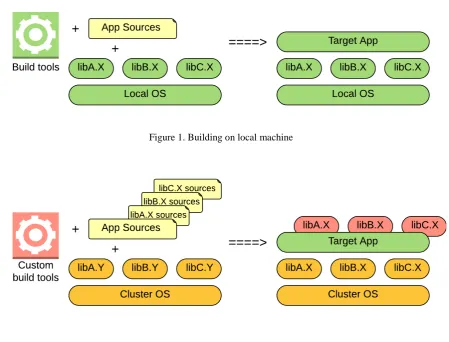
solving the same numerical problems. So, after successful build and test of complete software stack on local
machine (see Figure 1) it is quite a complex and deterministic task to move this stack to high performance
computing cluster. Building and running on a new system involves different assembly tools and different
versions of system libraries (Figure 2). So, there is no certainty that the resulted binary really matches tested
Figure 1. Building on local machine
Figure 2: Building on remote cluster
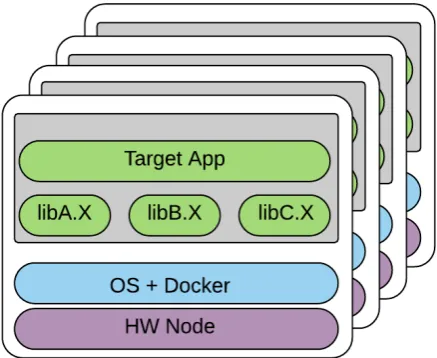
The authors adopted Docker containers to solve this problem. The numerical applications were compiled from
the sources and linked with system libraries in the most convenient environment (CentOS 7, Fedora 22, Ubuntu
15.10 - depending on the application). At the next step a computational Docker container was created with the
application binary and the software environment required for its operation, including specific versions of system
libraries and necessary environment variables (Figure 3). So, the container becomes a reference ready-to-use
Without the use of containers, the build and run procedures for the cluster would be a nontrivial task that
requires a high level system programmer. Thus, the use of containers made it possible to separate the
environments for the assembly and execution of applications and to provide the user with the opportunity to
quickly prepare and launch their own calculation modules without requiring either system programmer skills or
cluster administrator access rights.
Figure 4: Running container on a remote cluster
1.3. Deployment options
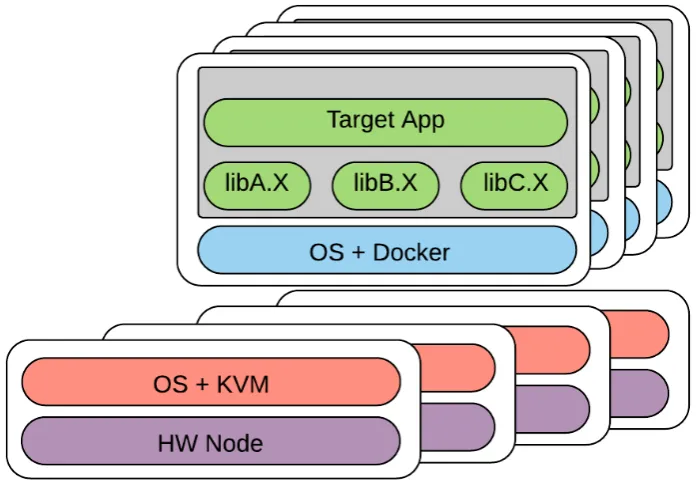
We used two deployment options during our research – bare metal deployment (Figure 5) and KVM deployment
(Figure 6).
In our previous work [6] we tested the performance of computational packages when working in containers. The
main tests were performed with OpenFOAM and GCM-3D solvers. Due to the architecture of container
virtualization there was no RAM overhead compared with bare metal deployment. Measurements of CPU time
for solving model problems also showed quite a low level of overhead, in all measurements the performance
degradation relative to the launch on physical equipment did not exceed 1-2%. So, running containers on bare
metal looks very promising, and the architecture shown on Figure 5 looks like a natural choice.
However, running containers requires some level of support from operating system side. It is not that complex,
but existing large scale computing clusters mostly were not build for containers. On the other hand, as
mentioned above, many clusters have already adopted KVM based virtualization. So, using the architecture
shown on Figure 6 may be a good compromise when running on such systems.
Figure 6: KVM deployment
2.Continuous integration
Containers may contribute the most to the reproducibility of numerical research when they are integrated
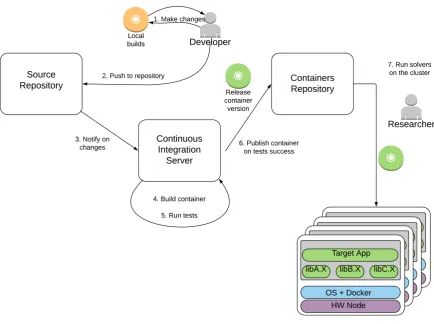
directly into the development of numerical solvers. This approach was tested with GCM-3D calculation module.
The source texts of GCM-3D are stored in Github repository. The repository infrastructure was configured in
such a way that when the developer makes a change to the source code, the binary modules are automatically
build and the container containing GCM-3D and the required software environment is updated. This container is
with different input parameters, so complete test package run may take several hours or even few days. The use
of cloud services, such as Travis CI, makes it much easier to achieve continuous integration by offloading basic
test runs to the cloud
Figure 7: GCM-3D workflow
3.Conclusion
Using computing containers for scientific applications provides a lot of new tools to achieve research
reproducibility. If containers are integrated into the development workflow of the solver, then the result of the
build is not just a binary, but a binary with the complete computing environment (system libraries of certain
versions, environment variables). This container can be transferred to any system and provide the same
calculation results.
4.Recommendations
Taking into account all the benefits that computing containers provide for the reproducibility of the numerical
research, it’s worth recommending publishing computing container images as a part of research supplementary
materials. This will allow independent researchers from other laboratories to reproduce author’s results reliable,
Acknowledgments
The research was supported by Russian Foundation for Basic Research grant 15-29-07096.
References
[1]. U. Markwardt. “Running Virtual Machines in a Slurm Batch System”, presented at Slurm User Group
Meeting, Washington DC, USA, 2015. [On-line]. Available:
http://slurm.schedmd.com/SLUG15/SlurmVM.pdf [June 01, 2018].
[2]. W. Felter, A. Ferreira, R. Rajamony, J. Rubio. "IBM Research Report. Performance Comparison of
Virtual Machines and Linux Containers." [On-line]. Available:
http://domino.research.ibm.com/library/cyberdig.nsf/papers/0929052195DD819C85257D2300681E7B
/$File/rc25482.pdf [June 01, 2018].
[3]. C. Kniep. "Containerization of High Performance Compute Workloads using Docker." [On-line].
Available: http://doc.qnib.org/2014-11-05_Whitepaper_Docker-MPI-workload.pdf [June 01, 2018].
[4] J. Cito, V. Ferme, H.C. Gall. "Using Docker Containers to Improve Reproducibility in Software and
Web Engineering Research." in Web Engineering. ICWE 2016. Lecture Notes in Computer Science,
vol. 9671. A. Bozzon, P. Cudre-Maroux, C. Pautasso (eds). Springer, 2016.
[5] L.H. Hung, D. Kristiyanto, S.B. Lee, K.Y. Yeung. "GUIdock: Using Docker containers with a common
graphics user interface to address the reproducibility of research." PLoS One, 11(4):e0152686, 2016.
[6] A. Ermakov, A. Vasyukov “Testing Docker Performance for HPC Applications” IOSR Journal of