A SAMOTHRACIAN ENIGMA
(PLATE 95)
SUPPLEMENTARY
excavation in the Sanctuary of the Great Gods in Samo-thrace -has revealed an unusual and puzzling structure which may provide a suitable offering to Professor Broneer, whose success in solving such problems is well known.'
The upper portion of a strong retaining wall has long been visible, supporting the largely artificial terrace east of the great Stoa with which the Sanctuary was embellished in the first half of the third century B.C. (Fig. 1, no. 9). But the succes- sive effects of violent earthquakes, post-medieval construction, and unchecked vege- tation disguised the magnitude of the wall and the fact that it served not only to retain the upper part of the ridge but equally to delimit a broad area at its base, which, to judge from the long and complex history of structures built there, played an im- portant part in the function of the Sanctuary for nearly a millenium, beginning as early as the fourth century B.C. (P1. 95, a, b).2
The retaining wall is, itself, an impressive piece of masonry, which, to judge from the scanty pottery in the filling of its foundation-trench, was built somewhat later than the Stoa, toward the end of the third century or early in the second cen- tury B.C.
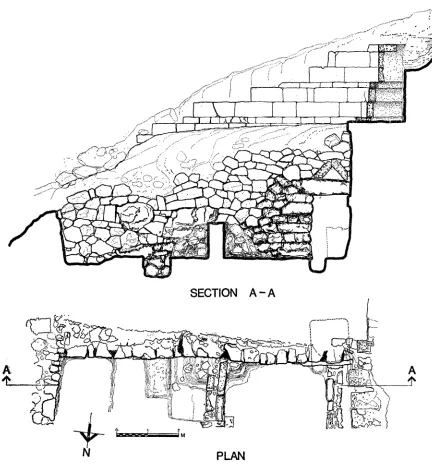
At the north, the wall terminates against natural soil, where the hillside emerges in an eastward salient, and an oblique concrete retaining wall of the Roman era now marks the line of a Hellenistic predecessor. At the south, the hillside again emerges, but more sharply, to form a high intermediate terrace upon which stood a square roomn of yet undetermined function (Fig. 1, no. 10). The retaining wall turned eastward to support this terrace, and here it consisted entirely of fieldstone and occasional sandstone fragments set in a polygonal style and adjusted to protruding native boulders.3
1 The excavation of this area is noted in A.J.A., LXXVII, 1973, p. 221.
2 The complex, Fig. 1, no. 7, consists of three rooms, probably for ritual dining. Originally
laid out in the second half of the fourth century B.C., it was reconstructed at least twice during
Roman times. Major reconstruction in the late third century and early fourth century after Christ is numismatically dated at the south of the area, and some work appears to be later.
3 The styles of masonry discouraged firm bonding between the main wall and its eastward
extension, but there is no physical evidence that they belong to separate projects, and the sherds from the original filling of the extension, though too few to give a precise date, confirm that the two are at least very nearly contemporary. The extension was radically rebuilt in later Roman times, and only the portion around the doorway (shown in darker lines in Fig. 2) retains its Hellenistic form unchanged.
American School of Classical Studies at Athens is collaborating with JSTOR to digitize, preserve, and extend access to
Hesperia
4~~~~~~~~
2/2
6 ~ ~ ~ ~ ~ ~ ~ ~ ~ ~ 1
/3 11
_ _ _ _ /~~~~~~~~~~~~~~~~~~~ 5 1 5 20 2 l
456 JAMES R. McCREDIE
SECTION A-A
At ~~~~~~~~~~~~A
N~~~~PA
The exceptional feature of this wall is an opening at its western end (Fig. -2; P1. 95, c, d). Six courses of fieldstone support the eastern end of a huge fieldstone lintel, whose western end is set in the main retaining wall. Above the lintel two porous sandstone blocks are set to form an empty "relieving triangle." The opening is otherwise unadorned. Within, its two jambs continue some two meters, where they enid against stony natural soil, and a few remaining blocks show that the opening was there terminated by a wall. The floor was of earth, and the debris with which the opening had been filled in the destruction of this area was devoid of suggestive material.
Unaided, then, either by clear topographical associations or by revealing finds, the architectural form of this enigmatic Hellenistic construction provides the only clue to its interpretation. To my knowledge, that form is without exact contemporary parallel.
As in a number of Samothracian structures of the Hellenistic period, massive masonry in a rough polygonal style recalls the work of a much earlier epoch; its resemblance to " Cyclopaean " masonry of the Heroic Age is immediately obvious. In the present instance, that general association is reinforced both by the massive and irregular lintel of the opening and, most especially, by the " relievinlg triangle"
formed by the sandstone blocks over it. The former feature may be compared with the " Mycenaean" postern of the Hellenistic fortifications on the Satnothraciani acropolis,4 but the latter is otherwise unexampled in Samothrace and at least rare in Hellenistic architecture elsewhere.5 Since the form is both uncommon and struc- turally unnecessary, there is little doubt that it was meant to suggest exactly what it does suggest to the modern observer-a Mycenaean construction.
In Mycenaean architecture, the "relieving triangle is characteristic of gates in fortifications (e.g. the Lion Gate of Mycenae) and of the entrances to tholos-tombs
(e.g. the " Treasury of Atreus "). Examples of both were exposed to view through- out Antiquity and susceptible to imitation.6
It is clear that, if our opening was meant to represent one of these venerable structures, a tomb rather than a gate was intended. A doorway leading into a hill- side is intelligible as the stomion of a tholos-tomb set, as mnany were, into rising slope, but unintelligible as any part of a fortification. Though the plain jambs of
our opening lack the ornamentation characteristic of the rmiost elaborate tombs, other
Mycenaean examples were as simple as ours, without ornament, without threshold,
4 A. Conze, et al., Untersuchungen auf Samnothrake, Vienna, 1875, pl. VII. H. Seyrig, B.C.II., LI, 1927, pp. 366-367, fig. 7.
5 A triangular head crowns the " Antre du Cynthos " on Delos, but it lacks the horizontal lintel normal to Mycenaean architecture. See, most recently, P. Bruneau, Recherches sur les cultes de Delos a l'epoque helle'nistique et ' l'e'poque impebriale, Paris, 1970, pp. 401-403, pl. V, 1.
6 They were seen by Pausanias, II, 16, 5-6. See G. Mylonas, Mycenae, A Guide to its Ruinls
458 JAMES R. McCREDIE
and without a proper door.7 The Hellenistic builders of Samothrace thus created a very respectable imitation of the blocked entrance to a Mycenaean tholos.8
Such an imitation can hardly be the result of coincidence or of architectural fancy. Some compelling reason of function must have given rise to the form, but, in the absence of direct evidence, that function can only be conjectured, in the fashion of the following suggestion.
The view held of Mycenaean tholoi by later Greeks is niot entirely clear. Physical evidence of cult at some tholoi in Hellenistic times implies that the structures were rightly seen as tombs of the Heroic Age,9 but Pausanias' identification of tombs at Mycenae and Orchomenos as "treasuries" clouds the picture. Even he, however, associates the structures closely with burials, and it seems likely that this was their primary connotation and the one to which an imitator would allude.'0
If our structure is thus meant to represent a heroic tomb, whose tomb should it be? The known cast of Samothracian heroes is relatively limited: Elektra, daughter of Atlas and one of the Pleiades; her offspring by Zeus, Dardanos, lasion-Aetion, and Harmonia; and the husband of the last, Kadmos." Like many modern Samo- thracians, most of these heroes emigrated, so that their tombs should bo sought else- where. Elektra, along with her sisters, adorns the sky; Dardanos, immigrant to the Troad, of which he became ruler, belongs in his adopted land; Kadmos, taking Har- monia with him, returned to Boeotian Thebes. Only Iasion-Aetion remained in Samo- thrace, where he perished from Zeus's thunderbolt for his indiscretion witll Demeter."2
Iasion-Aetion is, likewise, the heroic personage most intimately connected with the Mysteries; for it was he whom Zeus had personally instructed and placed in charge of the initiatory rites. It was he who first initiated foreigners and thus brought to the Sanctuary its international fame. Some 50 meters to the east of our monument, this preeminence of Iasion-A&ion was again commemorated only a few years later in the second-century pedimnental sculptures of the Hieron, where the birth of our
7For a recently studied example see H. F. Mussche, et al., Thorikos, V, 1968, Brussels, 1971,
pp. 21-76.
8 Those who seek literal accuracy may miss the dromos which regularly precedes the facade
of a tholos or may find the blocking wall rather deeply recessed.
9 As at Peristeria, where Hellenistic activity is attested, S. Marinatos, "Epyov, 1960, pp. 154- 155; for the late base at Orclhomenos see J. Frazer, Pausanias's Description of Greece, V, London, 1913, pp. 189-190.
10 Both at Mycenae (II, 16, 6) and at Orchomenos (IX, 38, 2-3), Pausanias moves immediately from the description of " treasuries " to the tombs of heroes. Although the suggestion has been firmly rejected by modern scholars, it is not impossible to conclude that he, too, regarded the "treasuries " as tombs.
"See the ancient sources on this family in Samothrace collected by N. Lewis, Samothrace, I,
The Ancient Literary Sources, New York, 1958, pp. 24-36.
12 Ibid., pp. 65-66, no. 142 =
hero was celebrated by a composition whose central group portrayed the infant Aetion borne by Dike (?).13
It may be objected that a tomb is neither necessary nor appropriate for a hero who perished by the thunderbolt of Zeus. Yet our monument is quite clearly a ceno- taph. Not only does it lack bones, but there never was an actual burial, since there is no tomb-chamber. What was built was a monument with only the form, not the function, of a tomb. It is exactly what one might wish to commemorate a vaporized hero,4 and the Hellenistic architect may simply have chosen this method of givring a monumental form to a spot already associated with a legendary event.'5
Should this conjecture prove sound, it may also illuminate the other buildings which line the base of the ridge, between the Stoa and the streambed which divides the Western Hill from the older cult-center of the Sanctuary. The series of square rooms, built originally in the fourth century B.C. and repeatedly remodeled in Roman times, are likely to have served for ritual dining (Fig. 1, nos. 7, 8 ?, 10 ?). The ancient sources are silent on this observance, just as they are on a heroic tomb, but a meal in honor of the Great Gods, held at the site sacred to the hero to whom -was due the dissemination of the Mysteries, would seem a not unfitting postlude to the initatory rites.
JAMES R. MCCREDIE
AMERICAN SCHOOL OF CLASSICAL STUDIES AT ATHENS INSTITUTE OF FINE ARTS,
NEW YORK UNIVERSITY
1' P. W. Lehmann, Samothrace, III, The Hieron, I, New York, 1969, pp. 288-294.
14
One might, probably wrongly, draw some support for this notion of a tholos-cenotaph from Euripides' description of Kapaneus' pyre as a At?'s O-ravpos' (Suppl. 1910).
15 The construction of a sanctuary of Palamedes at Isthmia only in Roman times, when there.
a. Retaining wall east of Stoa, before excavation (German
Archaeological Institute, Athens) b. Retaining wall and area east of Stoa, fromras
C. East extension of retaining wall, from north d. "Mycenaean" opening, from north