Research Article
Eigenvalue-based Detection Techniques Using Finite
Dimensional Complex Random Matrix Theory: A Review
Ayse Kortun
Queen’s University Belfast, Belfast BT7 1NN, UK
Abstract
Detection of primary users without requiring information of signal is of great importance in spectrum sensing (SS) in Cognitive Radio. Therefore, in recent years, eigenvalue based spectrum sensing algorithms are under the spotlight. Many primary user detection techniques have been proposed for use in Cognitive Radio (CR) and their drawbacks and benefits have been examined. However, among the various methods proposed, only some of them can survive in an antagonistic environment. Therefore, another appealing side of eigenvalue based primary user detection algorithms is the fact that they are totally immune to uncertain noise levels so they are called robust detectors. Random matrix theory (RMT) is a useful tool which is applicable across a large number of fields and in the last decade, a considerable applications in signal detection has emerged. In this paper, the detection performances of the eigenvalue based techniques are analyzed based on the exact threshold formulations using RMT. As opposed to the threshold estimations with large number of samples and antennas presented in the literature, the exact thresholds are used for finite number of samples and antennas. The importance of accurate decision threshold selection in spectrum sensing is emphasized. It is shown that the accurate threshold computations enable the achievement of higher detection performances than asymptotic analyses reported in the literature.
Keywords: Spectrum sensing, cognitive Radio, eigenvalue-based detection, cooperative spectrum sensing, Wishart matrix.
1. Introduction
The eigenvalues and eigenvectors of the received signal covariance matrix give us useful information about the signal environment. For the single primary user, the eigenvector gives us the primary user direction. If there is more than one primary user then the number of primary users can be estimated by counting the number of largest eigenvalues, moreover, the corresponding eigenvectors span the signal subspace. This signal subspace is orthogonal to noise subspace, which is spanned by the eigenvectors corresponding to the smallest eigenvalues. This concept has been exploited in Multiple SIgnal classification (MUSIC) algorithm [1]. Since then the use of eigenvalues and the eigenvectors of the received signal covariance matrix have many applications in signal processing and communication, more recently in cognitive radio (CR).
Spectrum sensing is an essential part of the establishment of cognitive radio and is defined as the process of detecting the existence of primary (licensed) users in order to determine the channel accessibility for cognitive (unlicensed) users. The emerging spectrum sensing techniques [2]-[8], provide opportunistic spectrum usage by relying on different system parameters such as noise or signal information. However, this is not a realistic
assumption since cognitive radio users do not know the signal information of primary users in advance. Thus, techniques which do not require the knowledge of primary user signal are highly demanded in cognitive radio applications. In addition, robustness of a sensing scheme to noise power fluctuation which is phrased 'noise uncertainty' has a crucial importance on the decision about the presence of primary signal. In this sense, the most accurate techniques that can simultaneously achieve both high probability detection and low probability false alarms are the eigenvalue based detection techniques. Thus, this provides a major initiative for studying on the eigenvalue based sensing schemes.
The major eigenvalue-based detection techniques studied in the literature are: 1) maximum eigenvalue detector (MED) [9], 2) maximum-minimum eigenvalue (MME) detector [10], 3) energy with minimum eigenvalue (EME) detector and 4) blind generalized likelihood ratio test (B-GLRT) [11]. In the eigenvalue based sensing schemes, one of the most important problems is to find the distribution of the test statistics which helps to set the decision threshold given a pre-defined false alarm rate. In general, the asymptotic distribution based schemes have the advantage of simple analytical characterization, while their sensing performance could be significantly inferior, especially in those applications with limited number of antennas or small sample sizes. In contrast, the exact
on Industrial Networks and Intelligent Systems
Received on 23 May2018, accepted on 17 June2018, published on 27 June 2018
Copyright © 2018Ayse Kortun, licensed to EAI. This is an open access article distributed under the terms of theCreative Commons Attribution licence (http://creativecommons.org/licenses/by/3.0/), which permits unlimited use, distribution and reproduction in any medium so long as the original work is properly cited.
2
distribution based sensing schemes allow the calculation of the exact sensing threshold, thereby ultimately improving the robustness of the spectrum sensing schemes. Hence, estimating the exact decision threshold expressions for finite number of samples and finite number of antennas is of great interest. In this paper, the exact distributions of the test statistics are studied using finite dimensional complex random matrix theory (RMT).
Random matrix theory is a useful tool which is applicable in different fields such as in physics and wireless communications. Despite its applicability over a large area, in the last decade, a considerable application in spectrum sensing has emerged. In order to utilize the random matrix theory, the key assumption used in the eigenvalue based sensing is using additive complex Gaussian noise model. This is because, in the absence of primary signal, the sample covariance matrix of the received signal forms a special matrix called Wishart matrix. Wishart matrices have been known for nearly a century and they have been investigated widely. Recently, the statistics of the eigenvalues of Wishart matrices have received great attention from the cognitive radio research community due to the emergence of the eigenvalue based spectrum sensing schemes in cognitive radio systems. Thus, RMT became a very useful mediator for analyzing the detection performance of the eigenvalue based sensing techniques.
The asymptotic threshold formulation of MED, MME and EME detectors are based on theorems in [12] and [13]. Thus, the probability of false alarms are asymptotically formulated in terms of Tracy-Widom distribution which is calculated using the limiting distributions of eigenvalues assuming large number of antennas and samples. An alternative asymptotic threshold for only MED and MME techniques are derived for any fixed number of antenna and large number of samples in [14]. However, in practical scenarios the number of samples and the number of antennas are both finite and considerably small to achieve optimal performances and efficient spectrum usage. Therefore, estimating the exact threshold expressions for finite number of samples and finite antennas is of great interest. In this paper, in contrast to the asymptotic analysis reported in the literature, based on our derived exact distribution of the test statistics for these techniques, the exact thresholds for any desired probability of false alarm rate and any number of samples and antennas are provided. So, the detection performances of all the eigenvalue based methods are analyzed based on the derived exact thresholds in the absence and presence of noise uncertainty.
The decision metric for B-GLRT have been widely used in different applications such as hypothesis testing in statistics [15], medical imaging [16], geoscience [17], MIMO radar applications [18] and signal detection in wireless communications [19]. In [20], [21] and [22], asymptotic distributions of this metric were presented.
However, as mentioned earlier, the asymptotic distribution based schemes experience inferior performance for finite systems. On the other hand, the exact distribution has been studied in [23] and [24]. However the distribution function of the decision metric is expressed computationally complex expressions which limit its application to the above mentioned different areas. Thus we obtain a simple analytical expression which allows for fast and efficient evaluation.
2. Exact Threshold for MME
In [9], it has been shown that in the MME type of eigenvalue-based detection method, the ratio of the maximum eigenvalue to minimum eigenvalue can be used to detect the signal. One of the asymptotic threshold formulations for MME is given in [25]. The given expression is obtained using the results in [26] which assumes, CSCG noise samples and sufficiently high number of samples. However, the proposed threshold in [25] cannot be evaluated for a desired probability of false alarm which is vital in spectrum sensing for an efficient spectrum utilization. Thus, in this sense, a better approximation for an asymptotic formula of sensing threshold for MME has been proposed in [27]. For a complex signal, the sensing threshold in terms of desired probability of false alarm is calculated by using the results of the theorems in [27] and [29] in terms of the inverse of the cumulative distribution function of the Tracy-Widom distribution of order 2 which is defined in [30]. The defined threshold expression is formulated based on the deterministic asymptotic values of the minimum and maximum eigenvalues of the covariance matrix, when the number of samples is very large. However, in order to use this formulation in practice, large number of collaboratively sensing cognitive receivers are needed. An alternative asymptotic threshold is recently derived for any fixed number of antennas and large number of samples in [14].
In our work [31], the sensing threshold is formulated in terms of the desired probability of false alarm based on the the exact density of the condition number of a complex Wishart matrix. Building on a result of [32] where a complicated expression involving multiple integrations is given for the density of a function of the condition number, a simplified expression is obtained by solving the multiple integration. The proposed exact value of the threshold can be computed for any finite number of antennas and the number of samples. The proposed exact formulation is further simplified for the case of two receiver based cooperative spectrum sensing [33]. In addition, an approximate closed form formula of the exact threshold is derived for a special case having equal number receive antennas and signal samples.
EAI Endorsed Transactions on Industrial Networks and Intelligent Systems
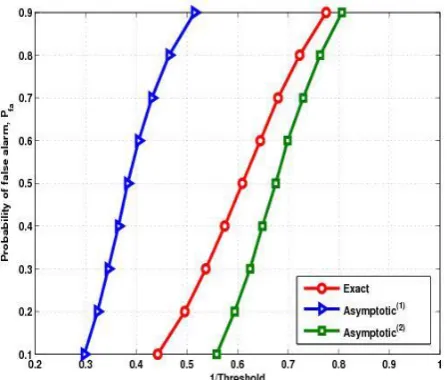
Here, we consider a spectrum sensing problem with a cognitive user with m receive antennas, received signals of length n and a primary user equipped with a single antenna. Note that it is assumed the noise is independent of the primary user signal and channel. For the convenience of analysis, the primary user signal and the noise are assumed as circularly symmetric complex Gaussian noise. The derived exact and the mentioned two asymptotic thresholds [30], [14] of MME and the detection performances based on these thresholds corresponding to desired probability false alarm of 0.1 are shown in Figures 1 and 2 respectively. The figures are plotted for 2 number of antennas and 20 number of samples for ease of calculation of the second asymptotic formula. It is worth noting that, although the detection performance of second asymptotic threshold looks higher in Figure 2, the actual target probability of false alarm is 0.3 not the desired of 0.1.
Figure 1. Probability of false alarm for MME vs exact and asymptotic thresholds for m=2 and n=20.
Figure 2. Probability of detection for MME vs SNR
using exact and asymptotic thresholds for m=2 and n=20.
3. Exact Threshold for EME
The EME detection is proposed in [8]. Basically, it compares the signal energy with the minimum eigenvalue of the sample covariance matrix to detect the primary user signal. The asymptotic threshold for EME is proposed in [8]. However, it is worth nothing that, there is no asymptotic threshold formula for EME when the complex-valued Gaussian noise is used.
We have studied the distribution for the ratio of sum of the eigenvalues to minimum eigenvalue in order to calculate the exact decision threshold as a function of the desired probability of false alarm for the energy with minimum eigenvalue detector. The ratio of energy to minimum eigenvalue is also called the Demmel condition number of Wishart matrix [34], [35]. Utilizing the results on the PDF of the Demmel condition number presented in [35], we derived the exact CDF of the Demmel condition number of an arbitrary complex Wishart matrix in closed form [36]. In addition, for the particular case with two number of antennas, we proposed a very simple expression.
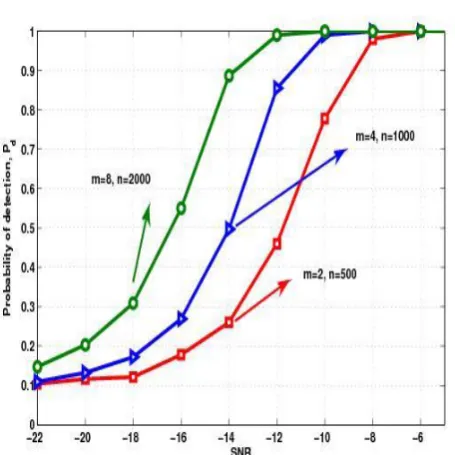
Figure 3 shows the exact threshold values versus probability of false alarm for EME. Using the exact thresholds corresponding to the desired probability false alarm of 0.1 given in Figure 3, the detection performances are calculated for a range of SNR values which is given in Figure 4. As obvious way it looks, the pair of m=8, n=2000 has the highest detection probability.
4
Figure 4. Probability of detection vs SNR for EME.
4. Exact Threshold for MED
The decision statistics for the MED is defined as the maximum eigenvalue of the received signal covariance matrix. This method relies on the received signal and noise power information in order to decide the existence of the signal. An asymptotic formula of sensing threshold for MED is proposed in [9]. For a complex signal, the sensing threshold in terms of desired probability of false alarm is calculated by using the results of theorem [28]. The given threshold is derived based on the limiting distribution of the maximum eigenvalue of the received signal covariance matrix. An improved alternative asymptotic threshold for MED is derived for any fixed number of antennas and large number of samples in [14].
In [37], we derived the exact decision threshold of maximum eigenvalue detection for multiple receiver spectrum sensing. As opposed to the decision threshold estimations based on an asymptotic analysis with large number of samples and/or antennas presented in the literature, the proposed mathematical formulation can be used to calculate exact thresholds for finite number of samples and antennas. Moreover, the proposed thresholds are valid for both correlated and uncorrelated Gaussian noise cases. The formulations are represented by complex hypergeometric functions of matrix argument, which can be expressed in terms of complex zonal polynomials [32]. It is shown that the probability of detection performance with the proposed exact decision thresholds performs better than the performance achieved with the decision thresholds calculated based on the asymptotic analysis.
The asymptotic (
γ
Asy) and the exact (γ
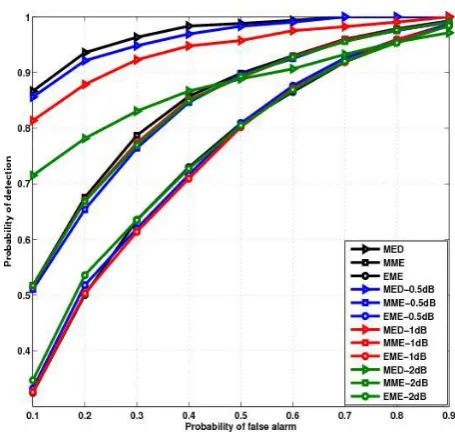
Ex) threshold values at some specific number of samples are shown in Table 1. It can be observed that, both asymptotic thresholds of MED [9], [14] are more closer to the exact threshold as compared to the closeness of the exact-asymptotic thresholds of MME. This is because both asymptotic distributions of the maximum eigenvalue are more accurate than the asymptotic distribution of the ratio of maximum to minimum eigenvalue. Also, it is clear that, in terms of closeness, the first asymptotic thresholds of MME works better than second asymptotic approach especially for small number of samples. But, it is worth nothing that, even very small difference between asymptotic and exact threshold values of low m and n can make a difference in detection probability.After we examine the individual eigenvalue based sensing schemes of EME, MED and MME, we compared all these schemes together. The performances of the methods at different SNR values are given in Figure 5. As it can be seen from the figure, the MED detector outperforms the MME and EME detectors. The Receiver Operating Characteristics (ROC) curve is shown in Figure 6. In this figure, the detection probabilities are calculated for a range of desired probability of false alarm at SNR=-8dB. The all methods in absence of noise uncertainty are compared with the presence of 0.5,1 and 2 dB noise uncertainties. From the figure, we see that MME and EME are significantly robust to the noise uncertainty. However, even MED is not robust as MME and EME, still it provides higher detection performance in the presence of noise uncertainty.
Figure 5. Comparison of probability of detection vs
SNR: Pfa=0.1, m=4, n=100.
EAI Endorsed Transactions on Industrial Networks and Intelligent Systems
Table 1. Numerical Table for exact and asymptotic thresholds for MME, MED and EME: m=2, Pfa=0.1.
Figure 6. ROC curve at SNR=-8dB: m=4, n=100.
5. Exact Threshold for B-GLRT
The fundamental principle of eigenvalue based techniques discussed above are constructed from the generalized likelihood ratio test [20], [21]. As it is well known, the optimum Neyman-Pearson test is the most powerful test when the knowledge of complete parameters are assumed to be known [41]. However, the exact
densities in the absence and presence of primary signal can not be evaluated and thus it is not a realistic approach in practical scenarios. Therefore, estimating the unknown parameters is one of the approaches to overcome this difficulty. Different estimation methods can be used in order to make this suitable for real applications. One of the estimation techniques which enables tractable (likelihood ratio test) LRT is maximum likelihood estimate (MLE) [42]. Replacing the unknown parameters in LRT with their ML estimation is called generalized likelihood ratio (GLR). So, the GLR detector can be developed from the LR function and requires the partial or complete MLE of the signal, noise and channel parameters. In general, the GLR based approaches are called generalized likelihood ratio test (GLRT).
The decision metric for B-GLRT is the maximum eigenvalue of the sample covariance matrix to the sum of the eigenvalues. The term blind refers to the fact that this method assumes that all the noise and the channel parameters as unknown. So, B-GLRT achieves the optimal performance when the channel and the noise parameters are all unknown [38]. Thus, this method is very important in blind spectrum sensing compared to others.
6
threshold given in [20]. On the other hand, the exact distribution of the decision metric for B-GLRT is studied in [23, 24]. However, the distribution function of the decision metric is expressed in terms of multi-dimensional integrals and computationally complex expressions which limit its application in different areas. Thus, it is important to obtain a simple analytical expression which allows for fast and efficient evaluation.
In [43], we derived the novel analytical expressions for the probability density function (PDF) and cumulative distribution function (CDF) of the decision metric for B-GLRT for general uncorrelated Wishart matrices. Utilizing the PDF expression of the maximum eigenvalue given in [44], we calculated the density by exploiting the theorem given in [45]. The derivation of simple closed-form expressions for the PDF and CDF for the special dual uncorrelated and dual correlated complex central Wishart matrices (m=2) are further contributions of our work. The obtained expressions involve only standard functions. Therefore they can be evaluated in a very fast and efficient manner. Based on these results, the sensing performance of the exact distribution-based blind generalized likelihood ratio test (B-GLRT) scheme is investigated.
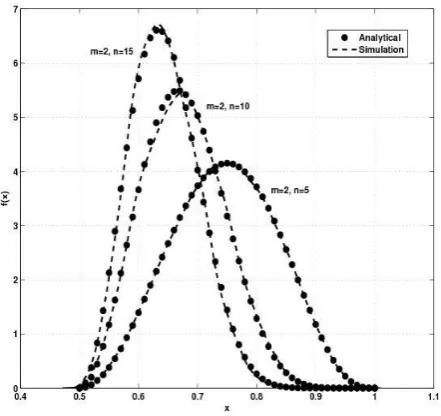
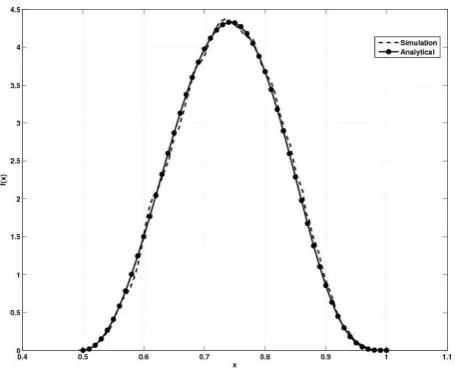
Figure 7 illustrates the PDF of the decision metric for B-GLRT for the uncorrelated dual complex Wishart matrices with different number of samples. It can be seen that the analytical and Monte Carlo simulation results are in perfect agreement. The derived closed–form CDF expression, [43] for m=2 is also verified in Figure 8. The PDF is plotted in Figure 9 for correlated dual complex Wishart matrix for m=2 and n=6. The sigma matrix is taken as Σ2=[0.4 0; 0 0.6]. So, correctness of the derived distribution is justified by the consistency of the analytical and simulation results. The Receiver Operating Characteristics (ROC) curve is shown in Figure 10. In this figure, the detection probabilities are calculated for a range of desired probability of false alarm at SNR= -8dB. All methods in the absence of noise uncertainty are compared with those in the presence of 0.5, 1 and 2 dB noise uncertainties. As it can be seen, MME, EME and B-GLTRT are fully robust to noise uncertainty. However, the susceptible detection performance of MED can be clearly observed.
Figure 7. The PDF of the ratio of the largest eigenvalue to the trace of a uncorrelated dual
complex Wishart matrix.
Figure 8. The CDF of the ratio of the largest eigenvalue to the trace of a uncorrelated dual
complex Wishart matrix.
EAI Endorsed Transactions on Industrial Networks and Intelligent Systems
Figure 9. The PDF of the ratio of the largest eigenvalue to the trace of a correlated dual complex
Wishart matrix.
Figure 10. ROC curve at SNR=-8dB: m=4, n=50.
6. Conclusions
This paper overviewed the eigenvalue-based spectrum sensing schemes using more accurate decision threshold computations as compared to the existing formulations in the literature. This accurate threshold computation enables the achievement of a higher detection performance. Formulations are developed for four major eigenvalue based schemes namely MME, EME, MED and B-GLRT. The threshold calculation of B-GLRT scheme which is the optimal eigenvalue-based scheme is based on to the
derivation of a new probability density and a cumulative distribution expression. The noise uncertainty issue and its influence on the eigenvalue-based sensing schemes are also examined using the exact threshold results. It is shown that the methods of B-GLRT, MME and EME which belong to the blind detection category and which do not assume any knowledge of the noise are robust to varying noise levels. However, MED is very vulnerable to changes in noise levels which in turn makes the detection unreliable.
References
[1] Schmidt R. O. [1986], ‘Multiple emitter location and signal parameter estimation’, IEEE Transactions on Antennas
and Propoagation34, (3): 276- 280.
[2] Zeng, Y., Liang, Y. C., Hoang, A. T., and Zhang R. [2010], ‘A review on spectrum sensing for cognitive radio: challenges and solutions’, EURASIP Journal on Advances
in Signal Processing2010: 1-15.
[3] Oh, D. C. and Lee, Y. H. [2009], ‘Energy detection based spectrum sensing for sensing error minimization in cognitive radio networks’, International Journal of
Communication Networks and InformationSecurity, 1(1):
1-5.
[4] Yucek T. and Arslan H. [2009], ‘A Survey of Spectrum Sensing Algorithms for Cognitive Radio Applications’
IEEE Commun. Surveys and Tutorials11(1).
[5] North D. O. [1963], ‘An analysis of the factors which determine signal/noise discrimination in pulsed carrier systems’ Procedings of IEEE, 5(7): 1016-1027.
[6] Tkachenko A., Cabric, D. and Brodersan R. W. [2007], ‘Cyclostationary feature detector experiments using reconfigurable BEE2,’ Proc. IEEE Int. Symposium on New
Frontiers in Dynamic Spectrum Access Networks, Dublin,
Ireland, 216-219,.
[7] Xiao Y., Hu F. [2009], Cognitive Radio Networks, Taylor \& Francis Group, CRC Press..
[8] Zeng Y., Liang Y. C. [2009] ‘Eigenvalue-based Spectrum Sensing Algorithms for Cognitive Radio,’ IEEE
Transactions on Communications, 57(6): 1784-1793.
[9] Zeng Y., Koh C. L. and Liang Y. C., [2008], ‘Maximum eigenvalue detection: theory and application’, IEEE
International Conference on Communications (ICC), pp.,
19-23 May 2008, 4160-4164.
[10] Zeng Y., and Liang Y. C., [2006], ‘Maximum minimum Eigenvalue Detection For Cognitive Radio’, The 18th Annual IEEE International Symposium on Personal,
Indoor and Mobile Radio Communications, 106(395):
91-95.
[11] Zeng, Y., Liang, and Zhang R. [2008], ‘Blindly combined energy detection for spectrum sensing in cognitive radio’,
IEEE Signal Process Lett., 15: 649-652.
[12] Z. D. Bai, [1999] ‘Methodologies in spectral analysis of large dimensional random matrices, a review’, Statistica Sinica, 9: 611-677.
[13] Z. D. Bai, [2001], ‘On the distributuion of largest eigenvalue in principle components analysis’, Analysis Statistics, 29(2): 295-327.
[14] Liang, Y. C., Pan, G., and Zeng, Y. H., [2010], On the performance of spectrum sensing algorithms using multiple antennas, IEEE Global Telecommunications
8 [15] Johnson D. E. and Graybill F. A., [1972], ‘An analysis of a
two-way model with interaction and no replication’,
Journal of the American Statistical Association, 67(340):
862-868.
[16] Nan F. Y. and Nowak R. D., [1999], ‘Generalized likelihood ratio detection for fMRI using complex data’
IEEE Transactions on Medical Imaging, 18(4): 320-
329.
[17] Meola J., Eismann M. T., Moses R. L. and Ash J. N., [2011], ‘Detection changes in hyperspectral imagery using a mpdel-based approach’, IEEE Transactions on
Geoscience and Remote Sensing, 49(7): 2647-2661.
[18] Cui G., Kong L., Yang X. and Yang J., [2010], ‘Two-step GLRT design of MIMO radar in compound-Gaussian clutter’, IEEE Radar Conference,343-347.
[19] Lim T. J., Zhang R., Liang Y. C. and Zang Y., [2008], ‘GLRT-based spectrum sensing for cognitive radio’, IEEE
Global Telecommunication Conference, 1-5.
[20] Taherpour A., Nasiri-Kenari M. and Gazor S., [2010], ‘Multiple antenna spectrum sensing in cognitive radio’,
IEEE Transactions on Wireless Communications, 9(2):
814-823.
[21] Bianchi P., Debbah M., Maida M. and Najim J., [2011], ‘Performance of statistical tests for single-source detection using random matrix theory’, IEEE Transactions on
Information Theory}, 57(4): 2400-2419.
[22] Nadler B., [2011], ‘On the distribution of the ratio of the largest eigenvalue to the trace of a Wishart matrix, Journal
of Multivariate Analysis’ 102(2): 363-371.
[23] Johnson D. E. and Graybill F. A., [1972], ‘An analysis of a two-way model with interaction and no replication’,
Journal of the American Statistical Association’, 67(340):
862-868.
[24] Schuurmann F. J., Krishnaiah P. R. and Chattopadhyay A. K., [1973], ‘On the distributions of the ratios of the extreme roots to the trace of the Wishart matrix’, Journal
on Multivariate Analysis, 3(4): 445-453.
[25] Cardoso L.S, Debbah M., Bianchi P., Najim J., [2008], ‘Cooperative spectrum sensing using random matrix theory’, International Symposium on Wireless Pervasive
Computing, 334-338.
[26] Baik J., Silverstein J. W., [2006], ‘Eigenvalues of large sample covariance matrices of spiked population models’,
Journal of Multivariate Analysis, 97(6): 1382-1408.
[27] Zeng Y., and Liang Y. C.,[2007], ‘Maximum minimum Eigenvalue Detection For Cognitive Radio’ IEEE International Symposium on Personal, Indoor and Mobile
Radio Communications, 1-5.
[28] Johnstone I. M., [2001], ‘On the distributuion of largest eigenvalue in principle components analysis’, Analysis Statistics, 29(2): 295-327.
[29] Bai Z. D., [1999], ‘Methodologies in spectral analysis of large dimensional random matrices, a review’, Statistica Sinica, 9: 611-677.
[30] Tracy C. A. and Widom H., [2000], ‘The distribution of the largest eigenvalue in the Gaussian ensembles’,
Calogero-Moser-Sutherland Models, New York: Springer,
461-472.
[31] Kortun A., Ratnarajah T., Sellathurai M. and Zhong C., [2010], ‘On the performance of eigenvalue-based spectrum sensing for cognitive radio’, The IEEE International
Dynamic Spectrum Access Networks (DySPAN),
Singapore, 1-6.
[32] Ratnarajah T., Vaillancourt R. and Alvo M., [2005], ‘Eigenvalues and condition numbers of complex random matrices’, Society on Industrial and Applied Mathematics
Journal on Matrix Analysis and Applications’, 26(2):
441-456.
[33] Kortun A., Ratnarajah T., Sellathurai M., Zhong C. and Papadias C. B., [2011], ‘On the performance of eigenvalue-based cooperative spectrum sensing for cognitive radio’, IEEE Journal of Selected Topics in Signal
Processing, 5(1): 49-55.
[34] Edelman A., [1989], ‘Eigenvalues and condition numbers of random matrices’, PhD dissertation, Massachusetts Institute of Technology.
[35] Zhong C., McKay M. R., Ratnarajah T., and Wong Kai-Kit, [2011], ‘Distribution of the Demmel condition number of complex Wishart Matrices’, IEEE Transactions on
Communications, 59(5): 1309-1320.
[36] Ratnarajah T., Zhong C., Kortun A., Sellathurai M. and Papadias B., [2011], ‘Complex random matrices and multiple-antenna spectrum sensing’, IEEE International
Conference on Acoustics, Speech and Signal Processing,
pp. 3848 - 3851.
[37] Kortun A., Ratnarajah T., Sellathurai M., [2010], ‘Exact performance analysis of blindly combined energy detection for spectrum sensing’, IEEE International Symposium on
Personal, Indoor and Mobile Radio Communications,
560-563.
[38] Nadler B., [2011], ‘On the distribution of the ratio of the largest eigenvalue to the trace of a Wishart matrix’,
Journal of Multivariate Analysis, 102(2): 363-371.
[39] Coullet R. and Debbah M., [2011], ‘A Bayesian framework for collaborative multi-source signal sensing’,
IEEE Transactions on Signal Processing, 58(10):
5186-5195.
[40] Wong K., Zhang Q., Reilly J., and Yip P., [1990], ‘On information theoretic criteria for determining the number of signals in high resolution array processing’, IEEE
Transactions on Signal Processing, 38(11): 1959- 1971.
[41] Neyman J. and Pearson E., [1933], ‘On the problem of the most efficient tests of statistical hypotheses’,
Philosophical Transactions of the Royal Society of
London, 231: 289-337.
[42] Van-Trees H. L., [2001], Detection, estimation and modulation theory, John Wiley \& Sons, New York, NY, USA.
[43] Kortun A., Sellathurai M., Ratnarajah T., Zhong C., [2012], ‘Distribution of the Ratio of the Largest Eigenvalue to the Trace of Complex Wishart Matrices’,
IEEE Transactions on Signal Processing, 60 (10): 1-5.
[44] Maaref A., and Aissa S., [2005], ‘Closed-form expression for the outage and ergodic shannon capacity of MIMO mrc sytems’, IEEE Transactions on Communications, 53(7): 1092-1095.
[45] Krishnaiah P. R. and Schuurmann F. J., [1974], ‘On the evaluation of some distributions that arise in simultaneous tests for the equality of the latent roots of the covariance matrix’, Journal on Multivariate Analysis,4(3): 265-282.
EAI Endorsed Transactions on Industrial Networks and Intelligent Systems