Volume-5 Issue-2
International Journal of Intellectual Advancements
and Research in Engineering Computations
Enhanced scalable and secure sharing of personal health records
in cloud using
Attribute-based encryption model
1. Ms. K.E.Eswari M.C.A.,M.Phil., Associate Professor 2. Ms. A.Shakila Banu Final M.C.A
Department of MCA, Nandha Engineering College, (Autonomous), Erode -52. [email protected]
Abstract—Personal health record (PHR) is an emerging patient-centric model of health information exchange, which is often outsourced to be stored at a third party, such as cloud providers. However, there have been wide privacy concerns as personal health information could be exposed to those third party servers and to unauthorized parties. To assure the patients’ control over access to their own PHRs, it is a promising method to encrypt the PHRs before outsourcing. Yet, issues such as risks of privacy exposure, scalability in key management, flexible access, and efficient user revocation, have remained the most important challenges toward achieving fine-grained, cryptographically enforced data access control. In this paper, we propose a novel patient-centric framework and a suite of mechanisms for data access control to PHRs stored in semi trusted servers. To achieve fine-grained and scalable data access control for PHRs, we leverage attribute-based encryption (ABE) techniques to encrypt each patient’s PHR file. Different from previous works in secure data outsourcing, we focus on the multiple data owner scenario, and divide the users in the PHR system into multiple security domains that greatly reduces the key management complexity for owners and users. A high degree of patient privacy is guaranteed simultaneously by exploiting multi authority ABE. Our scheme also enables dynamic modification of access policies or file attributes, supports efficient on-demand user/attribute revocation and break-glass access under emergency scenarios. Extensive analytical and experimental results are presented which show the security, scalability, and efficiency of our proposed scheme.
Index Terms-Personal health records, cloud computing, data privacy, fine-grained across control, attribute-based encryption
1.INTRODUCTION
In recent years, personal health record (PHR) has emerged as a patient-centric model of health information exchange. A PHR service allows a patient to create, manage, and control her
personal health data in one place through the web, which has made the storage, retrieval, and sharing of the medical information more efficient. Especially, each patient is promised the full control
of her medical records and can share her health data with a wide range of users, including healthcare providers, family members or friends. Due to the high cost of building and maintaining specialized data centers, many PHR services are outsourced to or provided by third-party service providers, for example, Microsoft HealthVault.1 Recently, architectures of storing PHRs in cloud computing have been proposed in [2], [3].
complete list of users. The complexities per encryption, key generation, and decryption are only linear with the number of attributes involved. However, to integrate ABE into a large-scale PHR system, important issues such as key management scalability, dynamic policy updates, and efficient on-demand revocation are nontrivial to solve, and remain largely open up-to-date.
Compared with the preliminary version of this paper [1], there are several main additional contributions: 1)We clarify and extend our usage of MA-ABE in the public domain, and formally show how and which types of user-defined file access policies are realized. 2) We clarify the proposed revocable MA-ABE scheme, and provide a formal security proof for it. 3) We carry out both real-world experiments and simulations to evaluate the performance of the proposed solution in this paper.
2. RELATED WORK
This paper is mostly related to works in cryptographically enforced access control for outsourced data and attribute based encryption. To realize fine-grained access control, the traditional public key encryption (PKE)-based schemes either incur high key management overhead, or require encrypting multiple copies of a file using different users’ keys. To improve upon the scalability of the above solutions, one-to-many encryption methods such as ABE can be used. In Goyal et al.’s seminal paper on ABE, data are encrypted under a set of attributes so that multiple users who possess proper keys can decrypt. This potentially makes encryption and key management more efficient. A fundamental property of ABE is preventing against user collusion. In addition, the encryptor is not required to know the ACL.
2.1 ABE for Fine-Grained Data Access Control
A number of works used ABE to realize fine-grained access control for outsourced data. Especially, there has been an increasing interest in applying ABE to secure electronic healthcare records (EHRs). Recently, Narayan et al. proposed an attribute-based infrastructure for EHR systems, where each patient’s EHR files are encrypted using a broadcast variant of CP-ABE that allows direct revocation. However, the cipher text length grows linearly with the number of unrevoked users. In a variant of ABE that allows delegation of access rights is proposed for encrypted EHRs. Ibraimi et al.applied cipher text policy ABE (CP-ABE) to manage the sharing of PHRs, and introduced the concept of social/professional domains. ABE to generate self-protecting EMRs, which can either be stored on cloud servers or cellphones so that EMR could be accessed when the health provider is offline. Recently, Yu et al. (YWRL) applied
key-policy ABE to secure outsourced data in the cloud [9], where a single data owner can encrypt her data and share with multiple authorized users, by distributing keys to them that contain attribute-based access privileges. They also propose a method for the data owner to revoke a user efficiently by delegating the updates of affected cipher texts and user secret keys to the cloud server. Since the key update operations can be aggregated over time, their scheme achieves low amortized overhead. We give detailed overviews to the YWRL scheme and CC.
TABLE 1 Frequently Used Notations
MA-ABE scheme in the supplementary material, which can be found on the Computer Society
Digital Library at
http://doi.ieeecomputersociety.org/10.1109/TPDS.2 012.97.
3 FRAMEWORK FOR PATIENT-CENTRIC, SECURE AND SCALABLE PHR SHARING
In this section, we describe our novel patient-centric secure data sharing framework for cloud-based PHR systems.
3.1 Problem Definition
We consider a PHR system where there are multiple PHR owners and PHR users. The owners refer to patients who have full control over their own PHR data, i.e., they can create, manage, and delete it. There is a central server belonging to the PHR service provider that stores all the owners’ PHRs. The users may come from various aspects; for example, a friend, a caregiver or a researcher. Users access the PHR documents through the server in order to read or write to someone’s PHR, and a user can simultaneously have access to multiple owners’ data.
3.1.1 Security Model
In this paper, we consider the server to be semi trusted, i.e., honest but curious. That means the server will try to find out as much secret information in the stored PHR files as possible, but they will honestly follow the protocol in general. On the other hand, some users will also try to access the files beyond their privileges. For example, a pharmacy may want to obtain the prescriptions of patients for marketing and boosting its profits. To do so, they may collude with other users, or even with the server. In addition, we assume each party in our system is preloaded with a public/private key pair, and entity authentication can be done by traditional challenge-response protocols.
3.1.2 Requirements
To achieve “patient-centric” PHR sharing, a core requirement is that each patient can control who are authorized to access to her own PHR documents. Especially, user-controlled read/write access and revocation are the two core security objectives for any electronic health record system. The security and performance requirements are summarized as follows:
Data confidentiality. Unauthorized users (including the server) who do not possess enough attributes satisfying the access policy or do not have proper key access privileges should be prevented from decrypting a PHR document, even under user collusion. Fine-grained access control should be enforced, meaning different users are authorized to read different sets of documents.
On-demand revocation. Whenever a user’s attribute is no longer valid, the user should not be able to access future PHR files using that attribute. This is usually called attribute revocation, and the corresponding security property is forward secrecy. There is also user revocation, where all of a user’s access privileges are revoked.
Write access control. We shall prevent the unauthorized contributors to gain write-access to owners’ PHRs, while the legitimate contributors should access the server with accountability.
The data access policies should be flexible, i.e., dynamic changes to the predefined policies shall be allowed, especially the PHRs should be accessible under emergency scenarios.
Scalability, efficiency, and usability. The PHR system should support users from both the personal domain and public
domains. Since the set of users from the public domain may be large in size and unpredictable, the system should be highly scalable, in terms of complexity in key management, communication, computation and storage. Additionally, the owners’ efforts in managing users and keys should be minimized to enjoy usability.
3.2 Overview of Our Framework
The main goal of our framework is to provide secure patient-centric PHR access and efficient key management at the same time. The key idea is to divide the system into multiple security domains (namely, public domains and personal domains) according to the different users’ data access requirements. The PUDs consist of users who make access based on their professional roles, such as doctors, nurses, and medical researchers. In practice, a PUD can be mapped to an independent sector in the society, such as the health care, government, or insurance sector. For each PSD, its users are personally associated with a data owner (such as family members or close friends), and they make accesses to PHRs based on access rights assigned by the owner.
The multi-domain approach best models different user types and access requirements in a PHR system. The use of ABE makes the encrypted PHRs self-protective, i.e., they can be accessed by only authorized users even when storing on a semi trusted server, and when the owner is not online. In addition, efficient and on-demand user revocation is made possible via our ABE enhancements.
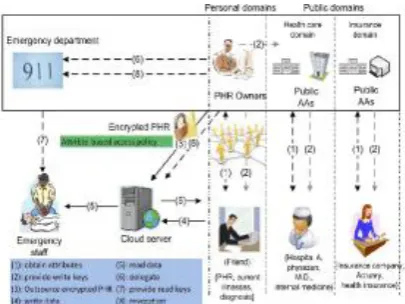
Fig. 1. The proposed framework for patient-centric, secure and scalable PHR sharing on semitrusted storage under multiowner settings.
3.3 Details of the Proposed Framework
addition, two ABE systems are involved: for each PSD the YWRL’s revocable KP-ABE scheme [9] is adopted; for each PUD, our proposed revocable MA- ABE scheme (described in Section 4) is used. The framework is illustrated in Fig. 1.
This is reflected by (1) in Fig. 1. MA-ABE is used to encrypt the data, and the concrete mechanism will be presented in Section 4. In addition, the AAs distribute write keys that permit contributors in their PUD to write to some patients’ PHR (2).
Fig. 2. The attribute hierarchy of files—leaf nodes are atomic file categories while internal nodes are compound categories. Dark boxes are the categories that a PSD’s data reader have access to.
PHR encryption and access. The owners upload ABEencrypted PHR files to the server (3). Each owner’s PHR file is encrypted both under a certain fine-grained and rolebased access policy for users from the PUD to access, and under a selected set of data attributes that allows access from users in the PSD. Only authorized users can decrypt the PHR files, excluding the server. For improving efficiency, the data attributes will include all the intermediate file types from a leaf node to the root.
Break-glass. When an emergency happens, the regular access policies may no longer be applicable. To handle this situation, break-glass access is needed to access the victim’s PHR. In our framework, each owner’s PHR’s access right is also delegated to an emergency department (ED, (6)). After the emergency is over, the patient can revoke the emergent access via the ED.
4 MAIN DESIGN ISSUES
In this section, we address several key design issues in secure and scalable sharing of PHRs in cloud computing, under the proposed framework.
4.1 Using MA-ABE in the Public Domain
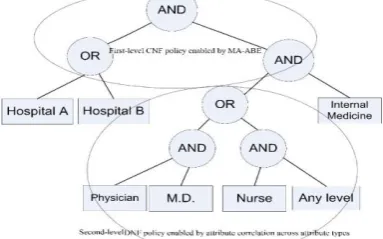
For the PUDs, our framework delegates the key management functions to multiple attribute authorities. In order to achieve stronger privacy guarantee for data owners, the Chase-Chow (CC) MA-ABE scheme is used, where each authority governs a disjoint set of attributes distributive. It is natural to associate the cipher text of a PHR document with an owner-specified access policy for users from PUD. However, one technical challenge is that CC MA-ABE is essentially a KP-ABE scheme, where the access policies are enforced in users’ secret keys, and those key-policies do not directly translate to document access policies from the owners’ points of view. By our design, we show that by agreeing upon the formats of the key-policies and the rules of specifying which attributes are required in the cipher text, the CC MA-ABE can actually support owner-specified document access policies with some degree of flexibility (such as the one in Fig. 4), i.e., it functions similar to CP-ABE.2
4.1.1 Basic Usage of MA-ABE
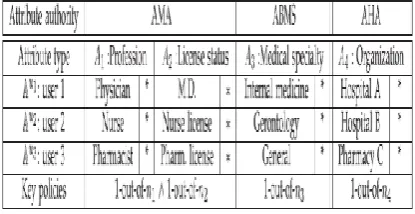
Setup. In particular, the AAs first generate theMKs andPK using setup as in CC MA-ABE. The kth AA defines a disjoint set of role attributes UUk, which are relatively static properties of the public users. These attributes are classified by their types, such as profession and license status, medical specialty, and affiliation where each type has multiple possible values. Basically, eachAAmonitors a disjoint subset of attribute types. For example, in the healthcare domain, the AMA may issue medical professional licenses like “physician,” “M.D.,” “nurse,” “entry-level license,” etc., the ABMS could certify specialties like “internal medicine,” “surgery,” etc; and AHA may define user affiliations such as “hospital A” and “pharmacy D.” In order to represent the “do not care” option for the owners, we add one wildcard attribute “_” in each type of the attributes.
TABLE 2
4.1.2 Achieving More Expressive File Access Policies
By enhancing the key-policy generation rule, we can enable more expressive encryptor’s access policies. We exploit an observation that in practice, a user’s attributes/roles belonging to different types assigned by the same AA are often correlated with respect to a primary attribute type. In the following, an attribute tuple refers to the set of attribute values governed by one AA (each of a different type) that are correlated with each other.
This primary-type based attribute association is illustrated in Fig. 3. Note that there is a “horizontal association” between two attributes belonging to different types assigned to each user. For example, in the first AA (AMA) in Table 2, “license status” is associated with “profession,” and “profession” is a primary type. That means, a physician’s possible set of license status do not intersect with that of a nurse’s, or a pharmacist’s. An “M.D.” Thus, if the second level key policy within the AMA is “1 out of n1 ^ 1 out of n2,” a physician would receive a key like “(physician OR *) AND (M.D. OR *)” (recall the assumption that each user can only hold at most one role attribute in each type), nurse’s will be like “(nurse OR *) AND (elderly’s nursing licence OR *).” Meanwhile, the encryptor can be made aware of this correlation, so she may include the attribute set: {physician, M.D., nurse, elderly’s nursing licence}during encryption. Due to the attribute correlation, the set of users that can have access to this file can only possess one out of two sets of possible roles, which means the following policy is enforced: “(physician AND M.D.) OR (nurse AND)
Fig. 3. Illustration of the enhanced key-policy generation rule. Solid horizontal lines represent possible attribute associations for two users.
Fig. 4. An example policy realizable under our framework using MAABE, following the enhanced key generation and encryption rules. elderly’s nursing licence). The direct consequence is it enables a disjunctive normal form (DNF) encryptor access policy to appear at the second level. If the encryptor wants to enforce such a DNF policy under an AA, she can simply include all the attributes in that policy in the cipher text. Since in reality, the number of PUDs is usually small, this method is more efficient and secure than a straightforward application of CP-ABE in which each organization acts as an authority that governs all types of attributes [1], and the length of cipher text grows linearly with the number of organizations. For efficiency, each file is encrypted with a randomly generated file encryption key (FEK), which is then encrypted by ABE.
4.1.3 Summary
In this above, we present a method to enforce owner’s access policy during encryption, which utilizes the MAABE scheme in a way like CP-ABE. The essential idea is to define a set of key-generation rules and encryption rules. There are two layers in the encryptor’s access policy, the first one is across different attribute authorities while the second is across different attributes overned by the same AA. For the first layer, conjunctive policy is enabled; for the second, either k-out-of-n or DNF policy are supported. We exploit the correlations among attribute types under an AA to enable the extended second-level DNF policy.
4.2 Enhancing MA-ABE for User Revocation
The original CC MA-ABE scheme does not enable efficient and on-demand user revocation. To achieve this for MAABE, we combine ideas from YWRL’s revocable KP-ABE, (its details are shown in supplementary material, available online), and propose an enhanced MA-ABE scheme. In particular, an authority can revoke a user or user’s attributes immediately by re-encrypting the cipher texts and updating users’ secret keys, while a major part of these operations can be delegated to the server which enhances efficiency.
texts containing that attribute. In order to reduce the potential computational burden for the AAs, we adopt proxy encryption to delegate operations 2 and 3 to the server, and use lazy-revocation to reduce the overhead.
4.3 Enforce Write Access Control
If there is no restriction on write access, anyone may write to someone’s PHR using only public keys, which is undesirable. By granting write access, we mean a data contributor should obtain proper authorization from the organization she is in (and/or from the targeting owner), which shall be able to be verified by the server who grants/rejects write access.
A naive way is to let each contributor obtain a signature from her organization every time she intends to write. Yet this requires the organizations be always online. The observation is that, it is desirable and practical to authorize according to time periods whose granularity can be adjusted. For example, a doctor should be permitted to write only during her office hours; on the other hand, the doctor must not be able to write to patients that are not treated by her. Therefore, we combine signatures with the hash chain technique to achieve our goals.
4.4 Handle Dynamic Policy Changes
Our scheme should support the dynamic add/modify/delete of part of the document access policies or data attributes by the owner. For example, if a patient does not want doctors to view her PHR after she finishes a visit to a hospital, she can simply delete the cipher text components corresponding to attribute “doctor” in her PHR files. Adding and modification of attributes/access policies can be done by proxy re-encryption techniques.
To reduce the storage cost, the owner can merely keep a random seed s0 and generate the s for each encrypted file from s0, such as using a pseudorandom generator. Thus, the main computational overhead to modify/add one attribute in the ciphertext is just one modular exponentiation operation.
TABLE 3 Comparison of Security
4.5 Deal with Break-Glass Access
For certain parts of the PHR data, medical staffs need to have temporary access when an emergency happens to a patient, who may become unconscious and is unable to change her access policies beforehand. The medical staffs will need some temporary authorization (e.g., emergency key) to decrypt those data. Under our framework, this can be naturally achieved by letting each patient delegate her emergency key to an emergency department. Specifically, in the beginning, each owner defines an “emergency” attribute and builds it into the PSD part of the cipher text of each PHR document that she allows break-glass access. She then generates an emergency key skEM using the single node key-policy “emergency,” and delegates it to the ED who keeps it in a database of patient directory. After the patient recovers from the emergency, she can revoke the break-glass access by computing a rekey: rkEM, submit it to the ED and the server to update her skEM and CT to their newest versions, respectively.
5. SECURITY ANALYSES
In this section, we analyze the security of the proposed PHR sharing solution. First we show it achieves data confidentiality (i.e., preventing unauthorized read accesses), by proving the enhanced MA-ABE scheme (with efficient revocation) to be secure under the attribute-based selective-set model. We have the following main theorem.
The results are shown in Table 3. It can be seen that, our scheme achieves high privacy guarantee and on-demand revocation. In comparison with the RNS scheme, in RNS the AAs are independent with each other, while in our scheme the AAs issue user secret keys collectively and interactively. In our scheme, such interaction is not needed. In addition, our proposed framework specifically addresses the access requirements in cloud based health record management systems by logically dividing the system into PUD and PSDs, which considers both personal and professional PHR users. Our revocation methods for ABE in both types of domains are consistent. The RNS scheme only applies to the PUD.
6. SCALABILITY AND EFFICIENCY
6.1 Storage and Communication Costs
TABLE 4
Notations for Efficiency Comparison
In our scheme, revocation of one user u requires revoking a minimum set of data attributes that makes her access structure unsatisfiable. From Table 5, it can be seen that our scheme has much smaller secret key size compared with VFJPS and BCHL, smaller rekeying message size than VFJPS, HN, and RNS, the size of cipher text is smaller than NGS while being comparable with HN and RNS. The public key size is smaller than VFJPS and BCHL, and is comparable with that of RNS; while it seems larger than those of HN and NGS, note that we can use the large universe constructions to dramatically reduce the public key size. Overall, compared with non-ABE schemes, our scheme achieves higher scalability in key management. Compared with existing revocable ABE schemes, the main advantage of our solution is small rekeying message sizes. To revoke a user, the maximum rekeying message size is linear with the number of attributes in that user’s secret key. To further show the storage and communication costs, we provide a numerical analysis using typical parameter settings in the supplementary material, available online.
6.2 Computation Costs
Next, we evaluate the computational cost of our scheme through combined implementation and simulation. We provide the first implementation of the GPSW KP-ABE scheme (to the best of our knowledge), and also integrated the ABE algorithms into a prototype PHR system, Indivo. The GPSW KP-ABE scheme is tested on a PC with 3.4 GHz processor, using the pairing based cryptography (PBC) library. The public parameters are chosen to provide 80 bits security level, and we use a pairing-friendly type-A 160-bit elliptic curve group.
Finally, we simulate the server’s computation cost spent in user revocation to evaluate the system performance of user revocation. Especially, the lazy-revocation method greatly reduces the cost of revocation, because it aggregates multiple cipher text/key update operations, which amortizes the computations over time.
7. CONCLUSION
In this paper, we have proposed a novel framework of secure sharing of personal health records in cloud computing. Considering partially trustworthy cloud servers, we argue that to fully realize the patient-centric concept, patients shall have complete control of their own privacy through encrypting their PHR files to allow fine-grained access. The framework addresses the unique challenges brought by multiple PHR owners and users, in that we greatly reduce the complexity of key management while enhance the privacy guarantees compared with previous works. We utilize ABE to encrypt the PHR data, so that patients can allow access not only by personal users, but also various users from public domains with different professional roles, qualifications, and affiliations. Furthermore, we enhance an existing MA-ABE scheme to handle efficient and on-demand user revocation, and prove its security. Through implementation and simulation, we show that our solution is both scalable and efficient.
REFERENCES
1) M. Li, S. Yu, K. Ren, and W. Lou, “Securing
Personal Health Records in Cloud Computing: Patient-Centric and Fine-Grained Data Access Control in Multi-Owner Settings,” Proc. Sixth Int’l ICST Conf. Security and Privacy in Comm. Networks (SecureComm ’10), pp. 89-106, Sept. 2010.
2) H. Lo¨ hr, A.-R. Sadeghi, and M. Winandy,
“Securing the E-Health Cloud,” Proc. First ACM Int’l Health Informatics Symp. (IHI ’10), pp. 220-229, 2010.
3) M. Li, S. Yu, N. Cao, and W. Lou, “Authorized
Private Keyword Search over Encrypted
Personal Health Records in Cloud Computing,” Proc. 31st Int’l Conf. Distributed Computing Systems (ICDCS ’11), June 2011.
4) “The Health Insurance Portability and
Accountability Act,
“http://www.cms.hhs.gov/HIPAAGenInfo/ 01_Overview.asp,2012.
5) “Google, Microsoft Say Hipaa Stimulus Rule
Doesn’t Apply to Them,”
http://www.ihealthbeat.org/Articles/2009/4/8 /, 2012.