61
High Sensitive Enzyme Based Glucose Sensor
Using Lead Sulfide Nanocrystals
Sai Cong Doanh*, Luu Manh Quynh
Faculty of Physics, VNU University of Science, 334 Nguyen Trai, Thanh Xuan, Hanoi, Vietnam
Received 25 March 2015
Revised 14 April 2015; Accepted 28 May 2015
Abstract:In recent years, glucose oxidase (GOx) based sugar level detecting techniques have been
intensively developed. In order to improve the diagnosis and desease treatment in low- and middle-income countries, the low cost, easily processing, but still high sensitive sensing systems/equipments play a very important rules in biomedicine and life science. In this work, lead sulfide (PbS) nanocolloids were used as electron receptor. The results showed that the sensitivity of the glucose sensor reached 546.2 A cm-2 mM-1. It is note that, some early works on GOx based
glucose sensor only reached sensitivity less than 100 A cm-2 mM-1.
Keywords: Lead sulfide nanoparticles, glucose sensor, glucose oxidase.
1. Introduction∗∗∗∗
Fact sheet number 312 announced by World Health Organization in August of 2011 showed that 346 million people worldwide have diabetes, and up to 2004 about 3.4 millions died from high blood sugar. Among those deaths, more than 80% occurred in low- and middle-income countries [1]. The exact, high sensitive and low cost sugar level diagnosis techniques have attracted much importance in early and effective diabete treatments [2]. After the first study by Updike and Hisks in 1967 [3], the enzyme based glucose sensor has been extensively developed with different methods, such as amperometric, potentiometric, and conductometric [4-8].
From 2000, epidermis number of nanomaterials has been used to increase the sensitivity of this sensor type [9-20]. Considering the best knowledge of the authors, the highest sensitivity of 64 A cm-2 mM-1 was reported by G. Cui’s group [11].
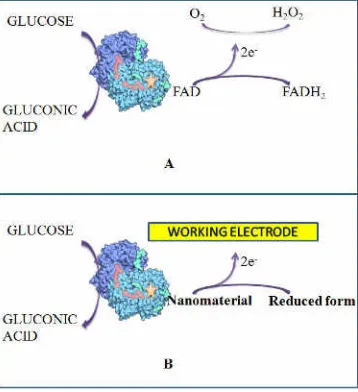
In May of 2012, glucose oxidase (GOx) was ranged to the enzyme of the month on the journal Sensor (MDPI, ISSN 1424-8820) and has been repeatedly applied in most enzyme based glucose sensors presented on this journal. In biology media, this enzyme catalyzes the oxidation of glucose to produce gluconic acid with the presence of flavin adenine dinucleotide (FAD). Due to this, the
_______ ∗
Figure 1.Schematic catalytic of GOx in glucose oxidation (A) and basic theory of glucose sensor using nanomaterials (B).
To increase the sensitivity of the biosensor, we studied the structure of GOx in order to find the way that transfers directly the electron from mediator-materials to the molecules. The GOx molecules are usually found to be 580 – 585 residue long, which have 3 sulfur atoms (S) containing hydrophilic cysteine at 164th, 206th and 512th positions, while the 512th lays at the outside of the N-domain and close to the FAD linking position. Besides, the metal sulfide nanocrystals could link easily to the S atom of the organic molecules with a stable covalent binding [22, 23]. Nanosize lead sulfide (PbS) has been chosen.
In this work, we set up a new enzyme-base glucose sensor based on the PbS nano-colloids as. A home-made gold electrode created from the PbS nanocolloids synthesized by sonochemical method was used to investigate the dependence of cyclic voltametric current on the glucose concentration. To ensure the reliability of the sensor, the sensitivity was checked after the electrode had been stored for 2 weeks.
2. Experimental methods
2.1. Lead sulfide nanoparticle synthesis
Figure 2.Schematic installation of sonically synthesizing method.
A mixture of 20 ml containing 0.25 M Pb(Ac)2, 0.6 M TAA and 0.06 M CTAB was added to three neck bottles and stirred for 15 min. The sonically synthesizing system was shown in figure 2. Nitrogen gas used against the oxidation reactions during the ultrasonic sound was set through a titanium horn. After 1 hour, the transparent solution changed to dark grey. The as-prepared solution was washed several times with distillated water to separate the remained chemicals before being stored in phosphate buffer saline pH =7 (PBS pH 7).
2.2. Electrode preparation and electrochemical installation
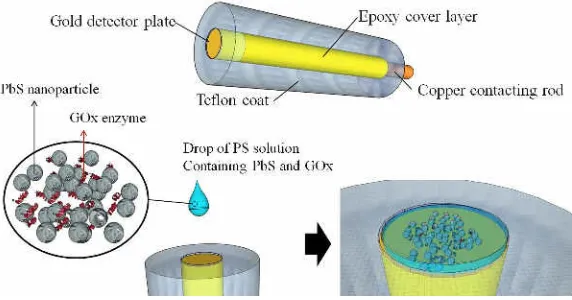
The working electrode was a home-made gold electrode, which is 3 mm diameter circle Gold plate (Fig. 3). After being polished with 4000 abrasive paper, the electrode was merged in 0.1M HCl then in 0.1M NaOH to clean all the unnecessary chemicals. Four hundred units of the glucose oxidase (GOx) were dispersed into 1 mL PbS nanoparticles containing solution, then dropped onto the electrodes. After drying, polystyrene (PS) was diluted by dichloromethane (CH2Cl2) and dispended onto the electrodes at room temperature. After the complete evaporation of CH2Cl2 , a PbS/GOx/PS thin film was created from the remained PS, which kept the PbS nanocolloids and GOx molecules stay on the surface of the electrodes.
3.1. Structure and morphology
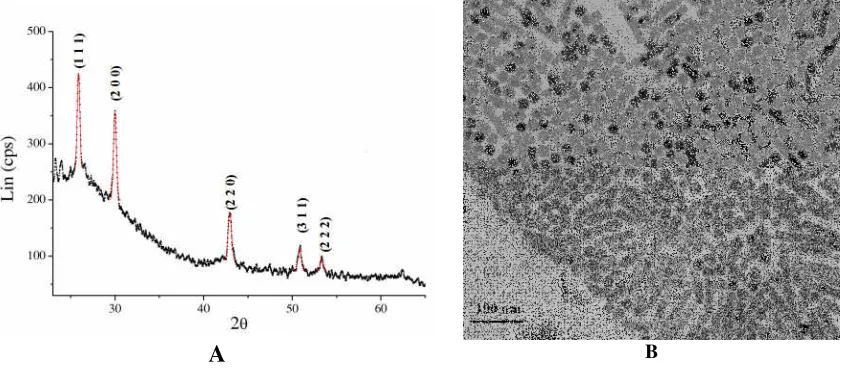
Figure 4A illustrated the X-ray diffraction pattern of as-prepared PbS nanocrystals. The X-ray diffraction peaks – the black points were the observed results, while the red lines were the fitting results - indicated the well crystallized structure, which agreed with the standard XRD line of face-centered cubic PbS (JCPDS Card No. 05-0592 of galena) via the reflection on (1 1 1), (2 0 0), (2 2 0), (3 1 1) and (2 2 2) faces. These results coincided with that reported previously [24,25]. No other peaks were observed indicating the high purity of the sample.
A B
Figure 4. X-ray diffraction and TEM image of the PbS nanocrystal synthesized by sonochemical method.
The TEM image (Fig. 4B) was consistent with the X-ray diffraction result. The colloids distributed at cubic shape centralized to 12 nm width and rod-like shape with means aspect ratio of (length/width) 7. By this, the (2 0 0) face and the cut off (1 1 1) face at the edges of the cubes, rods were dominated that gave higher reflection intensity on X-ray pattern.
3.2. Glucose concentration electrochemical sensor
ACID GLUCONIC TONE GLUCONOLAC O H O O H
GLUCOSE GOx HO
→ + → + + 2 2 2 2
2 12
Figure 5.Cyclic voltammogram of uncoated PbS prepared working electrode via deferent concentration of glucose after 3 days storage.
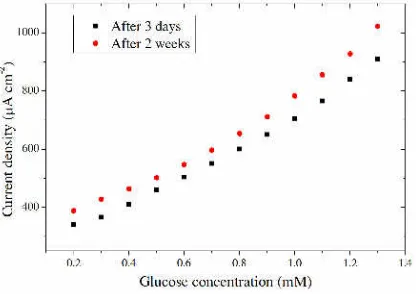
By increasing glucose concentration the activation current increased, which gave ascending at 1.15 V in I-V diagram (Fig. 5). In this measurement, the PbS colloids play a role of docking material. The direct linkage through the materials to the S atom from 512th residue induced the GOx-electrode electron transfer; thus increasing the sensitivity of the sensor. After fitting, we obtained 546.2 Acm -2
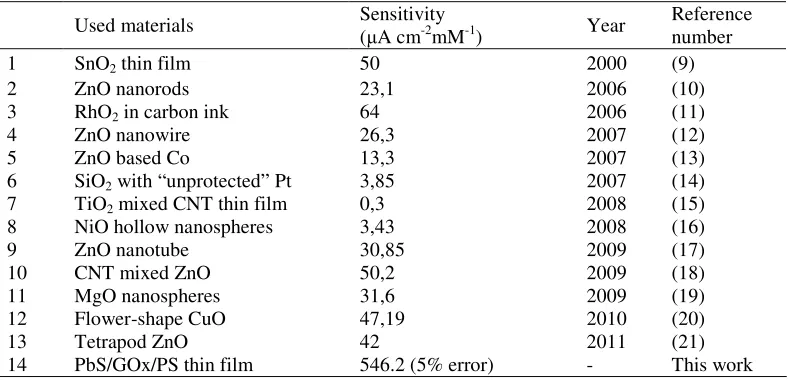
mM-1 sensitivity of the sensor, which is amazingly high in comparison with previous reports (Table 1).
Table 1.List of enzyme based glucose sensors using different nanomaterials with their sensitivities
Used materials Sensitivity
( A cm-2mM-1) Year
Reference number
1 SnO2 thin film 50 2000 (9)
2 ZnO nanorods 23,1 2006 (10)
3 RhO2 in carbon ink 64 2006 (11)
4 ZnO nanowire 26,3 2007 (12)
5 ZnO based Co 13,3 2007 (13)
6 SiO2 with “unprotected” Pt 3,85 2007 (14)
7 TiO2 mixed CNT thin film 0,3 2008 (15)
8 NiO hollow nanospheres 3,43 2008 (16)
9 ZnO nanotube 30,85 2009 (17)
10 CNT mixed ZnO 50,2 2009 (18)
11 MgO nanospheres 31,6 2009 (19)
12 Flower-shape CuO 47,19 2010 (20)
13 Tetrapod ZnO 42 2011 (21)
This work not only showed high glucose sensor sensitivity, but also set up a new method that increases the sensitivity of enzyme based organic molecules detecting sensors by exploiting the direct linkage between the electrochemical reaction of the nanomaterials and the oxido-reductase enzyme.
Figure 6. Glucose concentration dependence of current density at 1,15V by uncoated PbS prepared working electrodes after 3 days and 2 weeks storage.
Despite that the electrochemical interaction of the enzyme and the material is still unrevealed; we believed that the direct linkage between the lead atom of the nano-scale lead sulfide and the GOx molecules increased the sensitivity of the glucose sensor. The sensitivity of PbS-modified sensor reached 546.2 Acm-2mM-1. This would promise a good method to produce a long-reliable glucose sensor.
Acknowledgement
This work was financially support by VNU University of Science, Vietnam National University, Hanoi (No TN.14.06).
References
[1] http://www.who.int/mediacentre/factsheets/fs312/en/index.html
[3] Kang, X.H.; Mai, Z.B.; Zou, X.Y.; Cai, P.X.; Mo, J.Y. A Novel Glucose Biosensor Based On Immobilization of Glucose Oxidase in Chitosan on A Glassy Carbon Electrode Modified with Gold-Platinum Alloy Nanoparticles/Multiwall Carbon Nanotubes. Anal. Biochem. 2007, 369, 71–79.
[4] Shervedani, R.K.; Mehrjardi, A.H.; Zamiri, N. A Novel Method for Glucose Determination Based On Electrochemical Impedance Spectroscopy Using Glucose Oxidase Self-Assembled Biosensor. Bioelectrochemistry 2006, 69, 201–208.
[5] Tang, H.; Chen, J.H.; Yao, S.Z.; Nie, L.H.; Deng, G.H.; Kuang, Y.F. Amperometric Glucose Biosensor Based On Adsorption of Glucose Oxidase at Platinum Nanoparticle-Modified Carbon Nanotube Electrode. Anal. Biochem. 2004, 331, 89–97.
[6] Wang, S.G.; Zhang, Q.; Wang, R.L. ; Yoon, S.F.; Ahn, J.; Yang, D.J. Multi-Walled Carbon, Nanotubes for the Immobilization of Enzyme in Glucose Biosensors. Electrochem. Commun. 2003, 5, 800–803.
[7] Tsai, Y.C.; Li, S.C.; Chen, J.M. Cast Thin Film Biosensor Design Based on a Nafion Backbone, a Multiwalled Carbon Nanotube Conduit, and a Glucose Oxidase Function. Langmuir 2005, 21,3653–3658.
[8] Wang, J. Glucose Biosensors: 40 Years of Advances and Challenges. Electroanalysis 2001, 13, 983-988.
[9] 9. Kormos, F.; Sziraki, L.; Tarsiche, I. Potentiometric Biosensor fr Urinary Clucose Level Monitoring, RLA. 2000, 12, 291-295.
[10] Wei, A.; Suna, X.W.; Wang, J.X.; Lei, Y.; Cai, X.P.; Li, C.M.; Dong, Z.L.; Huang, W. Enzymatic Glucose Biosensor Based On ZnO Nanorod Array Grown by Hydrothermal Decomposition. Appl. Phys. Lett. 2006, 89, 123902(1–3).
[11] Cui, G.; Kim, S.J.; Choi, S.H.; Nam, H.; Cha, G.S. A Disposable Amperometric Sensor Screen Printed on a Nitrocellulose Strip: A Glucose Biosensor Employing Lead Oxide as an Interference-Removing Agent. Anal. Chem. 2000, 72, 1925–1929.
[12] Zang, J.; Li, C.M.; Cui, X.; Wang, J.; Sun, X.; Chang, H.D.; Sun, Q. Tailoring Zinc Oxide Nanowires for High Performance Amperometric Glucose Sensor. Electroanalysis 2007, 19,1008–1014.
[13] Zhao, Z.W.; Chen, X.J.; Tay, B.K.; Chen, J.S.; Han, Z.J.; Khor, K.A. A Novel Amperometric Biosensor Based On ZnO: Co Nanoclusters For Biosensing Glucose. Biosens. Bioelectron. 2007,23, 135–139.
[14] Yang, H.; Zhu, Y. Glucose biosensor Based on nano-SiO2 and “unprotected” Pt nanoclusters. Biosens. Bioelectron. 2007, 22, 2989–2993.
[15] Yang, D.H.; Takahara, N.; Lee, S.-W.; Kunitake, T. Fabrication of Glucose-Sensitive TiO2 Ultrathin Films by Molecular Imprinting and Selective Detection of Monosaccharides. Sens. Actuat. B-Chem. 2008, 130, 379–385. [16] Li, C.; Liu, Y.; Li, L.; Du, Z.; Xu, S.; Zhang, M.; Yin, X.; Wang, T. A Novel Amperometric Biosensor Based on
NiO Hollownanospheres for Biosensing Glucose. Talanta 2008, 77, 455–459.
[17] Yang, K.; She, G.-W.; Wang, H.; Ou, X.-M.; Zhang, X.-H.; Lee, C.-S.; Lee, S.-T. ZnO Nanotube Arrays as Biosensors for Glucose. J. Phys. Chem. C 2009, 113, 20169–20172.
[18] Wang, Y.T.; Yu, L.; Zhu, Z.-Q.; Zhang, J.; Zhu, J.-Z.; Fan, C.-H. Improved Enzyme Immobilization for Enhanced Bioelectrocatalytic Activity of Glucose Sensor. Sens. Actuator B-Chem. 2009, 136, 332–337.
[19] Umar, A.; Rahman, M.M.; Hahn, Y.-B. MgO Polyhedral Nanocages and Nanocrystals Based Glucose Biosensor. Electrochem Commun. 2009, 11, 1353–1357.
[20] Jiang, L.C.; Zhang, W.-D. A Highly Sensitive Nonenzymatic Glucose Sensor Based on CuO Nanoparticles-Modified Carbon Nanotube Electrode. Biosens. Bioelectron. 2010, 25, 1402–1407.
[21] Nguyen Thu Loan; Luu Manh Quynh; Ngo Xuan Dai; Nguyen Ngoc Long. Electrochemical biosensor for glucose sensor detection using zinc oxide nanotetrapods. Int. J. Nanotechnol., 2011, Vol. 8, Nos. ¾/5.
[22] Xiang, W.; Xinhui, L.; Yi, W.; Qing, G.; Zheng, F.; Xinhua, Zh.; Hongju, M.; Quinghui, J.; Lei, W.; Hui Zh.; Jianlong, Zh. QDs-DNA nanosensor for the detection of hepatitis B virus DNA and the single-base mutants. Biosensors and bioelectronics. 2010. DOI. 10.1016./j.bios.2010.01.007.
[23] Wongyoung, L.; Neil, P. D.; Orlando, T.; Jung-Rok, L.; Jaeeun, H.; Takane, U.; Fritz, B. P. Area-selective atomic layer deposition of lead sulfide: nanoscale patterning and DFT simulations. Lngamuir. 2010, 26(9), 6845-6852. [24] Jayesh, D. P.; Frej, M., Abdellah, A., Said, E. Room temperature synthesis of aminocaproic acid-capped lead
sulfide nanoparticles. Materials Sciences and Applications, 2012, 3, 125-130.