Original Research Article
Study of reproductive hygiene among married women at urban
field practice area, Dharwad
Pushpa S. Patil, Ashwini V. Rao*
INTRODUCTION
The status of reproductive health of women has to be assessed in all the stages of her life cycle as women can develop any serious health problems like reproductive tract infections (RTI), sexually transmitted diseases (STI) and HIV/AIDS; if proper care and guidance is not provided at the right time as there is a paramount need in addressing reproductive health problems. Women have to be equally educated about family planning and use of correct hygienic practices. Ignorance of the correct hygienic practices leads to deprivation of living a healthy life.1
Menstrual hygiene is an important issue that monthly affects adolescent girls and adult women. Personal, menstrual and sexual hygiene depends on individual’s socioeconomic status, personal preferences, local traditions and beliefs. In India, between 43% and 88% of women reuse cotton cloths instead of using disposable pads. Reusable materials are not sanitized properly. Cleaning is often done without soap usually with unclean water. Reusable clothes are dried away from open air and sunlight. All these practices are a result of various social taboos and restrictions which the women have been following since many years and are not ready to change ABSTRACT
Background: Women have to be assessed at every stage of her life to lead a healthy lifestyle free from diseases such as reproductive tract infections (RTI) and sexually transmitted infections, which can be easily prevented by good reproductive hygiene practices. There is a paramount need to address these problems at the earliest as they are increasing rapidly. This study was conducted to ascertain the practices of personal, menstrual and sexual hygiene among married women of reproductive age group, to determine the early symptoms of RTI’s in them and to determine association with key demographic variables and symptoms of RTI’s.
Methods: A cross sectional study was conducted among married women of reproductive age group visiting the urban health centre, Dharwad using semistructured questionnaire after taking informed consent from them. Data were analyzed using SPSS. Frequencies and Chi-square tests were applied.
Results: All the study participants practiced good personal hygiene practices. 59% of study participants used sanitary pads.78% washed their external genitalia during menstruation. 86% washed their genitalia after sexual intercourse. Backache (31%) was the most common symptom of RTI. Significant association was found between age and boils in the vaginal area (p=<0.01), age and low backache (p=0.013) and age and pain during coitus (p=0.006).
Conclusions: In our study most of them were aware of the correct hygienic practices. Backache is the most common symptom of RTI among them. Couples have to be educated on reproductive hygiene to prevent infections.
Keywords: Reproductive hygiene, Reproductive tract infections, Married women, Menstrual hygiene
Department ofCommunity Medicine, Shri Dharmasthala Manjunatheshwara Medical College of Medical Sciences and
Hospital, Dharwad, Karnataka, India
Received: 06 July 2018 Revised: 13 August 2018 Accepted: 14 August 2018
*Correspondence: Dr. Ashwini V. Rao,
E-mail: [email protected]
Copyright: © the author(s), publisher and licensee Medip Academy. This is an open-access article distributed under the terms of the Creative Commons Attribution Non-Commercial License, which permits unrestricted non-commercial use, distribution, and reproduction in any medium, provided the original work is properly cited.
them even after educating them the harmful effects of their practice. RTIs are a result of poor menstrual and sexual hygiene practices which could affect her reproductive health. Menstrual hygiene is also affected by factors such as access to places, access to the materials used during menstruation and also privacy and comfort for washing. At the household, these factors are influenced by having access to water and also sanitation facilities available in or closer to their household.2
RTIs are a major public health concern and are particularly common in low income regions. Considering huge burden of RTIs among women in the community, menstrual hygiene practices by reproductive age group women have documented evidence of being a key determinant and predictor of RTI. Menstrual hygiene
practices show a causal association with key
sociodemographic attributes.3
RTI’s are a silent epidemic and are closely related to poor menstrual hygiene. Similarly poor menstrual hygiene is also related to the development of RTIs. Use of old clothes result in increased urinary, vaginal and perineal infections. Serious infections are left untreated and may lead to various life threatening complications like fatal toxic shock syndrome. 10-15% of fetal wastage is caused as a result of untreated RTIs. The incidence of cervical cancer, HIV/AIDS, infertility, ectopic pregnancy, and a wide range of other symptoms have also increased due to increase in RTIs.4
The objectives of the study were to ascertain the practices of personal, menstrual and sexual hygiene among married women of reproductive age group (18-49 years), to determine the early symptoms of RTI’s in them and also to determine association with key demographic variables and symptoms of RTI’s.
METHODS
A cross sectional study was done in Urban Health Centre, Dharwad using a semistructured questionnaire after obtaining informed consent from the study participants. All married women of reproductive age group attending the Urban Health Centre for the period of 2 months (December 2017 to January 2018) were enrolled after taking informed consent to participate in the study. Women who had attained menopause were excluded from the study.
Sociodemographic details of the study participants were collected in the first section of the questionnaire. Second section had details of their menstrual and obstetric history. Third section involved the details of personal, menstrual and sexual hygiene practices. Last section involved various symptoms of RTI experienced by the participants in the past 12 months. The study participants were interviewed in a separate room by the author and their privacy undisclosed.
Data was collected and entered in excel sheet. Data were then coded and analysed in IBM developed SPSS version 21. Frequencies were calculated for qualitative data. Mean and standard deviation were calculated for quantitative data. Chi-square test was calculated to find the association between the key sociodemographic variables and symptoms of RTI.
RESULTS
Overview of respondents
A total of 197 respondents were included in the study. Study participants mean age was 33.72±6.73 years.
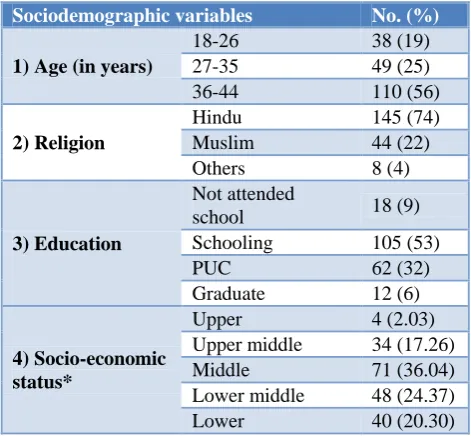
Table 1: Socio-demographic distribution of study participants (n=197).
Sociodemographic variables No. (%)
1) Age (in years)
18-26 38 (19)
27-35 49 (25)
36-44 110 (56)
2) Religion
Hindu 145 (74)
Muslim 44 (22)
Others 8 (4)
3) Education
Not attended
school 18 (9)
Schooling 105 (53)
PUC 62 (32)
Graduate 12 (6)
4) Socio-economic status*
Upper 4 (2.03)
Upper middle 34 (17.26)
Middle 71 (36.04)
Lower middle 48 (24.37)
Lower 40 (20.30)
*Modified B G Prasad classification (December 2017)
Table 1 shows sociodemographic distribution of study participants. Majority of the study participants (56%) were of 36-44 yrs age group. 74% were Hindus and 53% attended school. Majority (36%) were of middle class.
Majority of women attained menarche at 14 years. Mean age at marriage was 20.57±3.68. Most of the women were married for the duration of 15-21 yrs. Majority of the women had atleast one conception, most of the women underwent normal delivery and majority of them had two living children. 31% had one/two abortions and 69% had no abortions. During the study, 55.3% were tubectomised, 22.3% used no contraception, 19.3% used Copper T and 3% used condoms.
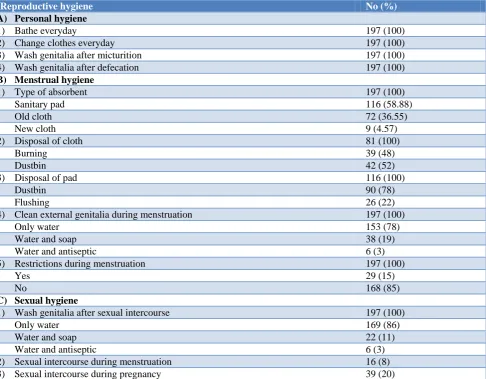
external genitalia with water both after micturition and defecation. On the days of heavy flow, majority of the study participants (79%) changed their absorbents twice daily. In the study participants who reused the cloth (37%), majority (41%) used water only and most (65%) of them dried under the sun.43% reused the cloth for 3 months. 14.7% had restrictions at home during menstruation such as they were not allowed to enter the kitchen, cook food for the family and had to sit outside. Most (86%) of the study participants washed their external genitalia after sexual intercourse only with water.
Table 3 shows the symptoms of RTI among the study participants. 65% of the study participants had one or more symptoms of RTI in the past 12 months out of which backache (31%) was the most common symptom followed by vaginal discharge (21%).
Table 4 shows the association between age and symptoms of RTI among the study participants. Significant association was found between age of the women (27-35 yrs) and boils/wounds in the vaginal area of the women (p≤0.01), age (36-44 yrs) and lower backache (p=0.013) and age (36-44 yrs) and pain during coitus (p=0.006). Significant associations were not found between other key sociodemographic variables and symptoms of RTI.
Table 2: Practice of reproductive hygienic methods among study participants (n=197).
Reproductive hygiene No (%)
A) Personal hygiene
1) Bathe everyday 197 (100)
2) Change clothes everyday 197 (100)
3) Wash genitalia after micturition 197 (100)
4) Wash genitalia after defecation 197 (100)
B) Menstrual hygiene
1) Type of absorbent 197 (100)
i) Sanitary pad 116 (58.88)
ii) Old cloth 72 (36.55)
iii) New cloth 9 (4.57)
2) Disposal of cloth 81 (100)
i) Burning 39 (48)
ii) Dustbin 42 (52)
3) Disposal of pad 116 (100)
i) Dustbin 90 (78)
ii) Flushing 26 (22)
4) Clean external genitalia during menstruation 197 (100)
i) Only water 153 (78)
ii) Water and soap 38 (19)
iii) Water and antiseptic 6 (3)
5) Restrictions during menstruation 197 (100)
i) Yes 29 (15)
ii) No 168 (85)
C) Sexual hygiene
1) Wash genitalia after sexual intercourse 197 (100)
i) Only water 169 (86)
ii) Water and soap 22 (11)
iii) Water and antiseptic 6 (3)
2) Sexual intercourse during menstruation 16 (8)
3) Sexual intercourse during pregnancy 39 (20)
Table 3: Symptoms of reproductive tract infections among study participants.
Symptoms of RTI No (%)
Itching in the vaginal area 24 (12)
Boils/wounds in vaginal area 6 (3)
Vaginal discharge 41 (21)
Pain abdomen 29 (15)
Backache 60 (31)
Increased frequency of micturition 34 (17)
Table: 4. Association between age and symptoms of RTI.
Symptoms of RTI
Sociodemographic variables No (%)
Total (%) Age (in years)
18-26 27-35 36-44
1) Itching in the vaginal area χ2=5.831
df=2 p=0.054
Present 8 (33) 2 (8) 14 (59) 24 (100)
Absent 30 (17) 47 (27) 96 (56) 173 (100)
2) Boils/wounds in vaginal area χ2=18.692
df=2 p≤0.01*
Present 0 (0) 6 (100) 0 (0) 6 (100)
Absent 38 (20) 43 (23) 110 (57) 191 (100)
3) Vaginal discharge χ2=0.831
df=2 p=0.660
Present 6 (15) 10 (24) 25 (61) 41 (100)
Absent 32 (20) 39 (25) 85 (55) 156 (100)
4) Pain abdomen χ2=1.898
df=2 p=0.387
Present 4 (14) 10 (34) 15 (52) 29 (100)
Absent 34 (20) 39 (23) 95 (57) 168 (100)
5) Low backache χ2=8.741
df=2 p=0.013*
Present 8 (13) 23 (38) 29 (49) 60 (100)
Absent 30 (22) 26 (19) 81 (59) 137 (100)
6) Increased frequency of micturition χ2=0.460
df=2 p=0.795
Present 6 (18) 10 (29) 18 (53) 34 (100)
Absent 32 (20) 39 (24) 92 (56) 163 (100)
7) Pain during coitus χ2=10.107
df=2 p=0.006*
Present 0 (0) 0 (0) 12 (100) 12 (100)
Absent 38 (20) 49 (27) 98 (53) 185 (100)
*Significant (p≤0.05).
DISCUSSION
In our study majority of the study participants belonged to the age group of 36-44 yrs whereas majority of study population (36%) belonged to the age group of 21-30 year age group in a study conducted by Balamurugan et al in Tamilnadu.4 In our study majority (59%) used sanitary pads, 5% used fresh cloths and 37% used reusable clothes and in a study conducted by Hemapriya et al in Puducherry, majority of the study participants (89.2%) used sanitary pads; fresh and reusable cloths were used by 6.6% and 4.2%, respectively. The less use of sanitary pads in our study may be due to majority of study participants in the age group 36-44yrs whereas in the study conducted in Puducherry there were adolescent girls who were much aware of sanitary pads and its uses due to health education provided in schools.5 In our study 59% used sanitary pads which were less when compared to a study done by Kumar et.al in south Delhi where 91% used sanitary pads since Delhi is metropolitan city therefore there was better awareness of usage of sanitary pads.6 65% of the study participants in our study reported atleast one symptom of RTI which was more when
compared to a study done by Mani in Tamil Naduwhere
33.3% reported atleast one symptom of RTI as majority belonged to Class III in our study when compared to Class II in Tamilnadu study.7 In a study done by Balamurugan et al in Hubli, Karnataka, majority of women (32.7%) complained of abnormal vaginal discharge followed by lower backache in (31.4%) and
lower abdominal pain in (23.5%) women. In our study, 21% complained of vaginal discharge, 31% Lower backache and 15% lower abdominal pain. Similar (31%) low backache was found in both the studies.8 In our study 21% had vaginal discharge which was less when compared to a study done by Sreelatha et al in Hassan,
Karnataka in which 63% had vaginal discharge. Low
backache was 31% and abdominal pain was 15% in our study was more than that in Hassan study which is 13% and 11% respectively.As the majority of the women in our study were of the age group of 36-44 yrs therefore the vaginal discharge is less and low backache is more when compared to the study done in Hassan where the majority of the study participants were of the age group 20-24 yrs as vaginal discharge is more common in that 20-24 yrs and backache is more common in 36-44yrs.9 In a study conducted by Rana et al in Jammu and Kashmir, vaginal discharge (22%) and pain abdomen (13%) reported were almost similar to our study where vaginal discharge and
abdominal pain were 21% and 15% respectively.10
CONCLUSION
have to be educated on reproductive hygiene to prevent infections.
Recommendations
Emphasis has to be given on adequate changing times of soaked absorbent, adequate number of times of cleaning of external genitalia, sanitary material used for cleaning
purpose and method of disposal.Every woman should be
given access to sanitary pads and its use has to be
universalised through social marketing. Reproductive
hygiene educations have to be provided to adolescent girls along with all the married women Reproductive health problems should be discussed with the physician and should be examined by the physician at the earliest.
ACKNOWLEDGEMENTS
The authors are thankful for all the women who participated in the study for their co-operation and support.
Funding: No funding sources Conflict of interest: None declared
Ethical approval: The study was approved by the Institutional Ethics Committee
REFERENCES
1. Singh S, Chaturvedi S, Kumar A, Kannan AT.
Reproductive Health of Newly Married Women residing in a Resettlement Colony of Delhi: A Longitudinal Study. Indian J Public Health. 2010;54(1):30-2.
2. Das P, Baker KK, Dutta A, Swain T, Sahoo S, Das
BS, et al. Menstrual Hygiene Practices, WASH Access and the Risk of Urogenital Infection in
Women from Odisha, India. PLoS ONE.
2015;10(6):e0130777.
3. Singh S, Kandpal SD, Roy D. Menstrual Hygiene
Practices and RTI among ever-married women in
rural slum. Indian J Community Health.
2011;23(2):41-3.
4. Balamurugan SS, Shilpa SS, Shaji S. A community
based study on menstrual hygiene among
reproductive age group women in a rural area, Tamil Nadu. J Basic Clin Reprod Sci. 2014;3(2):83-7.
5. Hema Priya S, Nandi P, Seetharaman N, Ramya
MR, Nishanthini N, Lokeshmaran A. A study of menstrual hygiene and related personal hygiene
practices among adolescent girls in rural
Puducherry. Int J Community Med Public Health. 2017;4(7):2348-55.
6. Kumar G, Prasuna JG, Seth G. Assessment of
menstrual hygiene among reproductive age women in South-west Delhi. J Family Med Prim Care. 2017;6:730-4.
7. Mani G. Prevalence of Reproductive Tract
Infections among married women in Tamil Nadu, India Pioneer. Med Sci. 2014;4(1):18-24.
8. Balamurugan SS, Bendigeri ND. Study of
Reproductive Tract Infections among Women of the Reproductive Age Group in the Urban Health Training Centre Area in Hubli, Karnataka. Indian J Community Med. 2012;37(1):34–8.
9. Sreelatha CY, Sumana M, Sundar M, Sreeranga A,
Pavithra P. Prevalence of symptoms of reproductive tract infections among married reproductive age group women in Hassan, Karnataka, India. Int J Community Med Public Health. 2017;4(1):206-10.
10. Rana M, Rana VM, Atri SK. Contribution of
Socioeconomic Factors to Reproductive Tract Infections and Infertility in Rural India. J Evol Med Dental Sci. 2015;4(21):3669-74.