1260 | P a g e
PRIORITY IN COMPUTER TECHNOLOGY FOR
MASS STORAGE AND DIGITAL IMAGE
PROCESSING PAVED
S.Nageshwari
1, Cherukuri Doraswamy
2, Sudhini Sushma
31
Software Engineering, Software Process & Project agrement.
2
Amulya Department of Computer Science And Engineering
SRTIST
3
Department of Computer Science And Engineering SRTIST, Nalgonda
ABSTRACT
With the continuous growth of modern technology, demand for image transmission and storage is increasing
rapidly. Advance in computer technology for mass storage and digital processing paved way for implementing
advanced data compression techniques .Fractal image is a new technique for encoding images compactly. It is
based on local self similarity within images. This compression technique gives higher compression ratio with
moderate image quality. In this algorithm instead of searching entire domain image it will search in the edges.
This compression technique is superior to the other existing methods and compression ratio as high as 100 is
possible. In the decoding technique the quality of image becomes better with each iteration.
Key Words
:
Fractal, Iterative, Encoding, Contrast, Brightness
1. INTRODUCTION
Data compression is the process of transforming the data description into a more succinct and condensed
form [3]. This improves storage efficiency, communication speed, and security. These facts justify the efforts, of
private companies and universities, on new image compression algorithms. Images are stored on computers as
collections of bits (a bit is a binary unit of information which can answer “yes” or “no” questions) representing
pixels or points forming the picture elements [2]. Since the human eye can process large amounts of
information (some 8 million bits), many pixels are required to store moderate quality Images. Most data
contains some amount of redundancy, which can sometimes be removed for storage and replaced for recovery,
but this redundancy does not lead to high compression ratios. An image can be changed in many ways that
are either not detectable by the human eye or do not contribute to the degradation of the image [1]. So how
can image data be compressed? Fortunately, the human eye is not sensitive a wide variety of information
loss [2].That is, the image can be changed in many ways that are either not detectable by the human eye or do
not contribute to degradation of the image. If these changes are made so that the data becomes highly
redundant, then the data can be compressed when the redundancy can be detected. Fractal image compression is
1261 | P a g e Institute of Technology [4]. Barnsley was the first to propose the notion of Fractal Image Compression by which
real life objects would be modeled by deterministic fractal objects. The fractals that one can easily generate with
an iterated function system are all of a particular type. It was Michael Barnsley and his research group from the
Georgia Institute of Technology who first saw and realized the potential of iterated function systems for
modeling of, e.g., clouds, trees, and leaves [3]. Fractal based techniques have been applied in several areas of
digital image About ten to fifteen years ago fractal techniques are introduced in computer science for natural
phenomena. The new idea comes from natural theory called iterated function system.(IFS). Michael Barnsley
and his research group from Georgia Institute of first saw and realized the potential of iterated function systems
for modeling of clouds, trees etc. The fractals that can generate with iterated function systems are of particular
type . Thus in an IFS coding of a picture of face one should observe tiny distorted copies of face everywhere.
This seemed not only unnatural but also technically infeasible. In 1989 ,Arnaud Jacquin one of the graduate
students of Barnsley ,realized the first automatic fractal encoding systems in his dissertation ,leaving behind the
rigid thinking in terms of global IFS mappings. This broke the ice for new direction research in image coding
[4][5].
1.1 Fractal Goldrush
The basic new ideas in Jacquin‟ s approach was simple. An image should not thought be thought of as a collage
copies of entire ,but copies of smaller parts of it. The general approach is to subdivide the image into a partion
into fixed size square blocks and then to find matching image portion of each part.. This set up has been known
as local or partitioned iterated function system(PIFS).
1.2 What is Fractal Image Compression?
Imagine a special type of photocopying machine that reduces the image to be copied by half and reproduces it
three times on the copy (see Figure 1). What happens when we feed the output of this machine back as input?
Figure 2 shows several iterations of this process on several input images. We can observe that all the copies
seem to converge to the same final image, the one in 2(c). Since the copying machine reduces the input image,
any initial image placed on the copying machine will be reduced to a point as we repeatedly run the machine; in
fact, it is only the position and the orientation of the copies that determines what the final image looks like[7].
The way the input image is transformed determines the final result when running the
copy machine inafeedback loop. However we must constrain these transformations, with the limitation that the transformations must be
contractive (see contractive box), that is, a given transformation applied to any two points in the input image must
bring them closer in the copy. This technical condition is quite logical, since if points in the copy were spread out the
final image would have to be of infinite size. Except for this condition the transformation can have any form. In
practice, choosing transformations of the form
(
1.2.1
)
1262 | P a g e is sufficient to generate interesting transformations called affine transformations of the plane. Each can skew,
stretch, rotate, scale and translate an input image. A common feature of these transformations that run in a loop
back mode is that for a given initial image each image is formed from a transformed (and reduced) copies of
itself, and hence it must have detail at every scale. That is, the images are fractals[6][9]. Barnsley suggested that
perhaps storing images as collections of transformations could lead to image compression.
II MATHEMATICAL FOUNDATION
2.1 CONTRACTIVE TRANSFORMATIONS
A transformation w is said to be contractive if for any two points P1, P2, the distance d(w(P1),w(P2) ) <
sd(P1,P2) for some s < 1, where d = distance. This formula says the application of a contractive map always
brings points closer together (by some factor less than 1).
2.2 THE CONTRACTIVE MAPPING FIXED POINT THEOREM
This theorem says something that is intuitively obvious: if a transformation is contractive then when applied
repeatedly starting with any initial point, we converge to a unique fixed point. If X is a complete metric space
N ( 2.2.1)
W
=
wi 1 i
and W: X→X is contractive, then W has a unique fixed point |W|. Usually w is of the form
Where each wi is a contractive mapping. However, this is not Strictly required. It is sufficient if w is eventually
contractive. However, this is not strictly required. It is sufficient if w is eventually contractive. For example, the
mapping w(x) = ½ x on the real line is contractive for the normal metric d(x,y) = |x-y|, because the distance
between w(x) and w(y) is half the distance between x and y. Furthermore, if we iterate w from any initial point
x, we get a sequence of points ½ x, ¼x, 1/8 x …..that converges to a fixed point 0.This simple sounding theorem
tells us when we can expect a collection of transformations to define image.
2.3 COLLAGE THEOREM:
Let (Y, dY ) be a complete metric space. Given an
suppose that there exists a contractive map f on Y with contractivity factor 0 ≤ c < 1 such that
(2.3.1)
If is the fixed point of
(2.3.2)
then
1263 | P a g e
So if one wishes to approximate a function y with the fixed point of an unknown contractive map f, it is only
needed to solve the inverse problem of finding f which minimizes the collage distance dY (y,f(y)). The main
result in Forte and Vrscay that we will use to build one of the IFSs estimators is that the inverse problem can be
reduced to minimize a suitable quadratic form in terms of the pi given a set of affine maps wi and the sequence
of moments gk of the target measure. Let
(2.3.4)
be the simplex of probabilities. Let w = (w1,w2, . . . ,wn), N = 1, 2, . . . be subsets of W = {w1,w2, . . .} the
infinite set of affine contractive maps on X = [0, 1] and let g the set of the moments of any order of
Denote by M the Markov operator of the N-maps IFS (w, p) and by[4]
(2.3.6)
(2.3.5)
, with associated moment vector of any order hN. The collage distance between the moment vector of
(2.3.7)
is a continuous function and attains an absolute minimum value min on ΠN
(2.3.8)
III ITERATED FUNCTION SYSTEMS
Before we proceed with the image compression scheme, we will discuss the copy machine example with some
notation. Running the special copy machine in a feedback loop is a metaphor for a mathematical model called an
iterated function system (IFS). An iterated function system consists of a collection of contractive
transformations; discuss the copy machine example with some notation. Running the special copy machine in a
feedback loop is a metaphor for a mathematical model called an iterated function system (IFS). An iterated
function system consists of a collection of contractive transformations.{ wi : R2 | i = 1…n } which map the
plane R2 to itself. This collection of transformations define a map
W (.) = wi(.)
The map W is not applied to the plane, it is applied to sets that is, collections of points in the plane. Given input
set S, we can compute wi (S) for each i, take the union of these sets, and get a new set W(S). So W is a map on
the space of subsets to the plane. We call these transformations „Block wise‟ transformations. An important
fact proved by Hutchinson is that when the wi are contractive in the plane, then W is contractive in a space of
(closed and bounded) subsets of the plane. Hutchinson‟ s theorem allows us to use the contractive mapping
fixed point theorem (see box), which tells us that the map W will have a unique fixed point in the space of all
images. That is, whatever image (or set) we start with, we can repeatedly apply W to it and we will converge to
a fixed image. Thus W (or the wi ) completely describe a unique image. In other words, given an input image f0,
we can run the copying machine once to get f1 = W(f0), twice to get f2 = W(f1) =W(W(f0)) = Wo2(f0), and so
on. The attractor, which is the result of running the copying machine in a feedback loop, is the limit set which is
1264 | P a g e concerned with them specifically. We will generalize the idea of the copy machine and use it to encode gray
scale images.
3.1 Affine Transformation
An affine transformation or affine map[1] or an affinity (from the Latin, affinis, "connected with") is a function
between affine spaces which preserves points, straight lines and planes. Also, sets of parallel lines remain
parallel after an affine transformation. An affine transformation does not necessarily preserve angles between
lines or distances between points, though it does preserve ratios of distances between points lying on a straight
line.
Examples of affine transformations include translation, scaling, similarity transformation, reflection, rotation,
shear mapping, and compositions of them in any combination and sequence. Every linear transformation is
affine, but not every affine transformation is linear[8].
If X and Y are affine spaces, then every affine transformation f : X → Y is of the form x→ Mx + b, where M is
a linear transformation on X and b is a vector in Y. Unlike a purely linear transformation, an affine map need not
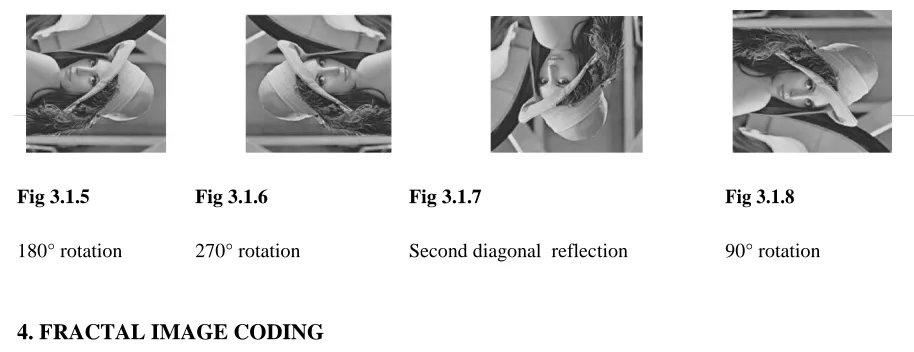
preserve the zero point in a linear space. There are eight types of affine transformation as follows
Fig 3.1.5 Fig 3.1.6 Fig 3.1.7 Fig 3.1.8
180° rotation 270° rotation Second diagonal reflection 90° rotation
4. FRACTAL IMAGE CODING
Suppose we are dealing with an image of 256×256 in which each pixel consists of one of 256 gray levels called
Range image. We then average an down sample the image into 128×128 size called domain image. We
partitioned both images into blocks of 8×8 pixels sizes. We performed the following affine transformations
to each block domain image Di,j = si Di,j +oi
Where si - [0,1], si €R and oi € [-255,255] oi €Z. In this case we are trying to find linear transformations of
our domain block to arrive to the best [11][12]approximation of a given Range block. Each domain block is
transformed and of our domain block to arrive to the best approximation of a given Range block. Each domain
block is transformed and then compared to each range block Rk,l [7][8]. The comparison process is done by
sliding a window of size 8×8 on the domain block. . The window is moved to one pixel value right and again
1265 | P a g e
will be 121×121 number of times. We will determine the values of si, oi which minimizes the mean square error.
The formula of si, oi is given below[2].
2
n n n
D
i R i) ( D i)(
R i)
n (
s i
i
1 1 i i 1
n 2
n 2 n 2
D i
( D
i )
i
1 i 1
n n
R i s i D i o i
i
1 i 1
2
n
(4.1)
(4.2)
And
Where m, n , Ns =2 or 4(size of blocks)
The value of Si and Oi should be quantized.The formula used for quantizing the values of Si and Oi is given
by[10].
Here we have taken 4 bits for si and 7 bits for oi to quantize. We can even quantize by taking 5 bits for si and 7
bits for oi. Each transformed domain block is compared to each range block i.e. T(Di,j) is compared to each
range block Rk,l in order to find the closest domain block to each range block. This comparison is performed
using the following distortion measure. (4.3)
Each distortion is stored and the minimum is chosen. The transformed domain block which is found to be the
best approximation for the current range block is assigned to that range block, i.e. the coordinates of the domain
block along with its a and to are saved into the file describing the transformation. This is what is called the
Fractal Code Book[4].
4.1 Encoding Algorithm
1266 | P a g e to create the domain image of 128×128 blocks.
2. Partition the range (R) and domain images into 4×4 (or) 8×8 (or) 16×16 blocks.
3. For each block of range image rigorously such
4. For each block of range image rigorously such its approximation block in the domain image within
the edges of the image.
5. We have to use the eight types of isometrics(Rotate 00 ,Rotate 900,Rotate - 900,Rotate
1800,Rotate -1800,Rotate 450,Rotate -450,Rotate 2700)
6. Find the contrast (si) ,brightness (oi) and the RMS error of the image. The domain block will be
the best match of range block which gives lowest RMS error.
7. Store the x,y co-ordinates of the domain block, the contrast(si), brightness(oi) and the types of
isometrics used.
8. This will be the fractal code for the range image.
4.2
Decoding Algorithm
1. Take an image of any size and find its domain image by averaging and down sampling the range image.
2. Read the fractal code and fetch the corresponding domain block from corresponding x,y co-ordinate of the
fractal code.
3. Rotate the block with the isometrics used in the fractal code.
4. Multiply the contrast and add the brightness with the corresponding block.
5. Use this method for the entire fractal code to create the new image.
6. Repeat step 1 to 6 for seven times to get the original image.
V RESULTS
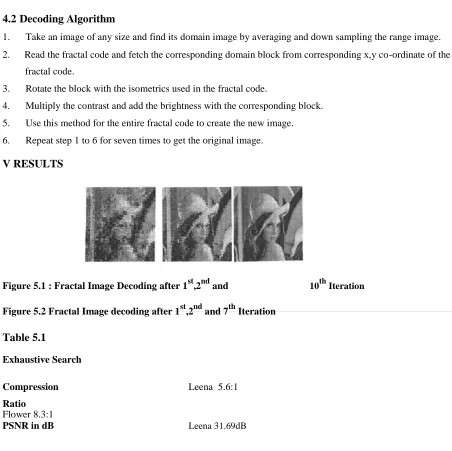
Figure 5.1 : Fractal Image Decoding after 1st,2nd and 10th Iteration
Figure 5.2 Fractal Image decoding after 1st,2nd and 7th Iteration
Table 5.1
Exhaustive Search
Compression Leena 5.6:1
Ratio Flower 8.3:1
1267 | P a g e Flower 31.24dB
Encoding Leena 6000 sec
Time
Flower 6100 sec
VI CONCLUSION AND FUTURE SCOPE
Using this fractal image compression technique we achieved better image compression ratio and the quality of
image becomes better with each iteration. We have decreased the encoding time to a significant amount. The
encoding time can be further reduced by using parallel processing and genetic algorithm.
REFERENCES
[1] An introduction to fractal image compression ,http//www.s.ti.com/psheets/bpra065.pdf.
[2] Y.Fisher, “Fractal image compression, Siggraph „92‟ course notes”.
[3] Kosmas karadimitrion , “set redundancy , the enhanced compression ,model and methods for
compressing images”, PhD Thesis , Lousiana state university,1999.
[4] Venu Gopalpuram, “Image coding based on fractal theory of iterative contractive image
transformations”,1999.
[5] Yuval Fisher, Fractal image compression theory and application, Springer –veralag,1995.
[6] http//www.njcmr.org/ ~mxr0096/thesis.ps.gz.
[7] Dietmar Saupe, Raouf Hamzaaouri, Hannes Hartnstein, “Fractal Image compression an
introductory overview”, ftp://ftp.informatik.Uni-freiburg,DE/documents /paper/fractal.
[8] Arnand E. Jacquin, “ A Novel Fractal block-coding Technique for digital images” ,Geogia Institute of
Technology ,Atlanta, 1989 .
[9] Mathias Ruhl, “Fractal based compression : Adaptive portioning and complexity” , PhD. Thesis
,Albert-Ludwigs - University,1997.
[10] Barnsley.M, “Fractals Everywhere”, San Diego ,1989.
1268 | P a g e S.Nageshwari pursuing M.Tech in Swami Ramananda Tirtha Institute of Science and
technology, Nalgonda, Telangana, India. Her research areas include Image Processing,
Computer Networks, Software Engineering, Mobile Ad-Hoc Networks, Software Process
& Project Management.
Cherukuri Doraswamy Amulya M.Tech Computer Science and Engineering from SRTIST
college of Engineering, JNTUH and B.Tech Computer Science and Engineering from
Nagarjuna Institute of Technology and Science, JNTUH She has more than 5 years of
experience and guided UG & PG students, currently she is working as Asst Prof at SRTIST
Engineering College. Her research areas include Image Processing, Software Engineering,
Data Mining, Object oriented Analysis &Design, Computer Networks.
Sudhini Sushma M.Tech Computer Science and Engineering from GGIH College of
Engineering, JNTU B.Tech Computer Science and Engineering from REC Engineering
College. She has more than 2 years of experience and guided UG & PG students, currently
she is working as Asst Prof at SRTIST Engineering College. Her research areas include
Image Processing, Computer Networks, Software Engineering, Mobile Ad-Hoc Networks,