345 | P a g e
COMPARATIVE STUDY ON STRENGTH
ENHANCEMENT OF CONCRETE USING MAGNETIC
AND NORMAL WATER
Gayatri Y. Firke
1, S.S.Bachhav
2, D.Y.Kshirsagar
31
Master of Engineering Student,
2PG Coordinator,
3Head of Department
Department of Civil Engineering, S.S.V.P.S. College of Engineering Dhule, Maharashtra (India)
ABSTRACT
The most important challenge for concrete technologists is to improve the properties of concrete i.e. To
increasing the compressive strength of concrete and to get more workable concrete at less water content. So
various methods are used to increase strength such as Use of fibre reinforcement, Use of fly ash, Use of epoxy
polymer and polymer concrete, Use of high range of water reducing super plasticizers etc. These methods
increase strength but are very costly. So our aim is to produce economical concrete with higher strength. Till
now Normal water is used for mixing different ingredients of concrete. This paper finds new technology called
magnetic water technology has been used in mixing and curing of concrete. As per this technology, by passing
water through a magnetic field, some of its physical properties tends to change which causes decrease in the
hardness of water, with an improvement in the workability and strength of concrete when compared to use of
Normal water in concrete. Strength tests conducted on this magnetic water concrete showed encouraging
results and one can easily replace normal water with magnetic water for mixing and curing of concrete.
Keywords: Compressive strength, Flexural strength, Hardness, Magnetic water, Normal water.
I.
INTRODUCTION
Concrete is a composite material that made up of aggregate, cement, and water. The role of aggregate is a filler
material as it is chemically inert. Meanwhile, the mix of cement and water form the cement paste required to
bind the aggregate together. Usually, Normal water is recommended to produce concrete as it does not cause
side reactions that may interfere with the hydration process. As a twenty percent by weight of cement, water is
required for the hydration of the cement. Extra amount of water (from 15% to 20% by weight of cement) is
required to provide space for the cement hydration products. The final water cement ratio is the most critical
factor affects the production of durable and consistent concrete as high water cement ratio (w/c) severely
reduces the concrete strength, while low water cement ratio (w/c) produces unworkable concrete. Therefore,
attempts have been made to increase the specific surface area of water and the effects of increased surface area
are studied on the workability and compressive strength of concrete. Magnetising the water is found to be
346 | P a g e
II.
EXPERIMENTAL DETAILS
Experimental program has been designed to compare the strength appraisal (& days and 28 days) by replacing
normal water with magnetic water for both casting and curing. This paper focuses on the use of M25 grade of
concrete as The IS 456:2000 recommendations with a target mean strength mean compressive strength of 31.6
N/mm2.
A)
MATERIALS USED
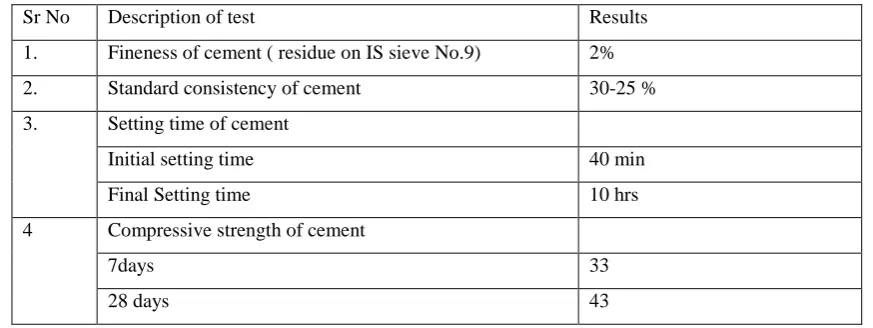
1) CEMENT : For the present investigation ordinary Portland cement-43 grade have been used. The cement
was tested according to IS 8112-1989.
Table 1. Physical properties of cement
Sr No Description of test Results
1. Fineness of cement ( residue on IS sieve No.9) 2%
2. Standard consistency of cement 30-25 %
3. Setting time of cement
Initial setting time 40 min
Final Setting time 10 hrs
4 Compressive strength of cement
7days 33
28 days 43
2) AGGREGATE:- Fin aggregate is locally available river sand. Coarse aggregate of 10 mm and 20 mm size
is used.
Table 2: physical properties of Fine aggregate
Sr no Property Fine aggregate Coarse aggregate
1 Particle shape, size Round,4.75 mm Angular, 10mm & 20mm
2 Fineness modulus 2.96 20 mm-7.4 and 10 mm 6.57
3 Silt content 1.6% 6.57
4 Specific Gravity 2.64 2.84
5 Water absorption - 0.40%
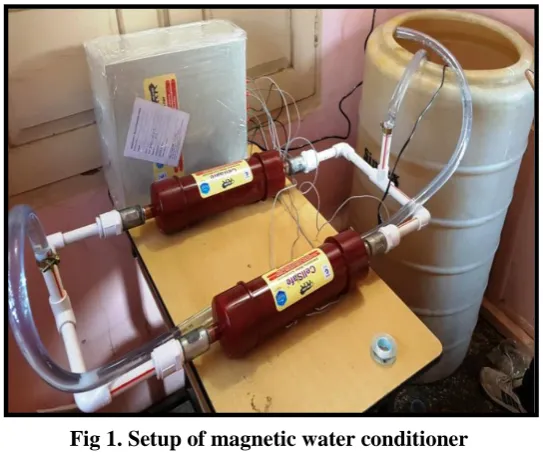
B) PREPARATION OF MAGNETIC WATER: For the preparation of magnetic water the instrument was
set up as shown if figure fitted the inlet of electromagnet instrument is attached to the outlet of water pump
and the outlet of electromagnet to the inlet of permanent magnet instrument. Both the magnets are attached
in series to each other as per the manual. The inlet of water motor and outlet of permanent magnet
instrument is made to receive and collect water in the same water tank respectively. This process of
recirculation of water through magnetic instrument was done for the minimum duration of 2 hour each day
with a discharge of 900 Lt/hr at a Guass of 12000. The magnetic water prepared for curing purpose was also
347 | P a g e
Fig 1. Setup of magnetic water conditioner
C) TEST CONDUCTED ON WATER
The water sample used for project was locally available for construction on site with TDS of 450.
Table 4: physical properties of water
Sr
no
Parameters (ppm) Normal
water
Magnetic
water
% increase or
decrease
Remark
1. pH determination 7.39 8.06 9.06% increase Increase in PH
2. Hardness 326 280 16.42% decrease Decrease in hardness
D) MIX DESIGN: In the present investigation work the effect of magnetized water on workability and
strength properties on M25 grade of concrete is carried out. The Indian standard mix design procedure
is adopted (i.e., IS: 10262-2009) in the present investigation to arrive the mix proportions for M25
grade of concrete.
Table 5: Mix design of M25 grade
Water Cement Fine aggregate Coarse aggregate
186 372 767.39 1094.31
0.5 1 2.06 2.94
E) RESULTS AND DISCUSSIONS:
1) WORKABILITY: Properties of fresh concrete were mainly judged by workability by slump test. Slump
test is performed to check the workability and consistency of the fresh concrete. Slump test as per IS: 1199
348 | P a g e
`Fig 2. A) Normal water slump B) magnetic water slump
Fig 2.B shows that the workability is improved when using MW (Magnetized Water) in concrete. Using NW in
concrete, slump (25 mm) is achieved while using MW in concrete slump (110 mm) is achieved in 0.5 w/c ratio.
There is drastic increase in workability when we use magnetic water in concrete.
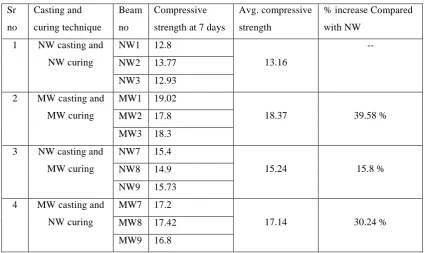
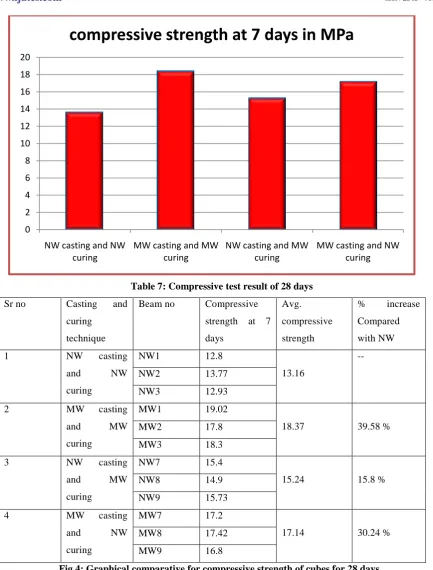
2) COMPRESSIVE STRENGTH OF CONCRETE: This is the important test which gives an idea about
all the characteristics of concrete and strength in compression. By this single test one judge that whether
concreting has been done properly or not. For cube test we have used 150mm x150mm x 150mm size
specimens. The testing is Perform after 7 days and 28 days curing with both magnetic water and normal
water . For testing of cubes compressive testing machine is used. . The compressive Strength of concrete
cube was determined based on IS: 516 – 1959.
Table 6: Compressive test result of 7 days
Sr
no
Casting and
curing technique
Beam
no
Compressive
strength at 7 days
Avg. compressive
strength
% increase Compared
with NW
1 NW casting and
NW curing
NW1 12.8
13.16
--
NW2 13.77
NW3 12.93
2 MW casting and
MW curing
MW1 19.02
18.37 39.58 %
MW2 17.8
MW3 18.3
3 NW casting and
MW curing
NW7 15.4
15.24 15.8 %
NW8 14.9
NW9 15.73
4 MW casting and
NW curing
MW7 17.2
17.14 30.24 %
MW8 17.42
MW9 16.8
349 | P a g e
Table 7: Compressive test result of 28 days
Sr no Casting and
curing
technique
Beam no Compressive
strength at 7
days
Avg.
compressive
strength
% increase
Compared
with NW
1 NW casting
and NW
curing
NW1 12.8
13.16
--
NW2 13.77
NW3 12.93
2 MW casting
and MW
curing
MW1 19.02
18.37 39.58 %
MW2 17.8
MW3 18.3
3 NW casting
and MW
curing
NW7 15.4
15.24 15.8 %
NW8 14.9
NW9 15.73
4 MW casting
and NW
curing
MW7 17.2
17.14 30.24 %
MW8 17.42
MW9 16.8
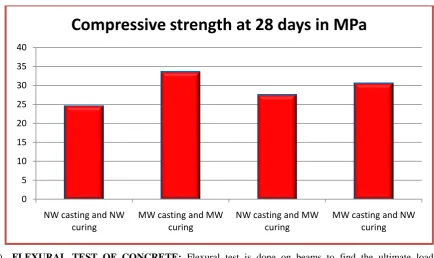
Fig 4: Graphical comparative for compressive strength of cubes for 28 days 0
2 4 6 8 10 12 14 16 18 20
NW casting and NW curing
MW casting and MW curing
NW casting and MW curing
MW casting and NW curing
350 | P a g e
3) FLEXURAL TEST OF CONCRETE: Flexural test is done on beams to find the ultimate load,deflection and ultimate moment of the given beam section. Two-point load is given at a distance of L/3
from the support. For beam test we have used 100mm x100mm x500mm size specimen. Flexural strength
test is perform after 7 days and 28 days curing. For flexural testing Universal testing machine is used.
The Flexural Strength of concrete Beam was determined based on IS: 516 – 1959.
Table 8: Flexural test result of 7 days
Sr no Casting and curing
technique
Beam no Compressive
strength at 7
days
Avg.
compressive
strength
% increase
Compared
with NW
1 NW casting and NW
curing
NW1 12.8
13.16
--
NW2 13.77
NW3 12.93
2 MW casting and
MW curing
MW1 19.02
18.37 39.58 %
MW2 17.8
MW3 18.3
3 NW casting and MW
curing
NW7 15.4
15.24 15.8 %
NW8 14.9
NW9 15.73
4 MW casting and NW
curing
MW7 17.2
17.14 30.24 %
MW8 17.42
MW9 16.8
0 5 10 15 20 25 30 35 40
NW casting and NW curing
MW casting and MW curing
NW casting and MW curing
MW casting and NW curing
351 | P a g e
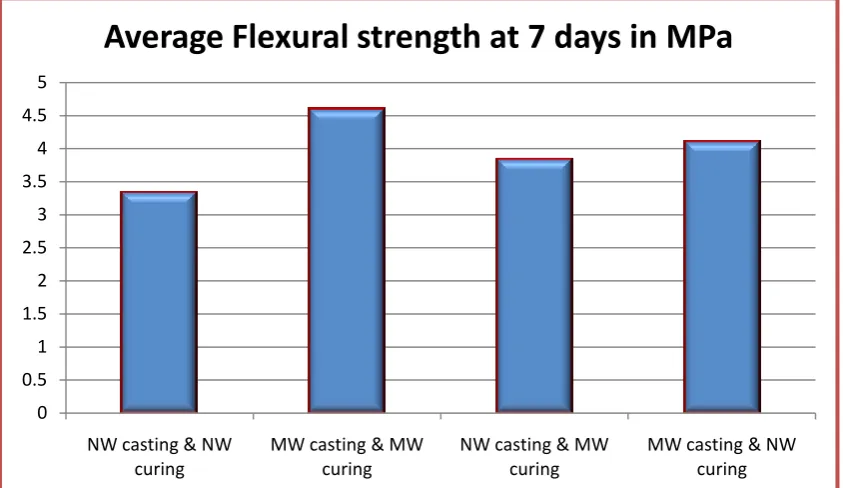
Fig5: Graphical comparative for Flexural strength of Beams for 7 days
Table 9: Flexural test result of 28 days
Sr no Casting and
curing
technique
Beam no Compressive
strength at 7
days
Avg.
compressive
strength
% increase
Compared
with NW
1 NW casting
and NW
curing
NW1 12.8 13.16 --
NW2 13.77
NW3 12.93
2 MW casting
and MW
curing
MW1 19.02 18.37 39.58 %
MW2 17.8
MW3 18.3
3 NW casting
and MW
curing
NW7 15.4 15.24 15.8 %
NW8 14.9
NW9 15.73
4 MW casting
and NW
curing
MW7 17.2 17.14 30.24 %
MW8 17.42
MW9 16.8
0 0.5 1 1.5 2 2.5 3 3.5 4 4.5 5
NW casting & NW curing
MW casting & MW curing
NW casting & MW curing
MW casting & NW curing
352 | P a g e
Fig6: Graphical comparative for Flexural strength of Beams for 28 days.
CONCLUSIONS
1) Compressive strength of concrete at 7 days increases by 39.58 % and that of 28 days increases by 36.36
% when treated and cured with magnetic water.
2) Flexural strength of concrete at 7 days increases by 37.72 % and that of 28 days increases by 32.76 %
when treated and cured with Magnetic water.
3) It is advisable to use magnetic water for casting and curing of concrete in construction industry.
4) The underground water that is brackish in nature can also me made soft by using magnetic treatment and
can be made suitable for construction purpose.
5) Eliminates the use of any known admixtures and supplementary materials.
6) One time investment for life time operation.
7) It treats water physically not chemically. So No use of recurring chemicals or salts or filters.
8) It increases solubility of water so improvement in workability.
9) Treated water surface tension will be low compared to non- treated water.
10) Fully automatic operation. No manual interference.
11) Ecofriendly.
REFERENCES
[1.] M.S Shetty “ Concrete Technology Theory and practice” S.Chand Publications, 2005
[2.] Craig Andrew McMahon, 2009 “Investigation of the quality of water treated by Magnetic fields” In
fulfillment of the requirements of Courses ENG4111 and 4112 Research Project Towards the degree
of Bachelor of Engineering (Environmental), University of Southern Queensland, Faculty of
Engineering and Surveying, Australia. 0
2 4 6 8 10 12
NW casting and NW curing
MW casting and MW curing
NW casting and MW curing
MW casting and NW curing
353 | P a g e
[3.] Dr. V.L.Shah and Dr. S.R.Karve, “Limit State Theory & Design Of Reinforced Concrete” StructuresPublications, 2010
[4.] Gabrielli, C., Jaouhari, R., Maurin, G. and Keddam, M. \Magnetic water treatment for scale
prevention", Wat. Res., 35(13), pp. 3248-3259 (2001).
[5.] H. Arabshahi, 2010 “The Effect of Magnetic Water on Strength Parameters of Concrete” An
International Journal of Chemistry, Vol.1 (1), pp. 30-35.
[6.] IS: 10262-2009, recommended guidelines for concrete mix, bureau of Indian standards, New Delhi.
[7.] IS: 516-1959,Indian standard methods of test for strength of concrete, bureau of Indian Standards,
New Delhi.
[8.] J. D., Donaldson, “Magnetic Treatment of Fluids -- Preventing Scale." Finishing. 12, (1988), Pages
(22-32).
[9.] L. A. Huchler, P. E. Mar, 2002 “Non-Chemical Water Treatment System: Histories, Principles and
Literature Review” International Water Conference,IWC-02-45, Pittsburgh, PA.
[10.] L., J., Lipus, Krope, and L. Garbai, “Magnetic Water Treatment for Scale Prevention”. Hungarian J.
Ind. Chem. 22, (1994), Pages (239-242).
[11.] L. Wang, S. Zhao, 2008 “Laboratory Studies on the Properties of Cement-Based Materials With
Magnetic Water” Indian Concrete Journal, Vol. 82, No. 9, pp. 17-27.
[12.] Saddam, M. Ahmed, 2009 “Effect of Magnetic Water on Engineering Properties of Concrete”
Al-Rafidain Engineering, Vol.17, No.1, pp.71-82.
[13.] State Construction Committee of Russia, “Application of Magnetic Fields in National Economy”,
Issued No.1058, October, (1993).
[14.] S. O., Mirumyants, E. A. Vandyukov, and R. S. Tukhvatullin, “The Effect of a Constant Magnetic
Field on the Infrared Absorption Spectrum of Liquid Water”.Russ. J. Phys. Chem. 46, (1972), Page