381 | P a g e
ADVANCE MANUFACTURING TECHNOLOGY
Priyanka. R. Chougale
1, Seema.M.Pethkar
21
P.G. Student, Department of Mechanical Engineering, Ashokrao Mane Group of institutions,
Vathar Tarf Vadgaon. (India)
2
Asst.prof, Department of Mechanical Rajgad Dnyanpeeth Technical Campus’s shree Chhatrapati
Shivajiraje College of Engineering Dhangawadi. (India)
ABSTRACT
Advance manufacturing of US manufacturing is future lies in educating technologies and implementation of
process based on computer based. The entire supply chain ecosystem encompassing manufacturers, distributors
and retailers in undergoing a business transformation global competition is being dictated by the rising Internet
and mobile economics. The constrains on increasing manufacturing speed have some common themes and
several of these are examined in to identify absolute limits to perform. The physical processes of production are
constrained by factors such as machine stiffness, actuator acceleration, heat transfer and the delivery of fluids
and for each of these, a simplified model is used to analyze the gap between current and limiting performance.
The wider systems of production require the co-ordination of resources and push at the limits of human
biophysical and cognitive limits. Evidence about these is explored and related to current practice. Additive
technology used to quick fabricate and create complex shaped part in short time. Besides traditional
occupational risks, advanced manufacturing processes (AMP) can generate other risks described by the
European Agency for Safety and Health at Work (EU-OSHA) as “new and emerging risks” (NER) to
occupational safety and health. Several studies have been carried out by the EU-OSHA in order to identify all
these risks.
Keywords:
Advance
manufacturing
workforce,
Distributed
Manufacturing
Systems,
Manufacturing Speed Productivity Constraint, new and emerging risk, Rapid protyping, Modified
Rapid Prototyping process.
I. INTRODUCTION
Historically, manufacturing has been ―the driver of economic growth, structural change, and catch-up‖ ―manufacturing has long been a cornerstone‖ Advanced manufacturing processes (AMP) are characterized by
innovative variables of a technological and organizational nature which tend to change with workplaces,
processes and conventional work practices, and can generate, as well as traditional occupational risks, other
so-called new and emerging risks (NER). This raises new challenges for workers and companies, and in turn
creates political demands, administrative and technical approaches that ensure high levels of safety and health at
382 | P a g e
When Americans think of manufacturing the usual conjured images are ―stuff‖ large and small—and ―dirty‖
factory floor where menial and dead end job are performed. The specific stuff being made is ever changing and
includes
Food textile, chemicals, drug devices, equipment, machinery. However today, the materials, components and
system by which ―stuff‖ get produced have change dramatically and in way in which the ―dirty factory floors‖ of the past decidedly play no part.
The term ―Advanced Manufacturing‖ is used to describe this transformation and refers to ―stuff’ whose creation
requires higher degree of technical competence, leveraging of new technologies and implementation of
processes often entirely computer based. A better known commercialized example includes precision machining
with computerized numerical control mechatronics and process technologies. In the Ensuring Leadership in
Advanced Manufacturing (2011) report to President Barak Obama ,future new technologies involve advanced
sensing, measurement and process control; advance material design e.g.; metals,coating,ceramics. IT including
visualization, energy efficient processing as well nanotechnology. These efforts will permit ―stuff‖ to be made
on a large scale by robots, artificial intelligence machines, and 3-D printing. The workforce leading the research
and development activities.
In Advance Manufacturing has the multiplier effects, being closely related to the other sectors of the economy.
According to these links can be both ―backwards‖ (such as with mining or construction), or ―forwards‖ (such as
with transportation, wholesale and retail trade and business services). Inter-linkages between manufacturing and
services have been underlined in many recent studies Spillover effects are presumed to be stronger within
manufacturing than within other sectors .The increasing demand for manufacturing stimulates the creation of
jobs, investments and innovations .The European Commission has highlighted recently that , the manufacturing
industry ―has a strong spill-over effect to other sectors - additional final demand in manufacturing generates
around half as much additional final demand elsewhere in the economy‖ Empirical studies based on Kaldor’s
Law argue that the manufacturing sector in developing countries represents the engine of economic growth and
development. Other empirical studies and statistical data argue that manufacturing represents a high export
sector and pays relatively high wages, a main driver for employment in other sectors, including services, a key
source of investment in research and development. Moreover, manufacturing is important for SMEs and it is
critical for education and innovation .McKinsey Global Institute points out that the role of manufacturing in the
economy changes over time and it differs according to the economic development stage of the country. Thus, in
developed economies manufacturing has the ability to drive productivity growth, innovation and trade.
Furthermore, this sector plays an essential role in reducing energy and resource consumption and limiting
greenhouse gas emissions .Despite all these well acknowledged advantages, Europe, and not only Europe, has
entered a process of deindustrialization for several decades In the developed economies, deindustrialization,
which is illustrated, especially, by the constant reduction in the manufacturing share in gross domestic product
(GDP) and employment and the rise in the share of service sector, has not been perceived, in general, as a
negative phenomenon, but it has rather been seen as a natural consequence of the economic development
process. On the contrary, according to Tregenna , in the developing countries, deindustrialization began too
early, considering that these countries had lower levels of income per capita than the levels recorded in
383 | P a g e
economic reforms respectively, than to the economic structure maturity (transfer to the tertiary sector). Szirmai
and Verspagen state that manufacturing has become a more difficult route to growth than before in developing
economies since 1990.The acceleration of the deindustrialization process, as a result of the financial and
economic crisis of 2008-2009, highlighted the vulnerability of the European industry, especially of the
manufacturing industry. Thus, there is an urgent need to look for new sources of economic growth. Warwick
argues that productivity growth generated by innovation, such as investment in intangible assets and exploiting
new demands, needs to be the driving factor for future growth. Therefore, the manufacturing industry is seen as
an important source for growth, both in Europe and USA economy. At the moment, deindustrialization is no
longer perceived as a natural process of economic development .At the level of the European Union, it is
believed that a relaunch of manufacturing is needed in order to stop the EU's economic decline. This represents
a strong point of the production system. In line with this, the European Commission under the European
Strategy 2020 has established a goal to raise the industry contribution to GDP from15.6% (2011) to 20% by
2020.
II. TRENDS IN MANUFACTURING TECHNOLOGIES.
Technological and engineering system tends towards ideality over time according to the law of technical system
evaluation. Considering the constantly changing business environment in which manufacturing industries
operate, production systems have to be evaluated and modified on the fly to align with the market conditions.
The major trends that underlie research in production technology can be categorized into:
� Capability for dynamic production characterized by system adaptability, � Flexible production that can handle a large number of product variants, � Near net shape manufacture for resource saving production, and
� Production of new materials, new product functionalities, high quality and accuracy.
As rapidly changing technology requirements warrant flexible and versatile production systems, it is
increasingly Imperative that existing technology knowledge is used effectively for the fast adaption of
manufacturing systems to suit new demands. Some of the solutions to this end refer to the design of application
of new materials and energy fields, hybridization of production systems and multi-level technology integration.
III. 5 Manufacturing Trends that will shape the market in 2015.
Greater automation and investment driven by accelerated production cycle. Advance technology and changing
labor demographics will continue to revolution of industry to remain economically viable, retailers must sell
products faster and at competitive prices. Which send a ripple effect down the supply chain for example
Advance manufacturing must accelerate production cycle and distributor takes shorter delivery time.
Stakeholders throughout the supply chain have no choice but to adjust their business models to meet consumer
demand and increase profits however technology helping business stay relevant in there changing time. Five
384 | P a g e
3.1„SMAC Stack‟ adoptions to gain speed
.
A manufacturing comeback is being driven by SMAC-Social, Mobile, Analytics and cloud. The SMAC Stack is
becoming an essential technology tool kit for enterprises and represents the next wave for driving higher
customer engagement and growth opportunities. The need to innovate is forcing cultural change without
historically conservative ―if it’s not broke don’t fix it‖ industry and SMAC is helping early adopters in the
manufacturing market increase efficiencies and change.
3.2 Social media to further impact business model innovation.
According to IDC white paper ―The Future of Manufacturing‖ sponsored by Infore, social media is forcing
manufacturer to become customer –centric. The traditional business-to-business model is becoming outdated
because today’s connected consumers are better informed and expect products demand. Consumers compare,
select or buy multiple products with a tap of their smartphone and social media has become their preferred
communication platform.
3.3 Internet of Things (IOT) will increase automation and job opportunities.
A renewed focus on science and engineering education is cultivating a manufacturing workforce that can
manage highly technical systems and allow for greater automation. This frees up employees to put their talents
to work on R & D which is helping to redefine what it means to have a career in manufacturing. In addition, Iot
allows for condition based maintenance which is driving efficiencies as business save on labor and service costs.
3.4 Greater capital investment
.
Though the slow economic recovery continues to hinder expansion and growth opportunities, recent government
and industry reports show an uptick in capital investment funding. As manufacturers become focused on
capturing value through innovation, original design and speed to market, they are increasing spend for
upgrading plant, equipment and technologies.
3.5 The emergence of “Next-Shoring.”
The rise of a more technical labor force to manage supply chain operations- combined with rising wages in Asia,
higher shipping costs and consumer demands – has led to more companies shifting their manufacturing
strategies from outsourcing overseas to developing products closer to where they will be sold ―Next-shoring‖ as
this tactic has been dubbed, allows manufacturers to increase the speed at which product is replenished on store
shelves. The faster inventory can be moved to the consumer, the sooner the costs to warehouse ship and dock
goods can be freed up.
IV. Double Speed Manufacturing
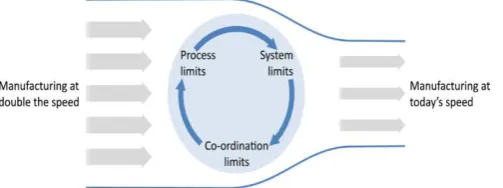
The speed of manufacturing processes today depends on a trade-off between the physical processes of
production and the co-ordination a supply chain in the pursuit of meeting customer needs. The examining
manufacturing at the double the speed is to develop an improved understanding of limits to current processes.
Material selection affected on the speed of manufacturing, this speed might be increased by substitution of
385 | P a g e Fig. 1. Rotating bottlenecks that inhibit manufacturing at double the speed.
The speed of manufacturing could be increased by increasing the capacity of the processes for example running
machine in parallel, increasing machine power or switching between existing processes as well as speed by
reducing requirements for tolerance or quality. Tool path design ,tool selection and vibration control are also
affected on speed of manufacturing. The advance manufacturing processes of improvement is in normal
industrial practice with trial and error approach.
4.1 Limitation to double speed
The limits to manufacturing speed may arises from material handling, CNC programming and equipment
testing, switchover between parts in job shop. Increasing cutting speed increases the size of stability lobes and
increasing the stiffness of the system increases the magnitude of them. Tool speed in turning and drilling
operation is a function of motor speed and In milling tool follows a complex path, tool speed is limited by
acceleration rapid, rate of change of acceleration may also lead to an impulsive force on the machine that
triggers vibration at machine resonant frequencies. Surface quality in machined and turned components is
principally determined by machine stiffness, feed rate and precision tool geometry. Surface quality also
constrained by the material speed. A speed improvement in manufacturing varies with different manufacturing
processes.
V. ADVANCE MANUFACTURING TECHNOLOGIES USED IN INDUSTRY.
5.1 Additive Manufacturing:
Additives manufacturing (AM) is an appropriate name to describe the technologies that build 3D objects by
adding layer-upon-layer of material whether the material is plastic,metal,concrete or human tissue common to
AM technologies is the use of a computer,3D modeling software, machine equipment and layering material.
Once a CAD sketch is produced, the AM equipment reads in data from the CAD file and days down or adds
successive layer of liquid, powder, sheet material or other in a layer-upon –layer fashion to fabricate 3D object
AM application is limitless.AM is being used to fabricate end use products in aircraft, dental, medical, implants
automobile and even fasten products. RP is an additive manufacturing process in which a three dimensional
product or component is produced from a three dimensional design using computer aided design (CAD)
software in a very short period of time. The components are produced by metal deposition or plastic process.
386 | P a g e
(a) Stereo lithography (SL)
(b) Selective laser sintering (SLR)
(c) Fused deposition modeling (FDM)
(d) Laminated object sintering (LMS)
1. Stereo Lithography (Sl)
In the advanced stereo lithographic systems a blade spreads resin on the part of the material as the blade travels
through the vat.This process helps in obtaining a reduced recoating time, smoother surface and reduced Trapped
volumes. After the part is deposited the block is removed from the vat and excess resin is drained. It will take a
long time because of the high viscosity of liquid resin. The part obtained will be in green color and is then
Post-cured in an ultra violet oven after removing support materials.
Fig.2 Stereo Lithography Set-up
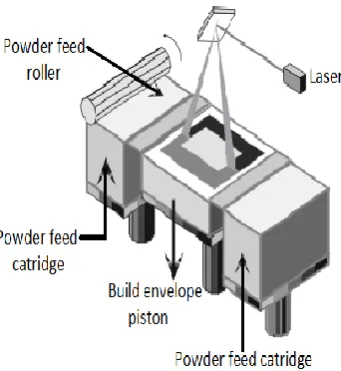
2 Selective Laser Sintering (SLR)
It is a metal addition process that uses 3 Dimensional printing technology in which the power source is a laser
which directs the laser beam on the points defined by the designed Computer Aided Design model to sinter the
Powdered material and binds the material to form the final product. In the Selective Laser Sintering process a
fine polymeric powder is spread on the substrate with a help of a roller. Before the process starts the entire bed’s temperature is raised just below the melting point by infrared heating. This reduces the thermal distortion and
facilitates the fusion to the previous layers. The laser is modulated in a way that the grains that are in contact
with the beam are only affected. Then the process starts and the laser scanning cures a slice and the bed is
387 | P a g e Fig 3. Selective Laser Sintering Set-up
Counter rotating roller the powder is spread evenly over the build area. The main advantage of this process is
the support structures are not required because of the unsintered powder acts as a support structure. And this
powder can be cleaned away and it also can be recycled after the model is completed. Fig 2.Shows a detailed
schematic diagram of Selective Laser Sintering Process (SLS).
3 Fused Deposition Modeling (FDM)
In this method, material is laid down in layers and the material is supplied by plastic filament or a metallic wire.
In Fused Deposition Modeling a movable nozzle which has only X-Y movement deposits a molten polymeric
material on to a substrate. The material is heated slightly above its melting temperature. It is chosen in order to
get it solidified within a very short period of time after extension and cold-welds to the last formed layer. The
modern Fused Deposition Modeling process involves two nozzles, one for the part material and the other for
additional material. The support material is of poor quality and it can be broken easily. In more advanced
process water-soluble support structure material is used. The additional structure can be deposited with fewer
densities by providing gaps between the consecutive roads. Fig3. Shows a detailed schematic diagram of fused
deposition modeling process (FDM).
388 | P a g e 4 Laminated Object Manufacturing (LOM)
In this method layer of adhesive coated material is in turn glued out to obtain the component’s shape using laser
or a knife. In Laminated Object Manufacturing process the slices are being cut in required shapes from roll of
material by using a laser beam. The new slice is bonded to the previous slice with the help of a hot roller which
applies a heat sensitive adhesive. The wanted material is also hatched in rectangles for later removal. If one slice
is completed, the platform can be lowered and the roll of the material can be advanced by winding this onto a
roller until a new area of sheet lies over the part. After the process is completed they are sealed to prevent laser
distortion of the prototype
Fig.5 Laminated Object Manufacturing
through the absorption of water. This process is 5-10 times faster than other rapid prototyping process. The
limitation of this process is undercuts and re-entrant features cannot be made. Fig. shows a detailed illustration
of Laminated Object Manufacturing process
VI. NEW AND EMERGING RISKS IN RELATION OF ADVANCE MANUFACTURING.
Advance manufacturing process (AMP) are characterized by innovative variables of technological and
organizational nature which tends to change with workplaces, process, and conventional work practices, and can
generate traditional occupational risks that called new and emerging risks(NER). General nature NER
susceptible in AMP but it not possible in more cases, to establish direct link with specific AMP. However it has
been possible to identify among those NER a set of technical aspects with which can be established starting
point to facilitate the identification of AMP that are potential
The advanced manufacturing process (AMP), due to its innovative characteristics, are susceptible to generating,
as well as traditional occupational risks, others defined by the European Agency for Safety and Health at Work
(EUOSHA) as new and emerging risks (NER), being its basic definition "any occupational risk that is both new
and increasing" with that Agency taking the first steps in identifying specific NER with the publication of four
reports, that make up the framework of this study, covering physical risks , biological , psychosocial and
chemical. The International Labor Organization indicates the need for research in the field of NER, looking at
alternatives when they are the result of new technologies, work processes or substances. In this reference , in the
prospective study on NER associated with new technologies in 2020, published by the EU-OSHA , were
389 | P a g e 6.1 Occupational risk model
Known risk components must be defined according to the objective of this work, being necessary for it
complement the definitions given by the reference standards, given its generic nature in the context of risk
management, by analyzing more specific sources in the field of OSH.
Definition 1. Source of risk (SR): hazard leads to a source of potential damage may be the source: materials, equipment, methods or work practices. And it is understood as damage: human damage or deterioration of
health, or a combination thereof, besides being able to fall on someone, it could also do it something.
Definition 2. Cause (C): act or condition responsible for an action or outcome. Or the facts that report on why they occur or may occur, both accidents and incidents.
Definition 3. Event (E): occurrence or change of a particular set of occupational circumstances which cause or may cause personal injuries through accidents, incidents and exposures to adverse situations.
Definition 4. Consequences (CO): personal injuries: injury for occupational accidents; occupational diseases; fatigue; dissatisfaction, stress; nonspecific pathologies. And the consequences of an incident: a result of any
unexpected and unwanted event which may cause damage to property, equipment, products or the environment,
production losses or increased legal responsibilities .
Definition 5. Likelihood (L): indicates the possibility that some event occurs that this possibility is defined, measured or determined objectively or subjectively, qualitatively or quantitatively, and described using general
or mathematically terms. , as the process of risk identification is associated with four characteristic components,
and to the subsequent risk analysis is carried out joint assessment of the likelihood and consequences of the
identified risks, can be considered that the risk is further configured by a fifth component, namely the
likelihood. Thus, it can be described as the risk model according to Definition 6.
Definition 6. Risk model (R): a risk (R) is a structure consisting of five components, being: the source of risk (SR), causes (C), events (E), consequences (CO) and the likelihood (L); this set may be expressed as
R= (SR, C, E, CO, L)
VII. CONCLUSION
The aim of this review paper was to understand the manufacturing process and their advanced technologies.AM
contribute a job creation both in manufacturing and service sector .one point is that in the future because of
citizen with well suited and advanced knowledge and skills could emerge so that peaks and carrier
achievements and advance manufacturing industry sector prove successful. The future product development will
be based on market development reasons for decentralized production strategy. Manufacturing speed increases
with line arrays of point actuators, advanced tool, proper selection of material, also by adopting advanced
manufacturing processes (AMP) speed of manufacturing process will develop. The additive manufacturing
technologies can be adopted for mass production of complex parts, product to be produced at a time by helping
additive technology this help in mass production. The advance manufacturing (AM) and new emerging risks
NER are closely related to each other, NER do not explain their quality of new and emerging. The NER model
390 | P a g e
REFERENCES
[1] Babak Kianiana, Sam Tavassolib, Tobias C. Larssona ―The Role of Additive Manufacturing Technology in
job creation: an exploratory case study of suppliers of Additive Manufacturing in Sweden‖Procedia CIRP,
12th Global Conference on Sustainable Manufacturing, journal of science direct 26 ( 2015 ),pp 93 – 98.
[2] Gale Tenen Spak,‖Us advanced manufacturing skill gap: innovative education solutions‖ Published by
Elsevier Ltd.Procedia - Social and Behavioral Sciences, journal of science direct.Vol 106 ( 2013 ) pp.3235
– 3245.
[3] Sarah K. Everton,Matthias Hirsch, Petros Stravroulakis ―Review of in-situ process monitoring and in-situ
metrology for metal additive manufacturing‖ Published by ElsevierLtd. Materials and Design journal.vol
95 (January 2016) pp.431–445
[4] Dominik T. Mattab, Erwin Raucha, Patrick Dallasegaab, ―Trends towards Distributed Manufacturing
Systems and modern forms for their design‖ Published by Elsevier Ltd9th CIRP Conference on Intelligent
Computation in Manufacturing Engineering. Vol.33 ( 2015 ) pp.185 – 190
[5] J. Salgueroa, M.C. Muñoz-Cauquia, M. Batistaa, ―R&D&i Management System in Distributed
Manufacturing Systems‖ Procedia Engineering journal of science direct. Vol.132, ( 2015 )pp. 54 – 61
[6] Julian M. Allwooda,, Tom H.C. Childsb, Adam T. Clarec, Anjali K.M. De Silvad,Vimal Dhokiae, Ian M.
Hutchingsa, Richard K. Leachc ―Manufacturing at double the speed‖ Journal of Materials Processing
Technology, vol. 229, (2 nov 2015) pp.729–757
[7] Emilia Herman, ―The Importance of the Manufacturing Sector in the Romanian Economy‖ Procedia
Technology,journal of science direct, vol.22 ( 2015 ) pp.976 – 983
[8] F. Brocal Fernándeza,b, Miguel Ángel Sebastián Péreza, ―Analysis and Modeling of New and Emerging
Occupational Risks
[9] in the Context of Advanced Manufacturing Processes‖ Published by Elsevier Ltd, journal of science direct
Procedia Engineering vol.100, ( 2015 ) pp.1150 – 1159
[10]F. Brocala,b,, M.A. Sebastiána ―Identification and analysis of advanced manufacturing processes
susceptible of generating new and emerging occupational risks‖ journal of Procedia Engineering, vol.132 (
2015 ), pp887 – 894.
[11]Andreas Roderburga , Fritz Klockea, Philip Koshyb, ―Principles of technology evolutions for
manufacturing process design‖ Published by Elsevier Ltd. Published in TRIZ Future Conference 2009. Vol 9
(2011) pp.294–310.
[12]Jaiganesh .V, Andrew anthony christopher 1, Mugilan E. ―Manufacturing of PMMA Cam Shaft by Rapid
Prototyping‖ Published by Elsevier Ltd. Published in 12th GLOBAL CONGRESS ON MANUFACTURING
AND MANAGEMENT, GCMM 2014, vol.97 ( 2014 ) pp.2127 – 2135.
[13]Yi Zonga , Jian Maob, ―Tolerance optimization design based on the manufacturing-costs of assembly
quality‖ Published by Elsevier Ltd. Published in 13th CIRP conference on Computer Aided Tolerancing,