University of Pennsylvania
ScholarlyCommons
Publicly Accessible Penn Dissertations
2017
Canonical Correlation Analysis And Network Data
Modeling: Statistical And Computational
Properties
Zhuang Ma
University of Pennsylvania, [email protected]
Follow this and additional works at:
https://repository.upenn.edu/edissertations
Part of the
Statistics and Probability Commons
Recommended Citation
Ma, Zhuang, "Canonical Correlation Analysis And Network Data Modeling: Statistical And Computational Properties" (2017).
Canonical Correlation Analysis And Network Data Modeling: Statistical
And Computational Properties
Abstract
Classical decision theory evaluates an estimator mostly by its statistical properties, either the closeness to the underlying truth or the predictive ability for new observations. The goal is to find estimators to achieve statistical optimality. Modern "Big Data" applications, however, necessitate efficient processing of large-scale ("big-n-big-p'") datasets, which poses great challenge to classical decision-theoretic framework which seldom takes into account the scalability of estimation procedures. On the one hand, statistically optimal estimators could be computationally intensive and on the other hand, fast estimation procedures might suffer from a loss of statistical efficiency. So the challenge is to kill two birds with one stone. This thesis brings together
statistical and computational perspectives to study canonical correlation analysis (CCA) and network data modeling, where we investigate both the optimality and the scalability of the estimators. Interestingly, in both cases, we find iterative estimation procedures based on non-convex optimization can significantly reduce the computational cost and meanwhile achieve desirable statistical properties.
In the first part of the thesis, motivated by the recent success of using CCA to learn low-dimensional feature representations of high-dimensional objects, we propose novel metrics which quantify the estimation loss of CCA by the excess prediction loss defined through a prediction-after-dimension-reduction framework. These new metrics have rich statistical and geometric interpretations, which suggest viewing CCA estimation as estimating the subspaces spanned by the canonical variates.
We characterize, with minimal assumptions, the non-asymptotic minimax rates under the proposed error metrics, especially how the minimax rates depend on the key quantities including the dimensions, the condition number of the covariance matrices and the canonical correlations. Finally, by formulating sample CCA as a non-convex optimization problem, we propose an efficient (stochastic) first order algorithm which scales to large datasets.
In the second part of the thesis, we propose two universal fitting algorithms for networks (possibly with edge covariates) under latent space models: one based on finding the exact maximizer of a convex surrogate of the convex likelihood function and the other based on finding an approximate optimizer of the original non-convex objective. Both algorithms are motivated by a special class of inner-product models but are shown to work for a much wider range of latent space models which allow the latent vectors to determine the
connection probability of the edges in flexible ways. We derive the statistical rates of convergence of both algorithms and characterize the basin-of-attraction of the non-convex approach. The effectiveness and efficiency of the non-convex procedure is demonstrated by extensive simulations and real-data experiments.
Degree Type Dissertation
Degree Name
Doctor of Philosophy (PhD)
First Advisor Dean P. Foster
Second Advisor Zongming Ma
Keywords
Canonical Correlation Analysis, computational efficiency, dimension reduction, minimax rates, network data modeling, non-convex optimization
CANONICAL CORRELATION ANALYSIS AND NETWORK DATA MODELING:
STATISTICAL AND COMPUTATIONAL PROPERTIES
Zhuang Ma
A DISSERTATION
in
Statistics
For the Graduate Group in Managerial Science and Applied Economics
Presented to the Faculties of the University of Pennsylvania
in
Partial Fulfillment of the Requirements for the
Degree of Doctor of Philosophy
2017
Supervisor of Dissertation
Dean P. Foster
Marie and Joseph Melone Professor Professor Emeritus of Statistics
Co-Supervisor of Dissertation
Zongming Ma
Associate Professor of Statistics
Graduate Group Chairperson
Catherine Schrand, Celia Z. Moh Professor, Professor of Accounting
Dissertation Committee
Dean P. Foster, Marie and Joseph Melone Professor, Professor Emeritus of Statistics Zongming Ma, Associate Professor of Statistics
CANONICAL CORRELATION ANALYSIS AND NETWORK DATA MODELING:
STATISTICAL AND COMPUTATIONAL PROPERTIES
c
ACKNOWLEDGEMENTS
The last four years as a Ph.D. student have been a special and memorable journey with
mixed ups and downs, which I cannot possibly finish without tremendous and unconditional
love and support from my advisors, friends and families.
First and foremost, I would like to express my sincere gratitude to my advisors Dean Foster
and Zongming Ma for their guidance, encouragement and trust, which have made me an
independent researcher. I was given maximum freedom to explore research topics I am
passionate about. The discussions with them are always inspiring and stimulating. Thank
Dean for bringing me to areas beyond classical statistics and raising my interest in natural
language processing and deep learning. Thank Zongming for introducing me to network
data modeling which interlaces statistics, optimization and real data analysis.
I am also deeply grateful to Lawrence Brown and Robert Stine for sitting in my thesis
committee, being great collaborators and sharing their wisdom in both research and life.
In particular, I thank Bob for constantly encouraging and reminding me to pursue what I
am truly passionate about. I would also like to thank Michael Collins for hosting me at
Google Research and being a great mentor. Mike has showed me how theoretical intuitions
and domain knowledge could be transformed into state-of-art empirical results. I learned
enormously from his expertise in natural language processing and methods of scientific
research.
I am very fortunate to have collaborated with many senior colleagues in the department.
They generously shared their personal experience and offered me valuable suggestions which
have smoothed my research path. Special thanks go to Xiaodong Li, Yichao Lu and Asaf
Weinstein. Xiaodong is a role model and always pursues deeper understanding and sharper
Thanks go to all my friends at Penn, including but not limited to Sameer Deshpande, Wenjie
Dou, Zijian Guo, Colman Humphrey, Kwon Sang Lee, Shaokun Li, Xinyao Ji, Matt Olson,
Peichao Peng, Xin Lu Tan and Linjun Zhang. In particular, I thank Peichao for his help
all the way through.
Thanks also go to my high school and college friends, especially Kaifeng Chen, Huan He,
Yang Kang, Lin Li, Weifeng Sun, Jie Wang, Jun Wang, Jian Yin, Xun Zhang, Ke Zhao, and
Yunqing Zheng, for all the old days we spent together. It is always delightful and refreshing
when those memories come up every now and then.
Finally, I am indebted to my parents Donglei Ma and Yuanying Zhang for their continuing
love and support. They are the ultimate source of my strength and confidence.
Zhuang Ma
Philadelphia, PA
ABSTRACT
CANONICAL CORRELATION ANALYSIS AND NETWORK DATA MODELING:
STATISTICAL AND COMPUTATIONAL PROPERTIES
Zhuang Ma
Dean P. Foster
Zongming Ma
Classical decision theory evaluates an estimator mostly by its statistical properties, either
the closeness to the underlying truth or the predictive ability for new observations. The
goal is to find estimators to achieve statistical optimality. Modern “Big Data” applications,
however, necessitate efficient processing of large-scale (“big-n-big-p”) datasets, which poses
great challenge to classical decision-theoretic framework which seldom takes into account
the scalability of estimation procedures. On the one hand, statistically optimal estimators
could be computationally intensive and on the other hand, fast estimation procedures
might suffer from a loss of statistical efficiency. So the challenge is to kill two birds with
one stone. This thesis brings together statistical and computational perspectives to study
canonical correlation analysis (CCA) and network data modeling, where we investigate both
the optimality and the scalability of the estimators. Interestingly, in both cases, we find
iterative estimation procedures based on non-convex optimization can significantly reduce
the computational cost and meanwhile achieve desirable statistical properties.
In the first part of the thesis, motivated by the recent success of using CCA to learn
low-dimensional feature representations of high-low-dimensional objects, we propose novel metrics
which quantify the estimation loss of CCA by the excess prediction loss defined through
a prediction-after-dimension-reduction framework. These new metrics have rich statistical
the non-asymptotic minimax rates under the proposed error metrics, especially how the
minimax rates depend on the key quantities including the dimensions, the condition number
of the covariance matrices and the canonical correlations. Finally, by formulating sample
CCA as a non-convex optimization problem, we propose an efficient (stochastic) first order
algorithm which scales to large datasets.
In the second part of the thesis, we propose two universal fitting algorithms for networks
(possibly with edge covariates) under latent space models: one based on finding the exact
maximizer of a convex surrogate of the non-convex likelihood function and the other based
on finding an approximate optimizer of the original non-convex objective. Both algorithms
are motivated by a special class of inner-product models but are shown to work for a
much wider range of latent space models which allow the latent vectors to determine the
connection probability of the edges in flexible ways. We derive the statistical rates of
convergence of both algorithms and characterize the basin-of-attraction of the non-convex
approach. The effectiveness and efficiency of the non-convex procedure is demonstrated by
TABLE OF CONTENTS
ACKNOWLEDGEMENTS . . . v
ABSTRACT . . . vi
LIST OF TABLES . . . x
LIST OF ILLUSTRATIONS . . . xii
CHAPTER 1 : Introduction . . . 1
1.1 Canonical Correlation Analysis . . . 1
1.2 Network Data Modeling . . . 3
1.3 Thesis Outline . . . 4
CHAPTER 2 : Canonical Correlation Analysis: Subspace Perspective and Minimax Rates . . . 6
2.1 Introduction . . . 6
2.2 Subspace Perspective: Excess Prediction Loss and Subspace Angles . . . 12
2.3 Minimax Upper and Lower Bounds . . . 19
2.4 Proof of Theorem 1 . . . 26
2.5 Proof of Theorem 2 . . . 28
2.6 Proof of Theorem 3 . . . 42
2.7 Proof of Technical Lemmas . . . 52
CHAPTER 3 : Canonical Correlation Analysis: Iterative Algorithm . . . 71
3.1 Introduction . . . 71
3.2 Algorithm: Augmented Approximate Gradient Descent . . . 74
CHAPTER 4 : Network Data Modeling . . . 94
4.1 Introduction . . . 94
4.2 Latent Space Models . . . 99
4.3 Two Model Fitting Methods . . . 102
4.4 Simulation Studies . . . 116
4.5 Real Data Examples . . . 121
4.6 Discussion . . . 130
4.7 Proofs . . . 133
LIST OF TABLES
TABLE 1 : Brief Summary of Datasets . . . 82
TABLE 2 : Proportions of mis-clustered nodes by different methods on three
LIST OF ILLUSTRATIONS
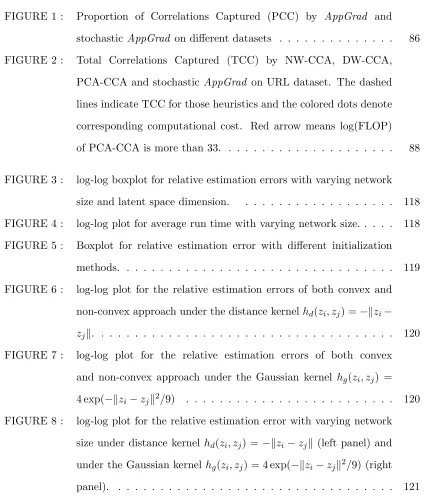
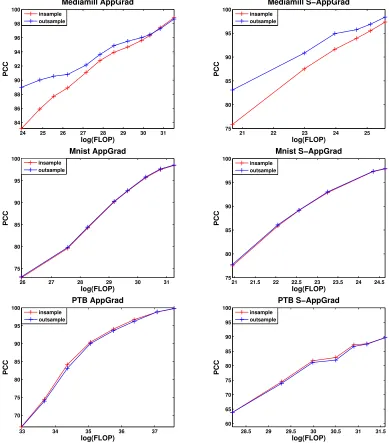
FIGURE 1 : Proportion of Correlations Captured (PCC) by AppGrad and
stochasticAppGrad on different datasets . . . 86
FIGURE 2 : Total Correlations Captured (TCC) by NW-CCA, DW-CCA,
PCA-CCA and stochasticAppGrad on URL dataset. The dashed
lines indicate TCC for those heuristics and the colored dots denote
corresponding computational cost. Red arrow means log(FLOP)
of PCA-CCA is more than 33. . . 88
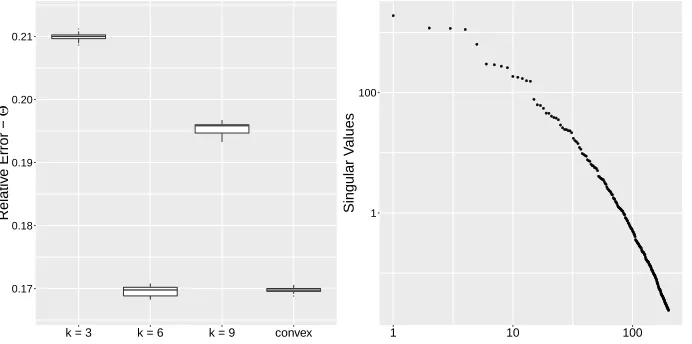
FIGURE 3 : log-log boxplot for relative estimation errors with varying network
size and latent space dimension. . . 118
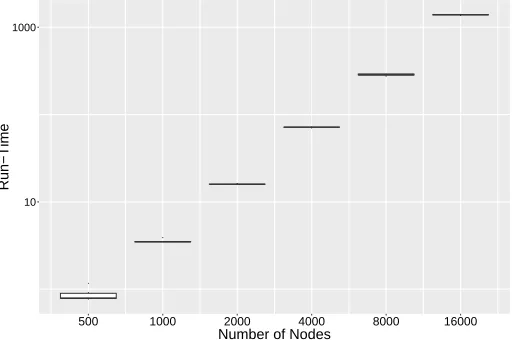
FIGURE 4 : log-log plot for average run time with varying network size. . . 118
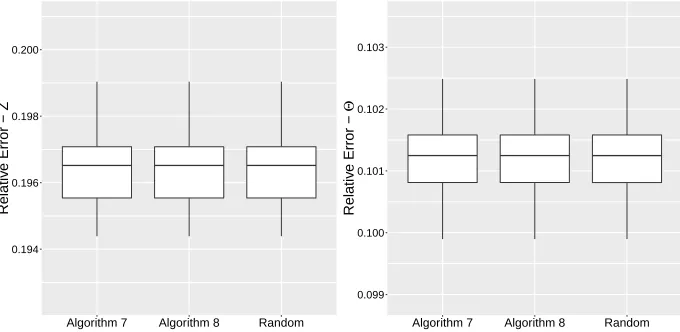
FIGURE 5 : Boxplot for relative estimation error with different initialization
methods. . . 119
FIGURE 6 : log-log plot for the relative estimation errors of both convex and
non-convex approach under the distance kernelhd(zi, zj) =−kzi−
zjk. . . 120
FIGURE 7 : log-log plot for the relative estimation errors of both convex
and non-convex approach under the Gaussian kernel hg(zi, zj) =
4 exp(−kzi−zjk2/9) . . . 120
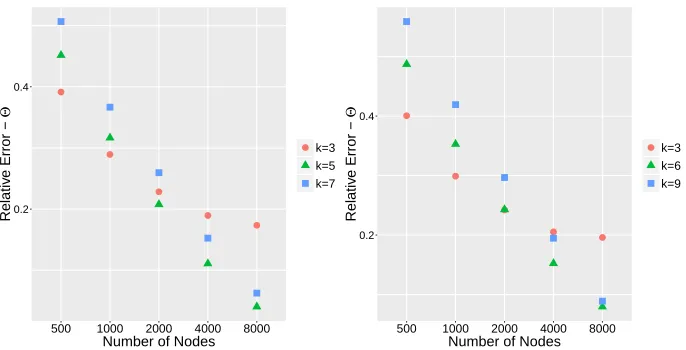
FIGURE 8 : log-log plot for the relative estimation error with varying network
size under distance kernelhd(zi, zj) =−kzi−zjk (left panel) and
under the Gaussian kernelhg(zi, zj) = 4 exp(−kzi−zjk2/9) (right
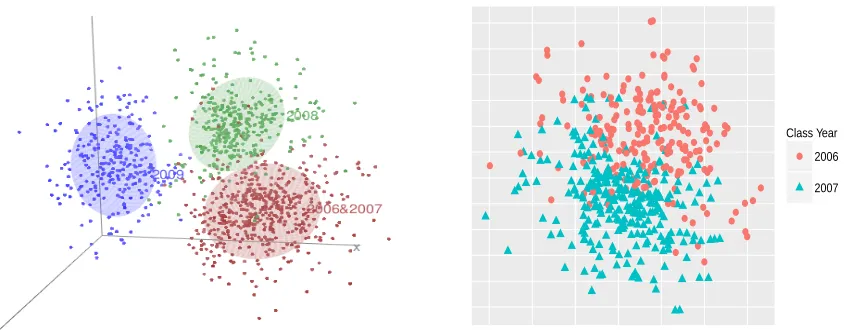
FIGURE 9 : The left panel is a visualization of the network with the first three
coordinates of the estimated latent vectors. The right panel is a
visualization of students in class year 2006 and 2007 by projecting
the four dimensional latent vectors to an estimated two dimensional
discriminant subspace. . . 125
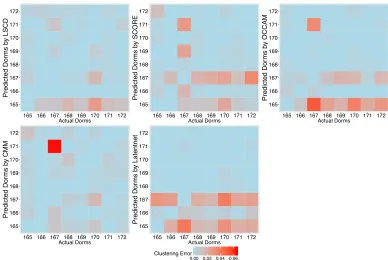
FIGURE 10 : Comparison of community-wise misclustering errors in Caltech
friendship network. Top row, left to right: LSCD, SCORE and
OCCAM; bottom row, left to right: CMM and Latentnet. . . 126
FIGURE 11 : Visualization of the lawyer network using the estimated two
dimensional latent vectors. The left panel shows results without
including any covariate while the right panel shows results that
used practice type information. . . 127
FIGURE 12 : Boxplots of misclassification errors using logistic regression with
different feature sets. We randomly split the dataset into training
and test sets with size ratio 3:1 for 500 times and computed
misclassification errors for each configuration. PC represents the
leading 100 principal components of the document-word matrix.
Z(k) represents the feature matrix where the ith row is the
concatenation of the estimated degree parameter αbi and the
CHAPTER 1 : Introduction
The age of “Big Data” features cheap and easy availability of large quantities of
massive, high-dimensional, complex datasets, the analysis of which interlaces statistics,
machine learning and numerical optimization. The challenge/goal is to extract
low-dimensional structures from high-low-dimensional complex objects in a statistically optimal and
computationally efficient manner. This thesis brings together statistical and computational
perspectives in the study of canonical correlation analysis (CCA) and network data
modeling. We aim to answer questions such as:
What are the proper error metrics to quantify the estimation/prediction loss?
Under such metrics, what are the quantities that characterize the fundamental
statistical limits (e.g. the minimax rates)? To achieve the optimal error rates
on large datasets, what are the efficient algorithms?
1.1. Canonical Correlation Analysis
Canonical correlation analysis (CCA), first introduced by Hotelling (1936), is a fundamental
statistical tool to characterize the relationship between two groups of random variables and
finds a wide range of applications across many different fields. In recent years, CCA has
been successfully applied to learning low dimensional representations of high dimensional
objects like images (Rasiwasia et al., 2010), text (Dhillon et al., 2011) and speeches (Arora
and Livescu, 2013). Meanwhile, a parallel line of research builds up the theoretical fundation
for CCA to achieve sufficient dimension reduction (Kakade and Foster (2007); Foster et al.
(2008); Sridharan and Kakade (2008); Fukumizu et al. (2009); Chaudhuri et al. (2009) and
many others), especially under a popular multi-view setup.
Motivated by such empirical and theoretical success of CCA, we revisit CCA with a new
of CCA dates back to the study of the asymptotic distribution of the sample canonical
coefficients and sample canonical vectors like Hsu (1941), Izenman (1975), Anderson (1984,
1999) and many others. More recently, Chen et al. (2013) and Gao et al. (2014, 2015b)
established the non-asymptotic minimax rates of sparse CCA in a high dimensional setup.
Furthermore, there has been a surge of interest in developing scalable algorithms for
estimating CCA, to name a few, Avron et al. (2013) Lu and Foster (2014) (before the
proposed algorithm was published), Ge et al. (2016a), Wang et al. (2016) and Allen-Zhu
and Li (2016) (after the proposed algorithm was published).
Compared with previous work, our major contributions are as follows:
1. We propose novel metrics to quantify the estimation loss of CCA by the excess
prediction loss defined through a prediction-after-dimension-reduction framework.
These new metrics have rich statistical and geometric interpretations, which suggest
viewing CCA estimation as estimating the subspaces spanned by the canonical
variates.
2. We characterize, with minimal assumptions, the non-asymptotic minimax rates under
the proposed error metrics, especially how the minimax rates depend on key quantities
including the dimensions, the condition number of the covariance matrices and the
canonical correlations. To the best of our knowledge, this is the first finite sample
result that fully captures the effect of the canonical correlations on the minimax rates.
3. We propose an efficient (stochastic) first-order algorithm to compute the
leading-k dimensional sample canonical vectors. Compared with the well-known closed form
solution, the proposed iterative algorithm avoids multiplying/inverting/factoring large
1.2. Network Data Modeling
Network produces a prevalent form of data for quantitative and qualitative analysis in
many areas, including but not limited to sociology, engineering and neuroscience.
Real-world networks exhibit complex characteristics such as degree heterogeneity, transitivity,
homophily and community structure. These pose significant challenges to statistical
modeling. To date, researchers have proposed a collection of network models in various
fields. These models aim to catch different subsets of the foregoing characteristics, and
Goldenberg et al. (2010) provides a comprehensive overview. An important class of network
models are latent space models (Hoff et al., 2002). Suppose there are n nodes in the
observed network. The key idea underlying latent space modeling is that each node i
can be represented by a vectorzi in some low dimensional Euclidean space (or some other
metric space of choice) that is sometimes called the social space, and nodes that are “close”
in the social space are more likely to be connected. Hoff et al. (2002) considered two
types of latent space models: distance models and projection models. In both cases, the
latent vectors {zi}ni=1 were treated as fixed effects. Later, a series of papers (Hoff, 2003;
Handcock et al., 2007; Krivitsky et al., 2009) generalized the original proposal in Hoff et al.
(2002) for better modeling of other characteristics of social networks, such as clustering,
degree heterogeneity, etc. In these generalizations, the zi’s were treated as random effects
generated from certain multivariate Gaussian mixtures. Model fitting and inference in these
models has been carried out via Markov Chain Monte Carlo, and it is difficult to scale these
methodologies to handle large networks (Goldenberg et al., 2010). Moreover, one needs to
use different likelihood function based on choice of model and there is little understanding
of the quality of fitting when the model is mis-specified. Albeit these disadvantages, latent
space models are attractive due to their friendliness to interpretation and visualization.
We make progress on tackling the foregoing two issues simultaneously in this thesis, which
we summarize as the following main contributions:
are able to characterize degree heterogeneity, transitivity, homophily and community
structure. We design two fitting algorithms: one based on finding the exact maximizer
of a convex surrogate of the non-convex likelihood function and the other based on
directly finding an approximate optimizer of the non-convex objective. We derive high
probability error bounds for both algorithms and characterize the basin-of-attraction
of the non-convex optimization approach.
2. We show that these two fitting algorithms are “universal” in the sense that we are able
to establish their high probability error bounds for a wide range of latent space models
beyond the inner-product model class. For example, they work simultaneously for the
distance model and the Gaussian kernel model. Thus, the class of inner-product
models as well as the proposed fitting algorithms are indeed flexible and can be used
to approximate other latent space models of interest.
3. We demonstrate the effectiveness and efficiency of the model and algorithms on real
data examples for several different tasks, including visualization, community detection
and network-assisted learning. In particular, we obtain state-of-art performance for
the task of community detection on three benchmark datasets.
1.3. Thesis Outline
The reminder of the thesis is organized as follows. In Chapter 2, we propose new error
metrics which quantify the estimation loss of CCA by the excess prediction loss defined
through a prediction-after-dimension-reduction framework. This framework suggests
viewing CCA estimation as estimating the subspaces spanned by the canonical variates.
We also characterize, with minimal assumptions, the non-asymptotic minimax rates under
the proposed error metrics, especially how the minimax rates depend on the key quantities
including the dimensions, the condition number of the covariance matrices and the canonical
local linear convergence of the proposed algorithm.
In Chapter 4, we switch to the second part of the thesis: network data modeling. We propose
a special class of latent space models, called inner-product models, which could capture
typical characteristics of real-world networks. Then we propose two fitting algorithms based
on convex and non-convex optimization respectively. We further establish the statistical
rates of convergence of both algorithms and characterize the basin-of-attraction of the
non-convex approach. Finally, simulations and real-data experiments are provided to support
the proposed models and algorithms.
Chapter 2 and Chapter 3 are based on the paper Ma and Li (2016) and Ma et al. (2015)
respectively. Chapter 4 is based on the unpublished manuscript Ma and Ma (2017). My
research on shrinakge estimation (Ma et al. (2014a), Weinstein et al. (2015)) and reduced
CHAPTER 2 : Canonical Correlation Analysis: Subspace Perspective and Minimax
Rates
2.1. Introduction
Canonical correlation analysis (CCA), first introduced by Hotelling (1936), is a fundamental
statistical tool to characterize the relationship between two groups of random variables and
finds a wide range of applications across many different fields. For example, in genome-wide
association study (GWAS), CCA is used to discover the genetic associations between the
genotype data of single nucleotide polymorphisms (SNPs) and the phenotype data of gene
expression levels (Witten et al., 2009; Chen et al., 2012). In information retrieval, CCA is
used to embed both the search space (e.g. images) and the query space (e.g. text) into
a shared low dimensional latent space such that the similarity between the queries and
the candidates can be quantified (Rasiwasia et al., 2010; Gong et al., 2014). In natural
language processing, CCA is applied to the word co-occurrence matrix and generates vector
representations of the words which capture the semantics (Dhillon et al., 2011; Faruqui and
Dyer, 2014). Other applications, to name a few, include fMRI data analysis (Friman et al.,
2003), computer vision (Kim et al., 2007) and speech recognition (Arora and Livescu, 2013;
Wang et al., 2015).
The enormous empirical success motivates us to revisit the estimation problem of canonical
correlation analysis. From a decision-theoretic point of view, two questions are naturally
posed: What is the proper error metric to quantify the discrepancy between the population
CCA and its sample estimates? And under such a metric, what are the quantities that
characterize the fundamental statistical limits?
The justification of loss functions, in the context of CCA, has seldom appeared in the
literature. From the first principle that the proper metric to quantify the estimation loss
reduction. The first category, mostly in genomic research (Witten et al., 2009; Chen
et al., 2012), treats one group of variables as responses and the other group of variables
as covariates. The goal is to discover the specific subset of the covariates that are most
correlated with the responses. Such applications are characterized by low signal-to-noise
ratio and the interpretability of the results. The other category is investigated extensively
in statistical machine learning and engineering community where CCA is used to learn
low dimensional latent representations of complex objects such as images (Rasiwasia et al.,
2010), text (Dhillon et al., 2011) and speeches (Arora and Livescu, 2013). These scenarios
are usually accompanied by a relatively high signal-to-noise ratio and prediction accuracy,
using the learned low dimensional embeddings as a new set of predictors, is of primary
interest. In recent years, a series of publications has established fundamental theoretical
guarantees for CCA to achieve sufficient dimension reduction (Kakade and Foster (2007);
Foster et al. (2008); Sridharan and Kakade (2008); Fukumizu et al. (2009); Chaudhuri et al.
(2009) and many others), especially under a multi-view setup as will be discussed in detail
in Section 2.2.4.
In this thesis, we aim to address the problems raised above by treating CCA as a tool for
dimension reduction.
2.1.1. Linear Invariance of Canonical Variates
On the population level, CCA extracts the most correlated directions between two sets of
random variables: x∈Rp1 and y∈Rp2. To be specific, CCA recursively finds the pairs of
vectors φi ∈Rp1,ψi ∈Rp2,1≤i≤p:= min{p1, p2} such that
(φi,ψi) = arg max
φ>Σ
xφ=1,ψ>Σyψ=1
φ>Σxyψ
subject to φ>Σxφj = 0, ψ>Σyψj = 0, ∀ 1≤j≤i−1.
(2.1)
For 1≤i≤p, (φi,ψi) is theith pair of canonical coefficients (loading vectors), (φ>i x,ψ>i y)
Define Φ := [φ1,· · · ,φp], Ψ := [ψ1,· · · ,ψp] and Λ := diag(λ1,· · ·, λp). Then by definition,
Σx1/2Φ,Σy1/2Ψ have orthonormal columns and Λ = Φ>ΣxyΨ, which further implies that
Σx1/2Φ,Σ1y/2Ψ are respectively left and right singular vectors of Σx−1/2ΣxyΣ−y1/2. With these
notations, the first type of applications discussed above can be understood as identifying the
support of the top-kcanonical vectors: Φ1:kand Ψ1:k, where Φ1:k∈Rp1×kand Ψ1:k ∈Rp2×k
consist of the firstkcolumns of Φ and Ψ respectively. Dimension reduction, which motivates
this paper, is concerned with the leadingkcanonical variates: Φ>1:kxand Ψ>1:ky(kis assumed
to be pre-specified).
What distinguishes CCA from other dimension reduction methods like principal component
analysis or partial least squares is its linear invariance. As highlighted in Hotelling (1936)
when canonical correlation analysis was first developed:
The relations between two sets of variates with which we shall be concerned
are those that remain invariant under internal linear transformations of each set
separately.
Among all the population parameters, Hotelling (1936) noticed that the canonical
correlations λ1,· · · , λp and the functions of these quantities are the only linear invariants
of the system. On the contrary, the canonical coefficients Φ and Ψ will change accordingly
either with rotation of axes or scaling of the variables, which diminishes the rationale for
using an error metric built directly upon the loadings. If extending Hotelling’s notion
of invariants to include random vectors, the canonical variates are actually invariant
under linear transformations of each set separately. To illustrate, let T1, T2 be any pair
of nonsingular matrices and define the new random vectors a = T1>x, b = T2>y. As
will be shown in Section 2.3.1, T1−1Φ1:k, T2−1Ψ1:k are the top-k canonical coefficients of
(a, b). Therefore, the top-k canonical variates of (a, b) will be (T1−1Φ1:k)>a = Φ>1:kx and
(T2−1Ψ1:k)>b = Ψ>1:ky, which are the same as those of (x, y). This fact substantiates our
What is the proper error metric to quantify the discrepancy between (Φ>1:kx,Ψ>1:ky) and the
sample counterparts (Φb>1:kx,Ψb>1:ky)? And under such a metric, what are the quantities that
characterize the fundamental statistical limits?
For the rest of the paper, we will focus on the relationship between Φb>1:kx and Φ>1:kx since
similar results can be obtained for the other pair by symmetry.
2.1.2. Subspace Estimation and Subspace Loss
In Section 2.2, we show that when CCA is used for dimension reduction, it is the difference
between the predictive power of Φ>1:kx and Φb>1:kx that matters, rather than the Euclidean
distance between Φ>1:kxandΦb>1:kx. Specifically, we characterize the discrepancy between the
predictive power by the excess prediction loss induced by replacing the population canonical
variates Φ>1:kx with the sample estimatesΦb>1:kx. When linear prediction is concerned, such
discrepancy is reduced to the difference between the linear span of the population and
sample canonical variates, denoted by span(x>Φ1:k) and span(x>Φb1:k), which are subspaces
of span(x>) := {x>w, w ∈ Rp1}. This suggests that CCA estimation can be viewed as
subspace estimation, that is, estimating the subspace spanned by the leading-k canonical
variates: span(x>Φ1:k). From this perspective, the error metric L(·,·) we pursue could be
rewritten as
L(Φ>1:kx,Φb>1:kx) =L(span(x>Φ1:k),span(x>Φb1:k)). (2.2)
Interestingly, the error metrics derived through the excess prediction loss is closely related
to the principal angles (defined in Section 2.2.3) between span(x>Φb1:k) and span(x>Φ1:k).
Suppose θ = (θ1,· · ·, θk)> is the vector of such principal angles. As elaborated in
Theorem 1,
Worst case excess prediction loss'
PΣ1x/2Φb1:k −PΣ1x/2Φ1:k
2
=ksin(θ)k2∞
Bayesian excess prediction loss'
PΣ1x/2Φb1:k
−PΣ1/2
x Φ1:k
2
F/2k=ksin(θ)k 2 2/k
where 'means ‘equal up to an absolute constant’, sin(θ) = (sin(θ1),· · ·,sin(θk)) and P(·)
denotes the projection matrix w.r.t. the column space of the matrix in the subscript.
2.1.3. Minimax Rates
In section 2.3, we characterize the non-asymptotic minimax estimation rates for CCA
under the error metrics proposed in (2.3), especially how the minimax rates depend on
the key quantities, including the dimensions, the condition number of the covariance
matrices and the canonical correlations. Informally, with operator norm error as an
example, in Theorem 2 and Theorem 3, we show that under certain a sample size condition
(n≥Cλk,λk+1(p1+p2)), the minimax rate is characterized by
inf
b
Φ1:k
sup
Σ∈FE
PΣ1x/2Φb1:k−PΣ1x/2Φ1:k
2
(1−λ
2
k)(1−λ2k+1)
(λk−λk+1)2
p1
n.
To the best of our knowledge, this is the first finite sample result that captures the factor (1−
λ2k)(1−λ2k+1). This term is not negligible becauseλk, λk+1are parameters depending on the
dimensions and should not be treated as constants. In practice, as the number of variables
increases, one should expect the canonical correlations to increase as well (e.g. considering
the case that the variables are gradually added to the two groups). The other important
feature is the independence of the dimensionp2. If only interested in the ‘estimation’ of the
canonical variates ofx, then even whenp2p1, as long as the sample size is large enough,
the minimax rate of ‘estimating’ Φ>1:kx does not depend on p2. This phenomenon was also
revealed in Gao et al. (2014) and Cai and Zhang (2016) with the additional assumption that
all the residual canonical correlations are zero: λk+1=· · ·=λp1 = 0. Finally, the minimax
rates are independent of the condition number of the covariance matrices: κ(Σx), κ(Σy).
This is due to the linear invariance of the canonical variates as illustrated in Section 2.3.1.
We hope our theoretical findings could provide some guidance for the practical use of CCA
because in real applications, these factors matter both computationally and statistically
The upper bound of the minimax rates is achieved by sample CCA which is defined
in the same manner as (2.1) by replacing the population covariance matrices with the
corresponding sample estimates. The sample canonical variates are also linear invariant,
which is crucial in reducing the estimation error of sample CCA to the “standard form”, as
spelled out in Section 2.3.1, in which Σx and Σy are identity and Σxy = [Λ,0] (p1≤p2).
Theoretical understanding for the estimation of CCA dates back to the study of the
asymptotic distribution of sample CCA, in the low dimensional regime with fixed dimensions
and sample size going to infinity, for both sample canonical coefficients and sample canonical
correlations (Hotelling, 1936; Hsu, 1941; Izenman, 1975; Anderson, 1984, 1999) (and many
others). More recently, Chen et al. (2013) and Gao et al. (2014, 2015b) have studied the
non-asymptotic minimax rates of sparse CCA in a high dimensional setup. We defer the
detailed comparison between these results and ours to Section 2.3.2.
2.1.4. Notations
Throughout this chapter, we use lower-case and upper-case letters to represent vectors
and matrices respectively. For any matrix U ∈ Rn×p and vector u ∈
Rp, kUk,kUkF
denotes operator (spectral) norm and Frobenius norm respectively,kuk denotes the vector
l2 norm, U1:k denotes the submatrix consisting of the first k columns of U, and PU
stands for the projection matrix onto the column space of U. Moreover, we use σmax(U)
and σmin(U) to represent the largest and smallest singular value of U respectively, and
κ(U) =σmax(U)/σmin(U) to denote the condition number of the matrix. We use Ip for the
identity matrix of dimensionp and Ip,k for the submatrix composed of the firstk columns
of Ip. Further, O(m, n) (and simply O(n) when m = n) stands for the set of m×n
matrices with orthonormal columns andSp+denotes the set ofp×pstrictly positive definite
matrices. For a random vectorx∈Rp, span(x>) ={x>w, w∈
Rp}denotes the subspace of
all the linear combinations ofx. Other notations will be specified within the corresponding
2.2. Subspace Perspective: Excess Prediction Loss and Subspace Angles
In this section, we propose a prediction-after-dimension-reduction framework to quantify
the loss of any generic dimension reduction algorithm (including CCA). This framework
suggests two error metrics, one induced by the worst case excess prediction loss and the
other induced by the average excess prediction loss. For CCA, these two error metrics are
closely related to the principal angles between the subspaces spanned by the population
and sample canonical variates, respectively.
2.2.1. Linear Prediction Revisited
First, we review the basics of linear model theory under the random design setup. Suppose
given
x1, . . . , xp, z∈L2(Ω,F,P),
whereL2(Ω,F,P) is the set of random variables with mean zero and finite second moment,
and the goal is to predict the response z with the random vector x := (x1, . . . , xp)>. We
measure the prediction loss by
loss(z|x) := min
β∈RpE[(z−x >
β)2].
We further assume that (x, z) has joint covariance matrix:
Cov
x
z
=
Σx σxz
σ>xz σ2z
.
By classical linear model theory
β∗ := arg min
β∈RpE
[(z−x>β)2] = Σ−x1σxz,
where rxz := Σ
−1/2
x σxz(σz2)−1/2 and krxzk2 is the population R2 which characterizes the
proportion of the variability in the response z explained by the predictor x. One notable
feature of such prediction loss is its linear invariance. Define the linear subspace spanned
by the coordinates ofx as
span(x>) :={x>w:w∈Rp} ⊂L2(Ω,F,P).
If for another set of random variables{v1, . . . , vp} ∈L2(Ω,F,P) with span(v>) = span(x>)
and v:= (v1, . . . , vp)>, then by definition,loss(z|x) =loss(z|v). Therefore, we can rewrite
loss(z|x) =loss(z|span(x>)).
These two notations will be used interchangeably throughout the paper. The linear
invariance property can be revealed by noticing that krxzk2 = E[(Pspan(x)z)2]/E[z2] where
P(·) is the projection operator defined in the Hilbert space L2(Ω,F,P) with covariance
operator as the inner product.
2.2.2. Competing with Oracles
Consider the scenario where the predictor x is in a high dimensional space and many
directions in span(x>) are redundant for predicting the response z. Practitioners usually
perform certain kind of dimension reduction on x before applying supervised learning
algorithms. SupposeU ∈Rp×k is a reduction matrix obtained by some generic dimension
reduction method. The subspace perspective of the prediction loss discussed in the previous
section suggestsloss(z|span(x>U))−loss(z|span(x>)), or simplyloss(z|span(x>U)) as the
measure of goodness for dimension reduction algorithms.
prediction loss can be quantified by:
loss(z|span(x>U1))−loss(z|span(x>U2)) =E[(Pspan(x>U
2)z)
2−(P
span(x>U
1)z)
2]
=σ2z
rxz>
PΣ1/2
x U2 −PΣ1x/2U1
rxz
. (2.4)
The first equality is geometrically straightforward, measuring the proportion of the
variability in response z explained by the two subspaces: span(x>U1) and span(x>U2).
The algebraic expression in the second equality (proved in Theorem 1) is less obvious but
decouples the loss into an interaction between a supervised learning factor rxz and an
unsupervised learning factorPΣ1/2
x U2−PΣ1x/2U1. To shed more light on this excess prediction risk, we parametrize the joint covariance matrix of (x, z) in terms of separate covariance
matrices Σx, σz2 and the vectorrxz, that is
Cov x z =
Σx σxz
σxz> σz2 =
Σ1x/2 0
0 σz
Ip rxz
r>xz 1
Σ1x/2 0
0 σz
. (2.5)
Considering the worst case discrepancy across all possible correlation structures, as proved
in Theorem 1,
sup
rxz:krxzk2=R2
n
loss(z|span(x>U1))−loss(z|span(x>U2))
o
=σ2zR2
PΣ1x/2U1 −PΣ1x/2U2 ,
which suggests the right hand side of the equation as a sensible metric to quantify the
difference between the two reduction matrices. Actually, it is more informative to replace
the competitor U2 with an oracle reduction matrix, denoted by U?. As suggested by (2.4),
we say that a reduction matrixU? is an oracle reduction matrix ifPΣ1/2
x U?rxz =rxz. Define
A := {r : P
Σ1x/2U?r = r,krk
2 = R2} as the set of ‘correlation’ vectors such that U ? is
prediction loss withinA, then according to Theorem 1,
sup
rxz∈A
loss(z|span(x>U))−loss(z|span(x>U?)) =σ2zR2
PΣ1x/2U−PΣ1x/2U?
2
. (2.6)
Interestingly, the operator norm is replaced by its square when the competitor is an oracle
reduction matrix. On the other hand, from a Bayesian perspective, considering the prior
that the vector rxz is sampled with respect to the uniform measure (Haar measure) onA,
denoted byπ, then the average excess prediction loss will satisfy (also refer to Theorem 1):
Erxz∼π
n
loss(z|span(x>U))−loss(z|span(x>U?))
o = σ
2 zR2
2k
PΣ1x/2U −PΣ1x/2U?
2
F. (2.7)
The analysis above connects the prediction loss for the generic response z with the
estimation loss for the oracle reduction matrix U? under the metrics derived in (2.6) and
(2.7). Therefore, when CCA is used for dimension reduction, it is natural to quantify the
discrepancy betweenΦb>1:kx and Φ>1:kx by the excess prediction loss:
PΣ1x/2Φb1:k−PΣ1x/2Φ1:k
2
,
PΣ1x/2Φb1:k−PΣ1x/2Φ1:k
2
F.
2.2.3. Measuring Subspace Distance by Principal Angles
In this section, we show that the loss defined in (2.6) and (2.7) are closely related to the
principal angles between the two subspaces spanned by the reduced predictors. For any
p dimensional random vector x with mean zero and bounded second moments, define the
Hilbert space
H= span(x>) ={X|X=x>w, w∈Rp}
with covariance operator as the inner product, that is, for any X1, X2 ∈ H, hX1, X2i
:= Cov(X1, X2) = E(X1X2). Suppose we have a pair of full column rank matrices
U1, U2 ∈ Rp×k and consider the canonical correlation analysis between the two subspaces
second, ..., and kth pair of canonical variates between span(x>U1) and span(x>U2).
Then span(W1, . . . , Wk) = span(x>U1), span(Wc1, . . . ,Wck) = span(x>U2) and hWi, Wji =
hWi,Wcji = hWci,cWji = 0, for any i 6= j and Var(Wi) = Var(cWi) = 1, for i = 1, . . . , k.
Theith principal angle is defined asθi :=∠(Wi,Wci). Without loss of generality we assume
θ1≥ · · · ≥θk and define the distance between the two subspaces as:
L2(span(x>U1),span(x>U2)) := k
X
i=1
sin2θi= k X i=1 1− D
Wi,Wci E
2
.
This is a valid metric because the principal angles are uniquely defined though the canonical
variates need not be. Sincex>Σ−x1/2is an orthonormal basis ofHunder the covariance inner
product, it is convenient to represent the elements in Hby this basis. Let
(W1, . . . , Wk) =x>Σ−x1/2B, and (Wc1, . . . ,Wck) =x>Σ−x1/2B,b
where B := [b1, . . . , bk], Bb := [bb1, . . . ,bbk]∈Rp×k are the coordinate representations under
x>Σ−x1/2. Notice that by definition, {W1, . . . , Wk}and{Wc1, . . . ,Wck}are orthonormal bases
of span(x>U1) and span(x>U2), respectively. ThenB,Bbarep×kbasis matrices. Moreover,
we have b>ibbj =hWi,Wcji= 0, for alli6=j.
Let’s now representL2(span(x>U1),span(x>U2)) in terms of B and Bb. In fact, since
1−
D
Wi,Wci E
2
= 1−
b
>
ibbi 2 = 1 2 bib
>
i −bbibb>i 2 F, we have
L2(span(x>U1),span(x>U2)) =
1 2 k X i=1 bib
>
i −bbibb>i 2 F = 1 2 k X i=1
bib>i −bbibb>i 2 F = 1
BB>−BB>
2
where the second equality is due to b>i bj =bb>i bj =bb>i bbj = 0, for alli6=j.
Finally, notice that span(x>U1) = span(W1, . . . , Wk), x>U1 = (x>Σ−x1/2)(Σ1x/2U1), and
(W1, . . . , Wk) = x>Σ
−1/2
x B. Then B and Σ1x/2U1 have the same column space. Since
B ∈Rp×k is a basis matrix, we have BB>=PΣ1/2
x U1, which is the orthogonal projector to the column space of Σ1x/2U1. Similarly, we haveBbBb>=P
Σ1x/2U2, which implies
L2(span(x>U1),span(x>U2)) =
1 2
PΣ1x/2U1 −PΣ1x/2U2
2
F.
On the other hand, we can also define the distance through the largest principal angle:
L1(span(x>U1),span(x>U2)) := sin2θ1= 1−
D
W1,Wc1 E
2
.
Letθ= (θ1,· · ·, θk), then BB>BbBb>=Bdiag(cos(θ))Bb>, and by Lemma 2.18,
PΣ1x/2U1 −PΣ1x/2U2
2
=
BB
>− b BBb>
2
= 1−σmin2 BB>BbBb>
= sin2(θ1) =L1(span(x>U1),span(x>U2))
We summarize the results into the following theorem of which the proof is deferred to
Section 2.4.
Theorem 1. Suppose(x, z)∼Pfor some unknown distributionPwith covariance structure
specified in (2.5)and subspace angles defined above. For any pair reduction matricesU, U? ∈
Rp×k,
loss(z|span(x>U))−loss(z|span(x>U?)) =σz2
r>xzP
Σ1x/2U?−PΣ1x/2U
rxz
sup
rxz: krxzk2=R2
loss(z|span(x>U))−loss(z|span(x>U?))
=σz2R2
PΣ1x/2U−PΣ1x/2U?
=σ
2
Let A={r :P
Σ1x/2U?r=r,krk
2=R2}. By treatingU
? as an oracle reduction matrix,
sup
rxz: rxz∈A
n
loss(z|span(x>U))−loss(z|span(x>U?))
o
=σz2R2
PΣ1x/2U−PΣ1x/2U?
2
=σ2zR2ksin(θ)k2∞.
By treating U? as a Bayes oracle, that is rxz ∼ π where π is the uniform measure (Haar
measure) onA, then
Erxz∼π
n
loss(z|span(x>U))−loss(z|span(x>U?))
o
= σ
2 zR2
2k
PΣ1x/2U−PΣ1x/2U?
2
F =
σz2R2
k ksin(θ)k
2 2
2.2.4. CCA for Multi-view Dimension Reduction
In the research and applications of multi-media analytics, data of the same object, is often
collected from multiple sources and exhibit heterogeneous properties. Features obtained
from different domains are referred to as different ‘views’. Usually each view summarizes a
specific aspect of the studied object and different views are complementary to one another.
For example, in web-page classification, the hyperlink structure and the words on the page
are two different views (Chaudhuri et al., 2009). In video surveillance, images of cameras
from different angles constitute different views (Loy et al., 2009). For more recent results,
see the survey paper of Xu et al. (2013) and references therein.
Although multiple views provide more potential discriminative information to distinguish
the patterns of different classes, the feature vector of each view usually lies in a high
dimensional space. It is critical, both statistically and computationally, to perform
dimension reduction before applying any supervised learning algorithm. It has been shown
(2008); Sridharan and Kakade (2008); Fukumizu et al. (2009); Chaudhuri et al. (2009) and
many others)
Suppose the input variablexcan be split into two viewsx(1), x(2) and the goal is to predict
the response z based on the two views. Let (Φ1:k,Ψ1:k) be the top-k population canonical
coefficients betweenx(1) and x(2). Foster et al. (2008) proved the following proposition.
Proposition 2.1. (Sufficient Dimension Reduction by CCA Foster et al. (2008)) Under
certain multi-view assumptions1,
loss(z|x(1)) =loss(z|span((x(1))>Φ1:k))
loss(z|x(2)) =loss(z|span((x(2))>Ψ1:k))
This proposition shows that the predictive power of the original high-dimensional predictors
x(1) and x(2) is fully captured by the top k canonical variates. However, the proposition
focuses on the population level and does not take into account the estimation error induced
by substituting the population canonical coefficients with the sample estimates. Such
sample-population discrepancy can be quantified by
loss(z|span((x(1))>Φb1:k))−loss(z|span((x(1))>Φ1:k)),
loss(z|span((x(2))>Ψb1:k))−loss(z|span((x(2))>Ψ1:k)),
or equivalently, the proposed loss functions according to Theorem 1.
2.3. Minimax Upper and Lower Bounds
In this section, we introduce our main results on non-asymptotic upper and lower bounds
for estimating CCA under the proposed loss functions. Specifically, the upper bound is
achieved by sample CCA.
2.3.1. Reduction for Sample CCA
In this section, we show that the linear invariance of both population and sample canonical
variates enables us to reduce the estimation error of sample CCA to the special case that
Σx=Ip1,Σy =Ip2 and Σxy = [Λ 0] (we assume p1 ≤p2 without loss of generality).
LetX = (x1,· · · , xn)> be the data matrix where x1,· · · , xn i.i.d
∼ N(0,Σx) and similarly we
defineY. It is well known that the top-k sample canonical coefficients can be defined as a
solution to the following optimization problem:
(Φb1:k,Ψb1:k)∈arg max
Wx,Wy
tr(Wx>ΣbxyWy)
subject to Wx>ΣbxWx=Ik, Wy>ΣbyWy =Ik.
(2.8)
whereΣbx,Σby,Σbxy are sample variance and covariance matrices defined as
b Σxy =
1 nX
>Y, b Σx =
1 nX
>X, and b Σy =
1 nY
>Y.
Coming back to the definition of population CCA in (2.1), Ψ is a p2 ×p1 matrix such
that Σ1y/2Ψ∈ O(p2, p1). In this section, we abuse notation and redefine Ψ as the p2×p2
matrix by arbitrarily padding the rest p2 −p1 columns such that Σy1/2Ψ ∈ O(p2). Let
ai = Φ>xi and bi = Ψ>yi. Then we will have ai i.i.d
∼ a= Φ>x with distributionN(0, Ip1)
and bi i.i.d
∼ b= Ψ>y with distributionN(0, Ip2). Moreover,
Σab:=Eaib>i = Φ
>
ΣxyΨ = (Σ1x/2Φ)
>
Σ−x1/2ΣxyΣ−y1/2(Σ 1 2
yΨ) = [Λ 0].
where the last equality is due to the fact that Σ1x/2Φ,Σ1y/2Ψ are respectively left and right
singular vectors of Σ−x1/2ΣxyΣ
−1/2
y . This implies
a
b
i.i.d ∼ N
0,
Ip1 Σab
Σ I
and their top-k population canonical coefficients (Φa1:k,Ψb1:k) = (Ip1,k, Ip2,k). Let A =
(a1,· · · , an)>=XΦ andB = (b1,· · ·, bn)>=YΨ. Then
b Σa=
1 nA
>A= Φ> b ΣxΦ,
b Σb =
1 nB
>B = Ψ> b ΣyΨ,
b Σab =
1 nA
>
B = Φ>ΣbxyΨ.
(2.9)
Since (Φb1:k,Ψb1:k) is a solution to the sample CCA (2.8), then
(Φ−1Φb1:k,Ψ−1Ψb1:k)∈arg max
Wx,Wy
tr(Wx>Φ>ΣbxyΨWy)
subject to Wx>Φ>ΣbxΦWx=Ik, Wy>Ψ>ΣbyΨWy =Ik,
or, by (2.9), equivalently,
(Φ−1Φb1:k,Ψ−1Ψb1:k)∈arg max
Wx,Wy
tr(Wx>ΣbabWy)
subject to Wx>ΣbaWx =Ik, Wy>ΣbbWy =Ik.
Therefore, (Φ−1Φb1:k,Ψ−1Ψb1:k) are the sample canonical coefficients for (a, b), which we
denote by (Φba1:k,Ψb1:bk). Then a>Φba1:k =x>Φb1:k and a>Φa1:k = x>Φ1:k (linear invariance of
canonical variates). Hence,
PΣ1x/2Φ1:k−PΣ1x/2Φb1:k
2
=L1(span(x>Φb1:k),span(x>Φ1:k))
=L1(span(a>Φba1:k),span(a>Φa1:k))
=
PΦa1:k −PΦba
1:k
2
.
By the same argument, with L1 replaced byL2,
PΣ1x/2Φ1:k −PΣ1x/2Φb1:k
2
F=
PΦa1:k−PΦba
1:k
2
F
[Λ 0] to analyze the estimation error of sample CCA.
Remark 2.2. As a byproduct, the reduction argument reveals that the estimation error
of sample CCA is independent of the condition numbers of the covariance matrices: κ(Σx)
and κ(Σy). This is not obvious because the separate estimation errors, kΣx−Σbxk,kΣy−
b
Σyk,kΣxy−Σbxyk, are in fact proportional to κ(Σx) and κ(Σy).
2.3.2. Upper and Lower Bounds
In this section, we assume x ∈ Rp1, y ∈
Rp2 are jointly normal with mean zero and joint
covariance matrix Σ specified by
Σ =
Σx Σxy
Σ>xy Σy
where Σx and Σy are nonsingular. Recall thatλ1,· · ·, λp1∧p2 are the canonical correlations
and (Φ,Ψ) are the canonical coefficient matrices (loadings) as defined in (2.1). For any
1≤k < p1∧p2, define thekth eigen-gap as ∆ =λk−λk+1.
Theorem 2. (Upper bound) There exists universal positive constantsC, C1, C2 independent
ofn, p1, p2 andΣsuch that if n≥C(p1+p2), the top-ksample canonical coefficients matrix
b
Φ1:k satisfies
E
PΣ1x/2Φb1:k −PΣ1x/2Φ1:k
2
≤C1
(1−λ2k)(1−λ2k+1) ∆2
p1
n +C2
p1+p2
n∆2
2
E
PΣ1x/2Φb1:k−PΣ1x/2Φ1:k
2
F/k
≤C1
(1−λ2k)(1−λ2k+1) ∆2
p1−k
n +C2
p1+p2
n∆2
2
The upper bounds forΨb1:k can be obtained by switchingp1 andp2.
This theorem exhibits several notable features:
1. The multiplicative factor (1−λ2k)(1−λ2k+1)/∆2 appears in the principal term. The
between the two sets of random variables. When there is perfect correlation, that
is λk = 1, we can recover the CCA directions errorlessly because the observed data
along those directions are perfectly co-linear. The factor (1−λ2k+1) comes as surprise
and appears in our lower bound as well. When λk is close to 1 and the eigen-gap ∆
is close to 0, for example, in the regime thatλk = 1−C∆, as ∆→0,
(1−λ2k)(1−λ2k+1)/∆2 constant
which indicates that consistency might still be achieved. In contrast, without the
factor (1−λ2
k+1), the principal term will explode since (1−λ2k)/∆2 1/∆. We
remark thatλk, λk+1 are parameters depending on the dimensions and should not be
treated as constants. As the number of variables increases, one should expect the
canonical correlations to increase as well (e.g. considering the case that the variables
are gradually added to the two groups).
To the best of our knowledge, this is the first finite sample result to capture the
factors: (1−λ2k) and (1−λ2k+1). This is achieved by a careful Taylor expansion of the
estimating equations for Φb1:k and Ψb1:k, inspired by the classical multivariate theory
of Anderson (1963, 1984, 1999) and Birnbaum et al. (2013), while the analysis of Gao
et al. (2014, 2015b) and Cai and Zhang (2016) does not yield this factor.
2. The dimension parameter p2 only appears in the high order term, which implies that
even whenp2 p1, as long as the sample size is large enough (see Corollary 2.4), the
‘estimation’ error of Φ>1:kxwill not depend onp2. This phenomenon was first revealed
by Gao et al. (2014) through multi-stage estimation and sample splitting. The recent
work of Cai and Zhang (2016) directly proved such a result for sample CCA without
splitting the samples. The results of both Gao et al. (2014) and Cai and Zhang (2016)
are based on the artificial assumption that all the residual canonical correlations are
3. The upper bound does not depend on the condition number of the covariance matrices:
κ(Σx) and κ(Σy). It is directly implied by the reduction argument but not obvious
because the separate estimation errors, kΣx −Σbxk,kΣy −Σbyk,kΣxy −Σbxyk, are in
fact proportional to these condition numbers. The success of the reduction argument
relies on the linear invariance of both population and sample canonical variates. For
loss functions directly based on the loadings (Chen et al., 2013; Gao et al., 2015b),
the upper bounds will be proportional toκ(Σx) andκ(Σy).
4. The only assumption made in Theorem 2 is that Σx,Σy are invertible. Anderson
(1999) assumes the canonical correlations are distinct because the argument requires
the asymptotic convergence of each individual canonical vector and coefficient.
Moreover, the result is asymptotic without finite sample guarantee. Gao et al. (2014)
and Cai and Zhang (2016) assumeλk+1 =· · ·=λp1 = 0, and Gao et al. (2014, 2015b)
assume the condition numberκ(Σx) andκ(Σy) are bounded.
To establish the minimax lower bound, we define the parameter space
F(p1, p2, k, λk, λk+1, κ1, κ2)
as the collection of joint covariance matrices Σ satisfying
Σx,Σy are nonsingular, κ(Σx) =κ1, κ(Σy) =κ2
0≤λp1∧p2 ≤ · · · ≤λk+1< λk≤ · · · ≤λ1 ≤1
We deliberately set κ(Σx) = κ1, κ(Σy) = κ2 to demonstrate that the lower bound is
independent of the condition number. For the rest of the paper, we will use the shorthand
F to represent this parameter space for simplicity.
and Σsuch that
inf
b
Φ1:k
sup
Σ∈FE
PΣ1x/2Φb1:k−PΣ1x/2Φ1:k
2
≥c2 (
(1−λ2k)(1−λ2k+1) ∆2
p1−k
n !
∧1∧p1−k
k )
inf
b
Φ1:k
sup
Σ∈FE
PΣ1x/2Φb1:k −PΣ1x/2Φ1:k
2 F/k
≥c2 (
(1−λ2k)(1−λ2k+1) ∆2
p1−k
n !
∧1∧p1−k
k )
where ∆ =λk−λk+1. The lower bounds for Ψb1:k can be obtained by switching p1 and p2.
The proof of the lower bound is deferred to Section 2.6.
Remark 2.3. The upper and lower bounds together imply that the condition numbers of
Σx and Σy are neither cursing nor blessing when subspace estimation is concerned.
Gao et al. (2015b) obtained minimax lower bounds for sparse CCA in high dimensional
regime. Rephrasing their results without sparsity assumptions, they essentially proved
E
inf
Q∈O(p1)
E
x
>Φ
1:k−x>Φb1:kQ 2 F/k
≥c2
1−λ2k κ1λ2k
p1−k
n
∧1∧p1−k
k
,
with the parameter space λp1∧p2 = · · · = λk+1 = 0 < λk ≤ · · · ≤ λ1 ≤ 1. The inner
expectation is with respect to an independent samplex and the outer expectation is with
respect to the data from whichΦb1:kis constructed. The inverse dependency on the condition
number in their results can be removed by noticing that
inf
Q∈O(p1)
E
x
>
Φ1:k−x>Φb1:kQ 2 F ≥ 1 2
PΣ1x/2Φb1:k −PΣ1x/2Φ1:k
2
F.
(see Section 2.7.9 for the proof) and applying Theorem 3 with λk+1 = 0.
Corollary 2.4. When p1 ≥2k and
p1+p2
n∆2 ≤c
(1−λ2k)(1−λ2k+1) (1 +p2/p1)
for some universal positive constant c, the minimax rates can be characterized by
inf
b
Φ1:k
sup
Σ∈FE
PΣ1x/2Φb1:k−PΣ1x/2Φ1:k
2
(1−λ
2
k)(1−λ2k+1)
∆2
p1
n,
inf
b
Φ1:k
sup
Σ∈FE
PΣ1x/2Φb1:k
−PΣ1/2
x Φ1:k
2
F/k
(1−λ
2
k)(1−λ2k+1)
∆2
p1
n.
where ∆ =λk−λk+1.
Remark 2.5. For consistency, we only need the left hand side of (2.10) to converge to zero.
However in order for the high order term to be dominated by the principal term, the left
hand side of (2.10) is required to converge to zero faster than the right hand side.
2.4. Proof of Theorem 1
For anyU1, U2 ∈Rp×k, from classical linear model theory,
βi:= arg min
β E
z−β
>(U>
i xi)
2
= (Ui>ΣxUi)−1Ui>σxz, i= 1,2,
and
loss(z|span(x>Ui)) =E[z2]−E[(βi>(Ui>xi))2]
=σz2−σxz>Ui(Ui>ΣxUi)−1Ui>ΣxUi(Ui>ΣxUi)−1Ui>σxz
=σz2
1−rxz>(Σx1/2Ui)(Ui>ΣxUi)−1(Σ1x/2Ui)>rxz
.
Notice that (Σ1x/2Ui)(Ui>ΣxUi)−1/2 has orthonormal columns with column space
span(Σ1x/2Ui), then
loss(z|span(x>Ui)) =σ2z
1−r>xzPΣ1/2
x Uirxz
.
By the variational definition of the leading eigenvalue,
sup
rxz:krxzk2=R2
loss(z|span(x>U1))−loss(z|span(x>U2)) =σz2R2λmax
PΣ1/2
x U2−PΣ1x/2U1
=σz2R2
PΣ1x/2U2 −PΣ1x/2U1 ,
where the second equality is by the characterization of the difference between two projection
matrices due to Wedin (1983). This proves the first claim of the theorem. For the second
part, sincerxz∈ A,
loss(z|span(x>U))−loss(z|span(x>U?))
=σz2rxz> P
Σ1x/2U?−PΣ1x/2U
rxz
=σz2rxz>P
Σ1x/2U?
P
Σ1x/2U?−PΣ1x/2U
P
Σ1x/2U2rxz
=σz2rxz>PΣ1/2
x U?
Ip−PΣ1/2
x U
PΣ1/2
x U?rxz
≤σz2R2
PΣ1x/2U?
Ip−PΣ1/2
x U
P
Σ1x/2U?
=σz2R2
PΣ1x/2U?
Ip−PΣ1/2
x U
2
=σz2R2
PΣ1x/2U?−PΣ1x/2U
2
.
Notice thatP
Σ1x/2U?
Ip−PΣ1/2
x U
P
Σ1x/2U?is positive definite. Letu1 be the leading singular
vector of this matrix and definer∗xz =Ru1. Then r∗xz ∈ Aand with such choice of r∗xz, the
inequality above will become equality and this implies that
sup
r∗ xz∈A
n
loss(z|span(x>U))−loss(z|span(x>U?))
o
=σ2zR2
PΣ1x/2U−PΣ1x/2U?
2
.
For the last part of the theorem, let P
Σ1x/2U? =QQ
>. Then the setA can be rewritten as
A={r :r=RQer, re∈S
The uniform measure (Haar measure)π onA can be defined through the uniform measure
(Haar measure) πe on the sphere Sk−1. Because eπ is uniform on the sphere S
k−1, then
Var(eπ) =Ik/k (by symmetry) and
E
rxz∼π
h
loss(z|span(x>U))−loss(z|span(x>U?))
i
=σ2zR2 Ere∼πe
h
e
r>Q>P
Σ1x/2U?−PΣ1x/2U
Qeri
=σ2zR2tr
Q>
PΣ1/2
x U?−PΣ1x/2U
Q
/k
=σ2zR2tr
PΣ1/2
x U?−PΣ1x/2U
QQ>
/k
=σ2zR2trIp−PΣ1/2
x U
P
Σ1x/2U?
/k
Notice that PΣ1/2
x U?=P
2 Σ1x/2U?
,
E
rxz∼π
h
loss(z|span(x>U))−loss(z|span(x>U?))
i
=σ2zR2trP
Σ1x/2U?
Ip−PΣ1/2
x U
P
Σ1x/2U?
/k
=σ2zR2
PΣ1x/2U?
Ip−PΣ1/2
x U 2 F/k
=σ2zR2
PΣ1x/2U−PΣ1x/2U?
2
F/2k,
where the last equality is due to Lemma 2.18.
2.5. Proof of Theorem 2
Throughout the proof, we assume p1 = p2 for the ease of presentation and the same
argument works for any p1 and p2 at the cost of heavier notations (when p1 6= p2, in
the definition (2.14), Λ2,Λb2 will be rectangular instead of square matrices. As a result, the
subsequent places where Λ2 appears in the current proof should be understood as either Λ2
or Λ>2 according to the dimensions in the specific context). We will still usep1, p2 (p1 ≤p2)