421 |
P a g e
ICE BLASTING
Pradeep Kumar
1, Sagar Pawar
2, Amol Paymode
3, G.R.Jeughale
41,2,3
BVCOE&RI NASIK B.E MECHANICAL (Pune University)
4
Assistant Professor Mechanical Dept.BVCOE&RI Nashik
ABSTRACT
Ice blasting is a simple process that uses compressed air and ice crystals, shot through a hose and directed with a nozzle, a fine powerful mist is blasted onto a surface, acting like a chisel to remove debris. Ice blasting is a non-abrasive, cleaning process that uses ordinary tap water, compressed air and electricity to create an environmentally friendly, cost effective method to address a variety of cleaning needs.
Ice is a phase change media. Ice starts as a solid and changes into a liquid. Therefore it possesses the combined characteristics of both solid and liquid blasts. Ice is not abrasive, therefore is only marginal in erosion applications. Erosion by ice blast is a result of impact fracture, not abrasive action. Being a phase change material, ice does not generate dust on impact and does not require a large volume to do useful work.
I. INTRODUCTION
Ice blasting is a simple process that uses compressed air and ice crystals, shot through a hose and directed with a nozzle, a fine powerful mist is blasted onto a surface, acting like a chisel to remove debris. Ice blasting is a non-abrasive, cleaning process that uses ordinary tap water, compressed air and electricity to create an environmentally friendly, cost effective method to address a variety of cleaning needs.
II. BLASTING IN GENERAL
Blasting refers to a high-speed impact of a projectile on a target. The projectile can be either discrete, as in solid media blasting, or continuous, as in water blasting. A simple impact phenomenon involves 2 bodies. The projectile normally called the blast media can be spherical or angular, large or small, hard or soft, solid or liquid and projected at a variety of speed and angle towards the target. In general the user has no choice in
terms of nature of target the user’s choice is in the media property and condition of blasting.
a) Abrasive Blasting:
422 |
P a g e
b) Water blasting:
Water Blasting is non-abrasive therefore its applications relate mainly to cleaning. Although at very high pressures, water is used for cutting as in water jetting. For effective cleaning, normally detergents or other cleaning chemicals are added to the water. The impact action is primarily rinsing. In many applications the water is recycled, thereby requiring water treatment as additional process and cost. Generally water blast uses a large volume of water, in the range of 1000-2500 Liters per hour. The treatment cost for such a high volume can be considerable.
c) Ice Blasting: -
Ice blast is a cleaning technology which is essentially a hybrid between abrasive (i.e. sand) and non-abrasive (i.e. water) types. Because ice is a phase change material, it cleans as a solid, then deforms on impact and performs a scrubbing and rinsing action. No other blast cleaning material can work in this fashion.
III. WORKING
In ice blast, ice particles are accelerated by a stream of high velocity of air to do impact cleaning work. Ice particles are not free flowing and will pack and agglomerate when stationary. For ice blast to work readily, ice particles must be created and consumed continuously in a dynamic state.
An ice blast machine is ready for work within seconds of pushing the start button. Ice particles are produced continuously at a rate of 200 pounds per hour. Using a two hose system, ice particles are transported through a low pressure hose to the blasting nozzle where a second higher pressure hose delivers up to 200 psi (“pounds per square inch”) pressure to accelerate the ice particles towards the target surface. The solid ice particles displace surface contaminants through the energy from the impact and through the lateral deformation of the ice particles. At the heart of the ice blast technology is the scrub and flush cleaning that takes place when the ice crystals impact onto a substrate. Ice crystals deform to scrub on impact, and after impact melt into water to flush away debris. Ice blasting uses up to 20 gallons per hour. Further, upon impact, the ice particles explode, turning approximately half of its solid mass into vapour and the other half into liquid, thus resulting in even less wastewater to contain.
3.1. Equipment used for Ice Blasting:-
A device that couples two commercially reliable items, the ice maker and the ejector nozzle, forms the basis of a continuous ice blast machine. This device contains fractured chips, receives sufficient fluidizing air form one end to balance the suction demand of the ejector on other end to create an induced fluidized flow of the ice chips from source to nozzle. When balanced this process operates indefinitely in a steady-state mode giving the ice blast process unmatched long reliability as an industrial process. Figure 7 shows the process of making ice chips, transporting them to the nozzle and ejecting them towards a target.
423 |
P a g e
IV. REFRIGERATION AND ICE MAKING
Ice blast requires ice particles and compressed air to provide high velocity for impact work. Equipment-wise, it requires refrigeration and ice making. These are the two most reliable industrial components today as our entire food supply infrastructure depends on them. They can operate reliably under harsh climatic and environmental conditions,). In combination, they have the attributes of a robust industrial process that is reliable and cost-effective. This is the reason why production of ice crystals by cryogenic fluids is neither cost effective nor reliable in comparison.
1) Refrigeration and ice making: -
The most reliable ice making process is known as “immersed cold drum" (Figure 8). As refrigerant cools a rotating drum surface, a thin sheet of ice is immediately formed. Under appropriate conditions of drum diameter, temperature and rotational speed, the ice sheet can be formed with sufficient internal stress that when its frontal edge impacts a doctor blade, the sheet fractures into small ice fragments similar to the shattering effect of a broken stressed (safety or Pyrex) glass.
2) Moving the Ice particles:
Above the doctor blade is mounted a tube with a longitudinal slot over the entire length of the blade. One end of this tube is connected to a venturi-type nozzle that draws by vacuum the ice fragments from the tube. The other end of the tube is connected to a compressed air source that supplies sufficient air to balance the vacuum caused by the venturi. In this manner, ice fragments are instantly fluidized and moved to the nozzle by the induced flow.
V.SALIENT FEATURES
a) No mechanical Intervention:-
In this process design, there is no mechanical intervention within the ice particle production area. This allows ice particles to flow with no interference. This process takes advantage of the natural fragmentation of a stressed ice sheet to create particles and not rely on any mechanical means to size them.
424 |
P a g e
As ice particles disintegrate on impact, they create a blast mist, which can help to suppress dust from the operation and to cool the environment for the workers. This is particularly helpful in the summer. Evaporation will normally reduce the net liquid waste to about 50-70 Litres per hour.
VI.BENEFITS AND COMPARISONS
6.1Benefits
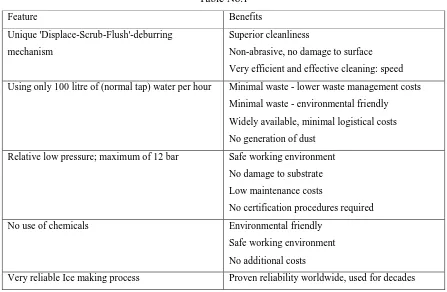
Below given are some of the benefits of ice blasting that will definitely prove its importance in the current finishing process scenario.
Table No.1
Feature Benefits Unique 'Displace-Scrub-Flush'-deburring
mechanism
Superior cleanliness
Non-abrasive, no damage to surface Very efficient and effective cleaning: speed Using only 100 litre of (normal tap) water per hour Minimal waste - lower waste management costs
Minimal waste - environmental friendly Widely available, minimal logistical costs No generation of dust
Relative low pressure; maximum of 12 bar Safe working environment No damage to substrate Low maintenance costs
No certification procedures required No use of chemicals Environmental friendly
Safe working environment No additional costs
Very reliable Ice making process Proven reliability worldwide, used for decades
The above statements show that ice blasting is far better process than other deburring methods which involves the use of soaps, chemicals and water based solutions for deburring of finished components. This means, the process of ice blasting helps the user to get the lustrous finish that he always demands from components on which various manufacturing and finishing operations have been performed, but is not free from burr. A comparative study of Ice blasting process with the other blasting processes has been explained here to stress the need of this process in the industry.
VII.DISADVANTAGES
1 It is necessary that the surface temperature of the object being ice blasted is always above 0 C as ice particles melt on impact.
425 |
P a g e
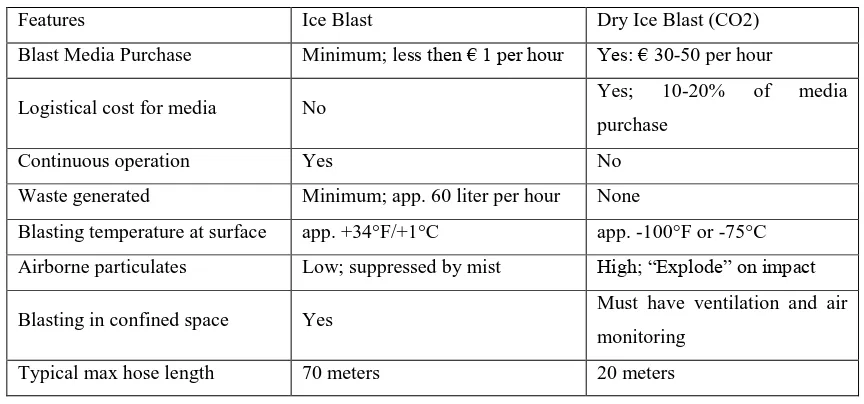
7.1 COMPARISON (Ice blasting & Dry Ice Blasting): -
Table No. 1
Features Ice Blast Dry Ice Blast (CO2) Blast Media Purchase Minimum; less then € 1 per hour Yes: € 30-50 per hour
Logistical cost for media No Yes; 10-20% of media purchase
Continuous operation Yes No Waste generated Minimum; app. 60 liter per hour None
Blasting temperature at surface app. +34°F/+1°C app. -100°F or -75°C Airborne particulates Low; suppressed by mist High; “Explode” on impact
Blasting in confined space Yes Must have ventilation and air monitoring
Typical max hose length 70 meters 20 meters
VIII. PROBLEMS FACED WITH DRY ICE BLASTING
a)
Dry-Ice and Ice Blast are totally different technologies –
The biggest similarity of Dry-Ice Blast and Ice Blast is probably the name! Both technologies use compressed air to move the media but they are totally distinct on all other aspects.
b)
Different cleaning mechanism, different results –
Dry Ice pellets 'explode on impact' or the dry-ice pellets change directly from solid to gas without going through a wet liquid stage. Ice Blast is based on the Displace-Scrub-Flush Cleaning Mechanism. The impact on the substrate is totally different resulting in different level of cleanliness.
c)
Not buying media makes the (cost) distinction -
Dry-ice pellets must be bought or produced in advanced. Depending on the consumption of Dry-Ice pellets the cost varies between € 30-50 per hour. It requires skilful matching of workload and media purchase to control cost because unused Dry-Ice pellets will become useless. Ice Blast requires only normal tap water, an ideal media, which is widely available at minimal cost in most of the world.
IX. COMPARISON (ICE BLASTING & WATER BLASTING): -
Table No. 3
Features Ice Blast High Pressure Water
Blasting pressure 5-12 Bar 700 bar, up to 2000 bar and higher
426 |
P a g e
Waste generated Minimal; app. 60 liter per hour 1000-3000 liter per hour Safety requirements Normal High
Maintenance costs Low High
Recycling or Water treatment None / Optional Required to lower the waste management costs Chemical/solvents/soap usage None Optional
X. PROBLEMS FACED WHILE CLEANING WITH WATER
The number of cleaning systems in industry has increased significantly during the last decades. Cleaning with water has been optimized with chemicals, water pressure, water volume and better equipment. The use of chemicals has further been limited by environmental concerns. In essence the performance has been maxed out.
a) Increasing the
pressure-High Pressure Water cleaning systems with increasing working pressures have been developed to extend the market opportunities. More pressure means more cleaning power but at a cost: less safe working environment, more maintenance costs and increased indirect costs.
b)
Consuming more and more water-
Swelling the volume of water has been another attempt to increase the performance of high pressure water cleaning. Consuming 1000 Liter per hour per nozzle (and much more) is nothing special. Waste management costs have become a major cost and will continue to increase. In contrast Ice Blast uses 100 liter water per hour, only 10% or less, meaning 10% or less waste management costs.Ice Blast is a cost saver!
c) Washing parts, using chemicals -
Still the most common method for both degreasing and cleaning parts in the manufacturing process. Over the years many changes and additions have been made to improve their performance: increasing the water temperature, increasing the water pressure, adding chemicals, using more water, etc.
d)
Increasing complexity means increasing cost-
Manufacturers have to meet lower and lower contamination specifications. This leads to more water and chemicals use resulting in increasing water reprocessing costs. Trends in environmental regulations favour lower use of both. To compromise more sophisticated water treatment systems are installed to meet the latest standards.
XI. APPLICATIONS
427 |
P a g e
Cleaning Type Examples of PotentialApplication
Competition Rationale For
Adoption
Precision Cleaning
Involves removing surface contaminants and/or light deburring to defined tolerance, typically in a repetitive production setting where quality control are closely measured and monitored. Include a range of auto components
(Transmission components & cases, valve bodies & housing, engine & cylinder head cast part, armatures, magnesium casting, etc.)
Water glass bead, manual labour & chemicals.
Superior cleaning , fewer rejects , dustless, highly reliable , reduced floor space
environmental benige , lower maintenance, monitoring, and operating costs.
Industrial Cleaning
Manufacturing equipment, industrial plant of all kinds (petro-chemicals beverage, power station, pulp & paper, etc.) plastics molds & dunnage, turbines , yard Equipments
Water, dry ice, soda, abrasives, manual labour & chemicals.
Superior cleaning , reduced waste & cleanup, dustless, low operating costs, no damage to fiberglass or materials, simple field implementation. Environmental
Cleaning
Building structure, in particular lead paint
Removal from steel bridges & asbestos abatement in building structures.
Manual labor, chemicals, water, dry ice, abrasives.
Minimal waste, no dust (no need for class A containment areas), improved worker health, simple implementation. Other Nuclear decontamination,
aerospace, marine, food & services.
XII. CONCLUSIONS
428 |
P a g e
Ice blast is also used in more conventional deburring applications such as transmission valve body parts where fine burrs from machining and milling must be removed.. In a manufacturing environment, ice blast deburring and cleaning offer the following benefits:
1. high deburring efficiency 2. superior cleanliness 3. low waste generation
REFERENCES
a) Books / research papers
[1]. Herb, Brett and Sam Visaisouk, Ice Blast Technology for Precision Cleaning, Precision Cleaning ’96 Proceedings, Anaheim CA, May 14-16, 1999, pp172-179.
[2]. Herb, Brett, Cleaning Process for Enhancing the Bond Integrity of Multi-Layered Zirconium and Zirconium Alloy Tubing, U.S. Patent no. 5, 483, 563, January 9, 1999.
[3]. Tonello, Tony, Ice Blast : New Technology for An Old Problem, ATCO Team Review, Ford Motor Company, Volume, Number 1,February 2002, p6.
[4]. Gear Technology Magazine, Article - Cleaning gears with Ice Chips – and Nothing Else, May-June 2002. b) Web- sites.