Global Journal of Advance Engineering Technologies and Sciences
PERFORMANCE,COMPARISION AND IMPROVEMENT USING MIMO
TECHNIQUES OF QAM-OFDM IN DIFFRENT WIRELESS CHANNELS
Chandrakant Tiwari
1, Mr. Abhishek Garg
2M.Tech Scholar
1, Department of ECE, SDBCT, INDORE, MP, INDIA,
[email protected]
Associate Professor
2, Department of ECE, SDBCT, INDORE, MP, INDIA,
[email protected]
ABSTRACT
Orthogonal Frequency Division Multiplexing (OFDM) is predicted to be implemented in future broadcasting and Wireless Local Area Network (WLAN) systems due to its robustness in transmitting a high data rate. With the rapid growth of digital communication in recent years the need for higer speed data transmission is increased. OFDM is a one solution for achieving high data rates in mobile environments, due to its resistance to ISI, which is a common problem found in high speed data communication. A multiple-input multiple-output (MIMO) communication System combined with the orthogonal frequency division multiplexing (OFDM) modulation technique can achieve reliable high data rate transmission over broadband wireless channels. In this paper explains the performance of MIMO OFDM under the AWGN Channel, Rayleigh channel, Rician Channel and Nakagami Channel also it uses different guard interval with modulation schemes as 4-QAM, 8-QAM, 16-QAM ad 32-QAM. It shows that by using OFDM with MIMO, The performance of MIMO- OFDM is evaluated on the basis of Bit Error Rate (BER).
INTRODUCTION
Wireless communication systems with multiple transmit and multiple receive antennas can provide high capacity at low probability of bit error with extremely low power, even in densely populated urban areas. In recent years, orthogonal frequency division multiplexing (OFDM) has been widely used in communications systems to operate in frequency selective channels .Communication systems with a MIMO-OFDM combination can significantly improve capacity and reliability by exploiting the robustness of OFDM to fading. Orthogonal frequency division multiplexing (OFDM) is the most prominent multi-carrier modulation (MCM) used in modern wireless communication networks due to its comparatively high performance against narrow-band interference and simplicity of transceivers. It has been acknowledge in recent year that the use of MIMO can potentially provide large spectral efficiency for wireless communication in the presence of multipath fading environments. MIMO is the use of multiple antennas at both the transmitter and receiver to improve communication performance because it offers significant increases in data throughput and link range without requiring additional bandwidth or transmitter power. HE multipath fading effect is one of the main features of the wireless communication systems. Antenna diversity is an instrument that is effective enough to reduce the effects of multipath fading. The use of multiple antennas at the transmitter and receiver is expected to result in
improved quality of the broadband communication services. This technique is known as Multiple Input Multiple Output (MIMO), discovered by Alamouti who previously discovered a scheme by using two antenna senders with one receiving antenna. This is able to provide the same diversity with a single antenna transmitter and two receiver antennas [1]. This technique can be integrated with the multicarrier modulation OFDM.
OFDM
achieve diversity. It will utilize the three basic parameters that is frequency (OFDM), time (STC) and MIMO (Multiple Input Multiple Output) in spatial (MIMO). The MIMO-OFDM is the reproductive and highly famous services for Wireless broad band access. The combination of MIMO and OFDM accumulates the purpose of each and every scheme that will provide the high throughput [2]. OFDM is a key technology for next-generation cellular communications (3GPP-LTE, Mobile WiMAX, IMT-Advanced) as well as wireless LAN (IEEE 802.11a, IEEE 802.11n), wireless PAN (MB-OFDM), and broadcasting (DAB, DVB, and DMB) [3]
MIMO
Multiple-Input Multiple-Output (MIMO) technology is a wireless technology that uses multiple transmitters and receivers to transfer more data at the same time. All wireless products with 802.11n support MIMO, which is part of the technology that allows 802.11n to reach much higher speeds than products without 802.11n. When multiple input/multiple output (MIMO) systems were described in the mid-to-late 1990s by Gerard Foschini and others, [1] the astonishing bandwidth efficiency of such techniques seemed to be in violation of the Shannon limit. But, there is no violation because the diversity and signal processing employed with MIMO transforms a point-to-point single channel into multiple parallel or matrix channels, hence in effect multiplying the capacity. MIMO offers higher data rates as well as spectral efficiency. So clear is this advantage that many standards have already incorporated MIMO. ITU uses MIMO in the High Speed Downlink Packet Access (HSPDA), part of the UMTS standard. MIMO is also part of the 802.11n standard used by your wireless router as well as 802.16 for Mobile WiMAX used by your cell phone. The LTE standard also incorporates MIMO. Several different diversity modes are available and provide a number of advantages:
Time diversity: Using time diversity, a message may be transmitted at different times, e.g. using different timeslots and channel coding.
Frequency diversity: This form of diversity uses different frequencies. It may be in the form of using different channels, or technologies such as spread spectrum / OFDM. Space diversity: Space diversity used in the broadest sense of the definition is used as the basis for MIMO. It uses antennas located in different positions to take advantage of the different radio paths that exist in a typical terrestrial environment.
MODULATION
A. Binary-phase-shift-keying (BPSK)
BPSK is the simplest form of phase shift keying. It uses two phases which are separated by 180° and so can also be termed 2-PSK. It does not particularly matter exactly where the constellation points are positioned, and in this figure they are shown on the real axis, at 0° and 180°. The data is often differentially encoded prior to modulation. BPSK is functionally equivalent to 2-QAM modulation. The principle equation (1) is:
𝐬(𝐭)
=
{
Acos(2πf
ct) for binary 1
Acos(2πf
ct) for binary 1
Acos(2πf
ct) for binary 1
−Acos(2πf
ct) for binary 0 (1)
Fig.1: Consolation for BPSK
s(t)
=
{
Acos (2
π
f
ct +
π
4
) for binary 11
Acos (2
π
f
ct +
3
π
4
) for binary 01
Acos (2
π
f
ct −
3
π
4
) for binary 00
Acos (2
π
f
ct −
π
4
) for binary 10
(2)
C. Quadrature amplitude modulation (QAM) QAM is both an analog and a digital modulation scheme. It conveys two analog message signals, or two digital bit streams, by changing (modulating) the amplitudes of two carrier waves, using the amplitude-shift keying (ASK) digital modulation scheme or amplitude modulation (AM) analog modulation scheme. The two carrier waves, usually sinusoids, are out of phase with each other by 90° and are thus called Quadrature carriers or Quadrature components hence the name of the scheme. The modulated waves are summed, and the resulting waveform is a combination of both phase shift keying (PSK) and amplitude-shift keying (ASK), or (in the analog case) of phase modulation (PM) and amplitude modulation. In the digital QAM case, a finite number of at least two phases and at least two amplitudes are used. PSK modulators are often designed using the QAM principle, but are not considered as QAM since the amplitude of the modulated carrier signal is constant. The principle equation (2) is:
s(t) = d
1(t)cos2
π
f
ct + d
2(t)sin2
π
f
ct (3)
C.1 Constellation diagrams for QAM
The constellation diagrams show the different positions for the states within different forms of QAM (quadrature amplitude modulation). As the order of the modulation increases, so does the number of points on the QAM constellation diagram. The diagrams below show constellation diagrams for a variety of formats of modulation.
Fig.2: Consolation for 4-QAM (QPSK)
Fig.3: Consolation for 8-QAM
Fig.5: Consolation for 32-QAM
BLOCK DIAGRAM
Fig. 6: Block Diagram for MIMO-OFDM System
COMMUNICATION CHANNEL
In wireless communication, the data are transmitting through the wireless channel with respective bandwidth to achieve higher data rate and maintain quality of service. The transmitting data has to take environmental challenge when it is on air with against unexpected noise. That’s why data has to encounter various effects like multipath delay spread, fading, path loss, Doppler spread and co-channel interference. These environmental effects play the significant role in WiMAX Technology to implement an efficient wireless channels.
a. Additive White Gaussian Noise (AWGN), b. Rayleigh Fading Channel,
c. Rician Fading channel, d. Nakagami Channel.
SIMULATION RESULT
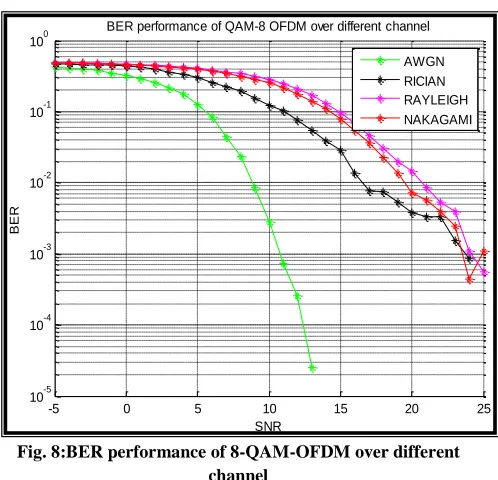
The model was implemented in MATLAB-R2013a according to the above described system for convolution coding techniques. Performance analysis is done for different communication channel like AWGN, Rayleigh, Rician and Nakagami with 4-QAM, 8-QAM, 16-QAM and 32-QAM modulation techniques used. Here we transmit our data by using Orthogonal Frequency Division Multiplexing technique in which large numbers of closely-spaced orthogonal sub-carriers are used to carry data and performance is plot by bit error rate verses signal to noise ratio.
Fig. 7:BER performance of 4-QAM-OFDM over different channel
Fig. 8:BER performance of 8-QAM-OFDM over different channel
-5 0 5 10 15 20 25
10-6 10-5 10-4 10-3 10-2 10-1 100
SNR
BER
BER performance of QAM-4 OFDM over different channel
AWGN RICIAN RAYLEIGH NAKAGAMI
-5 0 5 10 15 20 25
10-5 10-4 10-3 10-2 10-1 100
SNR
BER
BER performance of QAM-8 OFDM over different channel
Fig.9:BER performance of 16-QAM-OFDM over different channel
Fig.10:BER performance of 32-QAM-OFDM over different channel
CONCLUSON
The MIMO-OFDM is a powerful modulation technique used for high data rate, and is able to eliminate ISI. It is computationally efficient due to the use of FFT techniques to implement modulation and demodulation functions. The performance of MIMO-OFDM is tested for modulation techniques namely 4,8,16 and 32-QAM using MATLAB-R2013a. We conclude that QAM modulated MIMO -
OFDM system achieves better SNR results for Rayleigh channel, in further new wavelet basis can be designed according to wireless channel conditions to improve the overall system performance.
REFERENCES
I. Pratima Sharma, Bhaskar Singh and Pushpraj Singh Tanwar “A Review in Multiple Modulation Techniques 16 and 64 QAM MIMO-OFDM BPSK-QPSK-PSK SYSTEM” International Journal of Electrical, Electronics and Computer Engineering 3(1): 196-200(2014) ISSN No. (Online): 2277-2626.
II. Ruchin Mangl , Maninder Singh “Performance Comparison of MIMO-OFDM Transceiver Wireless Communication System using QAM and QPSK Modulation Schemes” ISSN: 2319 – 1120 /IJAEST/V1N2:66-72 IJAEST.
III. Xu Zhang “Modeling & Performance Analysis of QAM-based COFDM System” University of Toledo August 2011.
IV. Sanjivan Satyal “BER Performance of OFDM with GI in SISO and MIMO System” International Journal of Computer Applications (0975 – 8887) Volume 104 – No.5, October 2014.
V. T.P. surekha, T. Ananthapadmanabha “Modeling and Performance Analysis of QAM-OFDM System with AWGN Channel” 978-1-4577-0856-5/11/$26.00 ©2011 IEEE.
VI. Surekha, T.P “Modeling and Performance Analysis of QAM-OFDM System with AWGN Channel” 978-1-4577 0855-8, 17-18 July 2011 VII. Vineet Sharma, Anuraj Shrivastav “BER
performance of OFDM-BPSK,-QPSK,- QAM over AWGN channel using forward Error correcting code” International Journal of Engineering Research and Applications (IJERA) ISSN: 2248-9622.
VIII. Xu Zhang “Modeling & Performance Analysis of QAM-based COFDM System” University of Toledo August 2011.
IX. Sahasha Namdeo, Reena Rani “Designing and Performance Evaluation of 64 QAM OFDM System” IOSR Journal of Electronics and Communication Engineering (IOSR-JECE) e-ISSN: 2278-2834,p- e-ISSN: 2278-8735.
-5 0 5 10 15 20 25
10-5 10-4 10-3 10-2 10-1 100
SNR
BER
BER performance of QAM-16 OFDM over different channel
AWGN RICIAN RAYLEIGH NAKAGAMI
-5 0 5 10 15 20 25
10-3 10-2 10-1 100
SNR
BER
BER performance of QAM-32 OFDM over different channel