ISSN: 2231-5381
http://www.ijettjournal.org
Page 3500A Study on Utilization Aspects of Stone Chips as an
Aggregate Replacement in Concrete in Indian Context
Saiyed Farhana1, Parmar Bhumika2, Prajapati Jayesh3, Prof. Jayeshkumar Pitroda4
1,2,3
Students of final year B.E. Civil Engineering,B.V.M. Engineering College, VallabhVidyanagar
4
Assistant Professor & Research Scholar, Civil Engineering,Department, B.V.M. Engineering College, Vallabh Vidhyanagar
ABSTRACT— The high consumption of raw materials by the construction sector, results in chronic shortage of building materials and the associated environmental damage. In the last decade, construction industry has been conducting various researches on the utilization of industrial waste products in concrete in order to reduce the utilization of natural resources.India is pioneer in the exploration, mining of commercial rock deposits and in establishing a firm base for stone industry. Of the 300 varieties of stone; being traded in the world market, nearly half of them are from India.The study concerns mainly on the possible use of stone waste in construction industry, which would reduce both environmental impacts and the production cost. Concrete works in construction industry is particularly important as it is not only responsible for consuming natural resources and energy but also its capacity to absorb other industrial waste. Presently large amounts of stone wastes are generated in natural stone processing plants with an important impact on the environment due to its disposal. Stone chips aggregate are generated as a waste during the process of cutting and polishing of Marble/Granite/Kotastone. This Research Study describes the feasibility of using the Stone Waste chips in concrete production as partial replacement of natural aggregates in Indian context and to reduce disposal and pollution problems. As aggregates are being an important part of concrete by volume and cost. Too, it’s necessary to find an effective alternative to reduce the overall cost of concrete without affecting its properties. Stone Chips have such potential as they possess good physical and chemical properties.
Keywords—Stone chips, natural aggregates, concrete, cost
INTRODUCTION
India possesses a wide spectrum of dimensional stones that include granite, marble, kota stone,sandstone, limestone, slate, and quartzite, spread out all over the country. India is also amongst the largest producer of raw stone material and the sector is quite developed and vibrant in the South, as well as in Rajasthan and Gujarat, with a dedicated resource of entrepreneurs.
Stone are the natural, hard substance formed from minerals and earthmaterial which are present in rocks. Rock are the portion of the earth’s crusthaving no definite shape and structure. Almost all rocks have a definite chemical compositionand are made up of minerals and organic matter. Some of the rock-forming minerals are quartz,felspar, mica, dolomite, etc. The various types of rocks from which building stones are usuallyderived are granite, basalt, trap, marble, slate, sandstone and limestone.
Stone have still remained a major base in construction industry in India, as there are being used extensively in public buildings, hotels, and temples.
Use of stone in building construction is traditional in the places where it is produced,through its high cost imposes limitations on its use. Stone has been used in the construction of most of the important structures since prehistoricage. Most of the forts world over, the TajMahal of India, the famous pyramids of Egypt and theGreat Wall of China are few examples.
ISSN: 2231-5381
http://www.ijettjournal.org
Page 3501transportation and dressing which consume a lot of time resulting in slowpace of construction.
AGGREGATES
One of the most particular and general but most important material used for making concrete is AGGREGATE.Aggregates are used as filler with binding materials in production of concrete.Aggregates occupy about 72-75% of volume of concrete and they greatly influence the strength of concrete. These are cheaper than cement and admixtures. The aggregate impart density to concrete. Aggregates may be fine or coarse.The coarse aggregates form the main matrix of concrete and fine aggregate form the filler matrix between coarse aggregates. They may be available naturally or made artificial.
CLASSIFICATION OF AGGREGATES
BASED ON SIZE, SHAPE & OTHERS
Based on unit weight of aggregates Based on geological origin Based on parent rock Based on shape Based on size
TABLE 1
CLASSIFICATION OF AGGREGATES BASED ON SIZE, SHAPE & OTHERS
NATURAL BASALTIC AGGREGATES
Natural basalticaggregate consist of rock fragments that are used in their natural state or used after various mechanical processing such as crushing, sizing, washing etc. Normalweight natural aggregates can be used in all type of work.The specific gravity of these aggregates ranges from 1.5 to2.7. The concrete having density of 2300 kg/m3 to 2600 kg/m3 is produced.
CLASSIFICATION NATURAL
BASALTICAGGREGATE BASED ON
WEIGHT
Normal Weight Aggregates Light Weight Aggregates Heavy Weight Aggregates
TABLE 2 CLASSIFICATION OF AGGREGATESBASED ON WEIGHT
CHARACTERISTICS OF AGGREGATES
(FACTORS INFLUENCING SELECTION OF AGGREGATES)
1. Strength 2. Stiffness 3. Bond Strength 4. Shape and Texture 5. Specific Gravity 6. Bulk Density 7. Voids 8. Porosity
9. Moisture Content 10. Bulking
11. Fineness Modulus
COMPOSITIONOF NATURAL AGGREGATES
Some percentage of RCS (Respirable Crystalline Silica)/Free Silica
Lime (CaO)
Magnesium oxide (MgO)
PHYSICAL PROPERTIES OF NATURAL AGGREAGATES
F igure 1: Physical Properties of Natural Aggregates
ISSN: 2231-5381
http://www.ijettjournal.org
Page 3502Chemical properties of natural aggregatesare varyingand generally depending on source of product.Natural aggregates generally used for construction purpose includes basalt.Basalt is an igneous rock.The aggregate formed from this rock are hard tough and dense.Other rocks like basalt are granite and dolerite.Most often basalt aggregates are used in construction field as aggregates in concrete mix. Moreover basalt is hard and dense rock,normally undergoes very little creep or no creep.The modulus of elasticity of naturally occurring hard aggregates is one of the important factors influencing creep. Out of all natural aggregate basalt is more preferred.
BASALT AS CONSTRUCTION MATERIAL
The main properties of Basalt are as follows: Basalt is a dense looking black volcanic rock. Its texture is fine grained to glassy.
It is composed of Plagioclase, Hornblende, Olivine, Biotite and Iron Oxide.
It has been estimated that Basalt is 5/6th of all the volcanic igneous rocks of the world. Basalt sometimes contains residues which have become filled with secondary minerals like Quartz, Calcite and Zeolite.
USES OF BASALT
The crushed Basalt is used as road metal and concrete aggregate.
Basalt is an important rock used in the construction of bridges, pavements of highways, railways and other engineering works.
It is not used for very important buildings because of its dark colour and the quality of not taking good polish.
INTRODUCTION TO STONE
CHIPSAGGREGATES
The aggregates formed from basalt rock are used for construction work due to high strength and hardness.In recent times there has been a shortage of construction material and hence artificial replacement of construction materials is made possible fully or partially.This idea also keeps the concept of attaining nearly same or same strength as obtained by the basic construction materials. Keeping in mind the economic feasibility and technical viability of thehandled project, the work admires the replacement of natural aggregates by stone chips (waste or scrap of quarry). This will
lead to effective utilisation of such waste in worthy works of construction.Tons and tons of such kind a waste is generated every year from quarries, which is rendered useless and may also spoil the aesthetics of surrounding regions.
CHEMICAL COMPOSITION OF
MARBLE,GRANITE AND KOTASTONE
TABLE–3
CHEMICAL COMPOSITION OF MARBLE, GRANITE,KOTASTONE
Chemical
Composition Marble Granite
Kota Stone
Lime 28-32% 1-4% 37-39%
Silica 3-30% 72-75% 24-26%
MgO 20-25% 05-1% 4-6%
FeO+Fe2O3 1-3% - -
Loss of ignition 20-45% 5-10% 32-35%
Source:Mamta B. Rajgor,Jayeshkumar Pitroda (A study of utilization of stone waste in Indian context)
It is found that stream materials,crushed stones and artificial aggregates have been used in concrete aggregate in the world.It is unquestionable and more suitable material than other aggregate types. Same units can make stone grit and chips, butcurrentlychips are more in demand. The demand for stone chips is directly linked with the volumeof construction activity. Stone chips are used in concreting, along with cement and sand and inroad pavement work. Looking at the decreasing economic costs involved with storage while preventing possible environmental negative impacts it can be considered as a future pre-requisite to use crushed stone chips for construction in countries having scarce resource.
Figure2: Stones: Marble, Granite, Kota Stone
Source: www.geology.com
ISSN: 2231-5381
http://www.ijettjournal.org
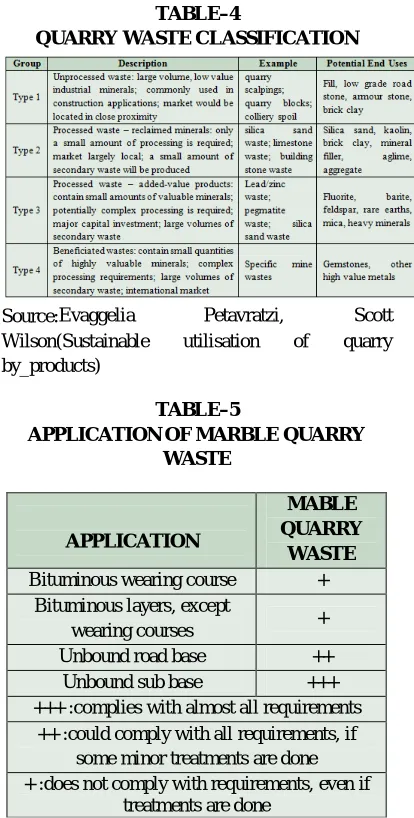
Page 3503It can be collected from the stone quarry. It is available as waste product of quarry. From such waste stone chips can be produced.
TABLE–4
QUARRY WASTE CLASSIFICATION
Source:Evaggelia Petavratzi, Scott Wilson(Sustainable utilisation of quarry by_products)
TABLE–5
APPLICATION OF MARBLE QUARRY WASTE
APPLICATION
MABLE QUARRY
WASTE
Bituminous wearing course + Bituminous layers, except
wearing courses + Unbound road base ++
Unbound sub base +++ +++ :complies with almost all requirements
++ :could comply with all requirements, if some minor treatments are done + :does not comply with requirements, even if
treatments are done
Source: Helena Lima;ICOR-Road construction institute,Portugal(Applicability of marble quarry waste in pavement layers)
CASE STUDY
Dushyant R. Bhimani, Prof. Jayeshkumar Pitroda, Prof. Jaydev J. Bhavsar (2013), “Innovative Ideas for Manufacturing of the Green Concrete by Utilizing the Used Foundry Sand and Pozzocrete” International Journal of Emerging Science and Engineering TM, IJESE
In thepresentstudy, effect of stone chips aggregateas coarseaggregate replacementonthecost of concrete having mix proportions of 1:1.48:3.21 was designed as per IS: 10262:2009 methods was investigated. Thepercentages of replacementswere 0%, 10 %,20%, 30%, 40% and 50%byweightof coarseaggregate.The design mix proportion is done in Table 6. And economical feasibility is done in table-7&8.
TABLE - 6
M20 MIX DESIGN PROPORTIONS
W= Water, C= cement, F.A. = Fine Aggregate, C.A. = Coarse Aggregate, S.C.A. = Stone Chips Aggregate
TABLE- 7 COSTS OF MATERIALS
Sr. No. Materials Rate (Rs/Kg)
1 Cement (OPC 53 grade) 6.00
2 Fine aggregate (Regional ) 0.61
3 Coarse aggregate (Regional ) 0.65
4 Stone chips aggregate 0.20
TABLE - 8
TOTAL COST OF MATERIALS FOR M20 DESIGNE MIX CONCRETE (1:1.48:3.21) PER m3
C.T. = Concrete Types,C= Cement, F.A. = Fine Aggregate, C.A. = Coarse Aggregate, S.C.A. = Stone Chips Aggregate
CONCLUSION
a) We can say that for 1m3 M20 grade of concrete consumption of coarse aggregate is 1231.11kg. Here in specimen A1, A2, A3, A4, A5 we replace coarse aggregate by 10 %,20%, 30%, 40% and 50% by weightof coarse aggregate for 1m3 M20 grades of concrete.
Natural basaltic aggregate replacement by stone chips aggregate
By weight, [kg]
0% 10% 20% 30% 40% 50%
W(Lit) 191.60 191.60 191.60 191.60 191.60 191.60
C(Kg/m3) 383.21 383.21 383.21 383.21 383.21 383.21
F.A.(Kg/m3) 569.38 569.38 569.38 569.38 569.38 569.38
C.A.(Kg/m3) 1231.11 1108.00 984.89 861.78 738.67 615.55
S.C.A.(Kg/m3) - 123.11 246.22 369.33 492.44 615.55
C.T.
Consumption of Design Mix Proportions For M20 Concrete (1:1.48:3.21)
Total Cost /m3
% Cost change
C F.A. C.A. S.C.A.
A0 383.21 569.38 1231.11 - 3446.80 0
A1 383.21 569.38 1108.00 123.11 3391.40 -1.61
A2 383.21 569.38 984.89 246.22 3336.00 -3.21
A3 383.21 569.38 861.78 369.33 3280.60 -4.82
A4 383.21 569.38 738.67 492.44 3225.20 -6.43
ISSN: 2231-5381
http://www.ijettjournal.org
Page 3504So, as per literature review conclude that up to approximate 30% stone chips aggregate utilized for economical and sustainable development of concrete.
b) If compressive strength is not achieved as per design the use of admixture recommended achieving in strength. So stone chips aggregate in concrete can save the stone industry disposal costs and produce a ‘greener’ concrete for construction.
c) Stone chips are providing a cost effective alternative to conventional natural aggregates, by reducing the cost of concrete.
d) It reduces the depletion of conventional coarse aggregates from environment and also enables to produce Green Concrete.
e) Thus, an innovative supplementary Construction Material is formed through this study.
ACKNOWLEDGMENTS
The Authors thankfully acknowledge to Dr.C.L.Patel, Chairman, Charutar Vidya Mandal, Er.V.M.Patel, Hon.Jt. Secretary, Charutar Vidya Mandal, Mr. Yatinbhai Desai, Jay Maharaj Construction, Prof. J.J.Bhavsar, Associate Professor, Civil Engineering Department, B.V.M. Engineering College, Vallabh Vidyanagar, Gujarat, India for their motivational and infrastructural support to carry out this research.
REFERENCES
[1] Agarwal R.K.; 'Modern stone waste processing
techniques and their suitability for Indian
condition"; a company report by Rajasthan Udyog, Jodhpur.
[2] Anon; "Technological evaluation & norms study in stone waste & granite industry'" Report of Ministry of Science & Technology, GOI; July 1993. [3] Ankit N. Patel, Prof. Jayeshkumar Pitroda (2013),
“Stone Waste In India For Concrete With Value Creation Opportunities”The International Journal of Latest Trends in Engineering & Technology, IJLTET, Volume 2 Issue 2 March 2013 • ISSN No 2278 – 621X / 113-120
[4] Ankit N. Patel, Prof. Jayeshkumar Pitroda (2013), “An Exploration Study on Stone Waste as Foregoing Alternatives for Green Concrete” International Journal of Advanced Engineering Research and Studies, Technical Journals Online (IJAERS), E-ISSN2249–8974, Volume-II, Issue-III, April-June, 2013 /35-38
[5] Ashokan Pappu, Mohini Saxena, Shyam
R.Asolekar. solid waste generation in India and their
recycling potential in building materials. Regional Research Laboratory (CSIR), Habib Ganj Naka, Bhopal–462026, India CESE, Indian Institute of Technology, Bombay-400076, India
[6] Battacharya B.C.; "Possible utilization of waste stone waste powder / slurry - a case study". Seminar on gainful utilization of stone waste slurry in various construction activities; UCCI, Udaipur; Sept. 18,2002.
[7] Bhatnagar A.; "Scientific and modern mining of stone waste - Development of large block extraction with minimum of waste". Global seminar for golden jubilee of I.I.T. Kharagpur, TMMPE-2000; Dec. 1-3-2000.
[8] Dr.T.Sekar, N.Ganesan&Dr.NVN.Nampoothiri
(2011) ,“Studies on strength characteristics on utilization of waste materials as coarse aggregate in concrete”,International Journal of Engineering Science and Technology,Volume 3 No 7, 2011. [9] F.A. Olutoge (2010), “Investigations on sawdust
and palm kernel shells as aggregate replacement” ARPN Journal of Engineering and Applied Sciences,VOL. 5, NO. 4, April 2010.
[10]Gupta TN. Building materials in India: 50 years, a
commemorative volume. Building Materials
Technology Promotion Council . New Delhi, India: Government of India; 1998.
[11]G.Murali, K.R.Jayavelu, N.Jeevitha, M.Rubini,
N.R.Saranya / International Journal of Engineering Research and Applications (IJERA) ISSN: 2248-9622 www.ijera.com Vol. 2, Issue 2,Mar-Apr 2012, pp.322-327 322 Experimental investigation on concrete with partial replacement of course aggregate.
[12]http://www.wideformatonline.com/index.php/featur es/tips-a-tricks/vinyl/3540-stone-chip-protection-adding-value-applications
[13]http://web.firat.edu.tr/iats/cd/subjects/Civil&Constr uction/CAC-11.pdf.
[14]http://www.ijbbb.org/papers/54-B108.pdf
[15]http://www.nbmcw.com/magazines/constructionma
gazine.html
[16]IS 456-2000 Specifications for plain and reinforced concrete.
[17]IS 10262:2009Recommended guidelines for
concrete mix Design, BIS. NewDelhi, India, 2009. [18]IS: 383-1970,Specification for Coarse and Fine
Aggregates from natural sourcesfor concrete (Second edition)
[19]KamelK.Alzboon and Khalid
N.Mahasneh(2009),“Effect of Using Stone Cutting Waste on the Compression Strength and Slump Characteristics of Concrete”, International Journal of Civil and Environmental Engineering ,1:4 2009.
[20]Mamta B. Rajgor,Prof. Jayeshkumar Pitroda (2013),
ISSN: 2231-5381
http://www.ijettjournal.org
Page 3505Research Analysis, (GRA), Volume: 2, Issue: 1, Jan 2013, ISSN No 2277 – 8160, pp-50-53
[21]Nutan C. Patel,Prof. Jayeshkumar Pitroda (2013), “A Technical Study on Quarrying and Processing of Marble and Its Waste Incorporating With Concrete” International Journal Global Research Analysis, (GRA), Volume : 2, Issue : 2, Feb 2013, ISSN No 2277 – 8160, pp-82-84
[22]Nutan Patel, Amit Raval, Prof. Jayeshkumar Pitroda
(2013), “Marble Waste: Opportunities For
Development of Low Cost Concrete” International Journal Global Research Analysis, (GRA), Volume: 2, Issue : 2, Feb 2013, ISSN No 2277 – 8160, pp-94-96
[23]Nima FarzadniaAbang Abdullah Abang Ali and
RamazanDemirboga (2011), “ Incorporation of
Mineral Admixtures in Sustainable
HighPerformance Concrete” ,International Journal
of Sustainable Construction Engineering &
TechnologyVol 2, Issue 1, June 2011.
[24]P.Turgut and E. S.Yahlizade(2009), “Research into Concrete Blocks with Waste Glass”, International Journal ofCivil and Environmental Engineering 1:4 2009.
[25]Robert L.purifoy,William B.Ledbetter,Construction
planning,equipments and methods.McGrawhill
international editions.
[26]Report on characteristics of natural aggregates by Athanasios Kalofotias, PRESTE ,Sofia mavridou and Nilolaos oikonomou,LBM.July 2011
[27]VeeraReddy.M (2010), “Investigations on stone
dust and ceramic scrap as aggregate replacement in concrete”, International journal of civil and structural engineering Volume 1, No 3 ,ISSN 0976 – 4399.
AUTHORS BIOGRAPHY
Saiyed Farhana M. was born in 1992 in Petlad town, Gujarat. She is pursuing her Bachelor of Engineering degree in Civil Engineering from Birla Vishvakarma Mahavidhyalaya Engineeringcollege, Vallabh Vidyanagar, Gujarat.She is interested in research work on utilization of stone industry waste in construction industry.
Prajapati Jayesh was born in 1992 in Anand District, Gujarat. He is final year student of Bachelor of Engineering degree in Civil Engineering branch from Birla Vishvakarma Mahavidyalaya Engineering College, Vallabh Vidyanagar, Gujarat. He is interested in research work on utilization of stone industry waste in construction industry.
Bhumika J. Parmar was born in 1992 in Anand District, Gujarat. She is final year student of Bachelor of Engineering degree in Civil Engineering branch from Birla Vishvakarma Mahavidyalaya Engineering College, Vallabh Vidyanagar, Gujarat. She is interested in research work on utilization of stone industry waste in construction industry.