ISSN: 2231-5381
http://www.ijettjournal.org
Page 13
Gender Recognition from Model’s Face Using
SVM Algorithm
Deepak Deshmukh
Lecturer EXTC Dept. VOGCOE Dist. Thane. Mumbai. India
Abstract - This paper presents a
method for Gender Recognition using Support Vector Machine (SVM).This System consists of two stages – Feature Extraction and SVM Classification. In Feature Extraction we separate out eyes nose and mouth from the face. In SVM Classification those separated parts are grouped in two parts.(Male anf Female). This System is carried out in two Process – Training Process and Testing Process. In Training Process we create the database of few persons and mention their group (Male or Female) simultaneously. Testing Process deals with the test samples which we have to predict if its male or female. And finally Gender Classification is done by using Facial Feature, using SVM.
Keywords – SVM , Support Vectors , Fisher
Algorithm.
I. INTRODUCTION
Here we are going to recognize a gender of person from its image of the face. First of all we are going to store the image of selected faces in our database. This stored images in our database are used for future processing in our project. This image will compare the face of the human which we have to recognize or match the face. Here we are first separating out the facial features of the face like eyes , nose and mouth. After separating out we are grouping them as male or female. This will be stored in our database. Now our database have knowledge
that which face is of male or female. It means we have done the Training Process. Now to test that does our system can really classify the Genders or not , we are going to Test it in Testing Process by giving the new samples of image from different persons. Same process is carried out for extraction now and after that, comparing the Facial Features using SVM with the database it classifies the Gender as Male or Female.
II. LITERATURE SURVEY
Gender Classification can be carried out in different methods also like LDA and Fisher’s Algorithm. But still we are using Support Vector Machine (SVM).The reason behind this can be explained as follow by discussing some Algorithms.
ISSN: 2231-5381
http://www.ijettjournal.org
Page 14
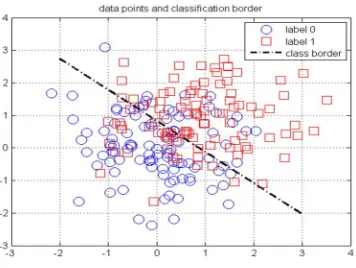
Fig 1 .Nearest Neighbour Algorithm.Advantages
• The main advantage of the algorithm is that the final result does not make any
global assumption on the data
distribution, and the data is created by minimizing the classification error in the training data set.
• The objective of analysis is to find the features that best separate the different classes from each other.
• The main advantage offered by the
featured-based techniques is that
extraction of the feature points don’t need to have any memory to be stored.
B. Fisher’s Algorithm - In Fisher’ Algorithm , data is grouped according to the properties of data. This grouping is done on the basis of difference in the two consecutive data which are injecting in the sample set. This results better
than Nearest Neighbour Classification
Algorithm because this groups the data according to the property and not according to the data available in sample sets. But complications arises when calculations of Eigen Vectors and Eigen Values occurs to extract the features.
Fig 2. Fisher’s Algorithm
Advantages
• Used to group data in two parts.
Specially, when training samples are less.
• Eigen Vectors are best to extract the features.(In our project we have used YCBCR model instead of Eigen Vectors)
C. Support Vector Machines. - In this algorithm data is classified in two groups using Support
Vectors. Support Vectors are maximum
differentiating properties between the two groups. It results almost same as Fisher’s Algorithm but chances of errors are reduced aa we don’t have calculations of Eigen Vectors and Eigen Values
.
ISSN: 2231-5381
http://www.ijettjournal.org
Page 15
How it can Overcome Other Algorithms ?• Nearest Neighbour Algorithm would
not predict data, it only classify the data from given set of samples where as in SVM the samples are trained
• In Fishers Algorithm we have to
calculate the Eigen Vectors and its value for Training data which can be skipped in SVM.
By training the data in SVM properly it can overcome the results of Principle Component Analysis.
III. SYSTEM ANALYSIS
Upto now we have seen the flow of the system. In this point we will discuss in short how each part is carried out successfully. First of all we have to extract the Facial Features in our Database.
A. Define Facial Features
Using the command “ bbox = bbox(x,y). ” in matlab we will define Facial Features.
Where x and y are used to define the position of the feature or the location of particular feature. This bounding boxes are very essential in extracting the features some of which are mentioned below.
bbox: bbox(1: 4) is bounding box for face
bbox( 5: 8) is bounding box for left eye
bbox( 9:12) is bounding box for right eye
bbox(13:16) is bounding box for mouth
bbox(17:20) is bounding box for nose
B. Extraction of Facial Features
If in case , the face is inclined to horizon by angle “theta”. Then incline that face by rotating the image by anti clock wise by angle “theta” and make face parallel to vertical level by using the matlab command
thet=(180/pi)*atan((((bbox(1,10)+bbox(1,12))-(bbox(1,6)+bbox(1,8)))/
((bbox(1,9)+bbox(1,11))-(bbox(1,5)+bbox(1,7)))));
img = imrotate(img,thet);
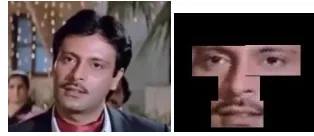
Fig. 4..Inclining Eyes Parallel to Horizon level
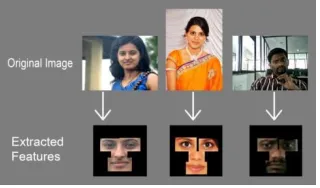
C. Extracted Facial Features
After aligning the face ,extract out its facial features and store that in our database. Following is the sample of one of the face in our database
Fig.5. Original Image and Extracted Image
D. Samples Of Database.
ISSN: 2231-5381
http://www.ijettjournal.org
Page 16
Fig 6. Samples of DatabaseE. Samples Of Test Image Samples.
Now , after creating database; we test our system by providing it with different Test Samples images. Same process is carried out as for database and finally we extract its Facial Features. Following are some of the Test Image Samples..
Fig.7. Samples of Test Input Images
F. Comparison Of Images.
Now , its time to compare the Test Image with Database. Following are steps of comparision.
During comparision only Brightness and
Luminance of image are considered.
Convert RGB image to YCbCr Mode.
Resize Image to 100x100 Resolution.
Compare Features with Database using Train Label
train_label=[ 2 1 1 1 1 1 …..1 1 1 2 ]‘
Where 2 = Female
1 = Male
IV. PERFORMANCE ANALYSYS.
A. Drawbacks of Nearest Neighbour Classifier.
• The main problem of algorithms is their
dependency on a set of assumptions that sometimes are not met in the data distribution.
• Features extracted by using this
nonlinear techniques cannot be always marked in order of importance for classification purposes.
• What we purpose here is an embedding from high dimensional space to a low-dimensional one, where the features are marked according to the algorithm.
• It makes no assumptions on the data distribution which is specially suitable for feature extraction
. How SVM can overcome it ?
• By defining the facial features we can properly train the data in two different groups .
• Features extracted by using this
techniques is always marked in order of what we train so importance of order is defined properly
• Here facial features are marked
according to the algorithm. So the system can work properly in both high
dimensional and low dimensional
spaces.
• Only the internal features of the images have been taken into account, there is almost no hair or external information for making confusion for system
B. Drawbacks of Fisher’s Algorithm
• Here we have to calculate the Fishers optimal vectors so in order to train the samples so sometimes, it becomes a problem to calculate.
ISSN: 2231-5381
http://www.ijettjournal.org
Page 17
becomes a problem when test samplesare different than training samples.
How SVM can overcome it ?
• No need to calculate Fishers Vectors as we are training the data directly into two groups. So, no chances of calculations.
Using the train label it can classify the test input image with training image properly so prediction problem can be overcome
Comparision Study
Fig.8 Comparision of Error Rate
V. RESULT ANALYSYS.
Result is shown at the end of Algorithm.
It is displayed in two rows and ‘n’ number of Columns
Where , n = number of images
First row is the sequence of image in folder
Second row is the result shown by either ‘1’ or ‘2’.
Where ,
1 = Male and 2 = Female
Fig.9. Final Result
A. Future Scope
This work is the platform of many
useful system.
By keeping light conditions constant it can be used in security systems
where a person can be identified even after clothing his face.
As it can identify a person even after changing his facial looks this can
be used for ladies compartment where males are restricted.
Can be used as a password in biometric
identifications
By working more on facial features it can even detect and predict the age
of person after specific duration of time.
Useful in public places for tracking a specific person.
Can also used in online Identity Cards verification.
VI. REFERENCES
ISSN: 2231-5381
http://www.ijettjournal.org
Page 18
[2]. David Masip, Jordi Vitrià ‘Boosteddiscriminant projections for nearest neighbor classification’
[3]. Proyecto Fin de Carrera ‘Face Recognition Algorithms’,’ June 16, 2010’ [4]. Support Vector Machines for
Classifying Face Data David Shaw Due: 12/14/2009.
[5]. Pattern Based Gender Classification Omveer Singh, Gautam Bommagani, , Sravan Reddy Ravula. Vinit Kumar Gunjan,’ International Journal of Advanced Research in Computer Science and Software Engineering’
[6]. ‘Support Vector Machines for Classifying Face Data’ David Shaw Due: 12/14/2009
[7]. Classification of Face Images Based on Gender using Dimensionality Reduction Techniques and SVM Fahim Mannan [8]. ‘GENDER CLASSIFICATION USING
SUPPORT VECTOR MACHINES’ Ashwin Swaminathan ENEE633: Statistical and Neural Pattern Recognition.
[9]. “International Journal of Signal Processing, Image Processing and Pattern Recognition” 3, September, 2011 Face Recognition Based on SVM and 2DPCA Thai Hoang Le, Len Bui.
[10]. MITSUBISHI ELECTRIC RESEARCH LABORATORIES Gender Classification with Support Vector Machines Baback Moghaddam and Ming-Hsuan Yang.