SCITECH
Volume 4, Issue 2
RESEARCH ORGANISATION
September 5, 2015
Journal of Research in Business, Economics and Management
www.scitecresearch.com
Development of a Model for Identification of Reasons for
Deviation in Forecasts
Mohammad Reza Yavarzadeh
1, Yashar Salamzadeh
2, Farzaneh Azari Yekta
3 1Ph.D. Candidate in Futures Studies, Institute of Humanities and Social Studies, Tehran, Iran.
2 Ph.D. in Public Administration, Management Department, Farabi Institute of Higher Education, Tehran, Iran. 3Student at Master degree of EMBA (Strategic Management), Farabi Institute of Higher Education, Iran.
Abstract
Most organizations use forecasting techniques in order to achieve their goals and to reduce risk in uncertain conditions and varying situations. Forecasting by senior managers plays a very important role in the success or failure of organization and company projects as well as their affairs. However, the scope of forecasting has not yet structured or regulated and there is no approved or special conceptual framework for it, especially in relation to the reasons decisions of mangers deviate while forecasting, which can have a crucial influence on the whole organization. The aim of this study is to develop a conceptual model of the reasons for deviation from forecasting by senior managers. To understand the subject, a systematic review and meta-analysis of the research and literature was carried out. A conceptual model was developed according to the results of this research and the data from a focus group. The results of meta-analysis show that trends in optimistic and pessimistic forecasting and senior managers are the main reasons for deviations from forecasting by management. Moreover, it did not confirm that voluntary forecasts are responsible for increased accuracy in forecasting by management, and that there are still contradictions in this field. The results of our meta-analysis also indicated that some studies considered voluntary disclosure of forecasting as a factor in the reliability of the forecasting. Some researchers consider it as a factor of an optimistic trend of forecasting and others consider it as a factor effecting deviation from forecasting by management directly due to the individual motivation of managers and inaccuracy of information on which the decisions are made. According to the findings, it was not confirmed that voluntary forecasting on its own is a factor in the accuracy of forecasting.
Keywords:
Combining Forecasts; Decision Making; Error Measures; Rule-Based Forecasting; Optimistic and Pessimistic Forecasting.1. Introduction
Based on the system approach, an organization is an open system which constantly exchanges energy and information with its surroundings. Duties of a manager, especially senior management in the organization, are consistent with the conditions of the organization including environmental possibilities and limitations. But the environment of an organization does not constitute a set of constant factors (Sarrafizadeh, 4991). Managers use different types of forecasting and estimating for precision in the organizational status. Forecasts are both essential and powerful in the short term and under constant conditions. Managers are needed certainly and reduce the risk of decision-making and this is what provides forecasts (Lindgren & Bandhold, 2007). Although forecasts are one of the important resources of successful decision making, it should not be assumed that forecasts are valid by them. Forecasts are valid only if used in parallel with specific methods for separating pure from impure information (Gordon, 3142).
2003). Forecasting is a key element in decision making because the final effectiveness of any decision depends on the outcome and events occurring after the decision. The ability to predict uncontrollable aspects of these events before decision making can lead to a better choice. For this reason, management systems have forecasting models for planning and management of operations (Jamali, 3141). The human need to forecast is evident in the numerous occupations of tellers, forecasters, futurists, economists, sociologists, journalists, financial consultants, market researchers, planner‟s security and defense, technology teachers and advisers and analysts. Sometimes the work of this industry is called "anticipates" or "future studies”. But these forecasts also fall into conservative topics such as economic analysis, market research, technology assessment or competitive insight (Gordon, 3142).
Senior managers of companies and organizations are in a type of force field and determining which tasks to undertake influenced by interacting forces in this field (Sarrafizadeh, 4991). The success of managers in achieving the objectives of the organization has always been considered as the first and one of the key issues of management science. Managers are vital members of the organizations and it can be said that the success of managers is the success of the organizations and their failure is the failure of organizations. As the success and failure of managers is so important, understanding the factors affecting success and failure is an absolute necessity (Jafari, 4991). Organizational behavior and performance of a manager is to some extent affected by his perception, attitude and personality, and every job is limited to some degree by the employee‟s ability. If the employee in a particular case has a wide range of ability or information, the duties and responsibilities of his/her job will develop in that direction. Conversely, lack of ability and insufficient information in a particular field causes limitation on the job (Sarrafizadeh, 4991). In addition, the forecast for influences on business decisions, such as budget, compensation, and financial reporting is important. Incorrect forecasting can reduce the effectiveness of the planning process and have a negative impact on production efficiency, cost management, and ultimately, the company's performance (Xiaoling et al., 2015). Beaver says: "Forecasting can be done without making a decision, but the smallest decisions cannot be made without a forecasting." (Jamali, 3141). Forecasting of the future is sterile unless it is accompanied by systematic, well-grounded, comprehensive actionable plans (Godet, 1994). However, the area of forecasting is not yet regulated. There are no accepted conceptual frameworks, accepted methods, professional standards agreements, or guidelines that can be applied in business policy or decision making (Gordon, 3142). The purpose of this study is to evaluate the reasons for deviation and bias in forecasting by senior managers of organizations.
Main Question of Study
Can a senior manager be a deviation factor in management forecasting? Sub-Questions of Study
Are optimistic or pessimistic biases the main causes of deviation in management forecasting? Can voluntary disclosure of forecasting be an accuracy factor in forecasting?
2.
Theoretical Research
2.1. Forecasting and the Reasons for its Importance
2.1.1. Forecasting
In the dictionary, there is forecasting and prediction which means to anticipate and predict. The term can be used to mean the same thing or have two different meanings. In the Webster dictionary, forecast has been defined as estimating or calculating something ago and predict has been defined as knowing something ago (Jamali, 1389). Forecasting attempts to identify the various impacts of our activities and decisions in future (Boshehri and Malekifar, 3112). When a forecast is made, it is in the best effort to connect with what happens in the future. In practice, forecasting is used to influence, set expectations and support the planning process extensively (Bliss, 2007).
A forecast is a guess of future events (Jafari, 3142). Forecasts are associated with risk and uncertainties, but are formed by a logical-scientific method or philosophical foundations (Taghva and Alizadeh, 2006). For those people who are seemingly able to predict the rewards are high. Some benefits include supporting the decision-making process and informed planning and resource allocation decisions, and high-quality data can influence its accuracy (Bliss, 2007).
2.1.2. Environmental Uncertainty and Forecasting
2.1.3. Forecasting Methods
Forecasting uses both qualitative and quantitative methods (David, 3142).
2.1.3.1. Qualitative Methods
Qualitative methods include subjective appraisal by expert comments. In qualitative methods, the forecast is based on a subjective judgment and the predictor predicts future data using their experience and taking into account the current situation and predictable changes (Jamali, 3141). Qualitative forecasting methods are based on the intuition and common sense of decision-makers, knowledge and experience of experts and managers, the experience of practitioners, and research about the market (Khodayari and Rahimi, 3112). A cautious forecast probably involves more of a point of view that is followed by discussion to achieve a consensus. Under conditions that includes choice, experts can be replaced by a consumer or focused group. In such cases, the organization should match views and data to formulate their vision of the future (Bliss, 2007). In the forecasting process, the absence or lack of access to historical information or inadequate volume necessitates the use of judgment methods (Jamali, 3141).
2.1.3.2. Quantitative Methods
Most of quantitative methods are based on fitting mathematical models than on historical data. By default, this forecasting is a perception kind of continuity and its stability lies in the past data and finding the law of this integration can create a model that is extendable into the future (Khodayari and Rahimi, 3112). Quantitative methods are mainly based on data. Often statistical data are used to identify relationships and extrapolate trends. The data can be affected in different ways by experts who are ready to forecast (Bliss, 2007). In a quantitative method, the operation is done on the basis of mathematical calculations. In this way, by examining historical data and reviewing past trends, it is assumed that the process is sustainable and extendable into the future. Forecasts done using time-series models are one of the quantitative methods. In statistic methods, forecasting is done based on regular analysis of historical data. This gives objectivity to the system and leads to effective management of data content. Statistical forecasts act as input in the subjective evaluation of an aware decision-maker who moderates forecasting by using other relevant information and their expectations of the future (Jamali, 3141).
2.1.4. The Importance of Forecasting
Forecasting is an attempt to avoid many problems that can occur in the future (O'Brien and Robertson, 2009). If an event is previously predicted and what might happen is understood, it can be prepared for (Reynolds, 2013). Forecasting is a key factor in economic decisions. Investors, creditors, managers and other entities make economic decisions based on forecasting and expectations (Motamedi, 3143). Forecasting (predicts, estimates or calculates something in the future) is an integral component in the cycle of management control (Bliss, 2007). Forecasting is a link in the chain between the organization and its environment. Even if forecasting is not always in the form of a direct and formal activity, it has a very important rolein decision-making and planning. Due to this, forecasting is very useful for senior management and all functions within the organization, especially marketing, finance and production. Exact forecasting is an art (Jafarnejad and Faryabi Basmenj, 3112). Forecasting the environment of an organization begins by identifying vital factors in the external environment. The impact of these factors on the organization is shown in terms of opportunities or threats determined by the strategist (Ahmadi and Esfahanian, 1999). The most important foundation for decision-making is forecasting and forward-looking at events and activities of the organizations. Organizations for creation long-term life and drawing horizon plans, activities and resources is needed that forecasting is done in terms of policies and long-term strategies (Hamidizadeh, 4991) Forecasting is important from this aspect because it is a fundamental and key element in the decisions of internal and external users of the organization. Accordingly, the efficiency and final effectiveness of each decision depends on the results of the events that occur following any decision. Thus, effective and efficient decisions are made by forecasts based on the correct foundation (Haghighat, 3144). In fact, forecasts are management‟s expectations of the company's future performance, so the accuracy of these forecasts is a key factor for investors, managers and creditors (Abzari et al., 2012). Financially and business outlook, forecasting will allow to data recipients to verify that the programs and perspectives can be accomplished or are available, if proven otherwise and is as a strong forecasting of satisfaction individuals and organizations, is needed to corrective measures (Bliss, 2007).
2.1.5. Important Reasons of Forecasting for Investors and Managers Forecasts
Forecasting is important in economic decisions. Investors, creditors, managers and other institutional shareholders potentially profit from economic decisions based on their expectations. Investors investing in companies and buying shares require information, such as forecasted earnings per share, and use this information for share pricing, especially in new companies with little history. Based on these forecasts, investors may sell their shares or keep them (Abzari et al., 2012). The literature confirms that management forecasts are important and have useful information for investors (Amini Motlagh, 3141). Since the investors require information about future prospects of the company to make decisions, companies are required to provide forecasted earnings per share along with other information in order to provide expectations of the company‟s future. If management does not provide adequate information to investors forced to pay for it or get help from financial analysts (Jamali, 3141). Also, according to Chang et al. (2008) information related to manager‟s forecasts plays an important role in reducing information asymmetry between managers and investors. Lanks and Part (2006) argue that reducing information asymmetry between managers and investors reduces the opportunity for some investors to use private information to achieve higher profits, thus reducing information asymmetry reduces investment cost. Diamond and Verchia (1991) also believe that reducing information asymmetry reduces the cost of capital and increases liquidity of the stocks (Jafari, 3142).
Investors rely on information, such as forecasted earnings per share, and use it in pricing their stock. Correct forecasting of profit can help investors and creditors to achieve objectives such as: 1. Helping to assess the power of profitability of business units; 2. Forecasting future profits; 3. Estimating the risk of investing in the business unit; and 4. Estimating the risk of lending to the Business Unit (Motamedi, 3143). Houghton and Astaken (2007) studied the impact of fame on the reaction of investors to the forecasts of the management of profit. They found that the reputation of management in forecasting was a key factor of forecasting validity among the effective factors on the validity of forecasts of profit (Amini Motlagh, 3141).
2.2. The Duties of Managers in the Organization and its Relationship with Management Forecasts
Managers have the responsibility of a formal organization or a sub-unit of it. A manager who has formal authority is faced with two main goals: 1. The manager shall ensure that the organization will effectively produce a product or service. 2. The manager must ensure that the organization fulfill the objectives of those who control or influence its survival (Sarrafizadeh, 4991). One of the duties of managers is monitoring and assessment of the organization‟s environment in the changing environment of today's business market. A manager must constantly assess the environment, and consider and deal with the impact of variables affecting the forecast for the survival and development of their organization. A manager must always look to the future to prepare their organization to coordinate quickly with environmental changes. To do this, a manager must be fully aware of all the factors within the organization in addition to variables outside the organization, and as a leader be able to influence employees and executives to join together to achieve the objectives of the organization.
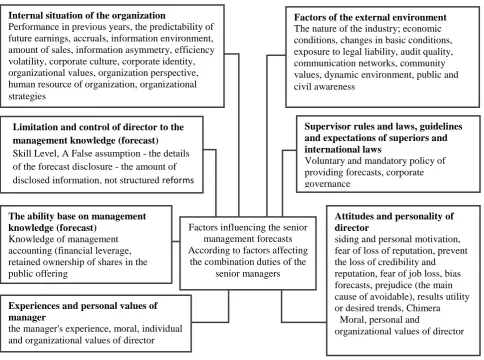
According to the theory of field of forces, it is not enough to provide appropriate job descriptions and communicate with managers to obtain the desired results from their performance. To achieve this purpose, it is necessary to identify the effective forces on the manager‟s work; neutralize the disruptive forces and strengthen the good forces (Sarrafizadeh, 4991). Figure 1 shows the most important effective factors on the combination of duties of senior managers.
Fig 1: The Most Important Effective Factors on the Combination of Duties of Senior Managers (Sarrafizadeh, 4991)
The combination of duties and responsibilities that senior managers actually deal with
External constraints and limitations Rules and laws
Guidelines and expectations of superiors
The ability based on management knowledge
Personal experience of manager Limits and control of manager on
management knowledge The root causes of the internal
situation of the institution
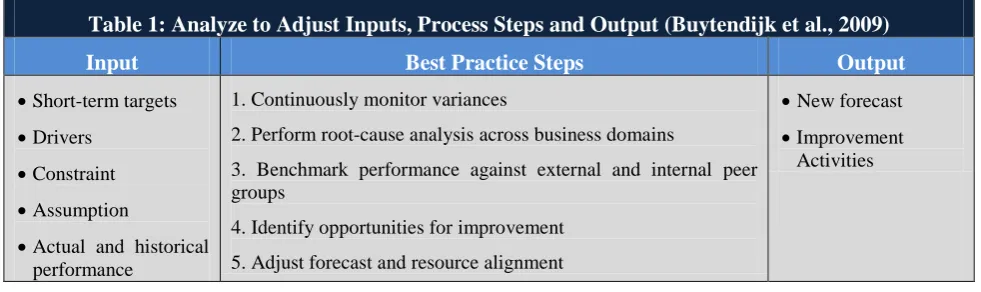
The factors mentioned in Figure 1 are factors that potentially could affect the duties of the manager, as well as the management forecasts. Some of these factors have been tested in internal and external investigations, and others have been based on other research. The results of some studies show that the quality of managers forecasts may be damaged under the influence of imposed conditions "in the environment (uncertainty of the future)", "the expertise of the manager" and "personal motives of suppliers of information" (Parsley , 3142). Analysis and reforms of the management process deals with the detection and analysis of deviations from the program and the decision in support of the responses of what the organization should do. The following table describes inputs, optimal methods, and outputs to the analysis of the reform of process management (Buytendijk et al., 2009).
Table 1: Analyze to Adjust Inputs, Process Steps and Output (Buytendijk et al., 2009)
Output
Best Practice Steps
Input
New forecast Improvement
Activities 1. Continuously monitor variances
2. Perform root-cause analysis across business domains
3. Benchmark performance against external and internal peer groups
4. Identify opportunities for improvement 5. Adjust forecast and resource alignment Short-term targets
Drivers Constraint Assumption
Actual and historical performance
2.2.1. Forecasting Presented by Managers and its Relationship with the Effective Factors on the
Composition of Senior Manager’s Duties
Managers forecast the profit for four reasons, 1. Managers in accordance with the hypothesis of dampen of expectations are tried to the investors‟ expectations associated with them. 2 Managers and their forecasts try to reduce asymmetric of information in the market. 3. The managers try to show their ability in their supervision of environment changes. 4. The plan is to reduce the expected cost of justice (Jamali, 3141). Many researchers have studied the factors effecting managerial decisions to issue earning forecast. These factors include reducing information asymmetry and the risk of litigation while creating fame and a reputation for transparent reporting and driving down market expectations (Brown and Zhou, 2015).
2.2.1.1. Forecasts by Management and Supervisory Regulations
Gounopoulos, Kraft, and Skinner, (2013), in their study of " volunteer forecasts of profit management in IPOs against the mandatory forecasts" is said that changing the rules is a potential channel through which to improve forecasting revenue (i.e. reducing the level of forecast error of brief biographies to the annual report) should increase the credibility of management . Regulatory change increases the financial flexibility of management thanks to the independent decisions. So it is expected that there is a positive relationship between improved communication and management and investors to accurately forecast revenue (Gounopoulos, et al., 2013).
2.2.12. The Impact of Past Experiences of Management in a Forecasting
The neglect of past experience is the dramatic aspect of planning error. In other words, people have optimistic forecasts for the future are to maintain a pessimistic view about their overall abilities, and timely completion of tasks. Why do people ignore easily valuable feedback from experience? A convincing argument by Bilvor et al. (1994) showed that one of the factors may tend to avoid self-blame for past failures (Pezzo, Pezzo, and Stone, 2006). Also, Bilvor et al. (1994) have pointed out they tend to ignore the failures of the past as "past neglect" and show that this is a key factor in planning error (Buehler, Griyn, and Ross, 1994). To reduce the negative impact of self-image with past failures, planners are compared the failure to certain temporary factors, and controlled from the outside. Although this strategy is supported by self-image, but, caused to be considered the past experiences as irrelevant to future conditions (Pezzo, Pezzo, and Stone, 2006).
2.2.1.3. Management Forecasts and Managers Personality Traits
remarkable discussion about the relative merits of factors and evaluation of the aspects of personality (Anglim and Grant, 2014).
Comparing the predictive value of a model with 30 individual predictors with the five main predictors mentioned above shows the challenge for researchers (Sieglerand Brummett, 2000). Researchers of character are often seeking to forecast results such as welfare, job performance, and personality disorders along with other factors. Subsequently, researchers will decide whether these cases need to include other aspects of personality, or only use the five basic factors as predictors (Anglim and Grant, 2014). Past research has not always shown a significant relationship between the character and forecasts with regards to timely affairs; probably because these studies examined variables more dependent on the beginning of the study rather than the timely completion of a work, or the degree of positive outlook rather than a desire to focus on the work. When a significant relationship was found between personality and forecasting tendencies, the result concepts are uncertain, perhaps because the assigned tasks are to be done immediately and therefore required advanced planning (Pezzo, Litman, and Pezzo, 2006 ).
Managers have individual differences. There are many measures of individual differences mentioned in the studies. As it has been shown, none of them are particularly useful to determine who shows an optimistic versus pessimistic trend (Windschitl, Smith, Rose, and Krizan, 2010). Bilvor and Griffin (2003) also examined whether forecasting bias are linked to the individual differences in the level of optimism and delay or dodge. In two separate studies, a significant relationship was not found between forecasting prejudices and personality traits, probably because optimism and delay are related more to a general positive outlook; the work begins by the accuracy of the forecasting or completeness of work (Buehler and Griffin, 2003).
2.2.1.3.1. Personality Trait of Confidence
More confidence is a psychological characteristic that may be defined as intention to have unrealistic beliefs (positive) about any unclear results. Several studies show that the "more confidence of Managers" are likely to lead to the release of a more optimistic forecast and less accuracy in forecasting the company‟s future. Other factors can affect the managers optimistic forecasting can be one of the "opportunistic" characteristics of managers and the "pressure and low legal risk" level on the managers for the quality and accuracy of the presented forecast. Also, Haribar and Yung (2011) expressed that more confidence may be from a lot of optimism about the future performance or an underestimation of changes in the future performance of the company. They also stated that these managers, more than managers who are less confident in achieving their forecast, are more likely to manage the earnings (Parsley, 3142).
2.2.1.3.2. Character Traits, Risk Managers
According to the future and the desire to live in the present, knowledge of past events are necessary to take risks in life. If the manager is not willing to take risks, he/she will not realize the potential for growth and development. Risk managers should decide on the conditions of uncertainty and check the possibility of success against loss (Jafari, 4991). But in changing circumstances of today, there are uncertainties about many issues, some risks are irreparable and may put at risk the fate of an organization. These risks can be reducing by analyzing the environment and accurate and appropriate forecasts of senior manager.
The aim of forecasting is to reduce the risk in decision making. Although forecasts are not necessarily correct, the error rate of forecasting can be dependent on the systems used for forecasting along with some other factors. Allocating more resources to forecast can increase its accuracy and eliminate or reduce some of the uncertainty losses in the decision-making process. Since, forecasting cannot fully eliminate the risk, it is essential to explicitly consider the forecasting uncertainty in the decision process (Jamali, 3141).
2.3. Management Forecasts and the Role of Information Management
A manager should act as the main interface of information between his organization and the environment. Because of manager's official power, he is only able to create a vital link between specific resources of information and the organization (Sarrafizadeh, 4991).
The manager with detailed information about his organization can produce good forecasts about it. According to the Speaker role, the manager has also the ability to present the information about the organization as reports, forecasts, etc. to others outside the organization for specific objectives.
Mitenzberg (1973) stated the information role of managers including the role of the central nervous system (receiver), the information distributor and the speaker (Sarrafizadeh, 4991). Management with more and timely information can better draw the future prospect of companies for foreign users. However, to attract the trust of users, managers must try to reduce the deviation between real and forecasted returns (Motamedi, 3143).
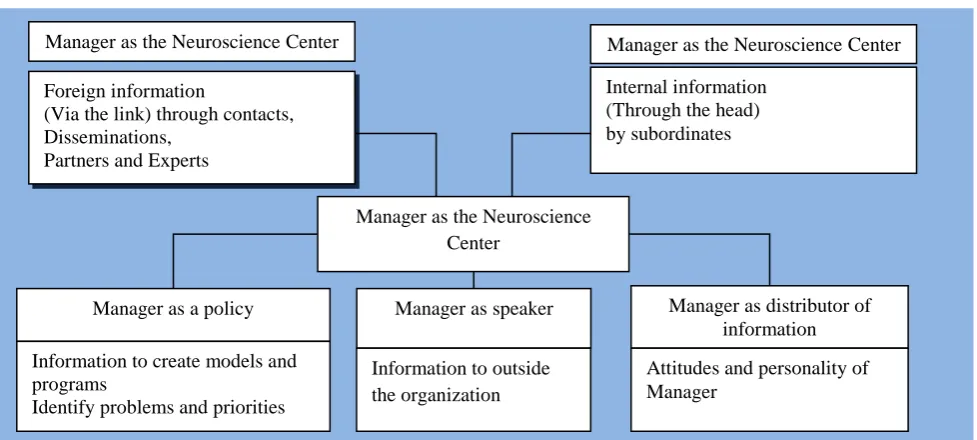
A manager in the role of Neuroscience Center is constantly seeking information and a host of information is sent to him that enables him to be aware of organization and environment events. He is looking for information that identified changes, issues, problems and opportunities so that he can take advantage of this knowledge in decision-making or publishing them (Sarrafizadeh, 4991). Figure 2 shows the role of a manager in information processing and the position of manager in relation to management issues through this role.
Fig 2: The Manager as the Information Processing System (Mitenzberg, 1973) (Sarrafizadeh, 4991)
2.4. Perspective View of Opportunistic Behavior and Information Management
The opportunistic behavior view of managers, as opposed to the information view, has a cynical approach to managers and believes that managers abuse the opportunities and flexibility that accounting and financial reporting offers them. According to the authorities, they try to hide the facts from the shareholders and investors. According to this view, the purpose of corporate managers is to maximize their prosperity. On the other hand, according to the information perspective, managers make good use of voluntary opportunities which they get in accounting and financial reporting and try to use this opportunity to convey private information that sometimes managers only have access to it (Jafari, 3142).
2.5. The Reasons of Managers for Unrealistic Forecasts
Managers with incentives such as the prevention of eviction have a successful career or achieve rewards in cases where compensation is depended on performance; proceeds to increase management of profit (Jafari, 3142).
2.5.1. Fear of Loss of Reputation and Litigation
Managers who forecast profit higher than the reality have adopted the accounting procedures of increasing profit and when forecast profit is less than the reality have adopted the accounting procedures of reducing profits. In either case, managers will be reaching to the forecasts. The reason is that they fear losing their reputations or want to be safe from financial effects of the investors proceeding (Amini Motlagh, 3141). Skinner (1994) concluded that managers may forecast the bad news to investors and in this way protect themselves against risk of litigation and loss of reputation (Jafari, 3142). Of course, managers are concerned with their forecasts and want to fulfill them, because, not reaching a forecast or forecast error (especially if it is negative) will be charged to the managers. Empirical evidence suggests that the costs of forecast error are often in the form of litigation and lead to lose the reputation of accuracy of management (Amini Motlagh, 3141).
2.5.2. Fear of Job Loss
Senior managers and financial managers who suddenly emit bad financial forecasts may lose their jobs. Naturally, they might delay bad news as long as possible and neglect the worsening situation in the hope for a miracle to maintain their job for a few more months (Bliss, 2007). Trying to keep a job and to upgrade it, setting a favorable target for future performance, and efforts and pressure from the corporate governance structure of the axis bank are among the reasons and motives leading managers to avoid loss of forecasting (Jafari, 3142). Who will forecast a budget deficit, if they are at risk of dismissal, or risk elimination and a bankrupt organization is forecasted surplus economic goods? (Bliss, 2007).
Manager as the Neuroscience Center
Internal information (Through the head) by subordinates Manager as the Neuroscience Center
Foreign information
(Via the link) through contacts, Disseminations,
Partners and Experts
Manager as the Neuroscience Center
Manager as distributor of information
Attitudes and personality of Manager
Manager as a policy
Information to create models and programs
Identify problems and priorities
Manager as speaker
2.5.3. Bias and Personal Motives
Managers sometimes have a personal incentive to refrain from disclosing private information and potentially have motivation to falsify the financial statements; at this time, disclosure requirements ensure that the capital market operates efficiently (Amini Motlagh, 3141). Rugerz (2008) found that managers were strategically altering the quality of disclosure in response to personal motives; he reported that the quality of the disclosure before the sale is on average higher between the persons of a group, while it is lower before an internal purchase. In an environment where managers felt little risk for possible legal consequences as a result of providing misleading information, they may also provide profit forecasts based on personal motives (Jafari, 3142).
Although managers may not have such an incentive, investors can still find bias in other sources such as oversight analysts, auditors, or the next earnings reports (Jamalifar, 3141).
However, the sobering reality is that even the most impartial forecasts in the best institutions are often quite wrong. Even when future analysts are worked meritly and hard, the complexity of many natural and human systems is very random and it can be risky looking at both the medium and distant future (Gordon, 3142).
2.6. Forecasting Accuracy and Issues Related to the Accuracy of Management Forecast
The value of forecasting is dependent on its accuracy and credibility (Brown, Clarke, How, and Lim, 2000). Good forecasting is needed to be honest on the part of all those interested (Bliss, 2007). Profitability of forecasting is related to its difference from reality. If forecast accuracy is higher, its deviation will be lower (Abzari et al., 2012). If the prediction is made with accuracy, some of the losses caused by uncertainty in the decision making process will be reduced or removed (Jafari, 3142). Accurate forecast of product demand is important for the companies because it has application in decisions about inventory control, production planning, purchasing, logistics, planning of cash flow and other aspects of business (Petropoulos, Fildes, and Goodwin, 2014). Despite the risks, forecasting accuracy is essential (Bliss, 2007). The researchers suggest that forecasting manner should include accuracy of the confidence of managers about the future, and more accurate forecasts (e.g. point) are generally thought to reflect the management's confidence in forecasting with less accuracy (i.e. widespread) (Jafari, 3142). Forecasts accuracy is increased by implementing a voluntary policy in mature companies that have multiple stakeholders and high demand (Gounopoulos, Kraft, and Skinner, 2013). Forecast accuracy of stock dividend increases with the ratio of retaining ownership in public offerings of the company stock and forecast ability of its future earnings. In addition, it seems to create a company‟s law is started the period that management forecasts be more accurate (Brown, Clarke, How, and Lim, 2000). Also, strong corporate governance and the presence of analysts in the capital market are among the factors that can have a direct relationship with the accuracy of forecast. Research also shows that the accuracy of seasonal or cyclical forecasting by managers is better than annual forecasting (Jafari, 2013). Economic conditions will affect the manner and accuracy of the managers forecast (Jamali, 3141). Also, if the organizations only intend that the forecast shows the breakeven point (without profit and loss) this removes any incentive for an accurate forecast. A Breakeven Forecast by the end of the year is easier; however, it is not a good practice (Bliss, 2007). Some other factors that are inversely related to the accuracy of profit forecast include fluctuation of efficiency, cost of ownership, exposure to legal liability, duration, and time horizon of forecasting (Jafari, 3142).
2.7. Prediction Error and the Factors Affecting the Forecast
There is uncertainty in the predictions. This fact is due to an unusual component in the time series. The presence of this element indicates the presence of undefined or unpredictable fluctuations in the data leading to forecast error. If this unusual component creates a significant error and has considerable effect on the ability to accurately forecast, the result becomes insignificant, but if it is limited to a higher accuracy, it can be achieved in forecasting by determining annual and seasonal patterns (Jamali, 3141).
Forecasts are usually associated with errors, but enlargement of forecast errors depends on various factors (Jafari, 3142). Many factors are involved in the deviation of actual earnings from forecasted earnings. These factors reduce the accuracy of forecasts and increase the forecast error. Forecast error can be reduced by identifying these factors and considering them in the calculation of forecast earnings (Abzari et al., 2012).
60 companies. The result of this study shows that the size of the company and the forecast time horizon has an effect on the deviation of the profit forecast and there is a positive relationship between them.
Fluctuations in economic conditions are difficult to forecast and therefore increase the error rate (Jamali, 3141). Also, when the amount of details increases in the disclosure of the forecast, the forecast error is reduced. This strong finding is in terms of reverse causality tests and suggests that the amount of details in the disclosure of the forecast increases the reliability of the earnings forecast (Cazavan-Jeny and Jeanjean, 2006). Many studies have shown that institutions having poor performance observe wider profit forecast errors and are likely to encounter problems meeting profit forecasts (Motamedi, 3143). There are two opposite interpretations for a negative relationship between disclosure of accurate forecast and forecast error. First, this negative relationship may mean that the disclosure of an accurate forecast lead to smaller forecast error, because the forecasts are more reliable; or it may indicate that only companies with reliable forecasts are emitting accurate forecasts (self-selection bias) (Cazavan- Jeny and Jeanjean, 2006). According to Ijiri (1966), a number of factors may be affecting the accuracy of forecasts such as the period of time that forecasts should be performed, industrial nature of companies, the external environment, and the degree of skill and experience in forecasting (Motamedi, 3143).
Research has found some factors affecting profit forecast error; they are as following: company size, the forecast period, the life of the company, financial leverage, economic conditions, industry type and annual adjustments (Jamali, 3141). Another study found some factors affecting revenue forecast as follows: the amount of disclosed information, company size, financial leverage, age, diversity of earning changes, the performance of the previous year, operating profit, earnings per share (EPS), audit quality, economic value added (EVA), integration, employee rewards for the purchase of shares, environmental factors, information asymmetry, accruals, information environment, etc. (Abzari et al., 2012). In the extrapolation of the trend, a false assumption is faced to fail all the set of accurate data and very accurate extrapolation and forecast got away from the truth. By changing the basic conditions, the conclusion of the process becomes nonsense and ridiculous (Gordon, 3142). In a forecast, for example, these three errors can be detected in a statistic test (Godet, 1994):
Using an assumption that is not eventually provable. Ignoring a hypothesis or an event that is proved in fact.
Not asking the right questions, for example, ignored prospective thinking about the assumptions or events that will have a prominent role in the future.
Ijiri (1966) has classified the main issues that should be considered in financial forecasts to minimize forecast error as follows: (Motamedi, 3143)
Reliability that is concerned with the relative accuracy of forecasts.
Responsibility that is related to the expression of possible legal obligations in the forecasts. Reticence which must be considered in the disclosure of forecasting due to competitive conditions.
2.7.1. Factors Affecting Management Forecast Error
2.8. Optimistic Management Forecast
When people who speculate about the possible outcomes have an optimistic forecast, this is an important conclusion, because many aspects of a company‟s daily life are tied to the forecast of results which are fully or partially random (Windschitl, Smith, Rose, and Krizan, 2010). A manager‟s forecast of profits is usually different from the real profits due to the nature of forecasts and the uncertainty of future events. If a manager's estimated forecasted profits are more than real profits, the forecast was optimistic, and if the profits are less than real profits, the forecast was pessimistic. Some researches show that profit forecasts are all optimistic (Jafari, 3142). However, the optimistic and the pessimistic forecasts are done for many reasons, and these biases in the forecast cause the manager‟s forecast to deviate from the actual results.
2.8.1. Reasons and Motivations of Managers for Optimistic and Pessimistic Management Forecast
One of the reasons for optimistic trends in forecasts is that in order to avoid self-blame managers may reduce problems experienced in similar cases (Pezzo, Litman, and& Pezzo, 2006). Another reason is a false opinion (false thinking) they put above all other ideas, especially when this results in the desired forecast (Buehler, Griffin, and MacDonald, 1997). Managers have various incentives for optimistic forecasts to obtain the desired value of the market. These reasons may include job security, compensation and reward incentives based on performance or the need for financing, etc. (Jafari, 3142). People may present optimistic forecasts in order to appear more productive and more successful. A study by Pezzo, Pezzo and Stone (2006) found that participants who presented unknown forecasts had not shown an optimistic trend (Pezzo, Litman, and Pezzo, 2006). Quito et al. (2009) and Jafari (3142) both stated that more manager confidence and behavioral prejudices were considered as possible motivations for an optimistic forecast, and concluded that the opportunism of management is considered the most likely reason for an optimistic forecast by management. Kato and Skinner (2009) said that in the Japan, it is not important that litigation is related to the managers forecast error. Many initial forecasts are too optimistic especially for companies that are not profitable, and many managers forecast too optimistically every year (Amini Motlagh, 3141).
Managers intentionally emit pessimistic forecast which in turn causes market participants to revise their expectations downward and subsequently cause an easier standard to reach or get closer to the real benefit. Chen (2004) in a studied sample observed that when the forecasts of management were pessimistic, the real benefit exceeded above the forecasted profit. Often a pessimistic forecast is used by managers to justify their profit forecasts as a means to reduce market expectations of company profit (Jafari, 2013).
2.9. Forecast Prejudices (Trends) - No Prejudice is More Important than Accuracy
Predictors are added to time series forecasts in most unstructured emotional reforms. This can be a source of bias and prejudice. For example, managers can change the sale forecast by pride style to motivate employees. Retailers may change the forecast so that it can be more easily surpassed. So it is not surprising that some early studies have shown unstructured reforms often damage forecasts (Armstrong, 2006). A problem more important than the forecast accuracy is whether the bias in the forecast is a major factor of avoidance. This is a big concern during judgment. Hoggart and Makridakis (1981) carried out an extensive survey about the prejudices that developed in human judgment; the investigation revealed how these prejudices could lead to serious errors in forecasting and planning (Erickson, 1987). How much does a desired result affect possible judgments or establish optimism? The number of published studies on this question is not convincing (Krizan and Windschitl, 2007). Desirable attitudes (prejudice) are generally too weak or do not exist in cases where there is uncertainty and forecasting is not a coincidence, unless a person is unsure that he only guesses about results, or allows only his views and understanding of evidence to guide his forecasts (Windschitl, Smith, Rose, and Krizan, 2010). Tests that directly checked prejudices have had mixed results (Vosgerau, 2009). This can also be seen in the research of Barhillel and Bodesko (1995) and in their chapter titled "Wishful Thinking in Forecasting of the World Cup Results: the Deceptive" (Bar-Hillel, Budescu, and Amar, 2008). Windsaytel, Smith, Rose, and Krizan, (2010), in the study "The Favorable Trend in the Forecasting: Optimism without Being Realistic", shows that the impact of favorable results must be comprehensible in the following two ways: First, people may express optimistic or pessimistic tendencies in no large scale, and how they assess the probability of a desired outcome and the estimation of these probabilities must be shown to have been done in a common practice. Second, people may have an optimistic image about the potential consequences, but this optimism becomes apparent only when using some certain measures (for example, a forecast of the outcome, the special possible measures are used to encourage and facilitate the expression of opinion).
by anyone in particular. In some studies, participants offered forecasting that either is completely accurate (e.g. has no significant tendency) or is relatively pessimistic (e.g. is finished earlier than expected). Totally these findings suggest that there are differential trends for creating the prejudices in forecasts. However, exactly what features are connected to which people is not clear (Pezzo, Litman, and Pezzo, 2006).
2.10.Managers Biased Forecasts and Planning Error
In the first theoretical analysis of planning error, Kahenman and Turesky (1979) adopted a predominantly cognitive approach of an individual‟s tendency to judgment error rather than informed statistical judgments. Kahenman and Toresky argued that people presented biased forecasts because they focused on specific information, (For example, the specific features of a given task) regardless of the distributed information (e.g. description of the individual work and the completion of a typical task for the general population (Pezzo, Pezzo, and Stone, 2006). Also, the manager‟s upward forecast of dividend is biased as a forecast of company earnings. However, the dividend forecasts are substantially more accurate and less biased than their colleagues incomes (Brown, Clarke, How, and Lim, 2000).
Some studies suggest that participants are encouraged to focus on the specific programs with the aim of completing a task or increasing your optimistic attitude, (Buehler R., 2003). Studies have found that participants who have done forecasts as compared to other people (and people who may have no incentive to past failures) have shown less planning biases (Buehler, et al., 1994; Pezzo, Pezzo, and Stone, 2006). It has been shown that as the systems which are trying to forecast their behavior become more complex, planning is becoming irrelevant (Lindgern and Bandhold, 3112).
2.11.Voluntary and Mandatory Disclosure Management Forecasts
Mandatory and voluntary disclosures are two important channels through which managers send information to shareholders. While a significant amount of literature shows that both types of disclosure contain valuable information and significantly affect the price of securities (government bonds and stocks) (Kothari, 2001). Also, previous research has shown that voluntary disclosure by managers helps users to process information more effectively (Brown and Zhou, 2015). The optional amount of disclosure to reduce the false allocation of resources in the capital market will depend on the accuracy of the published information about the economic situation of the business unit. Since the optional disclosure is dependent on the manager's decision, the accuracy of the information contained therein is not clear (Jafari, 2013). The literature of voluntary disclosure of management forecasts of profit is based on the tendency of knowing the motivation of managers to disclose or their tendency to disclose personal information when it is not necessary. This is a fundamental concept for accounting and security provisions. In this respect, what set of disclosure requirements should be developed and implemented? As long as managers have a personal motivation for optional disclosure of personal information, it seems that disclosure provisions are not necessary (Amini Motlagh, 3141).
Managers can try to achieve the correct forecast or forecast with their desired results. Credit of optional disclosure means the accuracy of the published information by the management; on the other hand, the release of the voluntary disclosure has an effect on the stock price of the company (Jafari, 2013). Ganopolo's and colleagues (2013), findings in a study on the "Voluntary Forecasts of Management Profit in IPOs, against Mandatory Forecasts ", indicates that a pessimistic revenue forecast at a time when companies are required to publicly offer next year profit changes to an optimistic forecast when shifted to a voluntary period. Comparing two time periods in the study showed that forecasting of compulsory income could force companies to anticipate what they had neither the motivation nor the ability to do (Gounopoulos, Kraft, and Skinner, 2013).
Roland et al. (1990) showed that revenue forecast publication could reduce the adverse selection and moral hazard, so it was easier to attract new capital. They showed companies that have increased their capital by holding down the shares of former shareholders, by publishing more forecasts. The motivation to do such a work in France where there is less risk of litigation should be higher (Djankov, La Porta, F, and Shleifer, 2003). Lou and Penman (1990) showed that generally companies with good news voluntarily disclosed their forecasts to distinguish themselves from the companies with bad news (Cazavan-Jeny and Jeanjean, 2006). The refuting hypothesis argues that when managers are owner of all the confidential and unclassified information, even if declaration of all information is not possible for them, the lack of disclosure or a slight disclosure is more favorable to them (Jamali, 3141). Hiley and Palio (2001) believe that there are two potential mechanisms to enhance the credibility of voluntary disclosure: (Jafari, 2013):
i) The third parties that play the role of middleman can provide the essential confidence about the quality of management disclosure.
ii) Confirmation at the time of publication of the financial statement of period end, for example credit of managers forecast of revenues and net income, can be approved or rejected by publication of the real financial statements at the period end. These mechanisms, while useful in increasing the credit degree of the manager‟s forecast, are adequate punishment for those managers who knowingly published false forecast.
are changed after the forecast was offered to the market, they will lose their credibility in forecast accuracy in the following years; so when they offer their first forecast of profits to the market, the shareholders are less responsive to this forecast and their stock prices are less affected by information relating to the benefit forecast (Amini Motlagh, 3141).
3. History Research
3.1. International Research
Chu et al. (2011) examined the optimistic forecast and avoiding behavior from the losses forecast of the management in Japanese companies. . Their final sample was 1771 companies selected among the 2,079 Japanese companies between the years of 1988-2005. They showed that companies avoiding behavior from the loss forecast were made up of a small fraction of the companies (about 25.5% of companies) but they explained a large percentage (61.6%) of optimistic bias in management. They also said that the market recognized this opportunistic behavior and discounted the information of the profit forecast (Jafari, 2013).
Gong et al. (2009) examined the relationship between the management forecast error of revenues in the year after and accrual in the current year. They assumed that management earnings forecast showed more optimism (pessimism) when accruals were relatively high (low). Consistent with this hypothesis, they found that there was a positive relationship between forecast error of management earning and accrual. This positive relationship for companies operating in a business environment is more uncertain, and companies in industries that offer a larger synchronize changes between accruals and activities related to growth is stronger. In addition, when this positive relation is significant, that most likely reflected the true beliefs of management about perspectives of the company's business, but it disappears when accruals are manipulated to increase the profits of the managers business (Gong, Li, and Xie, 2009).
Irani (2003) examined the relationship between the bias in the published profit forecast by executives at companies that had a financial crisis and the results of internal trade. This study was conducted during the period 1990-1995 at US companies. In his research in 2001, he found optimism in such forecasts and he tried to evaluate whether the observed optimism is related to the opportunistic behavior of management or their true belief that the company is better. Unusual Internal Transaction in Management forecasts in the past period showed that their optimistic forecast was associated with opportunistic behavior (Jafari, 2013).
3.2. Internal Research
Jafari (1392) examined the relationship between optimistic management forecast and avoiding behavior from the loss forecast. The results showed that a lot of optimistic bias were explained by avoiding behavior from the loss forecast and the market showed a positive reaction to the benefit forecast of companies that had avoiding behavior from the loss forecast. Therefore, this behavior is not recognized and new data does not discount the profit forecast.
Mashayekh and Shahrokhi (3112) addressed assessing the accuracy and effective factors of profit forecast by the managers. They compared the forecast accuracy of managers from the earnings per future share with forecast based on information from the Random Walk Model. To this end, the forecasting of 279 companies during 1381-1384, including 639 observations were evaluated by the Mean Differences Method. Findings showed that there was a significant difference between the inaccuracy of the managers forecast and the inaccuracy of forecast based on Random Walk. In addition, comparing the mean differences of the two models showed that the accuracy of the manager‟s forecast was higher than the forecast based on the Random Walk. Also, results of other assumptions showed that the manager‟s forecasts had optimistic deviation (Mashayekh and Shahrokhi, 3112).
Mehdi and Hossein Abadi (3144) examined the relationship between forecasted profit error and accruals of listed companies in Tehran Stock Exchange. The main objective of their study was to investigate the relationship between forecasted profit error by the management and the total accruals. To this end, they collected the information of 112 companies that had the presented characteristics during the period 1387-1382. The results showed that there was a significant relationship between the forecasted benefit error by management and the total accrual. Also, the relationship between the forecasted benefit error by management and the total accrual was not accepted in a commercial environment with high uncertainty (Mahdavi and Zare Hossein Abadi, 2011).
4. Research Method
Research done by the qualitative method is descriptive, and the data collection method is documents.
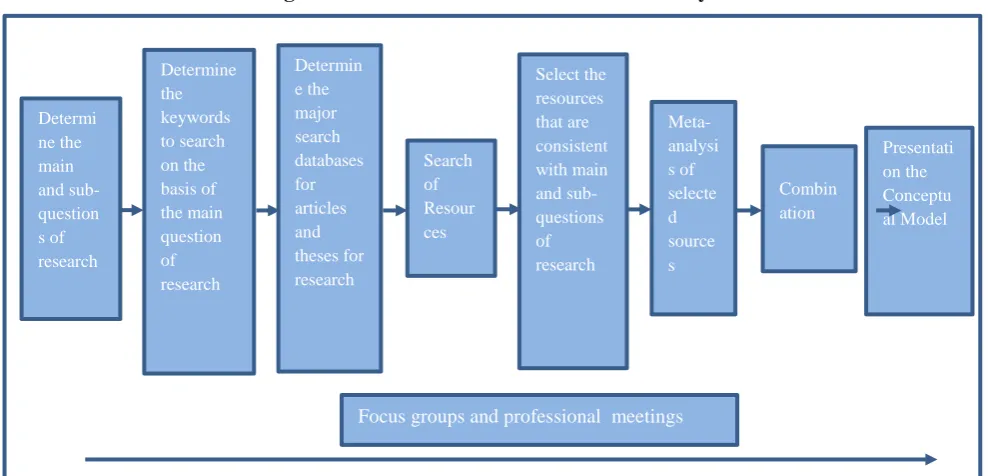
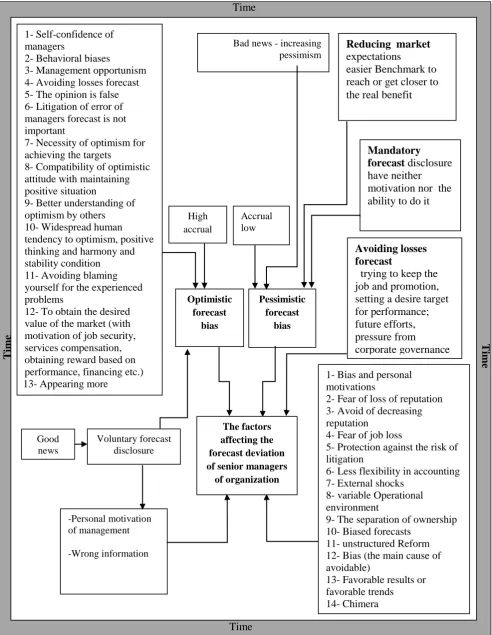
In this study, the basic framework was presented based on a meta-analysis of reviewed research, focus groups, and professional meetings. Then experts' opinions were added to the above frame and amendments were made to the initial frame. Finally, the model presented in the study was finalized during regular focus groups meetings. Figure 3 shows the theoretical framework of this research.
The duration of research was studies with a similar title, from 1985 to 2015, and over a period of 30 years.
Fig 3: The Theoretical Framework of the Study
Table 2: The Frequency Table of the Results of Previous Studies, The Period 1985-2015
(Source: Researcher)
Index of Title
Category
References of Index
Kato and Skinner (2009) Source (Jafari, 3142). Optimistic forecast bias
more manager confidence
Kato and Skinner (2009) Source (Jafari, 3142). Optimistic forecast bias
Behavioral biases
Kato and Skinner (2009) Source (Jafari, 3142). Irani (2003) Source (Jafari, 3142). Optimistic forecast bias
Management opportunism
Research Chu et al. (2011). Research (Jafari, 3142).
Optimistic forecast bias Avoiding losses forecast
(Buehler, Griffin, & MacDonald, 1997). Optimistic forecast bias
The opinion is false
Kato and Skinner (2009) Source (Amini Motlagh, 3141).
Optimistic forecast bias litigation of error of managers
forecast is not important
(Segerstrom, Taylor, Kemeny, & Fahey, 1998) Optimistic forecast bias
Necessity of optimism for achieving the targets
(Segerstrom, Taylor, Kemeny, & Fahey, 1998) Optimistic forecast bias
Compatibility of optimistic attitude with maintaining positive situation
Segerstrom, Taylor, Kemeny, & Fahey, 1998). Optimistic forecast bias
better understanding of optimism by others
(Lench & Ditto, 2008). Research (Windschitl, Smith, Rose, & Krizan, 2010). Optimistic forecast bias
Widespread human tendency to optimism, positive thinking and harmony and stability condition
Focus groups and professional meetings
(Pezzo, Litman, & Pezzo, 2006). Optimistic forecast bias
Avoiding blaming yourself for the experienced problems
(Jafari, 3142). Optimistic forecast bias
To obtain the desired value of the market (with motivation of job security, services compensation, obtaining reward based on performance, financing etc.)
(Pezzo, Litman, & Pezzo, 2006). Optimistic forecast bias
Appearing more productive and successful for others
Research (Gounopoulos, Kraft, & Skinner, 2013 ) Optimistic forecast bias
Voluntary forecast disclosure
(Jafari, 3142). credit of optional forecast
Credit of optional disclosure means the accuracy of the published
information
(CAZAVAN-JENY & JEANJEAN, 2006) -
Voluntary forecast disclosure (Good news)
Research (Gong, Li, & Xie, 2009) Optimistic forecast bias
Accruals (High accrual- optimism)
Research (Gounopoulos, Kraft, & Skinner, 2013 ) Pessimistic forecast bias
Mandatory forecast disclosure have neither motivation nor the
ability to do it
Chen (2004) Source: (Jafari, 3142). Pessimistic forecast bias
Reducing market expectations
Research (Windschitl, Smith, Rose, & Krizan, 2010)
Pessimistic forecast bias Bad news - increasing pessimism
Research (Gong, Li, & Xie, 2009) Pessimistic forecast bias
accruals (Accrual low – pessimism)
(Jafari, 3142). The forecast deviation of
senior managers Avoiding losses forecast (trying to
keep the job and promotion, setting a desire target for performance; future
efforts, pressure from corporate governance structure)
Rugerz (2008) Source: (Jafari, 3142). (Amini Motlagh, 3141).
The forecast deviation of senior managers Bias and personal motivations
(Amini Motlagh, 3141). The forecast deviation of
senior managers Fear of loss of reputation
(Jafari, 3142). The forecast deviation of
senior managers Avoid of decreasing reputation
(Bliss, 2007). The forecast deviation of
senior managers Fear of job loss
(Jafari, 3142). The forecast deviation of
senior managers Protection against the risk of
litigation
(Jafari, 3142). The forecast deviation of
senior managers Less flexibility in accounting
(Jafari, 3142). The forecast deviation of
senior managers External shocks
(Gong, Li, & Xie, 2009) The forecast deviation of
(Jafari, 3142). The forecast deviation of
senior managers The separation of ownership
Kahenman and Turesky (1979) Source: (Pezzo, Pezzo, & Stone, 2006)
The forecast deviation of senior managers Biased forecasts
(Armstrong, 2006). The forecast deviation of
senior managers unstructured Reform
(Erockson, 1987) The forecast deviation of
senior managers Bias (the main cause of avoidable)
(Windschitl, Smith, Rose, & Krizan, 2010) The forecast deviation of
senior managers Favorable results or favorable trends
Hillel & Budescu, 1995) Source: (Bar-Hillel, Budescu, & Amar, 2008) The forecast deviation of
senior managers Chimera
(Motamedi, 3143). The forecast deviation of
senior managers The degree of management skills
(Jafari, 3142). (Motamedi, 3143). The forecast deviation of
senior managers Management experiences
(Amini Motlagh, 3141). The forecast deviation of
senior managers Personal motivation of management
(optional disclosure of forecasts)
(Jafari, 3142). The forecast deviation of
senior managers Wrong information (optional
disclosure of forecasts)
4.1. Research Questions
Main Question of Study
Can a senior manager be a deviation factor in management forecasting? Sub-Questions of study
Are optimistic biases the main cause of deviation in management forecasting? Are pessimistic biases the main causes of deviation in management forecasting? Can voluntary disclosure of forecasting be an accuracy factor in forecasting?
5. The Meta-Analysis Results of the Research Questions
5.1. Main question: Can a Senior Manager be a Deviation Factor in Management Forecasting?
Table 3: The Factors Affecting the Deviation in Management Forecasting - By Senior Manager
Row The factors affecting the deviation in management forecasting - by senior manager
Row The factors affecting the deviation in management forecasting - by senior manager
1 Avoiding losses forecast (trying to keep the job and promotion, setting a desire target for performance; future efforts, pressure from corporate governance structure)
11 Biased forecasts
2 Bias and personal motivations 12 unstructured Reform
3 Fear of loss of reputation 13 Bias (the main cause of avoidable) 4 Avoid of decreasing reputation 14 Favorable results or favorable trends
5 Fear of job loss 15 Chimera
6 Protection against the risk of litigation 16 The degree of management skills 7 Less flexibility in accounting 17 Management experiences
8 External shocks 18 Personal motivation of management (optional disclosure of forecasts)
9 variable Operational environment 19 Wrong information (optional disclosure of forecasts)
10 The separation of ownership
5.2. First Sub-question: Are optimistic biases the main causes of deviation in management forecasting?
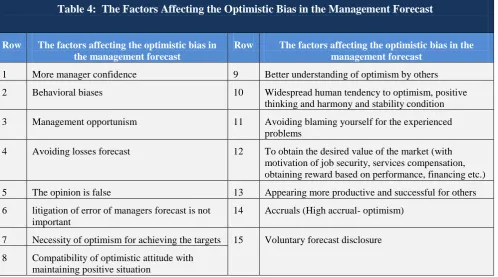
Considering that 14 of the cases in the documented researches considered the reasons of the deviation from management forecast directly affected the optimistic forecast bias of management and only 1 case of error depended on the conditions, it can be concluded that the answer is yes, and optimistic bias is the main factor of deviation from management forecast(Table 4).
Table 4: The Factors Affecting the Optimistic Bias in the Management Forecast
Row The factors affecting the optimistic bias in the management forecast
Row The factors affecting the optimistic bias in the management forecast
1 More manager confidence 9 Better understanding of optimism by others 2 Behavioral biases 10 Widespread human tendency to optimism, positive
thinking and harmony and stability condition 3 Management opportunism 11 Avoiding blaming yourself for the experienced
problems
4 Avoiding losses forecast 12 To obtain the desired value of the market (with motivation of job security, services compensation, obtaining reward based on performance, financing etc.) 5 The opinion is false 13 Appearing more productive and successful for others 6 litigation of error of managers forecast is not
important
14 Accruals (High accrual- optimism)
7 Necessity of optimism for achieving the targets 15 Voluntary forecast disclosure 8 Compatibility of optimistic attitude with
5.3. Second sub-question: Are pessimistic biases the main causes of deviation in management forecasting?
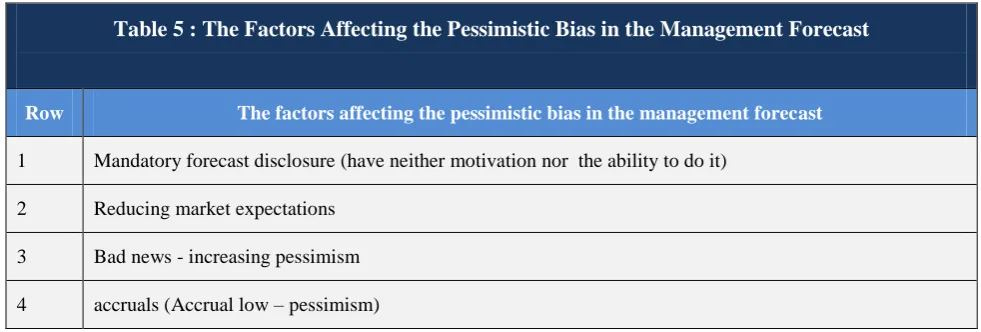
Four cases of the factors that may cause deviations in the forecast are factors of pessimistic bias of management forecast, so pessimistic bias can be one of the factors of deviation from management forecasts (Table 5).
Table 5 : The Factors Affecting the Pessimistic Bias in the Management Forecast
Row The factors affecting the pessimistic bias in the management forecast
1 Mandatory forecast disclosure (have neither motivation nor the ability to do it)
2 Reducing market expectations
3 Bad news - increasing pessimism
4 accruals (Accrual low – pessimism)
5.4. Third sub-question: Can voluntary disclosure of forecasting be an accuracy factor in forecasting?
According to meta-analysis in this study, there is a paradox in optional disclosure of manager‟s forecasts. Some researchers validated the optional disclosure to mean accuracy of the published information by management, while others questioned the accuracy of the information due to the dependence of the voluntary disclosure of forecast to the manager‟s decision, and they knew that it depended on the motivation of the managers to disclose it. Results of another study showed that the forecasts were pessimistic at the time of mandatory disclosure, but the forecasts shifted to optimistic when companies voluntarily disclosed forecasts. These results are inconsistent with each other and one implicitly gives credibility to the voluntary disclosure, while others know that information accuracy depends on the motivation of the manager and considers it as a factor for deviation from forecast concluding that a shift from pessimistic to optimistic forecasts occurs at the time of voluntary disclosure. A meta-analysis results of previous studies show that voluntary forecast directly caused the deviation of forecast if the manager published it with personal motivation or the forecast data is not correct. If the manager of the disclosure doesn‟t have personal motivation and the information is correct, the optimistic forecast is good news. Therefore, answer of this question is no, and the optional disclosure cannot be an absolute cause of the accuracy of forecast.
6. Findings and Conception Model of Research
This study is the first systematic comprehensive review in the field of the management forecast of the organization, especially inspection of personality traits of senior managers and their thoughts and motivations. This research used an innovative meta-analysis method. The study has also provided a comprehensive set of effective factors for the organization forecasts in addition to offering a model to identify the effective factors on the deviation of senior manager‟s forecasts according to the results of previous research and literature (note Table 6). In addition, this study has tried to look at the theories of management that used senior managers roles in the world of management science to forecast future events in today‟s uncertain condition; the providence of managers of organization and their possessions that have effective factors on the combination of senior managers' duties (see Figure 1 Note). According to the meta-analysis of past research, the effective factors of the task of senior executives forecast are introduced where the environment of variable business market is critical for today's organizations.
From the application aspect, this research can provide a wide range of information to the senior managers of organizations, stakeholder organizations and researchers in the field of management and forecasting. Also, in terms of compliance, the presented results are completely consistent with past research results and are entirely based on meta-analysis of past research.
6.1. Table of effective factors on the organizations forecast
According to a systematic review, deep literature search, and results of past research, it was found that some of the factors are effective in the forecasts of organizations. These factors can cause accuracy or forecast deviation depending on the quality and their direction.
Table 6 shows the factors generally affecting the forecasts of organizations. Some of these factors are completely relevant to organizations such as the size and age of the organization; and some of these factors are relevant to the external environment of organizations such as economic conditions. Some factors such as the forecast style and time duration of forecast are at the discretion of the managers or analysts. A number of factors such as the level of detail in the forecast disclosure and the amount of disclosed information are fully available to the senior managers as the nerve center of the organization in accordance to the role of spokesperson for the organization according to the strategy of the organization, stakeholders opinion, legal, market share, market control, personal motivations, etc. determined by senior managers.
Table 6: Factors Affecting the Company’s Forecasts
(Source: Researcher)
Factors Affecting the Forecasts of Corporate Income and Profit
Organization Size Forecast horizon Age of Organization Economic conditions
The amount of detail in the disclosure of forecast
Duration time of forecast The nature of the industry Forecast period
Financial Leverage Maintain ownership Corporate governance Voluntary and mandatory policy of forecasts
presentation Annual adjustments
Amount of disclosed information A variety of changes in income The previous years performance The predictability of future earnings
The presence of analysts in the capital market Operating profit
Earnings per share Audit Quality
Economic Value Added (EVA) Amount of Sales
Environmental factors Information asymmetry Accruals
Informational environment A false assumption Change the basic conditions
Volatility of efficiency Exposure to legal liabilities
The degree of skill and experiences
Forecasting style