IJEDR1702051 International Journal of Engineering Development and Research (www.ijedr.org) 303
Illumination Invariant Face Recognition using Local
Directional Number Pattern (LDN)
Sailee R Salkar, Nikhil S Patankar, Ra meshwar D Chinta mani, Yogesh S Deshmu kh
Sanjivani K.B.P. Polytechnic Kopargaon India, SRES’s, College of Engineering Kopargaon India, SRES’s, College of Engineering Kopargaon India, SRES’s, College of Engineering Kopargaon India
________________________________________________________________________________________________________ Abstract -This paper introduces a system in which the face recognition is carried out with the help of the local feature descriptors under the varying illumination conditions. As today face recognition is a very active area of research, a system which carries out the robust face recognition is needed to be developed. Face recognition is used in various fields of security and access control, surveillance military etc.
Local directional number pattern (LDN) is the descriptor which is used here to extract the features from the face image. The LDN code is computed by con volving the original image with the mask to extract the edge response images, from this images the most pos itive and most negative directions are taken to encode the information. The six bit binary code is then generated to give an LDN image. The face image is then divided into several regions and then for each region LDN is computed and the histogram of each region is ta ken. Then all the histograms are concatenated to form a feature vector.
Here the parameter used for evaluating the performance of the proposed system is recognition rate. This can be defined as num ber of person identified correctly di vided by total number of persons in the test database. Number of experiments is carried out using different database-PIE, YALE, ORL. Numbers of face images from the original database are divided into training and test database. For the experiments carried so for, the recogniti on rates obtained for these masks are more than 70%. It is expected that the results may further improved by dividing the LDN image into more number of sections.
Keywords- Face recognition, LDN (Local Directional Number Pattern), feature extraction, FRM (Face recognition method).
________________________________________________________________________________________________________
I. IN TRO DUC TION
Today there is no area of technical endeavor that is not impacted in some way by digital image processing. Image processing allo ws the use of more comp licated algorith m and hence can offer both more advanced and comple x perfo rmance at simp le tasks. Also, today face recognition is one of the well known techniques and it is being used in various fields. But there are c ert ain circu mstances or barriers in recognizing the face wh ich can get an impostor into. Such circu mstances include variation in po s e, e xpressions and illu mination condition under which the face is captured.
Thus, to make the face recognition system robust against such circu mstances is the main motto here.
Here we deal with the illu mination problem of the face i.e. recognizing the face in the different lightning conditions. The system is to be developed such that it recognizes the face in the different ligh tning conditions that is what called as illu mination [3]. So we can say that we have to develop the system wh ich avoids the varying illu mination and the system so called is the illu mination invariant system. The problem of illu mination variation has involv ed hundreds of scientists to find an ultimate solution to this problem and the solution re mains elusive. The system which dea ls with such a proble m is developed here [4].
II.LITERA TURE SURVEY
IJEDR1702051 International Journal of Engineering Development and Research (www.ijedr.org) 304 are usually captured in controlled settings, using a predefined arran gement of subjects and capture devices, whereas the probes (test images) are captured in quite d ifferent settings.
The performance of any Face Recognition system is adversely affected by changes in the facial appearance caused by variation in lighting and pose [3]. The illu mination variation proble m is one of the well-known proble ms in face recognition in uncontrolled environment. Existing survey of methods for illu mination invariant recognition can be found in [4]. An extensive and up-to-date survey of the existing techniques to address this problem is presented. This survey covers the passive techniques that attempt to solve the illu mination proble m by studying the visible light images in wh ich face appearance has been altered by varying illu mination, as well as the active techniques that aim to obtain images of face modalities invariant to environmen tal illu mination.
Recently, local matching features have gained much attention in the field of recognition. The recognition task is performed very effic iently by using the local approaches. The main concept behind using the local matching methods is to first locate the various features on the face and then classify the faces by comparing and combin ing the local statistics.
In the literature there are many holistic methods which are used to deal with such problems for e xa mp le in LBP [2] few number of pixels are used for recognition which limits its accuracy and also it discards most of the informat ion of the neighborhood pixels. And thus it becomes sensitive to noise. In this paper, the Local Directional Nu mber Pattern (LDN) descriptor is used which gives more informat ion of an image and thus is more stable and also it is insensitive to the lightning changes. The LDN is a six bit binary code assigned to each pixe l in a face image that shows the texture and the intensity transitions of an image [1]. In LDN the pattern is created by computing the edges using a compass mask. The kirsch compass mask is used here. This mask operates in the gradient-space and thus our method becomes robust against illu mination, and noise due to smoothing.
III. SYS TEM METHODOLOGY
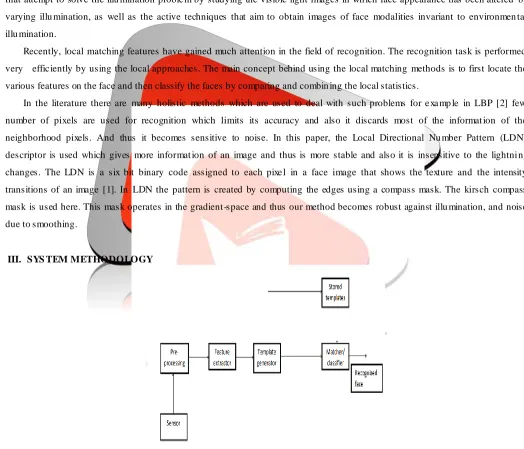
Fig. 01 Block diagram of illumination invariant face recognition
The block diagra m of the illu mination invariant face recognition is as shown. The function of each block is detailed belo w: 1. Sensor: In the sensor the images from different databases is taken for the testing and training purposes. The databases used are PIE, YA LE and ORL database.
2. Preprocessing: As shown in the block diagra m after the different images fro m the databases are taken the pre -processing is carried out which means here the LDN (Local Directional Nu mber Pattern) code computation is applied on the different databases to find out the LDN image.
IJEDR1702051 International Journal of Engineering Development and Research (www.ijedr.org) 305 3. Feature Extractor: After obtaining the LDN image the features are e xtracted fro m the image in the form of the histogram of pixe ls with different intensities. This histogram is taken by dividing the whole image into 4*4 i.e . 16 parts. In this way we h ave formed a feature vector.
2
4. Template generator: Template is generated by concatenating all the histograms. This template represents PDF (Probability Density Function).
3
5. Stored templates: The output of the template generator is given to the stored templates or also we can call it as the database to store the templates in it of the processed image. These temp lates are then used for matching purpose. 4
6. Matcher/Classifier: The minimu m distance between the template of the input image and the stored template will represent the closest match and that will be the recognized face image. The matching is performed with the chi square dissimila rity measure. Th is measure between two feature vectors,F1 and F2 is of length N is defined as :
The corresponding face of the feature vector with the lowest measured value indicates the match found.
The illu mination invariant face recognition system works in two phases the training phase and the testing phase: The results at each stage are described below:
A. Training phase:
Initia lly the image is captured by the sensor which is nothing but a camera and the output is an image taken by the ca mera. Then the preprocessing is done on that image and as mentioned the preprocessor gives the LDN image.
Then the features are extracted fro m an LDN (Loca l Direct ional Nu mber Pattern) image whose output is then given to the template generator.
The template generator generates the template of images i.e. t he code of the images which is then given to the database where it is stored. Now the database contains many such images for detection purpose.
B. Testing phase:
In the testing phase the face image to be recognized is taken first. Then the test image is given to the preprocessor where again the preprocessing is carried out and then the image is applied to the re ext ractor where features are e xtracted using LDN.. The output of feature extractor which is a filtered face image is then given to template generator. Than the images from database content is compared with this testing image.
Based on the min imu m d istance between two images the output is taken which is our recognized image.
IV EXPERIMENTS
IJEDR1702051 International Journal of Engineering Development and Research (www.ijedr.org) 306
Fig. 02 Sample images and their computed LDN images
Fro m these images of five persons three person’s images are taken for train ing purpose and two are taken for the testing purposes. Depending upon the min imu m d istance between the training and the testing images the match is found and the person is recognized. The histogram of the images is show below. The histograms of the different images of each person are conc atenated to get the final histogram o f the image. The histogram is the plot of intensity of the image (x-a xis) and no. of pixe ls (y-a xis).
Fig.03 Histogram of the LDN images
After getting this histogram the testing of images is performed in the testing phase. The result for testing is shown below:
Test image Equivalent image
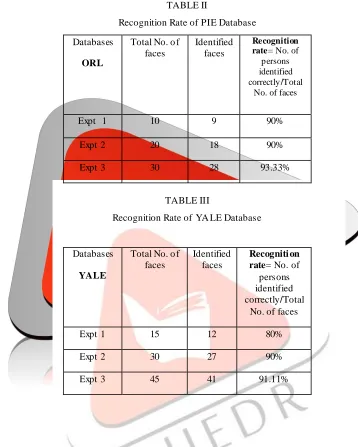
Fro m the e xperiments carried out for the different databases are tabulated as shown below: TABLE I
Databases PIE
Total No. o f faces
Identified faces
Recognition rate= No. of persons identified correctly/Total
No. offaces
Expt 1 5 17 85%
Expt 2 8 36 90%
IJEDR1702051 International Journal of Engineering Development and Research (www.ijedr.org) 307 Recognition Rate of ORL Database
TABLE II
Recognition Rate of PIE Database Databases
ORL
Total No. o f faces
Identified faces
Recognition
rate= No. of
persons identified
correctly/Total
No. of faces
Expt 1 10 9 90%
Expt 2 20 18 90%
Expt 3 30 28 93.33%
TABLE III
Recognition Rate of YA LE Database
Databases YALE
Total No. o f faces
Identified faces
Recogniti on rate= No. of
persons identified correctly/Total
No. of faces
Expt 1 15 12 80%
Expt 2 30 27 90%
Expt 3 45 41 91.11%
V REFER ENC ES
[1] Adin Ra mire z Rivera, Jorge Rojas Castillo, and Oksam Chae. ―Local Directional Nu mber Pattern for Face Analysis: Face and Exp ression Recognition,‖ IEEE Transactions On Image Processing, Vol. 22, No. 5, May 2013.
[2] Di Huang, Ca ifeng Shan, Mohsen Ardabilian, Yunhong Wang, Member and Liming Chen, ―Local Binary Patterns and Its Application to Facial Image Analysis: A Survey,‖ IEEE Transactions On Systems, Man, And Cybernetics —Part C: Applicat ions And Reviews, Vo l. 41, No. 6, November 2011.
[3] Baochang Zhang, YongshengGao, Sanqiang Zhao, and Jian zhuang Liu, ― Local Derivative Pattern Ve rsus Local Binary Pattern: Face Recognition With High-Order Local Pattern Descriptor,‖ IEEE Transactions On Image Processing, Vo l. 19, No. 2, February 2010.
[4] Xi aoyang Tan and Bill Triggs, ―Enhanced Local Textu re Feature Sets for Face Recognition Under Difficu lt Lighting Conditions,‖ IEEE Transactions On Image Processing, Vo l. 19, No. 6, June 2010.
[5] JieZou, QiangJi, and George Nagy, ―A Co mparat ive Study of Loca l Matching Approach for Face Recognition,‖ IEEE Transactions On Image Processing, Vol. 16, No. 10, October 2007.
[6]Ekenel H. K, San kur B, ―Feature selection in the independent component subspace for face recognition‖, Pattern Recognition , Letters 25, 2004, pp.1377-1388.
[7]Tsalakanidou F, Tzovaras D, and Strintzis M.G, ―Use of depth and colour eigenfac es for face recognition‖, Pattern Recognition, Letters 24, 2003, pp.1427–1435.
[8]Hehser C, Srivastava A, and Erlebacher G, ―A novel technique for face recognition using range imaging‖, Proc. 7th Int. Symp. On Signal Processing and Its Applications (ISSPA) , IEEE. 2003.
IJEDR1702051 International Journal of Engineering Development and Research (www.ijedr.org) 308 [10] Maria De Marsico, M ichele Nappi, Dan iel Ricc io, and Ha rry Wechsler, ― Robust Face Recognition for Uncontrolled Pose and Illu mination Changes,‖IEEE Transactions on Systems, Man, and Cybernetics: Systems, Vo l. 43, No. 1, January 2013.
[11]Mohammad Reza Faraji and Xiao jun Qi, ―Face Recognition under Varying Illu mination with Logarith mic Fractal Analysis,‖ IEEE signal p rocessing letters, vol. 21, no. 12, Dece mbe r 2014.
[12]Felix Juefe i-Xu,and Marios Savvides, ―Subspace-Based Discrete Transform Encoded Local Binary Patterns Representations for Robust Periocular Matching on NIST’s Face Recognition Grand Challenge,‖ IEEE transactions on image processing, vol. 23, no. 8, August 2014.