797 | P a g e
A NOVEL ATTENDANCE SYSTEM BASED ON RADIO
FREQUENCY IDENTIFICATION
Mehak Saini
1, Nidhi Arora
2, Nikita Nandwani
31
B.Tech Scholar (ECE),
2
Assistant Professor,
3
B.Tech Scholar (ECE)
B.M.I.E.T, Sonepat (India)
ABSTRACT
RFID is an acronym for Radio Frequency Identification and Detection. It is a fast and reliable means to identify an object. In this technique, the signals are transmitted by using the electromagnetic or electrostatic coupling in the radio frequency portion of the electromagnetic spectrum. Main advantages of this technique are its non-line-of-sight requirements, higher degree of automation, high speed operation & greater data capacity. Antenna, transceiver & transponder are three main components of a RFID system.
This paper proposes a classroom attendance system using RFID technology with AT89S52 microcontroller. It allows only authorized persons to enter the classroom. In this system, each student as well as teacher are issued RFID tags. Whenever card is placed near the reader module, it reads the binary data stored on the tag and compares the identifier of tag with stored database. If the identifier matches to a stored entry in database then it is considered as a „valid entry‟ otherwise „invalid‟. Gates are opened for the student (with valid entry) only if they come before the teacher.
The main objective of this work is to make the classroom attendance system fully automatic so as to maintain the discipline, provide more security and improve reliability.
Keywords: Component
—
Classroom Attendance, RFID, AT89S52 Microcontroller
I INTRODUCTION
Attendance needs to be taken at various places including colleges, schools, MNCs and industries. In order to improve the security and reliability of attendance system, the commonly used methods for auto identification are bar-code systems, optical character recognition; biometrics smart cards etc. [1].Another option is radio identification which is a fundamental and inexpensive technology that enables wireless data transmission [2]. RFID technologies are more efficient [5] and secure as compared to other networks [6]. They have been available for more than fifty years [3, 7]. Following are the main advantages of RFID over barcodes:
It does not require human to manually pass item over scanner.
More accurate inventory count.
798 | P a g e
It can track each individual item.
Three main components of a RFID system are antenna or coil, transceiver (with decoder) and transponder (RFID tag) electronically programmed with unique information. RFID tag is contactless card also known as a Proximity Integrated Circuit Card (PICC) [1]. It consists of a microchip which stores the identification code (serial number stored in the memory of RFID) of each object. The chip contains a serialized identifier, or license plate number that uniquely identifies that item in the same manner as in barcodes. These chips are also referred to as transponders as they receive radio signals and automatically transmit a different signal in response. Tags are of three types: active, passive and semi-passive.
Active transponders employ their own transmitters and power source which is generally in the form of a battery. Active tags are more advantageous than passive tags as they can be detected at a greater range. Passive tags are those which don‟t have any internal power source. They draw power from the electromagnetic field generated by the RFID
reader and then the microchip can send back information by modulating the same wave. They are also less expensive than active tags [2]. Semi-passive tags have their own power source that powers only the microchip. These have no transmitter. In this work, passive tags are used. The range of an RFID tag is dependent on its frequency which also determines the resistance to interference [4].
An RFID reader module or Interrogator is an antenna packaged with decoder and transceiver. EM-18 RFID reader module operating at 125 kHz is used in this system. It comes with an on-chip antenna and can be powered up with a 5V power supply. The module is powered-up and its transmit pin is connected to receive pin of the microcontroller. The reader can read information on card once the card is placed within the reading distance, which is nearly 6 -10 cm. In this work, a RFID based attendance management system for classroom is given. The main objective of this system is to improve the security & reliability of attendance system. With help of RFID technology & AT89S52 microcontroller, the proposed attendance system opens the gate of the classroom for the registered students only if they are on time. No student is allowed to enter the classroom after entry of the teacher, thus helping in maintaining discipline. The complete paper is organized as follows: Section 2 describes problem formulation and complete flow chart of RFID attendance system for classroom.. Section 3 describes the circuit diagram. Experimental arrangement has been explained in this section. Further sections include results, discussion and final conclusion.
II.RFID BASED ATTENDANCE SYSTEM (proposed structure)
799 | P a g e
according to the bit pattern it wishes to transmit. Then the RFID reader receives the modulated signal. Module is interfaced with the microcontroller which stores user information in its database.If data on card is matched with data in program memory then LCD displays: „valid user‟ and gate is opened. After a small duration, The gate automatically closes as the stepper motor takes an anti-clockwise turn. Now the LCD displays "Gate Closed". The gate remains closed until it receives another request. If data is not matched then an alarm is raised and „invalid user‟ is displayed on the LCD and gate remains closed.
800 | P a g e
III.EXPERIMENTAL ARRANGEMENT
Fig 2.Block diagram of RFID system
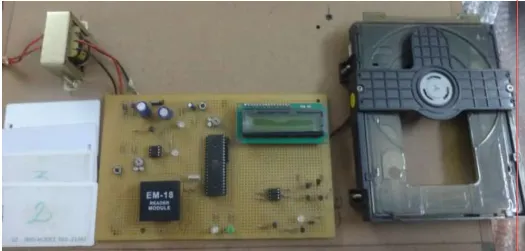
In this system, the hardware circuit uses RF reader interface and RF passive card. RF reader system is connected to the PC via COM port. Whenever RFID tag is placed near the reader module, then the reader gets the identifier of the tag by sending radio frequency signals. The reader relays the data from the tag to the microcontroller. The microcontroller used is AT89S52 which is a low-power, high-performance CMOS 8-bit microcontroller with 8K bytes of in-system programmable Flash memory.LCD displays the message according to the result of the comparison made by the microcontroller in its database. In order to give the supply, the a.c. input i.e., 230V from the main supply is stepped down by the transformer to 12V and is fed to a rectifier and then to filters to obtain pure constant d.c. voltage as shown in the Fig.3. The software for this project has been written in „C‟ language and Keil software is used to convert the C-codes into the Intel Hex code which is burnt into the microcontroller. The complete experimental set up has been shown in Fig. 4.
801 | P a g e
Fig. 4.Experimental Setup
IV.CONCLUSIONS AND FUTURE SCOPE
The proposed RFID attendance system for the classroom is fully automated and it does not require any human interaction except setting up initial stage. This system is more accurate than manual attendance system and thus minimizes error. It helps in dissolving the proxy or false attendance of the students. Moreover, it allows only registered students to enter the class before the entry of the teacher. Hence, it is helpful in increasing security & maintaining discipline. The probable threat to the system is cloning of tags, which can be avoided by encryption of the ID of the tag.
V. ACKNOWLEDGEMENT
The authors are thankful to the department of Electronics & Communication Engineering, B.M.I.E.T, Fazilpur, Sonepat for providing the facilities to complete this project work.
REFERENCES
802 | P a g e
2. Gynanendra K Verma, Pawan Tripathi, “A digital security system with door lock system using rfid
technology”, International Journal of Computer Applications (0975 – 8887) Volume 5– No.11, August
2010.
3. Nambiar A.N, “A supply chain perspective of RFID Systems”, World Academy of Science, Engineering
and Technology Journal, Volume 6, 2009, pp1-5.
4. Mingyan Li; Radha Poovendran; Rainer Falk t.al., “Multi-domain rfid access control using asymmetric key
based tag-reader mutual authentication”, ICAS 2008,2008, pp.2841-2850.
5. Zhang, L., “An Improved Approach to Security and Privacy of RFID application System”, Wireless Communications, Networking and Mobile Computing. International Conference, 2005, pp 1195- 1198. 6. Xiao, Y., Yu, S., Wu, K., Ni, Q., Janecek., C., Nordstad, J,” Radio frequency identification: technologies,
applications, and research issues” Wiley Journal of Wireless Communications and Mobile Computing, Vol
7, May 2007.
7. Rohit Chandrashekar, Jayashree Shinde, Dashrath Mane, “Importance and Analysis of RFID in Attendance
System”, International Journal of Emerging Science and Engineering (IJESE) ISSN: 2319–6378,