Pre-Decorrelation for Coded DS-CDMA
System with Space-Time Block Coding
F. S. Elhosarey, Ahmed A. Abouelfadl, Youssef A. Mobarak, S. A. Deraz, M. El-ShahatDessouki, A. I. Elbasiouny, A. El-Bahnasawy
Electrical Engineering Dep., Faculty of Engineering, King Abdulaziz University, Rabigh 21911,Saudi Arabia
Abstract
This paper proposes an improved pre-decorrelating approach for the coded direct sequence code division multiple access (DS-CDMA) multiuser detection (MUD) with space time coding (STBC). The main contribution of this work is the simplification of the mobile station by performing the decorrelation process at the base station. This is achieved by using the pre-decorrelation matrix at the base station them using a simple matched filter at the mobile station. The performance of the model is evaluated against the conventional decorrelating detector. It is found that the proposed model is superior due to the simplicity of the mobile station with better performance than the conventional one. The drawback of our method is increase in the transmitting energy by a factor to keep the transmitted power constant as the system without using pre-decorrelation detection.
Keywords - Decorrelating Detector, Pre-Decorrelation, MIMO STBC, Alamouti, Turbo coding.
I. INTRODUCTION
The new generations of mobile communications systems aim to provide enhanced voice, text and data services to the user. These demands give rise to the complexity and power consumption of the user terminal (UT) while the objective is smaller, lighter and power efficient mobiles. This thesis aims to introduce advanced signal processing techniques to examine ways of reducing the UT receiver’s computational cost while maintaining a good performance.
Under severe channel conditions (i.e. multipath), the multiple access interference (MAI) becomes the major source of performance degradation for direct sequence CDMA (DS-CDMA) systems. This is because of the loss of orthogonality between the spreading codes used by each user due to the multipath channel effects. To overcome this problem, many receiver-based MUD techniques have been proposed [1,2]. These techniques demand high computational complexity, power and knowledge of spreading codes of all users. As a result, in the downlink of a CDMA system it is not feasible to
transmitter-based techniques were proposed to shift computational complexity and power consumption to the base station (BS), where they can be afforded. It was shown that these methods are very effective in removing the MAI. We propose a multiuser transmitter based (multiuser pre-processing) low complex method with similar performance improvements as the receiver-based methods. In the proposed method, functions of multipath combining and MAI cancellation are presented. The MAI cancellation matrix in the proposed method is simple and does not depend on the time-varying fading channel coefficients. Multiuser pre-processing can be combined to further improve the performance. Multiuser pre-processing preserves the multipath diversity while removing the MAI [3-5].
Extending multiuser pre-processing to multiple antennas results in space diversity in addition to multipath diversity which improves the system performance[6,7].
On the other hand, parallel and serial concatenated codes, the so-called Turbo codes, are considered the most important breakthrough in the coding community in the 1990's. These powerful codes can achieve near-Shannon-limit error correction performance with relatively low complexity [8-10]. We gain high performance improvement by applying turbo codes to the system. Performance comparison is made between our proposed system with turbo codes and convolutional codes. The paper is organised as follows: Section II represents the STBC using the simple Alamouti's scheme. The MUD using decorrelating detector is introduced in section II. The proposed scheme using the pre-decorrelating detector is presented in section IV and the simulation results are shown in section V.
II. ALAMOUTISPACE-TIMEBLOCK CODING
In order to illustrate how OSTBCs work, a simple example introduced by Alamouti is used. Originally, it employs MT = 2 transmit antennas and MR = 1 receive antenna. However, it can be easily extended to more receive antennas.
Tx1
Data
source Modulator Tx2
**
1 2
2 1 2 1
s s
s s s s
Fig. 1 Block diagram of the Alamouti space-time encoder.
The approach as outlined by Alamouti is shown in Fig. 1. The information bits are first modulated using an M-ary modulation scheme. The encoder then takes a block of two modulated symbols s1 and s2 in each encoding operation and gives it to the transmit antennas according to the code matrix,
𝑆 = 𝑠1 −𝑠2 ∗
𝑠2 𝑠1∗ (1)
In eq.(1), the first column represents the first transmission period and the second column the second transmission period. The first row corresponds to the symbols transmitted from the first antenna and the second row corresponds to the symbols transmitted from the second antenna. Elaborating further, during the first symbol period, the first antenna transmits s1 and the second antenna transmits s2. During the second symbol period, the first antenna transmits –s2* and the second antenna transmits s1* being the complex conjugate of s1.
This implies that we are transmitting in space (across two antennas) and time (two transmission intervals).
𝑠1 = 𝑠1, −𝑠2∗ 𝑠2 = 𝑠2, 𝑠1∗ (2)
where the information s1 is from the first antenna and the information s2 is the second antenna output.
III. DS-CDMADECORRELATINGDETECTOR FORSTBCSYSTEM
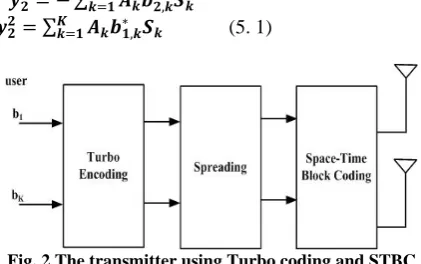
Fig.2 shows the base station transmitter. The number of transmit antennas is MT=2 and the STBC is achieved using Alamouti's scheme where the data symbols are transmitted in two consecutive time intervals.
Let 𝑦𝑗𝑖 be the transmitted vector in time interval j from antenna i. According to the code matrix in eq.(1), the transmitted signals in the first time interval are
𝒚𝟏𝒊 = 𝑨 𝒌𝒃𝒊,𝒌𝑺𝒌 𝑲
𝒌=𝟏 (3)
bi,k is the kth user transmitted turbo coded data from the ith antenna, and the signals transmitted at the second time interval are
𝒚𝟐𝟏= − 𝑨 𝒌𝒃𝟐,𝒌∗ 𝑺𝒌 𝑲
𝒌=𝟏 𝒚𝟐𝟐= 𝑨
𝒌𝒃𝟏,𝒌∗ 𝑺𝒌 𝑲
𝒌=𝟏 (5. 1)
Fig. 2 The transmitter using Turbo coding and STBC
Fig. 3 shows the mobile station receiver, the kth user received signal at time j is
𝒓𝒋,𝒌= 𝒉𝒌𝟏𝒚 𝒋
𝟏+ 𝒉
𝒌
𝟐𝒚
𝒋
𝟐+ 𝒏
𝒋,𝒌(4)
where nj,kis the kth mobile station noise vector in the time interval jth. The matched filter bank output at time j is given by zj=[ zj,1, zj,2, ………. zj,K]T, or
𝒛𝒊= 𝒉𝒌𝟏𝑺𝒚 𝒊
𝟏+ 𝒉
𝒌
𝟐𝑺𝒚
𝒊
𝟐+ 𝒘
𝒊 (5)
where wi = [Snj,k]1xK. Substituting into eq.(5) we get 𝒛𝟏= 𝒉𝒌𝟏𝑹𝑨𝒃
𝟏+ 𝒉𝒌𝟐𝑹𝑨𝒃𝟐+ 𝒘𝟏
𝒛𝟐= −𝒉𝒌𝟏𝑹𝑨𝒃 𝟐
∗ + 𝒉
𝒌
𝟐𝑹𝑨𝒃
𝟏
∗+ 𝒘
𝟐 (6)
where A=diag(Ak)KxK is the diagonal matrix of the amplitude.
The matched filters output is passed through the decorrelating detector which is [R-1]KxK, which eliminates the multiuser interference
𝒛𝟏′ = 𝒉𝒌𝟏𝑨𝒃
𝟏+ 𝒉𝒌𝟐𝑨𝒃𝟐+ 𝒘𝟏′
𝒛𝟐′ = −𝒉𝒌𝟏𝑨𝒃 𝟐
∗+ 𝒉
𝒌
𝟐𝑨𝒃
𝟏
∗ + 𝒘
𝟐
′ (7)
where 𝑤𝑗′= 𝑅−1𝑤
𝑗, j=1,2.
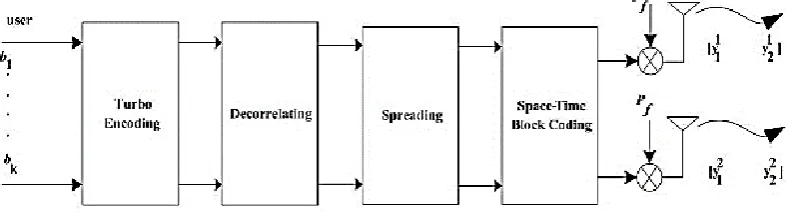
Fig. 4 The base station transmitter with pre-decorrelation, turbo coding and STBC.
The noise enhanced by the factor R-1 which is the main drawback of this detector. The decorrelating detector's output is combined by STBC decoding algorithm [8] where the decision variables for the data in two time intervals are
𝒕𝟏= 𝒉𝒌𝟏∗𝒛 𝟏
′ + 𝒉
𝒌 𝟐𝒛′
𝟐 ∗
𝒕𝟐= 𝒉𝒌𝟐∗𝒛 𝟏
′ − 𝒉
𝒌 𝟏𝒛′
𝟐 ∗
(8) Substituting from eq.(7) into eq.(8) and doing some
manipulations we have 𝐭𝟏= 𝐡𝐤𝟏
𝟐
+ 𝐡𝐤𝟐 𝟐 𝐀𝐛𝟏+ 𝛈𝟏
𝐭𝟐= 𝐡𝐤𝟏 𝟐+ 𝐡 𝐤
𝟐 𝟐 𝐀𝐛
𝟐+ 𝛈𝟐 (9)
Where
𝜂1=ℎ𝑘1∗𝑅−1𝑤1+ℎ𝑘2𝑅−1𝑤2∗ 𝑎𝑛𝑑
𝜂2
=ℎ𝑘2∗𝑅−1𝑤1 −ℎ1𝑘𝑅−1𝑤2∗
IV. CODEDDS-CDMASTBCSYSTEMUSING PRE-DECORRELATION
The proposed system is presented in this section where the turbo-coded users' data [9-10] can be pre-decorrelated before transmission at the base station. Fig.4 shows the transmitter of the base station. The vector d is the turbo-coded data of all users. This vector passes through a pre-decorrelating filter and the output is:
𝒅′= 𝑹−𝟏𝑨𝒅 (10)
where 𝑑′= 𝑑1′, 𝑑′2, . . . 𝑑𝐾′ and 𝑑𝑘′ is the pre-decorrelated data for user k. We note from eq.(10) that the user's data is boosted by R-1 so the transmitted power is changed. We limit the power in the transmitter by a scaling factor Pf which maintains
the transmitted power with using the decorrelating is equal to the case without pre-decorrelating.
𝐲𝟏𝐢 = 𝑷𝒇 𝑲𝒌=𝟏𝑺𝒌𝒅𝒊,𝒌′ (11)
is the transmitted vector in time interval j from antenna i. The transmitted signals in the second time interval are
𝐲𝟐𝟏= −𝑷
𝒇 𝑺𝒌𝒅𝟐,𝒌′
𝑲
𝒌=𝟏 𝐲𝟐𝟐= 𝑷𝒇 𝑲𝒌=𝟏𝑺𝒌𝒅𝟏,𝒌′ ∗ (12)
Consider the mobile receiver shown in Fig. 4, the kth user received signal at time j is written as
𝐫𝐣,𝐤= 𝐡𝐤𝟏𝐲
𝐣𝟏+ 𝐡𝐤𝟐𝐲𝐣𝟐+ 𝐧𝐣,𝐤 (13)
where the noise vector in the jth time interval in the kth mobile station is ni,k. The received signal is passed through a single user matched filter matched to the corresponding spreading sequence. The output in the jth time interval of the kth user's matched filter is given by
𝒁𝑗 ,𝑘= 𝑺𝑘(ℎ𝑘1𝑦
𝑘1+ ℎ𝑘2𝑦𝑘2+ 𝒏𝑗 ,𝑘) (14)
The output of all users' receivers at time j is given by the zj=[ zj,1, zj,2, ………. zj,K]T, which can be written as
𝒁𝒋= 𝑯𝟏𝑺𝒚 𝒋
𝟏+ 𝑯𝟐𝑺𝒚
𝒋
𝟐+ 𝒘
𝑗(15)
where wj = [Snj]1xK. Substituting from eq.(11) and eq.(12) into (15) we get
𝐯𝟏 = 𝑷𝒇𝐇𝟏𝐀𝐝𝟏+ 𝑷𝒇𝐇𝟐𝐀𝐝𝟐+ 𝐰𝟏(16) 𝐯𝟐 = −𝑷𝒇𝐇𝟏𝐀𝐝
𝟐
∗ + 𝑷
𝒇𝐇𝟐𝐀𝐝𝟏∗+ 𝐰𝟐
Combining the despreaded data by the STBC decoding algorithm where the decision variables for the turbo-coded data in two time intervals are
𝐭𝟏= 𝐇𝟏∗𝐯𝟏+ 𝐇𝟐𝐯𝟐∗ 𝐭𝟐= 𝐇𝟐∗𝐯𝟏− 𝐇𝟏𝐯𝟐∗(17)
Substituting from eq.(16) into eq.(17) and after some manipulations we have
𝐭𝟏= 𝑷𝒇 𝐇𝟏 𝟐
+ 𝐇𝟐 𝟐 𝐀𝐝𝟏+ 𝛈𝟏
𝐭𝟐= 𝑷𝒇 𝐇𝟏 𝟐+ 𝐇𝟐 𝟐 𝐀𝐝𝟐+ 𝛈𝟐(18) where
𝛈𝟏=𝐇𝟏∗𝐰𝟏 + 𝐇𝟐𝐰𝟐∗ 𝒂𝒏𝒅 𝐇𝟐∗𝐰𝟏 − 𝐇𝟏𝐰𝟐∗
We note that, From eq.(18) the MUI is eliminated and the system is converted into a singe user detection system. This result is obtained with the trade off increasing the transmission energy. The power scaling factor Pf is chosen to keep the 2
2 1 1
constant for two successive intervals for the two transmitting antennas we can rewrite the transmitted signal with pre-decorrelation in eq.(3) for the first antenna at the first time interval in matrix form as 𝐲 = 𝑷𝒇𝐒𝐑−𝟏𝐀𝐝 (19)
The average energy of this signal is given by:
𝐄𝒂𝒗= 𝑬 𝑦 𝑡 2 𝑑𝑡
𝐄𝒂𝒗= 𝑷𝒇𝟐𝑬 𝐒𝐑−𝟏𝐀𝐝 𝑇 𝐒𝐑−𝟏𝐀𝐝 𝑑𝑡
𝐄𝒂𝒗= 𝑷𝒇𝟐𝑬 𝐀𝐝 𝑇𝐑−T 𝐒𝐒T 𝑑𝑡 𝐑−1𝐀𝐝 (20) 𝐄𝒂𝒗= 𝑷𝒇𝟐 𝒕𝒓 𝑬 𝐑−T 𝐀𝐝 𝐀𝐝 𝑇
𝐄𝒂𝒗= 𝑷𝒇𝟐 𝒕𝒓 𝐑−T𝐀𝐄 𝐝𝐝T 𝐀T
Using E(ddT)=Ik, since E(didk)=0, k i, and R-1=R-T we get
𝐄𝐚𝐯= 𝑷𝒇𝟐 𝐀 𝐤
𝟐𝐑
𝒌,𝒌 −𝟏 𝐊
𝐤=𝟏 (21)
where𝐑−𝟏𝒌,𝒌is the kth diagonal element of the matrix R-1. The energy of the transmitted signal without pre-decorrelation is given by:
𝐄𝐚𝐯= 𝐊 𝐀𝟐𝐤/𝟐
𝐤=𝟏 (22)
Equating eq.(21) and eq.(22) we can write the power scaling factor as
𝑷𝒇= 𝑲𝒌=𝟏𝑨𝒌𝟐/𝟐
𝑨𝒌𝟐𝑹𝒌,𝒌−𝟏 𝑲
𝒌=𝟏 (23)
We can use the same power scaling factor for the two antennas according to eq.(3) and eq.(4).
V. SIMULATIONANDNUMERICALRESULTS
In this section, we show simulation results representing the performance of STBC and coded STBC for pre-processed multiuser DS-CDMA system in Rayleigh fading channels. The assumptions for the Monte Carlo simulations that are carried out are listed below.
The spreading codes for the users are random codes to allow for the worst case.
The receiver has perfect channel state information and that the fading between transmit and receive antennas is mutually independent.
Space-Time block coding method in this paper passed on Alamouti's scheme with two antennas in the base station and one antenna in the mobile terminal.
Rate-half turbo code with memory-length m = 2, and soft-in-soft-out modified Log-MAP decoding algorithm [9-10] have been used.
Soft-decision convolutional codes with m = 5, and 16 quantization levels are considered.
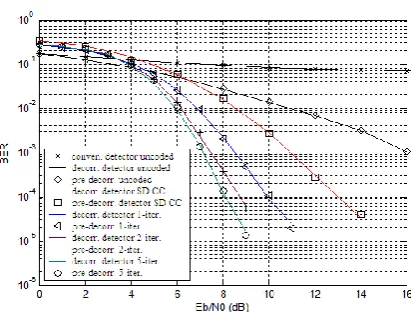
Fig. 5 shows the performance improvement obtained by using multiuser detection in an uncoded system with K=10 users and random spreading with
PG=32. The curve of the conventional detector is flattened and does not affected by increasing the SNR; this because of the MAI has the dominant effect. Using the multiuser decorrelating detector improves the performance by removing the MAI but the curve is parallel to the single user bound because of the noise enhancement by the factor R-1.
Using the multiuser pre-decorrelator gives the same performance as the decorrelating detector with transforming of the complexity from the MT to the BS.
Fig. 5 Bit error rate for uncoded STBC with decorrelating detector and multiuser pre-decorrelating
for K=10, and PG=32.
Fig. 6 Bit error rate for turbo-coded STBC with multiuser decorrelating and pre-decorrelating for K=10,
and PG=32.
Fig. 6 represents the STBC multiuser pre-processed system using pre-decorrelation with the application of turbo coding. The results for the pre-decorrelator are the same as that for the pre-decorrelator. We compare the performance of the system when using turbo-codes and convolutional codes using soft-decision Viterbi decoding algorithm. A coding gain of 5 dB is obtained by using SD-VA at BER=10-3. Using iterative turbo codes of 1, 2 and 5 iterations will exceed the coding gain over that of the SD-VA by 2 dB, 1 dB and 0.5 dB respectively. As shown, increasing the number of iterations improves the performance. Increasing the number of iterations over 5 will not improve the performance by a note sable manner because, the extrinsic soft-output information
becomes the same and this will give the same performance.
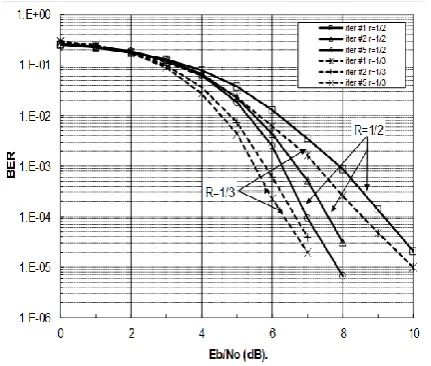
Fig. 7 Bit error rate for turbo-coded STBC with multiuser decorrelating for different Turbo-Code rates,
K=10, and PG=32.
In Fig. 7 we simulate the STBC system using multiuser pre-decorrelator with rate 1/2 and 1/3 turbo codes. Power gain of 1 dB is obtained by using rate 1/3 turbo code. Also increasing the number of iterations improves the performance.
VI. CONCLUSIONS
Transmitter-based techniques were proposed to shift computational complexity and power consumption to the BS, where it can be afforded. Transmitter diversity in the downlink using multiple transmitter antennas provides similar performance gains as for the mobile terminal (UT) receiver diversity without the complexity of a second UT receiver antenna. Transmitter based methods enable to shift signal processing to the transmitter where power and computational complexity are more abundant, thus simplifying receiver units.
We propose a low complex transmitter-based method with similar performance improvements as the receiver-based method. In the proposed method, the functions of multipath combining and MAI cancellation are explained separated. Thus, the MAI cancellation matrix does not depend on rapidly time-varying fading coefficients. Multiuser pre-processing preserves the multipath diversity while removing the MAI.
STBC provides significant performance gain using modest number of antennas. The complexity of the used Alamouti STBC is the lowest since it not requires CSI. Alamouti STBC can be easily combined with pre-decorrelator.
It was shown that these techniques, though very effective in removing the MAI, demand high computational complexity, power and knowledge of spreading codes of all users. As a result, in the downlink of a CDMA system it is not feasible to employ such methods at the UT. Using the multiuser pre-decorrelator gives the same performance as the decorrelating detector with transforming of the complexity from the UT to the BS.
REFERENCES
[1]Basar, E. "On multiple-input multiple-output OFDM with index modulation for next generation wireless networks," IEEE Transactions on Signal Processing, 64, 2016.
[2]Hu, F., Du, D., Zhang, P., & Wang, Z. A joint swarm intelligence algorithm for multi-user detection in MIMO-OFDM system. International Journal of Electronics, 101, 1478–1494, 2014.
[3]M. N. R. Esmailzadeh, "Pre-RAKE Diversity Combination For Direct Sequence Spread Spectrum Communications Systems,"
in IEEE International Conference on
Communications, 1993, pp. 463-467.
[4]S. G. a. A. Duel-Hallen, "Pre-RAKE Multiuser Transmitter Precoding for DS-CDMA Systems," in on Information Sciences and Systems, John Hopkins University, March 2003. [5]A. A. a. M. F. M. Farid S., "A Pre-Processed Turbo-Coded
CDMA System Using Decorrelation in Fading Channels," in JIEEEC'06, Amman, Jordan, 2006.
[6]N. S. V. Tarokh, A.R. Calderbank, "Space-time codes for high data rate wireless communication: performance criterion and code construction," IEEE Transactions on Information Theory, vol. 44, pp. 744-765, March 1998.
[7]Alamouti, "A Simple Transmit Diversity Technique forWireless Communications," IEEE Journal on Selected Areas in Communications, vol. 16, pp. 1451–1458, Aug.,1998. [8]D. D. a. F. Pollara., "Turbo codes for PCS applications," in Proc. IEEE Int. Conf. Commun., ICC'95, Seattle, WA, June 1995.
[9]S. B. D. D. G. M. a. F. Pollara, "Soft-output decoding algorithms in iterative decoding of turbo codes," in Jet Propulsion Laboratory. TDA Progress Report 42-124, Feb. 1996, pp. 63-87
[10] K. Enokizono and H. Ochiai, "A simple interleaver design for variable-length turbo code," 6th Int. Symp. on Turbo Codes and Iterative Info. Processing (ISTC 2010), Sep. 2010, pp. 354-358.