WHEN%ALLIES%ACT:%THE%ROLE%OF%EUROPEAN%PUBIC%OPINION%IN%THE%2011%MILITARY% INTERVENTION%IN%LIBYA%%
Megan M. Poole
A thesis submitted to the faculty of the University of North Carolina at Chapel Hill in partial fulfillment of the requirements for the degree of Master of Arts in the Department of Political
Science, Concentration European Governance.
Chapel Hill 2014
Approved by:
ABSTRACT
Megan M. Poole: When Allies Act: The Role of European Public Opinion in the 2011 Military Intervention in Libya
(Under the direction of Milada Anna Vachudova)
This thesis investigates the conditions under which decisions for military intervention are constrained by public opinion. Prior studies have identified electoral cycles and
TABLE OF CONTENTS
LIST OF TABLES ………..………...vi
LIST OF FIGURES ………..…..………....vii
CHAPTER INTRODUCTION………..………...…1
I. LITERATURE REVIEW ………..………...5
II. THEORETICAL EXPECTATIONS ………..………..9
III. RESEARCH DESIGN………..………...12
a. Case Selection: Libya ………..……….13
b. Case Selection: Case Countries ………..…………..…………14
c. Data and Operationalization………..…....18
IV. EMPIRICAL ANALYSIS ………..…22
a. Key Case Studies ………..27
i. Denmark ………...30
ii. Poland ……….………...……...32
V. DISCUSSION AND CONCLUSIONS ………..……34
Table 1. Case Countries ………..…..………….16
Table 2. Case Country Data for Empirical Analysis ………..………20
Table 3. Empirical Test: Electoral Constraint Hypothesis ………..…...24
Table 4. Legislative Constraints of Case Countries………....25
INTRODUCTION
In February 2011 protests in Libya escalated into violence between rebel and
government forces. By March, Muammar Gaddafi’s forces were preparing attacks on the
rebels and the civilian population of Benghazi (STRATFOR 2011). On March 17, 2011 the
UN Security Council adopted Resolution 1973, providing a mandate for a no-fly zone, arms
embargo, asset freezes, and ‘all necessary means’ to protect civilians in Libya (United
Nations Security Council Resolution 1973: 3-5). UN mandate in hand, a coalition of forces
headed by the British and French implemented a no-fly zone and naval blockade on Libya,
thwarting military attacks by Gaddafi. On March 23, NATO launched Operation Unified
Protector (OUP) to take over the mission in Libya (NATO 2011b).
Despite being members of an alliance that was granted a UN mandate for a military
mission to protect civilians, fourteen of NATO’s 28 members did not contribute to OUP.
Many of the noncontributing NATO members simply lacked the resources required to
enforce a no-fly zone and naval blockade, much less to conduct air strikes. For!as!long!as!
NATO!has!existed,!European!states!have!used!their!scarce!military!capabilities!to!justify!
sitting!on!the!sidelines!during!military!operations.!!So!from!this!angle!there!is!little!to!be!
learned!from intervention in Libya. However, a number of European NATO members,
notably Germany and Poland, were militarily capable yet refused to contribute to the
opinion as a significant factor in their decision-making (Bell & Hendrickson 2012: 156). In
this thesis I ask: Does public opinion explain why some European states chose not to
participate in OUP, while others contributed?
I use Libya as a case study and test two factors which I hypothesize determine
whether a NATO member’s decision about military intervention is constrained by public
opinion: the proximity of the next election, and the strength of any legislative check on
government decisions for military deployment. My electoral constraint hypothesis
recognizes that governments are always concerned about staying in power, but that these
concerns are more acute in the immediate run up to an election (Gaubatz 1991). I
hypothesize that if there is an election on the horizon then public opinion determines whether
or not a government chooses to participate in military intervention. My legislative constraint
hypothesis recognizes that public opinion exerts pressure on parliaments and if parliaments
have significant influence over military deployments, they possess multiple veto points over
policies that diverge from public opinion (Dieterich, Hummel, and Marschall; Wagner,
Peters, and Glahn 2010). I hypothesize that if there is a strong legislative check on foreign
policy then public opinion drives the decision over military intervention. Conversely, I
hypothesize that the absence of immediate electoral pressure or weak legislative checks on
foreign policy, grants governments discretion to consider factors other than public opinion
(e.g. alliance politics, humanitarian responsibilities, idiosyncratic factors).
My findings suggest that governments are chiefly constrained to public opinion when
elections are on the horizon. Strong legislative checks on foreign policy are notsufficient to
constrain governments to public opinion in their decision for military intervention. As
words, these constraints are not enough to predict government decisions for military
intervention. My findings however suggest that a lack of electoral pressure combined with
weak legislative checks on foreign policy is sufficient to expect governments to contribute to
NATO interventions regardless of public opinion.
My thesis breaks new ground by showing that the timing of elections relative to a
decision over military intervention is a significant intervening variable, moderating the role
of public opinion in foreign policy making. At the same time, I cast doubt over the role of
parliaments as ‘transmission belts’ for public opinion on foreign policy. My study integrates
factors that scholars previously identified as important democratic constraints on military
action, but whose interaction with actualpublic opinion has been largely neglected.
This thesis also suggests lessons for NATO’s future missions. In the wake of OUP,
many commentators argued that Libya not only exposed capabilities deficits among
European allies, but also a lack of political will (Clark 2011; Gates 2011; Hallams & Schreer
2012; Howorth 2012). My finding that governments are chiefly constrained to public
opinion through immediate electoral pressure calls into question any broad conclusions about
the future of NATO based on European political willingness to contribute in Libya. Since
the timing of elections is a dynamic and changing mechanism for public opinion to influence
foreign policy, the lessons from European participation in OUP may be limited.
Contributions to other NATO missions may vary according to changing electoral time
horizons. This means that the specific constellation of contributing and abstaining countries
assembled for NATO’s 2011 mission may not be indicative of future missions, when
different countries face different electoral constraints. Nevertheless, the mission in Libya, a
European members will likely face again in the coming decades. If an election is on the
horizon, I show that public opinion is highly likely to determine whether or not a government
chooses to participate in a NATO military operation. My theory that electoral cycles can
drive decisions about military intervention can be tested to help explain intervention
decisions in the past – and to predict intervention in the future.
The rest of this thesis is divided into five parts. First, I explore the theoretical
literature that has informed my hypotheses, and explain how my study breaks new ground.
Second, I outline the theoretical expectations associated with my electoral and legislative
constraint hypotheses. Third, I discuss my research design, case selection, and evidence.
Fourth, I present my empirical analysis, first testing my electoral and legislative constraint
hypotheses and subsequently looking into the necessity and sufficiency of combinations of
electoral and legislative constraining conditions. I augment the results of this initial analysis
by process tracing suspected sufficient conditions through the decision-making processes of
two key countries: Denmark and Poland. Finally, I conclude by qualifying my results and discussing the implications of my findings for NATO and academic discussions of public
I. LITERATURE REVIEW
This section explores the literature on the role of public opinion and domestic
institutional structures in foreign policy making. I demonstrate how this thesis incorporates
public opinion and domestic structures to analyze foreign policy in a new way. In this
section I include findings from Holsti (1992) and Risse-Kappen (1991) about the important
but inconsistent role public opinion plays in foreign policy. Second, I discuss Gaubatz’s
(1991) focus on the role of electoral cycles in moderating decisions for military action.
Finally, I consider various legislative structures that are thought to moderate decisions for
military action (Auerswald 1999; 2000; Clark and Nordstrom 2005; Reiter and Tillman 2002;
Wagner et al. 2010).
The role of public opinion in foreign policy has not always been widely accepted in
the scholarly community. In the early 1990s, Holsti (1992) and Risse-Kappen (1991)
reinvigorated scholarly discussion on the subject by establishing that public opinion does
influence foreign policy and that this influence presents important avenues for research.
Focusing on American public opinion, Holsti (1992) affirms the impact public opinion has on
foreign policy, but recognizes that the opinion-policy link is the least well-developed area of
existing literature. My thesis contributes not only to this underdeveloped aspect of the
discussion, but also to the neglected study of public opinion in foreign policy outside
than that of other countries. This neglect continues despite studies that demonstrate, for
example, that European public opinion on foreign policy is as stable and coherent as opinion
in the United States (Isernia, Juhasz, and Rattinger 2002).
While public opinion does influence foreign policy, the link between opinion and
policy is not unequivocal. Risse-Kappen (1991) argues that public opinion influences
foreign policy, but that this influence is indirect. Risse-Kappen (1991) stresses the
importance of domestic structures as intervening variables between public opinion and
foreign policy. The decision of some European countries to join the coalition of the willing in
Iraq despite oppositional public opinion demonstrates that decisions on military deployment
do not always correlate with public opinion (Chan and Safran 2006; Dieterich et al. 2008;
Mello 2012; Schuster and Maier 2006; Tago 2009). Yet, instances of disregard for public
opinion do not undermine the argument that public opinion plays a role in foreign policy
making, but rather highlight the complexity of the link between opinion and foreign policy.
Risse-Kappen’s (1991) investigation of institutional opportunity structures for public
influence in foreign policy incorporates this complexity. Risse-Kappen’s approach also
provides the point of departure for my study of the interaction between public opinion and
electoral and legislative constraints on decisions for military intervention.
In the study of the influence public opinion has on decisions for military action, it is
implied that elected politicians prioritize re-election. Gaubatz (1991) hypothesizes that the
power of society relative to the state varies within election cycles, with society strengthened
close in time to an election. Gaubatz (1991) differentiates between democracies facing
immediate elections and democracies facing no immediate elections, finding that
My electoral constraint hypothesis builds on Gaubatz’s (1991) study in two aspects. First,
Gaubatz (1991) finds significant correlation between the election cycle and the decision for
military conflict, but acknowledges shortcomings in terms of causal inference. By focusing
on the impact of the timing of elections in a single case study I better isolate the role of the
election cycle in the policymaking process. Secondly, Gaubatz (1991) assumes a war-averse
public for the purposes of his study. My electoral constraint hypothesis investigates the
interaction between public opinion and the timing of elections, accounting for the neglected
reality of actual public sentiment.
My legislative constraint hypothesis builds on academic work that explores how
domestic institutional structures influence decisions for military action. First, I draw on
Auerswald’s (1999; 2000) theoretical relationship between democratic subtype and military
action. Auerswald (1999) predicts that more majoritarian systems (Westminster and
semi-presidential) are less constrained than less majoritarian systems (coalition parliaments and
presidential). Auerswald (1999; 2000) argues that the established rules of interaction
between the executive, legislature, and the public determine whom the executive is
accountable to and the extent to which the legislature can challenge the executive. Second, I
incorporate Reiter and Tillman’s (2002) and Clark and Nordstrom’s (2005) arguments that
single-party majority governments are less constrained in their foreign policy making than
coalition governments. Finally, I utilize Wagner et al.’s (2010) distinction between
parliaments with and without an ex ante veto over military deployments, arguing that
countries without an ex ante veto are less constrained than countries with parliaments that
the only aspect of parliamentary control over military policy, it is the strongest means a
parliament has to constrain the decision for military action.
The insights from this literature allow me to classify states with strong or weak
legislative checks on foreign policy (see Table 4). States with strong legislative checks on
foreign policy include coalition parliamentary or presidential systems with a coalition
government and/or a parliamentary ex ante veto over military deployments. States with
weaker legislative checks include Westminster parliamentary or semi-presidential systems
with a single-majority government and/or the absence of a parliamentary ex ante veto over
military deployments. As with my electoral constraint hypothesis, I build on the existing
literature by explicitly focusing on the interaction between public opinion and legislative
constraints on foreign policy. Unlike the existing literature, which assumes a conflict-averse
public, this thesis investigates the directional pull of public sentiment. This allows for a
study of public sentiment that balances the costs of military intervention with other
considerations, for example humanitarian responsibilities and alliance obligations.
II. THEORETICAL EXPECTATIONS
In this section, I outline what decisions I expect European governments to make about
military intervention given my electoral and legislative constraint hypotheses. These
theoretical expectations are based on the literature examined in the previous section and
guide the remainder of this thesis. Overall, I use a comparative approach to test the
conditions under which foreign policy is constrained, or even determined by, public opinion.
This approach integrates factors previously identified as important in understanding decisions
made by governments about military intervention, but whose interaction with public opinion
has been largely neglected.
With my electoral constraint hypothesis (H1), I build on Gaubatz’s (1991) theory that
governments are more constrained to public opinion in their foreign policies in the run-up to
an election than if there are no immediate electoral pressures. In other words, whether public
opinion constrains government decision-making is moderated by the electoral cycle. This
leads to two predictions:
H1a: If a government faces an immediate election, this condition is sufficient to motivate governments to make decisions about military intervention that are
H1b: If a government does not face an immediate election, this condition is necessary but not sufficient for governments to diverge from public opinion in decisions about
military intervention.
Hence, I expect to see foreign policy that mirrors public opinion in countries where
governments are facing elections within a year: Governments engage in military intervention
if public opinion is supportive, and stay on the sidelines if public opinion is opposed. In the
absence of upcoming elections, I expect governments to be less constrained to public
opinion, facing the necessary condition for foreign policy to diverge from public opinion.
Still, the absence of electoral constraints is not sufficient to predict whether foreign policy
will actually diverge from public opinion. I expect this to vary as governments have some
flexibility to weigh public opinion against other political factors.
My legislative constraint hypothesis investigates how legislative constraints moderate
the influence of public opinion on government decisions over military intervention. My
investigation of countries with strong or weak legislative constraints lead to two hypotheses
(H2):
H2a: If a government faces strong legislative checks on foreign policy making, this condition is sufficient to motivate governments to make decisions about military
H2b: If a government faces weak legislative checks on foreign policy making, this condition is necessary but not sufficient for governments to diverge from public
opinion in decisions about military intervention.
In sum, I predict that states with stronger legislatures are more constrained by public opinion
in their foreign policies because the executive is less able to overcome domestic opposition.
Therefore, I expect governments facing strong legislative constraints to intervene if public
opinion is supportive of military intervention, and abstain if public opinion is opposed.
Conversely, states with weaker legislatures are less constrained by public opinion because
these states are better able to overcome domestic opposition in foreign policy making. This
executive power relative to the legislature could be utilized to pursue foreign policy that
indulges other policy objectives while diverging from public opinion. But, the absence of a
strong legislative constraint is not sufficient to predict whether foreign policy will actually
III. RESEARCH DESIGN
In this section I explain my decision to focus on the 2011 NATO intervention in
Libya, how I select case countries, the evidence I employ, and how I operationalize my
variables. This thesis focuses on a small number of cases and investigates the conditions
under which outcomes occur, rather than estimating the average effect of a set of independent
variables. When determining whether a decision for military intervention aligned with public
opinion, causal relations are expressed in terms of necessary and sufficient conditions (Ragin
1987; 2000). Necessary conditions are conditions that must be present for an outcome to
occur but do not guarantee such outcome. Sufficient conditions are conditions that always
lead to an outcome, but such outcome may also occur without the condition present. I
recognize the possibility of different paths to the same outcome and that individual
conditions may not be singularly necessary or sufficient; I therefore examine the sufficiency
of combinations of casual conditions as well (Ragin 2000: 91-95). The conditions
investigated in this analysis (timing of elections, legislative checks on foreign policy) are
understood as intervening between an initial condition (public sentiment towards foreign
policy) and a final outcome (foreign policy decision that mirrors or diverges from public
a. Case Selection: Libya
Studying whether or not states chose to intervene in Libya in 2011 allows me to
control for a number of variables. First, the selection of Libya conforms to the findings of
public salience literature. This literature suggests that instances of international crises raise
foreign policy issue salience to a level that captures the attention of the public and thereby
the attention of the government to public opinion (Oppermann and Viehrig 2009).
Second, Libya is the first NATO mission to take place after the divisive 2003
invasion of Iraq and years of unpopular NATO engagement in Afghanistan. I argue that Iraq
and Afghanistan, both involving massive ground troop deployments, were exceptional cases
of post-Cold War military deployment. On the other hand, the mission in Libya, as well as
NATO actions in Serbia in the 1990s, were limited military interventions without the
deployment of ground troops and intended to prevent the slaughter of civilians. Libya and
Serbia are more characteristic of the sort of mission NATO and European governments may
see repeated in the coming decades (Valasek 2011). The nature of the military intervention
in Libya therefore makes this study generalizable beyond Libya, pointing to implications that
can be considered across similar instances of NATO military interventions.
Third, the intervention against Gaddafi’s regime had a humanitarian rationale and was
endorsed by international and regional bodies (Valasek 2011). To many, Libya represented
the sort of mission European countries would most likely find appropriate for military
intervention, given the humanitarian rationale, international mandate, and the strategic
importance of North Africa (Howorth 2012). However, German abstention from UN
contributions to OUP were mixed. Given this, the study of the role of public opinion in
European involvement in Libya provides insight into implications for NATO and the EU.
b. Case Selection: Case Countries
My cases meet three criteria: (1) they have democratic political institutions, (2) they
are militarily capable of contributing to OUP, (3) and they are members of the EU and
NATO. As a threshold for uncontested democratic political institutions, I utilize the Polity
IV Country Reports (2010) data, insuring that included countries scored an 8 or above on the
combined autocracy-democracy scale (Marshall and Jaggers 2010).1 Military capability is
determined by whether member states spent at least 2,000 million US dollars on military
spending in 2011 (NATO 2011a).2 I limited my cases to members of both the EU and NATO because commentary in the wake of OUP highlights the lack of a EU response to the crisis in
Libya, and the varied responses of EU member states to the subsequent military intervention.
Given the centrality of the EU’s lack of a role in Libya, this case selection enables me to
comment on the implications of Libya for the role of EU member states within NATO.3 To enhance cross-case comparability and control for varying national interest in
Libya, I applied three further criteria. First, Libya’s former colonial power Italy is omitted to
!!!!!!!!!!!!!!!!!!!!!!!!!!!!!!!!!!!!!!!!!!!!!!!!!!!!!!!!
1!Out of NATO’s members, this criterion excluded Turkey.
2!This threshold has been utilized to determine military capability to contribute to OUP by other 2!This threshold has been utilized to determine military capability to contribute to OUP by other authors, for example by Chapell (2011). Out of NATO’s members, this criterion excluded Albania, Bulgaria, Croatia, Estonia, Hungary, Iceland, Latvia, Lithuania, Luxembourg, Slovakia, and Slovenia.
!
avoid confounding any results with the complexities of post-colonial ties.4 Second, during the 2011 crisis Gaddafi explicitly used migration as a ‘weapon’ against European countries,
framing the threat from Libya in terms of refugee flows (Coticchia 2011: 54). Yet, as
demonstrated by Italy, Malta, Cyprus, and Greece having to plead in Brussels for European
solidarity in the face of an influx of North African refugees, such migration concerns were
not deeply held by European countries beyond this part of the Mediterranean (Spiegel 2011).
To control for extraordinary migration pressures emanating from Libya, Greece is also
excluded from my set of cases.
Finally, Belgium and Portugal are excluded from this analysis due to unusual
domestic political circumstances. In Belgium, the decision to intervene in Libya was taken
nearly 300 days into a record-long period of government crisis under the rule of a temporary
government. This temporary government faced different political incentives and institutional
constraints than Belgian governments usually face. Hence, it is not possible to test the role of
the Belgian legislature and public in constraining foreign policy to public opinion (Gertis
2011; Presseurop 2011). Portugal is omitted because on March 23, 2011, the same day
NATO launched OUP, Portugal’s Prime Minister stepped down after the parliament rejected
an austerity bill meant to prevent Portugal from seeking an international bailout (Alvarenga
and Bugge 2011). Given the timing of this political upheaval, Portugal is considered unable
to contribute to OUP.
Based on these criteria, I select nine European NATO countries for my analysis.
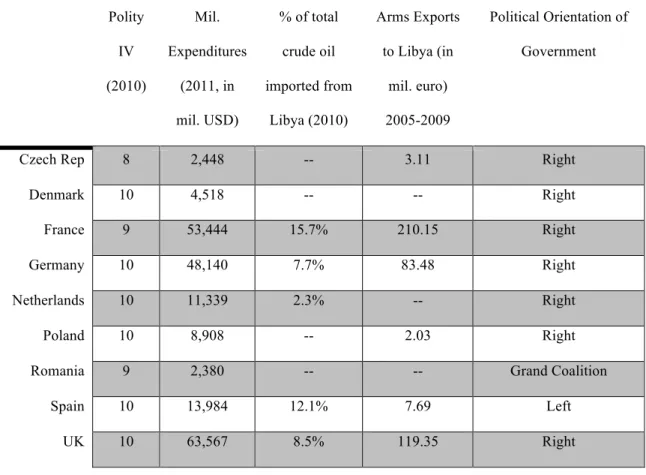
Table 1 lists my cases, their Polity IV scores (2010) and military expenditures as of 2011.
phenomenon. My empirical analysis of these cases is also complimented by more nuanced
process tracing in key case countries. These key case countries are identified in response to
the initial empirical analysis of my cases. Due to the limitations of this paper, I focus on
countries that, in this initial analysis, demonstrated the most striking results. This process
tracing provide further evidence for my conclusions and strengthens my casual inference.
My case selection allows me to control for alternative explanations for decisions
Polity IV (2010) Mil. Expenditures (2011, in mil. USD)
% of total
crude oil
imported from
Libya (2010)
Arms Exports
to Libya (in
mil. euro)
2005-2009
Political Orientation of
Government
Czech Rep 8 2,448 -- 3.11 Right
Denmark 10 4,518 -- -- Right
France 9 53,444 15.7% 210.15 Right
Germany 10 48,140 7.7% 83.48 Right
Netherlands 10 11,339 2.3% -- Right
Poland 10 8,908 -- 2.03 Right
Romania 9 2,380 -- -- Grand Coalition
Spain 10 13,984 12.1% 7.69 Left
UK 10 63,567 8.5% 119.35 Right
Table 1. Case Countries!
Polity IV (Marshall and Jaggers 2010) scores represent the combined autocracy-democracy scale with
scores of 10 representing the most democratic. Military expenditures data was drawn from a 2011
NATO report, Military Spending of the NATO countries from 1990 to 2011. Percent of total crude oil
about intervention in Libya. First, some international relations approaches reject the role of
domestic politics in foreign policy making. For example, theories derived from the realist
tradition privilege systemic factors, such as relative power or alliance dependencies, over
domestic political factors. Even a cursory look at my case countries casts doubt on the
applicability of these theories in Libya. Not only was the intervention in Libya motivated by
humanitarian aims rather than balance-of-power politics, but among my cases those that
intervened and those that did not include large and small states, eastern and western states,
and Atlanticist and Europeanist states.
Second, it is possible to argue that domestic politics did affect European foreign
policy making towards OUP, but that national interest accounts for the variation in European
involvement and not pressure from domestic public opinion. Such arguments point to
economic ties, specifically oil and arms trade between European NATO allies and Libya, or
to security concerns associated with migration. I contend that such national interests provide
an incomplete portrayal of the domestic political incentives and constraints facing European
governments in their decision on OUP. My selection of case countries demonstrates that
even when controlling for concerns for migration, European policies present significant
variation. Moreover, my case countries had relatively comparable economic interests in
Libya in terms of oil and arms trade (Table 1 includes indicators of these economic interests).
Finally, it is possible to recognize that domestic public opinion influences foreign
policy, but highlight alternative intervening variables to explain the varying constraint public
sentiment places on foreign policy. For example, some argue that partisan politics help
explain European contributions to Operation Iraqi Freedom (Mello 2012; Schuster and Maier
and more likely to send troops to Iraq in solidarity with the conservative American
government that was leading the coalition (Mello 2012; Schuster and Maier 2006). In the
case of Libya, partisan effects are less clear-cut. OUP was conducted with the lukewarm
support of a left-of-center American government and the humanitarian rational of OUP,
associated with the liberal internationalist tendencies of left-of-center governments,
complicates the hypothesis that right-of-center governments are more prone to military
action. Overall, the partisan hypothesis appears inconclusive in Libya.
c. Data and Operationalization
This study derives the position of each country towards contributing to OUP from
news coverage, policy statements, and NATO documentation of the mission in Libya.
Whether each case country militarily intervened in Libya as part of OUP is then combined
with public opinion data on the attitudes of citizens. This helps determine whether the
decision about intervention in Libya aligned with public opinion. The 2011 Transatlantic
Trends Survey (TTS) provides cross-country public opinion data for all case countries except
Denmark and the Czech Republic (Kennedy et al. 2011). This survey was conducted from
May 25, 2011 to June 20, 2011 and asked respondents to what extent they approve or
disapprove of military action in Libya by international forces. The timing of the poll is
problematic, as the poll was conducted just after the decision whether to intervene was made.
Yet, TTS public opinion data is the best available measure for public opinion towards OUP
since the availability of cross-country data is important for my analysis. Czech public
Empirical Studies (Johnston 2011). The Czech poll posed a slightly different question,
asking respondents whether the military campaign against Gaddafi was justified, rendering
the Czech poll an imperfect but adequate supplement to TTS. This poll was conducted
between March 24 and 29, 2011 giving it a comparable timeline with the TTS poll.
Similarly, I utilize Danish public opinion data from a Danish Gallup Poll conducted the same
week (Buley 2011). This poll asked Danes whether they support Danish military
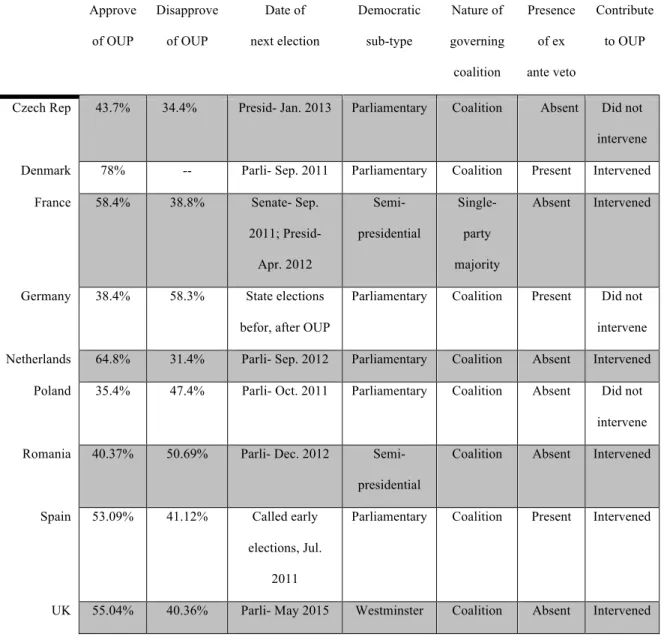
involvement in enforcing a no-fly zone in Libya. These poll results are presented in Table 2.
The European Election Database and Parties and Elections in Europe database
provide data on the timing of elections in case countries (Nordsieck 2013; Norwegian Social
Science Data Services 2013). If a country was hosting a general, legislative, presidential,
and/or regional election within 2011, that country is coded as facing an immediate election.
If the next election was after 2011, the country is coded as facing no immediate election.
Upcoming election dates are also presented in Table 2.
In terms of my legislative constraint hypothesis, I utilize a number of sources to index
three kinds of legislative constraints: democratic subtype, whether a single-party majority
runs the government, and whether parliament has an ex ante veto over military deployments.
The descriptive data for these legislative constraints is presented in Table 2. I utilize the US
Central Intelligence Agency’s World Factbook (2013) field listing for government type,
Polity IV (2010) details of governing coalitions, and Wagner et al.’s (2010) information on
legislatures in each case country. For each aspect of legislative checks on foreign policy,
weak checks are coded as 0 and strong checks are coded as 1. The sum of the three
categories of legislative constraints represents the overall legislative constraint on foreign
Approve of OUP Disapprove of OUP Date of next election Democratic sub-type Nature of governing coalition Presence of ex ante veto Contribute to OUP
Czech Rep 43.7% 34.4% Presid- Jan. 2013 Parliamentary Coalition Absent Did not
intervene
Denmark 78% -- Parli- Sep. 2011 Parliamentary Coalition Present Intervened
France 58.4% 38.8% Senate- Sep.
2011; Presid- Apr. 2012 Semi-presidential Single-party majority
Absent Intervened
Germany 38.4% 58.3% State elections
befor, after OUP
Parliamentary Coalition Present Did not
intervene
Netherlands 64.8% 31.4% Parli- Sep. 2012 Parliamentary Coalition Absent Intervened
Poland 35.4% 47.4% Parli- Oct. 2011 Parliamentary Coalition Absent Did not
intervene
Romania 40.37% 50.69% Parli- Dec. 2012
Semi-presidential
Coalition Absent Intervened
Spain 53.09% 41.12% Called early
elections, Jul.
2011
Parliamentary Coalition Present Intervened
UK 55.04% 40.36% Parli- May 2015 Westminster Coalition Absent Intervened Table 2. Case Country Data for Empirical Analysis !
Public opinion data from the 2011 Transatlantic Trends Survey for all countries except the Czech Republic and Denmark. Czech public opinion from a Czech poll by the Center for Analysis and
Empirical Studies and data on Denmark comes from a Danish Gallup Poll. Date of next election derived from election statistics provided by the European Election Database. Democratic subtype identified by author by looking at various databases and secondary-sources on the form of government in European countries. Single-party majority and coalition governments were identified through the European Election Database and the Parties and Elections in Europe database. The presence of absence of an ex ante veto of military deployments utilized Wagner et al.’s (2010) coding of parliamentary veto powers. Wagner et al.’s (2010) data covered parliamentary powers up to 2004. I have updated this dataset to account for a change of law since this time, notably in Spain in 2005. The author, in consult with NATO sources, news coverage, and secondary-literature, determined the contribution of each country to OUP. “—“ indicates data missing from original source.
representing those countries with the weakest legislative role in foreign policy making and 3
representing those with the strongest legislative role.
IV. EMPIRICAL ANALYSIS
Under what conditions are foreign policy decisions constrained to public opinion? I
begin my analysis by focusing on the case study of Libya and whether the electoral cycle
moderates the constraint public opinion has on foreign policy. I first distinguish between
governments facing immediate elections and those facing no immediate electoral pressure. I
determine that governments in four countries (Denmark, France, Germany, and Poland) faced
immediate elections, while five governments did not (Czech Republic, Netherlands,
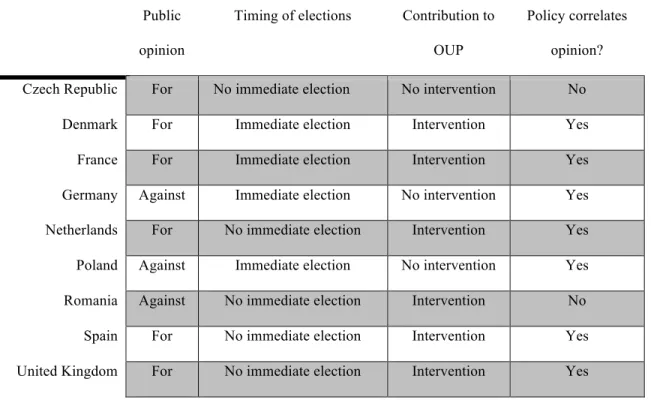
Romania, Spain, and the United Kingdom).5 I then compare public sentiment towards
military intervention in Libya to the decision made by each country on whether to contribute
to OUP.
In each country facing immediate electoral pressures, the decision about military
intervention in Libya correlated with the preferences of the public. Denmark and France
faced publics that favored military action and both countries contributed to NATO’s
intervention. Germany and Poland faced publics that opposed military intervention and both
countries refused to contribute to OUP. This evidence supports my hypothesis (H1a),
!!!!!!!!!!!!!!!!!!!!!!!!!!!!!!!!!!!!!!!!!!!!!!!!!!!!!!!!
5!Spain is designated as having no immediate election, despite holding elections in November 2011. These elections were called early due to domestic political issues unrelated to the decision to
suggesting that immediate electoral pressure motivates governments to make decisions about
military intervention that are consistent with public opinion.
The absence of near term elections proves to be a necessary but not a sufficient
condition for governments to disregard public opinion in foreign policy making, supporting
hypothesis H1b. The Netherlands, Spain, and the UK faced public sentiment that favored
military intervention and each country decided to contribute to NATO’s mission. Hence,
despite being free from electoral pressures, these governments remained true to public
opinion in their foreign policies. On the other hand, both the Czech Republic and Romania
pursued foreign policies that disregarded public sentiment. The Czech government faced a
public that favored intervention, yet the government chose not to contribute to OUP.
Romania faced a public opposed to intervention, yet the government decided to contribute to
NATO’s mission. Overall, these results suggest that the electoral cycle moderates whether
foreign policy is constrained by public opinion (see Table 3). When a government faces
immediate electoral pressures, public opinion will be reflected in foreign policy decisions. It
is only absent these electoral pressures that governments may ignore public opinion.
I follow a similar approach to test my legislative constraint hypothesis that countries
with stronger legislative checks on foreign policy are more likely constrained to public
opinion. I first determine whether my case countries have strong or weak legislative checks
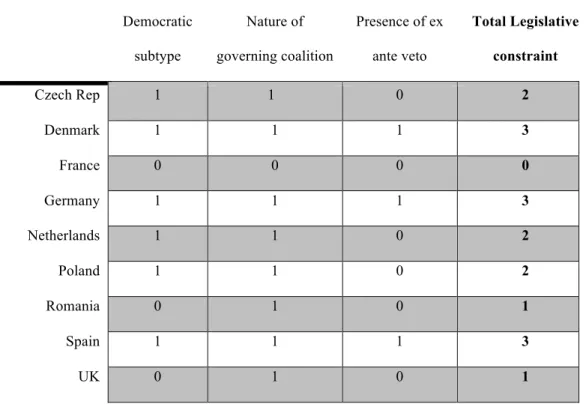
on foreign policy. I draw from the democratic subtype, nature of governing coalition, and
presence of an ex ante veto data presented in Table 2, and code weak checks as 0 and code
strong checks as 1. For democratic subtype, less majoritarian systems (coalition
parliamentary and presidential systems) are coded 1 and more majoritarian systems
with coalition governments are coded 1 and countries with a single-party majority are coded
0. Finally, countries where parliament has an ex ante veto over deployments are coded 1 and
countries without an ex ante veto are coded 0. The sum of these legislative constraints
represents the overall legislative constraint on foreign policy making, placing my case
countries on a scale from 0 to 3. I condense this scale into a dichotomous category, where
countries with overall scores of 0 or 1 have weak legislative checks and countries with
overall scores of 2 or 3 have strong legislative checks (see Table 4). I determine that six
countries (Czech Republic, Denmark, Germany, the Netherlands, Poland, and Spain) face
strong legislative checks on foreign policy making, while three countries (France, Romania,
Public
opinion
Timing of elections Contribution to
OUP
Policy correlates
opinion?
Czech Republic For No immediate election No intervention No
Denmark For Immediate election Intervention Yes
France For Immediate election Intervention Yes
Germany Against Immediate election No intervention Yes
Netherlands For No immediate election Intervention Yes
Poland Against Immediate election No intervention Yes
Romania Against No immediate election Intervention No
Spain For No immediate election Intervention Yes
United Kingdom For No immediate election Intervention Yes
Table 3. Empirical Test: Electoral Constraint Hypothesis !
Public opinion refers to overall public sentiment towards international military intervention in Libya and is drawn from the public opinion data presented in Table 2. Timing of elections is similarly determined by simplifying the upcoming election dates presented in Table 2 into the presence or absence of an election within a year of the decision to intervene in Libya.
!
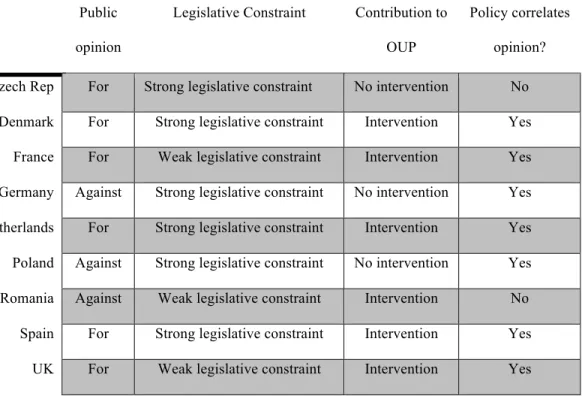
My analysis of these legislative constraints and whether foreign policy decisions
correlate with public opinion delivers mixed results. These results do not support the
hypothesis (H2a) that a strong legislative check on foreign policy is sufficient to motivate
governments to make decisions about military intervention that are consistent with public
opinion. While Denmark, Germany, the Netherlands, Poland, and Spain are constrained by
strong legislative checks on foreign policy and their decisions towards Libya reflected public
opinion, this does not hold true for the Czech Republic. The Czech government faced
favorable public opinion and strong legislative checks, yet abstained from intervening in
Libya. Given the small size of my set of cases, this divergence casts doubt that strong
legislative checks are sufficient to constrain foreign policy to opinion (see Table 5). The
Democratic
subtype
Nature of
governing coalition
Presence of ex
ante veto
Total Legislative
constraint
Czech Rep 1 1 0 2
Denmark 1 1 1 3
France 0 0 0 0
Germany 1 1 1 3
Netherlands 1 1 0 2
Poland 1 1 0 2
Romania 0 1 0 1
Spain 1 1 1 3
UK 0 1 0 1
hypothesis (H2b) that weak legislative checks on foreign policy are necessary for
governments to ignore public sentiment is similarly unsupported by my evidence.
These initial results suggest that in the case of immediate elections, electoral
pressures are sufficient to constrain policy to opinion. This accounts for the decision of four
out of nine case countries (France, Denmark, Poland, and Germany). Since my legislative
constraint hypothesis fails to independently account for the decisions of the five remaining
countries, I now test whether the combination of facing no upcoming elections but having
strong or weak legislative constraints is sufficient to account for government decisions
towards OUP.
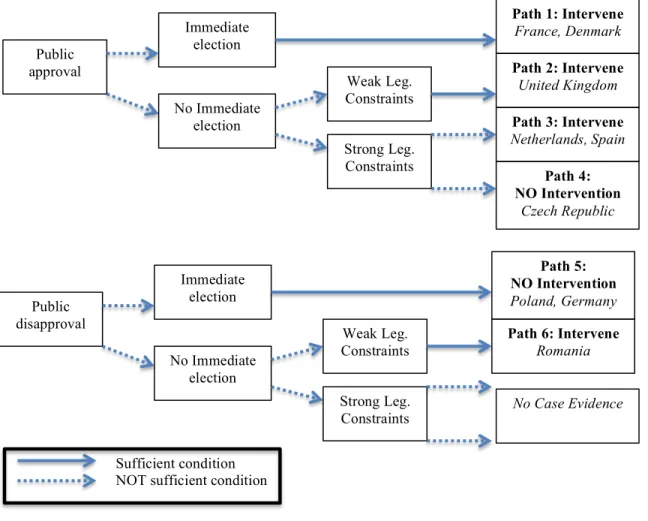
Figure 1 presents this combined analysis of public sentiment, electoral horizons, and
the strength of legislative checks. This analysis reveals six paths that lead to the foreign
Public
opinion
Legislative Constraint Contribution to
OUP
Policy correlates
opinion?
Czech Rep For Strong legislative constraint No intervention No
Denmark For Strong legislative constraint Intervention Yes
France For Weak legislative constraint Intervention Yes
Germany Against Strong legislative constraint No intervention Yes
Netherlands For Strong legislative constraint Intervention Yes
Poland Against Strong legislative constraint No intervention Yes
Romania Against Weak legislative constraint Intervention No
Spain For Strong legislative constraint Intervention Yes
UK For Weak legislative constraint Intervention Yes
policy decisions made by my case countries. Path 1 and Path 5 were previously identified
and suggest that, regardless of the strength of legislative checks on foreign policy making, an
immediate election is sufficient to constrain governments to public opinion in their foreign
policy making. A lack of immediate electoral pressure in combination with strong legislative
constraints is indeterminate. These conditions are not sufficient to constrain foreign policy to
public opinion or consistently predict that governments will ignore public opinion. This is
demonstrated in the divergence between the Netherlands and Spain (Path 3) and the Czech
Republic (Path 4). Conversely, my evidence suggests that a lack of immediate electoral
pressure in combination with weak legislative checks on foreign policy is sufficient for
governments to intervene regardless of public opinion. Path 2 and Path 6 show that all case
countries without immediate elections and with weak legislative constraints chose to
intervene militarily in Libya. This raises the possibility of an interventionist bias in these
strong states. Such bias is beyond the scope of this analysis, but presents an avenue for
further research.
a. Key Case Studies
Since my initial analysis suggests that immediate elections are singularly sufficient to
constrain policy to opinion, I now present two key case studies –Denmark and Poland – to
strengthen casual inferences from these findings. Denmark and Poland are both cases where
an upcoming election was identified as singularly sufficient to constrain policy towards
Libya to the dictates of public opinion. In Denmark, the public approved of military
OUP. The Polish government faced upcoming elections but the public was opposed military
intervention and Poland abstained from NATO’s mission. By focusing on the details of
Danish and Polish decision-making about Libya, these case studies provide further evidence
of the role of elections in constraining governments to public opinion in their decisions about
military intervention.
In a 2011 speech, US Secretary of Defense Robert Gates (2011) commended Norway
and Denmark for striking one third of the targets in Libya despite having provided only
Sufficient condition NOT sufficient condition! Figure 1. Paths to Observed Outcomes !
Public approval
Immediate election
Path 1: Intervene France, Denmark No Immediate election Weak Leg. Constraints Strong Leg. Constraints
Path 2: Intervene United Kingdom
Path 3: Intervene Netherlands, Spain Path 4: NO Intervention Czech Republic Public disapproval Immediate election No Immediate election Weak Leg. Constraints Strong Leg. Constraints Path 5: NO Intervention Poland, Germany
Path 6: Intervene Romania
and Poland to contribute to the campaign but both countries steadfastly refused to become
involved (Cloud 2011).6 With the exception of Secretary Gates singling out Denmark and Poland for their contrasting positions towards OUP, these two countries have otherwise been
characterized by a marked degree of similarity. Denmark and Poland are Atlanticist countries
and are amongst those NATO members who were small but militarily capable of contributing
to OUP (Bell & Hendrickson 2012; Wivel 2013). Denmark and Poland both contributed in
Kosovo, Afghanistan, and Iraq, gaining reputations as active supporters of NATO (Bell &
Hendrickson 2012: 154; Jakobsen 2012: 106-107). As of 2010, Denmark’s military
expenditures amounted to $4,504 million, accounting for 1.5 percent of Danish gross
domestic product (GDP). Poland out spent Denmark, with military expenditures hitting
$8,781 million, accounting for 1.9 percent of GDP (Stockholm International Peace Research
Institute 2012).
Further, Denmark and Poland had comparable national interests in Libya. While 71
of Libya’s crude exports go to Europe, 58 percent of these exports end up in Italy, Germany,
France, Spain, or the UK. The remaining 13 percent is dispersed the rest of Europe (Energy
Information Agency 2013). In the case of Denmark and Poland, only PGNiG, a
state-controlled Polish oil and natural gas giant, was operating in Libya as of 2011 (Nolan 2011).
Danish oil interests in Libya were limited to general, global oil and shipping interests (James
2011). Additionally, Denmark and Poland had only marginal migration concerns emanating
from Libya (Spiegel 2011). Finally, center-right coalition governments governed both
Denmark and Poland, with the Liberal, Conservative, and Danish People’s parties governing
Denmark and Civic Platform (PO) and Polish People’s party (PSL) forming Poland’s
conservative government (Ministry of Foreign Affairs 2013; Pidd 2011).
Denmark and Poland both face strong legislative constraints on foreign policy, though
there is still variation between the two. The Danish parliament possesses an ex ante veto
over military deployments while the Polish parliament does not (Wagner et al. 2010: 47-48,
80-81). Additionally, a tradition of minority governments pushes Danish politics towards
consensus. Together, this makes Denmark one of the most legislatively constrained countries
in Europe. Poland is comparatively less constrained, yet despite differences in legislative
constraints, the Polish government was motivated to mirror public opinion in its policy
towards Libya. Turning individually to each country, an examination of the discourse of
Danish and Polish leaders reveals the attempts each government made to assuage voters with
their decision towards Libya in the run up to their 2011 parliamentary elections.
i. Denmark
With minority governments and a parliamentary ex ante veto over military
deployments, any decision for military intervention faces high institutional hurdles in
Denmark. With numerous legislative veto points over foreign policy, a first look suggests
that it is very difficult for Denmark to pursue any military intervention or similarly activist
foreign policy. Yet, as humanitarian crisis loomed in early 2011, a domestic consensus arose
in support of intervening in Libya. A March 2011 Gallup Poll revealed that 78% of Danish
(Buley 2011). With Denmark facing parliamentary elections upcoming in September 2011,
this support for intervention was not ignored in Danish foreign policy circles.
With the support of a significant majority of the Danish electorate, the Danish
government and a wide spectrum of Danish parliamentarians began to perceive OUP as good
domestic politics, as well as an opportunity for Denmark to pursue its wider foreign policy
interests.Danish foreign policy elites and parliamentarians began publically to characterize
intervention in Libya as an ideal opportunity for Danish foreign policy. The Danish Foreign
Policy Yearbook 2012 characterizes the intervention in Libya as a perfect war from a Danish
perspective: Libya’s humanitarian rationale tapped into the Danish commitment to promote
UN norms, stability in North Africa was perceived to be a Danish national security interest,
and the Danish air force, unengaged elsewhere, was available so Denmark could ‘do its part’
as a member of NATO (Jakobsen & Moller 2012: 108-109, 111).7
With eyes on the upcoming September 2011 elections, Danish elites seized OUP as a
good foreign and domestic political move. Danish participation in OUP was approved
unanimously by parliament. Such political consensus was critical, mitigating the political
risk associated with military deployment in the face of upcoming parliamentary elections.
Danish Prime Minister Lars Loekke Rasmussen announced Denmark’s support for OUP and
explained that while Denmark is a small country, they recognize and uphold their
international responsibilities (Ahram Online 2011). Rasmussen made Danish F-16s available
to NATO without caveats and dropped 11% of the total bombs dropped during OUP
ii. Poland
In contrast with Denmark, the Polish parliament does not have an ex ante veto over
military deployments, though the nature of the Polish parliamentary system still erects some
legislative checks over foreign policy. Looking at legislative constraints alone suggests that
Poland could more easily engage in military intervention than Denmark, but public opinion
on the eve of elections complicates this assumption. Polish parliamentary elections
immediately followed the decision about Libya. Yet, unlike in Denmark, no opposition
parties were calling for action in Libya. In light of split Polish public opinion that was
generally unfavorable towards military intervention in Libya, Poland’s conservative coalition
government was ill advised to intervene in Libya if they wished to maintain office beyond
2011.
Lacking public and parliamentary consensus in support of intervening in Libya, the
Polish government was unable to disperse the political risk of a military intervention in the
face of upcoming elections. Therefore, citing public opinion as a key reason, Polish Foreign
Minister Radoslaw Sikorski announced Poland’s refusal to contribute to OUP (Bell &
Hendrickson 2012: 155-156). Polish Prime Minister Donald Tusk assured his public that
Poland would only take part in military action in Libya if there were ‘immediate dangers’ to
Polish and NATO security (Economist Intelligence Unit 2011). Lacking public support and
wishing to avoid suffering the domestic political costs attached to the decision about Libya,
Tusk presented the military intervention in Libya as ‘European hypocrisy.’ In these
accusations, Tusk pointed to Europe’s inconsistency over human rights, namely cozy
EU presidency in July 2011, Tusk also suggested that a neutral Poland might serve as a more
credible mediator for the EU in post-intervention Libya (Dylla 2011).
Polish foreign policy elites characterized the intervention in Libya very differently
than their Danish counterparts. Foreign policymakers from the two countries perceived
different political incentives or disincentives for contributing to OUP and responded to public
sentiment with different portrayals of the Libya mission. Denmark, empowered by
supportive public opinion, embraced the narrative of humanitarian and alliance responsibility
in the name of Danish national interest, and intervened in Libya. Conversely, Poland faced
more mixed public opinion and the conservative government risked blowback at the ballot
box if they took initiative in Libya. Therefore, Poland rejected the narrative of humanitarian
and alliance responsibility, suggesting an alternative role for Poland as a neutral EU
negotiator and refused to intervene in Libya. Overall, the interaction of different public
opinions with electoral pressures constrained Danish and Polish decisionmakers to different
policies towards OUP. Danish and Polish leaders presented voters very different
interpretations of the choice for military intervention in Libya. These differences were not so
much the result of holding deep and differentiated views of humanitarian intervention, but
rather, Danish and Polish leaders faced different political incentives in light of public
V. DISCUSSION AND CONCLUSIONS
The!scope!and!character!of!NATO’s!intervention!in!Libya!can!help!us!understand!
what!to!expect!next!time!a!humanitarian!crisis!compels!the!allies!to!act.!!This thesis
investigates the conditions under which governments mirror public opinion in their foreign
policies and asked whether public opinion helps explains why some European countries
intervened in Libya, while others sat on the sidelines. My findings suggest that governments
are constrained to public opinion in their decisions about military intervention when they
face upcoming elections. If there are no elections in the near future, governments have the
flexibility to either mirror or disregard public opinion. My findings also suggest that when
governments do not face an immediate election and have only weak legislative checks on
foreign policy, governments pursue military intervention regardless of public opinion. This
finding presents the possibility of an interventionist bias, but this bias is outside the scope of
this analysis, presenting an avenue for further research.
This thesis adds to the existing literature on the role of public opinion in foreign
policy by explicitly focusing on the interaction between public opinion, the electoral cycle,
and legislative constraints on foreign policy. My findings support Gaubatz’s (1991)
argument that the electoral cycle moderates government choices for military action, but
suggest that the effect of the electoral cycle on this choice depends on the direction and
initiation of military conflict in the face of an upcoming election, yet my analysis of Libya
showed instances where the public favored military intervention and leaders decided to
intervene despite upcoming elections. My findings also cast doubt on the role of parliaments
as a ‘transmission belts’ for public opinion, especially when there are no pressing elections.
Further research is required to better determine the role of parliaments in constraining foreign
policy to public opinion.
Overall, my results indicate that considering public opinion is critical for
understanding government decisions about military action, but also that public opinion
cannot be considered in a vacuum. Other domestic political arrangements, chiefly the
electoral cycle, must be considered. Additionally, when utilizing public opinion in foreign
policy analysis, scholars must set aside assumptions of a war-averse public and recognize
that public sentiment can either dissuade or encourage governments to take military action.
This thesis also contributes to policy discussions about the future of NATO and
European willingness to contribute to the alliance. In the wake of OUP, commentators
compiled lists of good, contributing NATO members, and bad, free-riding NATO members.
My findings suggest that such commentaries should be tempered. European contributions to
OUP do not necessarily represent a lasting delineation of willing and unwilling member
states. Rather, the actions taken by European governments towards Libya reflect national
public sentiments within varied electoral time horizons. The enthusiastic contributors of
OUP may abstain from coming missions, while countries on the sidelines of the Libyan
intervention may step up to lead NATO’s next mission. My findings suggest that future
European contributions will depend on the tides of public opinion and the timing of NATO’s
Finally, while I argue that the implications of which countries were willing or
unwilling to contribute to OUP are limited, the results of this thesis are still important for
NATO. Because electoral horizons and public sentiment vary across so many allies, it may
be difficult for NATO to move beyond continually shifting coalitions of those willing to
contribute to missions. With NATO contributions held hostage by electoral time horizons
and public sentiment, my findings only add to the ongoing uncertainty as to whether NATO
can consistently and continually fulfill its raison d’etre.
REFERENCES
Ahram Online (19 March 2011). Denmark, Norway prepare contribution to Libya action. Ahram Online, Retrieved from http://english.ahram.org.eg/News/8050.aspx
Alvarenga, D. and A. Bugge (23 March 2011). Portugal PM resigns as parliament rejects austerity. Reuters. Retrieved from http://www.reuters.com/article/2011/03/23/us-portugal-crisis-idUSTRE72M2CK20110323
Auerswald, D. (1999). Inward bound: Domestic institutions and military conflicts. International Organization, 53(3), 469-504.
---. (2000). Disarmed democracies: Domestic institutions and the use of force. Ann Arbor: The University of Michigan Press.
Bell, J.P. and R.C. Hendrickson (2012). NATO’s Visegrad allies and the bombing of
Qaddafi: The consequences of alliance free-riders. Journal of Slavic Military Studies, 25, 149-161.
Buley, J. (25 March 2011). Danish six-pack attacks Gaddafi. The Copenhagen Post:
International Edition. Retrieved from http://cphpost.dk/news/danish-six-pack-attacks-gaddafi.410.html
Central Intelligence Agency (2013). The world factbook: Field listing: Government type. Central Intelligence Agency. Available at
https://www.cia.gov/library/publications/the-world-factbook/fields/2128.html
Chan, S. and W. Safran (2006). Public Opinion as a constraint against war: Democracies’ responses to Operation Iraqi Freedom. Foreign Policy Analysis, 2, 137-156.
Chapell, G. (2011). Operation Unified Protector: No “Swan Song” for NATO. The Polish Quarterly of International Affairs, 2, 63-78.
Clark, D.H. and T. Nordstrom (2005). Democratic variants and democratic variance: How domestic constraints shape interstate conflict. The Journal of Politics,67(1), 250-270.
Clark, M. (2011). Curious victory for NATO in Libya. London: Royal United Services Institute.
Cloud, D.S. (09 June 2011). Gates calls for more NATO allies to join Libya air campaign. Los Angeles Times. Retrieved from http://articles.latimes.com/2011/jun/09/world/la-fg-libya-nato-20110609
---. (2012b). Swords into ploughshares: The effect of pacifist public opinion on foreign policy in western democracies. Cooperation and Conflict, 47(3), 309-330.
Dieterich, S., H. Hummel, and S. Marschall (2008). Parliamentary war powers and European participation in the Iraq War 2003: Bridging the divide between parliamentary studies and international relations. Published by Parliamentary Control of Security Policy (PAKS) at the University of Dusseldorf, 1-32.
---. (2010). Parliamentary war powers: a survey of 25 European parliaments. Occasional Paper 21, published by the Geneva Centre for Democratic Control of Armed Forces (DCAF), 1-94.
Dylla, D. (03 June 2011). Poland, Libya, and NATO. New Atlanticist: The Atlantic Council Policy Blog, Retrieved from
http://www.atlanticcouncil.org/blogs/new-atlanticist/poland-libya-and-nato
Economist Intelligence Unit (19 April 2011). Poland politics: Divisions over foreign policy. Economist Intelligence Unit: Country Views Wire. Retrieved from
http://go.galegroup.com/ps/i.do?id=GALE%7CA254342714&v=2.1&u=unc_main&it =r&p=AONE&sw=w&asid=00378aad156338922d1e022c6ac1cedb .
Energy Information Administration (2013). Country analysis: Libya. U.S. Energy Information Administration. Retrieved from
http://www.eia.gov/countries/cab.cfm?fips=LY.
Gates, R. (2011). The Security and defense agenda (Future of NATO), speech by Secretary of Defense Robert M. Gates, US Department of Defense, Brussels, 10 June 2011.
Gaubatz, K.T. (1991). Election cycles and war. Journal of Conflict Resolution, 35(2), 212- 244.
The Guardian (02 March 2011). EU arms exports to Libya: who armed Gaddafi?. The Guardian: Data Blog. Retrieved from
http://www.theguardian.com/news/datablog/2011/mar/01/eu-arms-exports-libya#data
Gertis, F. (2011). Understanding Belgium’s engagement in Libya. The Holland Bureau. Retrieved from http://www.thehollandbureau.com/2011/03/28/understanding-belgium’s-engagement-in-libya/
Hallams, E. and B. Schreer (2012). Towards a ‘post-American’ alliance? NATO burden- sharing after Libya. International Affairs, 88(2), 313-327.
Howorth, J. (2012). CSDP and NATO post-Libya: Towards the rubicon?. Security Policy Brief, EGMONT Royal Institute for International Relations, 1- 6.
International Energy Agency (21 February 2011). Facts on Libya: oil and gas. International Energy Agency (IEA). Retrieved from http://www.iea.org/media/news/facts_libya.pdf
Isernia, P., J. Juhasz, and H. Rattinger (2002). Foreign policy and the rational public in comparative perspective. Journal of Conflict Resolution, 46(2), 201-224.
Jakobsen, P.V. and K.J. Moller (2012). Good news: Libya and the Danish way of war. Pp. 106-103 in Danish Foreign Policy Yearbook 2012, edited by N. Hvidt and H. Mouritzen. Copenhagen: Danish Institute for International Studies (DIIS).
James, S. (17 April 2011). Scandinavian and other “neutral” states support assault on Libya. World Socialist Website. Retrieved from
https://www.wsws.org/en/articles/2011/04/scan-a12.html
Johnston, R. (30 March 2011). Poll: Stay out of Libya. Ceskapozice.cz. Retrieved from http://www.ceskapozice.cz/en/news/politics-policy/poll-stay-out-libya
Kennedy, C., Z. Nyiri, P. Isernia, P. Everts, and R. Eichenberg (2011). Transatlantic trends survey, 2011 ICPSR34422-v1. Ann Arbor, MI: Inter-university Consortium for Political and Social Research [distributor], 2012-12-10. Available at:
http://dx.doi.org/10.3886/ICPSR34422.v1
Lindstrom, M. and K. Zetterlund (2012). Setting the stage for the military intervention in Libya: Decisions made and their implications for the EU and NATO. Swedish Defense Research Agency (FOI), 1-94.
Lombardi, B. (2012). The Berlusconi government and intervention in Libya. The International Spectator: Italian Journal of International Affairs, 46(4), 31-44.
Mahoney, J. (2012). The logic of process tracing tests in the social sciences. Sociological Methods & Research, 41(4), 570-597.
Marshall, M.G. and K. Jaggers (2010). Polity IV Country Reports 2010. Societal-Systems Research and Center for Systemic Peace [distributor], 2010. Available at:
http://www.systemicpeace.org/polity/polity06.htm
Mello, P.A. (2012). Parliamentary peace or partisan politics? Democracies’ participation in the Iraq War. Journal of International Relations and Development, 15, 420-453.
NATO (2011a). Military Spending of the NATO countries from 1990 to 2011* (in million U.S. dollars). Statistica [distributor]. Available at:
http://www.statista.com/statistics/263127/military-spending-of-the-nato-countries-1990-2011/
---. (2011b). Operation UNIFIED PROTECTOR Final Mission Stats. Public Diplomacy Division- Press & Media Section Media Operations Centre, 02 November 2011.
Nolan, L. (5 December 2011). Libya’s riches. Warsaw Buisness Journal. Retrieved from http://www.wbj.pl/article-57173-libyas-riches.html
Nordsieck, W. (2013). ‘Parties and elections in Europe.’ Available at: http://www.parties- and-elections.eu/index.html
Norwegian Social Science Data Services (2013). European election database. Norwegian Social Science Data Services (NSD) [distributor]. Available at:
http://www.nsd.uib.no/european_election_database/index.html
Oppermann, K. and H. Viehrig (2009). The public salience of foreign and security policy in Britain, Germany and France. West European Politics, 32(5): 925-942.
Panetta, L. (2011). Carnegie Europe (NATO), speech by Secretary of Defense Leon E. Panetta, US Department of Defense, Brussels, 5 October 2011.
Peters, D. and W. Wagner (2011). Between military efficiency and democratic legitimacy: Mapping parliamentary war powers in contemporary democracies, 1989-2004. Parliamentary Affairs, 64(1), 175-192.
Pidd, H. (10 October 2011). Poland re-elects PM Donald Tusk. The Guardian, Retrieved from http://www.theguardian.com/world/2011/oct/10/poland-re-elects-donald-tusk
Presseurop (22 March 2011). War in Libya makes kingdom work. Presseurop, Retrieved from http://www.presseurop.eu/en/content/news-brief/564041-war-libya-makes-kingdom-work
Ragin, C.C. (1987). The comparative method: Moving beyond qualitative and quantitative strategies, Berkeley, California: University of California Press.
---. (2000). Fuzzy-set social science, Chicago: University of Chicago Press.
Reiter, D. and E.R. Tillman (2002). Public, legislative, and executive constraints on the democratic initiation of conflict. The Journal of Politics, 64(3), 810-826.