Address for correspondence Dr. Sundeep Chowdhry
Department of Dermatology, ESIPGIMSR, New Delhi, India
Email: [email protected]
Case Report
Nevus of Ota with port-wine stain – A rare entity
Introduction
Nevus of Ota, which was originally described by Ota and Tanino in 1939, is a hamartoma of dermal melanocytes. Clinically, nevus of Ota presents as a blue or gray patch on the face, which is congenital or acquired and is within the distribution of the ophthalmic and maxillary branches of the trigeminal nerve. Nevus can be unilateral or bilateral, and, in addition to skin, it
may involve ocular and oral mucosal surfaces.1,2
Male-to-female ratio is 1:4.8 for nevus of Ota. Acquired bilateral nevus of Ota-like macules (ABNOM) or Hori's nevus which was first described by Hori et al.3 in 1984 presents as
asymptomatic blue-brown or slate-gray colored macules, located bilaterally on the face, without mucosal involvement. Here, we report a case of nevus of Ota with port-wine stain, the association of which is very rare, in a 28-year-old female.
Case Report
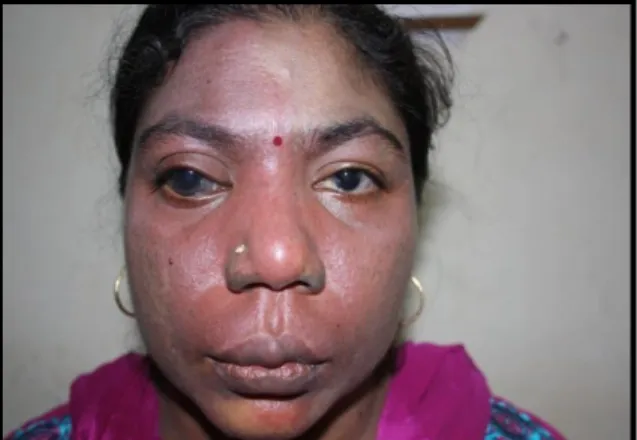
A 28-year-old female presented to the skin outpatient department with no symptoms except for cosmetic concern of her dark pigmentation on face (Figure 1, 2) and the red spot on her
chin (Figure 3), both of which were present
since birth.
On examination, we observed symmetrical blue-gray discoloration on either side of her face. The patient mentioned that her mother noticed the lesions at the time of her birth, along with discoloration of her eyes and oral cavity. No history suggestive of change in size, color, distribution of the lesions over the past few years could be elicited. There was no evidence of neurological involvement but off late the patient complained of visual disturbance in the form of dimness of vision. Patient was not on medications for any other medical condition. Sundeep Chowdhry, Neha Yadav, Dipak D. Umrigar*, Akhilesh Shukla
Department of Dermatology, ESIPGIMSR, New Delhi, India
* Department of Dermatology Govt. Medical College & New Civil Hospital, Surat, Gujarat, India
Abstract
Nevus of Ota, which was originally described by Ota and Tanino in 1939, is a hamartoma of dermal melanocytes. It, also known as nevus fuscoceruleus ophthalmomaxillaris, is a pigmentary change involving the first and second divisions of the trigeminal nerve. Patients with the nevus of Ota have increased amounts of melanin (pigment) and melanin producing cells (melanocytes). The melanocytosis also affects the oral cavity, nasal mucosa, external auditory canal, tympanic membrane, orbital fissures, meninges and the brain. A port-wine stain (PWS) is defined as a macular telangiectatic patch (CM) which is present at birth and persists throughout life. They may be localized or extensive, affecting a whole limb. Here, we report a rare case of co-existence of nevus of Ota and port-wine stain.Key words
Figure 1 Multiple hyperpigmented macules over face.
Figure 2 Right and left lateral view of hyperpigmented macules over face.
Figure 3 Port-wine stain over chin.
Figure 4 Hyper-pigmented macules over palate
Figure 5 Histopathological picture of nevus of ota showing increased melanin in the basal layers of the epidermis
Figure 6 Histopathological picture of port-wine stain.
She was referred to department of
Discussion
Hormonal factors have been thought to play a role for the development of this type of lesion
because of the female dominance.2The naevus
of Ota comprises of dermal melanocytes4,5
presumably through the dermal arrest of cells
migrating from the neural crest.2The lesion can
be congenital or acquired during adolescence.2,6
Ota’s nevus is also designated as ‘persistent aberrant mongolian spot’, and has the same histological features. In contrast to the nevus of Ota, the mongolian spot is present at birth and usually diminishes at about the age of 5-7
years.7,8 The lumbosacral area is the common
site, whereas the nevus of Ota develops in the skin adjacent to the eye.7,8 Ito’s nevus is another
dermal lesion distinguishable from the nevus of Ota only by its typical localization on the shoulder, neck, supraclavicular area and upper arm. Pigmentary changes occurring in Ota’s nevus can progress and may cause psychological
problems.8
After onset, nevus of Ota may slowly and progressively enlarge and darken in color, and its appearance usually remains stable once adulthood is reached. The colour or perception of the colour of nevus of Ota may fluctuate according to personal and environmental conditions, such as fatigue, menstruation, insomnia, and cloudy, cold, or hot weather conditions. Nevus of Ota can be associated with
other cutaneous disorders, leptomeningeal
conditions and ocular disease (Box 1).
Ophthalmologic examination and follow-up care for nevus of Ota is mandatory because of a reported 10% association of nevus of Ota with increased intraocular pressure.
Histologic findings for nevus of Ota shows that the overlying epidermis is normal. In the
Box 1 Cutaneous, leptomeningeal conditions associated with nevus of Ota.
Nevus of Ito
Phakomatosis pigmentovascularis Nevus flammeus
Sturge-Weber syndrome Neurofibromatosis Leptomeningeal melanosis
Malignant melanoma (meninges, skin)11,12
Ocular abnormalities
Pigmentation of the sclera, cornea, retina, and optic disc
Cavernous hemangiomas of the optic disc Elevated intraocular pressure
Glaucoma (10.3%)13
Ocular melanoma
papillary and upper reticular dermis, dendritic melanocytes are present and surrounded by fibrous sheaths (which are not present in other dermal melanocytosis, such as blue nevus or mongolian spots). Dermal melanophages may be present.
Nevi of Ota have been classified histologically into 5 types based on the locations of the dermal melanocytes, which are (1) superficial, (2) superficial dominant, (3) diffuse, (4) deep dominant, and (5) deep.7
This histologic classification correlates clinically with the observation that the more superficial lesions tend to be located on the cheeks, while deeper lesions occur on periorbital areas, the temple, and forehead.
Specific variants of nevus of Ota have been described in the literature under the names of nevus fuscoceruleus zygomaticus, plaque-type variant of blue nevus. Differential features of these conditions are related to the location of patch or macules, extent of involvement, age of onset, tendency to occur as familial cases and presence of a papular component. Nevus of Ota can cause facial disfigurement, resulting in
cases, melanoma, which can be life threatening,
has been reported to arise from nevus of Ota.15
Pathology and response to therapy appear similar for all forms of nevus of Ota.
Cosmetic camouflage makeup can minimize the disfiguring facial pigmentation resulting from nevus of Ota. Otherwise, topical therapy is of no value in the medical treatment of nevi of Ota and Ito.
Laser surgery is the first-line treatment. pulsed Q-switched ruby laser (694 nm) surgery is unquestionably the current treatment of choice for nevi of Ota and Ito, and it works via selective photothermal and photomechanical destruction
of dermal melanocytes and melanophages.8 High
success rate and minimal adverse effects have been reported with the switched ruby, Q-switched alexandrite (755 nm) and Q-Q-switched Nd:YAG lasers (1064 nm).9,10,16,17,18,19 After 4-8
treatments, skin pigmentation is reduced dramatically or removed in 90-100% of cases, with a less than 1% risk of scarring. Prior epidermal ablation with carbon dioxide laser has been found to increase the therapeutic efficacy
of pigment specific lasers.20,21 Dermabrasion
using the coarse diamond fraise tip has also been found to be cost-effective with good cosmetic results.5
Other surgical methods like cryotherapy, microsurgery, dermabrasion (alone or combined with other modalities, such as carbon dioxide snow, autologous epithelial grafting), sequential dry ice epidermal peeling have been superseded by laser surgery.16,22
Skin biopsies are warranted if clinical changes are suspected of malignant transformation (e.g. ulceration, new papular lesions, variegations in color) within the involved skin, ocular, or mucosal tissues.
Without treatment, the skin lesions are permanent for which the patient must be counselled.
The patient was informed of her treatment options, mainly in the form of pigment-specific lasers, but as she was asymptomatic as regards to the pigmentation aspect, she refused any treatment and underwent glaucoma surgery alone.
References
1. Ota M, Tamino H. A variety of nevus frequently encountered in Japan, nevus fusco-coeruleus ophthalmomaxillaris and its relation to pigmentary changes in the eye. Tokyo Med J. 1939;63:1242-4.
2. Hidano A, Kajima H, Ikeda S, Mizutani H, Miyasato H, Niimura M. Natural history of nevus of Ota. Arch Dermatol. 1967;95 :187-95.
3. Hori Y, Takayama O. Circumscribed dermal melanoses: Classification and histologic features. Dermatol Clin. 1988;6:315-26. 4. Fulk CS, Morristown TN. Primary disorders
of hyperpigmentation. J Am Acad Dermatol. 1984;10:4.
5. Lever WF, Schaumburg-Lever G, editors. Histopathology of the Skin, 7th ed. Philadelphia: JB Lippincott; 1990. P. 776-7. 6. Hirayama T, Suzuki T. A new classification
of Ota’s nevus based on histopathological features. Dermatologica. 1991;183:169-72. 7. Champion RH, Burton JL, Ebling FJG.
Dermal melanocytic naevi. Textbook of Dermatology, 5th ed. London: Blackwell Scientific Publications; 1992. P. 1537-9. 8. Moschella SM, Hurley HJ. Disturbances of
Pigmentation Dermatology. WB Saunders Company, Philadelphia, 1985: 1280–1282. 9. Liu JC, Ball SF. Nevus of Ota with
glaucoma: report of three cases. Ann Ophthalmol. 1991;23:286-9.
10. Hartmann LC, Oliver GF, Winkelmann RK et al. Blue nevus and nevus of Ota associated with dural melanoma. Cancer. 1981;64:182-6.
Klin Monatsblatt Augenheilkd. 1992;200:665-70.
12. Mosher DB, Fitzpatrick TB, Hovi J, Ortonne J-P. Disorders of pigmentation. In: Fitzpat-rick TB, Eisen AZ, Wolff K, editors. Dermatology in General Medicine, 4th edn. New York: McGraw-Hill, 1993: 979. 13. Kolde G, Schmollack K-P, Sterry W.
Periorbitale hyperpigmentierung. Hautarzt. 2001;52:460-3.
14. Patel BC, Egan CA, Lucius RW et al.Cutaneous malignant melanoma and oculodermal melanocytosis (nevus of Ota): report of a case and review of the literature. J Am Acad Dermatol. 1998;38:862-5. 15. Theunissen P, Spincemaille G, Pannebakker
M, Lambers J. Meningeal melanoma associ-ated with nevus of Ota: case report and review. Clin Neuropathol. 1993;12:125-9. 16. Ueda S, Isoda M, Imayama S. Response of
naevus of Ota to Q-switched ruby laser treat-ment according to lesion colour. Br J Dermatol. 2000;142:77-83.
17. Cho SB, Park SJ, Kim MJ, Bu TS. Treatment of acquired bilateral nevus of Ota-like macules (Hori's nevus) using 1064-nm Q-switched Nd: YAG laser with low fluence. Int J Dermatol. 2009;48:1308-12.
18. Chan HH, Leung RSC, Ying S-Y et al. A retrospective analysis of complications in the treatment of nevus of Ota with the Q-switched alexandrite and Q-switched Nd:Yag lasers. Dermatol Surg. 2000;26:1000-6.
19. Lam AY, Wong DS, Lam LK, Ho WS, Chan HH. A retrospective study on the efficacy and complications of Q- switched alexandrite laser in the treatment of acquired bilateral nevus of Ota-like macules. Dermatol Surg. 2001;27:937-41.
20. Whitmore SE, Wilson BB, Cooper PH. Late-onset nevus of Ota. Cutis. 1991;48:213-5.
21. Manuskiatti W, Sivayathorn A, Leelaudomlipi P, Fitzpatrick RE. Treatment of acquired bilateral nevus of Ota-like macules (Hori's nevus) using a combination of scanned carbon dioxide laser followed by Q-switched ruby laser. J Am Acad Dermatol. 2003;48:584-91.