ISSN: 2147-611X
www.ijemst.com
Hong
Kong
and
U.S.
Teachers’
Perceptions
of
Mathematical
Disagreements and their Resolution
Processes
Angela T. Barlow1, Rongjin Huang1, Huk-Yuen Law2, Yip Cheung Chan2, Qiaoping Zhang2, Wesley A. Baxter3, Angeline K. Gaddy4
1Middle Tennessee State University 2The Chinese University of Hong Kong 3
Nashville State Community College
4Smyrna High School
To cite this article:
Barlow, A.T., Huang, R., Law, H-Y., Chan., Y.C., Zhang, Q., Baxter, W.A., & Gaddy, A.K.
(2016). Hong Kong and U.S. teachers’ perceptions of mathematical disagreements and their
resolution processes.
International Journal of Education in Mathematics, Science and
Technology, 4(4), 299-318. DOI:10.18404/ijemst.97650
This article may be used for research, teaching, and private study purposes.
Any substantial or systematic reproduction, redistribution, reselling, loan, sub-licensing,
systematic supply, or distribution in any form to anyone is expressly forbidden.
Authors alone are responsible for the contents of their articles. The journal owns the
copyright of the articles.
Volume 4, Number 4, 2016
DOI:10.18404/ijemst.97650
Hong Kong and U.S. Teachers’ Perceptions of Mathematical
Disagreements and their Resolution Processes
Angela T. Barlow, Rongjin Huang, Huk-Yuen Law, Yip Cheung Chan, Qiaoping Zhang, Wesley A. Baxter, Angeline K. Gaddy
Article Info
Abstract
Article History
Received:
30 September 2015
Mathematical disagreements occur when students challenge each other’s ideas related to a mathematical concept. In this research, we examined Hong Kong and U.S. elementary teachers’ perceptions of mathematical disagreements and their resolutions using a video-stimulated survey. Participants were directed to give particular attention to the mathematics embedded within the disagreement and approaches for resolving the disagreement. Results revealed incomplete knowledge structures for the selected mathematical topic for both Hong Kong and U.S. participants. Differences existed between the two groups regarding the resolution of the disagreement, as Hong Kong participants focused on the content within the resolution process while U.S. participants focused on the form of the resolution process. Both groups found value in mathematical disagreements but for different reasons. Hong Kong participants indicated that the mathematical disagreements supported them in identifying students’ misunderstandings. In contrast, U.S. participants reported that mathematical disagreements helped to identify areas in which students lacked prerequisite knowledge. Implications for future work are provided.
Accepted: 27 January 2016
Keywords
Mathematics Disagreement Elementary Teachers
Introduction
As Hong Kong SAR, China, and the U.S. aim to improve mathematics teaching, reform efforts have emphasized supporting students’ engagement in proof (Barlow & McCrory, 2011; Common Core State Standards Initiative [CCSSI], 2010; Curriculum Development Council [CDC], 2001, 2002; Leung, 2005; National Council of Teachers of Mathematics [NCTM], 2000) and justification of mathematical ideas (CCSSI, 2010; CDC, 2001; Yackel, 2001). This justification process often leads to mathematical disagreements, defined as instances in which students challenge each other’s mathematical ideas (Barlow & McCrory, 2011). “The discourse that surrounds the disagreement allows students to organize their thoughts, formulate arguments, consider other students’ positions, and communicate their positions to their classmates” (p. 531). Facilitating students’ engagement in mathematical disagreements is one means for supporting reform efforts in both countries. Despite the support that mathematical disagreements provide for conceptual understanding (Barlow & McCrory, 2011; CCSSI, 2010; Lappen & Briars, 1995; Yackel, 2001), little is known regarding teachers’ perceptions of mathematical disagreements and the processes for resolving them. Given current reform efforts, teachers’ perceptions are of particular interest for two primary reasons. First, well-structured mathematics lessons in China (Chen & Li, 2010; Leung, 1995, 2005; Stevenson & Lee, 1995) may not provide the opportunity for a disagreement and its associated discourse to occur. Second, given the low-level cognitive processes often plaguing U.S. mathematics lessons (Silver, Mesa, Star, & Benken, 2009; Stigler & Hiebert, 1999), U.S. teachers and students may not have the necessary skillset for facilitating and participating in the disagreement, respectively.
to perceptions of the mathematical disagreement and their resolution processes? In answering this question, attention was given to similarities and differences between the two groups of participants (i.e., Hong Kong and the U.S.) with regard to the students’ mathematical understandings/misunderstandings and processes for resolving the disagreement. Conducting this cross-country comparison enhanced our ability to detect culturally based nuances within participants’ perceptions that might have otherwise not been detected. In this way, the cross-country comparison supported our theoretical sensitivity (Stigler & Hiebert, 1999; Strauss & Corbin, 1990).
Background and Literature
In recognition of this study’s purpose, the background and literature focus on four broad areas. First, a discussion of mathematical disagreements is provided that situates the disagreements in the context of mathematical discourse and argumentation. Second, background information on teachers’ mathematical knowledge for teaching geometry is presented. Third, a brief introduction of elementary teacher preparation in the U.S. and China (e.g., Mainland China and Hong Kong) is discussed, providing a background for understanding teachers’ knowledge. Finally, a comparison of U.S. and Hong Kong teachers is offered, featuring a selection of studies that focus on knowledge for teaching and instructional practices.
Mathematical Disagreements
“Mathematical discourse includes the purposeful exchange of ideas through classroom discussion, as well as through other forms of verbal, visual, and written communication” (NCTM, 2014, p. 29). Discourse is well recognized as necessary for enabling meaningful learning of mathematics as students share ideas, consider the ideas of others, and construct their mathematical understandings (e.g., Chapin, O’Connor, & Anderson, 2003; Forman, 2003; NCTM, 1989, 2000, 2014; Yackel & Cobb, 1996). Moving beyond this general notion of mathematical discourse, however, educators have highlighted the need for students to engage in the discourse of the discipline of mathematics (CCSSI, 2010; Lampert, 1990; Lerman, 1996). Key to such discourse is argumentation (Bazerman, 1988; Cobb & Bauersfeld, 1995; Krummheuer, 2007; O’Conner, 2001; Strom, Kemeny, Lehrer, & Forman, 2001).
Argumentation can be broadly defined as “trying to persuade others of the validity of one’s ideas as well as those of one’s colleagues” (Forman, 2003, p. 342). Examples of elementary students engaged in argumentation can be found in the literature (e.g., Kazemi & Stipek, 2001; Krummheuer, 2007), demonstrating that argumentation is “essential for the negotiation of intersubjective meaning . . . [and] essential for learning” (Forman, 2003, pp. 345-346). Given the importance of argumentation, it becomes necessary to understand its key components, and Toulmin’s Model of Argument (Toulmin, 1958) provides one means for doing so. Toulmin’s Model of Argument (Toulmin, 1958) includes three components in the simplest structure of an argument: data, claim, and warrant. In this model, data is offered in the form of facts or evidence, which lead to a claim. A warrant is utilized to connect the data to the claim. As students engage in argumentation as represented in this model, however, it is likely that instances will occur in which students espouse conflicting ideas related to the mathematics under consideration (Barlow & McCrory, 2011), which in Toulmin’s Model of Argument is termed a rebuttal. That is, a counter-argument can be offered that negates some or all of the original claim. To bring clarity, we utilize the term disagreement to describe these instances when a rebuttal is offered that leads to conflicting claims under consideration by students in the classroom. Although mathematical disagreements can be a source of social tension in the classroom (Lampert, Rittenhouse, & Crumbaugh, 1996), sociomathematical norms may be established that support the process of resolving the disagreement (Stephan & Whitenack, 2003). Proper resolution of the mathematical disagreement affords students the opportunity to make sense of the mathematics (Barlow & McCrory, 2011), thus leading to conceptual thinking (Kazemi & Stipek, 2001). Although researchers have demonstrated the importance of student engagement in mathematical disagreement, they have not examined teachers’ perceptions of or abilities to resolve mathematical disagreements. This was the impetus for our study.
Teachers’ Mathematical Knowledge for Teaching Geometry
often do not possess the necessary knowledge to teach geometry effectively (Fuys, Geddes, & Tischler, 1985; Jones, 2000; Swafford, Jones, & Thornton, 1997). These deficits in knowledge have been noted in teachers internationally (Clements & Sarama, 2011).
A focus on developing teachers’ mathematical knowledge for teaching geometry has, at times, experienced “debate about how specific a teacher’s knowledge of student thinking needs to be to serve as an effective guide” (Jacobson & Lehrer, 2000, p. 73) to teaching. A literature review revealed two studies directly related to the specific knowledge needed for teaching geometry. In the first study, Swafford and colleagues (1997) worked with teachers in grades four through eight to develop their understanding in two areas: geometry and the van Hiele theory (van Hiele, 1959/1985). Following a four-week program, the participating teachers showed significant gains in both areas, which resulted in recognizable shifts in their lesson plans that aimed to develop students’ knowledge of geometry at a higher van Hiele level. In the second study, Jacobson and Lehrer (2000) examined the practices of four second grade teachers as they engaged in teaching a geometry unit. All four teachers had participated in professional development that supported their implementation of effective instructional practices. However, two of the teachers had participated in additional professional development that focused on understanding students’ geometric thinking. This additional professional development enabled these two participants to engage students in discourse regarding fundamental geometric topics. As a result, students in the classrooms of the two teachers who were knowledgeable of students’ geometric thinking not only learned “more than did their counterparts, but this difference in learning was maintained over time” (p. 86). Together, these studies speak to the importance of developing teachers’ knowledge that is specific to geometry regarding the content and students’ thinking around that content.
Teacher Preparation in the U.S. and Hong Kong
Elementary Teacher Preparation in the U.S.
The preparation of U.S. elementary teachers involves completing a four-year college degree that typically aims to prepare them to teach all subjects (e.g., reading, language arts, mathematics, science, social studies). This attempt to prepare elementary teachers to teach all subjects has led to numerous reports attesting to the under preparedness of U.S. elementary teachers to teach mathematics (e.g., Greenberg & Walsh, 2008; Kitchen, 2005; Sleeter, 2001; Turner et al., 2012). Underscoring this under preparedness is the lack of consistency in teacher preparation programs across the country (Greenberg & Walsh, 2008). Despite recommendations regarding how to best prepare elementary mathematics teachers (e.g., Conference Board of the Mathematical Sciences, 2012), state agencies that mandate guidelines for teacher preparation do not provide evidence of an awareness of these recommendations, resulting in little emphasis on the necessary mathematics content needed for effective teaching. Attention to the pedagogy of teaching mathematics often falls short as well (Greenberg & Walsh, 2008). “American elementary teachers as a group are caring people who want to do what is best for children. Unfortunately, their mathematics preparation leaves far too many of them ill-equipped to do so” (p. 20).
Elementary Teacher Preparation in Hong Kong
Hong Kong is a special administration region of China. Hong Kong had been a colonial city of the United Kingdom for more than one and half centuries before its handover to China in 1997. Thus, it has a unique system of politics, economics, and education, which have been adapted from its UK heritage. For elementary teacher preparation, the typical route is a four-year bachelor of education program offered by the Hong Kong Institute of Education and Faculties of Education in two other major universities. Chinese, mathematics, and general studies are considered as general subjects, which all primary school teachers are supposed to be capable of teaching (Tsang & Rowland, 2005). In Mainland China (including Shanghai), the preparation of elementary teachers is through the four-year B.A. or B.Sc. program offered by normal or comprehensive universities since 1998. Yet, the program structures differ. There are mainly three orientations: integrated, focus-area specified, and mid-ground. While the integrated programs aim to prepare elementary teachers who will be able to teach various school subjects in the future, the focus-area specified programs tend to prepare elementary teachers who have more content training in a specific school subject area. The middle-ground programs try to balance sciences and arts in their preparation curricula for elementary teachers (Li, Zhao, Huang, & Ma, 2008).
has been publically perceived that Mainland China elementary mathematics teachers have a profound understanding of the fundamental mathematics they teach. Yet, studies on Hong Kong elementary teachers’ mathematics subject knowledge have suggested that Hong Kong elementary teachers’ understanding of mathematics is shaky and relatively shallow (Fung, 1999; Tsang & Rowland, 2005).
Comparisons of U.S. and Chinese Teachers
With the introduction of profound understanding of fundamental mathematics, Ma (1999) not only supported mathematics educators in thinking about the depth, breadth, and thoroughness of the subject matter knowledge required of an elementary mathematics teacher but also drew attention to the evidence that Mainland China (Shanghai in particular) elementary teachers possess this type of knowledge. Her comparisons between Mainland China and U.S. teachers illuminated the difference in knowledge structures between the two groups, specifically in the areas of subtraction with regrouping, multi-digit multiplication, division by fractions, and the relationship between area and perimeter. Since this seminal work, several studies have further explored mathematics teacher knowledge in Mainland China and the U.S. (e.g., An, Kulm, & Wu, 2004; Cai, 2005; Cai & Wang, 2006; Zhou, Peverly, & Xin, 2006). Here, we present a brief discussion of these studies.
Building on Ma’s work with PUFM, Zhou and colleagues (2006) compared 162 Mainland China and U.S. third grade mathematics teachers’ expertise in teaching fractions. These researchers reported that the Mainland China teachers significantly outperformed their U.S. counterparts in subject matter knowledge. The same could not be said, however, regarding general pedagogical knowledge. In this instance, the Mainland China teachers performed poorly in comparison to their U.S. counterparts on a test designed to measure general pedagogical knowledge. However, the researchers were unable to discern any determinative patterns regarding pedagogical content knowledge.
Focusing on pedagogical content knowledge, An and colleagues (2004) conducted a comparative study of Mainland China and U.S. middle school teachers. Through their comparison, the researchers reported that Mainland China middle school mathematics teachers emphasized gaining correct conceptual knowledge by relying on a more rigid development of procedures. In contrast, the U.S. teachers emphasized a variety of activities designed to promote creativity and inquiry in order to develop understanding of mathematical concepts. She, Lan, and Wilhelm (2011) enhanced these findings with a comparison of Mainland China and U.S. teachers’ ways of solving algebraic problems. In their study, the Mainland China teachers were inclined to utilize general roles/strategies and standard procedures for teaching. Furthermore, they demonstrated an interconnected knowledge network for solving problems. Such knowledge would seem to support the emphasis on correct conceptual knowledge and rigid development procedures identified by An et al. (2004). In contrast, She and colleagues (2011) reported that the U.S. teachers were more likely to use concrete models and practical approaches in problem solving. They seemed to lack, however, deep understanding of underlying mathematical theories. Such lack of knowledge would not necessarily support the U.S. teachers’ tendencies to utilize activities for developing understanding of concepts, as described by An et al. (2004).
Similarly, Cai and his colleagues (Cai, 2000, 2005; Cai & Wang, 2006) conducted a series of comparative studies between Mainland China and the U.S. on teachers’ construction of representations. Both groups of teachers used concrete representations for developing the concepts of ratio and average. Despite this similarity, differences existed in that Mainland China teachers tended to use symbolic representations for solving problems, while U.S. teachers preferred to use concrete representations when solving mathematics problems (Cai, 2005; Cai & Wang, 2006).
From these comparative studies, three themes are revealed. First, these studies seem to suggest that Mainland China elementary mathematics teachers have stronger subject matter knowledge and probably pedagogical content knowledge, when compared with that of their U.S. counterparts. Second, U.S. teachers’ general pedagogical knowledge may be stronger than that of their Chinese counterparts. Third, Mainland China mathematics teachers value symbolic representation more than U.S. counterparts when solving mathematics problems.
exploring mathematics. Hong Kong teachers typically teach three or more different subjects and very often have to teach six to seven periods a day. In contrast, Mainland China mathematics teachers typically teach mathematics and Chinese only (low grades 1-3) and teach mathematics only (up grades 4-6), two to three periods a day. Leung and Park (2002) argued that the weakness of Hong Kong elementary teachers compared with their counterparts in Shanghai might be attributed to their heavy workload and lack of time for professional development during their teaching career.
Thus, studies suggest that Hong Kong elementary teachers are competent in mathematics content and pedagogical knowledge, but relevantly weak in conceptual explanation of mathematics to students compared with counterparts in Chinese Mainland. Keeping the difference in mind will help to understand and interpret the findings of this study. In this study, we intended to deepen our understanding of teachers’ mathematics knowledge for teaching geometry by investigating U.S. and Hong Kong teachers’ perceptions and treatments of a disagreement in geometry. Moreover, we adopted a video-stimulated, online survey to gain more comprehensive data.
Theoretical Framework
Given the geometric nature of the disagreement featured in this research, the van Hiele Levels of Geometric Thinking (Fuys, Geddes, & Tischler, 1988) provided a means for describing the students’ thinking depicted in the video. In addition, the framework supported us in identifying key characteristics of instruction that support students’ advancement in geometric thinking. Of particular interest to this study were the lowest two levels: Level 0 – Visualization and Level 1 – Analysis. As a result, we give brief descriptions of these two levels along with instructional implications.
Level 0 – Visualization
Students at the visualization level are able to name and compare geometric figures (Fuys et al., 1988). In doing so, however, the students focus on the appearance of the figure rather than its properties. According to Van de Walle (2007), a student will label a figure a square, for example, providing the justification that it looks like a square. The student may be able to speak of the properties of a square, such as four congruent sides, but ultimately the decision to label it a square is based on its appearance.
Level 1 - Analysis
At this level, the student is able to analyze figures according to their components (Fuys et al., 1988). Furthermore, the student is able to think of a class of shapes, such as squares, in general and focus on the relevant features of the class of shapes rather than the irrelevant features (Van de Walle, 2007). Continuing the previous example, the student operating at Level 1 identifies a shape as a square because it has four right angles and four congruent sides. The shape remains a square when rotated because these defining characteristics have not changed even though the square may look different.
Instruction
A student’s movement from one van Hiele level to the next is the direct result of “appropriate instructional experiences” (Fuys et al., 1988, p. 5). In this case, instruction that supports a student in moving from Level 0 to Level 1 should include opportunities to focus on relevant features of shapes (e.g., angle measures) rather than irrelevant features (e.g., orientation). In working with the relevant features of shapes, students begin to see classes of shapes, and the irrelevant features tend to wane (Van de Walle, 2007).
Methodology
Recruitment Process
To recruit participants, we asked colleagues to provide e-mail addresses of elementary mathematics teachers with whom they had worked in professional development settings. In doing so, our goal was to recruit five to six participants from each country. Such a sample was appropriate given the exploratory nature of our study. An initial e-mail was sent to teachers inviting them to participate in the research. The e-mail included a description of the study along with expectations for participation. We were not able to offer incentives. We asked that teachers indicate their interest in participating by replying to the message. When such a response was received, the teacher then received a second e-mail, which included the secure website address, a username, a password, and step-by-step instructions regarding how to navigate the website. To protect the anonymity of participants, we randomly distributed five distinct usernames and passwords. Usernames/passwords were also reused in that once someone had completed the survey using a particular username, we sent the username to another participant for use. The first six teachers from each country that completed the survey in its entirety represented the sample for this study.
Participants
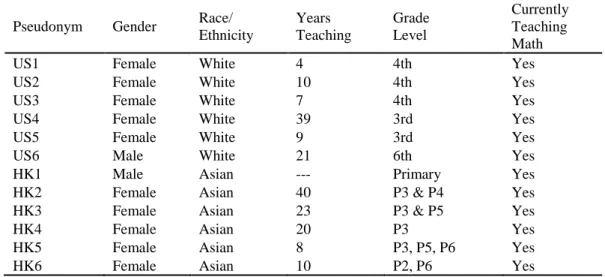
Participants included six elementary mathematics teachers from school districts within a southeastern state in the U.S. and six elementary mathematics teachers teaching in Hong Kong. Table 1 presents background information on the participants.
Table 1. Background information for participants Pseudonym Gender Race/
Ethnicity
Years Teaching
Grade Level
Currently Teaching Math
US1 Female White 4 4th Yes
US2 Female White 10 4th Yes
US3 Female White 7 4th Yes
US4 Female White 39 3rd Yes
US5 Female White 9 3rd Yes
US6 Male White 21 6th Yes
HK1 Male Asian --- Primary Yes
HK2 Female Asian 40 P3 & P4 Yes
HK3 Female Asian 23 P3 & P5 Yes
HK4 Female Asian 20 P3 Yes
HK5 Female Asian 8 P3, P5, P6 Yes
HK6 Female Asian 10 P2, P6 Yes
Note. --- denotes that the participant did not provide this information.
Video-stimulated Survey
Video Segment One
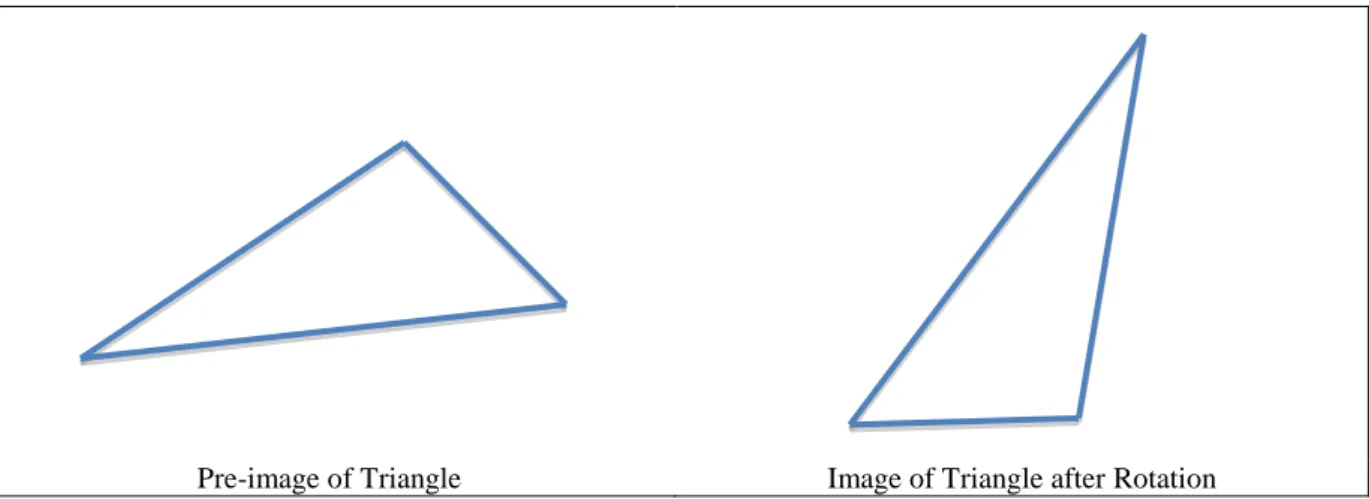
In the first video segment, participants viewed an eight-minute video and responded to two open-ended questions. The video began with a lesson introduction provided by the third grade teacher, in which she indicated that her goal for the lesson was to have students describe triangles based on side lengths and angle measures. Following the introduction, the video featured third grade students presenting their ideas regarding a triangle and its rotated image. Specifically, the teacher said, “Here’s the question. This is the original triangle. All right, watch. (Teacher rotates the triangle.) Is that the same triangle?” Figure 1 shows the position of the triangle before and after it was rotated.
Pre-image of Triangle Image of Triangle after Rotation
Figure 1. Rotated triangle
In response to this question, some students shouted, “No!” At the same time, other students were saying, “Yes!” Immediately, it was clear that the students had differing views. The teacher then gave students the opportunity to present contrasting viewpoints. Some students argued that the triangle and its rotated image were different triangles because they “looked different.” Jasmine attempted to explain this line of reasoning. As she pointed to a side of the rotated image on the overhead, she said, “Um, this one right here and right here, you know, when she turned it – it doesn’t still look the same. This looks like it is coming out a little more.” Mary Claire argued that for the two triangles to be the same their sides had to line up. In other words, they were the same if they looked the same. Since the rotation caused them to look different, Mary Claire concluded the rotated image was different from the original triangle. She also argued the triangles should be positioned in a “normal” way in order to compare them. She said, “If you put it like this it’s another triangle. If you put the sides equal it would be the same.”
The teacher wanted to be clear that the students were not saying the triangles were different solely because they were positioned differently. So, as James was explaining why he felt the triangles were different because they were turning in different ways, the teacher asked, “So it is the same – they are just pointing differently? Is that what you said?” However, James, replied, “No. They’re different.”
Alternatively, some students felt that nothing about the triangle had changed as a result of the rotation and attempted to justify why the triangles were the same. As other students argued against their reasoning, however, these students waivered on their argument. Ann said, “[They] still have three corners, and three sides, and straight sides, and closed sides, and two-dimensional, and um.” At this time another student spoke up and said, “But all triangles have [that].” Another student interjected that there were different types of triangles. Anne then stated, “Um, they’re different.” Given the presentation of contrasting views, we classified this as a mathematical disagreement.
Based on the video, we asked participants to respond to two open-ended questions in an effort to gain insight into their understandings related to the mathematical underpinnings of the disagreement and how they might envision the ensuing instruction. The two questions were:
1. What might have been the students’ mathematical understandings or misunderstandings that led to this disagreement?
2. If you were the teacher in this classroom, what would you do to resolve the disagreement? Why?
After responding to the questions, participants clicked the submit button which led them to the second video segment.
Video Segment Two
For the second video segment, participants viewed a seven-minute video and responded to six open-ended questions. In this video segment, the teacher attempted to support students in focusing on the relevant features of a triangle. She began by cutting four congruent triangles and rotating one of them so that it looked “different.” As in the first video, many students agreed that three of the triangles were “the same” and the fourth was “different.” However, the mathematical disagreement ensued just as before with others arguing the triangles were the same. Throughout the classroom students shouted, “They’re not different!” Others shouted, “Yes they are! . . . No! . . . Wait.” The teacher then marked the different triangle with a pencil and placed all four triangles in a paper bag. Students were encouraged to tell the teacher how to find the different triangle without looking in the bag. Through this process, students recognized that the triangles were not different. Right away, several students began stating, “They’re not different.” Others, however, required more time to understand that the bag was forcing them to consider relevant features of the triangle. Initially, a few students suggested that the teacher should feel for the pencil mark on the triangle. BreAnne asked, “You can feel the pencil [mark]?” Tyrone said, “Can’t you feel it [the pencil mark]?” Kandace said, “If you marked it down hard enough you would feel it.” After additional questioning and discussion focusing explicitly on relevant features of the triangles instead of the irrelevant ones (such as the pencil mark), at the end of the lesson students began chanting, “They’re not different!” This method of instruction helped lead the students to a resolution of their mathematical disagreement and likely supported students in beginning to transition to Level 1 of the van Hiele Levels of Geometric Thinking.
The questions in Video Segment 2 were designed to capture participants’ perceptions of the teacher’s process for resolving the disagreement. We were also curious as to whether participants valued mathematical disagreements in general. The two questions were:
1. Do you feel that this was an appropriate way to handle the mathematical disagreement? Why or why not? 2. Do you feel that it is important to allow mathematical disagreements to occur in the classroom? Why or
why not?
After entering their responses, participants clicked the submit button.
Data Analysis
In examining participants’ responses, we utilized open coding (Corbin & Strauss, 2008) searching for recurring themes within the data. Three researchers separately and then collectively coded U.S. participants’ written responses, and two researchers followed the same process for the Hong Kong participants’ responses. As we searched for “core consistencies and meanings” (Patton, 2002, p. 453), the research question guided our continuing analysis.
Limitations and Delimitations
Two primary limitations existed within this study. The first limitation was related to our use of a single source of data. Due to the exploratory nature of this work, we felt that the use of anonymous elicited texts was appropriate. According to Charmaz (2006):
Elicited texts involve research participants in writing the data. . . . Internet surveys containing open-ended questions are common sources of these texts. . . . Anonymous elicited texts can foster frank disclosures . . . [and] work best when participants have a stake in the addressed topics, experience in the relevant areas, and view the questions as significant. (pp. 36 – 37)
Further, Charmaz indicated that it is not uncommon to use anonymous elicited texts without the possibility of collecting follow-up data. This inability to collect follow-up data led to the second limitation of not being able to perform member checks as a validation strategy (Creswell, 2013). To offset this limitation, however, we utilized multiple researchers and independent coding as validation strategies. The primary delimitation for this study was related to the decision to utilize video that focused on a geometry-related disagreement. Therefore, it is important to recognize that different results may have been generated had the video focused on a different mathematical topic, for example fractions.
Results
In this section, we present the results of our analysis. These results are organized according to the survey questions. We include quotes taken from participants’ responses to illuminate the findings of our analysis. In addition, a brief discussion is provided for each question.
Mathematical Understandings or Misunderstandings
In analyzing participants’ descriptions of students’ mathematical understandings or misunderstandings represented in the featured mathematical disagreement, three codes emerged from the data: orientation – appearance, orientation – attribute change, and prerequisite knowledge. A discussion of these follows.
Orientation – Appearance vs. Orientation – Attribute Change
Most participants indicated that the orientation of the triangle was causing the students’ difficulty. However, there were two subtle, but quite important, differences in the participants’ descriptions that deserved closer scrutiny. In some instances, the participants indicated that the students believed the triangle and its rotated image were different triangles because they looked different. We coded these responses as orientation – appearance. Here, the participants identified the students’ focus on the irrelevant features of the triangles (e.g., the direction the triangle “pointed,” the number of “slanted” sides) as the issue undergirding the mathematical disagreement. In this way, participants’ views aligned with those described in the van Hiele Levels of Geometric Thinking (Fuys et al., 1988).
One U.S. participant provided a response that we coded as orientation – appearance. US1 wrote, “For the most part, the students say the two triangles are different because they look different.” Participant HK1 wrote a similar response. He wrote, “Students only rely on the position of the sides and the angles to determine whether two triangles are [the] same triangles.” HK2 provided an explanation that exemplifies how we defined the orientation – appearance code. She wrote:
Students [may] understand the concept of a triangle, which consists of three sides and three angles, but they may not be able to apply these attributes to compare whether a rotated triangle is the same as the original one; rather, they use orientation to judge [whether] two triangles are the same or not.
In total, three of the Hong Kong participants’ responses were coded as orientation – appearance.
side lengths or angle measures had changed to form a different shape. We noted two key points related to this line of thinking. First, there was no evidence in the video to support that students were thinking the triangle’s measurable attributes had changed or that the shape was no longer a triangle as a result of rotation. Based on the participants’ responses, it was not possible to know what might have led them to this conclusion. Second, our theoretical framework represented in the van Hiele Levels of Geometric Thinking did not align with this reasoning. Therefore, it was not clear as to whether identifying the mathematical misunderstanding in this way would yield effective plans for its resolution.
Three U.S. participants and two Hong Kong participants provided responses coded as orientation – attribute change. A U.S. participant, US2, wrote, “Students are debating if rotating or translating a triangle changes its shape. Students didn’t understand that a shape’s change of orientation does not change its shape.” A Hong Kong participant, HK3, provided a similar line of reasoning. HK3 wrote, “[Students] misunderstand that rotating a figure or changing the positions of a figure will change the attributes of the figure. They have not formulated the concept that rotating a figure does not change the shape of the figure.”
Prerequisite Knowledge
Some participants stated that the mathematical disagreement resulted from students’ inappropriate knowledge preparation. We coded these responses as prerequisite knowledge. Three U.S. participants provided responses coded as prerequisite knowledge. These participants mentioned that the students lacked knowledge of rotations (US6), vocabulary (US1), congruent figures (US5), and atypical triangles (US5). Participants seemed to indicate that had the prerequisite knowledge been in place, the disagreement would not have occurred, as demonstrated in US5’s response.
The students do not appear to have had earlier discussions on congruent figures, which would help them to understand that if objects are the same shape and size they are congruent no matter which way they are turned.
In comparison, none of the Hong Kong participants described students’ lack of prerequisite knowledge as the mathematical misunderstanding embedded within the disagreement.
Summary
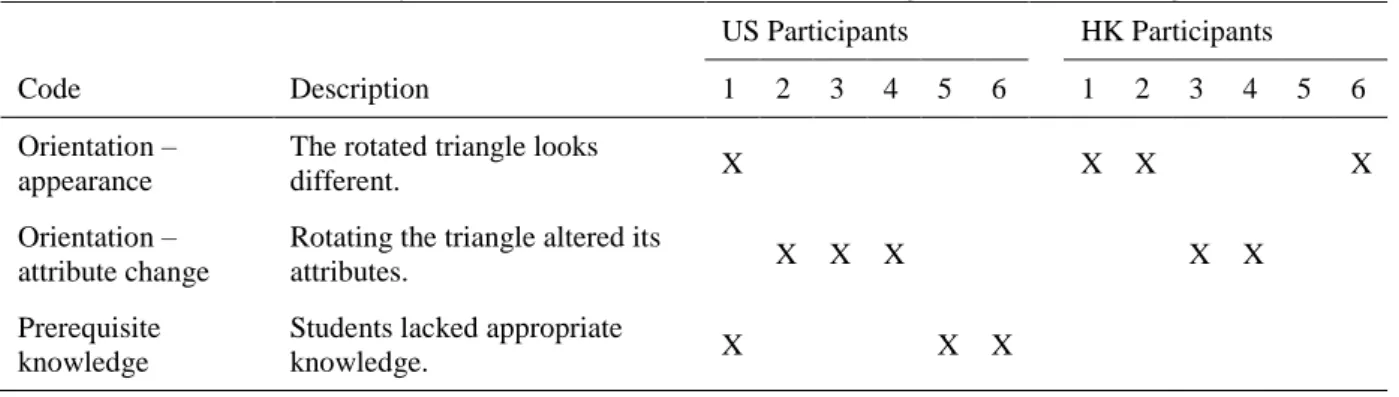
Table 2 presents a summary of the results related to mathematical understandings and misunderstandings.
Table 2. Summary of results for mathematical understandings or misunderstandings US Participants HK Participants
Code Description 1 2 3 4 5 6 1 2 3 4 5 6
Orientation – appearance
The rotated triangle looks
different. X X X X
Orientation – attribute change
Rotating the triangle altered its
attributes. X X X X X
Prerequisite knowledge
Students lacked appropriate
knowledge. X X X
might design instruction to resolve the disagreement. A presentation of participants’ proposed instructional strategies follows.
Instructional Strategies
Our analysis of participants’ descriptions regarding their resolution of the disagreement revealed five codes: different triangles/figures, use daily life examples, measuring sides and/or angles, teach a different lesson, and individual/small group exploration. We noted similarities across U.S. and Hong Kong participants’ responses in the first three of these five codes. It is in the latter two codes, however, that our analysis revealed differences between the two groups. These results are described in the following sections.
Different Triangles/Figures
We assigned the code different triangles/figures to participants’ responses that described the need for students to work with triangles or figures different from the one the teacher rotated. US1 wrote, “Another way to develop their understanding would be to use two different types of triangles and display them in the same direction of position then allow for comparison.” Similarly, HK3 wrote, “Allow students to cut out two triangles and overlap them, and then rotate one of them. By observing and comparing the triangles, let students understand the perception of the concept from the actual operation.” In total, we assigned this code to responses from five U.S. participants and four Hong Kong participants. Both groups suggested using physical operations and/or overlapping two figures so as to see “the sameness” of the triangle and its rotated image. From participants’ responses, however, it was not clear how the described processes would support students in focusing on the relevant features of the triangle as opposed to the irrelevant features, a process called for in the van Hiele Levels of Geometric Thinking.
Use of Daily Life Examples
One U.S. participant and three Hong Kong participants suggested physically acting out the concept as a means for supporting the resolution of the disagreement. US3 responded, “I would have a student lie on the floor and rotate them and ask the class if it is still the same student.” HK2 provided a very similar response. HK2 wrote, “To use daily life examples to help students transfer learning, such as asking questions: When you sit, you are a boy. Are you still a boy when you stand?” As with the previous code, it was unclear how these responses would provide a means for focusing students’ attention on the relevant features of the triangle. Furthermore, students were not arguing that the triangle was no longer a triangle when rotated, which is the misconception that these responses seem to be addressing.
Measuring Sides and/or Angles
Two U.S participants and one Hong Kong participant suggested that having students measure sides and/or angles of the triangle and its rotated image would be the best way to proceed in instruction. HK4 provided a very detailed process.
I believe that physical operation is the most effective learning method for students.
1) Cut out a triangle and then fix it. Allow students to measure it with a ruler or a rope and write down the results.
2) Then, rotate the triangle and then ask students to measure it with a ruler or a rope. The result is same as step 1.
Teaching a Different Lesson
One U.S. participant, US5, suggested that a lesson with a different mathematical focus should be taught. US5 stated, “I would also teach a lesson on congruent figures, using other polygons. This would help them to understand that the triangle was the same.” Previously, we noted that US5 indicated that the disagreement resulted from students’ lack of understanding of congruent figures. Clearly, she was interested in designing instruction that addressed this perceived lack of prerequisite knowledge as a means for resolving the disagreement. From her statement, however, it was not clear what this lesson would entail or how it would support students operating at Level 0 – Visualization. No other participants suggested teaching a lesson with a different mathematical focus.
Individual/Small Group Exploration
During our analysis, we noted that in some cases U.S. participants appeared to give attention to the form of the proposed instructional activity as opposed to its content. US6 wrote, “Students need to have the triangles on their desk and manipulate them.” Here, the participant noted the need for individual exploration without describing how such exploration might proceed or focus students’ attention on the underlying issues. As a second example, US1 wrote:
One way to approach this opportunity is to allow students to personally discover the display of position in relation to the item being displayed. Small groups would allow for discussion [so the students could] learn how to explain their thoughts.
Again, the participant’s response focused on the form of activity (i.e. use of small groups and discussion) rather than the content. We coded such instances as individual/small group exploration. Four of the U.S. teachers’ responses received this code. None of the Hong Kong participants’ responses received this code.
Summary
Table 3 presents a summary of the results related to instructional strategies. Table 3. Summary of results for instructional strategies
US Participants HK Participants
Code Description 1 2 3 4 5 6 1 2 3 4 5 6
Different triangles/figures
Students should work with different triangles or other figures.
X X X X X X X X X
Use daily life examples
Students should act out the rotating process.
X X X X
Measure sides and/or angles
Students should measure the sides and angles of the triangle and its rotated image.
X X X
Teach a different lesson
The teacher should teach a lesson with a different
mathematical focus.
X
Individual/small group exploration
The students should manipulate the triangles individually or in small groups.
To support students in transitioning from Level 0 – Visualization to Level 1 – Analysis, instruction should support students in focusing on the relevant features of shapes (e.g., side lengths and angle measures) as opposed to the irrelevant features of shapes (e.g., orientation). Only through appropriate instruction will students move from one level to the next (Fuys et al., 1988). None of the participants described instruction that clearly met this goal. This was a surprising fact given that four of the participants had correctly identified the mathematical misunderstanding that led to the disagreement in a way that aligned with the van Hiele Levels of Geometric Thinking.
Of the proposed instructional methods, those coded as measuring sides/angles held the greatest potential for meeting the goal. With these methods, the measurement process would direct the students’ attention to the relevant features, assuming the students possessed the prerequisite measuring skills. Interestingly, the participants who described measuring as a means for resolving the disagreement were not the participants who had previously identified the misunderstanding of focusing on the appearance of the triangle.
In comparing the responses across the two groups, our analysis revealed that the U.S. participants had a tendency to focus on the form of the activity as a means for resolving the disagreement. That is, their responses indicated that various instructional strategies such as individual exploration, small group exploration, or class discussion should be used to resolve the disagreement. Their descriptions were written in such a way, however, that the strategies could have been applied in any context without consideration for the mathematical nature of the disagreement. In contrast, the Hong Kong participants did not provide general instructional strategies. Rather, their descriptions of the ensuing instruction were clearly focused on the mathematics embedded within the disagreement.
Resolving the Disagreement
After viewing video segment two, participants reacted to the teacher’s process for resolving the disagreement. Our analysis revealed three primary codes: positive – attributes, positive – other, and alternative idea – student discovery. Each of these is described below.
Positive – Attributes
Four participants indicated a positive view of the instruction and justified this view with a focus on the attributes of the triangle. Two U.S. participants and one Hong Kong participant indicated that the teacher’s process was appropriate because it removed the visual aspects (i.e., irrelevant features) of the triangles. US5 wrote, “[The disagreement was] appropriately handled because [the] visual aspect was removed, thereby eliminating the differences between the two triangles.” HK2 responded:
This method effectively eliminates the fallacy caused by the students who are accustomed to using visual perception to judge. It also allows them to think in terms of the sides, angles, and sizes of triangles. It will help students to understand the attributes of a figure and the concept of different figures.
In addition to the removal of the irrelevant features, one of these participants, US3, noted that the relevant features became the focus. The fourth participant, HK6, noted the focus on relevant features as well.
Positive – Other
Alternative Idea – Student Discovery
Rather than directly addressing the teacher’s process for resolving the disagreement, several participants elected to describe an alternative instructional strategy. We coded these instances with the phrase alternative idea – student discovery. One U.S. participant and three Hong Kong participants provided responses that were coded in this way. US6 wrote:
It is definitely appropriate to have the mathematical disagreement, but I am not sure the approach used in the video was the most effective way. Why not allow the kids to cut out shapes themselves? They could then be lead [sic] through series of questions aimed at discovering whether the triangles were indeed congruent. You could divide the class into small groups either by like-minded thoughts or divergent thoughts.
Similarly, HK4 proposed an alternative instructional strategy.
[The teacher] felt that it is the most direct and fastest way of resolving the issue. But the better way is that teacher asks students how to compare two triangles to determine whether they are the same, or provide some tools to let students to find out a way to draw a conclusion.
Across all responses receiving this code, we noted that each participant proposed a means for students’ self discovery of the underlying ideas.
Summary
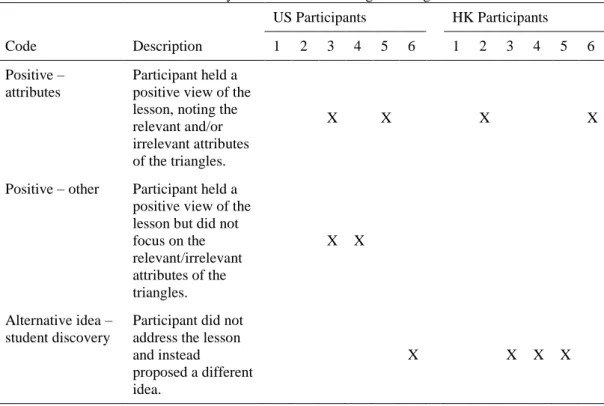
Table 4 presents a summary of results regarding the resolution of the disagreement. To support the resolution of the disagreement, the teacher in the video removed the irrelevant features of the triangle from the students’ view thus forcing the students to rely on the relevant features as a means for distinguishing the triangles. Two U.S. participants and two Hong Kong participants recognized these components of the instruction and used this to justify its appropriateness. For the two U.S. participants, the instructional strategy addressed misunderstandings that they had not identified via video segment one. Yet, they recognized the power of the strategy in video segment two. For the two Hong Kong participants, the instructional strategy aligned with their earlier assessment of the students’ misunderstandings.
Table 4. Summary of results for resolving the disagreement
US Participants HK Participants
Code Description 1 2 3 4 5 6 1 2 3 4 5 6
Positive – attributes
Participant held a positive view of the lesson, noting the relevant and/or irrelevant attributes of the triangles.
X X X X
Positive – other Participant held a positive view of the lesson but did not focus on the relevant/irrelevant attributes of the triangles.
X X
Alternative idea – student discovery
Participant did not address the lesson and instead
proposed a different idea.
Others who felt the instructional strategy was appropriate did not seem to be aware of the support the strategy offered for advancing students’ thinking in relation to the mathematical misunderstandings that were present. By focusing on informal assessment and real world connections, these two U.S. participants offered justifications that possibly were stated without consideration of the mathematics featured in the disagreement.
Finally, within the video, the teacher’s instructional strategy occurred in a whole class setting. The Hong Kong participants indicated the need for students’ self-exploration. Only one U.S participant mentioned this need for self-exploration. This finding was particularly interesting given the U.S. participants’ emphasis on individual/small group exploration that surfaced from the responses to video segment one.
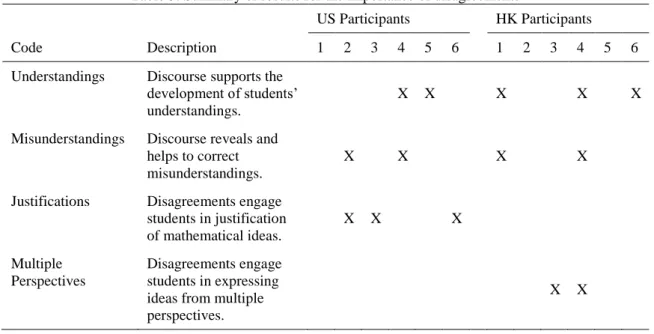
Is it important to allow disagreements?
All participants indicated that it was important to allow mathematical disagreements to occur in the classroom. The differences in the participants’ responses, however, resulted from their justifications. From this analysis, four codes emerged: understandings, misunderstandings, justifications, and multiple perspectives. These are described below.
Understandings
Two U.S. participants and three Hong Kong participants found value in mathematical disagreements because the discourse surrounding the disagreement facilitates the development of students’ understandings. US5 wrote, “Having disagreements allows children to learn and develop a deeper understanding of concepts.” Similarly, HK6 wrote, “Moreover, through different views, students can understand more thoroughly.”
Misunderstandings
In some instances, participants indicated that mathematical disagreements either revealed students’ misunderstandings or supported the process of correcting students’ misunderstandings. We assigned this code to statements from two U.S. participants and two Hong Kong participants. US4 said, “As students defend their ideas, they may see their own mistakes.” Both of these U.S. participants described mathematical disagreements as an opportunity for students to correct their thinking through the discussion surrounding their misunderstandings. In contrast, the two Hong Kong participants described the mathematical disagreements as an opportunity to gain insight into students’ thinking and adjust instructional plans. HK4 wrote, “Teachers also can understand what students think through the students’ expression, but teachers need to be careful to deal with the misconceptions.”
Justifications vs. Multiple Perspectives
Although both U.S. and Hong Kong participants provided responses related to understandings and misunderstandings, the same was not true for the remaining two codes: justifications and multiple perspectives. We assigned the justifications code to responses indicating that mathematical disagreements engaged students in the processes of reasoning and proof. Three U.S. teachers provided such responses. US3 wrote, “Students should justify their own ideas and listen to ideas of others as they attempt to change others’ minds or add to others’ ideas.”
In contrast, we assigned the multiple perspectives code to statements in which the participant indicated that the disagreements encourage students to express ideas from multiple perspectives. HK4 wrote, “It is an opportunity to train students' critical thinking and it is also a process of constructing mathematical concepts to guide students to think from multiple perspectives.” We assigned responses from two Hong Kong participants with this code. In each case, the Hong Kong participants emphasized critical thinking and multiple perspectives.
Summary
instruction. In addition, both groups saw these disagreements as an opportunity to enhance students’ understanding. Differences occurred, however, with regard to two aspects. The U.S. participants’ descriptions indicated that students were functioning as part of a group. Within this group, the students’ engagement in mathematical disagreements allowed them to recognize and correct their own mistakes. In contrast, Hong Kong participants described students as individuals. As such, mathematical disagreements were beneficial because they allowed students to consider others’ perspectives. In addition, disagreements provided opportunities for the teacher to recognize and plan how to handle students’ misunderstandings.
Table 5. Summary of results for the importance of disagreements
US Participants HK Participants
Code Description 1 2 3 4 5 6 1 2 3 4 5 6
Understandings Discourse supports the development of students’ understandings.
X X X X X
Misunderstandings Discourse reveals and helps to correct misunderstandings.
X X X X
Justifications Disagreements engage students in justification of mathematical ideas.
X X X
Multiple Perspectives
Disagreements engage students in expressing ideas from multiple perspectives.
X X
Discussion
As a result of the on-going reform efforts in China (Hong Kong and Chinese Mainland) and the U.S., emphasis will continue to be placed on students’ engagement in justification and proof (CCSSI, 2010; Leung, 2005; NCTM, 2000; Yackel, 2001). Mathematical disagreements are likely to result from this emphasis, leading to a need to understand teachers’ perceptions of the value and resolution processes of mathematical disagreements. To this end, our cross-country comparison revealed three key points regarding participants’ knowledge for teaching geometry and perceptions of mathematical disagreements.
First, both groups of participants recognized the students’ struggles with the impact of rotation on a figure. However, their knowledge of teaching and learning within this particular area of geometry was incomplete, as participants did not consistently identify the orientation of the triangle as the feature causing the triangles to be “different,” a claim evidenced in the video and supported by the literature (Fuys et al., 1988). According to the literature (Jacobson & Lehrer, 2000; Ma, 1999; Swafford et al., 1997), such knowledge is necessary for effective mathematics teaching.
who suggested that U.S. elementary teachers possessed more general pedagogical knowledge than their Mainland China counterparts. We wonder, though, if the U.S. participants might have been able to provide meaningful mathematical detail in their descriptions if encouraged to do so. As a result, future research should utilize follow-up interviews to support teachers in illuminating their perceptions of how to resolve mathematical disagreements.
Third, both groups found value in the mathematical disagreements but for different reasons. For the Hong Kong participants, mathematical disagreements provided a means for identifying the misunderstandings present in students and served to inform how to plan instruction that might correct the misunderstandings. In this way, the Hong Kong participants planned to move forward with instruction no matter what foundation students possessed. In contrast, U.S. participants felt the mathematical disagreements revealed a lack of prerequisite knowledge, indicating the need to remedy the students’ deficiencies through teaching separate lessons before moving forward with the planned instruction. This difference may reflect the Hong Kong participants’ roles in the classroom. Confucius said, “A man is worthy of being a teacher who gets to know what is new by keeping fresh in his mind what he is already familiar with”(温故而知新, 可以为师矣)(Confucian Analects, Book II, 11, Lee, 1996). That is, in order to “keep fresh in his mind what he is already familiar with,” it is necessary to practice regularly.
Alternatively, through frequently practicing and reviewing, knowledge and skills are consolidated and mastered. This may not necessarily be the case with U.S. participants. Participants’ tendency to want to reteach in order to prevent the occurrence of disagreements may present an obstacle to current reform efforts that emphasize flexible instructional practices that are shaped by the results of formative assessment (NCTM, 2014). Additional research is needed to further examine U.S. teachers’ perceptions of how to utilize the feedback regarding students’ mathematical misunderstandings revealed through disagreements.
Conclusion
Although both U.S. and Hong Kong participants acknowledged the importance of addressing disagreements as a learning opportunity, they did not demonstrate a deep understanding of students’ mathematical ideas underlying the disagreement nor an ability to plan for effective resolution of the disagreement. Additional research is needed, however, to confirm whether these exploratory findings hold within a large, representative sample from each country. If these results are confirmed, then attention must be given to assisting teachers as they develop skills in supporting the resolution of mathematical disagreements among their students. This, in turn, will support the reform efforts in both countries.
References
An, S., Kulm, G., & Wu, Z. (2004). The pedagogical content knowledge of middle school mathematics teachers in China and the U.S. Journal of Mathematics Teacher Education, 7, 145-172.
Barlow, A. T., & McCrory, M. R. (2011). Three strategies for promoting math disagreements. Teaching Children Mathematics, 17, 530–539.
Bazerman, C. (1988). Shaping written knowledge: The genre and activity of the experimental article in science.
Madison, WI: University of Wisconsin Press.
Cai, J. (2000). Mathematical thinking involved in U.S. and Chinese students’ solving of process-constrained and process-open problems. Mathematical Thinking and Learning, 2, 309–340.
Cai, J. (2005). U.S. and Chinese teachers’ constructing, knowing and evaluating representations to teach mathematics. Mathematical Thinking and Learning, 7, 135–169.
Cai, J., & Wang, T. (2006). U.S. and Chinese teachers’ conceptions and constructions of representations: A case of teaching ratio concept. International Journal of Mathematics and Science Education, 4, 145-186. Chapin, S. H., O’Connor, C., & Anderson, N. C. (2003). Classroom discussions: Using math talk to help
students learn (Grades 1 – 6). Saulsalito, CA: Math Solutions Publications.
Charmaz, K. (2006). Constructing grounded theory: A practical guide through qualitative analysis. Thousand Oaks, CA: Sage Publications.
Chen, X., & Li, Y. (2010). Instructional coherence in Chinese mathematics classroom - a case study of lesson on fraction division. International Journal of Science and Mathematics Education, 8, 711-735.
Cobb, P., & Bauersfeld, H. (Eds.). (1995). The emergence of mathematical meaning: Interaction in classroom cultures. Hillsdale, NJ: Erlbaum.
Common Core State Standards Initiative. (2010). Common core state standards for mathematics. Washington, DC: National Governors Association Center for Best Practices and the Council of Chief State School Officers. Available at http://www.corestandards.org/the-standards.
Conference Board of the Mathematical Sciences. (2012). The mathematical education of teachers II.
Providence, RI: American Mathematical Society.
Corbin, J., & Strauss, A. (2008). Basics of qualitative research (3rd ed.). Los Angeles, CA: Sage Publications. Creswell, J. W. (2013). Qualitative inquiry & research design: Choosing among five approaches (3rd ed.).
Thousand Oaks, CA: Sage Publications.
Curriculum Development Council (2001). Learning to learn -The ways forward in curriculum. Retrieved from http://www.edb.gov.hk/en/curriculum-development/cs-curriculum-doc-report/wf-in-cur/index.html. Curriculum Development Council (2002). Mathematics education: Key learning area curriculum guide
(primary 1 – secondary 3). Retrieved from http://www.edb.gov.hk/en/curriculum-development/kla/ma/curr/basic-education-2002.html.
Forman, E. A. (2003). A sociocultural approach to mathematics reform: Speaking, inscribing, and doing mathematics within communities of practice. In J. Kilpatrick, W. G. Martin, & D. Schifter (Eds.), A research companion to Principles and Standards for School Mathematics (pp. 333–352). Reston, VA: National Council of Teachers of Mathematics.
Fung, C. I. (1999). Pedagogical content knowledge versus subject matter knowledge: An illustration in the primary school mathematics context of Hong Kong (Unpublished doctoral dissertation). The University of Hong Kong, Pokfulam, Hong Kong.
Fuys, D., Geddes, D., & Tischler, R. (1985). An investigation of the van Hiele model of thinking in geometry among adolescents. Final Report of the Project. Brooklyn, NY: Brooklyn College of the City Univeristy of New York, School of Education.
Fuys, D., Geddes, D., & Tischler, R. (1988). The van Hiele model of thinking in geometry among adolescents. Journal of Research in Mathematics Education Monograph Number 3. Reston, VA: National Council of Teachers of Mathematics.
Greenberg, J., & Walsh, K. (2008). No common denominator: The preparation of elementary teachers in mathematics by America’s education schools (full report). Washington, DC: National Council on Teacher Quality.
Jacobson, C. J., & Lehrer, R. (2000). Teacher appreciation and student learning of geometry through design.
Journal for Research in Mathematics Education, 31, 71–88.
Jones, K. (2000). Teacher knowledge and professional development in geometry. Proceedings of the British Society for Research into Learning Mathematics, 20(3), 109–114.
Kazemi, E., & Stipek, D. (2001). Promoting conceptual thinking in four upper-elementary mathematics classrooms. The Elementary School Journal, 102, 59–80.
Kitchen, R. (2005). Making equity and multiculturalism explicit to transform mathematics education. In A. Rodriguez & R. S. Kitchen (Eds.), Preparing mathematics and science teachers for diverse classrooms: Promising strategies for transformative pedagogy (pp. 33–60). Mahwah, NJ: Lawrence Erlbaum.
Krummheuer, G. (2007). Argumentation and participation in the primary mathematics classroom: Two episodes and related theoretical abductions. Journal of Mathematical Behavior, 26, 60–82.
Lampert, M. (1990). When the problem is not the question and the solution is not the answer: Mathematical knowing and teaching. American Educational Research Journal, 27, 29–63.
Lampert, M. Rittenhouse, P., & Crumbaugh, C. (1996). Agreeing to disagree: Developing sociable mathematical discourse. In D. R. Olson & N. Torrance (Eds.), The handbook of education and human development: New models of learning, teaching, and schooling, (pp. 731–764). Oxford: Blackwell. Lappen, G., & Briars, D. (1995). How should mathematics be taught? In I. M. Carl (Ed.), Prospects for school
mathematics (pp. 131–156). Reston, VA: National Council of Teachers of Mathematics.
Lee, J. (1996). The Chinese classics volume 1: Confucian analects, Book II, 11. Hong Kong: Hong Kong University Press.
Lerman, S. (1996). Intersubjectivity in mathematics learning: A challenge to the radical constructivist paradigm.
Journal for Research in Mathematics Education, 27, 133–150.
Leung, F. K. S. (1995). The mathematics classroom in Beijing, Hong Kong and London. Educational Studies in Mathematics, 29, 297-325.
Leung, F. K. S. (2005). Some characteristics of East Asian mathematics classrooms based on data from the TIMSS 1999 Video Study. Educational Studies in Mathematics, 60, 199-215.