(will be inserted by the editor)
Mining Mid-level Features for Image Classification
Basura Fernando · Elisa Fromont · Tinne TuytelaarsReceived: date / Accepted: date
Abstract Mid-level or semi-local features learnt using class-level information are potentially more distinctive than the traditional low-level local features constructed in a purely bottom-up fashion. At the same time they preserve some of the robustness properties with respect to occlusions and image clutter. In this paper we pro-pose a new and effective scheme for extracting mid-level features for image classification, based on relevant pat-tern mining. In particular, we mine relevant patpat-terns of local compositions of densely sampled low-level fea-tures. We refer to the new set of obtained patterns as Frequent Local Histograms or FLHs. During this pro-cess, we pay special attention to keeping all the local histogram information and to selecting the most rele-vant reduced set of FLH patterns for classification. The careful choice of the visual primitives and an extension to exploit both local and global spatial information al-low us to build powerful bag-of-FLH-based image rep-resentations. We show that thesebag-of-FLHs are more discriminative than traditional bag-of-words and yield state-of-the-art results on various image classification benchmarks, including Pascal VOC.
Keywords Frequent itemset mining· Image classifi-cation·Discriminative patterns·Mid-level features.
1 Introduction
Vector quantized local features, be it densely sampled or extracted from interest points, have a proven track
B. Fernando, T. Tuytelaars
KU Leuven, ESAT-PSI, iMinds Belgium E. Fromont
Universit´e de Lyon, Universit´e de St-Etienne F-42000, UMR CNRS 5516, Laboratoire Hubert-Curien, France
record in vision. They are the default image represen-tation for a wide variety of applications ranging from image retrieval to image classification. Although early papers presented them as a kind of automatically dis-covered object parts (e.g. wheels of airplanes) [42], they have, in practice, only limited semantic meaning in spite of what the name visual words suggests.
Based on this observation, some recent works [6, 14, 22, 26, 39, 41] have looked into the construction of more distinctive, mid-level features (sometimes also referred to assemi-local featuresor parts). Some of them oper-ate in a strongly supervised setting (e.g. poselets [5]), while others use only weak supervision (i.e. no annota-tions at the parts-level, only at class-level), e.g. hyper-features [1], discriminative patches [41] or blocks that shout [22]. Here we focus on the weakly supervised case (which, by the way, has been shown to outperform the strongly supervised case [22]).
A first set of methods (e.g. [6, 14, 22]) starts from the same description that proved its value for local features, building on robust gradient-based represen-tations such as HoG [13]. The main difference lies in the fact that for mid-level features, typically larger (or actually, more detailed) patches are used compared to those used traditionally for local features. This makes them more informative, so potentially more distinctive. However, this also makes them more sensitive to mis-alignments, deformations, occlusions, parts not falling entirely on a single surface or object, etc. Simply clus-tering such larger patches, as done for local features, does not work very well under these circumstances, maybe due to the iterative nature of most clustering approaches, leading to problems with local minima. As a result, the patches within a cluster are not necessar-ily uniform in appearance (as we also observed in our experiments). To circumvent this problem, typical
vari-ations in appearance of the mid-level features should be learned, e.g. using exemplar SVMs as done in [22, 41]. However, these methods also start with an initial clus-tering or nearest neighbour search, which again limits them to cases with not too big deformations. Object parts close to an object boundary, (self)-occlusion or orientation discontinuity are not likely to be found with these methods.
Moreover, HoG patches are rigid. For small patches (local features), this is often a reasonable approxima-tion, as shown by the success of SIFT [29]. However, with the patches becoming larger, the rigidity of HoG makes the features very specific. They seem to lack the necessary flexibility needed to cope with the observed deformations, be it due to viewpoint changes or due to within-class variability.
A second set of methods (e.g. [1, 40]) builds on more robust representations typically used for global object or scene descriptions, such as bag-of-words [12] or Fisher Vectors [33]. They represent a mid-level feature based on the distribution of the local features it contains. This brings the necessary flexibility to cope with deforma-tions. In the work of Agarwal and Triggs [1], mid-level features are represented with local bag-of-words, which are then clustered to obtain a set of mid-level vector-quantized features. Simonyanet al.[40] do the same for Fisher Vectors, and further add a global discriminative dimensionality reduction step. In both cases, the link between the mid-level feature and the low-level features composing it, is lost in the final representation. More-over, for neither of these methods the construction of mid-level features is selective: if some low-level features inside the mid-level patch fall on the background or turn out to be unstable, they cannot be ignored, adding noise to the overall process.
Finally, some methods (e.g. [10, 27, 28, 37, 49, 51]) have looked at constructing mid-level features by combining multiple low-level features. However, this quickly brings combinatorial problems, and seemed not that successful in practice. Moreover, combinations have been limited to relatively few elements (usually pairs or triplets).
In this paper, we propose a new method to extract mid-level features, building on the extensive pattern mining literature and expertise. Mid-level features are constructed from local bag-of-words (LBOW, as e.g. used in [1, 34, 43, 53]) representing the distribution of local features in a semi-local neighbourhood. However, we do not keep the full bag-of-words, but select sub-sets of low-level features, that co-occur frequently. We refer to the resulting mid-level features asFrequent Lo-cal Histograms or FLHs. Each FLH is composed of a set of low-level visual words that are spatially close. Compositions are not restricted to pairs or triplets, as
in [10, 27, 28, 37], but can easily contain ten or more el-ements. Since we focus only on the number of these elements within a local image area, ignoring their spa-tial configuration, the resulting representation is very flexible and can cope well with various types of image deformations, occlusions and image clutter. Moreover, being constructed from standard low-level features (vi-sual words), they can be indexed efficiently, as we show in [19]. From all sets of visual words that co-occur fre-quently, we select the final set of FLHs based on their discriminativity for the classification task at hand, their non-redundancy as well as their representativity.
Even though frequent itemset mining techniques and variants thereof are well-established in the data-mining community [3, 45], they are, to date, not commonly used in state-of-the-art image classification methods. This is surprising, since it has been shown that these min-ing methods allow the construction of high-level sets of compound features which can, in many cases, capture more discriminative information [9]. Nevertheless, most attempts so far applying pattern mining to image clas-sification [31, 50, 34, 53] were not able to demonstrate competitive results on standard datasets. Here, we pro-pose an effective scheme for applying pattern mining to image classification by adapting the generic pattern mining tools to the specific context of visual features extracted from images.
In particular, we take care in loosing as few infor-mation as possible during the conversion step necessary to transform a histogram (LBOW) into a suitable in-put for a mining algorithm (known as a transaction) and we carefully but automatically select the relevant and non redundant patterns that will be used in our classification step. Thebag-of-FLHs creation process is shown and explained in the caption of Fig. 1.
This paper extends our earlier work [18] with more details about our motivations and related works as well as more extensive experimental validation. In partic-ular, we have added experiments comparing our ap-proach to non-mining ones and combining FLH and Fisher vectors, which leads to very good results.
The rest of the paper is organized as follows. First, we review related work in section 2. Section 3 provides details on the construction of relevant FLHs and shows how they can be used for image classification. In Sec-tion 4 we show how local and global spatial informaSec-tion can be combined. Section 5 describes the experimental validation, demonstrating the power of our method for challenging image classification problems. In Section 6 we compare FLH with state-of-the-art methods. Section 7 concludes the paper.
Fig. 1: FLH mining and image representation process. First dense SIFT descriptors are extracted. Each descriptor is assigned to a visual word (hard assignment). For each dense descriptor, its K spatial nearest neighbors are selected (in practice, we use all local descriptors within a square n×nneighbourhood). From these local distribution of visual words, a local histogram (LBOW) representation is created for each dense point. Then we mine for the most frequent local histograms from the entire dataset. These frequent local histograms are known as FLH patterns or just FLHs. Afterwards, using a post processing step, we select the most suitable set of FLHs for image classification. We encode the LBOWs in an image using these relevant FLH patterns (but note that some of the LBOWs won’t be captured by any of the selected FLH patterns). Finally by counting how many times each FLH pattern is used to encode an image, we create a bag-of-FLHs representation.
2 Related work
Frequent pattern mining techniques have been used to tackle a variety of computer vision problems, includ-ing image classification [23, 31, 53, 54], action tion [20, 35], scene understanding [50], object recogni-tion and object-part detecrecogni-tion [34]. Apart from the ap-plication, these methods mostly differ in the image rep-resentation used, the way they convert the original im-age representation into a transactional description suit-able for pattern mining techniques and the way they select relevant or discriminative patterns. We therefore organize our discussion on related works along these three axes. We end with a discussion of other methods for extracting mid-level features.
Image representations: A standard image representa-tion nowadays is the bag-of-visual words [12]. The BOW can be computed either globally or locally in a neigh-borhood around an interest point (LBOW). In the con-text of pattern mining-based image classification, local bag-of-words are usually preferred (e.g. in [23, 35, 34, 43,
53]), since they result in sparse representations, a better signal-to-noise ratio, an increased robustness to image clutter and some low level spatial information (proxim-ity). Spatial configuration mining based on LBOW was first shown by Quacket al.[34], although they did not use these configurations for classification. Perhaps, the distinctive feature configurations mined in their work were too specific, making them less suited for image classification. Secondly, they only created object spe-cific transactions, relying on interest points.
In contrast, we use dense sampling (which captures a larger amount of statistics) and relevant pattern min-ing to find not just frequent but rather discriminative image representations. More structured patterns such as sequences and graphs capturing the spatial distribu-tion of visual words have been used by [31], while [52] uses boosting on top of binary sets of visual words dis-covered by pattern mining. Gilbertet al. [20] have ap-plied itemset mining to action recognition using rather primitive features like corners, while in [54] high level features such as attributes [16] are successfully used with mining techniques. In [50], Yao et al. present a
structured image representation called group-lets. To find discriminative group-lets, they mine for class-based association rules [2] .
However, none of the above representations took a particular care both in designing a suitable encoding to effectively use pattern mining for image classification and, in designing a dedicated post-processing step to obtain state-of-the-art classification results on standard image classification datasets.
Transforming bags to transactions: Most existing min-ing methods simply use individual visual words as items in a transaction. Transactions are created in such a way that if a visual word is present in the histogram, then it is also present in the transaction (i.e. itemset). Infor-mation on the exact frequency, i.e. how often the visual word occurs in the LBOW, is lost in this process. In [23], Kim et al. use a new representation called Bag-to-set (B2S) to transform a histogram into a transactional form without losing information. In this approach, each bin of the histogram is converted into a sequence of bi-nary digits. The length of this sequence is given by the largest value that a specific bin can take. For example, if the maximum value for the first bin of a set of his-tograms is 5 and in a particular histogram, this first bin has the value 3, its B2S representation will be [11100] (the length of the sequence is 5 and only the 3 first val-ues are “true”). Afterwards, B2S concatenates all the sequences (from all the bins in the histogram), trans-forming the histogram into a binary sequence that can be regarded as a “transaction” by a traditional pattern miner. The B2S representation is, to our knowledge, the only unsupervised effort to explicitly avoid infor-mation loss in the conversion to transactions. However the mining phase might generate artificial visual pat-terns (ghost patpat-terns) that do not exist in the image database (see Fig. 2 for an example of such ghost pat-terns). For example, this encoding implies that when a histogram bit has some particular valuex, all the values lower thanxare also true at the same time in the binary encoding. This could result in wrong possible matching as shown for pattern c(1) in Fig. 2. Besides, a pattern could incorporate parts of a bin description that would have no ”real” meaning according to the original en-coding. These ghost patterns hinder the performance of the patterns constructed using the B2S method.
Note that giving each visual word a weight depend-ing on how many times it appears in the histogram and apply weighted itemset mining [55] is not really an alternative. However, this method only postpones the loss of information as it then simply sums all the item-set weights to discover patterns. FLH, as proposed in this paper, avoids information loss without generating
unexisting patterns, as the number of occurrences of a visual word must match exactly.
Mining relevant patterns: Frequent patterns can be more discriminative than individual features (e.g. visual words), since a pattern is a combination of several primitives and therefore likely to capture more distinctive infor-mation. However, when using local bag-of-words to cre-ate transactions as we plan to do, each source (image) generates multiple transactions and a pattern that is found only in a relatively small number of images can still be frequent if it appears in really high numbers within this small set of images. Applying standard rel-evant pattern discovery methods under these circum-stances, as done in [20, 34, 50, 53], may not be the best strategy. Most of the methods that use pattern min-ing in the context of image classification are restricted to standard class-based association rules [2], standard discriminative pattern mining approaches [20, 25, 34, 50, 53] or other supervised methods such as boosting to find interesting patterns [31, 52]. In [53], Yuan et al. present a visual pattern mining algorithm based on a likelihood ratio test to find relevant patterns in an un-supervised manner. None of these works considers the issue of repetitive structures in images, causing frequent yet not representative patterns.
Mid-level feature extraction: As mentioned already in the introduction, other methods have been proposed to extract mid-level features using compositions of low-level features. However, most of them are limited to the use of pairs or triplets of features [10, 27, 28, 37]. Only a few have used higher-order statistics (co-occurrence of visual words), albeit on a single image [49] or pairs of images [51] only. Unlike pattern mining, they do not exploit database-wide statistics.
Early work on extracting mid-level features are the hyper-features of Agarwal and Triggs [1]. Like us, they start from local-bag-of-words but cluster them recur-sively (in a hierarchical fashion) to find a new set of spatial features called hyper-features. Then they repre-sent each image as a bag-of-hyper-features. In our work, FLH patterns are constructed from local histograms in which sub-histograms are mined as patterns instead of clustering entire local histograms. While the approach of [1] also captures larger patterns, it does not have the same flexibility in local geometry as our scheme.
Boureauet al.[6] have proposed to construct macro-features by jointly encoding a small neighbourhood of SIFT descriptors from a 2×2 or 3×3 square. As in the case of hyper-features, this method cannot selectively add a patch (SIFT descriptor) to the macro-feature. In
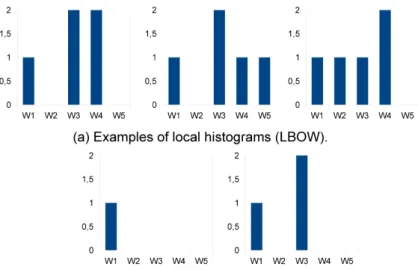
Fig. 2: Three different transaction creation methods and resulting patterns. For all the figures, the X axis shows the different visual words and the Y axis gives the value of the histogram bin for each visual words. (a) represents some local histograms. (b) shows some resulting FLH patterns extracted from the histograms in (a). (c) shows some patterns extracted using the B2S approach. (d) shows some patterns extracted from binarized histograms. Both FLH and B2S do not lose any information during the transaction construction stage. However, B2S generates some patterns that would be mapped to non existing data which we call ghost patterns. For example, (c1), the first B2S pattern (Fig. (c) first pattern) would be mapped to the first and second local histograms ((a1) and (a2)). However, (a1) should not be mapped to (c1) as the word frequencies of W4 do not match.
contrast, in our FLH approach, each patch in the lo-cal neighborhood is selected to be included in a pattern only if it satisfies certain criteria (such as frequency, discriminativity, redundancy etc.). As a result, and in contrast to [6], FLH patterns are robust to spatial de-formations, occlusions and image clutter.
In [41], Singhet al. start with HoG templates and try to find discriminative and representative patches using a clustering and a support vector machine-based approach. Unfortunately, there is no guarantee on the cluster purity or the class-based representativeness of the clusters. Nevertheless, empirically this method man-ages to converge to a set of reasonable clusters. In a similar spirit, Junejaet al. [22] learn parts incremen-tally, starting from a single part occurrence with an exemplar SVM and gradually adding more examples after an alignment step. As mentioned earlier, we be-lieve that starting from a rigid HoG representation does not allow sufficient flexibility and makes the parts too specific. We take a different approach and build more general (in the sense of more flexible) mid-level features as compositions of several local rigid SIFT features. It turns out the tradeoff between rigidity at a local scale and flexibility at a mid-level scale is an important pa-rameter when building mid-level features (e.g. by opti-mizing the size of the local SIFT features).
Our approach exploits thelocal statistics of an im-age while methods such as Fisher vector-based approaches [21] exploit zero, first and second orderglobal statistics of an image [33, 8]. Consequently, as shown in the exper-iments, our method is complementary to Fisher vector encoding. Recently, Simonyanet al.[40] have proposed Deep Fisher Networks, that apply the Fisher vector en-coding at a semi-local scale. Integrating Fisher vectors in our framework in a similar fashion, is an interest-ing research direction we plan to investigate in the near future.
3 FLH-based Image Representation and Classification
After introducing some notations, we explain how we mine frequent local histograms (FLHs) (section 3.1). We then show how we select the most relevant set of FLHs for image classification (section 3.2) and present a suitable kernel for relevant pattern-based image clas-sification (section 3.3).
Each imageIis described by a set of features{fi|i= 1. . . nI} and a class labelc, c ∈ {1. . . C}. We assume that all the descriptors have been clustered to obtain a set of so-called visual words. Then, each key pointfiis given a label wi ∈W known as the visual word index. |W|is the visual word dictionary size. In our approach,
for each featurefi we compute a local histogram (also called a local bag-of-words LBOW), xi ∈ N|W| using the K spatial nearest neighbours of fi (based on the distance between image coordinates and also including fi itself as a neighbour). In practice, we use all fea-tures within a local square neighbourhood of sizen×n around the feature. The set of all the local histograms xicreated from all images is denoted byΩ.
3.1 Frequent local histogram mining
Items, Transactions and Frequencies: In order to avoid loss of information during the transaction creation pro-cess without generating ghost patterns, we propose the following new definition of anitem. An item is defined as a pair (w, s), w ∈ W and s ∈ N, with s being the frequency of the visual wordwin the local histogram. Note that 0< s≤K and for a given image there is at most one item per histogram bin.
Next, we create the set of transactions Xfrom the set of local histogramsΩ. For eachx∈Ω there is one transaction x (i.e. a set of items). This transaction x contains all the items (wj, sj) such that the bin corre-sponding towj in x has the nonzero value sj. A local histogram pattern is an itemset t ⊆ Γ, where Γ rep-resents the set of all possible items. For any local his-togram patternt, we define the set of transactions that include the patternt,X(t) ={x∈X|t⊆x}. The fre-quency oft is |X(t)|, also known as the support of the patterntor supp(t).
Frequent Local Histogram: For a given constantT, also known as the minimum support threshold, a local his-togram pattern tis frequent ifsupp(t)≥T. A pattern t is said to be closed if there exists no patternt0 such thatt⊂t0 andsupp(t)=supp(t’).
The set of frequent closed patterns is a compact rep-resentation of the frequent patterns (i.e we can derive all the frequent patterns from the closed frequent ones). In this work we refer to a frequent and closed local his-togram pattern as aFrequent Local Histogram orFLH. Υ is the set of all FLHs.
FLH Mining: Given the set of transactionsX, we can use any existing frequent mining algorithm to find the set of FLHsΥ. What is specific to our method is that i) the input of our algorithm is a set of local histograms Ω, and ii) a preprocessing step is performed building the set of transactionsX from the local histogramsxi as described above. Items (wk, sk) in a transactionx∈ X can then be regarded as standard items in itemset mining.
The problems of finding these frequent itemsets are fundamental in data mining, and depending on the ap-plications, fast implementations for solving the prob-lems are needed. In our work, we use the optimised LCM algorithm [45].LCM uses aprefix preserving clo-sure extension to completely enumerate closed item-sets. This allows counting the support of an itemset efficiently during the mining process.
The LCM algorithm [45] supports database reduc-tion, so that it can handle dense traditional datasets in short time and computes frequencies in linear time. It includes a strong pruning method to further reduce the computation time when the number of large fre-quent itemsets is small. It also generates closed item-sets with no duplication. For all these reasons, LCM is preferred over the well-known APRIORI algorithm [3]. Note though that the outcome does not depend on the choice of mining algorithm.
Encoding a new image with FLHs: Given a new image, we extract features by dense sampling and assign them to visual words. For each feature, we compute a LBOW around it, considering its K spatial nearest neighbours. Given this LBOWx, we convert it into a transactionx and check for each FLH patternt∈Υ whethert⊆x. If t⊆xis true, thenxis aninstanceof the FLH pattern t. The frequency of a patterntin a given imageIj(i.e., the number of instances oftinIj) is denoted asF(t|Ij). We again refer to figure 1 for an example.
3.2 Finding the best FLHs for image classification
We want to use the FLH setΥ as a new set of mid-level features to represent an image. To this end, we first need to select the most useful FLH patterns fromΥ be-cause i) the number of generated FLH patterns is huge (several millions) and ii) not all discovered FLH pat-terns are equally relevant for the image classification task. Usually, relevant pattern mining methods select patterns that arediscriminativeandnot redundant. On top of that, we introduce a new selection criterion, rep-resentativity, that takes into account that, when using LBOW, a single image generates multiple transactions. As a result, some patterns may be frequent and con-sidered discriminative but they may occur in very few images (e.g. due to repetitive structures). We believe that such features are not representative and therefore not the best choice for image classification. A good FLH pattern should be at the same time discriminative, rep-resentative and non-redundant. In this section we dis-cuss how we select such patterns.
Relevance criterion: We use two criteria for pattern rel-evance: adiscriminativity scoreD(t) [9] and a new rep-resentativity scoreO(t).
The overall relevance of a pattern t is denoted by S(t) defined as:
S(t) =D(t)×O(t) (1)
We claim that if a pattern t has a high relevance scoreS(t), it is likely to be discriminative and repeat-able across images, hence suitrepeat-able for classification.
Discriminativity score: To find discriminative patterns, we follow the entropy-based approach of [9], where a discriminativity scoreD(t) (0≤D(t)≤1) for a pattern tis defined as:
D(t) = 1 +
P
cp(c|t)·logp(c|t)
logC , (2)
with p(c|t) the probability of classc given the pat-ternt, computed as follows:
p(c|t) =
PN
j=1F(t|Ij)·p(c|Ij)
PN
j=1F(t|Ij)
. (3)
Here,Ij is thejthimage andN is the total number of images in the dataset. p(c|I) = 1 if the class label ofIj iscand 0 otherwise. A high value of D(t) implies that the patterntoccurs only in very few classes. Note that in Eq. 2, the term logCis used to make sure that 0≤D(t)≤1.
Representativity score: The second factor for the rel-evance S(t) is the representativity O(t). To compute it, we compare the distribution of the patterns over all the images with the optimal distribution with re-spect to a class c. A pattern having an optimal dis-tribution is called an optimal pattern and denoted by t∗c for class c. This optimal distribution is such that i) the pattern occurs only in images of class c, i.e. p(c|t∗c) = 1 (giving also a discriminativity score of 1), and ii) the pattern instances are equally distributed among all the images of class c, i.e. ∀Ij, Ik in classc, p(Ij|t∗c) =p(Ik|t∗c) = (1/Nc) whereNcis the number of images of classc.
To find patterns with distributions close to the opti-mal one, we define therepresentativity scoreof a pattern tdenoted byO(t). It considers the divergence between the optimal distribution for classc p(I|t∗c) and the dis-tribution for pattern tp(I|t), and then takes the best match over all classes:
O(t) = max
c (exp{−[DKL(p(I|t
∗
where DKL(.||.) is the Kullback-Leibler divergence be-tween two distributions. The quantity p(I|t) is com-puted empirically from the frequencies F(t|Ij) of the pattern t:
p(I|t) =PF(t|I) jF(t|Ij)
(5)
Redundant patterns: We propose to remove redundant patterns in order to obtain a compact representative set of FLHs. We take a similar approach as in [48] to find affinity between patterns. Two patternstands∈Υ are redundant if they follow similar document distributions, i.e ifp(I|t)≈p(I|s)≈p(I|{t, s}) wherep(I|{t, s}) gives the document distribution given both patterns{t, s}.
p(I|{t, s}) = PF(t|I) +F(s|I)
jF(t|Ij) +F(s|Ij)
(6)
We define the redundancyR(s, t) between two pat-ternss, tas follows:
R(s, t) = exp{−[p(t)·DKL(p(I|t)||p(I|{t, s})) + p(s)·DKL(p(I|s)||p(I|{t, s}))]} (7) wherep(t) is the probability of patternt:
p(t) =
P
IjF(t|Ij)
P
tj∈Υ
P
IjF(tj|Ij)
(8)
Note that 0≤R(s, t)≤1 andR(s, t) =R(t, s). For redundant patterns, DKL(p(I|t)||p(I|t, s)) is appropri-ate toDKL(p(I|s)||p(I|t, s)) and is appropriate to zero which increases the value ofR(s, t).
Finding the most suitable patterns for classification: We are interested in finding the most suitable pattern subsetχ where χ⊂Υ for classification. To do this we define thegain of a patterntdenoted byG(t) s.t.t /∈χ andt∈Υ as follows:
G(t) =S(t)−maxs∈χ{R(s, t)·min(S(t), S(s))} (9) In Eq. 9, a patternthas a higher gainG(t) if it has a higher relevance S(t) (i.e. it is discriminative and representative) and if the pattern t is non redundant with any patternsin setχ(i.e. R(s,t) is small). To find the bestkpatterns we use the following greedy process. First we add the most relevant pattern to the relevant pattern set χ. Then we search for the pattern with the highest gain (non redundant but relevant) and add this pattern into the set χ until k patterns are added (or until no more relevant patterns can be found).
3.3 Kernel function for effective pattern classification
After computing thekmost relevant and non-redundant FLHs, we can represent each image using a new rep-resentation calledbag-of-FLHs by counting the occur-rences of such FLHs in the image. LetLbe such a bag-of-FLHs for the image IL and M be the bag-of-FLHs for the imageIM. We propose to use the kernel function
K(L, M) =X i
min(pL(i),pM(i)) (10)
to find the similarities between thebag-of-FLHs of LandM. HereL(i) is the frequency of theithselected pattern in histogramL. This kernel provides good clas-sification accuracies for our frequent pattern-based im-age representation. It is a standard histogram intersec-tion kernel but with non-linear weighting. This reduces the importance of highly frequent patterns and is nec-essary since there is a large variability in pattern fre-quencies. Similar power-low normalization methods are used in improved Fisher Vector-based methods [33, 11].
4 GRID-FLH: Incorporating global spatial information to FLH
Finally, we propose a variant of bag-of-FLHs that incor-porates both global and local spatial information. We build on the spatial pyramid idea [24] and apply it in our FLH mining framework. First we create LBOW for all features in the image. Then we discover grid-specific relevant FLH patterns by employing the process de-scribed in Section 3.2. For each image, we concatenate these grid-specificbag-of-FLH representations to create a new representation called GRID-FLH. The GRID-FLH is a more structured local-global representation with more flexibility than traditional spatial pyramids [24]. Note that we mine FLHs specific to a grid cell from all the images and then create a bag-of-FLHs in a grid spe-cific way. As a result each grid-cell uses a different set of FLH patterns.
5 Experimental Setup and Evaluations
First, we introduce the datasets used to evaluate our F LH-based method in section 5.1. Then, we compare our method with the most relevant baselines in sec-tion 5.2 using some default parameters (standard SIFT descriptors with a dictionary size of 200 visual words and transactions created using 5 spatial neighbours). In section 5.3, we analyze our parameters and design
choices. In section 5.4, we demonstrate on the impor-tance of the selection of the most relevant patterns and the use of an appropriate kernel. In section 5.5 we perform some experiments to evaluate the effect of our choices (in particular of our chosen parameters) for standard BOW-based methods. In section 5.6 we eval-uate the effect of our parameters on the mining step. Finally, in section 5.7 we evaluate the GRID-FLH ex-tension.
5.1 Datasets and evaluation criteria
We evaluate the newbag-of-FLH (hereafter denoted by just FLH) approach on several challenging natural im-age datasets:GRAZ-01 [32],Oxford-Flowers17[30], 15-Scenes [24],Land-Use [49] and thePASCAL-VOC2007 dataset [15].
The GRAZ-01 dataset consists of two object classes (bike and person) and a complex yet representative background class. For each object class (bike or person) we randomly sample 100 negative images (50 from the background class and 50 from the other object class) and 100 positive images, as done in [24]. The Oxford-Flowers dataset contains 17 flower categories where each category contains 80 images. We randomly select 60 im-ages from each category for training and 20 imim-ages for testing as in [30]. The 15-Scenes dataset contains 15 scene categories. This dataset is useful for evaluating scene classification. From each scene category, 100 ran-domly selected images are used for training and the rest are used for testing as in [24]. The Pascal-VOC-2007 dataset consists of 20 object classes and 9,963 ages. This dataset is one of the most interesting im-age classification benchmarks. The data has been split into 50% for training/validation and 50% for testing. Land-Use [49] is a new dataset consisting of 2100 im-ages of area imagery of various urban areas. There are 21 classes including various spatial structures and ho-mogeneous textures. For this dataset, we also keep 50% of the images for training and 50% for testing.
We use classification accuracy to evaluate our re-sults on the Oxford-Flower and Land-Use datasets and the mean classification accuracy computed over per-class-based classification accuracies for the 15-scenes dataset as done in the literature (and for comparison purpose). For the GRAZ-01 dataset we report ROC equal error rate. For the Pascal-VOC-2007 dataset, we report the mean average precision or mAP. Because of the size of the Pascal-VOC-2007 and Land-Use datasets, we did not perform any baseline comparisons nor pa-rameter optimizations for them, we simply report the results obtained with the parameters optimized for the other datasets.
For the initial baseline experiments (and for all datasets), we start from SIFT descriptors [29] densely sampled over the image with patches of size 16×16 pixels and a grid spacing of 8 pixels.
We use the K-means algorithm to create the visual dictionaries and LIBSVM [7]1 to train an SVM. We use the square root intersection kernel for FLH-based methods as presented in Section 3.3.
5.2 Initial comparison with baseline methods
We compare our FLH-based method using some de-fault settings (spatial neighborhood size K=5, standard SIFT, dictionary size of 200) with BOW-based image classification, spatial pyramid matching(SPM)[24], vi-sual word-based standard frequent itemset mining with binarized local bag-of-words (denoted byFIM) and with theB2S [23] representation. For all baseline methods, we use the same LCM algorithm for pattern mining and an intersection kernel for SVM. We use a maxi-mum of 10.000 patterns for all mining methods. We also report results for the mining-based method com-bined withBOW using an average Kernel (denoted by BOW+Mining-Method). The results are shown in Ta-ble 1.
FIM is comparable with SPM (except for 15-Scenes) while B2S (which is an alternative lossless histogram transformation approach as explained in Section 2) slightly outperforms FIM. TheFLH-based method outperforms all the baseline methods as well as all the other mining-based methods, except in the 15-Scenes dataset. This result shows the importance of not losing information during the transaction creation time. We believe that our FLH-based method improves the results over B2S because it does not generate artificial visual patterns (i.e. patterns not actually present in the data set) while B2S does. The combination ofBOWsandbag-of-FLHs gives better results compared to all other methods and is an indication of the complementary nature of both representations. Especially the improvement for the Flow-ers dataset is remarkable. FLH outperforms other base-lines for GRAZ-01 dataset as well. For the 15-Scenes dataset (with the default parameters) spatial pyramids and even just BOW outperform the other methods. These initial experiments, without parameter optimiza-tion, already clearly hint at the power of our new image representation.
Table 1: Comparison with baseline methods. Classification accuracies are reported for GRAZ-01, Oxford-Flower17 and 15-Scenes datasets with a local neighborhood size of K=5.
Dict. Baselines Mining Methods Mining+BOW size BOW SPM FIM B2S FLH FIM B2S FLH GRAZ-Person 200 79.4 79.7 80.5 81.8 83.5 81.8 83.4 84.0
GRAZ-Bike 200 76.8 79.6 78.0 78.4 81.3 80.6 81.8 82.5
Flower 200 56.4 57.3 54.7 55.3 59.0 60.8 64.4 71.1
15-Scenes 200 73.6 81.0 67.9 69.6 70.5 73.3 74.1 76.5
5.3 Parameter selection and optimization
In this set of experiments we analyze the effect of several parameters of our method: dictionary size, SIFT feature size, and local neighborhood size. We use a three-fold cross-validation on training data to optimize our pa-rameters using Oxford-Flower, 15-Scenes and GRAZ-01 datasets.
In the remaining experiments (sections 5.4, 5.5, 5.6 and 6), we then use the found optimal parameters to test our FLH-based methods on the test sets.
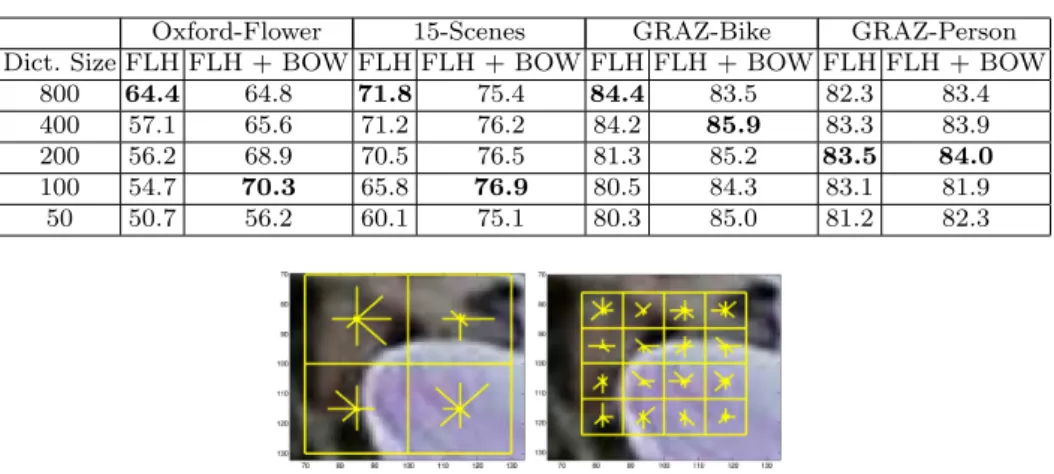
Dictionary size: We are interested in exploiting local spatial information using mining methods. Larger vi-sual dictionaries may restrict the possibility of exploit-ing co-occurrexploit-ing local statistics. To evaluate this phe-nomenon we evaluate the effect of the dictionary size on ourFLH-based method. We report results forFLH and FLH+BOW with different dictionary sizes (Table 2). Note that when combining FLH andBOW we do not reduce the dictionary size for BOW, but always use a dictionary size of 800, as large dictionaries have proven to perform better for BOW. Results decrease when the dictionary size is reduced. However, the results improve with reduced dictionaries forFLH+BOW, up to some level. This indicates that with a smaller dictionary size (up to some level) FLHs complementarity with BOW representation increases.
Smaller dictionaries reduce the discriminativity of the visual primitives. However, this does not seem to affect the discriminativity of the FLH patterns, which may even become more robust and stable when com-bined with BOW. Therefore, smaller dictionaries cre-ated using even less discriminative features might be better suited forFLH. This is tested in the next exper-iment.
Less discriminative features: We evaluate the effect of less discriminative features onFLH using the same four datasets and local neighborhood size of 5 (Table 3). For this we use SIF T32 features that are extracted like the standard SIFT (referred to as SIF T128) but performing spatial binning of (2×2) instead of (4×4) (See Fig.3). Results are shown in Table 3, for FLH with
SIFT32 by itself, as well as when combined withBOW (using SIFT128 and a 800 dimensional vocabulary for the BOW). For most of the settings, we obtain better results on all datasets except 15-Scenes, when compared to the case of SIFT-128.
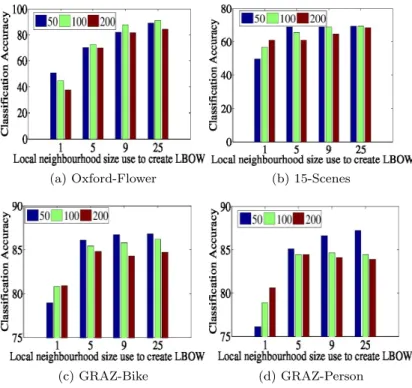
Larger local neighborhoods: The use of smaller dictio-naries and less discriminative SIFT features allows the FLH-based method to exploit larger neighborhoods. To evaluate this relation, we run some further experiments on the same datasets – see Fig. 4. The best results are obtained when reducing both SIFT feature size and dic-tionary size while increasing the neighborhood size of the local spatial histograms. For Oxford-flower, the best classification accuracy obtained with SIFT features is 91.0% for a dictionary size of 100 words, SIF T32 fea-tures and a neighborhood size of 25. A similar trend is observed for 15-Scenes dataset and the GRAZ dataset. Note that this is a larger neighborhood size (covering up to 48×48 pixels) than what is typically used in the literature [53, 20].
We can conclude that the FLH-based method ob-tains its best results when exploiting larger patterns with smaller dictionaries and less discriminative primi-tive features.
¿From now on, for all FLH-based experiments we use the SIFT32 descriptor and a neighborhood size of 25 neighbors. On average best performance is obtained around 100 visual words or less for most of the datasets. As a result hereafter we use a visual dictionary size of 100 words.
5.4 Effect of relevant pattern mining and of the kernel functions
FLH mining algorithms can generate a large number of FLH patterns (in our case, 1-20 million) before the relevant pattern mining step. Therefore, we select the most relevant-non-redundant ones, as described in Sec-tion 3.2. Here we evaluate the importance of this pat-tern selection step by comparing different criteria: the most frequent (Frq.), the most representative-non-redundant (Rps.)(eq. 4), the most discriminative-non-redundant
Table 2: The effect of dictionary size on FLH-based methods using SIFT-128. Classification accuracy on training data using cross-validation.
Oxford-Flower 15-Scenes GRAZ-Bike GRAZ-Person Dict. Size FLH FLH + BOW FLH FLH + BOW FLH FLH + BOW FLH FLH + BOW
800 64.4 64.8 71.8 75.4 84.4 83.5 82.3 83.4
400 57.1 65.6 71.2 76.2 84.2 85.9 83.3 83.9
200 56.2 68.9 70.5 76.5 81.3 85.2 83.5 84.0
100 54.7 70.3 65.8 76.9 80.5 84.3 83.1 81.9
50 50.7 56.2 60.1 75.1 80.3 85.0 81.2 82.3
Fig. 3: Spatial bining of SIFT32 (left) vs SIFT128 (right)
Table 3: Effect of SIFT-32 features on FLH. Classification accuracy on training data using cross-validation.
Oxford-Flower 15-Scenes GRAZ-Bike GRAZ-Person Dict. Size FLH FLH + BOW FLH FLH + BOW FLH FLH + BOW FLH FLH + BOW
800 69.1 79.4 70.4 74.9 83.9 85.1 83.5 84.1
400 69.5 80.1 70.0 75.6 84.8 85.8 83.6 84.2
200 70.4 80.6 68.9 75.8 84.8 87.2 83.6 84.4
100 72.7 80.7 65.4 75.3 85.4 87.2 83.7 84.4
50 70.0 80.4 61.0 75.0 86.1 86.7 82.0 85.1
(Disc.)(eq.2) and the most relevant-non-redundant (Rel.) (i.e. representative, discriminative and non-redundant) patterns (see Table 4). We always select the top 10.000 patterns for each criterion which we believe is sufficient to obtain good results. These results clearly show that only selecting the top-k most frequent patterns (as of-ten done in computer vision literature, e.g. [31]) is not a good choice for classification. Both representativity and discriminativity criteria alone also do not provide the best results. It’s the relevant non-redundant FLH patterns that are the most suitable for classification.
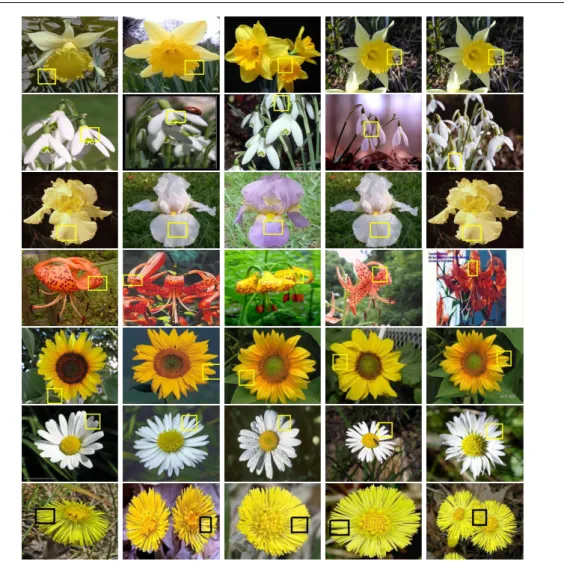
Some of these relevant and non-redundant FLH pat-terns are shown in Fig. 5. These selected most vant FLH patterns seem to capture most of the rele-vant shape information in an image. In Fig. 6 we show the most relevant pattern for seven different flower cat-egories. Note how each relevant pattern captures sev-eral local feature configurations. All these configura-tions seem visually similar, even though they show quite some variability as well, especially when compared to the mid-level features obtained by methods that start from a rigid HoG-based representation.
As can be seen from Fig. 5, these FLH patterns cover relatively large regions. Fig. 7 shows the distri-bution of pattern size. Most of the pattern sizes are between length 5 to 8. This implies that most of the
local histogram patterns consist of 5-8 non-zero com-ponents. Very large patterns and very small patterns have very low probability. The relevant-non redundant patterns contain slightly less items.
In Table 5, we evaluate the effect of the square root intersection kernel using relevant non-redundant FLH patterns onOxford-Flower,GRAZ-01 and15-Scenesdatasets. The proposed square-root weighting increases the clas-sification accuracy for all datasets, both when using the linear kernel and the non-linear intersection kernel.
The square-root intersection kernel combines an in-tersection kernel and a power kernel with power 0.5. Both kernels decrease the impact of very frequent pat-terns. As shown by experiments, this kernel is better than either kernel separately (see Table 5). This shows that the intersection kernel and power kernel with power 0.5 do not reduce sufficiently the influence of frequent patterns. An alternative would be to use a smaller power than 0.5, (e.g. 0.25). The main advantage of this is that the power kernel can be implemented as a simple nor-malization of the features. Efficient linear classifiers can be used subsequently as opposed to costly non-linear classifiers. We plan to investigate this effect in our fu-ture work.
(a) Oxford-Flower (b) 15-Scenes
(c) GRAZ-Bike (d) GRAZ-Person
Fig. 4: Effect of neighborhood size (K, horizontal axis), dictionary size (color coded) and SIFT-32 on classification accuracy for the (a) Oxford-Flower (b)15-Scenes (c) GRAZ-Bike (d) GRAZ-Person on training data using cross-validation.
Fig. 5: FLH patterns using SIFT32 where each red dot represents the central location and the blue square represents the size of the FLH pattern. Each pattern is generated from a 48×48 pixel image patch. In this region there are 25 features each covering a 16×16 pixel patch and overlapping 50% with their neighbors. Note how the relevant non-redundant patterns seem to capture most of the relevant shape information in the images.
5.5 Effect of larger patches and dictionary size on BOW based image classification
One might argue that the FLH-based method with the optimized parameters described in the previous section outperforms the BOW baseline because of the use of larger patches and much simpler features. To evaluate
this hypothesis, we perform another experiment using BOW with SIFT-32 descriptors extracted from large patches of size 48×48 pixels. By varying the dictionary size we evaluate the performance of the BOW and SPM methods. The results are shown in Table 6. They show that just increasing the patch size of SIFT descriptors is not sufficient to increase the classification accuracy for
Fig. 6: Each row represents the most relevant FLH pattern for a given flower category. Note the flexibility of our representation. While it’s always the same FLH pattern, the appearance of the corresponding patches varies a lot.
Table 4: Effect of relevant pattern mining on classifica-tion performance using FLH
Criterion Frq. Rps. Disc. Rel. Flower 65.6 84.2 90.9 92.5 15-Scenes 66.8 69.6 67.4 70.4 GRAZ-01 82.9 89.8 90.2 91.5
Fig. 7: The distribution of the pattern size
BOW-based methods. For example for Oxford-Flower dataset the best performance using SPM is 67.4% while
Table 5: Effect of the kernel on classification perfor-mance using FLH
K(x,y) =x·yt√x·√yt P
imin(xi,yi)Pimin( √
xi,√yi) Flower 89.5 92.0 91.2 92.5
15-Scenes 68.0 68.9 69.0 70.4
GRAZ-01 88.5 89.5 89.8 91.5
FLH reported 92.5%. For 15-Scenes dataset F LH + BOW reported 83.0 while the best for SPM is 76.4%.
5.6 Effect of larger spatial neighborhoods and smaller dictionary size on frequent pattern based image classification
To evaluate the effect of larger spatial neighborhoods and smaller visual dictionaries on all pattern-based meth-ods (i.e. FIM, B2S and FLH) we perform another exper-iment using SIFT-32 descriptors. Transactions are cre-ated using a spatial neighborhood size of 25 neighbors.
Table 6: Effect of larger patches (48×48) and dictionary size on BOW/SPM based image classification. Oxford-Flower 15-Scenes GRAZ-Bike GRAZ-Person
Dict. Size BOW SPM BOW SPM BOW SPM BOW SPM 100 55.0 60.8 66.5 73.7 79.5 83.0 79.5 80.0 1000 62.9 66.5 72.1 76.4 80.0 80.0 83.0 83.0 4000 65.5 67.4 72.9 76.2 79.0 80.5 83.0 82.5
Results are shown in Fig. 8. We report results using both histogram intersection kernel (Ints.) and square root histogram intersection kernel (Sqrt. Ints.). For all three methods (FIM, B2S and FLH), the traditional top-k most frequent pattern selection method performs poorly. All methods benefit from the relevant pattern selection but the FLH-based method benefits the most (the top-k most frequent pattern results are improved by 27% while it is 19% for B2S and 17% for FIM for Oxford-Flower). A similar trend can be observed for the other datasets too. It is clear from this experiment that smaller visual dictionaries that are constructed from less discriminative SIFT are only helpful if we use the relevant pattern selection step. Since the binary his-togram transformation used in the FIM method loses some valuable information, this method does not ben-efit that much from the relevant pattern selection step nor from the reduction of the dictionary size, SIFT di-mension and the increase of the spatial neighborhood. We believe that the significant 10% improvement (on Oxford-Flower) of FLH over B2S when using the same parameters is due to two reasons; (1) FLH local rep-resentation is more expressive and explicit compared to B2S, (2) FLH does not generate artificial patterns (ghost patterns).
5.7 Effect of GRID-FLH vs Spatial pyramids
In this section we compare the extension of bag-of-FLHs called GRID-FLH introduced in section 4. We com-pare GRID-FLH with FLH and spatial pyramids [24] with BOW (SPM-BOW) and spatial pyramids with FLH (SPM-FLH). SPM-BOW is the standard spatial pyramids applied over BOW while in SPM-FLH spa-tial pyramids are computed over bag-of-FLHs. Results are reported in Table 7. GRID-FLH consistently im-proves over FLH and spatial pyramid variants (both SPM-BOW and SPM-FLH). Especially in scene clas-sification the improvement obtained by GRID-FLH is significant.
(a) Oxford-Flower
(b) 15-Scenes
(c) GRAZ-01
Fig. 8: Effect of larger spatial neighborhoods (25), smaller dictionary size (100) and SIFT-32 descriptor on frequent pattern-based image classification.
Table 7: Effect of GRID-FLH vs Spatial pyramids
Method FLH SPM-BOW SPM-FLH GRID-FLH Flower 92.5 57.3 92.6 92.9
15-Scenes 70.4 81.0 82.8 86.2
6 Comparison to state-of-the-art methods 6.1 Comparison with non-mining methods
In this section we compare FLH with non-mining meth-ods that exploit local structural statistics. Specifically we compare our method with the spatial pyramid co-occurrence method (SPCK) of Yang et al. in [49] and the unbounded-order spatial features method of Chen and Zhang [51]. We also compare our method with the mid-level feature construction method of Boureau et al. in [6] and the PDK method [27] which uses proxim-ity distribution kernels based on geometric context for category recognition. Results are reported in Table 8. GRID-FLH outperforms all other non-mining methods for both GRAZ-01 and 15-Scenes datasets. Note that for these methods, no results were reported for the Oxford-flower dataset.
The mid-level features method of [6] using macro-features seems to work quite well on 15-Scenes. This method also uses dense SIFT features but a visual dic-tionary of 2048. In this method the sparsity and su-pervision is enforced during the feature construction. The Bag-of-FLH representation, on the other hand, is quite sparse after the relevant pattern mining step. For example, in the case of Oxford-Flower dataset, there were 17.6% non-zero bins before the relevant pattern mining step and 5.13% non-zeros bins after. One of the key differences between the macro-features and FLH is that macro-features capture very small neighborhood of 2×2 while FLHs capture comparatively larger neigh-borhoods of 5×5. Secondly for macro-features larger discriminative and supervised dictionaries seem to work well. For an unsupervised smaller dictionary of size 1048 macro-features reported only 83.6%.
Neither the spatial pyramid co-occurrence method of Yang et al. in [49] nor the unbounded-order spatial features method of Chen and Zhang [51] work as good as our GRID-FLH method. This could be due to the fact that none of these methods capture database wide spatial statistics.
6.2 Comparison with state-of-the-art methods
In this section we compareFLH using the parameters optimized as above with, to the best of our knowledge, the best results reported in the literature.
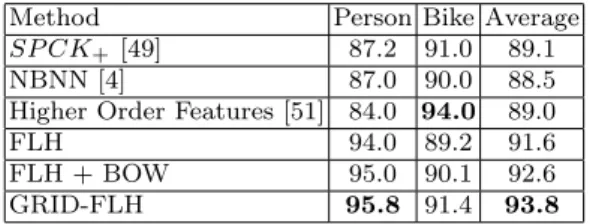
GRAZ-01: The results reported in Table 9 show that on average allFLH-based methods outperform the state-of-the-art. TheGRID−F LH representation, combin-ing local and global spatial information, yields the best results. For the “Bike” class, the higher order features [51]
seem the best. But on average FLH outperforms the higher order features [51] and the co-occurrence spatial features [49].
Table 9: Equal Error Rate (over 20 runs) for catego-rization on GRAZ-01 dataset
Method Person Bike Average
SP CK+[49] 87.2 91.0 89.1
NBNN [4] 87.0 90.0 88.5
Higher Order Features [51] 84.0 94.0 89.0
FLH 94.0 89.2 91.6
FLH + BOW 95.0 90.1 92.6
GRID-FLH 95.8 91.4 93.8
Oxford-Flower: The results are reported in Table 10. Note that only using SIFT features we get a classifica-tion accuracy of 92.9%, reaching the state-of-the-art. GRID-FLH only gives an insignificant improvement of 0.4% compared to FLH. Note that we use only SIFT features for classification. Most of the other works such as [30, 38, 47, 17] use multiple features such as Hue and ColorName descriptors [46]. To the best of our knowl-edge the best results on Oxford-Flower17 using a single feature is reported by Rematas et al. [36], 85.3%. We should mention that when we combine SIFT with color information (using the ColorName descriptor [46]) we obtain a classification accuracy of 94.0% outper-forming the state-of-the-art.
Table 10: Classification accuracy (over 20 runs) on the Flower dataset
Method Accuracy
Nilsback [30] 88.3
CA [38] 89.0
L1−BRD[47] 89.0
LRFF [17] 93.0
Pooled NBNN Kernel [36] 85.3
FLH 92.5
FLH + BOW 92.7
GRID-FLH 92.9
15-Scenes: Results are shown in Table 11. This dataset is strongly aligned.FLH does not exploit this and there-fore by itself cannot obtain state-of-the-art results. How-ever, the GRID-FLH method described in section 4 does take the global spatial information into account and achieves close to state-of-the-art results (86.2%). This is only outperformed by [54] who report 87.8% using CENTRIST and SIFT features along with LLC
Table 8: Comparison with non-mining methods
Dataset GRAZ-Bike GRAZ-Person 15-Scenes
GRID-FLH 95.8 91.4 86.2
FLH+BOW 95.0 90.1 83.0
FLH 94.0 89.2 70.4
SPCK [49] 91.0 87.2 82.5
PDK [27] 95.0 88.0
-Higher Order Features [51] 94.0 84.0
-Mid-Level Features [6] - - 85.6
coding. In our defense, our method uses only SIFT fea-tures. As far as we know the previous best classification accuracy using SIFT features was reported by Tuyte-laarset al.in [44] combining a NBNN kernel and a SPM method.
Table 11: Results on 15-Scenes dataset
Method Accuracy
SPM 80.9
SP CK+ + [49] 82.5 NBNN Kernel+SPM [44] 85.0 (AND/OR) [54] 87.8
FLH 70.4
FLH+BOW 83.0
GRID-FLH 86.2
Land-Use: Yang and Newsam proposed a spatial pyra-mid co-occurrence method called SPCK [49] to clas-sify Land-Use images. Most of these images are texture dominant. They use two types of spatial predicates: the proximity predicate and the orientation predicate, to define the SPCK method. We obtain a best result of 79.2% for this dataset, again outperforming best re-sults reported in [49]. The rere-sults for Land-Use dataset are shown in Table 12.
Table 12: Results on recent Land-Use dataset
Method Accuracy
BOW 71.9
SPM 74.0
SP CKSP1[49] 72.6 SP CKSP3+[49] 76.1
FLH 76.8
FLH+BOW 77.2
GRID-FLH 79.2
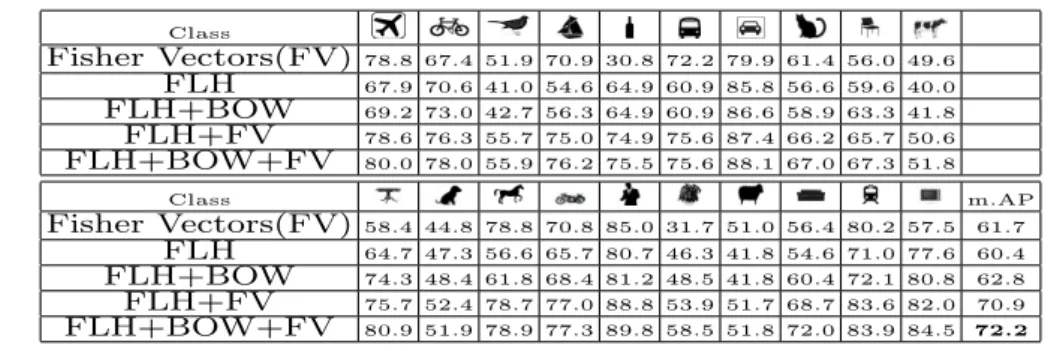
Pascal-VOC2007: Results are reported in Table 13. For this dataset Fisher Vector [33, 8] is the best performing method so far and the authors report a mAP of 61.7. The FLH-based method alone gives a mAP of 60.4.
In combination with BOW of SIFT-128 and 5000 vi-sual word vocabulary (with a weighted average kernel with weights learned using train/validation set), we ob-tain a state-of-the-art mAP of 62.8. Note that the score for each individual class often varies a lot between the FLH+BOW and the Fisher Vector [33] method. Our method does especially well on what are known to be ’hard’ classes such as bottle (+34% improvement), din-ing table (+11%), potted plant (+16%), or tv monitor (+23%). This suggests that both methods are comple-mentary. To evaluate this claim we also performed an-other experiment in which we average the output score of Fisher vector method [33, 8] with the output scores of (FLH+BOW) method. This yields a mean average pre-cision of 72.2. This approach clearly outperforms the state-of-the art by a significant margin. Not only this confirms the complementary nature of FLH and Fisher vectors but the improvement is consistent over every PASCAL-VOC class.
7 Conclusion
In this paper we show an effective method for using itemset mining to discover a new set of mid-level fea-tures called Frequent Local Histograms. Extensive ex-periments have proved that the proposed bag-of-FLH representation, the proposed relevant pattern mining method and the chosen kernel all improve the classifi-cation results on various datasets. We have also experi-mentally shown that the best results for FLH methods are obtained when exploiting a large local neighborhood with a small visual vocabulary and less discriminative descriptors. Finally, we have shown that extending a local approach such as FLH to exploit global spatial in-formation allows us to obtain state-of-the-art results on many datasets. The experiments have also put in light the complementary nature of FLH and Fisher vectors, the combination of which can significantly increase the classification accuracies on difficult classification prob-lems.
FLH uses dense sampling only at a single scale. This is a limitation of our approach even though we were able
Table 13: Results on PASCAL-VOC 2007 (Mean average precision)
Class
Fisher Vectors(FV)78.8 67.4 51.9 70.9 30.8 72.2 79.9 61.4 56.0 49.6 FLH 67.9 70.6 41.0 54.6 64.9 60.9 85.8 56.6 59.6 40.0 FLH+BOW 69.2 73.0 42.7 56.3 64.9 60.9 86.6 58.9 63.3 41.8 FLH+FV 78.6 76.3 55.7 75.0 74.9 75.6 87.4 66.2 65.7 50.6 FLH+BOW+FV 80.0 78.0 55.9 76.2 75.5 75.6 88.1 67.0 67.3 51.8
Class m.AP
Fisher Vectors(FV)58.4 44.8 78.8 70.8 85.0 31.7 51.0 56.4 80.2 57.5 61.7 FLH 64.7 47.3 56.6 65.7 80.7 46.3 41.8 54.6 71.0 77.6 60.4 FLH+BOW 74.3 48.4 61.8 68.4 81.2 48.5 41.8 60.4 72.1 80.8 62.8 FLH+FV 75.7 52.4 78.7 77.0 88.8 53.9 51.7 68.7 83.6 82.0 70.9 FLH+BOW+FV 80.9 51.9 78.9 77.3 89.8 58.5 51.8 72.0 83.9 84.5 72.2
to obtain good results on many datasets with a single scale. Note that moving to interest points instead of densely sampled points would not resolve this issue.
As future work we propose to investigate how to push the relevant and non redundant constraints di-rectly into the local histogram mining process to make it particularly efficient. Besides, as itemset mining is performed on the local histograms, the spatial informa-tion that can be captured in the patterns may be lim-ited in some applications. Using graph mining methods on the grid of visual words could be an interesting al-ternative method to the one proposed in this paper to build bigger mid-level features.
We also plan to further investigate pattern mining methods in image classification, image/video retrieval and multiple query image retrieval settings. Integra-tion of Fisher Vectors into our framework may lead to further performance gains. Furthermore, we would like to further explore unsupervised relevant pattern min-ing techniques and how to extend FLH usmin-ing Gaussian mixture-based visual word representations and proba-bilistic mining.
Acknowledgements The authors acknowledge the support of the iMinds Impact project Beeldcanon, the FP7 ERC Start-ing Grant 240530 COGNIMUND, the KU Leuven OT-project VASI and PASCAL 2 Network of Excellence.
References
1. Ankur Agarwal and Bill Triggs. Multilevel image coding with hyperfeatures. Int. J. Comput. Vision, 78:15–27, June 2008.
2. Rakesh Agrawal, Tomasz Imieli´nski, and Arun Swami. Mining association rules between sets of items in large databases. SIGMOD Rec., 0:207–216, 1993.
3. Rakesh Agrawal and Ramakrishnan Srikant. Fast algo-rithms for mining association rules in large databases. In VLDB, pages 487–499, 1994.
4. O. Boiman, E. Shechtman, and M. Irani. In defense of nearest-neighbor based image classification. InCVPR, 2008.
5. Lubomir Bourdev and Jitendra Malik. Poselets: Body part detectors trained using 3d human pose annotations. InICCV, 2009.
6. Y.-L. Boureau, F. Bach, Y. LeCun, and J. Ponce. Learn-ing mid-level features for recognition. InCVPR, 2010. 7. Chih-Chung Chang and Chih-Jen Lin. Libsvm: A library
for support vector machines. ACM Transactions on In-telligent Systems and Technology, 2:27:1–27:27, 2011. 8. K. Chatfield, V. Lempitsky, A. Vedaldi, and A.
Zisser-man. The devil is in the details: an evaluation of recent feature encoding methods. InBMVC, 2011.
9. Hong Cheng, Xifeng Yan, Jiawei Han, and Chih-Wei Hsu. Discriminative frequent pattern analysis for effective clas-sification. InICDE, pages 716 –725, april 2007.
10. O. Chum, M. Perdoch, and J. Matas. Geometric min-hashing: Finding a (thick) needle in a haystack. In CVPR, 2009.
11. Ramazan Gokberk Cinbis, Jakob Verbeek, and Cordelia Schmid. Image categorization using fisher kernels of non-iid image models. InCVPR, 2012.
12. Gabriella Csurka, Christopher R. Dance, Lixin Fan, Jutta Willamowski, and Cdric Bray. Visual categorization with bags of keypoints. InWork. on Statistical Learning in CV, pages 1–22, 2004.
13. Navneet Dalal and Bill Triggs. Histograms of oriented gradients for human detection. InCVPR, 2005. 14. Ian Endres, Kevin J. Shih, Johnston Jiaa, and Derek
Hoiem. Learning collections of part models for object recognition. InCVPR, 2013.
15. M. Everingham, L. Van Gool, C. K. I. Williams, J. Winn, and A. Zisserman. The PASCAL Visual Ob-ject Classes Challenge 2007 Results. http://www.pascal-network.org/ challenges/VOC/ voc2007/workshop/ in-dex.html, 2007.
16. A. Farhadi, I. Endres, D. Hoiem, and D. Forsyth. De-scribing objects by their attributes. InCVPR, pages 1778 –1785, june 2009.
17. Basura Fernando, Elisa Fromont, Damien Muselet, and Marc Sebban. Discriminative feature fusion for image classification. InCVPR, 2012.
18. Basura Fernando, ´Elisa Fromont, and Tinne Tuytelaars. Effective use of frequent itemset mining for image clas-sification. In ECCV, volume 7572 ofLecture Notes in Computer Science, pages 214–227. Springer, 2012. 19. Basura Fernando and Tinne Tuytelaars. Mining
multi-ple queries for image retrieval: On-the-fly learning of an object-specific mid-level representation. InICCV, 2013. 20. A. Gilbert, J. Illingworth, and R. Bowden. Fast
real-istic multi-action recognition using mined dense spatio-temporal features. InICCV, pages 925 –931, 29 2009-oct. 2 2009.
21. Tommi Jaakkola and David Haussler. Exploiting gener-ative models in discrimingener-ative classifiers. InNIPS, pages 487–493, 1998.
22. M. Juneja, A. Vedaldi, C. V. Jawahar, and A. Zisserman. Blocks that shout: Distinctive parts for scene classifica-tion. InCVPR, 2013.
23. Sangkyum Kim, Xin Jin, and Jiawei Han. Disiclass: dis-criminative frequent pattern-based image classification. In Tenth Int. Workshop on Multimedia Data Mining, 2010.
24. Svetlana Lazebnik, Cordelia Schmid, and Jean Ponce. Beyond bags of features: Spatial pyramid matching for recognizing natural scene categories. In CVPR, pages 2169–2178, 2006.
25. Anthony J.T. Lee, Ying-Ho Liu, Hsin-Mu Tsai, Hsiu-Hui Lin, and Huei-Wen Wu. Mining frequent patterns in im-age databases with 9d-spa representation.Journal of Sys-tems and Software, 82(4):603 – 618, 2009.
26. Yong Jae Lee, Alexei A. Efros, and Martial Hebert. Style-aware mid-level representation for discovering visual con-nections in space and time. InICCV, 2013.
27. Haibin Ling and S. Soatto. Proximity distribution kernels for geometric context in category recognition. InICCV, 2007.
28. D. Liu, Gang Hua, P. Viola, and Tsuhan Chen. Inte-grated feature selection and higher-order spatial feature extraction for object categorization. InCVPR, 2008. 29. D. G. Lowe. Object recognition from local scale-invariant
features. InICCV, pages 1150–1157, 1999.
30. M.-E. Nilsback and A. Zisserman. Automated flower clas-sification over a large number of classes. In ICVGIP, pages 722 –729, dec. 2008.
31. S. Nowozin, K. Tsuda, T. Uno, T. Kudo, and G. Bakir. Weighted substructure mining for image analysis. In CVPR, 2007.
32. Andreas Opelt, Michael Fussenegger, Axel Pinz, and Pe-ter Auer. Weak hypotheses and boosting for generic ob-ject detection and recognition. InECCV, pages 71–84, 2004.
33. Florent Perronnin, Jorge S´anchez, and Thomas Mensink. Improving the fisher kernel for large-scale image classifi-cation. InECCV, pages 143–156, 2010.
34. T. Quack, V. Ferrari, B. Leibe, and L. Van Gool. Efficient mining of frequent and distinctive feature configurations. InICCV, 2007.
35. Till Quack, Vittorio Ferrari, and Luc Van Gool. Video mining with frequent itemset configurations. InCIVR, pages 360–369, 2006.
36. Konstantinos Rematas, Mario Fritz, and Tinne Tuyte-laars. The pooled nbnn kernel: Beyond image-to-class and image-to-image. InACCV, volume 7724, pages 176– 189, 2012.
37. S. Savarese, J. Winn, and A. Criminisi. Discriminative object class models of appearance and shape by correla-tons. InCVPR, 2006.
38. F. Shahbaz Khan, J. van de Weijer, and M. Vanrell. Top-down color attention for object recognition. In ICCV, pages 979 –986, 2009.
39. Gaurav Sharma, Fr´ed´eric Jurie, and Cordelia Schmid. Expanded parts model for human attribute and action recognition in still images. InCVPR, 2013.
40. Karen Simonyan, Andrea Vedaldi, and Andrew Zisser-man. Deep fisher networks for large-scale image classifi-cation. InNIPS, 2013.
41. Saurabh Singh, Abhinav Gupta, and Alyosha Efros. Un-supervised discovery of mid-level discriminative patches. InECCV, 2012.
42. J. Sivic and A. Zisserman. Video Google: A text re-trieval approach to object matching in videos. InICCV, volume 2, pages 1470–1477, 2003.
43. J. Sivic and A. Zisserman. Video data mining using configurations of viewpoint invariant regions. InCVPR, 2004.
44. Tinne Tuytelaars, Mario Fritz, Kate Saenko, and Trevor Darrell. The nbnn kernel. InICCV, pages 1824–1831, 2011.
45. Takeaki Uno, Tatsuya Asai, Yuzo Uchida, and Hiroki Arimura. Lcm: An efficient algorithm for enumerating frequent closed item sets. InFIMI, 2003.
46. Joost van de Weijer and Cordelia Schmid. Applying color names to image description. In ICIP, pages 493–496, 2007.
47. Nianhua Xie, Haibin Ling, Weiming Hu, and Xiaoqin Zhang. Use bin-ratio information for category and scene classification. InCVPR, pages 2313 –2319, june 2010. 48. Xifeng Yan, Hong Cheng, Jiawei Han, and Dong Xin.
Summarizing itemset patterns: a profile-based approach. InACM SIGKDD, 2005.
49. Yi Yang and Shawn Newsam. Spatial pyramid co-occurrence for image classification. InICCV, 2011. 50. Bangpeng Yao and Li Fei-Fei. Grouplet: A structured
image representation for recognizing human and object interactions. InCVPR, 2010.
51. Tsuhan Chen Yimeng Zhang. Efficient kernels for identi-fying unbounded-order spatial features. InCVPR, 2009. 52. Junsong Yuan, Jiebo Luo, and Ying Wu. Mining
compo-sitional features for boosting. InCVPR, 2008.
53. Junsong Yuan, Ying Wu, and Ming Yang. Discovery of collocation patterns: from visual words to visual phrases. InCVPR, 2007.
54. Junsong Yuan, Ming Yang, and Ying Wu. Mining dis-criminative co-occurrence patterns for visual recognition. InCVPR, pages 2777 –2784, june 2011.
55. Unil Yun and John J. Leggett. Wfim: Weighted fre-quent itemset mining with a weight range and a minimum weight. InSDM’05, 2005.