Research Article
a
September
2019
ISSN: 2277-128X (Volume-9, Issue-9)
A Nutritional Recommender System for Rehabilitation of
NCD’s by Using Data Mining Techniques
B. Sri Surya
M. Tech, Department of CSE,
Shri Vishnu Engineering College for Women (A), Vishnupur,
Bhimavaram, West Godavari District, Andhra Pradesh.
Mrs. P. R. Sudha Rani
Associate Professor, Department of CSE,
Shri Vishnu Engineering College for Women (A), Vishnupur,
Bhimavaram, West Godavari District, Andhra Pradesh.
Abstract- Non Communicable or Chronic diseases tend to be long duration and are the results of a combination of genetic, phsycological, environmental and behaviour factors. About 41 million people died from NCD’s each year, which is equivalent to 70% of the global death toll. In many high-income countries, standard care for the long term management of NCD’s include Rehabilitation. So, in this paper I proposed that suitable Nutritional Diets play an important role in maintaining health, rehabitating the NCD’s and preventing the occurrence of NCD’s. For this purpose, I worked on a novel frame work named NutIngredientFood, which models the relationship between the Ingredients and their Proportions within food for the purpose of offering healthy recommendations. Specifically, NutIngredientFood consists of three main components: 1) using an embedding based ingredient predictor to predict the relevant ingredients with user-defined initial ingredients(Ingredient Predictor), 2) predicting the amounts of the relevant ingredients(Amount Predictor), 3) creating a healthy pseudo-NutIngredient with a list of ingredients and their amounts according to the nutritional information and recommending the top similar nutritional ingredients with the pseudo-Nut Ingredient.
Keywords: NCD, pseudo-NutIngredient
1. Introduction
The presence of food related content on the web has become prominent in recent years. With the large quantity of available data, finding the right recipe becomes a difficult task. Food recommender systems, a domain specific subclass of recommender systems, have been designed to assist in providing users with Nutritional Ingredients that accommodate their preferences.
Positive Nutritional Ingredients Recommenders, which usually rely on a tally to indicate people’s aggregated opinion; however are inevitably facing the following challenges that cannot be easily addressed by adopting existing methods. First, the majority of online positive nutritional do not adhere to the nutritional guidelines set by international food agencies and are therefore regarded as unhealthy. Second, a negative correlation is displayed between rating scores and healthiness measures, meaning highly rated nutritional ingredients tend to be even less healthy.
I propose NutIngredientFood, a framework that tackles the completion task whilst striving to retrieve healthy Positive Nutritional Ingredients. While in previous studies the relationships between ingredients are investigated and result in Positive Nutritional Ingredients recommendations for the purpose of list-completion or substitution, here I aim to generate full healthy Positive Nutritional Ingredients recommendations.
pseudo-NutIngredient is then matched against the nutritional ingredients in the dataset to find similar nutritional ingredients recommendations.
I propose a Positive Nutritional Ingredients Recommendation framework (NutIngredientFood), which first builds a positive pseudo-NutIngredient considering the nutritional values and then scans the nutritional ingredients dataset for items resembling the pseudo-NutIngredient. Our proposed NutIngredientFood relies not only on the relationship between the ingredients and themselves, but also on those of their quantities, which ultimately dictate the healthiness of nutritional ingredients. To the best of our knowledge, no prior study has incorporated these features.
The pseudo-NutIngredient is a list of ingredients with their quantities, and the nutritional values of the pseudo-NutIngredient should match the predefined targets as best as possible. To generate the pseudo-NutIngredient, I first propose an embedding-based ingredient predictor, which embeds all the ingredients into a latent space and predicts the supplemented ingredients based on the distances of ingredient representations; I propose an amount predictor to compute the quantities of the supplemented ingredients.
I conduct extensive experiments with two nutritional ingredients datasets, and the experimental results confirm the superiority of our methods over the baselines.
2. Related work
Recently, Positive Nutritional Ingredients Recommendation has been a hot research problem. In this project, I focus on Positive Nutritional Ingredients Recommendation and discuss the recent progress of the related methods and applications.
Positive Nutritional Ingredients Recommendation:
Positive Nutritional Ingredients Recommendation is a sub-domain of the larger nutritional ingredients recommendation task, and the problem of recommending healthy nutritional ingredients has been tackled in numerous studies. In literature, healthiness is measured by comparing Macro-Nutrient values against several International Guidelines.
Recommendation with Pre-Existing Positive Nutritional Ingredients:
Traditionally, Positive Nutritional Ingredients Recommendation methods rely on ratings and strive to suggest nutritional ingredients the user would rate high. For example, Positive Nutritional Ingredients ratings to explore the relationship between healthy Positive nutritional ingredients and their ingredients. They devise a break-down technique and examine the feasibility of extracting the users’ ingredient preferences from their ratings on nutritional ingredients.
Recommendation with Online Positive Nutritional Ingredients Datasets:
3. Proposed framework: NutIngredientFood General Framework
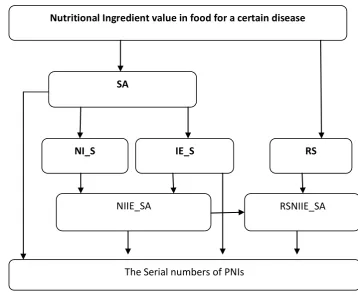
The proposed framework NutIngredientFood is inspired by a human-like deliberation and seeks to generate healthy Positive nutritional ingredients recommendations over an online non-healthy dataset. The user’s preferences are accommodated in the form of an ingredient-list and are passed to the framework as input. NutIngredientFood consists of three main stages: 1) predicting the relevant and Positive nutritional ingredients with an ingredient-list(Ingredient Predictor); 2) predicting the amounts of the relevant ingredients(Amount Predictor); 3) creating a healthy pseudo-NutIngredient and searching for similar nutritional ingredients in the dataset. The working process of NutIngredientFood is presented in full in Algorithm.
Ingredient Predictor: I propose an embedding-based predictor to find candidate relevant ingredients by computing top compatible ingredient lists with the current ingredient-set prSet (line 3).
Fig :- Architecture
Amount Predictor: A list of ingredients does not suffice to calculate nutritional values, to accomplish this task i demand the rations. I develop an amount predictor which enables us to predict the quantities of a given ingredient-set (line 4).
Healthy Positive Nutritional Ingredients Recommendation: By using the ingredient predictor and the amount predictor, the FindBestIngredientToAdd assess how each candidate ingredient impacts the nutritional values and returns the best ingredient to append to the working set.
Nutritional Ingredient value in food for a certain disease
SA
NI_S IE_S RS
NIIE_SA RSNIIE_SA
Algorithm:- Best Nutrition Predicting Input:
s: the initial ingredient-set
k: the number of recommendation
Output:
l: the list of recommended Nutritional Ingredients
Tuning params:
n: the number of ingredients adding to the pseudo-Disease
cos: cosine-weight for similar Disease 1: prSet = s
2: for i = 0 to n do
3: candidateIngredients = IngredientPredictor(prSet)
4: amountofCandidateIngredients = AmountPredictor(prSet)
5:bestIngredient = FindBestIngredientToAdd(candidateIngredients, amounto fCandidateIngredients)
6: prSet += bestIngredient 7: end for
8: pseudoDisease = CreateDiseaseFromSet(prSet) 9: l = FindSimilarDisease (pseudoDisease, cos, k) 10: return l
I iteratively execute this process for n times, and generate a healthy pseudo-NutIngredient, i.e. a data-structure containing the ingredients along with their respective amounts (line 9). Finally, with the healthy pseudo-NutIngredient, I search the dataset for the top-k most similar nutritional ingredients (line 10).
The Ingredient Predictor Model Description :
In order to retrieve the most befitting ingredients, I propose an embedding-based ingredient predictor (IP-embedding), in which the ingredients are projected into a latent space and the ones that usually occur in a positive nutritional are close to each other.
I propose to use a distributed representation method to model the generation of the given nutritional. Given a nutritional: {i1, i2… iNr } containing Nr ingredients, the objective
function is to maximize the probability of each target ingredient ia given its corresponding
context information:
g(ia) = Pr(ia | Context(ia)) - eq(1)
Where I consider the ingredients except ia in the nutritional r as its context. Formally,
I model each target ingredient ia with a d-dimensional embedding vector vi ε d a and embed
each contextual ingredient into the same latent vector space. Given an ingredient ia, i average
the embedding vectors of multiple contextual ingredients to compute a contextual vector cia = 1 /Nr-1 ΣNrt=1, t=a V’ it, - eq(2)
Where V’it is the embedding vector of the contextual ingredient it. Note that, i
distinguish between the role of a target ingredient and a contextual ingredient, and represent the same ingredient ia using two different vectors (via and v’ia ) depending on which role it
takes. I then apply a softmax function to compute the probability of a target ingredient ia
given its contextual vector as follows:
Pr (ia|Context (ia)) = exp (ciaT.via) / Σ exp (ciaT.vi) - eq(3)
Where is the set of ingredients? Such a model connects the target ingredient and its contexts via the embedding representations. For parameter learning, i need to maximize the
multi-classifier to predict the target ingredient is extremely high. Therefore, i adopt the efficient and effective negative sampling strategy to approximate the full softmax. When i train the vector of ia, i first obtain a corresponding negative sample set NEG(ia), in which ix is not the same as
ia if ix∈ NEG(ia). Then i define
Lia(i) = 1 𝑖 = 𝑖𝑎;
0 𝑖′= 𝑖′𝑎; (4)
Where Lia(i) is the label of the ingredient i. The labels of positive instances are 1, and 0 otherwise.
Given the contextual ingredients of a target ingredient ia, i want to maximize the
occurrence probability of ia and meanwhile minimize the occurrence probability of negative
samples ix∈ NEG(ia). The objective function for the target ingredient ia therefore becomes
g (ia ) = Pr(𝑖|𝐶𝑜𝑛𝑡𝑒𝑥𝑡 𝑖𝑎 ) -(5)
where Pr(𝑖|𝐶𝑜𝑛𝑡𝑒𝑥𝑡 𝑖𝑎 ) = 𝜎(𝐶𝑖𝑎 𝑉𝑖) Lia(i)
1 − 𝜎(𝐶𝑖𝑎 𝑉𝑖) Lia(i) -(6)
in which σ(z)= (1+exp(-Z))-1 is the sigmoid function. Further,
g (ia ) = 𝑖 𝜀 𝑖𝑎 𝑈𝑁𝐸𝐺(𝑖𝑎)𝑃𝑟(𝑖|𝐶𝑜𝑛𝑡𝑒𝑥𝑡(𝑖𝑎)),
= 𝑖 𝜀 𝑖𝑎 𝑈 𝑁𝐸𝐺(𝑖𝑎). [σ(ciaTvi)]Lia(ia). [1 − 𝜎(𝐶𝑖𝑎 𝑉𝑖) Lia(i)],
= σ(ciaTvia) 𝑖𝜀𝑁𝐸𝐺 (𝑖𝑎 ).. [1 − 𝜎(𝐶𝑖𝑎 𝑉𝑖)], - (7) Finally, i define the object function for all the ingredients,
ℓ = 𝑟 𝜀 𝑅. 𝑁𝑟 .
𝑎=1logg(ia),
= 𝑟 𝜀 𝑅. 𝑁𝑟𝑎=1.[log[σ(ciaTvia)] + 𝑖𝜀𝑁𝐸𝐺 (𝑖𝑎 ). log[1-σ(ciaTvia)]],
= 𝑟 𝜀 𝑅. 𝑁𝑟𝑎=1.[log[σ(ciaTvia)] + 𝑖𝜀𝑁𝐸𝐺 (𝑖𝑎 ). log[σ(-ciaTvia)]],----(8)
Given an incomplete nutritional, i regard all its ingredients as the context, and compute Pr(i|Context(i)) based on Eq. (3) for each candidate ingredient i, and return the top-Ni ingredients as outputs.
Parameter Learning:
IP-embedding needs to learn the embedding vectors of all the ingredients. I represent all the parameters with Θ, and learn the IP-embedding model by using maximum a posterior (MAP): Ǿ = argmax 𝑟 𝜀 𝑅. 𝑁𝑟𝑎=1.logg(ia) – ½ λ||Θ||2 --(9)
Where λ||Θ||2
is the regularization term.
All parameters are trained using the stochastic gradient ascent method. During the training process, the algorithm iterates over the target ingredients of all the nutritionals. At each time, a target ingredient ia with its contexts is used for update. For a certain context (ia),
the target ingredient ia is a positive sample, and we randomly sample Ne unobserved
ingredients as negative samples. After computing the loss function, the error gradient is obtained via back propagation and we use the gradient to update the parameters in our model.
Via = Via + η [ [[1 − 𝜎(𝐶𝑖𝑎 𝑇𝑉𝑖𝑎)]. cia – λ 𝑉𝑖𝑎]
Vix = Vix + η [ [[−𝜎(𝐶𝑖𝑎 𝑇𝑉𝑖𝑥)]. cia – λ 𝑉𝑖𝑥]- ix ε NEG(ia),
V’ic = V’ic + η [ [1 − 𝜎(𝐶𝑖𝑎 𝑇𝑉𝑖𝑥)]. via – 𝑖𝑥 𝜀 𝑁𝐸𝐺(𝑖𝑎 ).[σ (ciaTVix).vix] – λ 𝑉′𝑖𝑐
Ic ε Context(ia), - (10)
where η is the learning rate
Healthy Positive Nutritional Recommendation:
Squared Errors (MSE) measure is adopted as the distance measure. The error in this scenario is the distance between the target macro-nutrient values and the predicted ones. Formally:
MSE = 1/|N| ΣiεN (ti – Pi)2 -(11)
Where N is the set of macro-nutrients (protein, carbohydrates, sugars, fat, saturated fat, sodium fiber, etc….), t is the nutrients target values and p is the predicted macro-nutrients values of the current set extended by the inspected candidate. The ingredient which results in the lowest MSE score is chosen. The process halts after n iterations or when no new ingredient can improve upon the error. In this work i have limited the number of iteration to 5, so as to not exceed the average number of positive nutritional ingredients. Additionally, i do not wish to encourage the algorithm to pick ingredients which typically appear in small amounts (and thus do not meaningfully influence the MSE) just for the sake of adding more ingredients. The final product of this step is our pseudo-NutIngredient.
Retrieving Similar Nutritionals:
I point out our aspiration is to find positive nutritionals which resemble the pseudo-NutIngredient both in the ingredients themselves but also their quantities. Unfortunately, these two properties do not necessarily coincide. To mitigate this issue, i prescribe similarity as a weighted average of the Jaccard and cosine metrics:
sim = COSweight.simcos+(1-COSweight).simjacard----(12)
Cosine similarity captures the likeness in terms of amounts:
simcos = a’ . b’ / | a’ |. |b’ | = 𝒋=𝟏𝒎 𝐚’ . 𝐛’ /[ 𝒎𝒋=𝟏𝐚’ . 𝒎𝒋=𝟏𝐛’ ]---(13)
where a’ is the pseudo-NutIngredient amounts vector and b’ is a positive nutritional amounts vector, both of length m (the number of unique ingredients in the dataset).
4. Conclusion
In this project, I have proposed a framework named NutIngredientFood to tackle the healthy Positive Nutritional Ingredients Recommendation problem. To slove this problem, I used the classification techniques between two fact contents, one is the behavioural factors of a person and another one is Nutritional Ingredients. NutIngredientFood first predicts the relevant ingredients and their amounts with some user-defined initial ingredients, and then creates a healthy pseudo-NutIngredient considering the nutritional values. Finally, NutIngredientFood searches the top similar healthy Positive Nutritional Ingredients based on the pseudo-NutIngredient in the dataset. As evident from the presented results, NutIngredientFood is able to improve the average healthiness of a person affected by NCD’s without requiring any pre-computed nutritional information for the nutritional ingredients measures, meaning Positive nutritional ingredients tend to be even less healthy. The Mining of data is somewhat difficult to better select the core ingredient, if our perspective is combined with better attribute reduction algorithms the result would be likely be better and in line with reality, which will be our future work direction.
5. Reference
[1] CNS, “2016 Global Nutrition Report,” in Chinese Nutrition Society, 2016.
[2] WHO, “Global Status Report on Noncommunicable Diseases (2014),” in World Health Organization, 2014.
[3] S. Balsari, P. Vemulapalli, M. Gofine et al., “A Retrospective Analysis of Hypertension Screening at a Mass Gathering in India: Implications for Non-communicable Disease Control Strategies,” Journal of Human Hypertension, vol. 31, no. 11, pp. 750–753, 2017.
Public Health in Humanitarian Action,” International Humanitarian Action, pp. 229–317, 2017.
[6] F. Ara1, F. Saleh, S. J. Mumu, F. Afnan and L. Ali, “Awareness Among Bangladeshi Type 2 Diabetic Subjects Regarding Diabetes and Risk Factors of Non-communicable Diseases,” Diabetologia, pp. S379, 2011. DOI:10.1007/s00125-011-2276-4.
[7] QIANZHAN, “Report of Market Prospective and Investment Strategy Planning on China Intelligent medical construction industry (2017-2022),” in Qianzhan Intelligence CO.LTD, 2017.
[8] W. H. Ling, “Progress of Nutritional Prevention and Control on Noncommunicable Chronic Diseases in China,” China J Dis Control Prev, vol. 21, no. 3, pp. 215–218, 2017. [9] M. B. Margaret, B. K. Barbara and D. Colette, “Developing Health Promotion Workforce Capacity for Addressing Non-communicable Diseases Globally,” Global Handbook on Noncommunicable Diseases and Health Promotion, pp. 417–439, 2013.
[10] M. Williams and H. Moore, “Lumping Versus Splitting: the Need for Biological Data Mining in Precision Medicine,” BioData Mining, vol. 8, no. 16, pp. 1–3, 2015.
[11] G. M. Oppenheimer, “Framingham Heart Study: The First 20 Years,” Progress in Cardiovascular Diseases, vol. 53, no. 1, pp. 55–61, 2010.
[12] W. Y. Jiao, Y. Xue, T. C. He, Y. M. Zhang and P. Y. Wang, “Association Between South Korean Dietary Pattern and Health,” Food and Nutrition in China, vol. 23, no. 5, pp. 81–84, 2017.
[13] K. W. Lee and M. S. Cho, “The Traditional Korean Dietary Pattern Is Associated with Decreased Risk of Metabolic Syndrome:Findings from the Korean National Health and Nutrition Examination Survey 1998- 2009,” Journal of Medicinal Food, vol. 17, no. 1, pp. 43–56, 2014.
[14] H. Du, L. Li, D. Bennett et al., “Fresh Fruit Consumption and Major Cardiovascular Disease in China,” N Engl J Med, vol. 374, no. 14, pp. 1332–1343, 2016.