Available online at:www.managementjournal.info
RESEARCH ARTICLE
©2012-2020, IJAME. All Rights Reserved 1
Starting Points to Comprehensive Treatment of Social
Responsibility
Zivko Bergant
College of Accountancy and Finance, Ljubljana, Slovenia.
Abstract: The author presents the possibilities and approaches for comprehensive consideration of social responsibility as one of the most important orientations of people and organizations within building economic democracy. The starting point is the law of value added. Definitions of some concepts in relation to social responsibility are proposed, such as elements, dimensions, fields, types, forms, principles, and aspects. The author emphasizes value added as the most important approach and the need for its further promotion.
Keywords: Social responsibility,Added value, Stakeholders, Taxonomy of social responsibility.
Article Received: 30 Oct. 2019 Revised: 14 Nov. 2019 Accepted: 18 Dec. 2019
Inroduction
Understanding and addressing social responsibility (SR) is one of the conditions for shaping and establishing economic democracy toward a sustainable development. The basic justification for the need for economic democracy is already rooted in the fundamental principles of social responsibility. Authors as well as international institutions [1] in many ways define social responsibility. here are some examples: responsibility for future generations, for workers and human creativity, for income inequality, for governance, for the elderly, for entrepreneurship, for politics and for history.
SR can be considered as the responsibility of different entities and/or activities (states, communities, business, students etc.); however, perhaps the biggest focus in the literature is in corporate social responsibility (CSR). Such a view is supported by numerous editions, especially from Institute for Corporate Culture Affairs (ICCA) in its Handbook [2] and A-Z [3].
Nevertheless, besides CSR, there are individual persons as an important area for considering SR [4]. This, of course, did not exhaust all definitions and aspects of SR in the extensive literature. This was not even intention of this paper. The main goal was to
emphasize a wide range of definitions and approaches that try to address SR from different perspectives. The existence of a large number of different definitions of SR, points to its many aspects and to its importance as well. On the other hand, such a variety causes complications in systematic treatment and comprehensive approach to SR. This is reflected in many articles and debates, the common feature of which is that they deal mainly with one aspect of SR.
However, a holistic approach is necessary for a category to be systematically addressed. A systematic approach to SR could contribute to its further exploration and, last but not least, to its measurement and enforcement. SR should be treated through all its dimensions in accordance with the basic principles of integrity and interdependence. In the following, the idea of systematically dealing with SR will be presented.
©2012-2020, IJAME. All Rights Reserved 2 Value Added Law Definition Covers two
Aspects [5]
Value added is the net outcome of the organizational system in managing the risk, inherent to the system and belonging to risk holders in proportion to their contribution to the functioning of the organizational system (the aspect of creating value added);
The disproportionately high or disproportionately low participation of individual risk carriers in the value added (according to their labour contribution) increases the entropy of the organizational system and threatens the realization of its sustainable development (the aspect of value-added distribution).
The Value Added Law is general because of its validation in all socio-economic systems (past, present and future), which are oriented towards sustainable development. The law has various forms of its presence in different economic and political environments and in different types of organization (relations between people) of associations. SR clearly manifests itself in respecting the impact of the value added law, and the failure to comply with it, is a socially irresponsible act.
Obviously, SR is the responsibility of the people, so another definition is possible: social responsibility is the responsibility of individuals and organizational systems of all forms and levels in creating and distributing value added, that is, in enhancing the well-being of the whole society with the aim of its sustainable development. In order to deal with SR in a systematic way, it is useful to define the relevant basic terms with which we can describe individual aspects and their connection. Therefore, the concepts discussed below may be helpful both in theoretical articles and in the practical implementation and promotion of SR.
The Following Terms are Chosen
Elements
Dimensions
Areas
Types
Forms
Principles
Aspects.
The above terms are rather general, but SR can be treated more thoroughly by them, if their meaning is defined in more detail. This is elaborated in the following chapters.
Elements of Social Responsibility
Three Basic Elements Emerge from the Definition of SR in the Previous Chapter Sustainable development of the company as
a long-term goal;
Responsibility of the institutions (individuals and organizations);
Value added as a basic information.
Sustainable development is the most important starting point, since it stems from the basic human need, that is, its existence. It is therefore justified a general assumption that sustainable development is the fundamental goal of every society, and therefore it should be, in general, in the interest of each individual as well.
It Should be Emphasized that, in Principle, Each Objective has Several Dimensions, since it Means in Particular The direction of operation;
The criterion for measuring performance of the operation;
The criterion for controlling the business; A starting point for identifying the
information necessary for the creation of an appropriate information system.
This Implies the Responsibility of Entities to Achieve the Objectives, as
the Second Element of SR. It can be
differentiated to
Individual person's SR, Organization's SR,
Society's or particular communities’ SR. The achievement of the objective must be measured and the implementation of responsibilities monitored. Therefore, as a third element of SR is defined added value, which is the basic information and the basis of an appropriate information system.
Such an Information System Should Enable [1]
©2012-2020, IJAME. All Rights Reserved 3 Monitoring the effects of decision making
(efficiency and effectiveness). Interaction and interdependence of the three elements of SR are shown in Figure 1.
Figure 1: Basic elements of social responsibility
The steady developments of the basic elements of SR represent equilateral triangles in Figure 1, which connect the individual elements. The growth of triangles means the contribution of an individual entity to the growth of the overall well-being or risk reduction. At the same time, each
triangle shows the synergies of the connected elements. These triangles help to monitor the development of SR of each entity about the SR, and on this basis enhance to prepare the appropriate decisions. By the breakdown of the individual elements of SR, the dice in Figure 2 is derived.
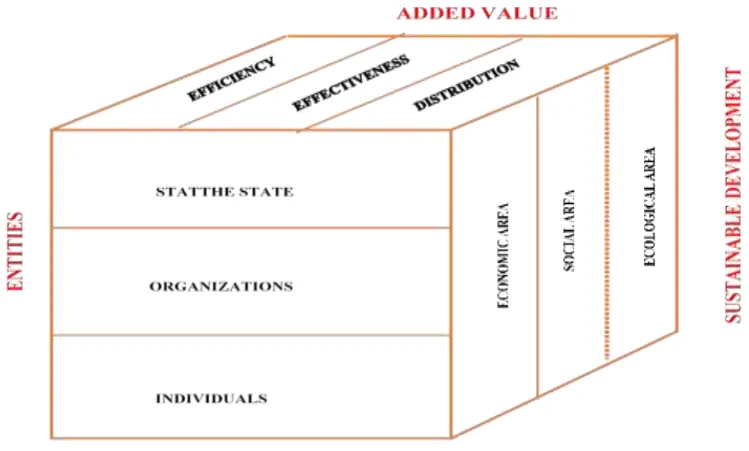
©2012-2020, IJAME. All Rights Reserved 4 The twenty-seven "drawers" (3 x 3 x 3) in the
dice in Figure 2 show more detailed structure of SR elements with their basic constituents, including the synergy between them. The most important element of SR covers three areas: economic, social and ecological as the first dimension of the dice. The key drivers of value added growth are the efficiency and the effectiveness of the business and the appropriate distribution of value added. They are the second dimension of the dice in Figure 2.
The third elements of SR are entities as the third dimension in Figure 2. It contains main forms of entities, e.g. states, organizations and individuals. Figure 2 shows also the synergies within the structure of the basic elements of SR. For example, the drawer at the point of intersection of dimensions contains the responsibility of the state regarding the distribution of value added from an economic point of view. It is important that each element can be subdivided further.
The Basic Dimensions of Social Responsibility
The Focus of SR is Reflected in its Fundamental Dimensions, Namely
Internal relationships, comprising the conduct of individuals and associations of all kinds in the business field (efficient use of elements, investment, innovation, improvement of material position and successful achievement of goals), thereby increasing the margin and value added for easier risk management. What is important
here is organizing the internal information and communication system and reporting, organizing and managing internal processes.
Stakeholder relationships, comprising the conduct of individuals and groups of all kinds with regard to the equality of all stakeholders, both in creating value and in sharing it. It is an expression of the ethical work of all those who are responsible in the processes of creating, sharing, managing people (human abilities), and appropriately governance and co-governance of employees.
Therefore, these relationships also include the relevant legal system, the tax system, due respect for the union, personal excellence (personal ethics), the well-being of those involved, and the organizational atmosphere. It is important to note that each entity has its own stakeholder population.
Relationships to others. They include the social field (education, health, culture, relations with other stakeholders), the ecological field (relationship to nature) an effective and reliable external information-communication system and reporting, and other ways of enhancing the well-being of society in its broadest sense.
The development of the SR of an entity can be studied and monitored (evaluated) by the above dimensions, which are interrelated and interdependent. This is illustrated by the coordinate system in Figure 3.
Figure 3: Monitoring of the development of social responsibility
Internal relationships
©2012-2020, IJAME. All Rights Reserved 5 In Figure 3, the triangles show the
correlation between the SR dimensions allowing for the synergies resulting from these connections. For the practical application and definition of points on the displayed coordinate axes, we need to specify
the content of the particular SR dimensions. By definition of contents on a single axle segments the structure of each dimension is specified. Therefore, a model could be designed again in the form of dice. This is shown in Figure 4.
Figure 4: Breakdown of the fundamental dimensions of social responsibility
The dice in Figure 4 contains 27 (3 x 3 x 3) drawers that illustrate different areas of SR and their interconnection. For example, the drawer at the point of intersection covers the field of education of employees and individuals, including the relevant information system (reporting). Figure 4 shows a holistic view of SR and the interdependence of segments of its fundamental dimensions.
Of course, the segments shown can (and should) be subdivided further. For example, within the stakeholders, business partners can be divided into creditors, customers and suppliers. Employees and individuals can be distinguished by employee type and individual type. Stakeholders may be found, for example, in the immediate and wider environment.
Areas of social responsibility
The areas of SR cover all kinds of activities of people and their organizations. The activities of people and organizations (economic, non-economic and leisure) are constantly changing and complementary and cannot be fully covered. However, it is important that there is no and will not be human activity where there is no need to claim SR.
From current thinking, it is evident that individual areas of SR need to be further elaborated and discussed, while linking them to the elements as well as to the dimensions of SR. Thus, numerous three-dimensional models can be created with the help of Figures 2 and 4, which can be used to break down areas for specific consideration.
Types of Social Responsibility
With breakdown of particular SR dimension, or the individual element, the types of SR are derived. It is a narrower focus that allows adequate analysis of the situation with concrete proposals for improvement. We can distinguish, for example: statutory responsibility, ethical responsibility, responsibility of organizations, responsibility of the state and state administration, management responsibility, responsibility of managers, including employee participation, responsibility of the individual, responsibility of employees, etc. Individual types of SR also need to be considered in relation to the elements and dimensions of SR or further elaborated.
Forms of Social Responsibility
©2012-2020, IJAME. All Rights Reserved 6 individual and are manifested as their
characteristic feature. A distinction can be, for example, responsibility to the concrete environment, a single layer of society, achieving individual business goals, employees and to the union, individual types of stakeholders, etc.
Principles of Social Responsibility
The Fundamental Principles of SR are Encompassed by ISO Standard 26000, which Provides in Chapter 4
Economic, social and environmental responsibility;
Transparency in decision-making and activities that affect society and the environment;
Ethical action;
Respecting, consideration and responding to stakeholders' interests;
Compulsory respect for the rule of law; Respect for international norms of
operation, respecting the rule of law;
Respect for the importance and universality of human rights.
The ISO standard treats the above principles as the responsibility of organizations and does not deal with the SR of the individual, mainly because of the assumption that people also participate in the organization. Nevertheless, the SR of the individual has several important peculiarities that must be taken into account [4].
Aspects (Partial Systems) of Social Responsibility
The use of the partial systems [2] approach in the study of SR is extremely important and useful. This way, we can comprehensively capture some of the categories we might not otherwise be able to. These are primarily categories that permeate all elements, dimensions, fields, types and forms of SR. Among the most important are the following aspects of SR: quality and excellence, ethics, risk, governance of corporations, management of corporations, individual person, organizing, short-term or long-term perspective, information system and information, business processes, legal system, added value, health and well-being, culture, education, communication, innovation, social well-being, etc [6-7].
Conclusion
The previous sections have systematically presented many options for dealing with SR. Consideration of the various possible approaches is necessary to ensure the integrity of the SR approach, but can also be the starting point for individual, concrete discussions and studies, which was also the primary purpose of the paper. In doing so, they remain the basic elements of SR as the common denominator of all researches and studies. Therefore, we cannot get past the question of which direction of study is the most important at the moment.
I believe that it is important to decide on the value added aspect, which is related to the basic human need and the risks involved. Therefore, the functioning of the Value Added Law cited in the starting point of this paper must be taken into account. At the same time, this aspect is also the most difficult to implement in practice, since it requires many changes, both in thinking and values of the people as well as the existing socio-economic and legal system.
This means that there should be scientific and professional discussions focused primarily on the promotion of value added and its enforcement as objective and criteria of success in achieving economic democracy and sustainable development.
References
1. ISO (26000) Social responsibility. (Retrieved: August 2019).
https://www.iso.org/iso-26000-social-responsibility.html.
2. ICCA (2006) the ICCA Handbook on Corporate Social Responsibility. Chichester: John Wiley & Sons, Ltd.
3. A−Z (ICCA 2010) The A to Z of Corporate Social responsibility. Chichester: John Wiley & Sons, Ltd.
4. Bergant Zivko (2019) the Quality of Accounting Information and User's Social Responsibility: Social Aspect. International Journal of Advances in Management and Economics. (Retrieved: December,).
http://www.managementjournal.info/index. php/IJAME/article/view/617/514
©2012-2020, IJAME. All Rights Reserved 7 Precondition of Social Responsibility.
Published in the documentation of the 12th International conference about social responsibility in Maribor, http://www.irdo.si/irdo2017/referati/plenar na-bergant.pdf. (Retrieved: December, 2019).
6. Stiglitz E, Joseph, Fitoussi Jean-Paul, Durand Martine (2018) Beyond GDP: Measuring What Counts for Economic and Social performance. Pariz: OECD Publishing. (Retrieved: December,). http://www.oecd.org/publications/beyond-gdp-9789264307292-en.htm.