Occupational Solution
Insurance Underwriter
Copyright © 2007 by NCS Pearson, Inc.
All rights reserved. No part of this publication may be reproduced or transmitted in any form or by any means, electronic or mechanical, including photocopy, recording, or any information storage and retrieval system, without permission in writing from the copyright owner.
Pearson and TalentLens logos are trademarks, in the U.S. and/or other countries, of Pearson Education, Inc. or its affiliate(s).
Portions of this work were previously published. Printed in the United States of America.
Occupational:
Insurance Underwriter
User’s Guide
Introduction
In response to customer needs and feedback, Pearson developed the Occupational: Insurance Underwriter assessment to provide human resource professionals and hiring authorities with a tool to evaluate key competencies for insurance underwriter jobs. These competencies are based on Department of Labor research and industry expert feedback that identified the characteristics required for success as an insurance underwriter.
This document is designed to facilitate your use of the Occupational: Insurance Underwriter
assessment and report and is organized into four sections:
9 An Overview of the Assessment
9 Administration Best Practices
9 Using Results in Employment Selection
9 Evidence of Reliability and Validity
An Overview of the Occupational: Insurance
Underwriter Assessment
The job category of insurance underwriter includes occupations that have responsibility for identifying and calculating the risk of loss from policy holders. Several insurance underwriter positions include, but are not limited to:
9 Underwriter or Account Underwriter
9 Insurance Underwriter
9 Lines Underwriter or Commercial/Personal Lines Underwriter
9 Automobile and Property Underwriter
This assessment contains two components, Critical Thinking and Work Styles, and takes approximately 50 minutes to complete.
Critical Thinking and Work Styles are two areas critical for effective performance as an insurance underwriter. The Critical Thinking section of the assessment provides information about a candidate’s ability to accurately evaluate situations and make logical decisions when faced with complex or ambiguous information. The Work Styles section provides information about the match between a candidate’s work style behaviors and those required for success in insurance underwriter positions. Together, critical thinking and work style compatibility provide an accurate measure of a candidate’s overall job fit.
The Occupational: Insurance Underwriter assessment comprises the Watson-Glaser Critical Thinking Appraisal (Short Form) as the Critical Thinking section and items from the Workplace Personality Inventory (WPI) as the Work Styles section. More detailed information on the
Watson-Glaser and the WPI can be accessed by logging on to the online testing platform at TalentLens.com. Documents available include:
9 Watson-Glaser Critical Thinking Appraisal Short Form Manual
9 WPI How to Guide
9 Development of the WPI
9 Evidence of Reliability and Validity of the WPI
Critical Thinking
The Critical Thinking section measures a candidate’s ability to make reasonable inferences, recognize assumptions, evaluate arguments, and draw logical conclusions. Critical thinking plays a vital role in occupations that require careful analysis and sound judgment to perform essential job functions. Candidates with a high level of critical thinking ability consistently apply sound logic and reasoning when analyzing information, and make objective and reasonable decisions based on the information available.
The Critical Thinking section is composed of reading passages or scenarios that include
problems, statements, and arguments such as those encountered on a daily basis at work. The 40-item Critical Thinking section is untimed and typically takes candidates about 30 minutes to complete.
Work Styles
The Work Styles scales for the insurance underwriter role were selected from the WPI. The WPI is based on a comprehensive taxonomy of important personality-based work behaviors that were identified by the Department of Labor and classified in their Occupational Information Network (O*NET). These work style behaviors are required for success, in various
combinations, across a wide variety of jobs and industries. The WPI also contains an Unlikely Virtues scale, which is used in the Occupational: Insurance Underwriter assessment to evaluate the candidate’s level of impression management. The 125-item Work Styles section is untimed and typically takes candidates about 20 minutes to complete.
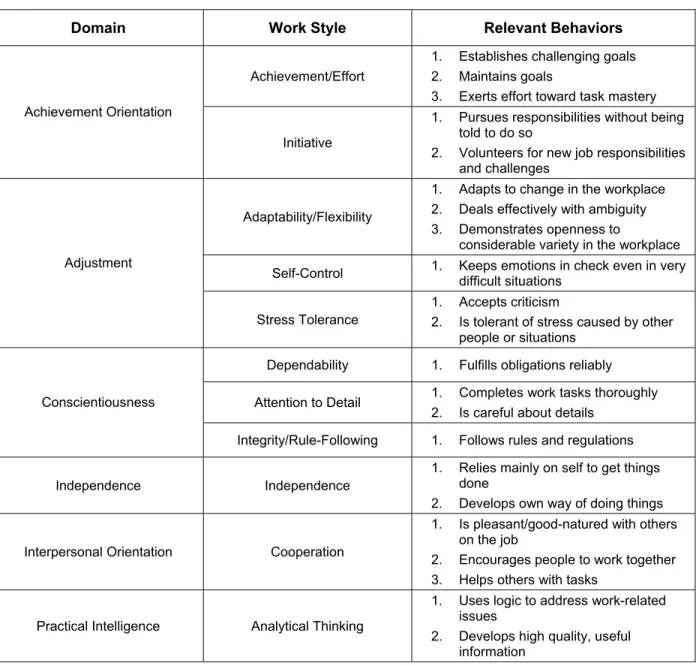
Table 1 presents the domains used in the Occupational: Insurance Underwriter assessment, the Work Style scales measured, and the behaviors each scale represents. These domains are based on the O*NET® content model from which the Work Styles taxonomy was derived. The
scales were chosen based on input from human resources professionals from large insurance organizations and on information provided in the O*NET online database
Table 1. Work Styles Measured by the Occupational: Insurance Underwriter Assessment
Domain Work Style Relevant Behaviors
Achievement/Effort
1. Establishes challenging goals 2. Maintains goals
3. Exerts effort toward task mastery Achievement Orientation
Initiative
1. Pursues responsibilities without being told to do so
2. Volunteers for new job responsibilities and challenges
Adaptability/Flexibility
1. Adapts to change in the workplace 2. Deals effectively with ambiguity 3. Demonstrates openness to
considerable variety in the workplace Self-Control 1. Keeps emotions in check even in very difficult situations Adjustment
Stress Tolerance
1. Accepts criticism
2. Is tolerant of stress caused by other people or situations
Dependability 1. Fulfills obligations reliably Attention to Detail 1. Completes work tasks thoroughly
2. Is careful about details Conscientiousness
Integrity/Rule-Following 1. Follows rules and regulations Independence Independence
1. Relies mainly on self to get things done
2. Develops own way of doing things Interpersonal Orientation Cooperation
1. Is pleasant/good-natured with others on the job
2. Encourages people to work together 3. Helps others with tasks
Practical Intelligence Analytical Thinking
1. Uses logic to address work-related issues
2. Develops high quality, useful information
Administration Best Practices
The Occupational: Insurance Underwriter assessment is administered through the online testing platform at TalentLens.com, an internet-based assessment system designed by
Pearson for the administration, scoring, and analysis of professional assessments. Candidates’ data are instantly captured for processing, and the scores are immediately available in an interpretive report.
Administrator’s Responsibilities
The best way for administrators to prepare for the assessment is to take it themselves,
complying with all directions. The administrator should ensure that the company’s assessment process complies with professional standards and practices, including HR policies. It is the responsibility of the administrator to ensure that candidates understand the purpose and procedures of the assessment. Before candidates take the assessment, the administrator should explain the nature of the assessment, why it is being administered, the conditions under which candidates are being evaluated, and the nature of any feedback the candidate will receive, as determined by company policy. Though not required for job applicants, Pearson recommends obtaining informed consent from the candidate before the assessment is taken. An informed consent form is a written statement explaining the type of assessment instrument to be administered, the purpose of the evaluation, and who will have access to the data. The
candidate’s signature validates that he or she has been informed of these specifics.
Administering the assessment takes about 1 hour total, including giving directions to candidates, answering questions about assessment procedures, and actual assessment time.
Assessment Conditions
The following conditions are necessary for accurate scores and for maintaining the cooperation of the candidates: good lighting; comfortable seating; adequate desk or table space; comfortable positioning of the computer screen, keyboard, and mouse; a pleasant and professional attitude on the part of the administrator; and freedom from noise and other distractions.
Handbags, briefcases, and other personal materials on or near the candidate’s work surface should be set away from the testing area in a secure location. A candidate may not use
reference materials, books, or notes to take the assessment; such materials must be placed out of reach of the candidate.
Answering Questions
Though the instructions for completing the assessment are presented on-screen, it is important to develop and maintain rapport with candidates. The administrator is responsible for ensuring that assessment-takers understand all requirements and how to interact with the assessment interface appropriately.
Candidates may ask questions about the assessment before they begin taking it. Clarification of what is required of candidates and confirmation that they understand these requirements is appropriate. See the section on “Instructions for Administering the Assessment” for an appropriate script when beginning the assessment.
Explaining the meaning of words or items to candidates must be avoided, as that could lead to inappropriate prompting of candidate responses. If candidates have questions about the interpretation of an item, they should be encouraged to respond to the item as they best
understand it. If candidates ask questions while completing the Work Styles section, they should be encouraged to avoid spending too much time thinking about individual Work Styles items. Candidates should be made aware that their quick, reasonably careful, and honest first
reactions to the Work Styles items will likely lead to the most accurate information, as specified in the online instructions provided to them.
Instructions for Administering the Assessment
Candidates do not need pencils or scratch paper for this computer-based assessment. After the administrator has accessed the online testing platform at TalentLens.com, and the initial
instruction screen appears, the candidate should be seated at the computer. This recommended script may be read to them at that time:
The on-screen directions will take you through the entire process, starting with
some demographic questions. After you have completed these questions, the
assessment will begin. The assessment contains two components. The first
component is a non-timed aptitude assessment. It typically takes about 30
minutes to complete this component. The second component is a non-timed
Work Styles inventory. Most people finish this component in about 20 minutes.
You will have as much time as you reasonably need to complete both
components. The assessment ends with a few additional demographic questions.
Do you have any questions before starting the assessment?
Any procedural questions may be addressed at this time. Following the Q&A, the administrator may say:
Please begin the assessment.
Once the candidate clicks the “Start Your Assessment” button, the first page of the Critical Thinking section appears. The candidate may skip items in this section, return to them, or review his or her responses before exiting this section. After the candidate responds to all the Critical Thinking items and exits this component of the Occupational: Insurance Underwriter
assessment, the system locks this section and the candidate cannot go back into it. The candidate can then begin the Work Styles section. Both the Critical Thinking and Work Styles sections are untimed. Candidates typically complete Critical Thinking in about 30 minutes and Work Styles in about 20 minutes.
If a candidate encounters technical problems while taking the assessment, he or she should be moved to another suitable computer location if possible and logged back into the system as before. If the candidate cannot move to another computer, or if the technical problems cannot be solved by moving to another computer location, contact Pearson’s Technical Support at 1-888-298-6227 for assistance.
Differences in Reading Ability—English as a Second Language
Directions and items in the Occupational: Insurance Underwriter assessment are written at or below the 9th grade reading level for the Critical Thinking section and at approximately the 8th
grade reading level for the Work Styles section. Because a level of reading proficiency in the English language is assumed and reflected in the items, reasonable precautions must be taken when assessing candidates whose first language is not English. Specifically, if a candidate has difficulty with the language or the reading level of the items, note this and consider it when interpreting the scores.
Accommodating Candidates with Disabilities
The Americans with Disabilities Act (ADA) of 1990 requires an employer to reasonably
accommodate the known disability of a qualified applicant, provided such accommodation would not cause an “undue hardship” to the operation of the employer’s business.
The administrator should provide reasonable accommodations to enable candidates with special needs to comfortably take the assessment. Reasonable accommodation may include, but is not limited to, modification of the assessment format and procedure, such as live assistance, in which an intermediary reads the online content to a visually impaired candidate and marks their answers for them (Society for Industrial and Organizational Psychology, 2003).
Scoring and Reporting
The score report is available on the online testing platform at TalentLens.com for viewing on screen or printing.
Using Results in Employment Selection
Understanding the Scores Reported
The interpretive report includes percentile scores indicating overall job fit, overall Critical
Thinking, and overall Work Style Compatibility, as well as percentile scores on each of the Work Style scales and Unlikely Virtues. The percentile score is a standardized score that indicates the standing of the candidate relative to individuals in the norm group. The percentile score
indicates the proportion of the norm group who possess less of the characteristic than the candidate. For example, if a candidate’s Critical Thinking score is at the 75th percentile of a
given norm group, it means that the candidate scored higher than or equal to 75% of the people in the norm group. A score above the 50th percentile is considered above average in
comparison to the norm group.
Using the Unlikely Virtues Scale
The Unlikely Virtues (UV) scale should be used to determine whether a candidate’s Work Styles scores are meaningful and undistorted. The UV scale contains self-effacing items and higher scores suggest that the candidate is presenting him/herself in a favorable manner. When an Unlikely Virtues score is excessively high (i.e., equal to or higher than 95% of the
standardization sample), the client should interpret the work style results with caution, and focus on other aspects of the selection process.
Making Selection Decisions
A key consideration in using the Occupational: Insurance Underwriter assessment as part of a selection process involves establishing how to combine the results from the assessment with other information obtained throughout the selection process. Many organizations use a holistic approach in which the interview, résumé review, assessment results, and other information are considered, collectively, to generate a comprehensive profile of each candidate. This approach recognizes that multiple predictors typically produce the most reliable and accurate prediction of job performance.
Another popular alternative is to use the assessment as a screener to determine which candidates are best qualified to advance to the next step in the selection process. The advantage of this is that it can increase efficiency and reduce the cost and time spent using
more expensive selection procedures (e.g., behavior-based interviews conducted by hiring managers) to differentiate between unqualified and qualified candidates.
Pearson does not establish or recommend a passing score (cut score) for the assessment. The client should set appropriate cut scores only after careful consideration of factors unique to their organization (e.g., the supply of talent in the labor market where the organization is located and the client’s emphasis and urgency for keeping jobs filled). In general, the higher a cut score, the higher the likelihood of success for candidates who score above the cut score. Arbitrary cutoffs should be avoided, however, as they can introduce disparate impact into a selection process. The best solution is local validation, which involves relating assessment scores with job performance in the client’s organization. This step provides the best foundation for interpreting scores and differentiating candidates who are likely to be successful from those who are not.
Monitoring the Selection System for Adverse Impact
Assessment results (scale scores, overall match scores, or any assessment metric used in decision making) should be evaluated for evidence of adverse impact. According to the Uniform Guidelines on Employee Selection Procedures (Equal Employment Opportunity Commission, 1978), adverse impact in an assessment is indicated when the selection rate for a protected group is less than 80% of the selection rate for the “majority” group. If a selection system demonstrates adverse impact under these terms, a local validation study showing that the employment assessment tool is equally predictive for protected groups will help demonstrate that the assessment is fair, as outlined by the Equal Employment Opportunity Commission.
Maintaining Security of Results and Materials
Assessment scores are confidential and should be stored in a secure location accessible to authorized individuals only. It is unethical as well as poor assessment practice to allow
assessment score access to individuals who do not have a legitimate need for the information. The security of assessment materials (e.g., access to online tests) and protection of copyright must also be maintained by authorized individuals.
Sources of Additional Best Practice Information
Governmental and professional regulations and guidelines cover the use of all personnel selection procedures. Relevant source documents that the user may wish to consult include the
Principles for the Validation and Use of Personnel Selection Procedures (Society for Industrial and Organizational Psychology, 2003) and the Uniform Guidelines on Employee Selection Procedures (Equal Employment Opportunity Commission, 1978). For an overview of the statutes and types of legal proceedings that influence an organization’s equal employment opportunity obligations, the user is referred to Cascio and Aguinis (2005) or the U.S. Department of Labor’s (1999) Testing and Assessment: An Employer’s Guide to Good
Practices. Assessment users should consult with qualified legal advisors and human resources professionals as needed to ensure that they understand and adhere to regulations related to employee selection.
Evidence of Reliability and Validity
Reliability—Critical Thinking
As reported in the Watson-Glaser manual, the internal consistency reliability was .81 for a sample of 1,608 employees from a variety of industries. The test-retest reliability was .81 for a sample of 42 publishing company employees, retested over an interval of 14 days. These values indicate that the Critical Thinking component of the Occupational: Insurance Underwriter
assessment has good internal consistency and test-retest reliability.
Reliability—Work Styles
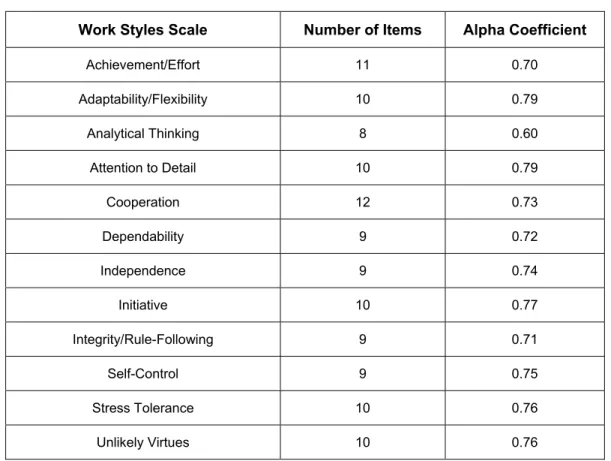
As presented in Table 2, the Work Style scales coefficient alphas ranged between .60 and .79 (median = .75) for a group of 687 respondents from a variety of occupations and organizational levels. These values indicate that the Work Styles component of the Occupational: Insurance Underwriter assessment has adequate internal consistency reliability.
Table 2. Alpha Reliability Coefficients for WPI Scales (n = 687)
Work Styles Scale Number of Items Alpha Coefficient
Achievement/Effort 11 0.70 Adaptability/Flexibility 10 0.79 Analytical Thinking 8 0.60 Attention to Detail 10 0.79 Cooperation 12 0.73 Dependability 9 0.72 Independence 9 0.74 Initiative 10 0.77 Integrity/Rule-Following 9 0.71 Self-Control 9 0.75 Stress Tolerance 10 0.76
Content Validity—Critical Thinking and Work Styles
In an employment setting, evidence of content validity is demonstrated by measuring competencies that are required for the job. For the Occupational: Insurance Underwriter
assessment, a two-step process was used. First, job-relevant scales for the assessment were identified through interviews with HR professionals in the insurance industry. Second, a review was conducted of the job analysis data provided in O*NET® on insurance underwriter jobs. This
two-step process insured that the items and the constructs measured in this assessment are highly relevant for insurance underwriters.
As an additional step, we recommend that you compare your job description and other sources of job information to the competencies (Critical Thinking and Work Styles) measured by the
Occupational: Insurance Underwriter assessment to insure that what is being measured is relevant for insurance underwriter positions in your organization. It is important to make sure that your position is being defined in a manner similar to the typical definition of insurance underwriter. For legal defensibility, the assessment solution must show relevance for the position for which it is used.
Convergent and Criterion-Related Validity—Critical Thinking
Evidence of convergent validity for the Critical Thinking component of the Occupational:
Insurance Underwriter assessment has been demonstrated in numerous studies that examined the relationship between the Watson-Glaser and tests measuring similar domains. Convergent validity relies on data demonstrating that scale scores that theoretically should be related to each other are, in fact, related to each other as evidenced by significant correlations. For example, a recent study showed that the Watson-Glaser correlated .70 (p < .0001) with the
Miller Analogies Test for Professional Selection in a sample of 63 job incumbents across multiple jobs and industries. The Watson-GlaserShort Form Manual (Watson & Glaser, 2006) contains additional evidence of convergent validity for the Watson-Glaser.
Evidence of criterion-related validity has been provided in a series of studies showing the relationship between Critical Thinking scores and job performance. These studies have shown that the criterion-related validity demonstrated by the Watson-Glaser typically ranges from “likely to be useful” to “very beneficial” (i.e., validity coefficients range from .21 to greater than .35), based on U.S. Department of Labor guidelines (1999). The Watson-GlaserShort Form Manual
(Watson & Glaser, 2006) contains descriptions of the many criterion-related validity studies that support the use of the Watson-Glaser for employee selection.
Convergent and Criterion-Related Validity—Work Styles
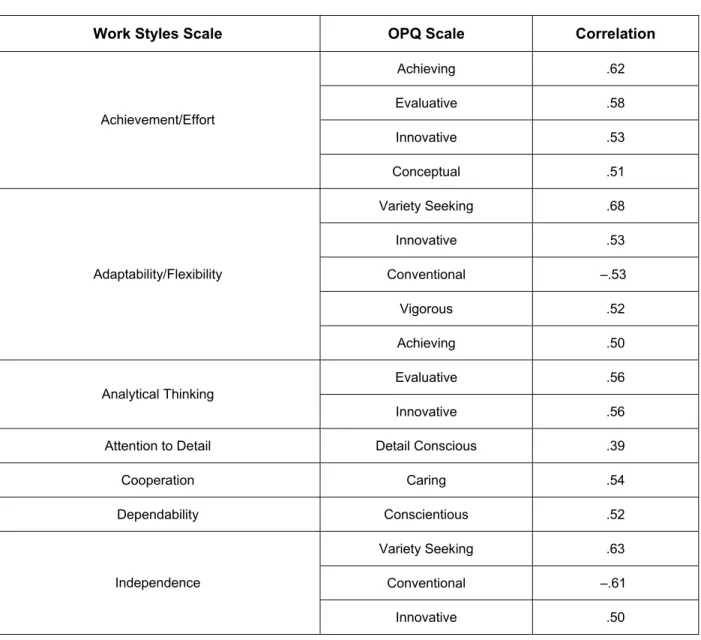
Evidence of convergent validity for the Work Styles component of the Occupational: Insurance Underwriter assessment has been demonstrated in studies that examined the relationship between the twelve WPI scales used in the Occupational: Insurance Underwriter assessment and personality tests measuring similar domains. A recent correlational study was conducted between the WPI and the Occupational Personality Questionnaire (OPQ; Saville & Holdsworth, 1990). As presented in Table 3, eleven of the twelve scales correlated .50 or better with a similar OPQ scale.
Table 3. Correlations of Work Style and OPQ scales (n = 74)
Work Styles Scale OPQ Scale Correlation
Achieving .62 Evaluative .58 Innovative .53 Achievement/Effort Conceptual .51 Variety Seeking .68 Innovative .53 Conventional –.53 Vigorous .52 Adaptability/Flexibility Achieving .50 Evaluative .56 Analytical Thinking Innovative .56
Attention to Detail Detail Conscious .39
Cooperation Caring .54
Dependability Conscientious .52
Work Styles Scale OPQ Scale Correlation Variety Seeking .67 Achieving .66 Innovative .61 Vigorous .59 Conventional –.54 Initiative Outgoing .51
Integrity/Rule-Following Rule Following .75
Tough Minded .62 Self-Control Social Desirability .54 Tough Minded .70 Relaxed .58 Worrying –.56 Stress Tolerance Socially Confident .50
Unlikely Virtues Social Desirability .70
Evidence of criterion-related validity for the Work Styles scales included in this assessment is based on broader research that used the WPI. The Work Styles scales were correlated with supervisory ratings and objective data, such as number of days absent. These studies showed support for a relationship between Work Styles scores and job performance. For instance, Adaptability/Flexibility scores correlated .30 (p < .05) with supervisory ratings of
adaptability/flexibility in a sample of 57 managers. Similarly, in a sample of 47 project managers, Self-Control scores correlated .48 (p < .01) with supervisory ratings of self-control, and in a sample of 74 customer service representatives, Dependability scores correlated –.38 (p < .01) with supervisory ratings of tardiness. The WPI Evidence of Reliability and Validity Technical Report (Pearson, 2007) contains additional evidence of validity based on assessment-criterion relationships for the scales included in this assessment.
References
Americans With Disabilities Act of 1990, Titles I & V (Pub. L. 101-336). United States Code, Volume 42, Sections 12101–12213.
Cascio, W., & Aguinis, H. (2005). Applied psychology in human resource management (6th ed.). Upper Saddle River, NJ: Prentice Hall.
Equal Employment Opportunity Commission. (1978). Uniform guidelines on employee selection procedures. Federal Register, 43(166), 38295–38309.
Pearson. (2007). Development of the Workplace Personality Inventory (Tech. Rep.). San Antonio, TX: Author.
Pearson. (2007). WPI Evidence of Reliability and Validity Technical Report. San Antonio, TX: Author.
O*NET OnLine (2007). Welcome to O*NET ™ OnLine! Making occupational information interactive and accessible to all. Occupational Information Network: O*NET OnLine. Retrieved February 13, 2007 via O*NET OnLine Access: http://online.onetcenter.org Saville, P. & Holdsworth, R. (1990). Occupational Personality Questionnaire manual. Surrey,
England: Saville & Holdsworth.
Society for Industrial and Organizational Psychology. (2003). Principles for the validation and use of personnel selection procedures (4th ed.). Bowling Green, OH: Author.
U.S. Department of Labor. (1999). Testing and assessment: An employer’s guide to good practices. Washington, DC: Author.
Watson, G. B. & Glaser, E. M. (2006). Watson-Glaser Critical Thinking Appraisal Short Form Manual. San Antonio, TX: Pearson.