A Pragmatic Approach to
Network Security for Virtualized
Computing Environments
Sponsor: Palo Alto Networks
Author: Mark Bouchard
Executive Summary
Virtualization technologies introduce a number of challenges when it comes to ensuring an adequate degree of network security is provided for modern computing environments. This is particularly true for server virtualization platforms that enable live migration of virtual machines and include virtual networking capabilities that support “network-in-a-box” configurations (i.e., where entire segments are implemented on a single physical host). This paper describes these challenges and provides a framework and best practices that organizations can use to address them in a pragmatic yet highly effective manner. Key points that are covered include the following:
• Organizations will be well served by continuing to adhere to the same core security and common sense principles that have long been used to ensure adequate protection is provided for their traditional, physical networks.
• Just because a network is virtualized does not mean that the only – or even best – way to secure it is with countermeasures that are also virtualized. Due to distinct advantages they have in several areas (e.g., performance and maintaining separation of duties), physical network security appliances will remain an indispensible part of organizations’ network security strategies, even as their networks and data centers evolve into fully dynamic, fabric-oriented computing infrastructure.
• What constitutes a best-fit solution for network security changes over time as organizations progressively take greater advantage of advanced virtualization capabilities in their environments and as network security tools steadily evolve to match this progression.
A Pragmatic Approach to Network Security
for Virtualized Computing Environments
Table of contents
Executive Summary ...2 Virtualization Introduces New Network Security Challenges ...3 Core Principles and Common Sense Still Apply ...4
Virtualization Introduces New Network Security Challenges
Although virtualization impacts other aspects of enterprise security, such as endpoint and host protection, the focus for this paper is on ensuring that adequate network security is provided for virtualized computing environments. To further frame the topic, it is important to also establish what is meant by the term “virtualized computing environments.” The most common and, therefore, relevant piece of the virtualization puzzle today is server virtualization. However, the intent here is to also account for the growing adoption of other virtualization technologies (e.g., for networks, storage, desktops and applications) and closely related cloud computing solutions, all en-route to creating a highly flexible computing fabric where resources can dynamically be assigned in a mix-and-match manner to best meet the needs of the organization at any given point in time. In any event, the primary challenges that arise from a network security perspective include the following: • Ensuring hypervisor integrity. This may sound like a host-oriented security issue, but is relevant to this
discussion because of the role that server-level hypervisors play in enabling the creation of virtual networks. Furthermore, a successful attack against a host’s hypervisor has the potential to negate the vast majority of technical countermeasures an organization puts in place, and is essentially equivalent to compromising all workloads being delivered by the host.
• Accounting for intra-host communications. This is where different virtual machines (VMs) are able to interact with each other without the associated communications traffic ever leaving the host on which they reside. The issue in this case is the potential loss of visibility and control for essential countermeasures such as firewalls and intrusion prevention systems.
• Accounting for virtual machine migration. This is where VMs are re-located from one host to another without disrupting ongoing sessions. The problem this presents is that it tends to break network security tools that rely too heavily on physical and/or network-layer attributes. More generally, it introduces the need for network security solutions capable of ensuring that applicable access control and traffic inspection rules continue to be enforced, regardless of the potential for workloads to move from one host to another, and, ultimately, from one site to another.
A fourth concern that is often raised is the possibility of having workloads with different trust levels co-exist on the same host. This is not, however, a truly independent problem. If all three of the above items are adequately addressed, then there’s no additional risk that can be attributed to having mixed trust levels present on a single host. The real problem here lies with the “if” in this statement. For the vast majority of situations encountered in organizations today, this condition will not be met. As a result, although it is not another challenge per se, the relative trust level of workloads is, in fact, an important variable that helps determine the requirements for an appropriate network security solution.
Core Principles and Common Sense Still Apply
The introduction of a new technology – even one that has the potential to completely transform the physical composition and arrangement of an organization’s computing infrastructure – does nothing to alter the fundamental principles that define good network security. Therefore, a sensible starting point for a network security strategy for virtualized computing environments is to consider those principles and related, common sense practices which have historically served as the basis for adequately protecting non-virtualized networks and data centers. Some of the more notable of these that remain applicable and deserve continued attention include:
• Defense in depth. Having multiple, complementary layers of protection defends against a broader range of threats and mitigates the risk of any single countermeasure being circumvented.
• Segmentation of resources with different trust levels. Ideally all resources – but at a minimum those with different trust levels – should be separated by intervening countermeasures. This helps prevent cascading compromises where a successful attack against one resource quickly leads to all neighboring resources also being subverted.
• Separation of duties. To avoid conflicts of interest that lead to lapses in protection, it is preferable that the same person not have control over both the operation of a resource and the tools used to secure it.
• Separation of countermeasures (i.e., from the resources they are intended to protect). Whenever possible, preference should be given to external countermeasures (as opposed to ones that are co-resident with the resource being protected). This ties back to the principle of defense in depth and effectively eliminates the possibility of having a single exploit which, in compromising a system, also neutralizes associated counter-measures.
Overall, the primary goal is to achieve a degree of separation and protection that is equivalent to what organizations have historically had in place for their non-virtualized infrastructure. Another bit of common sense that comes into play is that just because a thing can be done, doesn’t mean it should be done. For example, although server virtualization can be used to consolidate trust levels and thereby reduce infrastructure costs, the tradeoff is that this approach increases configuration complexity and, as a result, risk. The point is that all relevant factors and implications need to be carefully weighed when making such choices. As will be seen shortly, this is particularly the case when deciding whether to use physical or virtual appliance versions of a network security tool in a given situation.
Finally, it is important to recognize that a successful network security solution is one that is adaptable. Rather than remaining fixed over time, it makes far greater sense that tactics and tools should steadily evolve to account for the inevitable changes to the extent and nature of how virtualization technology is used.
Ensuring Hypervisor Integrity
Having established a framework of governing principles and practical guidelines, it’s now time to tackle the first challenge. In general, it makes sense to treat hypervisors the same as high-profile server operating systems. Meticulous patch and change management practices are, therefore, an essential starting point. As risk levels increase, it then becomes appropriate to progressively layer in the following items:
• Native security features that are part of the server virtualization platform. These include memory or process “firewalls” which are functionally similar to traditional host intrusion prevention technology.
• An external firewall and/or network intrusion prevention system (IPS). Granularly controlling access to a system effectively reduces its attack surface, while IPS can stop threats specifically targeted against the hypervisor.
• System-wide anti-virus/anti-malware. This is a super-agent that taps into the hypervisor and simultaneously provides protection both for the hypervisor itself as well as for all of the VMs on the system. Currently rare, such solutions are expected to be widely available within the next year or two.
Also relevant in this case is the fact that all server virtualization platforms are not the same. Inherent security characteristics and available features require attention not only at the time of product selection, but often during initial implementation and ongoing operations as well. For example:
• Bare-metal hypervisors (i.e., Type 1) are better from a security perspective due to the absence of guest operating systems.
• So-called “thin virtualization” solutions that avoid the need for a parent partition and minimize hypervisor code are better because of their reduced attack surface.
• Virtual switch/networking features – such as support for Layer 2 access control, promiscuous mode off by default, and the ability to prevent MAC address changes – provide the opportunity for incremental security gains.
• Robust resource reservation capabilities are crucial to preventing scenarios where excessive utilization by one VM starves out all other VMs on the same system.
Security for Virtual Networks and Migrating Workloads
Moving forward, the following sections describe a phased plan for addressing the other network security challenges presented by virtualized computing environments. The basis for this plan is that the requirements change as organizations progressively take greater advantage of virtualization technology in their environments and as network security tools evolve to keep pace. Another major advantage of this plan is that it aligns well with several practical realities, such as the inertia behind existing practices and product investments, the need to gain experience and ramp up related skill sets, and the likelihood that organizations will transform their infrastructure incrementally, rather than all at once.
Phase 1 – Server Consolidation Within Trust Levels
Applicable now, this first phase involves only having workloads that share the same trust level co-exist on a single host. Other characteristics and conditions that define this phase are as follows.
State of network security technology – leading products should incorporate a robust virtual systems capability, where a single instance of the associated countermeasures can be partitioned into multiple logical instances, each with their own policy, management, and event domains. This way, a single physical device can be used to simultaneously meet the unique requirements of multiple tenants (e.g., VMs, or groups of VMs).
Extent of intra-host communications – minimal/irrelevant. As a matter of routine for this phase, most traffic is directed off-box to users/systems residing at different trust levels. When intra-host communications do take place, not having intervening countermeasures is completely consistent with what most organizations currently do for their DMZs.
Extent of VM migration – live migration features are used to enable transfer of VMs only to hosts supporting workloads with the same trust level and only within the same subnet. Because VMs retain their IP and MAC addresses when they move, there should be no loss of context/control for intermediate network security devices. Physical network security appliances that are properly positioned and configured to control and protect inter-host traffic are all that organizations need during this phase. Because they combine all of the requisite countermeasures in a single device, next-generation firewalls (NGFWs) will typically prove to be an ideal solution.
Phase 2 – Server Consolidation Across Trust Levels
The approximate timeframe for this second phase is 1 to 2 years out. At that point, workloads with different trust levels will regularly co-exist on the same host.
“In the next few years, we will see scenarios in which workloads of vastly different trust levels are combined on the same physical hardware” – Gartner1
The solution for this phase is that internal communication paths are intentionally NOT configured between VMs with different trust levels. Instead, all traffic is forced off-box through a default gateway (i.e., a physical network security appliance) before being allowed to proceed to the destination VM. Typically this can be accomplished by configuring separate virtual switches with separate physical NICs for the VMs at each distinct trust level.
Phase 3 – Selective Network Security Virtualization
With an approximate timeframe of 2 to 5 years out, this phase involves selective virtualization of network security capabilities.
State of network security technology – next-generation firewalls from leading vendors need to be available as VM-based implementations.
Extent of intra-host communications – “architected.” All intra-host communication paths are strictly controlled to ensure that traffic between VMs at different trust levels is intermediated either by an on-box, virtual security appliance or an off-box, physical security appliance.
Extent of VM migration – “architected.” Long-distance live migration (e.g., between data centers) is enabled by combining native live migration features with a set of external products and mechanisms that address related networking and performance challenges.
A combination of both physical and virtualized network security tools are appropriate for this phase. The intense processing requirements for an NGFW workload will ensure that purpose-built physical appliances continue to play a leading role. That said, virtual instances will undoubtedly begin to make some inroads, particularly for scenarios where countermeasures need to “migrate” along with the workloads they are tasked to protect.
“By 2015, 40% of the security controls used in enterprise data centers will be virtualized, up from 5% in 2010” – Gartner2
TRUST LEVEL 1
HYPERVISOR HARDWARE
EXTERNAL NETWORK SECURITY GATEWAY PHYSICAL NETWORK
INTERFACES
VIRTUAL SWITCH VIRTUAL SWITCH
V
VIIRRTTUUAALL SSWW WWIITTCC
TRUST LEVEL 2
Additional tradeoffs to consider when selecting between physical and virtual instances for any given situation are identified in Table 1.
Table 1: Physical Appliances vs. Virtual Instances
Advantage for Physical Appliances Advantage for Virtual Instancesi
• Greater performance/capacityii • Less load placed on servers/hosts • Fewer instances to manage • Better separation of duties • Complete feature set • Industry certifications
• Greater device consolidation • Greater agility/portability • Less introduced latency
i) The term “virtual instance” refers to the situation when a virtualized security tool is run on the same host as the VMs it is protecting. This is in contrast to running it alone, as a dedicated virtual appliance.
ii) Operating a true NGFW (vs. a port-based firewall) as a virtualized workload on a shared, general-purpose platform will typically have significant performance implications not only for the firewall itself, but also for all other workloads running on the same host.
Phase 4 – Dynamic Computing Fabric (aka, Private Cloud)
Still relatively far out on the timeline (~5+ years), phase 4 is when conventional, static computing environments are finally transformed into dynamic fabrics where underlying resources (e.g., network devices, storage, servers) can fluidly be engaged in whatever combination best meets the needs of the organization at each point in time.
State of network security technology – this phase requires a new generation of both security and networking solutions that are not only capable of being virtualized, but are also virtualization aware/ready.
Extent of intra-host communications / VM migration – unrestricted. Virtualization aware networking and security solutions dynamically adjust as needed to address respective communication and protection requirements. In terms of a network security solution for this phase, it seems likely that a combination of physical and virtual instances will still be appropriate. The highly dynamic nature of future computing fabrics may play somewhat to the favor of virtualized tools, but at the end of the day physical appliances will still retain most of their advantages – not to mention the fact that even highly virtualized computing environments cannot escape their physical foundations.
This is not to say that it will simply be “business as usual” at this point. To remain effective, associated counter-measures will need to become virtualization-aware/ready. Although, the details of precisely what this entails and how it will be achieved are still unfolding, a couple of high-level requirements can be used to begin to paint the picture of what’s ultimately needed.
(2) Associated management applications will need to be capable of orchestrating the activities of physical and virtual instances of countermeasures first with each other, and subsequently with other infrastructure components as well. This will be necessary to ensure not only that adequate protection is provided despite the fact that workloads are always shifting around, but also that it is delivered in an optimal manner.
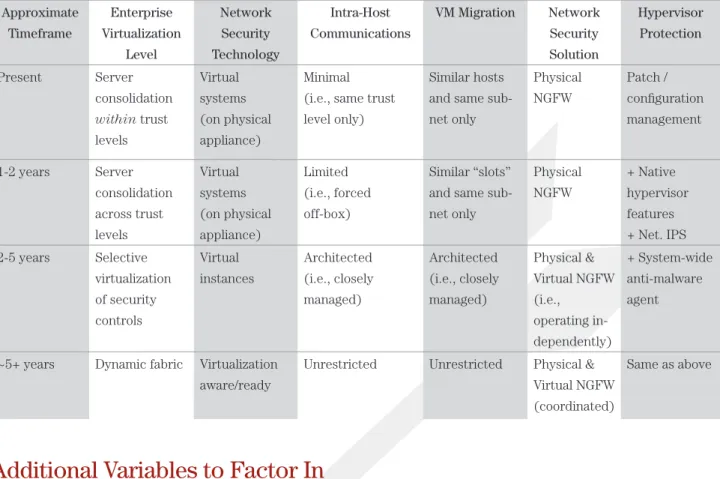
Table 2: Phased Network Security Plan for Virtualized Computing Environments
Approximate Timeframe Enterprise Virtualization Level Network Security Technology Intra-Host Communications VM Migration Network Security Solution Hypervisor Protection Present Server consolidation within trust levels Virtual systems (on physical appliance) Minimal (i.e., same trust level only)
Similar hosts and same sub-net only Physical NGFW Patch / configuration management 1-2 years Server consolidation across trust levels Virtual systems (on physical appliance) Limited (i.e., forced off-box) Similar “slots” and same sub-net only Physical NGFW + Native hypervisor features + Net. IPS 2-5 years Selective virtualization of security controls Virtual instances Architected (i.e., closely managed) Architected (i.e., closely managed) Physical & Virtual NGFW (i.e., operating in-dependently) + System-wide anti-malware agent
~5+ years Dynamic fabric Virtualization
aware/ready
Unrestricted Unrestricted Physical &
Virtual NGFW (coordinated)
Same as above
Additional Variables to Factor In
A couple of other variables also have the potential to influence the approach an organization takes when it comes to providing adequate network security for virtualized environments. These include the nature of the specific use case and applicable regulatory requirements, and, depending on the situation, may actually take precedence over the guidelines summarized in Table 2.
Use Case / Location. How and/or where a network security tool such as a next-generation firewall will be used is often indicative of the preferred form factor. For instance, physical appliances will generally be a better fit for well-defined, high volume choke points where performance is absolutely essential, such as Internet gateways or at the data center core. In comparison, the flexibility afforded by virtual instances and appliances often makes them the better option for enterprise test and development labs.
Vertical Industry / Regulatory Requirements. For many organizations that are subject to tighter security standards, possibly due to their vertical industry association(s), maintaining separate, physical network security controls will often be preferred – assuming it’s not actually required. In general, this approach provides higher assurance in terms of the degree of separation and protection that is provided. It also addresses the prevailing expectation that auditors will apply added pressure for highly virtualized scenarios given the greater risk of configuration errors and lower visibility of policy violations. Finally, there are those instances where applicable requirements leave little, if any, choice. Just consider the PCI Data Security Standard which explicitly states that “… preventive controls such as a network firewall should never be combined on a single logical host with the payment card data it is configured to protect.”3
Conclusion
At a high level, establishing an appropriate degree of network security for virtualized computing environments entails continuing to follow the same proven, principles and common sense guidelines that have long been used to secure traditional, physical networks and data centers. In terms of specific controls, the many advantages physical appliances have – for example, in the areas of performance, separation of duties, and reduced management complexity – ensures they will remain indispensible. In comparison, virtualized versions of key network security tools, such as next-generation firewalls, only become necessary as organizations reach a relatively high degree of virtualization maturity. Overall, maintaining effectiveness once networks and datacenters are transformed into fully dynamic, fabric-oriented infrastructures will require that both types of tools – physical and virtual – evolve to be fully virtualization-aware/ready. This includes being able to operate independent of physical and fixed network-layer attributes, as well as being able to dynamically coordinate inspection and control activities to ensure comprehensive protection is always in place, even for continuously shifting workloads.
Footnotes:
(1) “Net IT Out: Cloud Performance and Security” – Gartner Security & Risk Management Summit, June 2011 (2) ibid.