Program Evaluation in E-Learning
Badrul H. Khan, Ph.D
Many institutions invested heavily in the development and deployment of online programs. E-learning has increasingly become a viable, effective way of delivering instruction and training. Like any new learning initiative, stakeholders of online learning face many challenges. There is always room for improvement by exploring what worked and what did not. To understand online learning environment, we need to have a
comprehensive picture of people, process and product involved in it, and also study critical issues encompassing its various dimensions. Khan (2004a) developed
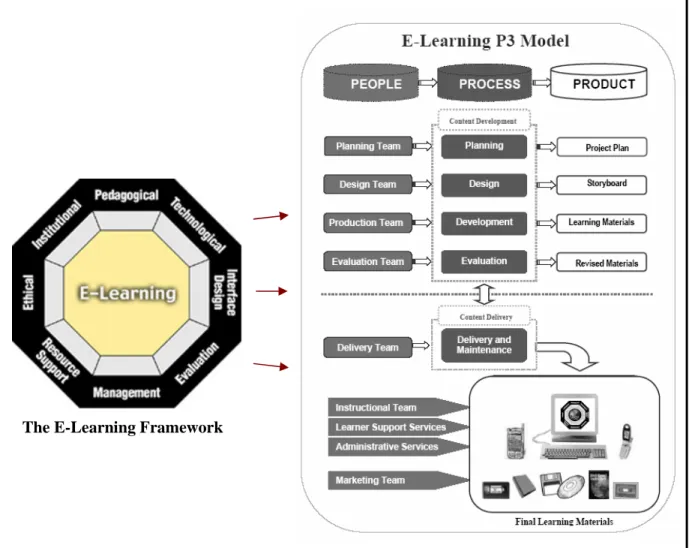
People-Process-Product Continuum or P3 Model (see in Figure 1) which can be used to map a comprehensive picture of e-learning. Khan (2005) has developed a Framework for E-Learning which puts the instructional systems design and pedagogical issues in the context of a much wider and complex set of factors integrating the analysis of an organization’s e-learning environment.
Implementation of e-learning is increasing worldwide. As more and more institutions review their e-learning programs from the various dimensions of an e-learning
environment, we become increasingly more knowledgeable about e-learning which, in turn, guides us to further inquiry in the field. Literature on e-learning program evaluation is naturally skimpy, Frydenberg (2002) noted that few fully developed programs have arrived at a stage where summative evaluation is possible. To evaluate online programs, Khan (2004) combined the knowledge base from his P3 model and the E-Learning Framework to develop a Comprehensive Approach to Program Evaluation in Open and Distributed Learning (CAPEODL which can be pronounced as “KA-POO-DUL) model. The following is an outline of the chapter:
• E-Learning Framework
• People–Process–Product Continuum in E-Learning or P3 Continuum
• A Comprehensive Approach to Program Evaluation in E-Learning (Review of People, Process and Product of E-Learning from the Perspectives of the E-Learning Framework, CAPEODL)
• Conclusion
E-Learning Framework
The E-Learning Framework which can be used to capture an organization’s inventory of e-learning by addressing issues encompassing the following eight dimensions of open and distributed learning environments:
1. Pedagogical: Refers to teaching and learning. This dimension addresses issues concerning content, audiences, goal and media analysis; design approach; organization and methods and strategies of e-learning environments. 2. Technological: Examines issues of technology infrastructure in e-learning
environments. This includes infrastructure planning, hardware and software. 3. Interface Design: Refers to the overall look and feel of e-learning programs. The
interface design dimension encompasses page and site design, content design, navigation, and usability testing.
4. Evaluation: Includes both assessment of learners, and evaluation of the instruction and learning environment.
5. Management: Refers to the maintenance of learning environment and distribution of information.
6. Resource Support: Examines the online support and resources required to foster meaningful learning environments.
7. Ethical: Relates to social and political influence, cultural diversity, bias,
geographical diversity, learner diversity, information accessibility, etiquette, and the legal issues.
8. Institutional: Issues of administrative affairs, academic affairs and student services related to e-learning.
People–Process–Product Continuum in E-Learning
In e-learning, people are involved in the process of creating e-learning products and making them available to a specified audience. The People–Process–Product Continuum or P3 Model (Figure 1) can be used to map a comprehensive picture of e-learning (Khan, 2004a).
The e-learning process can be divided into two major phases: (1) content development, and (2) content delivery. A typical e-learning development phase includes planning, design, development and evaluation stages, and the delivery phase includes instruction, marketing, and maintenance stages. The e-learning process is iterative in nature.
Although evaluation is a separate stage of the content development process, shown in Figure 1, ongoing formative evaluation for improvement (i.e., revision) should always be embedded within each stage of the e-learning process. Individuals involved in various stages of the e-learning process should be in contact with each other on a regular basis and revise materials whenever needed.
Based on the size and scope of the project, the number of individuals involved in various stages of an e-learning project may vary. Some roles and responsibilities may overlap as many e-learning tasks are interrelated and interdependent. A large-size e-learning project requires the involvement of various individuals. With a small or medium-sized e-learning project, some individuals will be able to perform multiple roles. When an e-learning course is completely designed, developed, taught, and managed by a single individual, it is clear that the same individual has performed the role of content expert, instructional designer, programmer, graphic artist, project manager, etc. This is an example of a small-size e-learning project. Many individuals have had experiences in developing their online courses by themselves, with intermittent staff support from their institutions.
A Comprehensive Approach to Program Evaluation in E-Learning To understand the overall status of an e-learning program, it seems necessary that each stage (e.g., planning, design, development, evaluation, delivery, and maintenance) of an e-learning process should be carefully examined through the eight dimensions (i.e., lenses) of the Framework. The Comprehensive Approach to Program Evaluation in Open and Distributed Learning (CAPEODL) uses the E-Learning Framework (as an octagonal magnifying glass) to review the P3 Continuum. In this section we discuss how each category of the Framework is used to review the quality of products and services during the content development and content delivery phases of e-learning process which, in turn, help us judge the performance of people involved in the process.
CAPEODL’s review process involves asking relevant and appropriate question(s) from each dimension of the E-Learning Framework. It is important to note that it may be difficult to come up with questions for some dimensions of the Framework for some specific stages of the e-learning phases—which is understandable given the
interrelationship among the characteristics of the eight dimensions. In such situations, we recommend not worrying about those particular dimensions and continue with other dimensions. Within the scope of this chapter, we have presented only a few sample questions for the following seven stages of the e-learning process:
Review of Content Development Phase 1. Review of Planning Stage 2. Review of Design Stage 3. Review of Development Stage 4. Review of Evaluation Stage Review of Content Delivery Phase
5. Review of Marketing Stage
7. Review of Instruction Stage
Figure 1 The CAPEODL model
The E-Learning Framework
Review of E-Learning Planning Stage
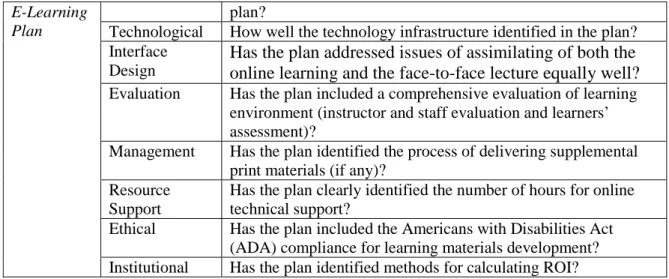
Based on the scope of the e-learning projects, the planning team may be comprised of key individuals such as project manager, business developer and instructional designer. The team develops a project plan (i.e., an e-learning plan) which clearly identifies the people, process, and product of each stage of the e-learning process. A project plan serves as a road map for an e-learning project. Table 1 provides sample review criteria (in the form of questions) for the planning stage.
Table 1 Product and the CAPEODL Performance Criteria for Planning Stage E-Learning
Products
CAPEODL Category
Sample Performance Criteria
plan?
Technological How well the technology infrastructure identified in the plan? Interface
Design
Has the plan addressed issues of assimilating of both the online learning and the face-to-face lecture equally well?
Evaluation Has the plan included a comprehensive evaluation of learning environment (instructor and staff evaluation and learners’ assessment)?
Management Has the plan identified the process of delivering supplemental print materials (if any)?
Resource Support
Has the plan clearly identified the number of hours for online technical support?
Ethical Has the plan included the Americans with Disabilities Act (ADA) compliance for learning materials development?
E-Learning Plan
Institutional Has the plan identified methods for calculating ROI?
Review of E-Learning Design Stage
With a comprehensive understanding of learners’ needs, institutional capabilities, and experience in e-learning design and research, the design team (led by instructional designer) is responsible for reviewing course content for pedagogical soundness and the selection of the appropriate delivery medium. In this stage, instructional designers work with subject matter experts, interface designers, copyright coordinators, and evaluation specialists.
The major product of an e-learning course design process is the storyboard. Brandon (2004) states, “A storyboard is to e-Learning design what a blueprint is to architecture.” The storyboard provides the details from the designers that are needed by the developers (production team) to produce e-Learning materials on time and within budget. Table 2 provides sample review criteria for the design stage.
Table 2 Product and the CAPEODL Performance Criteria for Design Stage E-Learning
Products
CAPEODL Category
Sample Performance Criteria
Pedagogical How well the instructional strategy used for each objective?
Technological How well are e-learning standards for interchangeability of learning objects (i.e., Sharable Content Object Reference Model - SCORM) used throughout the course?
Interface Design
If different delivery formats (i.e., online, face-to-face lecture are used in the course, how well is content structure, navigation and multimedia in each format integrated so that learners can switch between different types without confusion or interruption? Evaluation How well is Subject Matter Expert (SME) feedback regarding
the storyboard incorporated?
Management How well does the storyboard use existing learning materials?
Storyboard
Resource Support
How well are content-specific online resources incorporated in lessons?
Ethical Is the content requiring copyright permission identified?
Institutional Can the organization offer the course independently as well as in a blended program?
Review of E-Learning Production Stage
During production stage, the production team creates the learning materials for a course from the storyboard generated during the design stage. The production coordinator leads the e-learning production process. Team members include, but are not limited to: course integrator, programmer, graphic artist, multimedia developer, photographer/videographer, editor, learning objects specialist, and quality assurance person. The production team makes sure that the timeline is maintained for all deliverables. The e-learning production process is time consuming. It is a collaborative process in which each member does his or her own specific tasks for a course (some members of the development team can be remotely located) in compliance with due dates for their respective tasks. Table 3 provides sample review criteria for the production stage.
Table 3 Product and the CAPEODL Performance Criteria for Development Stage E-Learning
Products
CAPEODL Category
Sample Performance Criteria
Pedagogical How good is the content? How well do learners interact with it?
Technological How do the course materials fare with the existing technology infrastructure for the learners?
Interface Design
Are online course contents easy to use?
Evaluation How well is the content relevancy with the course objectives maintained?
Management Are the external links used in the course still active?
Resource Support
How well does the online help (if any) function?
Ethical Are course materials designed with good cross-cultural sensitivity?
E-Learning Materials
Institutional How well are course materials developed from the perspective of the academic or training standards of the institution?
Review of E-Learning Evaluation Stage
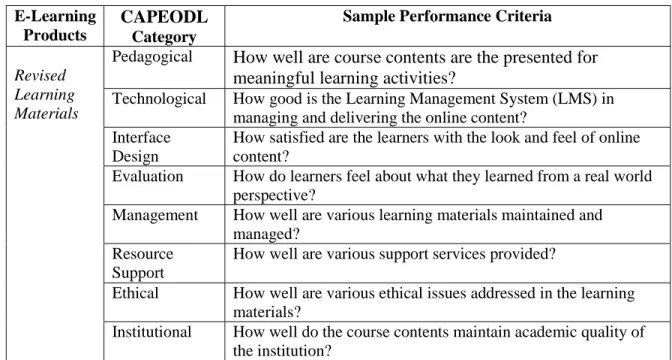
Several phases of evaluation can be conducted during the overall e-learning process. These evaluations are conducted to improve the effectiveness of e-learning materials. There are two types of evaluation: formative (conducted to improve the learning product as it is being developed - during the content development phase) and summative
(conducted as the final assessment of learning products—during the content delivery phase). By conducting ongoing formative evaluation, we can improve the e-learning product as it is being developed. Formative evaluation is inherent in the e-learning development process. Instructional designers and interface designers review learners’
feedback from the pilot and communicate with the production teams to make course revisions. Table 4 provides sample review criteria for the evaluation stage.
Table 4 Product and the CAPEODL Performance Criteria for Evaluation Stage E-Learning
Products
CAPEODL Category
Sample Performance Criteria
Pedagogical How well are course contents are the presented for meaningful learning activities?
Technological How good is the Learning Management System (LMS) in managing and delivering the online content?
Interface Design
How satisfied are the learners with the look and feel of online content?
Evaluation How do learners feel about what they learned from a real world perspective?
Management How well are various learning materials maintained and managed?
Resource Support
How well are various support services provided?
Ethical How well are various ethical issues addressed in the learning materials?
Revised Learning Materials
Institutional How well do the course contents maintain academic quality of the institution?
Review of E-Learning Marketing Stage
Institutions offering e-learning courses/programs are increasingly facing competition as learners have more options from which to choose with a variety of e-learning courses or programs from all over the world. This is good for learners, but it makes the e-learning market very competitive. With non-academic institutions or vendors often competing with academic institutions, ongoing market research with e-learners (i.e., clients) can provide institutions with advantage over others in their e-learning offerings. Market researchers and recruiters (or salespersons) are among the people who should be part of the overall e-learning marketing initiative. Effective marketing will help institutions to attract and recruit students for their courses and programs. An important marketing strategy for any offeror is to make accurate information about their e-learning offerings known to as many potential learners as possible. Table 5 provides sample review criteria for the marketing stage.
Table 5 Product and the CAPEODL Performance Criteria for Marketing Stage E-Learning
Products
CAPEODL Category
Sample Performance Criteria
Pedagogical How well does the course design contribute to an interactive and flexible learning environment?
Technological How well does the technology integration improve the effectiveness of the course?
Marketed Course
Interface Design
How well does the look and feel of the course content contribute to the efficiency and effectiveness?
Evaluation How well learners’ assessment is integrated into the course for academic performance measures?
Management Are course materials 24/7 accessible? Resource
Support
Do the course resource support services improve the efficiency and effectiveness of the courses?
Ethical Are ethical considerations included in the course to improve diversity, cross cultural and legal issues?
Institutional How well the course improves the return-on-investment?
Review of E-Learning Delivery and Maintenance Stage
All online course materials should be accessible by the learners at anytime from anywhere in the world. All supplemental course materials (e.g., CD, DVD, audio and video cassette, book, course pack, etc.) should be delivered to learners. The delivery and maintenance team consists of individuals such as systems administrator, server/database programmer, webmaster, etc., who are responsible for maintaining an effective and efficient e-learning environment. Table 6 provides sample review criteria for the delivery and maintenance stage.
Table 6 Product and the CAPEODL Performance Criteria for Delivery and Maintenance Stage
E-Learning Products
CAPEODL Category
Sample Performance Criteria
Pedagogical How instructionally sound is the course?
Technological Are learning materials easily accessible by learners? Interface
Design
How well can learners navigate the learning materials easily?
Evaluation How well are the assessments of students and evaluations of instructional/support staff supported?
Management Are learning materials delivered and updated efficiently? Resource
Support
Are resource support services well maintained?
Ethical How well are legal issues handled?
Final Learning Materials
Institutional How well are course materials received by students?
Review of E-Learning Instruction Stage
At the course instruction stage, instructional and support services (ISS) staff may include (but are not limited to): course coordinator, instructor, tutor, course facilitator, discussion moderator, technical support, librarian, counselor, customer service, registration and administrative staff. When a course is offered, the ISS is at the front line working directly with students. Students expect uninterrupted and meaningful learning environments. The online course coordinator should make sure that registered students receive orientation for the course and that ISS support is available as promised. The course coordinator should always be in touch with the delivery and maintenance team to resolve any technical problems that the ISS team may encounter during the course. Table 7 provides review criteria for the instruction stage.
Table 7 Product and the CAPEODL Performance Criteria for Instruction Stage E-Learning
Products
CAPEODL Category
Sample Performance Criteria
Pedagogical How well the instructor(s) facilitate learning?
Technological How well technology tools (Webinar, etc.) used by instructor(s)? Interface
Design
How well online and offline activities are seamlessly integrated during the instruction period of the course?
Evaluation How well students’ assessments are done in the course? Management How well course contents are updated?
Resource Support
How well resource support services provided during instruction period?
Ethical How well ethical issues (such copyright, learner and geographical diversities) are honored during the instruction period?
Course Taught
Institutional How well institutional academic standards and regulations are followed during the instruction period?
CAPEODL in Practice
CAPEODL was first used by The George Washington University graduate students (mostly professionals from government agencies, corporations and educational settings) taking the Program Evaluation course with the first author. Students used CAPEODL to review sixhigher education institutions in the USA and Canada, including; Regis University, Tallahassee Community College, University of Illinois-Springfield,
University of Alaska, Illinois Online Network, British Columbia Open University (Khan, 2004).
The results of the program evaluations were shared with the contact persons in each institution. Participating institutions received reviews of pedagogical, technological, interface design, evaluation, management, resource support, ethical and institutional aspects of their online programs. Institutions shared their views on using CAPEODL noting that they were able to identify areas where they had strengths and weaknesses—helping them to better appropriate resources and develop future budgets. For example, one participating institution’s online program did very well in the pedagogical issues, but poorly in ethical issues. By using the CAPEODL model students advised, “Since the pedagogical design of e-learning is satisfactory, there is no need to either replace the existing instructional designer or hire new one. Since the plagiarism and intellectual property rights issues were not adequately addressed, assistance from individuals with expertise in legal and
copyright issues should be considered in future online learning projects.”
The Federal Leadership Institute in the USA uses the CAPEODL for conducting workshops (see Figure 2) and for developing and reviewing e-learning and blended-learning materials for federal agencies, including: Federal Aviation
Administration (FAA), Department of Health and Human Services (HHS), Department of Housing and Urban Development (HUD), Department of Education (ED) and National Oceanic, Atmospheric Administration (NOAA) and Department of Defense (DOD).
Figure 2 The CAPEODL model adopted at the Federal Leadership Institute
Dr. Luara Granato of Federal Leadership Institute with Dr. Badrul Khan Conclusion
New developments in learning sciences and technologies provide opportunities to develop well-designed, learner-centered, engaging, interactive, affordable, efficient, effective, easily accessible, flexible, and meaningful e-learning environments (Khan, 2007). However, institutions that are invested heavily in the development and
deployment of online programs should be increasingly interested in investigating the return-on-investment of their e-learning products. These institutions must use a comprehensive review system to get a real picture of what works, what doesn’t and where needs improvement. The E-Learning P3 Model provides a comprehensive picture of the e-learning process and helps to identify the roles and responsibilities for the design, development, evaluation, implementation, and management of all e-learning and blended learning products. On the other hand, the E-Learning Framework allows us to examine critical issues within the eight dimensions of e-learning environment. By integrating both the P3 model and the framework, the CAPEODL model can capture an organization’s inventory of e-learning programs, and can provide valuable insights into what works and where adjustments are needed for improvement.
References
Brandon, B. (2004, May). Storyboards tailored to you: Do-it-yourself magic arrows. The eLearning Developers’ Journal. 1-8. Retrieved November 16, from:
http://www.elearningguild.com/pdf/2/050304des.pdf
Frydenberg, J. (2002). Quality Standards in e-Learning: A matrix of analysis. The International Review of Research in Open and Distance Learning, 3( 2), Retrieved March 14, 2007, from:
http://www.irrodl.org/index.php/irrodl/article/viewArticle/109/189
Khan, B. H. (Ed.). (2007). Flexible learning in an information society. Hershey, PA: Information Science Publishing.
Khan, B. H. (2005). Managing e-learning: Design, delivery, implementation and evaluation. Hershey, PA: Information Science Publishing.
Khan, B.H. (2004). Comprehensive approach to program evaluation in open and distributed learning (CAPEODL) model. Introduced in the Program Evaluation course. George Washington University.
Khan, B. H. (2002, January-February). Discussions of e-learning dimensions. Educational Technology. 42(1). 59-60. http://bookstoread.com/framework/ Khan, B. H. (2004a, September-October). People, process and product continuum in
e-learning: The e-learning P3 model. Educational Technology. Vol.44, No. 5. pp. 33-40. Retrieved March 14, 2007, from:
http://bookstoread.com/etp/elearning-p3model.pdf
_________________