82
ECOLOGICAL RECONSTRUCTION THROUGH AFFORESTATION
WORKS OF THE JILT DUMP HAVING AN AREA OF 10 HA, LOCATED IN
THE MIDDLE BASIN OF JILT RESULTED THROUGH SURFACE MINING
DINUCĂ NICOLAE CĂTĂLIN
The Ministry of Waters and Forests, Ramnicu Valcea Forest Guard, [email protected]
Key words: dump, afforestation, black locust, sea buckthorn.
ABSTRACT
Through the research undertaken on the present subject it aimed the scientific groundwork of the ecological reconstruction of the dump resulted through surface minings located in the middle basin of Jilt and the choice of afforestation technical solutions using the forest vegetation. This scientific groundwork follows the way to achieve the dumps and their current morphology, as well as the mineralogical and particle size, physical, hydrophysical and chemical composition of these dumps, factors underlying the characteristics of the composed technosoils and the choice of the species, formulae and of the afforestation schemata. Also, the groundwork aims the harmonization of the ecological requirements of the used wood species with the dump soil characteristics.The preparation technology of the dumps in order to afforestation is relatively simple and it requires a rest period after the release from the technological changes, to strengthening and stabilization, followed by a microlevelling and then the artificial ingrass on the sectors where it was not
naturally installed. To establish the species used in afforestation works and the way of installation of the forest vegetation on the taken dumps, it were taken into account aspects specific to the site conditions.Forest promotes the storage of water on slopes, by preventing the formation of the surface runoffs and of the flood waters, following the heavy rains and the snowmelt, thus counteracting the flood phenomena and soil erosion. The establishment of the forest plantations aims the slope stabilization and the development of some forests with multiple role: the protection of the environment by regulating the climate and the hydrological regime and by creating parks and recreation places of favorable habitats for wildlife and protective role.Outstanding results on afforestation of the Jilt dump presented: sea buckthorn, black locust, poplar and walnut, these species will be used for the stabilization of the future dumps.Less well results presented species of Quercus (sessile oak, Turkey oak, pedunculate oak, red oak), pine, hazel.
INTRODUCTION
The Jilt Dump improvement area is located in the north of the piedmont hills, namely the Motru hills, on the western part of the interfluvium separating Valea Motrului from Valea Jilţului. The current geomorphology of the analyzed perimeter is the result of the up-to-date exploitation of coal by scraping and dumping. The Jilt Dump was formed following the
deposition of the tailings resulted from the coal extraction.
83
wide slope, with a slope of over 35%, the slope is continuous and uneven, with a tilt to the east. There is a second, slightly inclined planar surface in the form of a plate, with a width of 20-40 m.
From a geological and lithological point of view, the Jilţ Dump is very complex, the complexity resulting from the fact that various underlying rocks meet different geological age, thickness, nature, granulometry, which were upgraded and mixed in a heterogeneous way.
All these materials are devoid of fertility or it is very low, and because of this, the lithological materials that make up the studied heap have different degrees of re-cultivation.
Lithological materials due to heterogeneity create great problems in the recultivation process because cultural measures can not be differentiated on each type of material due to uneven surfaces, which require different treatments.
In this perimeter of refurbishment there are also larger or smaller coal debris.
By exploiting so far coal through excavation and dumping ground, the initial appearance of the natural framework has changed radically. In addition to the changes directly produced by coal exploitation, there have been transformations due to water erosion, landslides.
Also, in the process of exploiting the carboniferous factor, "soil" has disappeared, even if fertile soil has been deposited in order to be used to cover the surfaces to be arranged. In addition to these changes to the natural setting, there are also many physico-chemical changes. These materials are physically and chemically heterogeneous, are devoid of biological activity and are diverse mineralogical (sands, clay, clay), which makes the fertility potential low. After the mining of the Jilţ Dump, the natural (pedogenetic) factors act permanently in time and space on the mining and organic materials through the processes of disintegration, alteration, migration and accumulation, leading to soil formation.
MATERIAL AND METHOD
The area of Jilt Dump 10 hectares was arranged in the summer of 2009, that is the leveling works of the waste material. Following the execution of the technical - mining stage, a plateau was formed around the slopes. In the autumn of 2010 several species were planted, as follows: the sea buckthorn. - Hippophae rhamnoides L., the 2 x 2 planting scheme , 5-000 pieces; walnut - Juglans regia L., planting scheme 4 x 4 - 120 pieces; hazelnut - Corylus avellana L., planting scheme 2 x 2 - 2000 pcs; black pine - Pinus nigra Arn., planting scheme 2 x 1 - 4000 pcs; acacia - Robinia pseudacacia L., planting scheme 2 x 1 - 3000 pieces; red oak - Quercus rubra L., planting pattern 2x1 - 2000 pcs; sky - Quercus cerris L., planting scheme 2x1 - 2000 pcs; quark oak - Quercus robur L., planting pattern 2x1 - 2000 pcs; squirrel - Quercus
petraea Lieb., planting scheme 2x1 - 2000 pcs; poplar tremulous - Populus tremula L., planting scheme 6x6 - 1000 pcs; ash - Fraxinus excelsior L., planting scheme 2 x 1 - 2000 pcs.
In the spring of 2011, after harvesting of the saplings, the catch percentage was performed and the following results were shown: sea buckthorn, 99% catch percentage; acacia, 95% catch percentage; tremulous poplar has a 75% grip; walnut, exhibits 85% grip; ash, exhibits an 80% grip; the pine has a catch rate of 78%, the red oak, the sky, the pedunculate oak, the oak have a grip between 60% and 70%.
During the years
84
RESULTS AND DISCUSSIONS
Following the annual control from autumn 2011, outstanding results showed the following species: sea buckthorn, 95% success rate; acacia, 85% success rate; tremulous poplar, success rate of 70%; black walnut has a success rate of 70%; ash has a success rate of 65%.
It was found that red oak, sky, pedunculate oak, oak, have a success rate of between 2% and 5% due to the limiting factor, the excessive drought in the summer of 2011, and the pine has a success rate of 5% the excessive drought limiting factor.
Considering the great results of sea buckthorn, acacia, poplar and walnut,
these species will be used to stabilize future tailings dumps. Lesser crops have been found in cervinaceae species (sessile oak, Turkey oak, pedunculate oak, red oak), pine, hazelnut, species not recommended for future plantings on tailings dumps.
In the autumn of 2014, after the annual control of regeneration, there was a success rate of: sea buckthorn, a success rate of 82%; acacia, a success rate of 62%; tremulous poplar, success rate of 62%; black walnut has a 62% success rate; ash, has a success rate of 50%.
Percentage of rooting dump Jilt 10ha, considering the year
Tabel no.1
Dump Jilt - 10
ha
No.
The planted species
Percentage of grip at the entrance to
the vegetation (%)
Percentage of success at the annual control (%)
First year - 2011
Second year - 2012
Third year - 2013
Fourth year -2014
1
sea
buckthorn 99 95 90 85 82
2 acacia 95 85 75 65 62
3
tremulous
poplar 75 70 69 65 62
4 walnut 85 70 68 64 62
5 ash 80 65 62 58 50
6 pine 78 5 3 3 2
7 red oak 80 5 3 2 2
8 turkey oak 78 4 2 1 1
9
pedunculate
oak 75 3 2 1 1
10 sessile oak 65 2 2 1 1
85
Figure no.1 Grip percentage and percentage of success on Jilt Dump
Distribution of trees by category of diameters on the Dump Jilt 10 ha
Tabel no.2 Categories of diameters
(cm) Composition 1 1,5 2 2,5 3 3,5 4 4,5 5 5,5 6 Total
Number of trees on the surface 1 - plateau
100 sea
buckthorn 1 0 16 22 24 7 10 5 1 0 0 86 Number of trees on the
surface 2 - plateau
100 sea
buckthorn 2 2 19 20 17 11 5 1 0 1 0 78 Number of trees on the
surface 3 - side
100 sea
buckthorn 0 1 5 22 0 20 8 2 1 3 3 65 Number of trees on the
surface 4 - plateau
100 sea
buckthorn 1 0 5 6 25 20 3 25 4 0 0 89 Number of trees on the
surface 5 - plateau 100 ash 5 0 30 16 6 5 4 0 0 0 0 66
Number of trees on the
surface 6 - plateau 100 ash 5 0 10 23 23 5 4 0 0 0 0 70
Number of trees on the
surface 7 - plateau 100 walnut 0 0 2 0 1 2 5 0 0 0 0 10
Number of trees on the
surface 8 - side 100 walnut 0 0 1 0 5 4 1 0 0 0 0 11
Total trees on 1600 mp 14 3 88 109 101 74 40 33 6 4 3 475
Total trees per ha 88 19 550 681 631 463 250 206 38 25 19 2969
86
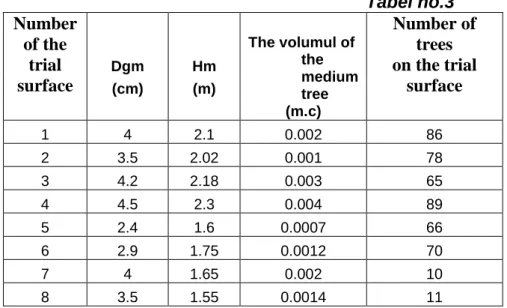
The taxing characteristics of the crops on the Jilţ Halda - Culture at the age of 4 years
Tabel no.3 Number
of the
trial Dgm Hm
The volumul of the medium tree (m.c)
Number of trees on the trial
surface surface (cm) (m)
1 4 2.1 0.002 86
2 3.5 2.02 0.001 78
3 4.2 2.18 0.003 65
4 4.5 2.3 0.004 89
5 2.4 1.6 0.0007 66
6 2.9 1.75 0.0012 70
7 4 1.65 0.002 10
8 3.5 1.55 0.0014 11
The stochastic dependence between the mean diameter and the average height of the trees on the Jilt Dump can no longer be expressed by a quadratic regression function. From Figure 3 we can see that the point cloud has a linear trend, this aspect being generated by the level of (<7cm). The linearity tendency of the studied dependence is very well statistically assured, the linear correlation coefficient
(r) being very significantly different from 0.
From the regression equation it results that on average an increase in diameter by 1 cm corresponds to an average increase in the height of approximately 27 cm. This equation is valid only for the studied field and can not be used for average diameters larger than 6 cm.
Figure no. 3 The right regression that estimates the stochastic dependence between the average diameter (D) and the average height of the trees (H) on the Jilt Dump.
CONCLUSIONS From the researches carried out in
the graphs presented and the field
87
Juglans nigra L. - black walnut is a pretentious species to sational conditions, prefers temperate climate, freezing frosts and frosts, poorly lighted, etc. It is pretentious to edaphic conditions, preferring fertile, mesohydric edatic soils and avoids soils with excess moisture, xerophytes, compact and acidic. Because it prefers soils with a slightly alkaline reaction, it is indicated on carbonate soils or weakly alkaline soils, generally on terraces or microterays on the slopes, where the fertility of technnosols is slightly higher (Şofletea N., Curtu L., 2008 ).
Pinus nigra Arn. - the black pine is a species with a lower ecological amplitude than the silvery pine, but it is a rustic species tolerant to climatic and edaphic factors (Şofletea N, Curtu L., 2008).
Being a mediated species, it adapts well under the conditions of climate with submediterranean influences, as is the case in Oltenia.
As a drought resistant species, it can be used on medium-coarse soils on the slopes of the heaps, sunny or partly sunny with extra summer heat.
These skills of xerophyte, calichole, subcalcicle species recommend it on degraded lands, such as tailings dumps.
Although in our experiments on Jilţ Dump the catch and keeping ratio was low given the ecological requirements of this species, it should be further used in forest crops on the dumps, either in the form of pure crops or mixed with other species.
Hippophae rhamnoides L. - the sea buckthorn, the sea bass is a species very resistant to frost and frost, but supports the limiting conditions with dry climates with strong sunstroke. It is an euriphic species, resists dryness and excess and alternate humidity regime. It is an euriedic species, it carries the raw, superficial, skeletal, poorer soils, grohotisuri and plundisuri, wet clays, compact soils (Şofletea N., Curtu L., 2008).
It is a species that fits very well the tailings, erodable and sand sheds, with a well-developed rooting system, proven by the culture set up on the Jilt Dump.
Performs symbiosis with nitrifying bacteria, enriching the soil in nitrogen. In addition to the protective function and soil improvers, sea buckthorn can also be used in the food and pharmaceutical industry, fruits that are rich in vitamins, especially vitamin C, are used (Şofletea N., Curtu L., 2008).
In addition to using seabuckthorn in degraded lands or tailings dumps, it can be used in hedges, against grazing. Sea buckthorn flowers are honey and beekeeping can develop.
Quercus rubra L. - red oak, American red oak is a species that takes good winter frosts and escapes from spring frosts as it starts in the vegetation relatively late. It proves to be sensitive to early frosts, which sometimes catch partially lignified lizards and thus produce bifurcation of the trunks (Şofletea N., Curtu L., 2008).
The red oak is grown on both halide materials with a sandy-loose texture, relatively poor in mineral elements, and clay-rich clay (clay-clayey, clay), sometimes quite heavy, compact. It manifests tendencies of eurifitism, resisting prolonged drought and, on the other hand, is able to vegetate on hydromorphic soils, such as pseudo-geological ones (Şofletea N., Curtu L., 2008).
Its temperament is
subheliophilous, supports lateral shading, can be installed on the slopes of the heaps with shaded or partially shaded slopes. The long-lasting shading leads to its elimination.
Although in our experiments on Jilţ Dump the catch percentage is good, 80%, its maintenance was low due to drought in the summer season, it should be used further in the forest crops on the dumps either in the form of pure crops or mixed with other species.
88
vegetation season, is a relatively thermophilic species (euthemia - mesotherm). It does not bear the great winter frosts, causing gels. It is a species that is well tolerant of drought and dryness, it falls into the category of mezoxeropite-xerophytes (relatively xerophytes) (Şofletea N., Curtu L., 2008).
The turkey oak prefers heavier, clay-clayey, heavily permeable soils with poor internal drainage, moderate to strong podzolite, from excessively wet after snow melting to strong dry during summer. The turkey oak has an amplitude to the seasonal dynamics of soil moisture, consumes plenty of water during periods of excess, reducing its claims during the summer season. The turkey oak is maintained in dry periods by the promptness of the closing and opening mechanism of the stomata. From this point of view, we admit the adaptive superiority of the turkey oak to the gutter under limiting thermal conditions (Şofletea N., Curtu L., 2008).
A very important feature of the use of Quercus cerris L. on tailings dumps is its resistance to CaCO3 - rich waste material.
Although the percentage of grappling is good in our Halda Jilts experiment, 78%, the percentage of success has not been satisfactory, but it has to be further used in forest crops on the dumps either in pure crops or mixed with other species.
Quercus robur L. - oak, pedunculate oak, tufa is a more resistant species than the bigger, but more demanding heat in the summer season, is a mesothermal - eutrophic species. As regards the requirements to the soil is a relatively pretentious species, growing on nutrient-rich, deep-water soil (mesotrof-eutrof), well-supplied with water (mesofit mesohigrofit). It is a species that supports even the floods, but not of great magnitude and only in a limited time (Şofletea N, Curtu L., 2008).
It grows unsatisfactorily on poor soils, on sandy, active drainage, dry, on very compact, with alternating humidity
regime, as is the case with dumped material from surface mining.
The upper shading is extremely damaging to the development and maintenance of oak specimens; instead, lateral shading is beneficial as it stimulates its growth in height and the formation of well-truncated trunks (Şofletea N., Curtu L., 2008).
Quercus robur L. can be introduced into the tailings dumps on sunny or partly sunny slopes.
Quercus petraea ssp. Petraea L. - sessile oak is a species closely related to the pedunculate oak tree. It is a less demanding species than the heat of the summer season, especially during the summer. He sessile oak is a typical mezoterm species (Şofletea N., Curtu L., 2008).
Regarding the physical properties of the heaped material, the sessile oak has great demands on them, but is more tolerant of their chemical properties. The optimal development is recorded in areas where the waste material has a coarse, loose texture, well drained, with constant humidity, is a mesophilic, drainfish species.
On sloping slopes, terraces, platforms and platforms rich in clay, which are hardly permeable, where it pours water from the tailings dumps, constitute unfavorable conditions for the growth and development of the sessile oak.
It is a more tolerant species than oak in terms of saturation in bases of exchange.
Concerning the experiences with the sessile oak species on the Jilţ Dump, a good catch percentage was found, and due to drought during the summer season, the seedlings were dried. However, it should still be used in forest crops on the dumps, either in the form of pure crops or in blends with other species.
89
material is richer in nutty substances, it is better than evergreen, it is a euritrophic species, mesophyte - eurifite and even with euriedaphic inclinations (Şofletea N., Curtu L., 2008).
In areas subject to dryness, such as those formed on sandstone, it is rarely encountered or completely absent.
It is a rustic species, with active growth in the youth, capable of fructification and dissemination, it can be introduced without major restrictions on the tailings dumps, being considered a pioneer species.
Fraxinus excelsior L. - ash, common ash is a species that meets from the Mediterranean to the Boreal. However, it is affected by the late frosts, which capture the terminal bud that started in the vegetation. The terminal bud opens faster about two weeks later, which leads to the frequent truncation of the trunk (Şofletea N., Curtu L., 2008).
Frasin was installed on the heaped material in areas well-supplied with water, even hydromorphs, where it boils water, but not for a long time, showing the tendency to abandon the status of a species of dissemination, forming pure stands, there is a trend of fading.
It is a pretentious species of soil in the bases of exchange. He has a temperament of light, in the early 5-6 years he is relatively shaded, so that, with the aging, he is more pretentious to light (Şofletea N., Curtu L., 2008).
Cele mai bune rezultate în recultivarea silvică pe Halda Jilț s-au obținut cu Robinia pseudacacia L., Hippophae rhamnoides L.Rezultate deosebite privind împădurirea haldelor de steril au prezentat cătina albă, salcâmul,plopul și nucul, aceste specii se vor folosi pentru stabilizarea viitoarelor halde de steril. Rezultate mai puțin bune au prezentat speciile de cvercinee (gorun,cer,stejar pedunculat,stejar rosu), pinul, alunul.
The best results in the forest recultivation on the Jilt Dump were obtained with Robinia pseudacacia L., Hippophae rhamnoides L. Special results for the afforestation of the tailings dumps showed sea buckthorn, acacia, poplar and walnut, these species will be used to stabilize the future tailings dumps. Less good results showed the species of cervinaceae (sessile oak, turkey oak, pedunculate oak, red oak), pine, hazelnut.
BIBLIOGRAPHY
1. Dinuca Nicolae Catalin, 2015: Researches regarding the scientific substantiation of the ecological reconstruction of tailings dumps resulting from surface mining in the middle basin of Jilţ and Motrului. PhD thesis. Transilvania University of Brasov.
2. Florescu Gheorghe, Abrudan Ioan Vasile, 2003, "Afforestation, Seeds. Nursery ", Transilvania University of Brasov Publishing House.
3. Florescu Gheorghe, Abrudan Ioan Vasile, 2003, "Technologies for the Installation of Forest Cultures", Transylvania University of Brasov Publishing House.
4. Sofletea Nicolae, Curtu
Lucian,2008, "Dendrology Second Edition", "For Life" Publishing House Brasov.