
ORIGINAL RESEARCH ARTICLE
Assessment of Knowledge, Attitude and Experience of Sexual
Violence among Female Employees in Sokoto Metropolis, Northwest
Nigeria
DOI: 10.29063/ajrh2020/v24i2.16
Oche Mansur Oche*, Habibullah Adamu, Shawwal A Mallam, Rasheedat A Oluwashola and
Aisha S Muhammad
Department of Community Health, Usmanu Danfodiyo University, Sokoto Nigeria
*For Correspondence: Email: [email protected]; Phone: +2348035045144
Abstract
This descriptive cross-sectional study was carried out to determine the knowledge, attitude and experiences of sexual violence among female employees in Sokoto metropolis. Multistage sampling technique was used to select 191 participants and a set of pre-tested structured questionnaire was used to obtain data from the participants. Data was analysed using IBM SPSS version 20. The mean age of the respondents was 28.9years ±6 with 102(53%) of them aged between 20-30 years. Up to 112(63.6%) of them were unmarried, 127(73%) were Muslims and 96(54.5%) in the upper socio-economic class (SEC). About 50% of respondents in both formal and informal settings had good knowledge of sexual violence and up to 36% and 64% of respondents in the formal and informal settings respectively have positive attitude towards sexual violence (SV). Overall prevalence of SV in the workplace was 63.8% (N=113) and significant predictors of SV in the work place include tribe (p=0.006), work setting (p=0.02) and society‘s perception of SV (P<0.001). Respondents in this study showed high levels of awareness and knowledge regarding SV in the workplace. The study revealed a high prevalence of SV in the workplace especially among females in formal settings with several factors including, perception of the society on sexual violence and working in the formal sector were found to have influenced respondents‘ experience of SV in the workplace. There is the need, therefore for the government and relevant stake holders to put in place measures to curb SV in the workplace and protect victims of such practices with relevant legislations . (Afr J Reprod Health 2020; 24[2]: 164-175).
Keywords: Sexual violence, female employees, knowledge, Sokoto metropolis
Résumé
Cette étude transversale descriptive a été réalisée pour déterminer les connaissances, l'attitude et les expériences de la vi olence sexuelle parmi les employées de la métropole de Sokoto. Une technique d'échantillonnage à plusieurs degrés a été utilisée pour sélectionner 191 participants et un ensemble de questionnaires structurés pré-testés a été utilisé pour obtenir des données des participants. Les données ont été analysées à l'aide d'IBM SPSS version 20. L'âge moyen des répondants était de 28,9 ans ± 6, dont 102 (53%) âgés de 20 à 30 ans. Jusqu'à 112 (63,6%) d'entre eux étaient célibataires, 127 (73%) étaient musulmans et 96 (54,5%) dans la classe socio-économique supérieure (SEC). Environ 50% des répondants dans les contextes formels et informels avaient une bonne connaissance de la violence sexuelle et jusqu'à 36% et 64% des répondants dans les contextes formel et informel respectivement ont une attitude positive envers la violence sexuelle (VS). La prévalence globale de la VS sur le lieu de travail était de 63,8% (N = 113) et les prédicteurs significatifs de la VS sur le lieu de travail comprennent la tribu (p = 0 ,006), le milieu de travail (p = 0,02) et la perception de la société de la VS (P <0,001). La prévalence de la VS s'est avérée élevée dans cette étude. Il est donc nécessaire que le gouvernement et les parties prenantes concernées mettent en place des mesures pour limiter les VS sur le lieu de travail. (Afr J Reprod Health 2020; 24[2]: 164-175).
Mots-clés: Violence sexuelle, employées, savoir, métropole de Sokoto
Introduction
Sexual violence (SV) is defined as any sexual act, attempt to obtain a sexual act, unwanted sexual
but not limited to home and work1. The word sexual violence can be used interchangeably with sexual harassment. Its behavior forms include visual (leering), verbal, (sexual teasing) jokes, comments or questions; unwanted pressures for sexual favor or date, unwanted touching or pinching, unwanted pressures for sexual favor with implied threats or job related consequences for non-cooperation, physical assault, sexual assault, rape2. The Center for Disease Control (CDC) 3 classified SV as completed consensual sex act (e.g. rape); attempted non-consensual act (e.g. attempted rape); abusive sexual contact (e.g. unwanted touching) and non-contact sexual abuse (e.g. sexual coercion and unwanted sexual attention). According to Britz, several forms of sexual harassment occur including: Verbal (Sexual innuendoes, jokes of a sexual nature, sexual propositions or sexual threats), Non-Verbal ( Sexual suggestive objects or pictures, suggestive or insulting sounds, leering, whistling or obscene gestures) and Physical ( Unwanted physical contact, including touching, pinching, brushing the body, coerced sexual intercourse or assault)4.
Sexual violence remains highly stigmatized in all settings, thus levels of disclosure of the assault vary between regions. In general, it is a widely underreported phenomenon, thus available data tend to underestimate the true scale of the problem. In addition, sexual violence is also a neglected area of research, thus deeper understanding of the issue is imperative in order to promote a coordinated movement against it5. According to the World Health Organization
(WHO), factors increasing a woman‘s
vulnerability to sexual violence include being young, consuming alcohol or drugs, having previously been raped or sexually abused, having many sexual partners, involvement in sex work, becoming more educated and economically empowered6.
Awareness and perception of women regarding sexual violence varies across regions and across different work settings; higher level of awareness of sexual violence have been reported in developed than developing countries7. While it is generally acknowledged that sexual violence is pervasive in all countries and at all levels of
society, reliable statistics concerning prevalence among people of different socioeconomic status in Nigeria are very limited8. In the United States (US), a prevalence rate of 42% was reported in a study9, in northern India, 18–40% of men admitted having nonconsensual sex with their wives, and 4– 9% had physically forced their wives to have sex10. In a local study in Melbourne, Australia, 13% of women interviewed had experienced rape or attempted rape11.In Spain, 4.3% of women seen in a general population were reported to have experienced sexual violence12.Studies on sexual violence found a life time prevalence of physical and or sexual violence of 61% in Tanzania13, 18.7 % of women aged 15-49 years experienced either sexual or physical violence in Nigeria14, whereas 1 in every 4 women had been raped in South Africa15, and 7.3% had experienced forced first intercourse in Eastern Cape16. Research on psychological violence in Kenya and South Africa showed that it was more prevalent than assumed17.
Not everyone who experienced sexual violence is affected in the same way; however, sexual violence can have profound effects on a person‘s employment regardless of when or where the incidence occurred. Sexual violence does not have to occur at the workplace or be perpetrated by a co-worker to impact the survivor‘s employment. When it occurs in the workplace, employees can feel threatened, harassed, and unsafe. Absenteeism, interrupted job performance, and loss of experienced employees are only some of the costs that employers bear as a direct result of sexual violence in the workplace18.
Numerous studies have shown that sexual violence can cause physical and psychological damage, disrupt social dynamics, negatively impact women‘s support systems and affect their attitudes towards their jobs19. In addition, women who choose to report often face retaliation from the employer and negative responses from her family and community. However, delays in reporting can have significant implications for a woman‘s ability to access timely medical, legal, and mental health assistance20.
The available data on sexual violence are derived from small-scale reproductive health surveys and police records. This study, therefore, aims to determine the knowledge, attitude and experiences of sexual violence among female employees in Sokoto metropolis.
Methods
Study area
The study was conducted in Sokoto metropolis which is the capital city of Sokoto state in the North Western part of Nigeria. Sokoto state has 23 local government areas and has a projected population of 5,2279,604 persons as at 2018 (based on current population growth of 2.61%). Hausa and Fulani constitute the predominant ethnic groups; however, there are also the Zabarma and the Tuareg minority in the border local government areas. Islam is the predominant religion while Christianity is practiced by some of the other ethnic groups, mainly non-indigenes. Farmers form the largest proportion of the population, while the rest are mostly civil servants, traders and artisans. Other commercial activities are cement and leather production. The State also has a number of tertiary educational institutions including federal and state universities, College of Education, Polytechnic and several secondary and
primary schools21. The state civil service
and private sector employs a large proportion of people resident in the state
capital.
Study design
This was a descriptive cross-sectional study carried out among female employees in both formal and informal settings within Sokoto metropolis of Sokoto state who have worked for not less than six months prior to the commencement of this study (Inclusion criteria). The study was carried out between April 10th and May 20th, 2019.
Sample size estimation and sampling
technique
Sample size was calculated using the formula for estimating sample size in a population less than 10,00022.
After adjusting for a non-response rate of 10%, a total of one hundred and ninety-one (191) respondents were recruited into the study.
A two staged sampling technique was used to select the respondents as follows: institutions where there was high number of female workers were identified as clusters including education, health, hospitality industry, civil service and the private sector representing the informal sector.
Selection of one cluster each from a sector after line listing and from each cluster selected, a list of all female employees was obtained. Thereafter, participants were selected by using systematic sampling technique after calculating sampling interval using proportion to size.
Study tool and data analysis
A set of semi-structured self- administered questionnaire was administered on the respondents which sought information on socio-demographic characteristics, knowledge regarding sexual violence, attitude towards sexual violence in the workplace and their experiences regarding sexual violence in the work place in Sokoto metropolis. A total of 178 questionnaires were found suitable for analysis, giving a response rate of 93%.
Results
The respondents‘ ages ranged from 18 to 46 years with mean age of 28 years ±5.7. One hundred and twelve (63.6%) of the respondents were unmarried and majority of them were Muslims (Table 1).
Majority of the respondents were aware of the term sexual violence and a greater proportion of them 65(41.4%) had as their source of information, radio/television. Most of them responded correctly to questions on sexual violence, however, up to 68(38.2%) of them wrongly responded to question on accidental body contact as a form of sexual violence (Table 2).
Majority, 171(96%) of the respondents had good knowledge of sexual violence (Figure 1). More than two thirds of the respondents regarded sexual violence as offensive and up to 138 (77.6%) of them believed women who were sexually assaulted by men was because of the way they talked or dressed. For 157 (88.2%) of the respondents, they believed perpetrators of sexual violence should be punished (Table 3).
Up to 167 (94%) of the respondents had positive attitude towards sexual violence (Figure 2). Prevalence of sexual violence in the workplace was higher [109 (61.1%)] among female
employees in the formal work setting as against those in the informal work setting (Figure 3).
Regarding the various forms of sexual violence experienced by respondents, sexual coercion was the most prevalent form experienced [108 (60.7%)], followed by sexual advancement and sexual enticement (59.6% and 57.3% respectively); rape was the least prevalent form of sexual violence, however, it was as high as 43.8% (Figure 4).
More than half [97 (54.5%)] of the respondents had experienced sexual violence at their work places within the past one year and up to 38 (38.8%) of them said it was from their bosses. About two-third (64%) of the respondents said the sexual violence they experienced affected their work; 55 (56.7%) of them said they had to resign from the job, 41 (31.1%) did nothing, however, some [50 (51.1%)] reported to the authority. For those respondents that did not report to the police, 37 (78.1%) said they felt there was
no need, 21 (24.1%) said it was due to fear, shame and stigma (Table 4).
Up to 80 (70%) of the respondents who were of the Hausa tribe had experienced sexual violence whereas among respondents who were of the Igbo extraction, 17 (60.7%) of them did not experience sexual violence; this association was statistically significant (p=0.002). Similarly, majority [91 (72.8%)] of the Muslim respondents had also experienced sexual violence as against the Christian respondents whom less than half [21 (42%)] experienced sexual violence; this association was also statistically significant. Other factors significantly associated with sexual violence in the workplace include respondents‘ work setting (p<0.001) and society‘s perception of sexual violence (p<0.001).
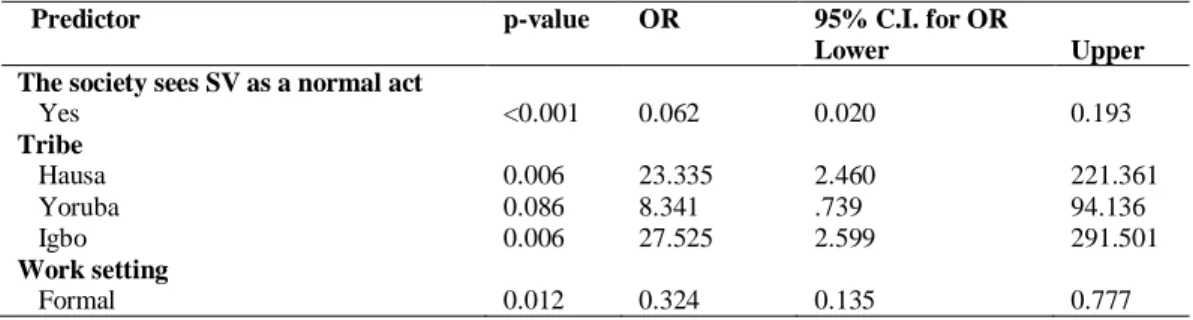
On forward logistic regression on factors associated with sexual violence in the work place, perception of the society on sexual violence was the strongest predictor of sexual violence in the workplace (p<0.001), followed by tribe and formal work setting (p=0.02). Those who believed the society sees sexual violence as a normal act were about 16 times less likely to experience sexual violence in the workplace (OR=0.062, p<0.001, 95% CI= 0.02-0.193); those in formal work setting are about three times less likely to experience sexual violence. Respondents who were of the Hausa tribe were 23 times more likely to experience sexual violence in the workplace (OR=23.36, p=0.006, 95% CI=2.4-221.361).
Discussion
Table 1: Sociodemographic characteristics of female employees in Sokoto Metropolis, Nigeria
Variables Frequency (%) N=176 Age(years)
<20 20-29 30-39 40-49
7(4.0) 102(58.0) 54(30.7) 13(7.4)
Marital status
Married Unmarried
64(36.4) 112(63.6)
Tribe
Hausa Yoruba Igbo Others
72(62.6) 5(22.5) 8(28.6) 3(25.0)
Religion
Islam Christianity
127(73) 47(27)
Work setting
Formal Informal
88(49.7) 89(50.3)
Table 2: Knowledge of female employees in Sokoto Metropolis, Nigeria on sexual violence
Variable Frequency (%)
Ever heard of the term sexual violence (SV)?
Yes No
157(88.2) 21(11.8)
Source of information
Radio/television Newspaper/magazine Colleagues
Others
65(41.4) 47(29.9) 36(23.2) 9(5.5)
Invasion of privacy is form SV Yes
No
153(86) 25(14)
Open expression of sexual offer is form of SV
Yes No
147(82.6) 31(17.4)
Accidental body contact is form of SV
Yes No
68(38.2) 110(61.8)
Attempted rape is form of SV
Yes No
154(86.5) 24(13.5)
Rape is form of SV
Yes No
159(89.3) 19(10.7)
Threats and bribery of sexual nature is form of SV
Yes No
153(86) 25(14)
The Majority of the respondents were aware of sexual violence in the workplace and a greater proportion of them (41.4%) heard about it from the radio/television. This high level of awareness observed is not surprising because this study also revealed that up to 96% of the respondents had good knowledge of sexual violence in the workplace. Similar observations were made within and outside Nigeria; for example, a study conducted in Osun state Nigeria also revealed a high level of awareness and knowledge of respondents of sexual violence23. Similarly, a study conducted by Paludi and Barickman7 also revealed a high level of awareness of the problem in the developed countries especially the United States and the United Kingdom. It is interesting to note however, that up to 38.2% of the respondents in this study wrongly responded to the question on accidental body contact as a form of sexual violence. This may not be unrelated to the fact that the meaning of sexual violence is socially constructed depending on the personal and situational characteristics of the individual making the judgement24. This therefore, implies that in evaluating what constitute sexual violence, one has to also consider the socio-cultural factors and personality of the individual.
Figure 1: Knowledge of sexual violence of female employees in Sokoto Metropolis, Nigeria
Table 3: Attitude of female employees in Sokoto Metropolis, Nigeria towards sexual violence
Variables Frequency (%) N=178
Sexual violence is offensive 161(90.4) The society see sexual violence as a
normal act
96(53.9)
Most women who are sexually assaulted by a man provoke his behavior by the way they talk, act or dress
138(77.6)
Sexual violence can decrease a woman‘s productivity
142(79.8)
Perpetrator of sexual violence should be punished
157(88.2)
Sexual violence is as a result of being single
138(77.5)
The all-time prevalence of sexual violence among female employees in the workplace in this study was found to be 63.5% which is quite higher than the 42% prevalence rate reported in a study in USA among female federal workers9, and 53% reported among female workers in the general population in San Francisco25.These differences in the prevalence estimates of sexual violence are probably due to usage of various definitions, the sampled population and the methodology used to measure it. There is no gold standard for measuring sexual violence as some experiences are difficult to categorize26; however, this study
used a broader definition of sexual violence including verbal harassment. In a study conducted in Alexandria, Egypt, a much lower prevalence rate (2.2%) of sexual violence was reported27. This could be explained by the fact that the study was conducted on only female health workers of a University Hospital and so not as diversified as the respondents in our current study. Another possible reason for the very low prevalence in Egypt was because other forms of workplace violence were assessed, and Egypt has very strict observance of Islamic laws which prescribe stiffer penalties for offenders of sexual violence.
More than half (54.5%) of the respondents had experienced sexual violence at their workplaces within the past one year. This finding is contrary to what was observed in a previous study where only 4.1% of the respondents experienced sexual harassment at workplace in the last one year prior to the study18, this wide contrast could be explained by the fact that the study was based not only on sexual violence but other forms of workplace violence.
Regarding the various forms of sexual violence experienced by respondents in this study, sexual coercion was the most prevalent form experienced while rape was the least prevalent form of sexual violence Rape or forced sex is mostly perpetrated by individuals known (trusted)
96% 4%
Knowledge of Sexual Violence
Figure 2: Proportion of female employees in Sokoto Metropolis, Nigeria with positive and negative attitude towards sexual violence
Figure 3: Prevalence of sexual violence among female employees in Sokoto Metropolis, Nigeria according to their work setting
to the victims seen as intimate partners, male family members, acquaintances and individuals in position of authority. This invariably exposes victims to unprotected sexual acts which often lead to sexually transmitted infections including HIV/AIDS and unwanted pregnancies. In a study conducted in Egypt, verbal sexual harassment was
reported to be the most prevalent form of sexual violence where up to 99% of the women reported experiencing verbal sexual harassment and 12% experiencing rape24. Other studies conducted by Marsh et al.18 and Noah2 in Ethiopia and Southern part of Nigeria respectively revealed relatively lower rates of various forms of sexual violence. 94%
6%
ATTITUDE TOWARDS SEXUAL VIOLENCE
Positive attitude Negative attitude
61.10%
38.90%
Formal setting
Informal setting
Prevalence of Sexual Violence by type
Figure 4: Forms of sexual violence experienced by female employees in Sokoto Metropolis, Nigeria
Table 4: Experiences of sexual violence among female employees in Sokoto Metropolis, Nigeria
Variables Frequency (%)
N=178 Experience sexual violence at
workplace within the past one year?
Yes
No 97(54.5)
81(45.5)
If experienced sexual violence, who was the perpetrator?
Immediate boss Work mate Subordinate Others
38(38.8) 29(30.2) 21(21.7) 9(9.3)
Frequent of sexual violence at workplace?
Always Rarely Only once
41(42.1) 53(54.5) 3(3.4)
Did the sexual harassment in any way affect your work?
Yes No
62(64) 35(36)
Action taken following SV
Resigned from the job Took leave
Changed place of work Reported to the authority/police Did nothing
*Multiple responses allowed
55(56.7) 50(51.1) 49(50.6) 50(51.1) 41(31.1)
If SV reported to the
authority/police, was any action taken?
Yes No
24(47.2) 26(52.8)
If no report to the authority/police, why?
(Multiple responses considered)
Fear of the perpetrator No need to report Fear of shame/stigma
16(33.3) 37(78.1) 11(24.1)
The occurrence of the different forms of sexual violence in all these studies suggests the global nature of sexual violence in the workplace. The variations observed in the prevalence of the various forms of the violence could have resulted from differences in the socio-cultural characteristics of the respondents and their work environment.
About 38% of those that experienced sexual violence said it was perpetrated by their immediate bosses and this finding was further collaborated by findings from a study conducted by Jewkes and Abrahams who opined that the boss may threaten the female employee by loss of her job if she resists him16. Other studies have also demonstrated that female employees at the lower cadre are often the target of sexual harassment by their superiors28,29. More than half of the respondents admitted that the sexual violence they experienced affected their work with more than half again saying they had to resign from the job as a result of the unbearable pressure in the work place. It has been shown that sexual violence can threaten the physical and psychological well-being of targets and may result in physical, mental, behavioral, and social consequences, depending on the circumstances; these consequences may be severe and long-lasting30. Despite these varying experiences, 31.1% of the respondents that experienced sexual violence did not do anything following the incidence. This is often true of patriarchal societies like ours where females usually do not challenge accepted and laid down
5
9.
60
%
60
.7
0%
57
.3
0%
5
0.
00
%
43
.8
0
%
S E X U A L A D V A N C E M E N T
S E X U A L C O E R C I O N
S E X U A L E N T I C E M E N T
A T T E M P T E D R A P E
Table 5: Factors associated with experience of sexual violence among female employees in Sokoto Metropolis, Nigeria
Variables Ever experienced sexual violence at work? Test statistic
Yes No
Age (years) <20 years 20-29 years 30-39 years 40-49 years 4(57.7) 58(61.7) 28(70) 7(70) 3(42.4) 36(38.3) 12(30) 3(0) df=3 P=0.804* Marital status Married Unmarried 37(71.2) 59(60.2) 15(28.8) 39(39.8)
X2=1.76 df=1 P=0.213 Tribe Hausa Yoruba Igbo Others 75(87.8) 9(56.3) 6(27.3) 7(70) 28(27.2) 7(43.8) 16(72.7) 3(30)
X2= 16.97 df=3 P<0.001 Religion Islam Christianity Others 83(74.1) 13(35.1) 1(50) 29(25.9) 24(64.9) 1(50) p<0.001* Work setting Formal Informal 63(84) 34(44.7) 12(16) 42(55.3)
X2=25.33df=1 p<0.001 Socioeconomic class Upper class Middle class Lower class 54(68.9) 30(61.2) 13(56.5) 25(31.2) 19(38.8) 10(43.5)
X2=1.37 df=2 P=0.523
Length of time as a worker
<5years ≥5years 20(60.6) 74(66.1) 13(39.4) 38(33.9)
X2=0.334 df=1 P=0.679
Number of Working hours per day
≤8hours
>8hours 86(68.3)
7(38.9)
40(31.7) 11(61.1)
X2=5.938 df=1 P=0.019
Does the society see sexual violence as a normal act? Yes No 74(92.5) 23(32.9) 6(7.5) 47(67.1)
X2=58.123df=1 P=<0.001
Do you think most women who are sexually assaulted by a man provoked his behavior by the way they talk, act or dress?
Yes No 89(74.8)) 8(25) 30(25.2) 24(75)
X2=27.214 df=1 P=<0.001
Is it only natural for a woman to use her sexuality as a way of getting ahead at work?
Yes No 84(72.4) 13(37.1) 32(27.6) 22(12.5) X2=14.56 df=1 P<0.001
Attitude towards sexual violence
Positive attitude Negative attitude 90(64.3) 7(63.6) 50(35.7) 4(36.4)
X2=0.002 df=1 P=1.00
Knowledge of sexual violence
Good Poor 94(64.4) 3(0) 52(35.6) 2(40) P=1.000*
Table 6: Predictors of sexual violence
Predictor p-value OR 95% C.I. for OR
Lower Upper
The society sees SV as a normal act
Yes <0.001 0.062 0.020 0.193
Tribe
Hausa 0.006 23.335 2.460 221.361
Yoruba 0.086 8.341 .739 94.136
Igbo 0.006 27.525 2.599 291.501
Work setting
Formal 0.012 0.324 0.135 0.777
female norms for fear of retributions or being ostracized. On the other hand, most would not report for fear of stigmatization and shame as they could either be divorced if married or would not get suitors for marriage in case of unmarried ones. Jain et al31 also reported that abused females decide not to report being exposed to sexual violence for fear of embarrassment and a sense of deep shame; this, along with the fact that they fear reprisal attacks from the assailant. Also, El –Elemi and colleagues explained in another way that blame for sexual assault -in our community- usually is placed on females, while the perpetrators, if brought to justice, often escape with limited punishment32. This demonstrates the reality of the work environment in most developing countries including Nigeria where as a result of the harsh economic climate, workers are willing to stay put in their jobs even if they have nasty experiences like low pay, poor working condition and sexual harassment. This is not due to factor of job commitment, but rather because it is very difficult to secure another job elsewhere2.
On bivariate analysis, factors found to be significantly associated with sexual violence in the workplace include tribe (p-0.002), religion (p<0.001), work setting (p<0.001) and society‘s perception of sexual violence (p<0.001). In a study conducted in Malaysia by Ismail et al, a significant association between physical attractiveness, sex roles, privacy of work area and sexual harassment was observed33.This suggests that more attractive women have a higher risk of sexual harassment; a previous study also revealed that physically attractive women are perceived as sociable, dominant, warm and socially skilled34.
However, on multivariate analysis using forward logistic regression for factors associated
with sexual violence in the work place, perception of the society on sexual violence was the strongest predictor of sexual violence in the workplace (p<0.001), followed by tribe and formal work setting (p=0.02). This compares to the findings of a previous study in Malaysia where women believed that they work in an environment where the belief system regards them as mere sex objects and inferior to men in terms of their capabilities and skills33.In the same study, manner of dressing of female worker was found to be a predictor of sexual harassment33.
In this study, those who believed the society sees sexual violence as a normal act are about 16 times less likely to experience sexual violence in the workplace (OR=0.062, p<0.001, 95% CI= 0.02-0.193). This is probably because this category of people is likely going to classify acts that are generally believed to be sexually violent acts as normal since they believe even the society sees those acts as normal. Respondents who are of the Hausa ethnic group are 23 times more likely to experience sexual violence in the workplace (OR=23.36, p=0.006, 95% CI=2.4-221.361). This is probably because of influence of culture on perception of individuals especially on sensitive issues like sexual violence, which, because it is socially constructed has various meaning depending on culture and personality of individuals23.
Ethical Approval
Ethical approval for this study was obtained from the Sokoto state Health Research and Ethics Committee. Participants were informed of the objectives of the study and were assured of the confidentiality of the information volunteered. Informed verbal consent was also obtained from all the respondents prior to the commencement of the study and were given options of opting out of the study should they decide to do so.
Conclusion
Majority of the respondents were aware and had good knowledge of sexual violence and most had positive attitude towards sexual violence. About two-thirds of the respondents had experienced sexual violence, with more than half experiencing it in the last one year. Governments and institutions should put in place mechanisms to address SV in the workplace and come to the aid of victims. Similarly, tougher sanctions should be put in place by necessary government agencies to bring to book perpetrators of this heinous crime against women.
Contribution of Authors
OMO and HA conceived the initial idea for the manuscript. ASM, ARO, SAM took part in the design of the questionnaire, supervised the data collection and wrote the first draft of the manuscript under the supervision and guidance of OMO and HA. All the authors contributed to the revision of the manuscript and approved the final manuscript.
Conflict of Interest
We declare that, there is no conflict of interest.
Acknowledgements
We acknowledge that, the authors presented herein fully funded the research.
References
1. World Health Organization. Violence against women:
Intimate partner and sexual violence against women. (Fact sheet N°239). 2013. Retrieved from: http://www.who.int/mediacentre/factsheets/fs239/ en/
2. Noah Y. Experience of sexual harassment at work by female employees in a Nigerian work environment, International NGO Journal 2008; 3(7):122-127.
Available at http//
www.academicjournals,org/INGOJ. Retrieved on 12/11/2017
3. US Department of Health and Human Services, Centres for Disease Control and Prevention, Sexual Violence: Definitions, updated January 2, 2014. http ://www.cdc.gov/violenceprevention/sexualviolence/ definitions.html
4. Till FJ. Sexual harassment: A report on the sexual harassment of students. National Advisory Council on Women‘s Educational Programs. Department of Education, Washington DC 1980; p87
5. Moving to end sexualassault.org/information/types- sexual-violence/ accessed on 21st October 2017 6. World health organization. World report on violence and
health, Geneva: world health organization 2009 7. Paludi MA and Barrickman R.B Academic and
workplace Sexual Harassment: A Resource Manual, Albany N.Y.: State University of New York 1991 8. Fawole O I, Ajuwon A J and Osungbade K O.
Evaluation of interventions to prevent gender-based violence among young female apprentices in Ibadan, Nigeria. Health Education 2005; 105: 2–9. 9. Waechter R and Ma V. Sexual Violence Sexual
Violence in America: Public Funding and Social Priority. American Journal of Public Health 2015; 105(12):2430-2437.
10. Martin SL, Tsui AO, Maitra K and Marinshaw R. Domestic violence in northern India. American Journal of Epidemiology 1999; 150: 417–426. 11. Mazza D, Dennerstein L and Ryan V. Physical, sexual
and emotional violence against women: A general practice– based study. Medical Journal of Australia 1996: 164: 14–17.
12. Gracia E, Martı´n-Ferna´ndez M, Lila M, Merlo J and Ivert A-K.. Prevalence of intimate partner violence against women in Sweden and Spain: A psychometric study of the ‗Nordic paradox‘. PLoS ONE 2019 14(5): e0217015
13. Kapiga S, Harvey S, Muhammad AK, Stöckl H, Mshana G, Hashim R, Hansen C, Lees S and Watts C . Prevalence of intimate partner violence and abuse and associated factors among women enrolled into a cluster randomised trial in northwestern Tanzania. BMC Public Health 17, 190 (2017). https://doi.org/10.1186/s12889-017-4119-9 14. Linos N, Slopen N, Subramanian S V, Berkman L and
Kawachi I. Influence of Community Social Norms on Spousal Violence: A Population-Based Multilevel Study of Nigerian Women. Am J Public Health. 2013 ;103(1):148–155.
Gray GE, McIntyre JA and Harlow SD Prevalence and patterns of GBV and revictimization among women attending antenatal clinics in Soweto, South Africa. American Journal of Epidemiology 2004; 160: 230–239.
16. Jewkes R and Abrahams N. The epidemiology of rape and sexual coercion in South Africa: an overview. Soc Sci Med 2002;55:1231–44
17. Pike I L and Williams SR. Incorporating psychosocial health into biocultural models: Preliminary findings from Turkana women of Kenya. AmericanJournal of Human Biology 2006; 18: 729–740.
18. Marsh J, Patel S, Gelaye B, Goshu M, Worku
A,Williams MA and Berhane Y. Prevalence of Workplace Abuse and Sexual Harassment among Female Faculty and Staff. Journal of Occcupational Health 2009; 51:314-322
19. Black M C, Basile K C, Breiding M J, Smith S G, Walters M L, Merrick M T and Stevens M R. (2011). The National Intimate Partner and Sexual Violence Survey (NISVS): 2010 summary report. [Accessed on 16th July, 2019]. Available from: http://www.cdc.gov/ViolencePrevention/pdf/ NISVS_Report2010-a.pdf
20. National Immigrant Women‘s Advocacy Project, ―Dynamics of Sexual Assault, 295
21. Sokoto State: location, History, Facts and Population.
Available at
https://www.britannica.com/place/Sokoto-Nigeria. Accessed 13/02/2020
22. Araoye M O. Research methodology with statistics for health and social sciences Ilorin. 2003, Ilorin: Nathadex Publishers, 115-29
23. Taiwo MO, Omole OC and Omole OE. Sexual
harassment and psychological consequence among students in higher education in Osun state,Nigeria. Journal of applied psychology 2014; 4(1):13 18.doi:10.5923/j, ijap.2014401.02
24. MohammedGF and Hashish RKH. Sexual violence
against females and its impact on their sexual function. Egyptian Journal of Forensic Sciences
2015; 5(3): 96-102 Available at
https://doi.org/10.1016/j.ejfs.2014.08.004 25. Gutek BA and Done R. Sexual harassment. In R.K.
Unger (Ed), Handbook of the psychology of women and gender, New York, John Wiley and sons 2001. 26. Leserman J. Sexual abuse history: prevalence, health
effects, mediators, and psychological treatment Psychosom Med 2005; 67: 1-11
27. Moustafa MS and Gewaifel GI.Work-related violence among female employees in a university hospital in Alexandria: An Epidemiologic study. Journal of
American Science 2013; 9(3)
http//www.americanscience.org
28. Yusuf N. Gender Issues in Nigeria‘s Industrial Relations Journal of Arts and Social Science 1998; 1:81-90. 29. Olutayo L. ―Violence against Women in Africa: The
Case of Nigeria‖, in, T. Odumosu et al. eds. Social problems and Social Work in Nigeria, LASU: Centre for Planning Studies 2000: 68-76.
30. Bott S. Sexual violence and coercion: implications for sexual and reproductive health In Social Determinants of Sexual and Reproductive Health, WHO 2010
31. Jain R, Mathur PN, Kothari S and Mathur P. Medico-legal evaluation of sex assault cases admitted at Sardar Patel Medical College & P.B.M. Hospital. Bikaner, India: Ind Medica 2008; 8(1).
32. El-Elemi A, Moustafa S and Hagras A. Reported cases of female sexual assault over 5 years period in Suez Canal area, Egypt: demographic study. Egypt J Forensic Sci, 1 2011:118-123
33. Ismail MN, Chee LM and Bee CF.Factors Influencing Sexual Harassment In The Malaysian Workplace. Asian Academy of Management Journal, Vol. 12, No. 2, 15–31, July 2007.
34. Feingold, A. Good-looking people are not what we think.


![Oversecurering en vrijgave: Over de werking van de Algemene Bankvoorwaarden bij een overmaat aan zekerheden [TvI 2019/9]](data:image/gif;base64,R0lGODlhAQABAIAAAP///wAAACH5BAEAAAAALAAAAAABAAEAAAICRAEAOw==)