NEGOTIATING NETWORKS:
EXPLORING THE INTERACTION AND INTERSECTION OF A TEACHER’S BELIEFS, LITERACY POLICY, AND INSTRUCTION
Aubrey N. Comperatore
A dissertation submitted to the faculty at the University of North Carolina at Chapel Hill in partial fulfillment of the requirements for the degree of Doctor of Philosophy in the Early
Childhood, Special Education, and Literacy program in the School of Education.
Chapel Hill 2017
ii © 2017
iii ABSTRACT
Aubrey N. Comperatore: Negotiating Networks: Exploring the Interaction and Intersection of a Teacher’s Beliefs, Literacy Policy, and Instruction
(Under the direction of Julie E. Justice)
The increasing standardization of literacy curriculum and instruction compounded with high-stakes accountability measures present unique challenges for teachers and policymakers (Barrett-Tatum, 2015). Teachers’ beliefs and interpretations of content, curriculum, instruction, and students shape the implementation of new mandates (Remillard & Bryans, 2004). However, when policy messages conflict with teachers’ perceptions of literacy instruction, implementation may compromise their instructional self-efficacy (Apple & Teitelbaum, 1986), instill a learned dependency on outside resources (Papola-Ellis, 2014), and erode their instructional beliefs (MacGillivray, Ardell, Curwen, & Palma, 2004; Stillman & Anderson, 2011; Valli & Chambliss, 2007). The black box (Black & William, 1998) of teachers’ policy enactment as manifested through their instruction has remained largely hidden to researchers and practitioners, as existing literature positions the teacher and the policy as separate entities.
iv
the policy’s narrative plot privileged positivistic research and an autonomous model of literacy (Street, 2003). Second, using observational and interview data collected over a five-month period, the study details the instructional beliefs and policy landscape of one North Carolina third-grade teacher under Read to Achieve and other local literacy policies. Comparisons
v
To Mrs. Lois Huber, who loved my writing; Mrs. Debra Savedoff, who made it better; and Suzie Lemon, who gave me something to write about.
vi
ACKNOWLEDGEMENTS
I’ve heard it said that people come into our lives for a reason, bringing something we must learn. And we are led to those who help us most to grow if we let them, and we help them in
return.
Dr. Julie Justice and Dr. Leigh Hall: The two of you are the yin and yang of mentors, and I am forever grateful for your guidance throughout this journey. Julie- Your brilliance, passion, humor, and realness have inspired me in more ways than you know. You saw my vision, sensed my doubts, and gave me a voice. I have learned more about myself as a researcher, teacher, and a mother by working with you. Thank you for taking on this immense project all the way from Elon, and introducing me to the amazingness that is Gerald and Piggie. Leigh- You took a chance on me as a Masters student when no one else would. That assistant gig gave me the research bug, and every subsequent opportunity to work with you has taught me invaluable lessons not only about research, but about how to adult and do life. You taught me how to value myself and my time, how not to mince words, and how to just get it done. Thank you for the cupcakes and Neomonde trips!
Dr. Cassandra Davis: What would I have done without you over the last 4.5 years? Your friendship, amazing sense of humor (Northerners, amiright?), firm hand, and kind heart have saved me from more pitfalls than you realize.
vii
Dr. Dana Griffin: Thank you for the valuable advice on how to simultaneously parent and dissertate with grace and dignity. I am grateful that you agreed to be a part of my committee, as your insight into Ms. Lemon’s classroom context shifted my entire understanding of her
experience.
Dr. J. Montana Cain: My spiritual advisor, shopping buddy, and Mexican restaurant partner. I am so thankful we were able to rekindle our Stats acquaintanceship into the amazing friendship we have today.
Dr. Jeanne Bissonnette: How did we get here? Just yesterday we were giggling like middle schoolers in class and here we are with PhDs. Your drive is a thing of legends, and inspires me to be better than I thought I ever could be.
Dr. Katie Caprino: Work wives unite! Thank you for your willingness to write with me. Dr. Kate Allman, Dr. Charna D’Ardenne, & Dr. Martinette Horner: You ladies made it look easy. I am so blessed to have found a tribe of brilliant grad school moms who just as easily talked about research methods as you did sleep regressions. Thank you.
My EPIC family: Your support and encouragement is above and beyond what a typical graduate assistantship should provide. Working with you all introduced me to a career that I can’t wait to be a part of.
My theatre family: Thank you for holding a place on the stage for me, and reminding me that there are other things out there besides grad school. I can’t wait to get back out there!
Dr. Jen Benkovitz: Working with you at Creech not only opened my eyes to the
viii
My former teaching colleagues, especially Sara, Sarah, and Dara: You are changing lives every day. Thank you for doing what you do, and letting me be a small part of it.
Marissa: 17 years and counting. Thank you for simultaneously keeping me grounded while lifting me higher.
Ray and Terry: How lucky I am to have in-laws like you who welcomed me into your family and supported me throughout every endeavor I have attempted. We love you.
Mom and Dad: You encouraged me to pursue anything and everything, so long as it made me happy. You instilled in me the drive to work hard, achieve my goals, and take care of “the little guy”. You provided me with a childhood full of love and laughter, and you have given this same gift to my girls. I owe so much of this to you, and I hope I’ve made you proud. Happy, sad, mad.
Pete: My best friend, my partner, my love. I would have never been able to do this
without you. You picked me up when I stumbled, and celebrated with me when I succeeded. You have been my biggest fan and no matter how chaotic our home got, you helped me push through. I am so looking forward to this next chapter together.
Finally,
Ellie and Maggie: You are my love and my light. Everything I do, I do for the two of you. You both have taught me to work harder, grow stronger, and love deeper. I am ever so proud to be your mom, and I know the two of you will conquer the world one day.
ix
TABLE OF CONTENTS
LIST OF TABLES………....xiv
LIST OF FIGURES………...xv
LIST OF ABBREVIATIONS………...…xvi
CHAPTER 1: INTRODUCTION TO THE STUDY………..….1
North Carolina Read to Achieve……….……….1
Problem Statement………...2
Definition of Key Terms………..4
Beliefs………..4
Policy………...4
Actors/Actants……….5
The Purpose Statement………5
Research Questions………..6
Organization of Study………..6
CHAPTER 2: LITERATURE REVIEW AND THEORETICAL FRAMEWORK………8
Literature Review: Teachers’ Beliefs and Policy Negotiation………8
Literature Review Methods……….8
Teachers’ Instructional Beliefs as a Construct……….………...9
Teachers’ Literacy Beliefs and Their Influence on Instruction……….13
Teachers as Literate Beings………...14
x
Teachers’ Beliefs About Literacy Learners………...18
Teachers’ Negotiation of Policy Around Literacy Education………21
Theoretical Framework……….28
Cultural-Historical Activity Theory………..29
Actor-Network Theory………...35
CHAT and ANT: Complementary Theories………..…40
CHAPTER 3: METHODOLOGY……….44
Research Design……….44
Revelatory Case Study Design…. ……….45
Study Context………48
Examining the Social Practice: Developing a Narrative Plot of Read to Achieve………56
Data Collection………..56
Data Analysis……….58
Examining the Instructional Practices: Teacher Case Study……….…61
Data Collection………..61
Data Analysis……….67
Researcher Positionality………...70
Conclusion……….………72
CHAPTER 4: THE SOCIAL TRANSLATION OF READ TO ACHIEVE……….74
A Summary of North Carolina’s Read to Achieve………75
Problematization………79
Problematizing the Problem: How History Created a Literacy Crisis…………...80
xi
“Learning to Read and Reading to Learn’: An Increased
on Third Grade Literacy……….………88
Intressement……….…..92
NCDPI’s Comprehensive K-12 Literacy Plan as an Obligatory Passage Point……….………93
NCDPI’s Comprehensive K-12 Literacy Plan Creates Alliances………..94
How NCDPI’s Comprehensive K-12 Literacy Plan Defines Literacy and Instruction………96
Introduction of mClass as a Network Device……….….100
Enrolment………...103
mClass’s Relationship with North Carolina………....104
How mClass Data Perpetuates an Autonomous Model of Literacy………...….105
Conclusion………...…………108
CHAPTER 5: MOBILIZATION: THE NEGOTIATION OF BELIEFS AND POLICY MESSAGES THROUGH INSTRUCTION………...110
Ms. Lemon’s Policy Landscape: The Major Actants and Policies Surrounding the Classroom……….111
The Major Actors in Ms. Lemon’s Local and School Policy Landscape………111
District, School, and PLC-level Policies Comprising Ms. Lemon’s Landscape………..………117
State, Local, and School Policies Create Conflicting Messages………..123
Who is Suzie Lemon? A Beliefs Profile………..………125
Ms. Lemon as a Literate Being………...……….125
Ms. Lemon’s Beliefs About Quality Teaching and Literacy Instruction……….127
Ms. Lemon’s Beliefs About Her Students………...………131
xii
Ms. Lemon’s Beliefs About Race and Social Justice………..133
Ideal vs Reality: Examining the Language Arts Activity Grid and Actual Instruction……….…….….…..135
Ms. Lemon’s Language Arts Activity Grid Privileges Social, Authentic Practices………..……136
Ms. Lemon’s Actual Literacy Instruction Differed from Her LAAG……….…137
Teacher-managed Instruction was Prominent and Varied………..…….…139
Writing in Response to Reading Dominated the Writing Activities………142
Formal Assessment Activities Comprised 18% of Classroom Instruction…..…143
Ms. Lemon’s Ideal Literacy Instruction Differs from Her Actual Instruction…143 Setting the Stage for Negotiation: Summarizing the Who and the What of Ms. Lemon’s Network………..…….…146
CHAPTER 6: ILLUMINATING THE BLACK BOX………147
Mobilized Messages……….……148
Mobilization of Messages………..………..148
The New Status Quo………....161
Negotiating Networks: Influential Factors in Mediating Activity Systems…….………162
The Four Types of Negotiations………..162
Summary of Negotiations………....181
The Factors Influencing Negotiations Around Policy Messages……….182
Ms. Lemon’s PLC: Collaborative Sensemaking……….…….184
Ms. Lemon’s Professional Identity………..185
Ms. Lemon’s Beliefs about Race, Equity, and Social Justice……….….187
The Black Box: What Happens in the Classroom, Stays in the Classroom………….…190
xiii
Limitations of the Study………...191
Implications for Teacher Education………..…..192
Implications for Practitioners………..193
Implications for Policymakers and Researchers……….………….195
Implications for Future Research Directions………...……197
Conclusion………...………198
APPENDIX A: LANGUAGE ARTS ACTIVITY GRID………..………..201
APPENDIX B: LANGUAGE ARTS ACTIVITY GRID CODING SCHEME………..…202
APPENDIX C: INITIAL TEACHER INTERVIEW PROTOCOL……….203
APPENDIX D: PRINCIPAL INTERVIEW PROTOCOL………..………207
APPENDIX E: LITERACY COACH INTERVIEW PROTOCOL………209
APPENDIX F: CLASSROOM OBSERVATION PROTOCOL……….………211
APPENDIX G: CONTACT SUMMARY SHEET……….……….212
APPENDIX H: TEACHER FOCUS GROUP PROTOCOL………..……….213
APPENDIX I: NC EXCELLENT PUBLIC SCHOOLS ACT………..……..215
APPENDIX J: MS. LEMON’S COLLECTION OF POWER READS……….……….223
xiv
LIST OF TABLES
TABLE 1 Components of First and Second Generation Activity Theory………..30
TABLE 2 The Four Moments of Translation………...………..36
TABLE 3 2016-17 Midtown Elementary Student Demographics by Race and Gender……50
TABLE 4 Results of the 2015-16 EOG Reading exams by proficiency and demographic....51
TABLE 5 Student demographics, including services, race, and reading level, by frequency and percentage……….………..55
TABLE 6 Data Collection Procedures and Instruments……….62
TABLE 7 Ms. Lemon’s initial Language Arts Activity Grid………...129
TABLE 8 Ms. Lemon’s literacy instructional schedule………...137
TABLE 9 Frequency and percentage of each observed literacy instructional activity, by minute………..…138
TABLE 10 Frequency and percentage of types of observed teacher-managed (T-M) activities, by minute……….….139
xv
LIST OF FIGURES
FIGURE 1 Third Generation CHAT Model……….……….…31
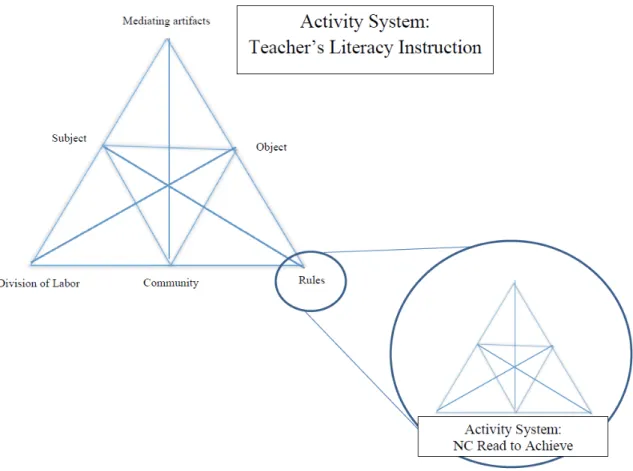
FIGURE 2 Depiction of teacher’s literacy instruction as an activity system and Read to Achieve as a contextual component of the system……….45
FIGURE 3 Teacher analysis framework………68
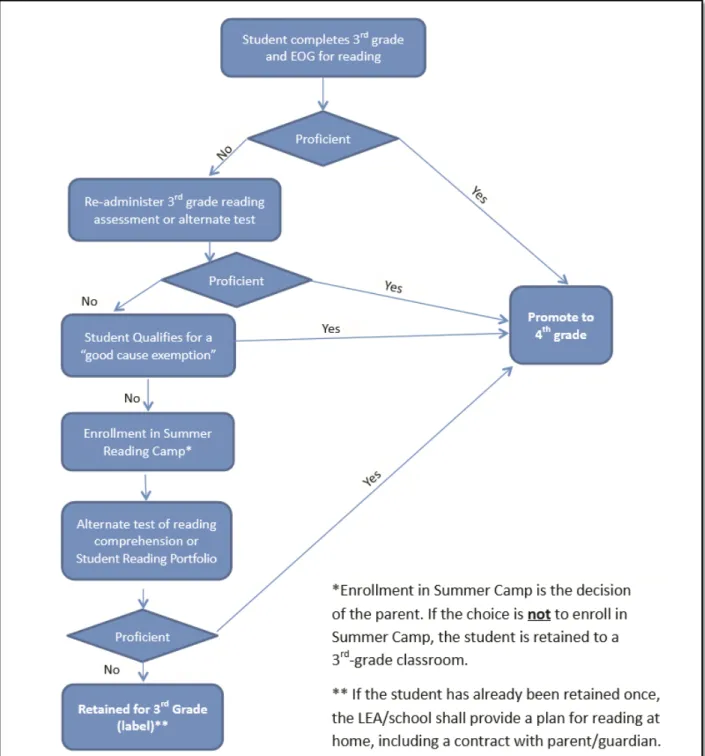
FIGURE 4 Flow map of North Carolina General Assembly’s Read to Achieve program…77 FIGURE 5 Timeline of the social translation of Read to Achieve……….………....79
FIGURE 6 A table of suggested teacher actions in implementing standards-based curriculum included in the NCDPI Comprehensive K-12 Literacy Plan………..……97
FIGURE 7 Suggested foci for literacy instruction across grade levels………99
FIGURE 8 NCDPI suggested balanced assessment practices across grade levels……...….101
FIGURE 9 mClass display of student Text and Reading Comprehension results……….…106
FIGURE 10 Activity system illustrating Ms. Lemon’s average literacy instruction………...164
FIGURE 11 Activity system of PLC planning meeting………...169
FIGURE 12 Activity system of Fundations lesson………..173
FIGURE 13 Activity system of Sonia Sotomayor read-aloud…………...………..178
xvi
LIST OF ABBREVIATIONS
1
CHAPTER 1: INTRODUCTION TO THE STUDY
Now more than ever educators exist under increased pressure to deliver standardized instruction and exceed accountability requirements brought about by federal, state, and local education policies. Since the 1950s when the country encountered Brown v. Board of Education and Why Johnny Can’t Read (Flesch, 1955), teachers have experienced a surge of government-backed initiatives aimed at regulating instruction and boosting student achievement (Darling-Hammond & Snyder, 1992; McGuinn, 2006; Pearson, 2002). Throughout the latter half of the twentieth century and into the twenty-first, literacy education has been at the forefront of political debate and critique. A Nation at Risk (National Commission on Excellence in
Education, 1983), commissioned by the Reagan administration, depicted a failing U.S. education system and a nation encountering a literacy crisis (Pearson, 2004). A string of political initiatives aimed at teachers’ literacy instruction and students’ reading achievement resulted. Two of the most significant mandates are No Child Left Behind’s Reading First policy (Coburn, Pearson, & Woulfin, 2011; U.S. Department of Education, 2001) and Race to the Top’s Common Core State Standards (National Governors Association, 2010). States followed with their initiatives, such as North Carolina’s 2012 Read to Achieve bill (N.C. Legis., 2012).
North Carolina Read to Achieve
2
2012). Additionally, students must demonstrate an ability to "read, comprehend, integrate and apply complex texts” through to high school (N.C. Legis., 2012). The law asserts the critical responsibility K-3 teachers must identify reading difficulties early on, provide targeted support where needed, and eliminate social promotion. As such, teachers are required to administer ongoing diagnostic reading exams to students to monitor their reading proficiency levels from Kindergarten through third grade (N.C. Legis., 2012). Read to Achieve, therefore, requires schools and teachers to adopt specific instructional software and assessments to track their students' reading progress (NCDPI, 2015a).
According to Read to Achieve, third grade is a pivotal year for students and teachers. A student’s reading proficiency level at the end of third grade, as measured by the state’s End-Of-Grade Test (EOG), determines her/his eligibility for promotion to the fourth grade (N.C. Legis., 2012). A student who is reading below proficient levels is retained and enrolled in a summer reading camp. If, after completing the camp, the student continues to read below proficient levels as measured by an alternative assessment, s/he is assigned to a third/fourth-grade transition class with a possibility of a midyear promotion (N.C. Legis., 2012). The law is currently in its fourth year of full implementation and accounts for a significant portion of K-3 teachers’ measures of accountability.
Problem Statement
3
mandates (Remillard & Bryans, 2004). If policies conflict with teachers’ perceptions of literacy instruction, implementation may compromise their instructional self-efficacy (Apple &
Teitelbaum, 1986), instill a learned dependency on outside resources (Papola-Ellis, 2014), and erode their instructional beliefs (MacGillivray, Ardell, Curwen, & Palma, 2004; Stillman & Anderson, 2011; Valli & Chambliss, 2007). Policymakers, on the other hand, argue that teachers’ individual and varied interpretations of literacy policies are to blame for implementation failures and policy abandonment, often at high financial losses (Coburn, 2001; Honig, 2006; Spillane & Jennings, 1997). How then should teachers and policymakers construct, disseminate, and implement literacy education policies to affect change over time?
Addressing the above question requires literacy and policy researchers as well as
4
Despite this literature’s contribution to the field, there is a paucity of studies seeking to describe the interaction and intersection of teachers and policies, specifically around literacy education. Studies aiming to explain the relationship between literacy educators and policies maintain a narrow focus on policy as a static, formal system (Coburn, 2005) rather than a fluid, evolving network of actants. Learning not only how teachers negotiate internal factors, such as their beliefs and perceptions of literacy, instruction, students, and policies but also how policies contribute to the shaping of these perceptions is relevant to both policy enactment and literacy instruction.
Definition of Key Terms
Beliefs, policy, and actor/actant are key terms I use throughout the manuscript and are essential to understanding the purpose and procedures of the study.
Beliefs
As discussed in the next chapter, the concept of beliefs is nebulous and the definition elusive. As Pajares (1992) has pointed out, beliefs are rarely explicitly defined in educational research. However, for my study, I adhere to Rokeach’s (1968) explanation of beliefs in which he asserted that all beliefs have three components—affective, cognitive, and behavioral— influenced by one’s experiences and knowledge and vice versa. Further, beliefs can be
descriptive, evaluative, or prescriptive; conscious or unconscious; and surmised from what one says and does (Pajares, 1992; Rokeach, 1968).
Policy
5
determined solely by the government. I include localized policies, such as those enacted in the classroom or school level. I also look to Ball’s (1993) two-pronged definition to ground the concept of policy for this study. Ball (1993) described policy as both text and discourse.
Specifically, policy is text constructed to address a problem and is meant to intervene in practice via its interpretation and implementation. Invoking Foucault’s (1971, 1974) writings on
discourse and power to describe policies, Ball (1993) described policy as the powerful creation of “truth” and “knowledge” (quotes in the original) seeking to promote action and values in a given community. Finally, policies are dynamic, living entities that are “encoded in complex ways and decoded in complex ways” (Ball, 1993, p. 11) by those who engage in them. Actors/Actants
The current study is grounded in both cultural-historical activity theory (CHAT) and actor-network theory (ANT). Both theories assert that human and nonhuman objects build and contribute to activity networks using the terms actor and actant to identify such objects (Engestrӧm, 2000; Latour, 1996). The study uses both terms interchangeably though the term actant is mostly attributed to ANT rather than CHAT to emphasize the nonhuman element of a network.
The Purpose Statement
The purpose of this study is to explore the relationship between one third-grade teacher’s instructional beliefs, literacy instructional practices, and the literacy education policies
6
2009), I analyzed the discourse of social order as it existed throughout the creation and
dissemination of the Read to Achieve policy as a contextual component of the teacher activity system. Finally, I examined both narratives together to describe if and how a state reading initiative’s network intersects with one teacher’s literacy instructional beliefs and practices.
Research Questions The following research questions guided this study:
1. How do literacy policies, instruction, and a teacher’s beliefs interact to inform literacy instruction?
a) How do state and local literacy policies define literacy and frame literacy education? b) Does an elementary teacher negotiate her literacy instructional beliefs in conjunction with state and local literacy policies in practice, and if so, how?
Organization of Study
I have organized this study into six chapters. The first chapter provides a brief
introduction to the intersection of teachers’ beliefs, instruction, and policy enactment, as well as an overview of Read to Achieve. It also establishes the need for a comprehensive study of the interaction between these entities and the discursive process of policy creation, dissemination, and implementation.
Chapter 2 is a literature review that situates the study among prior research, highlighting gaps that my research aims to address. It begins with a systematic review of studies examining the role of teachers’ beliefs on instruction, specifically literacy instruction. The conversation then focuses on the various lenses through which researchers have examined teachers' policy
7
Chapter 3 focuses on the methodology of the study. It begins by illustrating how I have conceptualized the Read to Achieve policy network as a part of a teacher’s overall literacy instructional activity system, informing the rules under which she exists. I then describe the two parts comprising this revelatory single-case study design. First, guided by ANT, I outline the data collection and analysis procedures used to trace Read to Achieve’s social translation and construct its narrative plot that defines literacy, instruction, and learning within a social order. I then outline the steps for collecting data and analyzing the case of Ms. Suzie Lemon, a third-grade teacher implementing Read to Achieve within her literacy instruction.
In Chapter 4, I share the findings from the construction of Read to Achieve’s narrative plot through the first three moments of its social translation into practice. From those moments— problematization, intressement, and enrolment (Callon, 1989)—I identify five underlying
messages defining how Read to Achieve positions literacy, instruction, and learning. I then present Chapter 5, focusing on Ms. Lemon’s policy landscape, beliefs profile, and instruction, as a representation of the final phase of translation—mobilization—wherein the policy is in full implementation mode.
Finally, in Chapter 6, the findings from the previous two chapters combine to inform an activity systems analysis (Yamagata-Lynch, 2010) of the four ways in which Ms. Lemon negotiated policy messages and other internal and external factors through her literacy
8
CHAPTER 2: LITERATURE REVIEW AND THEORETICAL FRAMEWORK To lay the foundation for the current study, what follows is a systematic review of the literature from two bodies of scholarship: (a) teachers’ instructional belief systems and (b) teachers’ sense making and enactment of educational policies. I begin this section with the methods I used to identify relevant literature. I then describe the seminal works grounding both fields of research, eventually narrowing the literature to studies relevant to literacy instruction and policy. Next, I use a sociomaterial perspective, specifically cultural-historical activity theory and actor-network theory, to frame the study. I conclude by describing how my study addresses the gaps evident in the research.
Literature Review: Teachers’ Beliefs and Policy Negotiation Literature Review Methods
To begin, I identified relevant literature by searching both the Education Resources Info Center (ERIC) and Education Full Text/EBSCO for peer-reviewed, scholarly articles. I also searched for relevant papers presented at peer-reviewed conferences (e.g., American Educational Research Association, Literacy Research Association, American Association of Colleges for Teacher Education). The search was limited to the years 1985 through 2015, during which occurred an increased interest in research on teachers’ beliefs and education policy
9
For literature on teachers’ literacy instructional beliefs, I used a combination of the following keywords as guided by the seminal research: literacy or reading education; teachers’ perceptions or beliefs or orientations or attitudes or conceptions; and instruction or instructional. On the basis of the results, I excluded research solely focused on teachers’ beliefs about science, technology, and mathematics. The searches yielded 65 articles. I then eliminated articles if their foci were not on teachers’ beliefs, literacy instruction, or elementary teachers. Ultimately, I accepted and analyzed 29 studies about teachers’ beliefs.
When reviewing the literature on teachers’ policy enactment, I used a combination of the following keywords: literacy or reading education; teachers’ perceptions or beliefs or
orientations or attitudes or conceptions; instruction or instructional; policy or politics or political; and state or federal or local. This search yielded an initial result of 64 articles. I ultimately
accepted 21 articles for further review and analysis based on the above criteria. Teachers’ Instructional Beliefs as a Construct
Only since the mid-twentieth century have scholars considered the role of teachers’ intentions, goals, and judgments on their instruction (Borko, Shavelson, & Stern, 1981). From the 1950s-1970s, researchers focused solely on the attitudes and dispositions correlated with student achievement (Doyle, 1977; Gage, 1963). However, results were inconsistent, statistically nonsignificant, and overall lackluster (Brophy, 1973; Rosenshine, 1976). A subsequent wave of studies examined the correlation between teachers’ instructional behavior and student
achievement, which yielded statistically stronger results; yet researchers continued to isolate teachers’ instruction from their beliefs and knowledge (Doyle, 1977).
10
heeded the call to investigate teachers’ motivations and belief structures as they influence
instructional decisions (Clark, 1988; Cole, 1989; Fenstermacher, 1978; Nespor, 1987). Education scholar Gary Fenstermacher (1978) emphasized the importance of examining teachers’ beliefs in conjunction with effectiveness research, calling beliefs “the single most important construct in educational research” (Pajares, 1992, p. 329). Though sparse, research on teachers and their instruction now positioned educators as active, professional decision-makers influenced by their beliefs and values about teaching and students (Borko et al., 1981). However, growing interest in teachers’ beliefs as they impact instruction was still lacking through the early nineties.
In his comprehensive review of belief research, Pajares (1992) noted Rokeach’s (1968) view that the vague nature of belief structures made it too difficult for researchers to study their development and influence on instruction empirically. Consequently, contradictions and
questions still abound over how to define the term belief (Clandinin & Connelly, 1987). Scholars have defined the notion in a myriad of ways (Kagan, 1992; Pajares, 1992). The literature
describes the construct of beliefs as dispositions leading to behavior (Brown & Cooney, 1982), a manipulation of knowledge for a specific purpose (Abelson, 1979), experiential memories (Sigel, 1985), an individual’s truth and reality (Harvey, 1986), or one’s assertion of value (Dewey, 1933). Richardson (1996) defined the construct of beliefs as the mental labels and descriptions compelling one’s actions.
11
Zeichner (1984) preferred the term teacher perspectives, claiming beliefs are simply opinions whereas teacher perspectives are a greater influence on the ways teachers think about teaching. Rokeach (1968) classified beliefs as educators’ attitudes toward teaching, learning, and students. Pajares (1992) defined beliefs as “an individual’s judgment of the truth or falsity of a
proposition, a judgment that can be inferred from a collective understanding of what human beings say, intend, and do” (p. 316). Contemporary literature largely adheres to the concept of beliefs as a complex composition of interconnected networks comprised of cognitive and affective structures that affect an individual’s perceptions and resulting behavior (e.g., Charalambous & Philippou, 2010; Meidl, 2013; Milner, Sondergeld, Demir, Johnson, & Czerniak, 2012).
12
With such an array of definitions and conceptualizations of teachers’ beliefs, Pajares (1992) has suggested researchers narrow their inquiry into subtopics. Bandura’s (1986) theory of self-efficacy has inspired studies examining how teachers’ levels of instructional self-efficacy influence their instructional quality (Allinder, 1994), job satisfaction (Coladarci, 1992), motivation (Pajares, 1996), and student achievement (Caprara, Barbaranelli, Steca, & Malone, 2006). Personal epistemology research looks at teachers’ beliefs about the nature of learning and knowing (Brownlee, 2004; Hofer, 2001). Another strand of beliefs research explores teachers’ subject- or content-specific beliefs. Content-specific studies focus on how teachers perceive teaching and learning in various disciplines, such as mathematics (Ernest, 1989; Stipek, Givvin, Salmon, & MacGyvers, 2011), science (Haney & McArthur, 2002; Levitt, 2002), technology (Ertmer, 2005; Windschitl & Sahl, 2002), and literacy (Behrmann & Souvignier, 2013; Maggioni, Fox, & Alexander, 2015).
Another strand of studies in the late 1990s and early 2000s focused heavily on the beliefs of preservice teachers and the role teacher education programs play in modifying their beliefs. Researchers (Fang, 1996; Kagan, 1992; Pajares, 1992; Richardson, 1996), inspired by
Tabachnick and Zeichner (1984), called for more investigation of the ways in which student teachers viewed teaching and learning before and after graduating from their preparation
13
Teachers’ Literacy Beliefs and Their Influence on Instruction
In response to earlier research, literacy scholars questioned whether teachers possess belief systems as aligned with theoretical orientations specifically to reading education (Barr & Duffy, 1978; Harste & Burke, 1977). Studies found that not only do educators hold literacy-specific beliefs but their beliefs influence the goals, activities, and decisions they make during their instruction (Barr & Duffy, 1978). In the following sections, I summarize the important work connecting teachers’ literacy beliefs to their instruction that laid the foundation for current research. I then review the contemporary literature I have labeled (a) teachers as literate beings, (b) teachers’ beliefs about literacy pedagogy, and (c) teachers’ beliefs about literacy learners. Each category elucidates how teachers’ beliefs about literacy directly influence their
instructional choices. The categories coincide with a similar review published by Maggioni and colleagues (2015).
The seminal studies of Harste and Burke (1977, 1980) and Barr and Duffy (1978) set the stage for further exploration of teachers’ beliefs about reading as they aligned with two
14
1990s to examine various instructional characteristics, such as teachers’ use of feedback (e.g., Hoffman & Kugle, 1982) and instruction of students at-risk or with special needs (e.g., Maxson, 1996). Despite their implications, scholars widened their research interests past what the TORP and PRI could provide and investigated other areas of teacher beliefs as they inform literacy instruction.
Teachers as Literate Beings
From the review of the research emerged a category of studies examining the relationship between teachers’ views of themselves as literate beings and how they engage in their literacy instruction. The studies argued two distinct but connected notions. First, they concluded that how teachers view themselves as readers and writers can influence their instructional practices
(Hamel, Shaw, Taylor, & Fink, 2013; Janzen, 2015). Second, teachers’ beliefs about themselves as literacy pedagogues impacts how they navigate their educational settings and practices (Deal & White, 2005; McElhone, Hebard, Scott, & Juel, 2009; Parsons et al., 2014). Though the studies are grounded in the works of Harste and Burke (1977, 1980) and Barr and Duffy (1978), they also challenge the restricted and dualistic view of literacy teaching and learning by
expanding on the ways literacy educators view themselves and their profession (Maggioni et al., 2015).
15
level of awareness of their prejudices as well as strategies for including students’ home literacies in their instruction. Janzen’s (2015) theory-laden text examined how teachers navigate the power structures found in the teaching profession and how they help or hinder professional identity development as literacy instructors.
Two studies employed teacher visioning as a means of engaging teachers in exploring themselves as literacy educators (McElhone et al., 2009; Parsons et al., 2014). Researchers defined visioning as a strategy for teachers to contemplate their literacy goals for their students, reflect on the pedagogical approaches they believe to be the most effective, and create an image of the literacy instructor identity they strive to have (Parsons et al., 2014). Visioning is based on the social constructivist assumption that guiding new teachers to identify their professional ideal may influence their practices and resilience in the profession (Duffy, 2002). This work directly links beliefs and teachers’ professional identities to changes in their practice.
16
The cited studies illustrate the influence teachers’ self-perceptions as literate beings and literacy educators have on their instructional beliefs. Further, their professional identities and motivations for engaging in literacy teaching can impact how they prioritize and enact literacy instruction in their classrooms. For instance, a comparison of the instructional motivations of Teach for America teachers and traditionally-prepared teachers found that teachers align their instruction with what they believe to be their mission as literacy teachers (Parsons et al., 2014). Specifically, traditionally-prepared teachers believed their mission was to instill joy and promote intrinsic motivation for reading as grounded in skills. As such, their instruction focused on the skills that increase student self-efficacy, ultimately growing reading enjoyment (Parsons et al., 2014). This category of research emphasizes the important contribution teachers’ beliefs about themselves as professionals and humans engaging in literacy practices have on how (a) they view their students as literate beings, (b) successful literacy instructors implement their instruction, and (c) to connect their personal literacy behaviors to those of their students.
Teachers’ Beliefs About Literacy Instruction
17
How teachers approach literacy instruction as grounded in specific paradigms is also related to their beliefs. Two studies examined teachers’ preferences and practices around phonics/skills-based, whole language, or balanced approaches to literacy. Baumann and
colleagues (1998) studied teachers’ pedagogical orientations and found that teachers never fully engaged in only one way of teaching (phonics or whole language). Instead, teachers utilized a balanced approach to their instruction in response to their students’ needs. Nearly 15 years later, Bingham and Hall-Kenyon (2013) implemented a similar survey to determine teachers’
instructional beliefs and found that 95% of the 581 respondents endorsed a skills-based, balance-oriented approach to literacy.
In addition to their pedagogical methods, what content teachers believe to be crucial to their literacy instruction may shape what and how they teach literacy in the classroom. Although contextual factors such as policies and curriculum were shown to have some influence on
teaching (Mesmer, 2006; Ness, 2011), teachers tended to align their content and pedagogy to what they believed to be the most essential skills and content for successful literacy learning. Therefore, it is plausible that when faced with curricular objectives that challenge their
instructional belief systems, teachers may adhere to the content and pedagogical strategies they believe to be most important. Thus, it is critical to reflect on how teachers prioritize specific content and objectives to understand their instructional decision-making in the classroom.
18
instruction (Baker & Dever, 2005; Mesmer, 2006; Ness, 2011). For instance, Mesmer (2006) examined how often teachers used beginning reading materials in conjunction with their literacy objectives, policies, programs, and levels of autonomy. Results showed that teachers who believed direct instruction of phonics was the most important selected a greater number of leveled beginner texts and used student workbooks more often than teachers who did not share the same belief. Mesmer (2006) also noted that teachers in Texas and California who were experiencing statewide policy shifts from literature-based to skills-based instruction expressed feeling conflicted between their beliefs and the new mandates. Implications included the
importance of outside factors on teachers’ literacy instruction despite their strongly held beliefs. Teachers’ Beliefs About Literacy Learners
The final category of research in the literature explored teachers’ implicit epistemological principles and beliefs underlying their literacy instruction. Specifically, researchers investigated how teachers’ perceptions of learners coupled with their knowledge and beliefs about literacy learning colored how they implemented literacy instruction (Berry, 2006; Deal & White, 2005; Durando, 2008; Hollenbeck, 2013). There were three clear foci within this category: (a) special education students, (b) students with reading difficulties, and (c) student motivation.
Teachers who work with students with special needs hold distinct beliefs about how their students can and should experience literacy instruction (Berry, 2006; Durando, 2008;
19
the social nature of literacy learning and valued relationships and collaboration. Researchers found that although both teams adhered to the same instructional objectives (e.g., teaching the writing process), the first team implemented explicit and highly structured writing instruction typical of teacher-centered pedagogy. In contrast, the other team utilized instruction group work and discussion, demonstrating their belief that students with special needs can thrive in more socially active environments. Similar studies showed that teachers who viewed students’ learning difficulties as hindrances likely adhered to teacher-centered, direct literacy instruction, despite exposure to research-based practices (Hollenbeck, 2013) or professional development training touting student-centered instruction (Durando, 2008).
Teachers’ epistemological beliefs about students with reading difficulties play a role in determining instructional practices (Hamel, 2003; Mallette, Kile, Smith, McKinney, &
Readence, 2000; Maxson, 1996). Although not necessarily identified as special education students, the learners described in the studies were labeled as at-risk based on home and
academic characteristics (e.g., socioeconomic status, race, and language). Maxson’s (1996) study of teachers of at-risk first-grade students found that although teachers felt it essential to facilitate a nurturing classroom climate, they also maintained a structured literacy learning environment to supposedly neutralize students’ backgrounds and home issues. The studies identified factors such as students’ home language barriers, classroom management issues, and administrative mandates as barriers to teachers’ literacy instruction for struggling readers (Hamel, 2003; Powers, Zippay, & Butler, 2006).
20
motivation by creating an environment where students felt successful, using materials that challenged their reading skills, and establishing the importance of becoming a good reader. Participants believed it was least important to foster student motivation by creating competitive environments, leveraging students’ grades, and manipulating students' feelings. The study noted the use of intrinsic motivation strategies increased teachers’ self-efficacy ratings when compared to teachers who valued extrinsic motivators, further illustrating the influence teachers’ beliefs had on their instructional practices and vice versa.
Overall, researchers concluded that teachers of students with learning disabilities varied in their views of both how best their students learned literacy and when and how to implement their literacy instruction. Common among the three studies was teachers’ underlying deficit perspectives of their students’ ability to engage in literacy instruction.
The reviewed literature captures not only the multiple layers comprising teachers’ literacy instructional belief systems but also how these systems influence instruction in the classroom. Teachers’ perceptions of their students, literacy pedagogies, and themselves inform how, when, and to whom teachers implement their literacy instruction. The studies also reveal some inconsistencies. For instance, although many of the studies showed the persistent power of teachers’ belief systems, several studies highlighted how the literacy beliefs of teachers,
21
beliefs, which is problematic for policymakers and school system leaders wishing to incite changes to curriculum and assessment practice.
Further, the literature identified several outside factors as both positive influences and barriers to teachers’ enactment of their literacy instructional beliefs. Potentially positive contextual influences included supportive colleagues and administration, teachers’ preparation programs, a strong sense of identity and instructional self-efficacy, and additional resources. The most common barriers included a lack of teacher autonomy, the use of scripted curricula, and limited time and resources. Researchers also emphasized politically mandated and high-stakes testing environments as barriers to the actualization of teachers’ literacy beliefs. As a result of the potential conflicts between teachers’ beliefs and their political and professional expectations, study participants struggled with maintaining what they believed to be high-quality literacy practices for their students alongside policy constraints. As such, policy plays a critical role in the development and enactment of teachers’ literacy beliefs and instruction.
Teachers’ Negotiation of Policy Around Literacy Education
22
federalization of educational policies and prompted media and public outcries of a nation in literacy crisis (Pearson, 2004).
In response, the federal government commissioned several meta-analyses of literacy research, most notably Preventing Reading Difficulties in Young Children (Snow, Burns, & Griffin, 1998) and The Report of the National Reading Panel (NRP, 2000). The reports urged reserachers to develop empirically-based best practices for teachers (Botzakis, Burns, & Hall, 2014; Coburn et al., 2011; Mraz & Vacca, 2012; National Research Council, 2010; Shanahan, 2014). Accordingly, states and the federal government mandated standards-based literacy instruction based on the results of the research syntheses. The high-stakes Reading First initiative of No Child Left Behind required U.S. schools to teach the skills and strategies highlighted in the reports (Coburn et al., 2011). The curricular mandates have since paved the way for Race to the Top’s Common Core State Standards, a standards-based curricular scope and sequence that guides instruction across the states (National Governors Association, 2010). In addition to federal policies overseeing curriculum and instruction, state legislative bodies also continue to pass instructional mandates.
23
practices, it is essential for researchers, policymakers, and school leadership to address how teachers engage in its enactment (Walski, 2014).
Scholars from the fields of both education and policy research have answered the call to look at how teachers implement policies in schools. However, there are significant differences in the lenses through which each body conducts their research. Literacy education researchers have investigated teachers’ enactment of policy at a microlevel (Taylor et al., 2010; Valencia & Wixson, 2001; Walski, 2014). Microlevel processes include policy enactment at the school, classroom, or individual teacher level. Contrarily, educational policy scholars study the top-down implementation of political initiatives through a macrolevel and organizational lens (Cohen & Spillane, 1992). Macrolevel factors include institutional and organization roles, norms, and rules, standards, and accountability measures (McGill-Franzen, Ward, Goatley, & Machado, 2002). There is, however, potential for both sets of research to inform the other. As such, researchers have recently begun to view policy enactment through an integrated micro- and
macroperspective (Coburn, 2001, 2006).
In her comprehensive review of literacy policy implementation research, Walski (2014) described a nested, ecological model layering a suite of theoretical lenses. The model includes both micro- and macrolevel theories from literacy policy enactment research: (a) the cognitive theory of sensemaking (Weick, 1995; Weick, Sutcliffe, & Obstfeld, 2005), (b) the sociocultural theories of communities of practice (Lave & Wenger, 1991; Wenger, 1998) and Vygotsky Space (Gallucci, 2003; Gavelek & Raphael, 1996), (c) and the organizational theory of
neo-institutionalism (Scott, 2013).
24
Reiser, & Reimer, 2002). Teachers’ attitudes, behaviors, and beliefs often intertwine to
contribute to their sensemaking. Similar to results found in the literature on instructional beliefs (Kagan, 1992), sensemaking occurs most often in uncertain, ambiguous, and stressful climates that disrupt typical and routine behaviors (Weick, 1995). For instance, Goertz, Floden, and O’Day (1995) found that though policies contributed to teachers’ actions their beliefs and knowledge were most influential to their instructional decision-making.
Sociocultural factors have also been shown to influence teachers’ policy enactment. Such factors include interactions between various public policy system and nonsystem actors, such as colleagues, coaches, professional membership organizations, and administrators, as well as the formation and facilitation of communities of practice (Coburn, 2005; Cohen & Hill, 2000). A sociocultural perspective on educational policy asserts the existence of a socially and culturally mediated and shared understanding of policy and reform messages among a group (Lave & Wenger, 1991). Research in this vein goes beyond examining individual teachers’ reactions to policy and expands the process to include the social and professional interactions occurring in and around school communities. Scholars have also used situated learning and activity theory as theoretical frameworks. For instance, Coburn (2005) found teacher communities rejected, assimilated, or accommodated curricular policy messages in response to their interactions with nonsystem actors such as professional development providers, university coursework, and curricula more often than when confronted by system actors, such as district leadership. Gallucci (2008) examined teachers’ shared understandings of political messages via their communities of practice, which included their teammates.
25
Space is a metaphorical space in which individuals encounter and contribute to political messages occurring in the public discourse within and around their professional communities (Gavelek & Raphael, 1996; Harré, 1984). Teachers then privately subsume the common messages to make sense of the policies impacting their experiences, a process aligned with the sense-making theory. Kragler, Martin, and Kroeger (2008) described how teachers who faced difficult school contexts, changes in curriculum, and mandated professional development sessions banded together to create a collective sense of efficacy and protection against new mandates. Subsequently, their teaching practices were unaffected by the macrolevel policy decisions.
The final layer of Walski’s (2014) model includes institutional factors, such as
organizational expectations about instruction, curricular resources, assessments, and instructional standards. Institutional factors are those with the capability of assessing and influencing
teachers’ instructional practices from outside the classroom, such as state standardized tests. The neo-institutional theory describes the relationship between microlevel and macrolevel rules and players, respectively (Spillane & Burch, 2006). Coburn’s (2005) study offers a glimpse into the interplay between the policy environment with its rules and expectations among system actors and teachers’ mediation of those messages.
26
the complex ways in which educators accept, reject, assimilate, modify, or implement policy messages and mandates.
Studies combining the micro with the macro report an alignment between policy, curriculum, teachers’ belief systems, and instructional practices. The seminal work of Spillane and Jennings (1997) examined the ways in which teachers in nine classrooms in Michigan reacted to new district literacy policies. Initial results showed teachers were enacting instruction as aligned with policy and curriculum mandates; however, a more nuanced look revealed teachers engaged in superficial implementation. Authors suggested the need for reformers to be more explicit about the pedagogical practices and materials required for the new policies. Implications also included the critical need for opportunities for teachers to integrate their knowledge and interpretations around policy texts and workshops.
Similarly, Phillippi’s (1998) ethnographic study of the implementation of a mandated constructivist literacy reform found that although the staff’s sense of professionalism increased and classroom climates improved, researchers were confronted with teachers who were heavily resistant to implementing the policy. The microlevel belief systems of the resistant teachers ultimately impacted macrolevel dissemination processes. Hall, Houston-Coleman, and Napier (1994) found similar results when measuring teachers’ perceptions of whole language teaching mandates versus basal and phonics instruction. They found that teachers who were given the choice to teach using pedagogies aligned with their beliefs held higher self-confidence and greater job satisfaction.
High-27
Quality Teaching study illustrated the ways in which teaching and learning, as well as teachers’ perceptions of the narrowing concept of teaching quality, were slowly impacted by literacy policies. Two studies examining teachers’ responses to literacy policies aimed at English Language Learners found that teachers felt devalued and limited in their pedagogical choices (Harper, de Jong, & Platt, 2008; Pacheo, 2010). Teachers in one study altered their practices to both align with and work around their political barriers in conjunction with their beliefs (Pacheo, 2010). The results echo those found in teacher belief literature and emphasize the critical role teachers’ instructional beliefs play in their interpretation, assimilation, revision, and eventual acceptance or rejection of policies intended to influence teacher practices.
The reviewed research demonstrates the need for literacy policy researchers to consider educators’ beliefs about teaching, learning, and children as they influence policy enactment through instruction. It is not enough to only determine teachers’ beliefs about literacy as they influence instruction around political contexts. Neither is it practical to restrict observations to how educators implement political mandates without considering the educator’s role in
interpreting the policy messages (Cohen, 1988; Smit, 2005). Rather, as the literature shows, to fully capture the dynamic relationship between educators, policy, and instruction, scholars should employ research methods and designs that account for how teachers actively engage with their beliefs, translate policy messages, and make real-time classroom instructional decisions.
Where contemporary research has attempted to investigate teachers’ cognitive and affective responses to policy development and implementation and vice versa, either one
28
pertinent to their study context, rarely do they expound on the parallel development and
implementation activities of the policy. Nonhuman actors and entities (Fenwick et al., 2011) are often ignored by educational research for intentional human actors (Sørensen, 2009). However, recent theoretical assertions point to the need for educational researchers to examine the
microconnections between all entities of teaching (Fenwick Pacheo, 2010, 2011; Hamilton & Pitt, 2011; Miettinen, 1999; Sørensen, 2009). My study seeks to fill this gap in the research by considering both the teacher and the literacy policies enveloped in the teaching context as separate, active, and fluid cases. Through a sociomaterial approach, namely cultural-historical activity theory and actor-network theory, I aim to describe the influence inter- and intranetwork relationships have on teachers’ literacy instruction.
Theoretical Framework
29
Sociomateriality focuses on the many negotiations and microconnections embedded in the study of social innovations, such as education and learning. Whereas much of the educational research privileges human processes, including phenomenology and social constructivism, as central to the school system, sociomaterial approaches call attention to the material entities embedded in teaching, learning, and politics (Fenwick et al., 2011). Material, in this case, includes tools, technologies, actions, texts, discourses, and objects that are “entangled in meaning, not assumed to be separate from it” (p. vi). Among the various sociomaterial theories applied to the social sciences, cultural-historical activity theory and actor-network theory are two that have an established stake in educational research.
Cultural-Historical Activity Theory
Activity theory, specifically cultural-historical activity theory (CHAT), offers a lens through which the interaction between teachers’ beliefs, classroom contexts, and instructional practices can be examined, especially in the local level (i.e., the classroom). Stemming from the constructivist learning theory, CHAT offers a framework that accounts for the situated and context-dependent nature of teaching, learning, and policy implementation (Barrett-Tatum, 2015).
Grounded in Vygotsky’s sociocultural theory of learning that emphasizes the interplay between social, cultural, historical, and individual factors, CHAT theorists refute the
30
focuses on the goal-oriented activities and cocreation of contexts in which humans participate, resulting in social and cognitive growth for its participants (Rogoff, 2003; Wertsch, 1991).
Activity theory has undergone three iterations since Vygotsky’s (1978) initial notion of activity mediation. The original theory, centered on a subject, its primary goal or objective, and the cultural tools or artifacts used to mediate the activity (Engestrӧm, 1987), linked the
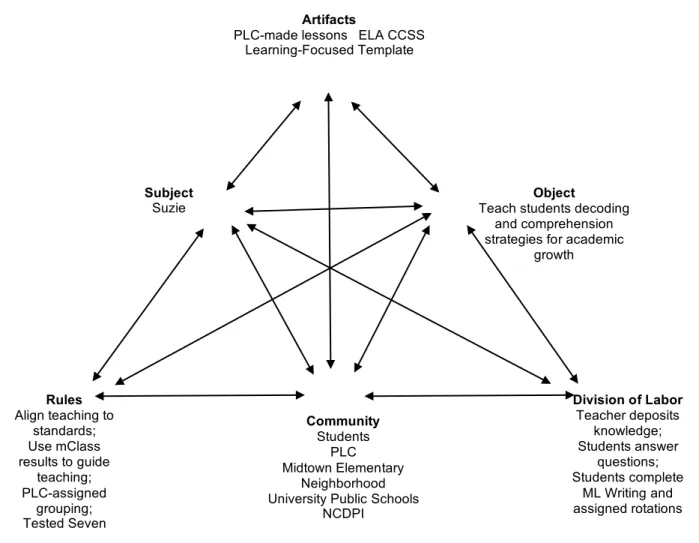
individual with their cultural context and vice versa. However, despite Vygotsky’s innovative inclusion of comediated cultural artifacts, the individual remained at the core of the model. In response, A. N. Leont’ev (1978), Vygotsky’s student, critiqued the model for its lack of attention to the social systems surrounding an individual and expanded the theory to include examining collective networked activity systems. Now part of Leont’ev’s second generation theory, activity systems accounted for the subject’s community, divisions of labor within the community, and the rules of interaction between roles (Barrett-Tatum, 2015; Engestrӧm, 2000; Fisher, 2012). Table 1 defines their components.
Table 1
Components of First- and Second-Generation Activity Theory
Component Definition
Subject Individual or groups of individuals engaging in the activity Object The objective motivating subjects’ participation in the activity Artifacts/Tools Signs, symbols, language, and conceptual understandings used to mediate the activity and obtain the object Community Social and cultural group in which subjects are participating in the
activity
Division of Labor Defines how tasks and roles are shared between system participants Rules The rules, norms, and roles guiding participants within the
community Note: Taken from Cole & Engestrӧm, 1993.
31
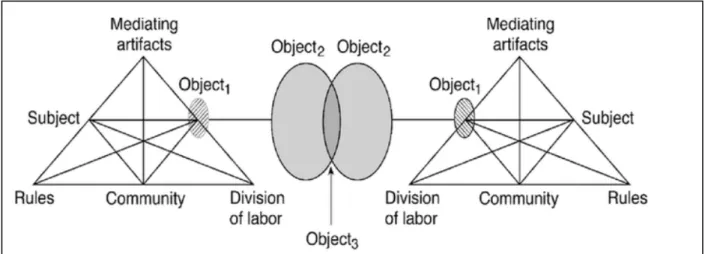
systems, thus inspiring a third iteration (Griffin & Cole, 1984). The third-generation model adds a cultural-historical perspective to the preexisting framework, creating cultural-historical activity theory, or CHAT (Engestrӧm, 1987). CHAT asserts that there is an interconnectivity of activity systems at both the micro- and macrolevels. The CHAT model and its depiction of the
interaction between systems can be used to examine how related systems mediate over time (Engestrӧm, 1987, 2011; Roth & Lee, 2007). As such, CHAT illustrates how subjects’ social interactions within each activity system shape their interaction with the cultural contexts. This interaction thus shapes and reshapes the systems. Figure 1 displays the theoretical model for third-generation CHAT.
Figure 1. Third-Generation CHAT Model. Taken from Barrett-Tatum, 2015.
32
identities. It is at these junctures that growth and development, both for the participant and the surrounding systems, can be achieved.
The application of CHAT in educational research has increased over the past 30 years, as it is particularly useful in addressing issues of praxis and implementation (Roth & Lee, 2007). Roth and Lee (2007) described CHAT’s potential to explain conflicting viewpoints in
educational research, such as the individual versus the collective, and theory versus praxis. Scholars have applied CHAT’s transactive and dialectical perspectives to explore teachers’ adoption and inclusion of technology in the classroom (Anthony, 2012; Kollias, et al., 2005), implementation and use of new curriculum (Garcia, 2011), and gaps in theory to practice in teacher preparation (Cole, 1988). Surveying the current research in teacher education outcomes, Cochran-Smith and colleagues (2012) identified a substantial body of research grounded in CHAT. Much of that research examined the interaction between teachers’ preparation, their subsequent performance, and the social, cultural, and institutional contexts surrounding them. For instance, Smagorinsky, Cook, Moore, Jackson, and Fry (2004) used CHAT to explore how a preservice teacher mediated conflicting beliefs and expectations of teaching between her
preparation program and her student teaching setting. In addition, the authors used CHAT to frame the preservice teacher’s negotiation between these experiences and the development of her teaching identity.
33
study of teachers’ responses to working with coaches and professional learning communities (PLCs) in using student data to make instructional decisions—a political mandate. They identified and described the dynamic interrelations between coaching sessions, PLCs, and teachers’ instructional use of data and their influence on the cocreation of knowledge across the differing contexts. Lee (2011) described the results of the implementation of a standardized science curriculum in Singapore, focusing on teachers’ changes in practice, the role of stakeholder power, and teachers’ mediation of conflicts surrounding previous practices and mandated assessments.
Several scholars have applied CHAT to teachers’ literacy instruction and their enactment of literacy educational policies. Fisher’s (2012) application of CHAT grounded his retrospective examination of six early-grades teachers’ implementation of a required dialogic writing program. The study described how teachers mediated competing motivations when participating in the activity of writing instruction, as well as their beliefs about writing and the children they were teaching. On the basis of his findings and influenced by Hedegaard’s (2009) work with CHAT and children’s development, Fisher (2012) described a three-part relational model through which activities take place that includes societal conditions (policy), institutional practice (teacher as school member), and individual perspective (teacher as individual). Implications for the study include the need for policymakers and those imposing educational initiatives to focus on the goals and perspectives of those enacting the policies (teachers) during every stage of
34
Most salient to the study, Barrett-Tatum’s (2015) study utilized CHAT to both frame and analyze her examination of two elementary teachers’ literacy instruction as influenced by the Common Core State Standards, their teaching experiences, and their personal beliefs about the standards and literacy. Barrett-Tatum (2015) used the components of CHAT as the coding scheme in a constant comparative analysis of the complex political and social processes
surrounding policy enactment and literacy instruction. With this method, she aligned the patterns and themes from the analysis to several third-generation CHAT models illustrating various activity systems, such as children in a small reading group alongside a teacher’s participation in literacy instruction within the group. Results found that the two teachers felt a loss of their professional autonomy for scripted and mandated curriculum. However, although both teachers covered the same literacy objectives as dictated by the Common Core State Standards, how they implemented their instruction and learning outcomes varied. Specifically, the rules and division of labor relating to student interaction and teacher roles, as well as the classroom and school communities, varied greatly across the teachers’ activity systems, thus inferring the importance of teachers’ beliefs and perspectives as they enact policy. On the basis of these results, the author asserted the utility of CHAT as a way to validate the social, historical, and cultural constructs influencing the reality of policy enactment and standardization (Barrett-Tatum, 2015).
35 Actor-Network Theory
Grounded in French philosophy and semiotics, specifically Foucault’s view on social orders (Kendall & Wickham, 1999), actor-network theory (ANT) frames technological and social innovations via a series of translations (Hamilton, 2011, 2014; Latour, 2005; Law, 2009). Researchers initially applied ANT to scientific and technology studies. However the theory has more recently been used to describe how complex networks, such as educational policies, develop and exist as social structures (Fenwick, 2010). In this context, ANT supports the notion that multiple stakeholders are involved in the creation, refinement, and implementation of complex educational policies before their use on the ground (Hamilton, 2011). Further, Edwards (2002) has described ANT as “[providing] a framework for analyzing the exercises of power by which cultural, social, and economic capital is produced or reproduced” (p. 355). That is, ANT does not view social projects, such as policy initiatives, as static, stable entities but rather as fluid, discursive, symmetrical networks of actants (human and nonhuman) comprised of multiple realities (Ball, 1993; Fenwick, 2010; Hamilton, 2014).
ANT emphasizes how various, seemingly unconnected elements, such as texts, people, and media messages, come together to form coherent policies and social innovations (Callon, 1984; Latour, 1987). These processes, known as translations, emphasize the negotiations
between elements, interlocking them into an activity network. Translations are documented using what French sociologist Michel Callon (1984, 1999a) called moments of the sociology of
36
(Hamilton, 2011). Table 2 defines each of the four moments and provides examples relevant to my study.
Table 2
The Four Moments of Translation
Moment Definition Example
Problematization
A problem is recognized, and the primary actors essential to the overall network are identified, excluding those that are not critical.
A national or state literacy crisis a la A Nation at Risk involving teachers, students, families, media, etc.
Intressement
The devices used to stabilize actors in a new alliance and infrastructure. Serves to confirm the validity of the problematization.
Development of policy documents, such as the Comprehensive K-12 Literacy Plan, in which policymakers, teachers, students, and institutions (research organizations, Amplify, etc.) collide to form new mandated processes.
Enrolment The assembly of resources, including material goods and services, to align the actors’ interests with the network.
Material investments include Amplify’s mClass: Reading 3D software and assessment. Grades and teaching
evaluations.
Mobilization
All actors and those affected by policies are experiencing the same reality. The policy is in full
implementation mode and has succeeded for the time being.
All K-3 classrooms statewide are fully implementing NC Read to Achieve, including instruction, assessment, and resulting decisions regarding student promotion.
Callon (1984, 1999a) considered the first two moments—problematization and
intressement—to be hypothetical and unsolidified in the political realm. Rather, these moments remain ideas or simple documents. A network is realized once the actants interact with their resources and take on their new roles during the enrolment moment. Finally, although
37
“constant overflow, disentangling from external entities that continue to crowd in and also steal away the actors” (p. 60). Likewise, Callon’s (1984, 1999a) moments should not be considered a rigid set of principles to be followed in exact order. However, these moments serve as critical points of analysis when attempting to describe the fluid political realm.
Researchers using the ANT approach to examine educational policies do not necessarily adhere only to analyzing Callon’s (1984, 1999a) moments. In fact, according to Fenwick (2010), originators of the theory have critiqued research seeking to produce a set of concrete methods for analysis. To that end, ANT methodologists also examine the discourse, power relations, artifacts, roles, routines, regulations, technologies, concepts, identities, and forms of institutional
knowledge found interwoven between and within networks (Fenwick & Edwards, 2010; Hamilton, 2001, 2014). They view these entities, mainly nonhuman actants, as symmetrical to human actants; that is, all forms are critical to the translation process. Therefore, current ANT research spans a wide range of topics and analytical forms.
38
1999, 2011) and how the local practice of standards is both prescriptive and negotiating networks (Hamilton, 2009; Murdoch, 1998).
Researchers have also applied ANT to studies of literacy education policies. Educational researcher Mary Hamilton has published the majority of extant work in literacy policy and ANT. Her work focuses on the rise and mobilization of England’s adult literacy policies and standards, curriculum, and practice. In documenting the “back room” moments of the policies, Hamilton (2001, 2011, 2012, 2014) has analyzed the translation process, including the dominant discourses found in policy documents, media messages, and curriculum that serve to mobilize a certain image of adult (il)literacy. Hamilton (2001) applied both ANT and New Literacy Studies to her analysis of the International Adult Literacy Survey in which she described how political and institutional discourses serve to influence dominant definitions and values of literacy across education. She followed up her results from that study in a 2014 article in which she traced the translation of representations of literacy and literate adults down to the local level.