in 3 cases, and grade 3 in 3 cases). This early intervention and appointment was feasible for each request, since patients were selected to live no >80 km (1 h trip) from the hospital. No other additional visit was needed, emphasizing the safety of the pro-cedure. Overall 98% of the patients mentioned their preference for home administration when compared with hospital adminis-tration of s.c. bortezomib. Despite some limitations including single-center design, a relatively small sample size, and a nonva-lidated survey, our results indicate that the administration of the
first s.c. bortezomib dose per cycle (day 1 of each cycle) in the outpatient department, followed by home administration pro-vided by visiting nurses trained on the s.c. administration of bortezomib and the management of side-effects represents a safe and cost-effective procedure for patients treated for MM.
disclosure
PM: advisory boards and honoraria from Janssen and Takeda.
references
1. Moreau P, Pylypenko H, Grosicki S et al. Subcutaneous versus intravenous administration of bortezomib in patients with relapsed multiple myeloma: a randomised, phase 3, non-inferiority study. Lancet Oncol 2011; 12: 431–440. 2. Barbee MS, Harvey RD, Lonial S et al. Subcutaneous versus intravenous
bortezomib. Ann Pharmacother 2013; 47: 1136–1142.
3. Durie BGM, Harousseau J-L, Miguel JS et al. International uniform response criteria for multiple myeloma. Leukemia 2006; 20: 1467–1473.
4. Merz M, Salwender H-J, Hanel M et al. Subcutaneous versus intravenous bortezomib in two different induction therapies for newly diagnosed multiple myeloma: an interim analysis from the GMMG-MM5 trial. Haematologica 2015; 100: 964–969.
5. Moreau P, Attal M, Facon T. Frontline therapy of multiple myeloma. Blood. 2015; 125: 3076–3084.
6. Dimopoulos MA, Richardson PG, Moreau P, Anderson KC. Current treatment landscape for relapsed and/or refractory multiple myeloma. Nat Rev Clin Oncol. 2015; 12: 42–54.
7. Lok A, Mocquard J, Bourcier J et al. Subcutaneous bortezomib incorporated into the VTD regimen as part of frontline therapy in the context of ASCT for multiple myeloma. Haematologica 2014; 99(3): e33–e34.
Annals of Oncology27: 318–323, 2016 doi:10.1093/annonc/mdv537 Published online 23 November 2015
Phase II trial of dasatinib for recurrent or metastatic
c-KIT expressing adenoid cystic carcinoma and for
nonadenoid cystic malignant salivary tumors
S. J. Wong
1*, T. Karrison
2, D. N. Hayes
3, M. S. Kies
4, K. J. Cullen
5, T. Tanvetyanon
6, A. Argiris
7,8,
N. Takebe
9, D. Lim
10, N. F. Saba
11, F. P. Worden
12, J. Gilbert
13, H. J. Lenz
14, A. R. A. Razak
15,
J. D. Roberts
16, E. E. Vokes
2& E. E. W. Cohen
171
Division of Hematology Oncology, Department of Medicine, Medical College of Wisconsin, Milwaukee;2
The University of Chicago, Chicago;3
University of North Carolina at Chapel Hill, Chapel Hill;4
Department of Thoracic/Head and Neck Medical Oncology, The University of Texas MD Anderson Cancer Center, Houston;5
University of Maryland Marlene and Stewart Greenebaum Cancer Center, Baltimore;6
H. Lee Moffitt Cancer Center & Research Institute, Tampa, USA;7
Department of Medical Oncology, Hygeia Hospital, Athens, Greece;8
University of Texas Health Science Center at San Antonio, San Antonio;9
Investigational Drug Branch, Cancer Therapy Evaluation Program, Rockville;10
Department of Medicine, City of Hope, Duarte;11
Winship Cancer Institute, Emory University, Atlanta;12
Department of Medicine, University of Michigan Cancer Center, Ann Arbor;13
Department of Hematology Oncology, Vanderbilt University, Nashville;14
USC Norris Comprehensive Cancer Center, Los Angeles;
15
Department of Medical Oncology and Hematology, Princess Margaret Hospital, Toronto;16
Massey Cancer Center, Richmond;17
University of California San Diego, Moores Cancer Center, San Diego, USA
Received 26 July 2015; revised 25 October 2015; accepted 26 October 2015
Background:Adenoid cystic carcinoma (ACC) is a subtype of malignant salivary gland tumors (MSGT), in which 90% of cases express cKIT. Dasatinib is a potent and selective inhibitor offive oncogenic protein tyrosine kinases (PTKs)/kinase families including cKIT. We conducted a phase II study to determine the antitumor activity of dasatinib in ACC and non-ACC MSGT.
Patients and methods:In a two-stage design, patients with progressive, recurrent/metastatic ACC (+cKIT) and non-ACC MSGT (separate cohort) were treated with dasatinib 70 mg p.o. b.i.d. Response was assessed every 8 weeks using RECIST.
Results:Of 54 patients: 40 ACC, 14 non-ACC (1, ineligible excluded); M:F = 28 : 26, median age 56 years (range 20–82
*Correspondence to:Dr Stuart J. Wong, Division of Hematology Oncology, Department of Medicine, Medical College of Wisconsin, 9200 W. Wisconsin Ave., Milwaukee, WI 53226, USA. Tel: +1-414 805 4603; E-mail: [email protected]
years), ECOG performance status 0 : 1 : 2 = 24 : 28 : 2, prior radiation: 44, prior chemotherapy: 21. The most frequent adverse events (AEs) (as % of patients, worst grade 2 or higher) were: fatigue (28%), nausea (19%), headache (15%), lympho-penia (7%), dyspnea (11%), alanine aminotransferase increased (7%), anorexia (7%), vomiting (7%), alkaline phosphatase increased (6%), diarrhea (6%), neutropenia (6%), and noncardiac chest pain (6%). No grade 4 AE occurred, 15 patients experienced a grade 3 AE, primarily dyspnea (5) and fatigue (4), and cardiac toxicity (1 prolonged QTc). Among ACC patients, best response to dasatinib: 1 patient (2.5%) had partial response, 20 patients (50%) had stable disease (SD) (3–14 months), 12 patients (30%) had PD, 2 withdrew, 3 discontinued therapy due to AE, and 2 died before cycle 2. Median progression-free survival was 4.8 months. Median overall survival was 14.5 months. For 14 assessable non-ACC patients, none had ob-jective response, triggering early stopping rule. Seven had SD (range 1–7 months), 4 PD, 2 discontinued therapy due to AE, and 1 died before cycle 2.
Conclusion:Although there was only one objective response, dasatinib is well tolerated, with tumor stabilization achieved by 50% of ACC patients. Dasatinib demonstrated no activity in non-ACC MSGT.
Key words:malignant salivary gland cancer, dasatinib, adenoid cystic carcinoma, cKIT, phase II
introduction
Malignant salivary gland tumors (MSGT) is a rare disease, com-prised of a wide spectrum of histologic types, that represents 6%–7% of head and neck cancers and 2600 new cases per year in the United States [1,2]. Systemic chemotherapy is used in the management of MSGT primarily for recurrent disease that is not amenable to surgery or radiation therapy, or for metastatic disease. The efficacy of conventional chemotherapy is generally poor and is considered palliative. Reported overall response rates range from 26% to 35% with median survival between 12.5 and 21 months [3–5]. Clinical studies utilizing conventional chemotherapy have not clearly demonstrated improvement in survival compared with supportive care alone; consequently, no superior drug or drug combination has been identified. The need to investigate new agents and molecularly targeted agents is underscored by these facts.
Adenoid cystic carcinoma (ACC) is a common histologic subtype of MSGT and represents between 10% and 40% of MSGT and is characterized by late recurrences with distant me-tastases occurring in roughly 37% of cases [1,2,6]. Metastatic ACC may follow a natural history of indolent growth succeeded by a more rapid growth phase. Expression of c-KIT ligand appears to be common in ACC—reported in 80%–100% of patients with ACC arising from salivary gland [7–9].c-kitis a proto-oncogene that encodes for a transmembrane cell surface receptor, kit. cKIT is a member of the same subclass of genes similar to platelet-derived growth factor and colony-stimulating growth factor. Functional mutations ofc-KIT have been asso-ciated with the pathogenesis of a number of malignancies that express c-KIT (e.g. gastrointestinal stromal tumors, mast cell disease, and acute leukemia). Overexpression ofc-KIThas been postulated to be associated with molecular pathogenesis of ACC [7–9]. Testing of this hypothesis in clinical trials using imatinib, a potent inhibitory of tyrosine kinases of PDGF as well as the receptor of kit, is feasible. However, detection of clinical response in tumors that follow an indolent growth pattern has been a barrier in trial design. Clinical trials that have examined the activity of imatinib in ACC and failed to demonstrate signifi -cant clinical efficacy have been limited by this problem. More stringent selection of patients with documented detectable tumor growth has been postulated to permit more accurate
detection of drug activity in ACC and has been reported by Faivre et al. [10].
Dasatinib (BMS-354825) is an aminothiazole analog that is an orally administered (p.o.) protein tyrosine kinase (PTK) inhibitor and has specificity for five kinases/kinase families (BCRABL, c-SRc, c-KIT, PDGFβreceptor, and EPHA2).In vitro,in vivo, and early clinical trials demonstrate potent antiproliferative activity in a wide spectrum of cancer cell lines/types, and patients with chronic myelogenous leukemia (CML) and solid tumor patients [11–13]. Dasatinib has also shown potent inhibition of vascular endothelial growth factor- and basic fibroblast growth factor-driven proliferation of human umbilical vein endothelial cells, with IC50 values of 43 and 248 nM, respectively. Dasatinib appears to have more potent antitumor effects compared with imatinib based on studies with imatinib-resistant tumors, while other studies have shown 500-fold greater potency than imatinib in inhibiting BCRABL. Based upon the above information, we hypothesized that dasatinib has potential clinical activity in ACC and, given its broad mechanism of action, that it may have activity in other MSGT. To test these hypotheses, we proposed a clinical trial with the primary objective of examining clinical response to dasatinib in ACC patients and an exploratory secondary objective of testing the activity of dasatinib in non-ACC MSGT.
patients and methods
patient eligibility
Two patient cohorts were enrolled in this study—patients with ACC and
those with non-ACC MSGT. Patients 18 years or older with histologically or cytologically documented MSGT were eligible; ACC patients were required to have c-kit-positive tumors determined by immunohistochemistry staining
performed at each participating institution using peroxidase–antiperoxidase
technique on 4-μM sections with antibody dilution of 1 : 10 (DAKO, Carpinteria, CA). Sections were scored as positive for c-KIT expression if a
diffuse staining pattern was present as defined by≥25% tumor cells staining
positive in cytoplasm and/or membrane.
Patients were required to have tumors that were not amenable to curative surgery or radiation. In addition, patients were required to have radiograph-ically measurable disease and evidence of tumor progression within 4 months before study registration. Patients were allowed to have unlimited prior therapy so long as no chemotherapy, radiation, or major surgery was administered within 4 weeks before registration; adequate performance
status (ECOG 0–2); life expectancy >12 weeks, and normal organ function
defined as absolute neutrophil count more than 1500/μl, platelet count more
than 100 000/μl, total bilirubin within the institutional limit, aspartate
ami-notransferase and/or alanine amiami-notransferase≤2.5 × institutional upper
limit of normal, creatinine within normal institutional limits, or creatinine
clearance≥60 ml/min/1.73 m2for patients with creatinine levels above the
institutional limit. Patients were excluded if they were taking another investi-gational agent, had prior treatment with other targeted agents that inhibited
VEGFR, BCRABL, c-SRc, c-KIT, PDGFβ receptor, or EPHA; history of
QTc prolongation, serious ventricular arrhythmia; brain metastasis; serious medical conditions such as nonhealing wounds, history of stroke within 12 months, history of myocardial infarction, arrhythmia, unstable angina, congestive heart failure, or arterial bypass with 6 months; uncontrolled inter-current illness; pregnant women or women who were breast-feeding; and patients who had an active pleural or pericardial effusion.
therapy
Study treatment, administered in the outpatient setting, consisted of 70 mg orally twice daily (total 140 mg/day). Dasatinib was provided by the National Cancer Institute, Division of Cancer Treatment and Diagnosis, Cancer Therapy Evaluation Program. Four weeks (28 days) constituted one cycle of treatment and continued until disease progression, unacceptable toxicity,
patient’s refusal to continue, or physician’s decision to discontinue therapy.
toxicity assessments and dose reductions
Toxicity was graded according to Common Terminology Criteria for Adverse Events (CTCAE) version 3.0. Three dose-level decreases were per-mitted for patients who encountered toxicity: 50 mg twice daily, 100 mg in AM daily (same dose as previous level but a different schedule), and 70 mg in AM daily. Patients received therapy without interruption or dose modifi-cation for grade 1 non-hematologic toxicity. For grade 2 toxicity, supportive care was instituted and was continued unless, at the discretion of the phys-ician for intolerable side-effects, treatment was held until toxicity resolved to grade <2 and treatment resumed at the same dose or at a 30% reduction (to 50 mg b.i.d.). For grade 3 or 4 toxicity, dasatinib was held and supportive therapy instituted until toxicity resolved to <grade 2, and therapy resumed at a dose reduced to the next lower level. Patients were removed from therapy if
they failed to recover to grade 0–1 or tolerable grade 2 toxicity within 14
days of discontinuation of study drug overall response they experienced agent-related AEs requiring dose modification despite three previous dose reductions (i.e. would require a fourth dose reduction), unless the investiga-tor and Cancer Therapy Evaluation Program senior investigainvestiga-tor agreed that the patient should remain on the study because of evidence that the patient might continue deriving benefit from study treatment.
assessment of response
Patients were evaluated by imaging every 8 weeks for objective response according to classification by Response Evaluation Criteria in Solid Tumor
Committee (RECIST) [14].
statistical considerations
The primary objective of the study was to determine response rate (complete response plus partial response) and progression-free survival (PFS) for ACC patients receiving dasatinib. Secondary objectives were to determine object-ive response rate for non-ACC MSGT; and for both cohorts: duration of re-sponse, stable disease rate; duration of stable disease, and overall survival. The study also examined the safety and tolerability of dasatinib for all
patients. In the ACC cohort, a sample size ofN= 40 patients was chosen,
which provided 85% power to detect an improvement in the median PFS
time from 2 months to a little over 4 months, based on a one-sidedαlevel of
0.05. For the non-ACC cohort, a two-stage design was used to test the null hypothesis that the response rate was 5% versus a 20% alternative. In order to reduce the risk of exposure of patients to potentially futile therapy, an early stopping rule was applied to both cohorts. For ACC patients, data were
analyzed after half (N= 20) patients were followed for 2 months. If the
observed PFS rate at 2 months was <50%, then accrual would be terminated for futility. Based on the results of Wieand and Therneau, this leads to a
minimal power loss of <2% [15]. For the non-ACC cohort, 14 patients were
to be enrolled in thefirst stage; if no responses were observed, then accrual
in this cohort would be discontinued [16]. If one or more responses were
observed, then a total of 25 patients would be enrolled and the drug would be considered promising for further investigation if at least three responses
were observed. This design has anαlevel of 0.12 and 88% power if the true
response rate is 20%.
results
patients and treatment
Between May 2009 and December 2011, 41 patients with ACC and 14 patients with non-ACC MSGT were enrolled on to this study from 14 centers in the United States and Canada. One ACC patient was found to be ineligible and is excluded from
Table 1.Characteristics of patients with adenoid cystic carcinoma and nonadenoid cystic carcinoma of the salivary gland
Characteristic ACC (N= 40) Non-ACC
(N= 14)
Age
Median 56 56
Min–max 30–82 20–71
N % N %
Sex
Male 18 45.0 10 71.4
Female 22 55.0 4 28.6
Zubrod
0 18 45.0 6 42.9
1 21 52.5 7 50.0
2 1 2.5 1 7.1
Ethnicity
Hispanic/Latino 2 5.0 0 0.0
African-American 1 2.5 3 21.4
Caucasian 35 87.5 11 78.6
Other 2 5.0 0 0.0
Prior RT 34 91.9 10 76.9
(Missing) (3) (1)
Prior chemotherapy 14 37.8 7 53.8
(Missing) (3) (1)
Prior surgery 31 83.8 9 69.2
(Missing) (3) (1)
Sites of metastases
Lung 35 87.5 9 64.3
Liver 13 32.5 4 28.6
Bone 10 25.0 5 35.7
No. of metastases
0 (recurrent disease) 2 5.0 4 28.6
1 23 57.5 5 35.7
2 10 25.0 2 14.3
3 5 12.5 3 21.4
analysis. Patient characteristics are summarized in Table1. All patients had measurable disease as well as evidence of measur-able tumor growth before study enrollment.
outcomes of non-ACC cohort
No objective responses were observed among the first 14 patients in the non-ACC cohort, thus accrual was halted to this arm. Seven patients had stable disease, four had early disease progression, and three discontinued therapy due to AEs before thefirst response evaluation.
outcomes in ACC cohort
For the ACC cohort, data were analyzed after the plannedfirst stage of accrual; the observed PFS met the threshold of 50% at 2 months thus permitting continuation of accrual to this cohort. One objective response was observed in ACC patients. The duration of response was 3.25 months. Twenty patients (50%) had stable disease. Three patients withdrew, one died, and four came off therapy due to AEs before thefirst disease assessment; these patients are all counted as non-responders. Objective re-sponse as demonstrated by maximum tumor effect for target lesions is shown in Figure1. A total of 29 patients among the 40 ACC patients eventually experienced disease progression, 5 died before disease progression, and 6 were censored (never pro-gressed while on study). Five patients withdrew from therapy due to toxicity. The earliest progression occurred at 0.9 months and the last progression occurred at 31.7 months. Approximately one quarter of the patients had stable disease for 1.8 months, and approximately three quarters of patients had stable disease for 7.4 months.
Median survival for ACC patients was 14.5 months. Six-month survival rate was 81.5% [95% confidence interval (CI) 68.1% to 94.9%]. Median PFS was 4.8 months (95% CI 1.8–6.9 months), and 6-month PFS was 35.9% (95% CI 20.0% to 51.8%). Of note, the 2-month PFS rate was 62.2%, which did not differ significantly
from the null value of 50% (one-sidedP= 0.063). Kaplan–Meier curves for PFS and overall survival are shown in Figures2and3, respectively.
tolerability and toxicity
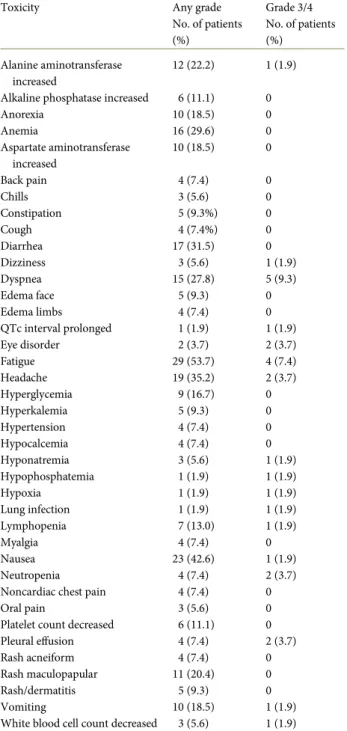
Dasatinib was generally well tolerated by most patients. The median and total number of cycles administered in the ACC cohort were 3 and 158, respectively, and the median and total number in the non-ACC group were 2 and 40, respectively. Fatigue was the most common toxicity associated with dasatinib occurring in over half of the patients (Table2). Severe fatigue however was reported in about 7% of patients (Table3). Nausea and headaches were the next most common side-effects but also were lower grade and severe only in a small percentage of patients (<5%). Grade 3/4 dyspnea occurred in 9.3% of the patients. The majority of other toxicities associated with dasati-nib were primarily low grade. Serious AEs at least possibly related to dasatinib were: noncardiac chest pain (grade 2), loss of vision (grade 4), anorexia (grade 2), hyperglycemia (grade 2), urticarial (grade 2), dyspnea (grade 3), nausea (grade 3), hypoxia (grade 3), alanine aminotransferase increased
100
50
0
P
ercent change
–50
Figure 1.Maximum objective changes in tumor size from before treatment in response to dasatinib for adenoid cystic carcinoma. In addition to the above tumor size changes, four patients developed new lesions, one patient had unequivocal progression of nontarget lesions, three patients had clinical disease progression, seven patients had adverse events and were removed
from therapy, one died and three withdrew from the trial before thefirst
disease evaluation.
0.00 0.25 0.50 0.75 1.00
0 12 24 36
Time (months) Overall survival
Figure 3.Kaplan–Meier curve showing overall survival. Vertical tics indi-cated censored observations.
0.00 0.25 0.50 0.75 1.00
0 12 24 36
Time (months) Progression-free survival
Figure 2.Kaplan–Meier curve showing progression-free survival. Vertical tics indicated censored observations.
(grade 2), and dyspnea (grade 3) occurring in eight (14.8%) patients.
discussion
To date ACC remains a subtype of salivary gland cancer in which advancement of clinical outcome has been elusive. Chief among these obstacles for managing this cancer is the high rate of local and distant tumor progression. These clinical features in combination with the high incidence of cKIT amplification, heightens the attractiveness for utilizing cKIT as a therapeutic
target for treating ACC. This strategy has been successfully demonstrated in several tumor models including CML, GIST, and melanoma.
Our strategy for examining the activity of dasatinib took into consideration prior attempts by other investigators to target cKIT in ACC. We speculated that, compared with imatinib, the heightened inhibitory effect of dasatinib on cKIT tyrosine kinase activity and broadened effects against other targeted pathways would significantly improve the likelihood of assessing antitumor effects cKIT inhibition. The trial design applied an enrichment strategy to improve the sensitivity to detect tumor response by selecting patients with cKIT overexpressing tumors and by utilizing a high level of stringency for patient selection that excluded patients with indolent tumors. However, our ob-servation that only one patient experienced significant objective tumor response indicates that cKIT is an inactive target in ACC. In agreement with this observation is evidence indicating that cKIT mutations in ACC are not functionally active [17]. Some patients experienced prolonged disease stability. It is possible that this could represent minor activity related to other pathways by which dasatinib is known to exert its inhibitory antitumor growth effects. Such effects however are perhaps insufficient to warrant further examination of this agent in this disease.
A potential limitation of early phase clinical trials of targeted agents is that the use of traditional study end points that may fail to detect clinical activity of drugs [18,19]. This constraint is conceivably heightened in diseases that are characterized by slow tumor growth rate. The use of alternative study end points (such as tumor specific markers, functional imaging, time to progression) for cytostatic molecular targeted agents has been suggested to improve the sensitivity of detecting clinical activity of new drugs [19]. Our observation of median PFS 19.2 weeks and 6-month PFS 35.9% in ACC patients compares favorably to that observed by Liu et al (median PFS 10 weeks, and 6-month PFS 12.5% (95% CI 3.4% to 45.7%). This contrast may be more meaningful considering that the more stringent eligibility cri-teria in our trial selected for an ACC population with a higher tumor growth rate and perhaps a poorer prognosis. Our obser-vation showing that only a single ACC patient achieved clinical response indicates that dasatinib is not a highly active drug in this disease. However, it is conceivable that dasatinib may have
Table 2.Toxicities considered at least possibly related to dasatinib occurring in at least 5% of patients (any grade) or grade 3/4; ACC and non-ACC patients (N= 54)
Toxicity Any grade
No. of patients (%)
Grade 3/4 No. of patients (%)
Alanine aminotransferase increased
12 (22.2) 1 (1.9)
Alkaline phosphatase increased 6 (11.1) 0
Anorexia 10 (18.5) 0
Anemia 16 (29.6) 0
Aspartate aminotransferase increased
10 (18.5) 0
Back pain 4 (7.4) 0
Chills 3 (5.6) 0
Constipation 5 (9.3%) 0
Cough 4 (7.4%) 0
Diarrhea 17 (31.5) 0
Dizziness 3 (5.6) 1 (1.9)
Dyspnea 15 (27.8) 5 (9.3)
Edema face 5 (9.3) 0
Edema limbs 4 (7.4) 0
QTc interval prolonged 1 (1.9) 1 (1.9)
Eye disorder 2 (3.7) 2 (3.7)
Fatigue 29 (53.7) 4 (7.4)
Headache 19 (35.2) 2 (3.7)
Hyperglycemia 9 (16.7) 0
Hyperkalemia 5 (9.3) 0
Hypertension 4 (7.4) 0
Hypocalcemia 4 (7.4) 0
Hyponatremia 3 (5.6) 1 (1.9)
Hypophosphatemia 1 (1.9) 1 (1.9)
Hypoxia 1 (1.9) 1 (1.9)
Lung infection 1 (1.9) 1 (1.9)
Lymphopenia 7 (13.0) 1 (1.9)
Myalgia 4 (7.4) 0
Nausea 23 (42.6) 1 (1.9)
Neutropenia 4 (7.4) 2 (3.7)
Noncardiac chest pain 4 (7.4) 0
Oral pain 3 (5.6) 0
Platelet count decreased 6 (11.1) 0
Pleural effusion 4 (7.4) 2 (3.7)
Rash acneiform 4 (7.4) 0
Rash maculopapular 11 (20.4) 0
Rash/dermatitis 5 (9.3) 0
Vomiting 10 (18.5) 1 (1.9)
White blood cell count decreased 3 (5.6) 1 (1.9)
Table 3.Summary of grade 3/4 AEs at least possibly related to dasatinib ACC and non-ACC patients (N= 54)
Toxicity No. of patients (%)
Fatigue 4 (7.4)
Headache 2 (3.7)
Neutropenia 2 (3.7)
Dyspnea 5 (9.3)
Lung infection 1 (1.9)
Nausea 1 (1.9)
Dizziness 1 (1.9)
Lymphopenia 1 (1.9)
Vomiting 1 (1.9)
White blood cell decreased 1 (1.9)
ECG QT-corrected interval prolonged 1 (1.9)
Eye disorder (loss of vision) 1 (1.9)
Pleural effusion 1 (1.9)
some minor clinical activity in ACC. Our observation of no clinical responses to dasatinib in the non-ACC population like-wise suggests absence of significant clinical activity. Similar arguments can be made about the limitations of these data that may be constrained by the trial design.
We conclude that dasatinib is tolerable but has no significant activity in ACC or non-ACC MSGT. Ourfindings underscore the need for future trials to examine molecular underpinnings of MSGTs and additional studies that examine targeted therapy approaches for treatment of this disease.
funding
This work was supported by the National Cancer Institute at the National Institutes of Health (NO1-CM-62201).
disclosure
The authors have declared no conflicts of interest.
references
1. Speight PM, Barrett AW. Salivary gland tumours. Oral Dis 2002; 8(5): 229–240. 2. Seifert G, Brocheriou C, Cardesa A, Eveson JW. WHO International Histological
Classification of Tumours. Tentative histological classification of salivary gland tumours. Pathol Res Pract 1990; 186(5): 555–581.
3. Dimery IW, Legha SS, Shirinian M, Hong WK. Fluorouracil, doxorubicin, cyclophosphamide, and cisplatin combination chemotherapy in advanced or recurrent salivary gland carcinoma. J Clin Oncol 1990; 8(6): 1056–1062. 4. Licitra L, Marchini S, Spinazze S et al. Cisplatin in advanced salivary gland
carcinoma. A phase II study of 25 patients. Cancer 1991; 68(9): 1874–1877. 5. Gilbert J, Li Y, Pinto HA et al. Phase II trial of taxol in salivary gland malignancies
(E1394): a trial of the Eastern Cooperative Oncology Group. Head Neck 2006; 28 (3): 197–204.
6. Garden AS, Weber RS, Ang KK et al. Postoperative radiation therapy for malignant tumors of minor salivary glands. Outcome and patterns of failure. Cancer 1994; 73(10): 2563–2569.
7. Edwards PC, Bhuiya T, Kelsch RD. C-kit expression in the salivary gland neoplasms adenoid cystic carcinoma, polymorphous low-grade adenocarcinoma, and monomorphic adenoma. Oral Surg Oral Med Oral Pathol Oral Radiol Endod 2003; 95(5): 586–593.
8. Jeng YM, Lin CY, Hsu HC. Expression of the c-kit protein is associated with certain subtypes of salivary gland carcinoma. Cancer Lett 2000; 154(1): 107–111. 9. Holst VA, Marshall CE, Moskaluk CA, Frierson HF, Jr. KIT protein expression and
analysis of c-kit gene mutation in adenoid cystic carcinoma. Mod Pathol 1999; 12 (10): 956–960.
10. Faivre S, Raymond E, Casiraghi O, Temam S, Berthaud P. Imatinib mesylate can induce objective response in progressing, highly expressing KIT adenoid cystic carcinoma of the salivary glands. J Clin Oncol 2005; 23(25): 6271–6273; author reply 6273–4.
11. Evans TR, Morgan JA, van den Abbeele AD et al. Phase I dose-escalation study of the SRC and multi-kinase inhibitory BMS=354825 in patient with GIST and other solid tumors. Proc Am Soc Clin Oncol 2005; 24: A3040.
12. Wu JY, Donato NJ, Hong DS et al. The SRC/ABL kinase inhibitor BMS-354825 induces apoptosis and overcomes imatinib resistance in chronic myelogenous leukemia cell lines and patient specimens. Proc Am Assoc Can Res 2004; 45: A3850.
13. Li S, Hu Y, Swerdlow SJ. Simultaneous targeting of SRC and BCR-ABL kinases by BMS-354825 cures ph+ acute lymphoblastic leukemia in mice. Blood 1976; 104: Abstr.
14. Therasse P, Arbuck SG, Eisenhauer EA et al. New guidelines to evaluate the response to treatment in solid tumors. European Organization for Research and Treatment of Cancer, National Cancer Institute of the United States, National Cancer Institute of Canada. J Natl Cancer Inst 2000; 92(3): 205–216.
15. Wieand S, Therneau T. A two-stage design for randomized trials with binary outcomes. Control Clin Trials 1987; 8(1): 20–28.
16. Simon R. Optimal two-stage designs for phase II clinical trials. Control Clin Trials 1989; 10(1): 1–10.
17. Tetsu O, Phuchareon J, Chou A et al. Mutations in the c-kit gene disrupt mitogen-activated protein kinase signaling during tumor development in adenoid cystic carcinoma of the salivary glands. Neoplasia 2010; 12(9): 708–717.
18. Sleijfer S, Bogaerts J, Siu LL. Designing transformative clinical trials in the cancer genome era. J Clin Oncol 2013; 31(15): 1834–1841.
19. Fox E, Curt GA, Balis FM. Clinical trial design for target-based therapy. Oncologist 2002; 7(5): 401–409.